
Hey there! Some links on this page may be affiliate links which means that, if you choose to make a purchase, I may earn a commission at no extra cost to you. I greatly appreciate your support. Read the full disclosure here.
Dehydration kills faster than starvation, faster than exposure in most climates, and faster than almost any other wilderness threat. The human body can survive roughly three weeks without food, but water deprivation becomes life-threatening in as little as three days, and in hot, arid conditions, that window shrinks to hours. Knowing how to find water in the wilderness is not optional knowledge for survivalists and preppers. It is the single most critical skill you can carry into any uncontrolled environment.
Key Takeaways
- The human body can survive approximately three days without water, but impairment begins within hours of dehydration onset.
- Low terrain, dense green vegetation, animal trails, and insect activity are the most reliable natural indicators of nearby water.
- All wild water sources, streams, rivers, collected rainwater, and plant-sourced water, should be purified before drinking.
- Boiling kills biological pathogens; filtering removes sediment and some contaminants; both together provide the strongest protection.
- Morning dew, transpiration bags on vegetation, and solar stills are viable collection methods when no surface water is visible.
- Cacti, certain vines, and broad-leafed plants can yield drinkable moisture in emergencies, but identification accuracy is critical.
- Common mistakes include drinking unpurified water out of desperation, ignoring terrain cues, and not carrying a backup purification method.
- A basic kit, water filter, purification tablets, and a metal container for boiling, covers most wilderness water scenarios.
How Long Can You Survive Without Water in the Wilderness
The short answer: not long. Most healthy adults reach critical dehydration within 72 hours without water intake, and cognitive impairment begins far earlier, sometimes within 12 to 24 hours depending on heat, exertion, and body size.
In a hot desert environment with direct sun exposure, that window can compress to a single day. Cold environments are deceptive because the sensation of thirst diminishes, but the body still loses water through respiration and exertion. For a deeper breakdown of survival timelines by condition, see how long you can survive without clean water.
The practical implication: water procurement must be your first priority after shelter in any survival scenario. Do not wait until you are thirsty to start looking.
What Are the Signs of Dehydration and How Do You Treat It
Dehydration in the wilderness follows a predictable progression. Catching it early is what separates a manageable situation from a medical emergency.
Early warning signs:
- Dark yellow or amber urine
- Dry mouth and increased thirst
- Mild headache or fatigue
- Reduced urine frequency
Moderate to severe signs:
- Confusion, irritability, or difficulty concentrating
- Rapid heartbeat and shallow breathing
- Dizziness when standing
- Muscle cramps
- Skin that does not spring back when pinched (poor skin turgor)
Treatment in the field: Rehydrate slowly with small, frequent sips rather than drinking large volumes at once. Rapid intake of large amounts of water can cause nausea and, in extreme cases, electrolyte imbalance. If you have access to electrolyte tablets or salt, add them to your water. Rest in shade, reduce physical exertion, and prioritize finding a reliable water source before continuing travel.
What Are the Best Ways to Find Water When Lost in the Wilderness
The most effective approach to finding water in the wilderness combines terrain reading, vegetation observation, and animal behavior tracking. These three methods work in virtually every environment and require no equipment.

Follow the terrain downhill. Water flows to the lowest point. Valleys, ravines, canyon floors, and the base of cliff faces are your first targets. On a topographic map, look for V-shaped contour lines pointing uphill, those indicate valleys and drainage channels where water collects.
Read the vegetation. Dense, lush, dark-green plant growth in an otherwise dry landscape almost always signals subsurface moisture or a nearby water source. Willows, cottonwoods, cattails, and alders are particularly strong indicators, these species require consistent water access to survive.
Watch wildlife patterns. Animals visit water sources at predictable times, typically dawn and dusk. Converging animal trails, especially in dry terrain, frequently lead to water. Insects, particularly bees and flies, rarely travel far from water. Flocks of birds flying low and in a consistent direction at dawn or dusk are often heading toward a water source.
Look for seeps and springs. Cliff faces and rocky outcroppings often have seeps, small trickles of water emerging from rock. These are among the cleanest natural water sources available because the rock acts as a natural filter.
For a broader look at wilderness skills that complement water procurement, the 25 most critical wilderness survival skills guide covers the full priority stack.
What Plants Indicate Water Is Nearby in Nature
Certain plant species are reliable biological markers for water. Knowing them can save your life.
High-reliability indicators:
- Willows and cottonwoods, Almost always within 20 to 30 feet of groundwater or a stream
- Cattails, Require standing or slow-moving water; their presence confirms a water source
- Elderberry and alder, Common along stream banks and moist valley floors
- Bright green grass in a dry area, Indicates moisture just below the surface; digging may yield water
Moderate indicators:
- Dense fern clusters in temperate forests
- Mossy rock faces and shaded cliff bases
- Patches of lush undergrowth in otherwise sparse terrain
If you are foraging plants for food alongside your water search, the guide to foraging edible wild plants for beginners is a useful companion resource.
Can You Get Water from Plants Like Cacti or Vines
Yes, but with important caveats. Some plants provide drinkable moisture; others are toxic and will accelerate dehydration or cause serious illness.
Safe plant water sources:
- Barrel cactus (Ferocactus species): The inner pulp of barrel cacti contains moisture. Cut open the top, mash the pulp, and squeeze or press the liquid out. Note: not all cacti species are safe, saguaro and most columnar cacti have toxic alkaloids in their flesh. Stick to barrel cactus if you can positively identify it.
- Grape vines: Cut a section of vine and allow the sap to drip into a container. This works best in spring and summer.
- Banana and plantain trees: The trunk contains significant moisture. Cut the trunk near the base and hollow out a bowl shape, it will fill with drinkable fluid.
- Transpiration bags: Tie a clear plastic bag over a leafy branch in direct sunlight. The plant releases moisture through its leaves (transpiration), which condenses inside the bag. A large, healthy branch can yield a cup or more of water per hour in warm conditions.
Plants to avoid: Euphorbia species (milky white sap), most columnar cacti, and any plant with a bitter or burning taste should not be consumed for hydration. When uncertain, consult the guide to avoiding poisonous plants before attempting to extract plant moisture.
How Do You Find Water at Night or in the Desert
Finding water in the desert or after dark requires different tactics than standard wilderness water procurement.
Desert water-finding strategies:
- Dry riverbeds: Even when a desert wash looks bone dry, water often sits just below the surface. Dig at the lowest point of the outer bend of a dry riverbed, moisture is frequently found within one to three feet.
- Rock pockets and crevices: Desert rock formations collect rainwater in natural basins called tinajas. After any rainfall, these can hold water for days or weeks.
- Morning dew collection: In many desert environments, nighttime temperature drops cause condensation on rocks, metal surfaces, and vegetation. Before sunrise, use an absorbent cloth to wipe dew from flat rock surfaces and wring it into a container. This method is slow but reliable.
- Solar still: Dig a hole approximately three feet wide and two feet deep, place a container at the bottom, cover the hole with a sheet of clear plastic, and weigh the center down with a small rock so it dips toward the container. The sun heats the soil, moisture evaporates, condenses on the plastic, and drips into the container. Output is modest, roughly one liter per day in favorable conditions, but it works when nothing else is available.
At night: Follow sound. Running water is audible at surprising distances in quiet wilderness conditions. Move downhill, listen for frogs or insects, and watch for the slight luminescence of open water under moonlight or starlight.
Can You Drink Water from Streams and Rivers Safely
Surface water from streams and rivers is rarely safe to drink without treatment. Even water that looks crystal clear can carry Giardia, Cryptosporidium, bacteria, and viruses, none of which are visible to the naked eye.
The risk level varies by location. Water sourced above human activity and livestock grazing at high elevation carries lower pathogen loads than water near trails, campsites, or agricultural land. But “lower risk” is not “no risk.” The rule for survivalists is simple: treat all wild water before drinking it. For a detailed look at what makes water unsafe, see water contamination signs.
What’s the Difference Between Boiling and Filtering Water Outdoors
Boiling and filtering address different threats, and understanding the distinction matters when resources are limited.
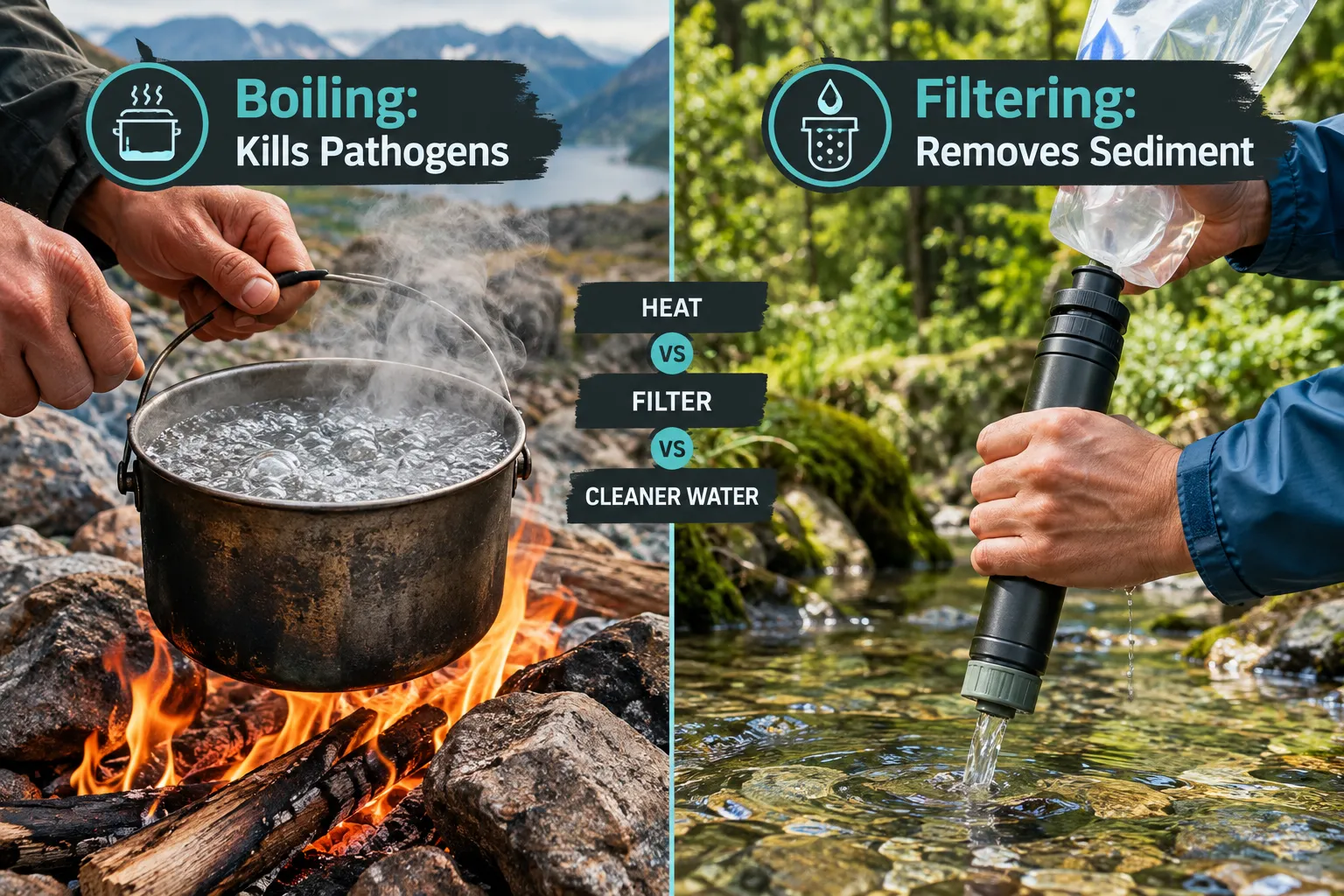
Boiling kills biological threats, bacteria, viruses, and protozoa. According to the CDC, bringing water to a rolling boil for one minute (three minutes above 6,500 feet elevation) is sufficient to eliminate all biological pathogens. Boiling does not remove chemical contaminants, heavy metals, or sediment. For a precise reference on boiling times by altitude and scenario, the boiling water survival time chart is worth bookmarking.
Filtering removes sediment, protozoa, and most bacteria from water, but standard portable filters (hollow fiber, ceramic) do not remove viruses. In North American backcountry environments, viral contamination is relatively rare, making a quality filter sufficient for most situations. In international or heavily human-impacted environments, viral risk is higher.
Best practice: filter first to remove sediment and larger organisms, then boil or use chemical treatment (iodine or chlorine dioxide tablets) to address viruses. This two-step approach covers virtually every biological threat.
For no-equipment purification methods, the complete guide to purifying water without tools outdoors covers improvised options in detail.
How Do You Purify Water in the Wilderness Without Equipment
When gear is unavailable, improvised purification is still possible, though less reliable than purpose-built tools.
Improvised methods:
- Boiling over fire: A metal container, a fire, and time are all you need. This is the most reliable no-equipment option. See how to start a fire without matches if fire-starting tools are also unavailable.
- Improvised filtration: Layer a container with grass, fine sand, charcoal from a fire, and more sand. Pour water through slowly. This removes sediment and some contaminants but does not kill pathogens, always follow with boiling. The improvised water filter for survival guide provides a detailed construction walkthrough.
- Solar disinfection (SODIS): Fill a clear plastic bottle with water and leave it in direct sunlight for six hours (or two days under cloudy conditions). UV radiation kills most biological pathogens. This method requires clear, low-turbidity water to be effective.
- Allowing water to settle: Let collected water sit undisturbed for several hours. Sediment and some organisms will settle to the bottom. Carefully pour off the clearer top layer before treating further.
Is Rainwater Safe to Drink Directly from the Ground
Rainwater collected directly from the sky in a clean container is generally safe to drink without treatment. The problem is collection method. Rainwater that has contacted the ground, vegetation, roofing materials, or standing pools picks up bacteria, parasites, and chemical contaminants quickly.
Safe collection: Use a clean tarp, poncho, or large leaves arranged as a funnel to direct rainfall into a container. Avoid the first few minutes of rainfall if collecting from a surface, this initial runoff carries the highest concentration of contaminants. For a full setup guide, see rainwater collection for emergency survival.
Ground puddles and pooled rainwater: Treat these the same as any surface water source. They are not safe to drink without purification.
How Do You Collect and Store Water When Camping or Hiking
Active collection and smart storage extend your water supply and reduce how often you need to search for new sources.
Collection strategies:
- Carry a lightweight tarp (minimum 8×10 feet) that can be rigged as a rain catchment funnel
- Use wide-mouth bottles or a collapsible reservoir to maximize collection speed from streams
- Collect more than you think you need before moving camp, water sources are not guaranteed at your next location
Storage best practices:
- Use food-grade containers only; never store water in containers that previously held fuel, chemicals, or non-food substances
- Keep water out of direct sunlight to slow bacterial growth
- Label treated water separately from untreated water if carrying both
Daily water needs in the field: The U.S. Army Field Manual recommends a minimum of one liter per hour during moderate activity in warm weather. In cool conditions with low exertion, two to three liters per day may suffice. Plan your procurement around these baselines.
What Mistakes Do People Make When Looking for Water in the Wild
The most dangerous mistakes are the ones that feel logical in the moment but accelerate the problem.
Common errors:
- Drinking untreated water out of desperation: Giardia and Cryptosporidium infections cause severe diarrhea and vomiting, which accelerates dehydration dramatically. Drinking untreated water can make your situation worse, not better.
- Ignoring terrain and heading uphill: Water flows down. Searching uphill wastes energy and rarely yields results.
- Relying on taste or appearance: Clear, cold, fast-moving water can still carry pathogens. There is no visual test for biological contamination.
- Not carrying a backup purification method: Filters can clog or freeze; tablets have expiration dates; fire requires dry conditions. Carry at least two methods. For a full breakdown of what goes wrong with filtration, see survival water filtering mistakes beginners make.
- Eating snow or ice without melting it first: Consuming frozen water lowers core body temperature and can accelerate hypothermia. Always melt and, if possible, warm snow water before drinking.
- Waiting too long to start searching: Begin water procurement before you are thirsty. By the time thirst is noticeable, mild dehydration has already begun.
What Tools Help You Find and Purify Water in Survival Situations
A compact, well-chosen kit handles the vast majority of wilderness water scenarios.
Core tools:
| Tool | Primary Function | Notes |
|---|---|---|
| Hollow-fiber squeeze filter (e.g., Sawyer Squeeze) | Removes bacteria and protozoa | Lightweight, no moving parts, long lifespan |
| Chlorine dioxide tablets | Kills viruses and bacteria | Backup for filter failure; 4-hour treatment time |
| Metal water bottle or pot | Boiling | Doubles as cooking vessel; titanium is lightest |
| Clear plastic sheeting | Solar still, rain catchment, transpiration bags | Multi-use; minimal weight |
| UV pen purifier (e.g., SteriPen) | Kills viruses, bacteria, protozoa | Battery-dependent; fast treatment |
Optional but valuable:
- Collapsible water reservoir (2-3 liter capacity) for bulk collection
- Pre-filter bandana or coffee filter for sediment removal before main filtration
- Topographic map of the area, invaluable for identifying drainage patterns and likely water locations
The 7 essential wilderness survival tools every hiker needs guide covers the broader gear stack that complements water procurement tools.
Frequently Asked Questions
Can I drink ocean or saltwater if I’m desperate?
No. Saltwater accelerates dehydration because the kidneys require more water to process the salt than the water provides. Drinking seawater in a survival situation will speed up your death, not delay it.
How do I know if a water source is contaminated?
You often cannot tell visually. Clear, fast-moving water can still carry Giardia and bacteria. Foul smell, oily sheen, unusual color, or dead animals nearby are warning signs, but the absence of these does not confirm safety. Always treat wild water.
Is it safe to drink water from a coconut?
Yes. Fresh coconut water is safe and provides electrolytes. It is one of the few plant-based fluids that can serve as a reliable hydration source in tropical environments.
What is the fastest way to purify water in the wild?
Boiling is the most universally reliable method. If fire is available, bring water to a rolling boil for one minute. UV pen purifiers (like SteriPen) are faster in terms of hands-on time but require charged batteries.
Can I get sick from drinking water from a mountain spring?
Yes. Springs can be contaminated by animal waste, dead animals upstream, or agricultural runoff. High-elevation springs carry lower risk than low-elevation sources, but no wild water source is guaranteed safe without treatment.
How much water do I actually need per day in the wilderness?
A minimum of two liters per day in cool, low-exertion conditions. In heat or during heavy physical activity, requirements climb to four to six liters or more. Err on the side of collecting more than you think you need.
Does filtering water through a shirt or cloth make it safe to drink?
No. Cloth filtration removes visible sediment and debris but does not kill or remove pathogens. It is a useful pre-treatment step before boiling or chemical treatment, not a standalone solution.
What is a solar still and does it actually work?
A solar still uses the sun’s heat to evaporate soil moisture, which then condenses on a plastic sheet and drips into a collection container. It works, but output is limited, typically under one liter per day. It is a last-resort method, not a primary strategy.
Can dehydration affect decision-making?
Yes, significantly. Even mild dehydration (1-2% body weight loss) measurably impairs concentration, reaction time, and judgment. This is why water procurement must be prioritized early, before cognitive function is compromised.
Is morning dew worth collecting?
In environments where dew forms, temperate forests, coastal areas, high-altitude meadows, yes. It is time-consuming but requires no equipment beyond an absorbent cloth. Combined with other collection methods, it can meaningfully supplement your water supply.
Conclusion
Knowing how to find water in the wilderness is a skill that operates on multiple layers: reading the landscape, recognizing biological indicators, improvising collection methods, and treating whatever you find before it goes in your body. None of these steps are optional in a real survival situation.
The hierarchy is straightforward. Prioritize water procurement immediately after securing shelter. Follow terrain downhill, watch vegetation and wildlife, collect rain and dew when surface water is absent, and never drink untreated wild water regardless of how clean it looks.
Actionable next steps for preppers and survivalists:
- Build a dedicated water kit for your bug-out bag: a squeeze filter, chlorine dioxide tablets, and a metal container for boiling.
- Practice identifying water-indicator plants, willows, cattails, and cottonwoods, in your region before you need the skill.
- Run a solar still and transpiration bag exercise in your backyard to understand the realistic output and technique.
- Review your current water storage and purification plan using the ultimate emergency water storage and purification guide to identify any gaps.
Preparedness is not about fear. It is about building the competence and confidence to handle what most people never think about until it is too late. Water is where that confidence starts.
Recommended Tools and Resources
Sawyer Squeeze Water Filter, Lightweight, reliable, and rated for up to 100,000 gallons. The standard choice for survivalists who want a no-fuss filtration solution that fits in a shirt pocket.
Aquatabs or Potable Aqua Chlorine Dioxide Tablets, Chemical backup for when your filter is unavailable, frozen, or clogged. Chlorine dioxide is more effective against Cryptosporidium than standard iodine tablets.
Titanium or Stainless Steel Single-Wall Water Bottle, The only container that can go directly over a fire for boiling. Avoid insulated double-wall bottles for this purpose, they cannot be used for boiling.
SteriPen Adventurer Opti UV Purifier, Fast, effective against viruses (which filters miss), and compact. Carry spare batteries or a solar charging solution.
Clear 4-mil Plastic Sheeting (10×10 feet), Multi-use survival material: solar still, transpiration bags, rain catchment, and emergency shelter. Weighs almost nothing and costs very little.
For those building a comprehensive preparedness system beyond water, the 25 most critical wilderness survival skills guide is the logical next read.