
Hey there! Some links on this page may be affiliate links which means that, if you choose to make a purchase, I may earn a commission at no extra cost to you. I greatly appreciate your support. Read the full disclosure here.
Every year, search and rescue teams in the United States respond to an estimated 250,000 incidents involving lost or injured hikers, and a significant number of those emergencies could have been avoided or survived with the right gear on hand. Knowing which wilderness survival tools every hiker needs is not a hobby interest. For anyone who spends serious time in the backcountry, it is a baseline competency.
This guide covers the essential tools, how to use them, how to choose for your experience level and climate, and how to avoid the gear mistakes that get people killed.
Key Takeaways
- The non-negotiable core tools are a fixed-blade knife, fire-starting kit, water purification system, navigation tools, emergency shelter, signaling device, and a first aid kit.
- A survival kit and an emergency kit serve different purposes, one is proactive, the other reactive.
- Experienced hikers carry fewer gadgets and more proven fundamentals.
- A well-built survival kit should add no more than 3-5 pounds to your pack.
- Wet conditions and winter environments require specific tool upgrades, standard gear often fails.
- Beginners should master three tools before adding more: a knife, a fire starter, and a water filter.
- Solo hikers carry redundancy; group hikers distribute weight and responsibility.
- The biggest survival gear mistake is owning tools you have never practiced with.
What Are the Most Essential Survival Tools for Hiking
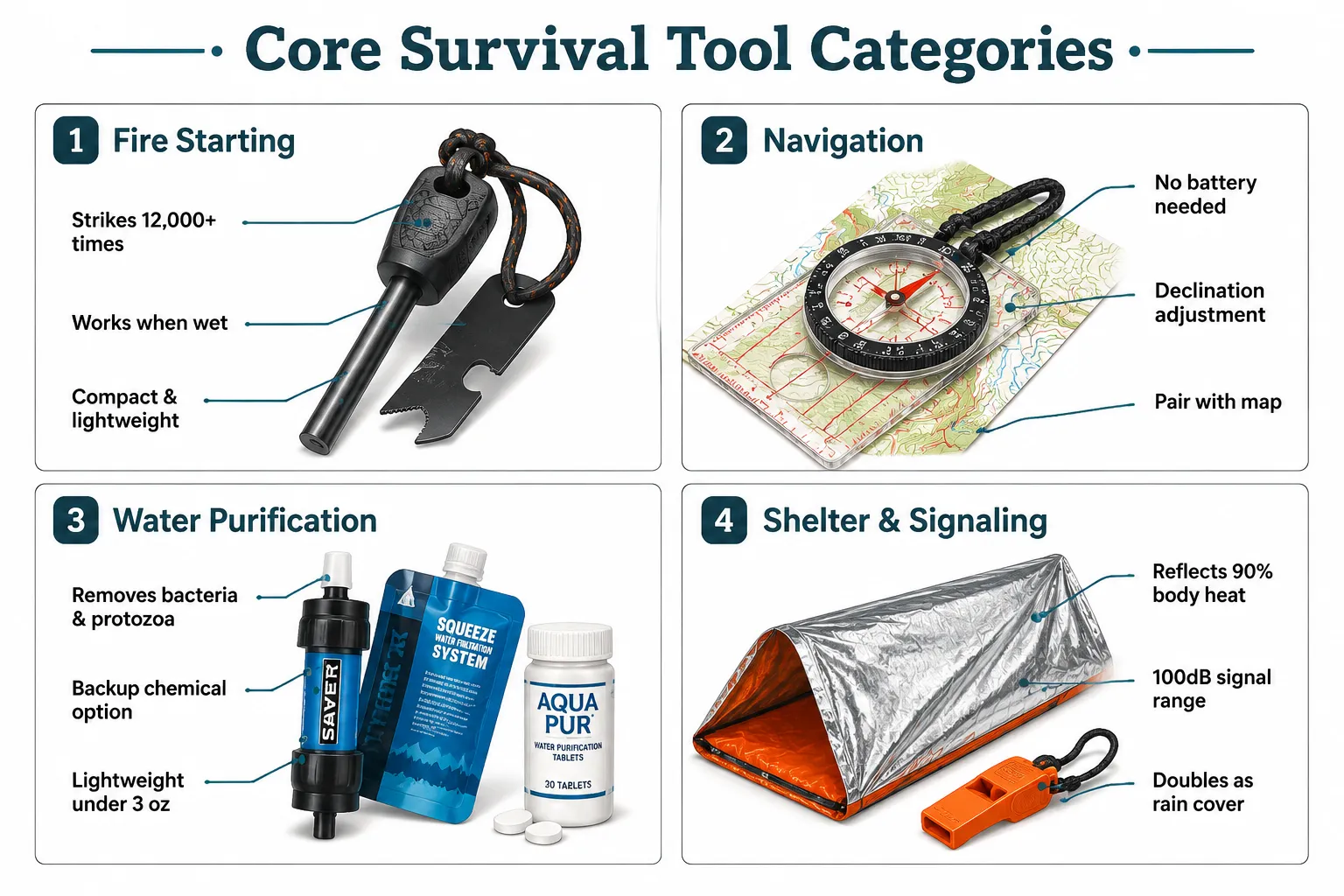
The most essential wilderness survival tools every hiker needs fall into seven categories: cutting, fire, water, navigation, shelter, signaling, and first aid. Every other piece of gear is secondary to these seven.
Here is the core list, ranked by how quickly the absence of each tool becomes life-threatening:
- Fixed-blade knife, cutting, food prep, shelter building, first aid
- Ferro rod or fire-starting kit, warmth, water purification, signaling
- Water filter or purification tablets, hydration without illness
- Map and compass, navigation when electronics fail
- Emergency bivy or space blanket, hypothermia prevention
- Signaling device, whistle, mirror, or personal locator beacon (PLB)
- First aid kit, wound care, blister management, medication
These are not suggestions. They are the tools that bridge the gap between a bad situation and a fatal one. For a deeper look at the skills that pair with this gear, the 25 Most Critical Wilderness Survival Skills, Ranked By Life-Saving Priority is essential reading.
What Is the Difference Between a Survival Kit and an Emergency Kit for Hikers
A survival kit is proactive, it contains tools that help you stay alive and self-rescue over an extended period. An emergency kit is reactive, it addresses immediate crises like bleeding, allergic reactions, or sudden weather changes.
Most hikers need both, but they serve different moments:
| Feature | Survival Kit | Emergency Kit |
|---|---|---|
| Purpose | Extended self-reliance | Immediate crisis response |
| Contents | Knife, fire starter, shelter, navigation | First aid, medications, emergency blanket |
| Weight | 2-5 lbs | 0.5-1.5 lbs |
| Use scenario | Lost overnight, multi-day emergency | Injury, sudden illness, weather event |
| Carried by | Every hiker | Every hiker |
The practical answer: build them separately, carry them together. Your emergency kit should be accessible within 10 seconds, not buried at the bottom of your pack.
For a thorough breakdown of what belongs in your medical supplies, see 47 Things Every Prepper First Aid Kit Needs.
How to Use a Ferro Rod for Starting Fires While Hiking
A ferro rod (ferrocerium rod) creates sparks exceeding 5,400°F by scraping a metal striker along the rod’s surface. It works in rain, wind, and cold, conditions that defeat matches and lighters.
Step-by-step ferro rod technique:
- Prepare a tinder bundle first, dry grass, birch bark, cattail fluff, or commercial tinder (fatwood shavings work well).
- Hold the ferro rod close to the tinder, about 1-2 inches above it.
- Grip the striker firmly and push the rod away from you while keeping the striker stationary. This controls spark direction better than pulling the striker toward you.
- Direct sparks into the center of the tinder bundle.
- Once the tinder catches, gently blow at the base of the ember and transfer to a prepared fire lay.
Common mistake: Most beginners scrape too fast and too far from the tinder. Slow, deliberate strokes with the rod angled close to the bundle produce better results.
A quality ferro rod lasts 12,000+ strikes. Choose one that is at least 3/8 inch in diameter, thinner rods are harder to grip with cold hands. For more detail on fire-starting in challenging conditions, read How To Start Fire In Wet Conditions and Fire Starting Mistakes.
What Survival Tools Do Professional Hikers Actually Carry
Professional guides, search and rescue personnel, and experienced survivalists consistently carry fewer gadgets and more proven basics. The pattern is clear: expertise reduces kit complexity.
What experienced hikers actually carry:
- A quality fixed-blade knife (3.5-5 inch blade, full tang)
- Ferro rod plus a backup lighter
- Sawyer Squeeze or similar lightweight water filter
- Topo map and baseplate compass (Suunto or Silva)
- SOL Emergency Bivy or similar vapor-barrier shelter
- Fox 40 pealess whistle
- Compact first aid kit with personal medications
- 50 feet of paracord (550 cord)
- Headlamp with extra batteries
- Signal mirror
What they do not carry: multi-tools with 27 functions, solar-powered chargers as primary navigation, or survival bracelets as their only fire-starting option. Redundancy matters more than novelty.
For a comprehensive ranked list of gear priorities, The Essential Survival Gear Guide: 50 Items Ranked By Priority is one of the most practical references available.
Wilderness Survival Tools for Beginners vs. Experienced Hikers
Beginners should start with three tools and master them before expanding their kit. Experienced hikers build redundancy and adapt their kit to terrain and conditions.
Beginner priority list (start here):
- A folding knife or fixed-blade knife
- A ferro rod with practice tinder
- A Sawyer Squeeze or LifeStraw water filter
Once those three are second nature, add navigation tools, then shelter, then signaling. Buying 15 tools and never practicing with any of them is the most common beginner mistake.
Experienced hiker additions:
- Redundant fire-starting methods (ferro rod + lighter + waterproof matches)
- PLB or satellite communicator (Garmin inReach)
- Heavier-duty fixed-blade knife for bushcraft tasks
- Dedicated water purification tablets as backup to the filter
- Lightweight tarp in addition to an emergency bivy
The 14 Essential Survival Skills Every Prepper Must Know pairs well with this progression, tools are only as useful as the skills behind them.
Can You Survive in the Wilderness With Just a Knife
A knife is the single most versatile survival tool, but relying on it alone puts you in a high-risk position. Experienced survivalists can extend their survival window significantly with just a knife, but most people cannot.
With a knife alone, a skilled person can:
- Build a debris shelter
- Process firewood and carve fire-starting tools (bow drill kit)
- Prepare foraged food
- Construct traps and fishing tools
- Perform basic wound care
Without a knife, almost every other survival task becomes dramatically harder. That said, a knife cannot purify water, signal rescuers, or navigate terrain. It is the foundation of a kit, not the complete kit.
The honest answer: A knife buys you time. Time to build fire, find water, and signal for help. Without the skills to use it, even the best knife is just a heavy piece of metal. See Survival Knife Training and Qualities for a deeper look at what makes a knife genuinely useful in the field.
Common Mistakes People Make With Survival Gear
The most dangerous survival gear mistake is owning tools you have never used. The second most dangerous is carrying gear that fails in the specific conditions you are hiking in.
Top survival gear mistakes:
- Never practicing with the gear, A ferro rod you have never struck in the dark, with cold hands, in rain, is not a survival tool. It is a liability.
- Relying on a single fire-starting method, Always carry at least two.
- Skipping water purification, Clear mountain water can carry Giardia and Cryptosporidium. Looks clean does not mean is clean.
- No navigation backup, GPS batteries die. Phone screens crack. A map and compass do not.
- Carrying gear that is wrong for the season, A summer kit in November is a problem.
- Overpacking gadgets, Heavy kits slow you down and exhaust you faster.
- Ignoring signaling tools, Many hikers carry no whistle or mirror. Rescuers cannot find you if you cannot signal.
Survival Tools for Different Seasons and Climates
The core seven survival tools apply in every environment, but specific conditions demand specific upgrades. A kit that works in summer in the Appalachians will underperform in a winter Rockies scenario.
Seasonal and climate adjustments:
- Winter/cold weather: Add chemical hand warmers, an insulated water bottle (filters freeze), and a heavier emergency bivy rated for sub-zero temperatures. A Winter Blizzard Survival Kit covers this in detail.
- Desert/arid environments: Water capacity doubles. Carry a minimum of 4 liters plus purification. Sun protection and a signal mirror become critical.
- Wet/tropical environments: Waterproof everything. Use a ferro rod instead of matches. Carry anti-fungal foot care and insect protection.
- High altitude: Navigation tools become more critical as visibility drops. Add a lightweight tarp for sudden weather.
The rule: know your environment before you pack your kit.
What Survival Tools Work Best in Wet Conditions
Wet conditions are where most standard survival gear fails. The tools that remain reliable when everything is soaked are the ones that matter most.
Wet-condition reliable tools:
- Ferro rod, Sparks at 5,400°F regardless of moisture on the rod surface
- Pealess whistle, Standard whistles with peas freeze and clog; pealess designs (Fox 40, Storm) work in rain and cold
- Water filter (squeeze or pump style), Sawyer Squeeze and Katadyn BeFree perform reliably in wet environments
- Topo map in a waterproof case, Laminated or stored in a dry bag
- Fixed-blade knife, Folding knives with exposed pivot points can rust and seize; a quality stainless fixed-blade does not
Avoid: waterproof matches as a primary fire source (they work once and poorly), paper-based navigation aids without protection, and cotton clothing (cotton kills in wet cold).
For fire-starting in rain specifically, Start A Survival Fire In Rain is a practical field reference.
Do You Really Need All Those Survival Gadgets, or Just the Basics
For most hikers, the basics outperform the gadgets every time. The survival gear market is full of multi-function devices that do several things poorly instead of one thing well.
The honest breakdown:
- A dedicated compass beats a compass built into a paracord bracelet.
- A quality fixed-blade knife beats a 21-function multi-tool for primary survival tasks.
- A Sawyer Squeeze beats a UV pen purifier in cold or turbid water.
- A dedicated PLB beats a smartwatch with an SOS function.
That said, some multi-function tools earn their weight. A good multi-tool (Leatherman Wave) is genuinely useful for gear repair. A headlamp with a red-light mode serves both navigation and signaling. Choose multi-function tools where the functions are equally good, not where one function subsidizes three weak ones.
Bottom line: Build your kit around proven single-purpose tools first. Add multi-function items only when they replace something you were already carrying.
How Much Weight Should Your Survival Kit Add to Your Backpack
A well-built wilderness survival kit should add between 2.5 and 5 pounds to your base pack weight. Above 5 pounds, you are carrying redundancy that slows you down. Below 2 pounds, you are likely missing critical categories.
Weight breakdown for a lean, complete kit:
- Fixed-blade knife: 4-6 oz
- Ferro rod + striker: 1-2 oz
- Water filter (Sawyer Squeeze): 3 oz
- Purification tablets (backup): 1 oz
- Emergency bivy (SOL): 3.8 oz
- Topo map + compass: 4-6 oz
- Whistle + signal mirror: 1 oz
- Compact first aid kit: 8-12 oz
- 50 ft paracord: 3 oz
- Headlamp + batteries: 3-4 oz
Total estimate: approximately 2.5-3 lbs
A PLB or satellite communicator (Garmin inReach Mini) adds another 3.5 oz but is worth the weight on solo trips or remote terrain.
Solo Hiking vs. Group Hiking: How Survival Tool Needs Differ
Solo hikers need redundancy and signaling priority. Group hikers can distribute weight and specialize responsibilities.
Solo hiking adjustments:
- Carry a PLB or satellite communicator, non-negotiable on remote routes
- Redundant fire-starting (three methods minimum)
- Larger first aid kit with self-treatment capability
- Navigation tools always on your person, not in your pack
Group hiking adjustments:
- Distribute weight: one person carries the group shelter, another carries the group first aid kit
- Each person still carries their own knife, fire starter, water filter, and whistle
- Designate a navigation lead with the primary map and compass
- Agree on a meeting point and communication protocol before separating
The mistake in groups: assuming someone else has the critical gear. Every hiker should carry the personal core tools regardless of group size.
Where to Buy Quality Wilderness Survival Tools
Quality wilderness survival tools are available through outdoor specialty retailers, direct manufacturer websites, and a handful of trusted online platforms. Avoid buying critical survival gear from discount marketplaces where counterfeit products are common.
Trusted sources:
- REI, Strong selection of knives, navigation tools, and shelters with knowledgeable staff
- Backcountry.com, Wide range of technical gear with detailed specs
- Direct manufacturer sites, Sawyer (filters), Suunto/Silva (compasses), SOL (emergency shelters), Garmin (PLBs)
- Amazon, Acceptable for name-brand items you can verify by manufacturer; avoid unknown brands for critical tools
- Local outdoor gear shops, Best for trying navigation tools and knives in hand before buying
What to avoid: Survival kits sold as complete bundles for under $20. These typically contain tools that fail under real conditions, knives that bend, compasses that do not hold declination, and emergency blankets that tear on first use.
For a budget-conscious approach, How To Build A 72-Hour Emergency Kit For Under $50 shows how to prioritize spending without sacrificing quality on the tools that matter most.
Wilderness Survival Tools Every Hiker Needs: Beginner vs. Expert Kit Comparison
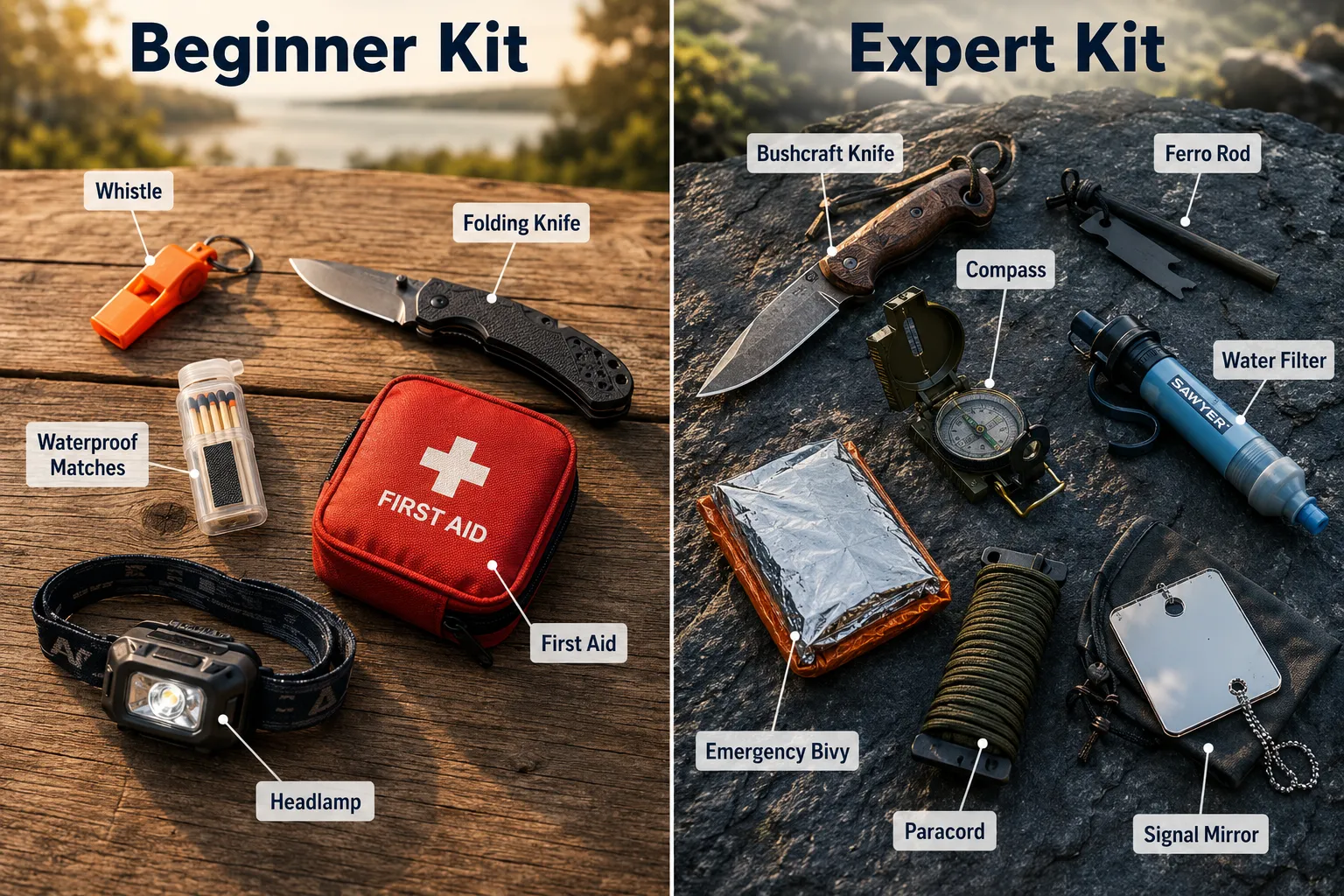
The gap between a beginner kit and an expert kit is not about spending more money. It is about understanding which tools earn their weight through proven performance.
| Tool Category | Beginner Pick | Expert Pick |
|---|---|---|
| Knife | Morakniv Companion (fixed blade) | Benchmade Bushcrafter or ESEE-4 |
| Fire Starting | Bayite ferro rod + waterproof matches | Light My Fire Army + Bic lighter + fatwood |
| Water | LifeStraw personal filter | Sawyer Squeeze + Aquatabs backup |
| Navigation | Suunto A-10 compass + printed map | Silva Ranger + laminated topo + Garmin inReach |
| Shelter | SOL Emergency Bivy | SOL Escape Bivy + lightweight tarp |
| Signaling | Fox 40 whistle | Fox 40 + signal mirror + PLB |
| First Aid | Adventure Medical Kits Ultralight | Custom kit with tourniquet + wound packing |
FAQ: Wilderness Survival Tools Every Hiker Needs
What is the single most important survival tool for hiking? A fixed-blade knife. It is the only tool that directly enables almost every other survival task, fire prep, shelter building, food processing, and basic medical care.
Should I carry a PLB or a satellite communicator? A PLB sends a one-way distress signal to rescue services and costs less. A satellite communicator (like Garmin inReach) allows two-way messaging and tracking but requires a subscription. For remote solo hiking, a satellite communicator is worth the added cost.
How often should I replace survival gear? Water filters have a rated capacity (Sawyer Squeeze: 100,000 gallons). Purification tablets expire (check the date). Batteries in headlamps and PLBs should be checked before every trip. Emergency bivies and space blankets should be replaced after use.
Is a multi-tool a substitute for a fixed-blade knife? No. A multi-tool’s blade is typically too short and too thin for heavy survival tasks. Carry both if weight allows, but never replace a fixed-blade with a multi-tool as your primary cutting tool.
What water purification method is best for hikers? A squeeze filter like the Sawyer Squeeze covers most scenarios. Add purification tablets as a backup for situations where the filter freezes or clogs. For more on water safety in the field, see How To Purify Water Without Tools Outdoors.
Do I need a compass if I have a GPS-enabled phone? Yes. Phone batteries fail, screens crack, and GPS signals can be unreliable in dense terrain or deep canyons. A baseplate compass and topo map are your failsafe.
What is the lightest complete survival kit I can build? A lean but complete kit, knife, ferro rod, Sawyer Squeeze, Aquatabs, SOL bivy, pealess whistle, and a compact first aid kit, weighs approximately 2.5 lbs and covers all seven core categories.
How do I keep my survival kit from getting too heavy? Choose tools that serve one function extremely well rather than gadgets that serve five functions poorly. Audit your kit before every trip and remove anything you have not used in three outings.
What survival tools are best for kids hiking with adults? Children should carry an age-appropriate whistle, a small headlamp, and a basic first aid kit. Adults carry the primary survival tools. For a structured approach, 12 Essential Survival Skills For Kids is a useful starting point.
Can survival tools expire? Yes. Purification tablets, medications in first aid kits, and glow sticks all have expiration dates. Batteries degrade. Check dates annually and before major trips.
Conclusion: Build the Kit, Then Build the Skills
The wilderness survival tools every hiker needs are not complicated, and they are not expensive. The challenge is not finding them, it is committing to learning them before you need them.
Start with the core seven. Practice with each one until using it under stress feels automatic. Then expand your kit based on the specific terrain, season, and conditions you actually hike in. A $20 ferro rod you have used 200 times is worth more than a $200 multi-tool still in its packaging.
Actionable next steps:
- Audit your current kit against the seven core categories. Identify the gaps.
- Purchase the missing tools, starting with water purification if you do not already have it.
- Spend one afternoon practicing fire-starting with your ferro rod before your next trip.
- Download and laminate a topo map of your next hiking area and practice using your compass with it.
- Tell someone your route and expected return time before every solo hike.
Preparedness is not about fear. It is about the confidence that comes from knowing you have the right tools and the skills to use them. That confidence changes how you move through the wilderness, and it may one day save your life.
Related Reading:
- 25 Most Critical Wilderness Survival Skills, Ranked By Life-Saving Priority
- The Essential Survival Gear Guide: 50 Items Ranked By Priority
- 20 Essential Bushcraft Skills For Beginners
- The Complete Beginner’s Guide To Navigation Without GPS
Products, Tools, and Resources
Knives
- Morakniv Companion, The best value fixed-blade for beginners. Full-tang equivalent performance at a fraction of the cost of premium brands.
- ESEE-4, A field-tested fixed-blade trusted by military and SAR professionals. Durable, maintainable, and purpose-built for hard use.
Fire Starting
- Light My Fire Army Ferro Rod, Thick grip, high spark output, rated for 12,000 strikes. Works reliably in cold and wet conditions.
- Fatwood tinder sticks, Natural resin-saturated wood that catches from a single spark. No chemical smell, no expiration date.
Water Purification
- Sawyer Squeeze Filter, 0.1-micron filtration, 100,000-gallon rated capacity, backflushable. The standard for lightweight hiking filtration.
- Aquatabs purification tablets, Compact chemical backup. Effective against bacteria and viruses where filters may not be.
Navigation
- Silva Ranger compass, Reliable declination adjustment, clear baseplate, and a sighting mirror for precision. A professional-grade tool at a reasonable price.
- CalTopo or Gaia GPS, For pre-trip map download and route planning. Always print and laminate a backup.
Shelter and Signaling
- SOL Escape Bivy, Vapor-permeable, reflects 70% body heat, and durable enough for multi-night use. A significant upgrade over standard mylar blankets.
- Fox 40 Classic whistle, Pealess design, 115 dB output, works in freezing temperatures and wet conditions.
- Garmin inReach Mini 2, Two-way satellite messaging, SOS capability, and GPS tracking. The most practical personal safety device for remote solo hiking in 2026.
First Aid
- Adventure Medical Kits Mountain Series, Pre-organized, well-stocked, and sized for multi-day trips. Supplement with a personal tourniquet (CAT or SOFTT-W) for remote travel.