
Hey there! Some links on this page may be affiliate links which means that, if you choose to make a purchase, I may earn a commission at no extra cost to you. I greatly appreciate your support. Read the full disclosure here.
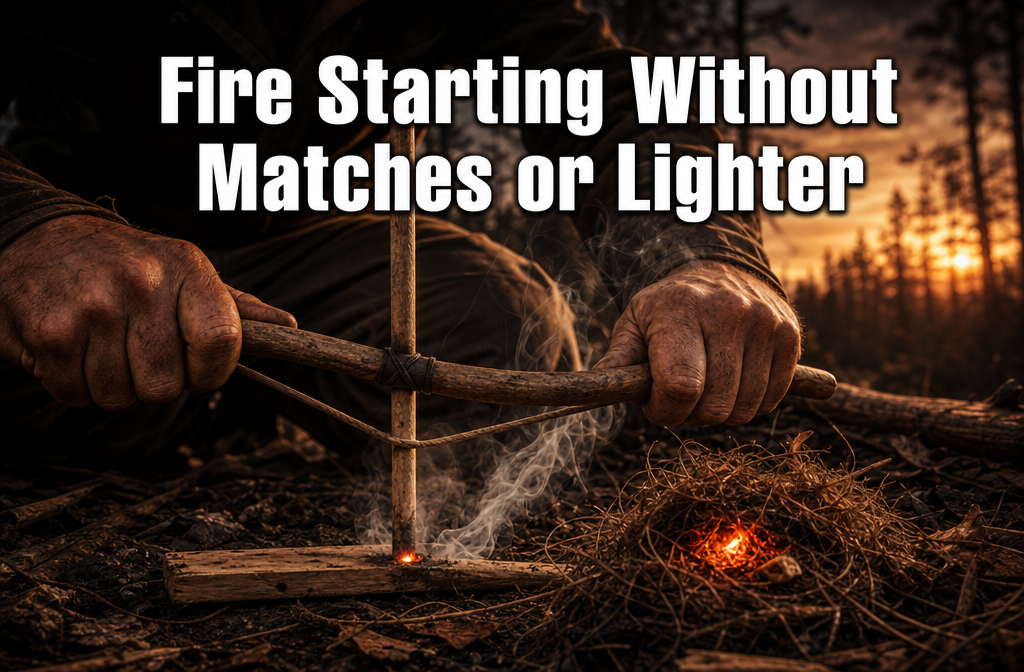
Fewer than 20% of adults in North America can reliably start a fire without modern ignition tools — yet fire remains the single most critical survival skill after shelter. Fire starting without matches or lighter is not a relic of the Stone Age. It’s a practical, learnable skill that separates people who survive from people who don’t when the gear runs out.
This guide “How to Start A Fire Without Matches or Lighter” covers every major primitive fire method, explains exactly how each one works, and tells you honestly which ones are realistic for the average person to learn. No fluff. No survival fantasy. Just the information you need to build a real fire when your life depends on it.
Key Takeaways
- Friction-based methods (bow drill, hand drill, fire plow) are the most reliable primitive techniques but require practice before an emergency
- Flint and steel is faster to learn than friction fire and works well in most climates
- Wet conditions are the biggest enemy of primitive fire starting — tinder preparation is more important than technique
- A bow drill fire can be achieved in under 5 minutes by a practiced person; beginners should expect 20–45 minutes
- Tinder quality determines success more than any other single factor
- Desert environments favor hand drill; temperate forests favor bow drill
- Emergency fire-starting tools (fire pistons, ferrocerium rods) bridge the gap between modern and primitive methods
- Primitive fire starting is absolutely realistic for average people — it just requires deliberate practice before you need it
What Are the Easiest Primitive Fire Starting Methods?
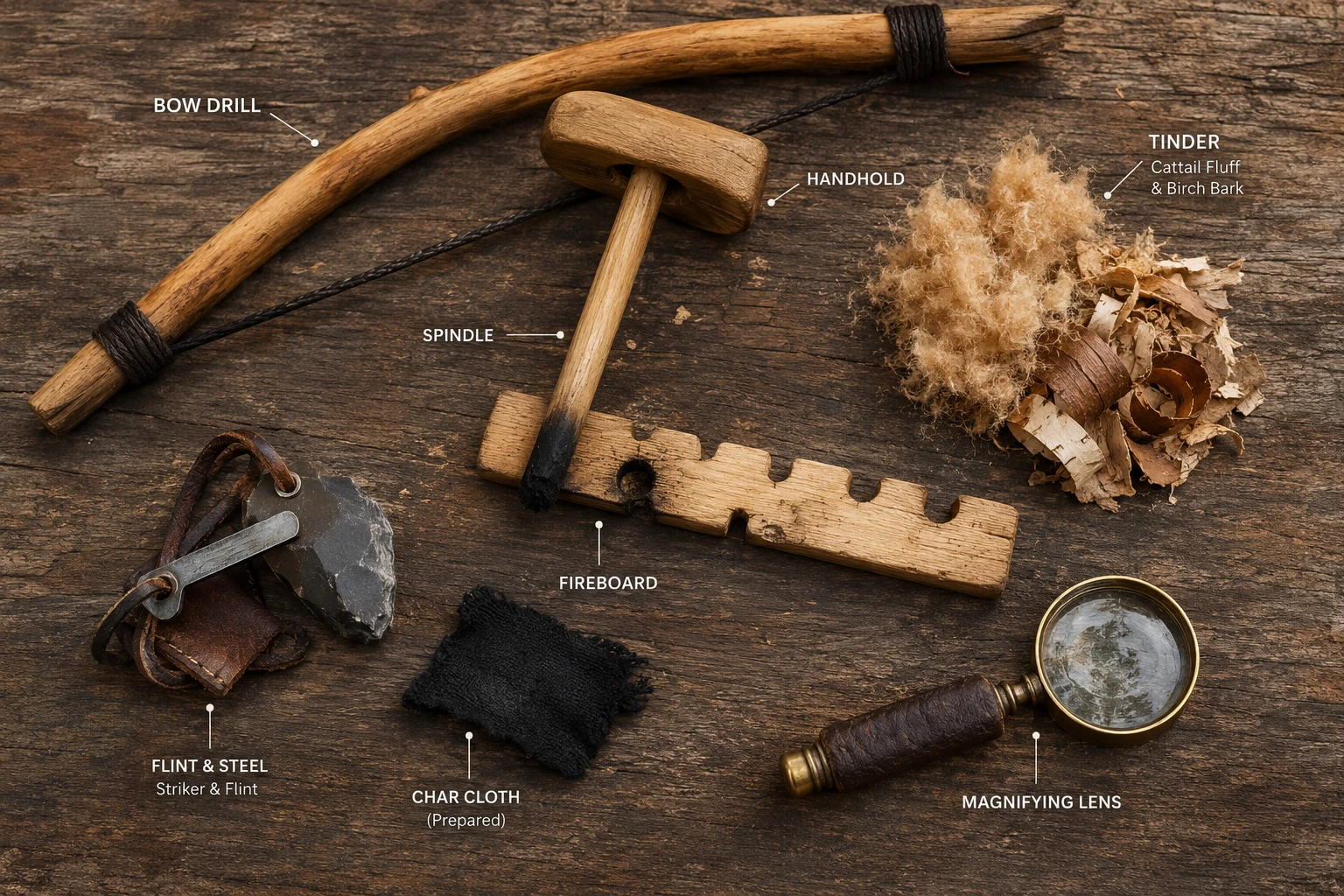
The easiest primitive fire starting methods for beginners are flint and steel with char cloth, the fire piston, and the bow drill — in roughly that order of difficulty. Flint and steel produces reliable sparks quickly, while the bow drill is harder to master but requires only natural materials found in most environments.
Here’s a practical breakdown ranked by beginner accessibility:
| Method | Difficulty | Materials Needed | Best For |
|---|---|---|---|
| Flint & Steel | Low–Medium | Flint/quartzite, high-carbon steel, char cloth | Beginners, cold climates |
| Fire Piston | Low | Piston tool, dry tinder | Humid tropics, prepared kits |
| Bow Drill | Medium | Spindle, fireboard, bow, cord, handhold | Temperate forests |
| Hand Drill | Medium–High | Spindle, fireboard | Desert, dry grasslands |
| Fire Plow | Medium | Hardwood plank, dry stick | Coastal, tropical areas |
| Lens/Solar | Low (conditions dependent) | Magnifying lens, sunlight | Clear-sky environments |
Choose flint and steel if you’re new to primitive fire and want the fastest learning curve. Choose bow drill if you want a method that works with materials you can find anywhere in a temperate wilderness.
“The method that works is the one you’ve practiced. The best primitive fire technique is the one you can execute under stress, in the dark, with cold hands.”
How Do Friction Fire Techniques Actually Work?
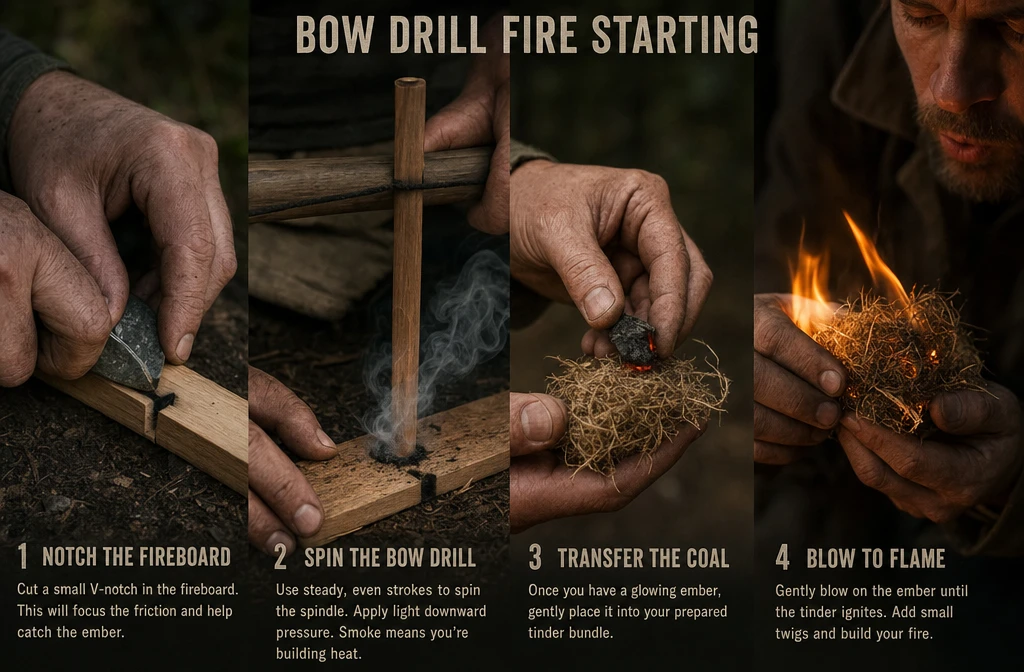
Friction fire works by generating heat through rapid mechanical friction between two dry wood surfaces. The friction creates fine wood dust that accumulates in a notch cut into the fireboard; that dust reaches ignition temperature (around 800°F / 425°C) and forms a glowing coal called an ember or coal.
The physics are straightforward: pressure + speed = heat. The challenge is sustaining both long enough to produce a coal, then transferring that coal into a prepared tinder bundle and blowing it into flame.
The three main friction fire methods each achieve this differently:
- Bow drill: A bow drives a wooden spindle in rotation against a fireboard. The bow multiplies stroke speed, making this the most accessible friction method.
- Hand drill: The spindle is rolled between both palms while applying downward pressure. Requires very dry conditions and specific wood combinations.
- Fire plow: A hardwood stick is dragged repeatedly through a groove in a softer wood plank, building up hot dust at the end of the groove.
Common mistake: Most beginners apply too much downward pressure and not enough rotational speed. Speed matters more than force. A light, fast stroke beats a slow, grinding one every time.
Can You Start a Fire With Just Rocks and Steel?
Yes — flint and steel is one of the oldest and most reliable methods for fire starting without matches or lighter. Striking a piece of high-carbon steel against sharp-edged flint, chert, quartzite, or obsidian produces a shower of hot sparks that can ignite prepared char cloth or dry fungus tinder.
What you need:
- A sharp-edged rock (flint, chert, quartzite, or obsidian work best)
- A piece of high-carbon steel (a carbon steel knife spine, old file, or dedicated striker)
- Char cloth, amadou (horse hoof fungus), or dried cattail fluff as a spark catcher
How to do it:
- Hold the rock in your non-dominant hand, edge pointing upward
- Strike the steel downward at a 30-degree angle across the rock’s edge
- Direct sparks onto the char cloth held just below the strike point
- Once the char cloth glows, fold it into a tinder bundle
- Blow steadily until flame appears
Edge case: Not all rocks spark. Granite and sandstone rarely produce useful sparks. Test rocks before you’re in an emergency by striking them against a steel blade in daylight — you’ll see immediately whether they throw sparks.
What Survival Skills Do You Need to Make Fire Without Modern Tools?
Successful fire starting without matches or lighter requires four interconnected skills: material identification, tinder preparation, technique execution, and fire management. Missing any one of them will cause failure even if the others are solid.
Material identification means knowing which local woods work for friction fire (dry, soft-to-medium hardness like cottonwood, willow, cedar, or mullein) and which don’t (green wood, resinous pines, very hard woods like oak for the spindle). This is a learnable skill that takes a few hours of field experimentation.
Tinder preparation is the most underrated skill. Your tinder bundle needs to be bone dry, finely shredded, and shaped like a bird’s nest with a hollow center. Good tinder materials include:
- Dry grass, cattail fluff, or thistle down
- Shredded dry inner bark (cedar, birch, or cottonwood)
- Dried moss or lichen
- Fine wood shavings from a dry stick
Technique execution requires practice. Reading about bow drill is not the same as doing it. Plan to practice at home before you need the skill in the field. For more foundational skills to build alongside fire starting, the 25 Most Critical Wilderness Survival Skills guide at Preppers HQ covers the full priority stack.
Fire management means knowing how to go from coal to flame to sustainable fire — including how to build a proper fire lay (teepee, log cabin, or star fire) that catches without smothering.
Which Fire Starting Method Works Best in Wet Conditions?
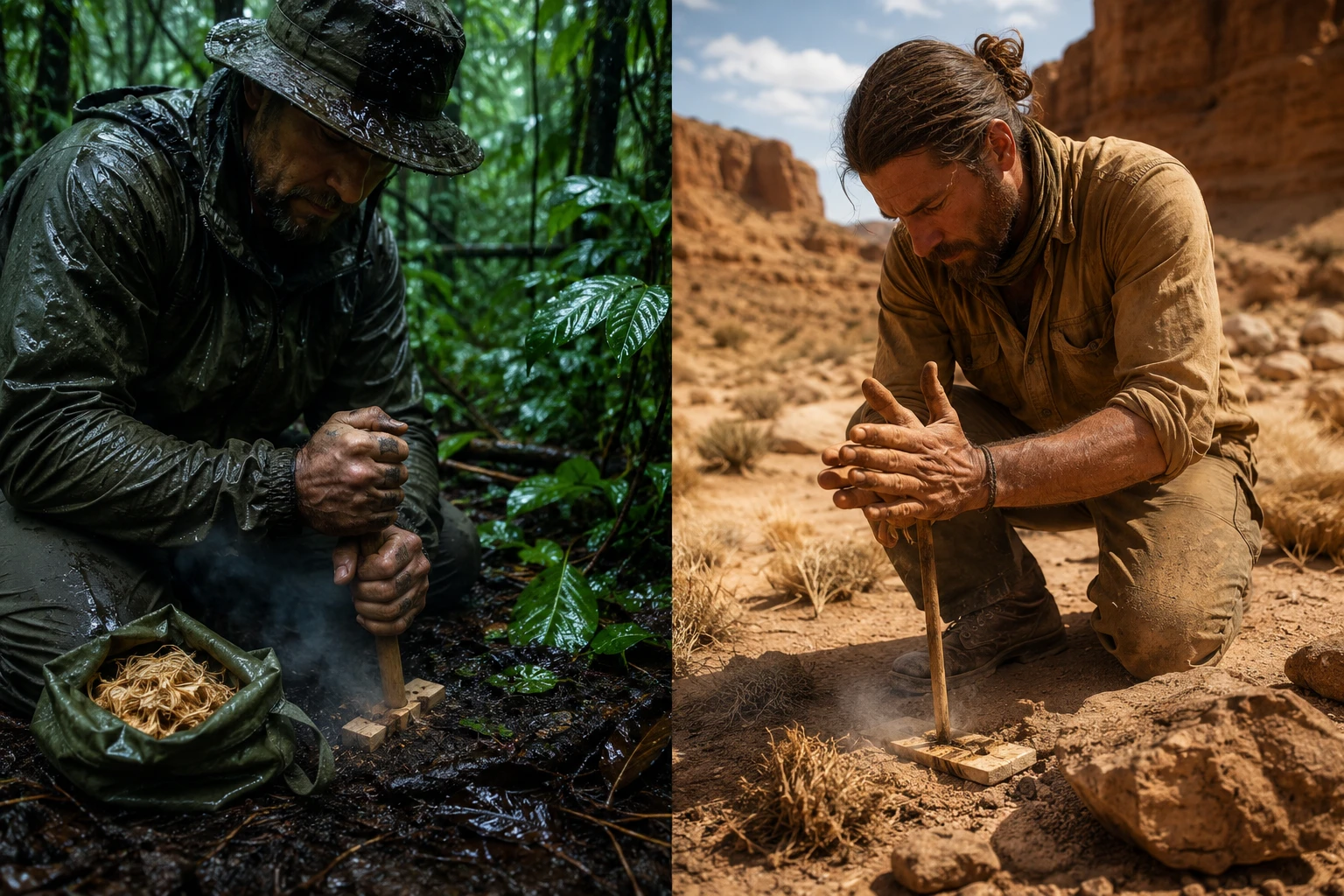
In wet conditions, the fire piston and flint-and-steel with pre-prepared char cloth are the most reliable methods for primitive fire starting. Friction methods become extremely difficult when wood is damp because moisture prevents the friction dust from reaching ignition temperature.
Wet-weather survival strategies:
- Protect your tinder first. Store dry tinder inside a waterproof container or inside your clothing against your body. No tinder, no fire — regardless of method.
- Split wet wood. The interior of a wet log is often dry. Use a knife or rock to split wood and access the dry core.
- Use fatwood. Resin-saturated heartwood from dead pine stumps ignites even when wet and burns hot enough to dry surrounding fuel.
- Build a platform. Lay two green logs parallel and build your fire on top of them so the fire isn’t sitting in wet ground.
- Feather sticks. Carve thin curls from dry inner wood — these catch flame more easily than solid pieces.
Avoid: The hand drill method in wet conditions. It’s nearly impossible without extremely dry materials and is best reserved for arid environments.
If fire is needed for cooking during an emergency and conditions are severe, also review emergency cooking without power for alternative heat source strategies.
How Hard Is It to Start a Fire Using a Bow Drill?
The bow drill is moderately difficult for beginners and achievable for most adults with 3–5 dedicated practice sessions. The learning curve is real, but it’s not prohibitive. Most people who fail at bow drill fail because of wood selection or tinder preparation — not because the technique itself is beyond them.
Realistic expectations:
- First attempt: Likely no coal. You’re learning body mechanics and wood feel.
- After 2–3 sessions: Smoke is consistent; coal production is possible.
- After 5–10 sessions: Reliable coal production in 2–5 minutes under good conditions.
The bow drill setup:
- Spindle: Straight, dry, pencil-diameter stick of soft-medium wood (mullein, willow, cedar, cottonwood), 18–24 inches long
- Fireboard: Flat piece of the same or similar wood, at least ½ inch thick
- Bow: A curved branch strung with paracord, shoelace, or natural cordage
- Handhold: A hard wood or stone socket to press down on the spindle top
- Notch: A V-shaped cut in the fireboard that collects the hot dust
The single biggest mistake beginners make is using wood that’s too hard, too soft, or still green. Cottonwood root is widely considered the most forgiving wood for beginners learning bow drill in North America.
For a broader look at bushcraft fundamentals that complement fire making, see the 20 essential bushcraft skills for beginners guide.
What Common Mistakes Do Beginners Make With Primitive Fire Starting?
The most common beginner mistakes in primitive fire starting are using the wrong wood, skipping tinder preparation, and practicing only in ideal conditions. These three errors account for the vast majority of failures.
Full mistake list:
- Wrong wood choice. Using green, wet, or overly hard wood for friction methods. Always test wood by pressing a fingernail into it — it should dent slightly but not crumble.
- Poor tinder bundle. Tinder that’s too coarse, too damp, or too loosely packed won’t sustain a coal long enough to flame.
- Inconsistent pressure. Stopping mid-stroke or varying pressure breaks the heat-building rhythm.
- Not notching correctly. The notch in the fireboard should be 1/8 of the spindle’s diameter and cut to the center of the burn circle — not too deep, not too shallow.
- Blowing too hard. Gentle, steady breath coaxes a coal into flame. Aggressive blowing scatters the ember.
- Only practicing in summer. Cold, wet hands and damp air change everything. Practice in varied conditions.
- No backup plan. Even experienced survivalists carry a ferrocerium rod. Primitive methods are skills, not replacements for redundant ignition tools.
Are There Differences Between Fire Starting in Desert vs. Forest Environments?
Yes — environment significantly affects which fire starting technique works best and which materials are available. Desert environments favor the hand drill because dry grasses and yucca stalks make excellent spindle material. Temperate forests favor the bow drill because softer woods are abundant and moisture is manageable with preparation.
Desert fire starting:
- Hand drill excels here — dry air and low humidity keep materials bone dry
- Yucca flower stalks, sotol, and agave stalks are ideal spindles
- Dry grass, shredded yucca fiber, and dried animal dung work as tinder
- Solar ignition (lens method) is viable most of the year
Temperate forest fire starting:
- Bow drill is the go-to method — abundant soft wood, accessible cordage plants
- Cedar, willow, cottonwood, and mullein are top wood choices
- Inner bark from birch and cedar makes excellent tinder
- Wet conditions require extra tinder prep and splitting of wood
Coastal/tropical environments:
- Fire plow works well with the dry hardwoods available
- Humidity is the primary enemy — tinder must be kept dry in advance
- Bamboo friction fire (bamboo-on-bamboo) is a traditional technique that works effectively in these regions
Understanding your specific geographic threat environment shapes which skills to prioritize. The geographic threat prep guide covers regional preparedness considerations in detail.
What Emergency Tools Can Help You Make Fire If You’re Stranded?
Several compact emergency tools bridge the gap between primitive fire starting and modern lighters. These tools belong in every bug-out bag, EDC kit, and vehicle emergency kit.
Top emergency fire-starting tools:
- Ferrocerium rod (ferro rod): Throws sparks at 3,000°F+, works wet, lasts thousands of strikes. The single best backup ignition tool for any kit.
- Fire piston: Compresses air to ignite tinder through adiabatic heating. Reliable in humid conditions where friction methods struggle.
- Magnesium fire starter: Shave magnesium onto tinder, strike the ferro rod insert to ignite. Burns extremely hot.
- Waterproof matches: Standard backup, but limited quantity. Store in a waterproof case.
- Windproof lighter (e.g., Zippo, plasma arc lighter): Useful but fuel-dependent.
- Tinder tabs / fire cubes: Pre-made fire starters that ignite easily and burn long enough to catch damp wood.
Recommended kit approach: Carry a ferro rod as your primary backup, a small supply of tinder tabs, and practice at least one primitive method so you’re never fully dependent on any tool. For a complete kit-building framework, see the essential survival gear guide and the 72-hour bug out bag checklist.
How Long Does It Take an Experienced Person to Start a Fire Without Matches?
An experienced practitioner can produce a coal with a bow drill in 60–90 seconds and have a full fire burning within 3–5 minutes. With flint and steel and prepared char cloth, ignition takes under 30 seconds. Hand drill times are similar to bow drill for experts.
These times assume dry materials and calm conditions. Add wind, cold, or damp materials and even experienced survivalists may take 10–20 minutes.
Realistic time benchmarks by skill level:
| Skill Level | Bow Drill Coal Time | Fire Ready Time |
|---|---|---|
| Beginner (1st attempt) | Often fails | N/A |
| Beginner (5 sessions) | 10–20 minutes | 15–30 minutes |
| Intermediate (20+ sessions) | 3–8 minutes | 8–15 minutes |
| Experienced (regular practice) | 60–90 seconds | 3–5 minutes |
The gap between beginner and experienced is almost entirely practice time, not innate ability.
What Materials Do You Need to Guarantee a Successful Fire Start?
No fire start is ever truly “guaranteed,” but having the right materials dramatically improves success rates. The non-negotiables are dry tinder, correct wood species for friction methods, and a functional ignition source.
The fire-starting material checklist:
- Tinder bundle: Finely shredded dry plant fiber, bone dry, shaped into a bird’s nest
- Kindling: Pencil-thin dry sticks, feather sticks, or wood shavings
- Fuel wood: Progressively larger dry sticks and logs
- Fireboard: Dry, soft-medium hardwood (cottonwood, cedar, willow, mullein)
- Spindle: Same or similar wood as fireboard, straight-grained, dry
- Notch catcher: A dry leaf or piece of bark placed under the notch to catch the coal
Tinder materials ranked by reliability:
- Char cloth (pre-made, catches sparks instantly)
- Amadou (horse hoof fungus inner layer)
- Dry cattail fluff
- Shredded dry cedar inner bark
- Dry grass, finely shredded
- Dried moss or lichen
Is Fire Starting Without Matches Realistic for the Average Person?
Yes — fire starting without matches or lighter is absolutely realistic for average adults. It requires practice, not exceptional strength or natural talent. The skills are learnable by most people in good physical health within a few dedicated sessions.
The honest caveat: it won’t work the first time you try it in an emergency if you’ve never practiced. That’s the critical distinction. The skill has to be built before the crisis, not during it.
Who can realistically learn primitive fire starting:
- Adults and teenagers in reasonable physical health
- People with limited outdoor experience (starting with flint and steel or ferro rod)
- Older adults (flint and steel is less physically demanding than bow drill)
Who may find it more challenging:
- People with limited hand or wrist strength (bow drill requires sustained effort)
- Anyone attempting it for the first time in cold, wet conditions without prior practice
The most foolproof primitive fire starting technique for the average person is flint and steel with char cloth — it requires less physical effort than friction methods, works in most weather conditions, and the skill transfers quickly. Pair it with a ferro rod as your emergency backup and you have a reliable two-layer ignition system that doesn’t depend on batteries, fuel, or perfect conditions.
Building fire skills fits naturally into a broader preparedness lifestyle. The 14 essential survival skills every prepper must know guide is a solid companion resource for anyone building out their full skill set.
Conclusion: Build the Skill Before You Need It
Fire starting without matches or lighter is one of those skills that feels optional right up until the moment it becomes critical. The people who come through wilderness emergencies, grid-down scenarios, and extended bug-out situations aren’t the ones who read the most — they’re the ones who practiced.
Actionable next steps:
- Start with flint and steel. Buy a basic striker kit and a piece of char cloth. Practice in your backyard until ignition takes under a minute.
- Learn the bow drill. Source cottonwood or willow wood and build a basic set. Dedicate 30 minutes per week to practice.
- Build a tinder kit. Collect and dry several types of natural tinder. Store them in a waterproof container in your bug-out bag.
- Add a ferro rod to every kit. Your bug-out bag, vehicle kit, and home emergency kit should each have one.
- Practice in bad conditions. Once you can start a fire in your backyard on a sunny day, try it in rain, cold, and wind.
Preparedness isn’t about fear. It’s about building the confidence that comes from knowing — with certainty — that you can handle what comes next.
FAQ
Can I start a fire with two sticks?
Yes, but not just any two sticks. Friction fire requires specific wood combinations — both pieces must be dry, and the species must be compatible in hardness. Cottonwood, willow, cedar, and mullein are reliable choices. Random sticks from the ground rarely work.
What’s the easiest primitive fire method for a complete beginner?
Flint and steel with char cloth. It produces reliable sparks with minimal physical effort, has a short learning curve, and works in most weather conditions. Most beginners can achieve ignition within their first or second session.
Does the bow drill work in the rain?
Not reliably. Rain wets the wood and tinder, which prevents the friction dust from reaching ignition temperature. In wet conditions, protect your tinder inside your clothing, split wood to access dry cores, and consider a fire piston or flint and steel instead.
What wood should I use for a bow drill fireboard?
Cottonwood root is the most forgiving choice for beginners in North America. Cedar, willow, and mullein also work well. The wood should be dry, slightly soft (your fingernail should dent it), and free of resin.
How do I know if my tinder is dry enough?
Dry tinder crumbles easily, feels light, and makes a rustling sound when handled. If it feels cool or slightly damp to the touch, it needs more drying. Store tinder in a waterproof bag or inside your clothing to keep it dry in wet conditions.
Can a magnifying glass really start a fire?
Yes — a lens concentrates sunlight into a focused point hot enough to ignite tinder. It requires direct, strong sunlight (overcast days won’t work), a clear lens, and very dry, dark-colored tinder. It’s a viable technique in clear-sky desert or open environments.
Is a ferro rod better than matches for a survival kit?
For most survival scenarios, yes. A ferro rod works when wet, lasts for thousands of strikes, doesn’t expire, and functions in extreme cold. Matches are limited in quantity and fail when wet. Carry both, but prioritize the ferro rod.
How long does it take to learn the hand drill?
Longer than the bow drill for most people. The hand drill requires very dry conditions and specific wood combinations, and the technique demands more consistent palm pressure over a longer stroke. Expect 10–20 practice sessions before reliable coal production.
What’s the difference between a coal and a flame?
A coal (ember) is a glowing, smoldering mass of hot wood dust — it’s not yet a flame. You transfer the coal into a tinder bundle and blow gently to convert it into an open flame. Skipping this step or rushing it is one of the most common beginner mistakes.
Should I practice primitive fire starting even if I carry a lighter?
Absolutely. Lighters fail in extreme cold, run out of fuel, and can be lost or damaged. Primitive fire starting is insurance against the failure of every modern tool you carry. Think of it as the last layer in a redundant fire-starting system.
Products, Tools, and Resources Worth Having
These aren’t affiliate recommendations for the sake of it — they’re tools that genuinely complement the skills covered in this guide.
Ferro rod (ferrocerium rod): The Light My Fire Swedish FireSteel and the Bayite 4-inch ferro rod are both widely trusted in the survival community. A quality ferro rod throws sparks at 3,000°F and lasts for thousands of strikes. Every kit should have one.
Char cloth kit: Pre-made char cloth is available from most outdoor suppliers, or you can make your own by charring 100% cotton fabric in a sealed tin over a fire. It catches sparks from flint and steel almost instantly.
Bow drill kit (pre-made): For beginners who want to skip the wood-sourcing step, several bushcraft suppliers sell pre-dried, matched bow drill sets. Starting with known-good wood eliminates one major variable while you’re learning technique.
Fire piston: The Czech-made Bohemia Fire Piston and similar designs are compact, durable, and work well in humid environments. A good option for anyone operating in tropical or coastal regions.
Tinder tabs / WetFire cubes: These pre-made fire starters ignite with a single spark and burn hot enough to catch damp wood. Keep a small supply in every emergency kit as a bridge between ignition and sustainable fire.
Survival knife with carbon steel spine: A high-carbon steel knife does double duty — it’s a tool and a fire striker. Mora, Condor, and ESEE all make reliable carbon steel blades suited for bushcraft and fire starting. See the survival knife training and qualities guide for selection criteria.
Waterproof tinder storage: A small waterproof pill container or dedicated tinder pouch keeps your char cloth and dry tinder usable in wet conditions. This one item has saved more fire-starting attempts than any technique refinement.
The skill of fire starting without matches or lighter is earned through repetition, not reading. Get the tools, get outside, and practice until it’s second nature.