
Hey there! Some links on this page may be affiliate links which means that, if you choose to make a purchase, I may earn a commission at no extra cost to you. I greatly appreciate your support. Read the full disclosure here.
The most dangerous survival water filtering mistakes beginners make include treating filtered water as automatically safe (filters don’t remove viruses), skipping pre-filtration of turbid water, neglecting filter maintenance, and choosing the wrong filter type for the terrain. These errors can lead to serious waterborne illness even when a filter is present. Knowing what your filter actually does — and doesn’t do — is the difference between staying healthy and being sidelined in a survival situation.
Find this useful? Add us as a preferred source on Google and more of what we publish will show up in your results.
Key Takeaways
- 🚰 Filtering is not the same as purifying. Most portable filters remove bacteria and protozoa but do NOT eliminate viruses.
- ⚠️ Cloudy water destroys filter performance. Pre-filter turbid water through cloth or a pre-filter before running it through your main system.
- 🔄 Cartridge replacement is non-negotiable. An expired or clogged filter can pass contaminants while giving you false confidence.
- 🌡️ Cold temperatures crack hollow fiber membranes. A frozen filter may look intact but be completely compromised.
- 💧 Not all water sources are equal. Agricultural runoff, mining sites, and stagnant water carry threats no standard filter can handle.
- 💰 Price doesn’t always equal protection. A $20 squeeze filter can outperform a $90 pump filter in the right scenario — and vice versa.
- 🧪 Purification tablets and filters solve different problems. Combining both is often the smartest approach in the field.
- 👶 Children and immunocompromised individuals need stricter water safety protocols than healthy adults.
- 🎒 Your bug-out bag filter choice matters. Weight, flow rate, and filter lifespan must match your specific scenario.
What Are the Most Common Water Filtering Mistakes When Camping?
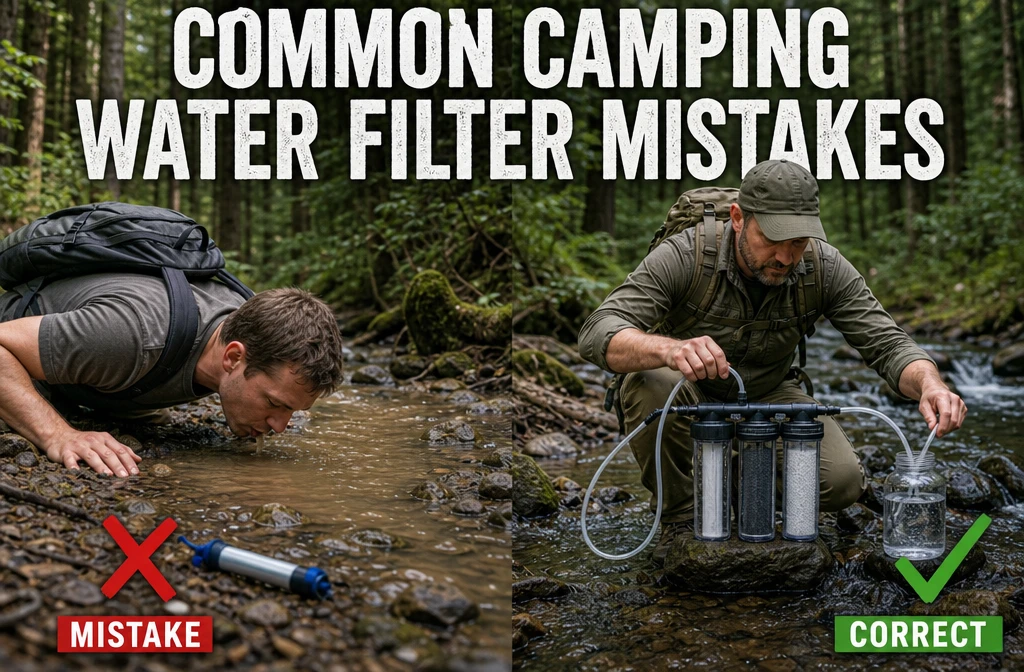
The single most common mistake is assuming that “filtered” means “safe to drink.” A filter removes what it’s rated for — nothing more. Most beginner-grade filters are rated for bacteria and protozoa (like Giardia and Cryptosporidium), but they leave viruses, heavy metals, and chemical contaminants completely untouched.
Here are the mistakes that show up most often in the field:
- Skipping pre-filtration on turbid water. Sediment, silt, and organic debris clog filter membranes fast. Running murky water straight through a hollow fiber filter without pre-filtering through a bandana or coffee filter dramatically shortens its lifespan and reduces effectiveness.
- Cross-contaminating the clean and dirty sides. Touching the output nozzle with dirty hands, or storing the filter in a bag where it contacts unfiltered water containers, reintroduces pathogens.
- Not backflushing after each use. Hollow fiber filters need to be backflushed regularly to maintain flow rate and remove trapped debris.
- Letting the filter freeze. This is a critical and often overlooked error. A hollow fiber membrane that freezes and thaws may develop microscopic cracks invisible to the naked eye. That filter will feel like it’s working fine — and it won’t be.
- Using a filter past its rated capacity without tracking usage. Most beginners have no idea how many liters they’ve pushed through their filter.
- Relying on a single method. In a real survival scenario, redundancy matters. One filter, no backup, is a single point of failure.
For a broader look at how water mistakes compound in emergencies, see The Worst Water Storage Mistakes Preppers Still Make.
Can You Get Sick Even After Using a Water Filter?
Yes — and this surprises a lot of beginners. Using a filter doesn’t guarantee safe drinking water, especially if the filter isn’t rated for the specific threat in your water source.
The main reasons people still get sick after filtering:
- Viruses aren’t removed by most mechanical filters. Hepatitis A, norovirus, and rotavirus pass straight through hollow fiber membranes. In North America, viral contamination in backcountry water is relatively rare, but in international travel or post-disaster scenarios, it’s a serious risk.
- The filter was damaged (frozen, dropped, or past its service life).
- Recontamination happened after filtration — dirty hands on a clean water bottle, shared containers, or improper storage.
- The water source contained chemical or heavy metal contamination that no standard filter addresses.
💬 “A filter is a tool with specific capabilities. Knowing what those capabilities are — and where they end — is the most important thing a beginner can learn.”
If you’re preparing for scenarios where water source quality is unknown, always combine mechanical filtration with a chemical treatment step (iodine tablets, chlorine drops, or a UV purifier) for full-spectrum protection.
How Do I Know If My Water Filter Is Actually Working?
There’s no simple field test that confirms a filter is performing at rated spec. That’s exactly why prevention — proper maintenance, tracking usage, and avoiding freeze damage — matters more than trying to test after the fact.
Signs your filter may be compromised:
- Flow rate has dropped significantly even after backflushing
- The filter has been frozen and thawed (assume it’s compromised)
- You’ve exceeded the manufacturer’s rated liter capacity
- The filter was dropped hard on a rock or concrete surface
- Output water has a noticeably different taste or smell than expected
What you can do:
- Keep a small logbook or mark your filter with a permanent marker each time you reach 100 liters. Most quality filters are rated between 500 and 4,000 liters.
- If you’re unsure, treat filtered water with a purification tablet as a secondary measure.
- Replace filters on a schedule, not just when they stop working.
How Often Should You Replace Your Water Filter Cartridge?
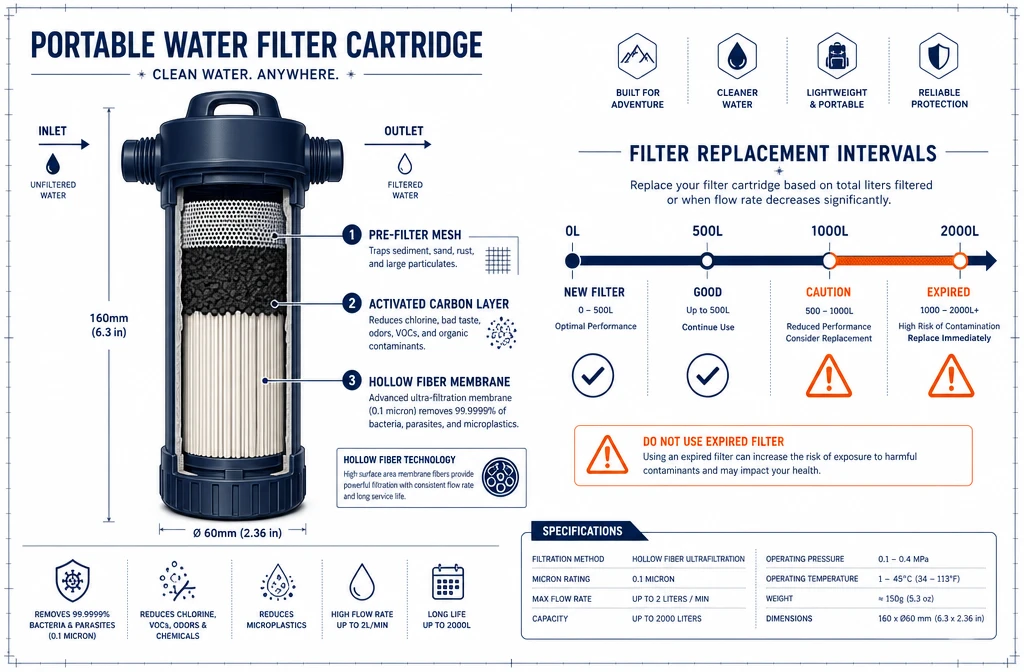
Replacement frequency depends on the filter type, the water quality being filtered, and actual usage volume — not calendar time alone.
| Filter Type | Typical Rated Capacity | Replacement Trigger |
|---|---|---|
| Hollow fiber squeeze filter | 1,000–4,000 liters | Capacity reached, freeze damage, or slow flow |
| Pump filter cartridge | 500–2,000 liters | Capacity or pump resistance increase |
| Activated carbon filter | 300–1,000 liters | Capacity or taste/odor change |
| UV purifier bulb | 5,000–10,000 uses | Battery failure or bulb burnout |
| Ceramic filter | 10,000+ liters | Cracking, chipping, or flow restriction |
Practical rule: Replace earlier than the rated maximum if you’ve been filtering heavily silted or turbid water. Dirty water burns through filter life faster than clean mountain stream water.
For beginners building out their first water preparedness kit, the Ultimate Emergency Water Storage and Purification Guide covers the full system — not just filtration.
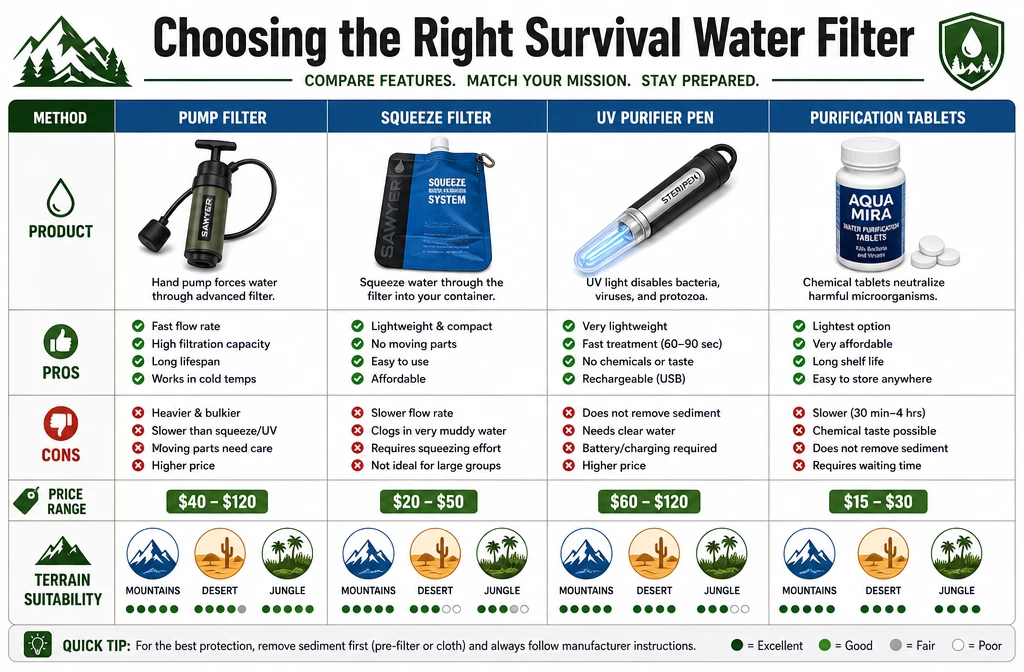
What’s the Difference Between Water Purification Tablets and Filters?
Filters and purification tablets solve overlapping but different problems. Understanding the distinction is one of the core survival water filtering mistakes beginners make when they assume one method covers everything.
Mechanical filters (hollow fiber, ceramic, pump):
- Remove bacteria, protozoa, and sediment
- Do NOT remove viruses (unless specifically rated as a purifier)
- Produce water immediately — no wait time
- Require maintenance and have a finite lifespan
Purification tablets (iodine, chlorine dioxide, sodium hypochlorite):
- Kill bacteria, protozoa, AND viruses
- Cannot remove sediment, heavy metals, or chemicals
- Require 30 minutes to 4 hours of contact time depending on the product
- Lightweight, cheap, and have a long shelf life — excellent as a backup
The smart approach: Use a mechanical filter first to remove sediment and biological threats, then add a purification tablet or UV treatment to neutralize viruses. This layered method covers nearly every field scenario.
Choose tablets if: You’re traveling internationally, operating in post-disaster urban environments, or your primary filter is unavailable. Choose a filter if: You need high-volume water processing, you’re in North American backcountry, or you need to avoid chemical taste.
What Water Sources Are Still Dangerous Even With a Filter?
Some water sources contain threats that standard portable filters simply cannot address. This is one of the survival water filtering mistakes beginners make that carries the highest risk — because the water looks filtered and “safe.”
Sources that remain dangerous even after mechanical filtration:
- Agricultural runoff areas: Contain pesticides, herbicides, and nitrates. No standard field filter removes these.
- Mining sites and industrial areas: Heavy metals like arsenic, lead, and mercury pass through hollow fiber membranes.
- Stagnant water with algal blooms: Cyanobacteria (blue-green algae) produce toxins that most portable filters don’t remove. Activated carbon helps but doesn’t fully eliminate the risk.
- Post-industrial flood water: Combines sewage, chemicals, fuel, and biological contamination in concentrations that overwhelm standard filters.
- Water near animal carcasses or heavy animal traffic: High pathogen load that may exceed filter capacity quickly.
Decision rule: If the water source is near farmland, industrial sites, or shows visible algae, don’t rely on a standard mechanical filter alone. Either find a different source or treat with activated carbon filtration combined with chemical purification — and even then, consider that source a last resort.
Which Water Filters Are Worst for Backpacking, and Are Expensive Filters Always Better?
Not all portable filters are created equal, and price is not a reliable indicator of performance for your specific use case. This is a survival water filtering mistake beginners make when they either buy the cheapest option available or assume a higher price tag equals better protection.
Filters that tend to underperform for backpacking:
- Straw-style filters with no storage capacity: Fine for personal use but useless for group water processing or filling containers for camp use.
- Pump filters with fragile plastic components: Heavy, slow, and prone to mechanical failure in cold weather.
- Pitcher-style gravity filters: Designed for home use, not field carry. Too bulky and slow for emergency scenarios.
The price vs. performance reality:
A $20–$30 hollow fiber squeeze filter (like the Sawyer Squeeze) consistently outperforms $80–$100 pump filters in field conditions for solo backpackers. The squeeze filter is lighter, faster, and has a higher rated capacity. However, a $15 straw filter is a poor choice for a family of four in a bug-out scenario where volume matters.
| Budget Range | Best Use Case | Limitation |
|---|---|---|
| Under $25 | Solo day hike, backup filter | Low volume, no virus protection |
| $25–$60 | Backpacking, bug-out bag | Still no virus protection (most) |
| $60–$120 | Group use, international travel | Weight, bulk, or chemical taste |
| $120+ | Long-term base camp, off-grid | Overkill for short scenarios |
For anyone building out a bug-out bag for beginners, a mid-range hollow fiber filter combined with a small pack of chlorine dioxide tablets covers most scenarios without breaking the budget.
Do Water Filters Work the Same in Different Climates?
No — and this is one of the most underappreciated survival water filtering mistakes beginners make. Climate directly affects filter performance, lifespan, and safety.
Cold climates:
- Hollow fiber membranes crack when frozen. Even a single freeze-thaw cycle can render a filter unsafe without any visible damage.
- Flow rate slows significantly in near-freezing temperatures.
- Fix: Store your filter against your body in cold weather. Sleep with it in your sleeping bag. Never leave it in an outer pack pocket overnight in freezing conditions.
Hot and arid climates:
- High sediment loads in desert water sources clog filters faster.
- UV purifiers work well here since sunlight is abundant and water temperatures are higher (which improves chemical purification effectiveness).
- Fix: Pre-filter aggressively through multiple layers of cloth before running water through your main filter.
Tropical and humid climates:
- High biological contamination in surface water, including viruses.
- Filter membranes can develop mold if stored wet in humid conditions.
- Fix: Dry your filter thoroughly after each use. Use a purifier (UV or chemical) in addition to mechanical filtration.
What Survival Water Filter Is Best for Beginners, and Can Kids Use Them Safely?
For most beginners, a hollow fiber squeeze filter is the best starting point. It’s lightweight, affordable, easy to use, has a high rated capacity, and requires minimal maintenance. The Sawyer Squeeze and similar products are widely available and well-documented in field conditions.
For beginners, prioritize these features:
- Simple operation (no pumping, no complex assembly)
- Clear capacity rating (look for 1,000+ liters)
- Ability to backflush to extend life
- Compatibility with standard water bottles and hydration bladders
Can kids use survival water filters?
Children can drink water filtered through standard portable filters, but the filtration process itself (squeezing, pumping, or sucking through a straw) may be physically difficult for younger children. More importantly, children are more vulnerable to waterborne illness than healthy adults — their immune systems are less developed, and the consequences of contamination (dehydration from diarrhea, for example) escalate faster.
Practical guidance for families:
- Filter and purify water for children using the adult’s filter, then transfer to the child’s container.
- Always add a chemical purification step when filtering water for children under 12 in uncertain conditions.
- Teach older children (12+) how to use the filter correctly — it’s a core wilderness survival skill worth practicing before it’s needed.
How Do Professional Hikers and Preppers Choose Their Water Filtration System?
Experienced survivalists and professional hikers don’t pick a single filter and call it done. They build a layered system based on the specific threats in their operating environment, their group size, and their weight budget.
The decision framework they use:
- Identify the threat profile. North American backcountry? Bacteria and protozoa are the primary concern. International travel or post-disaster urban environment? Add viruses to the list.
- Match the filter to the scenario. Solo bug-out: lightweight squeeze filter. Family group: gravity filter with high volume capacity. International or post-disaster: UV purifier or chemical treatment added to any mechanical filter.
- Build redundancy. Every serious prepper carries at least two methods. A primary filter plus purification tablets weighs almost nothing and covers scenarios where the primary fails.
- Account for terrain and climate. As covered above, cold weather demands a freeze-resistant strategy. Desert terrain demands pre-filtration capacity.
- Practice before it matters. The time to learn how to backflush a filter, read flow rate, and identify contamination signs is at home — not in the field.
This same layered thinking applies across all preparedness planning. Just as you wouldn’t rely on a single food source, you shouldn’t rely on a single water treatment method. The 14 Essential Survival Skills Every Prepper Must Know reinforces this principle across every critical category.
A Quick Checklist: Avoiding the Survival Water Filtering Mistakes Beginners Make
Before you head into the field or pack your emergency kit, run through this:
- Filter is rated for bacteria AND protozoa (minimum)
- Chemical purification backup (tablets or drops) is packed
- Filter has not been frozen since last use
- Usage volume has been tracked against rated capacity
- Pre-filter material (bandana, coffee filter) is available for turbid water
- Clean and dirty water containers are clearly labeled and separated
- Filter has been backflushed and stored dry since last use
- Water source has been assessed for chemical or industrial contamination risk
- Group members (including children) have a clear water handling protocol
- Replacement cartridge or backup filter is available for extended scenarios
Frequently Asked Questions
Q: Does boiling water make a filter unnecessary? Boiling water for one minute (three minutes above 6,500 feet elevation) kills all biological pathogens including viruses. It doesn’t remove sediment, heavy metals, or chemicals. In a scenario where fuel is available, boiling is one of the most reliable purification methods — but it doesn’t replace filtration for clarity and chemical removal.
Q: Can I use a survival water filter for tap water during a boil advisory? Yes, most hollow fiber filters will remove bacteria and protozoa from tap water. However, if the advisory is due to viral contamination, add a chemical treatment step. If it’s due to chemical contamination (like a main break near industrial sites), a standard field filter won’t help — use bottled water.
Q: How long can I store a water filter in my emergency kit without using it? Most hollow fiber filters have an indefinite shelf life when stored dry and away from freezing temperatures. Chemical purification tablets typically expire in 2–5 years (check packaging). UV purifier batteries degrade over time. Check all components annually.
Q: Is a LifeStraw good enough for a bug-out bag? A LifeStraw is a solid backup or secondary filter, but it has limitations as a primary system: you can’t fill containers with it, it has no storage capacity, and it doesn’t remove viruses. For a bug-out bag, a squeeze-style filter with a wide-mouth bottle is more versatile.
Q: Can I filter saltwater with a portable survival filter? No. Standard portable filters do not remove salt. Desalination requires either a reverse osmosis system or a solar still. Drinking filtered saltwater will accelerate dehydration and can be fatal.
Q: What’s the fastest way to get clean water in a survival emergency with no gear? Boiling is the fastest reliable method if you have a container and fire. If you have no gear at all, solar disinfection (SODIS) — filling a clear plastic bottle and leaving it in direct sunlight for 6+ hours — kills most biological pathogens, though it’s a last resort.
Q: Do I need a different filter for well water versus stream water? Well water may contain heavy metals, nitrates, or chemical contamination that stream water doesn’t, depending on location. A standard hollow fiber filter handles biological threats in both but won’t address chemical contamination in either. If you’re relying on a private well during an emergency, test it for chemical contamination when possible.
Q: Is it safe to share a water filter straw between multiple people? Sharing a straw filter between people creates cross-contamination risk. Squeeze filters that output into a clean container are safer for group use. Gravity filters are the best choice for groups because they process volume without contact.
Q: What’s the minimum water volume I should plan for per person per day in a survival scenario? A general planning estimate is one gallon (approximately 3.8 liters) per person per day for drinking and basic sanitation. In hot climates or high-exertion scenarios, that figure should be higher. Children, pregnant women, and individuals with medical conditions may need more.
Q: Can a water filter remove radiation from water? Standard portable filters do not remove radioactive particles or dissolved radioactive ions. Activated carbon can reduce some radioactive contaminants but is not a reliable solution. In a radiological emergency, use bottled water from sealed containers stored before the event.
Products, Tools, and Resources Worth Knowing
These aren’t paid endorsements — they’re the categories and tools that consistently come up in serious preparedness communities as reliable starting points.
For most beginners: A hollow fiber squeeze filter(Sawyer Squeeze or similar) is the most practical first purchase. Lightweight, affordable, high capacity, and easy to use. Pair it with a pack of chlorine dioxide tablets (Aquatabs or Katadyn Micropur) for virus coverage and backup.
For family or group use: A gravity-fed hollow fiber filter (Platypus GravityWorks or similar) handles volume without effort. Fill the dirty bag, hang it, and let gravity do the work. No pumping, no squeezing — practical when you’re managing water for multiple people.
For international travel or post-disaster scenarios: A UV purifier pen (SteriPen or similar) kills viruses, bacteria, and protozoa in about 90 seconds. It doesn’t filter sediment, so use it after mechanical filtration. Keep a backup set of batteries or choose a USB-rechargeable model.
For long-term base camp or off-grid living: A ceramic gravity filter(Berkey-style or similar) handles high volume, removes a broad spectrum of contaminants, and has an extremely long filter lifespan. Heavy and not portable, but excellent for stationary use. If you’re building out a homestead or off-grid setup, this category is worth the investment.
For your emergency kit reference: The Ultimate Emergency Water Storage and Purification Guide covers storage volumes, container types, and purification methods in detail. The Essential Survival Gear Guide ranks water filtration alongside other critical gear categories by priority.
Conclusion: Stop Assuming Your Filter Covers Everything
The survival water filtering mistakes beginners make almost always come down to one root cause: overconfidence in a single tool. A filter is not a guarantee. It’s a layer of protection — one that works best when combined with source selection, pre-filtration, chemical backup, proper maintenance, and an understanding of what the filter actually does and doesn’t remove.
Water is the one resource you cannot improvise your way around in a survival scenario. You can forage food. You can build shelter. You cannot go more than three days without water, and getting it wrong doesn’t just make you uncomfortable — it can end your ability to function entirely.
Actionable next steps:
- Audit your current filter: check its rated capacity, when it was last used, and whether it’s been frozen.
- Add a chemical purification backup if you don’t already have one.
- Practice your filtration system at home before you need it in the field.
- Read up on water storage mistakes to make sure your stored supply is as solid as your filtration plan.
- If you’re building out a full preparedness system, start with the Prepper Checklist for Beginners to make sure water is integrated into your broader plan — not treated as an afterthought.
Being prepared isn’t about fear. It’s about knowing exactly what your gear does, practicing it before it matters, and never putting your family’s safety in the hands of a single point of failure.
References
- Centers for Disease Control and Prevention (CDC). Water Treatment Methods for Backcountry and Travel Use. U.S. Department of Health & Human Services. https://www.cdc.gov/healthywater/drinking/travel/backcountry_water_treatment.html (accessed 2024)
- U.S. Environmental Protection Agency (EPA). Guide Standard and Protocol for Testing Microbiological Water Purifiers. EPA. https://www.epa.gov/sites/default/files/2018-09/documents/guide-microbiological-water-purifiers.pdf (published 1987, referenced standard remains in use)
- World Health Organization (WHO). Guidelines for Drinking-Water Quality, 4th Edition. WHO Press, 2011. https://www.who.int/publications/i/item/9789241548151
- NSF International. NSF/ANSI 42 and 53 Standards for Drinking Water Treatment Units. https://www.nsf.org/consumer-resources/articles/water-filter-standards (accessed 2024)
- Wilderness Medical Society. Wilderness Medical Society Practice Guidelines for Water Disinfection for Backcountry Use. Wilderness & Environmental Medicine, 2020.