
Hey there! Some links on this page may be affiliate links which means that, if you choose to make a purchase, I may earn a commission at no extra cost to you. I greatly appreciate your support. Read the full disclosure here.
Key Takeaways
- Correct plant identification is a non-negotiable survival skill, misidentification can be fatal, so always confirm at least three identifying features before eating anything.
- The most forager-friendly edible plants include dandelion, plantain, chickweed, wood sorrel, and cattail, all of which grow across North America and much of the world.
- Edible and toxic plants often look nearly identical, wild garlic and lily of the valley, for example, share similar leaves but one can kill you.
- Foraging varies significantly by season: spring and summer offer the most variety, while fall and winter require knowledge of roots, nuts, and bark.
- A quality printed field guide specific to your region is more reliable in the field than any app, carry both if possible.
- The universal edibility test is a last-resort method for unknown plants; it does not replace proper identification training.
- Urban and suburban environments contain many edible plants, but contamination from pesticides and pollution is a real concern.
- Preservation methods like drying, fermenting, and canning extend the shelf life of foraged plants significantly.
- Foraging is a complement to, not a replacement for, a well-stocked emergency food supply.
- Building plant identification skills takes time, start with five species and master them before expanding your knowledge base.
What Is a Bushcraft Foraging Edible Plants Identification Guide and Who Needs One?
A bushcraft foraging edible plants identification guide is a practical reference system, whether printed, digital, or memorized, that teaches you to locate, identify, and safely harvest wild plants for food. It is most valuable for survivalists, preppers, hikers, homesteaders, and anyone who wants to reduce dependence on supply chains for food security.
For preppers specifically, foraging knowledge is a force multiplier. It means that even if your 3-month emergency food supply runs low, you have a living, renewable food source available in the field. It also integrates directly with broader bushcraft skills for beginners, making you more capable and confident in any wilderness or grid-down scenario.
Who benefits most:
- Preppers building long-term food independence
- Bug-out planners who need to sustain themselves in transit
- Homesteaders supplementing garden production
- Wilderness survivalists who may face extended time in the field
What Are the Most Common Edible Plants to Forage in the Wild?
The most commonly foraged edible wild plants in North America are dandelion, broadleaf plantain, chickweed, wood sorrel, cattail, lamb’s quarters, purslane, and stinging nettle. These species grow across a wide range of climates and habitats, making them the best starting point for any beginner.
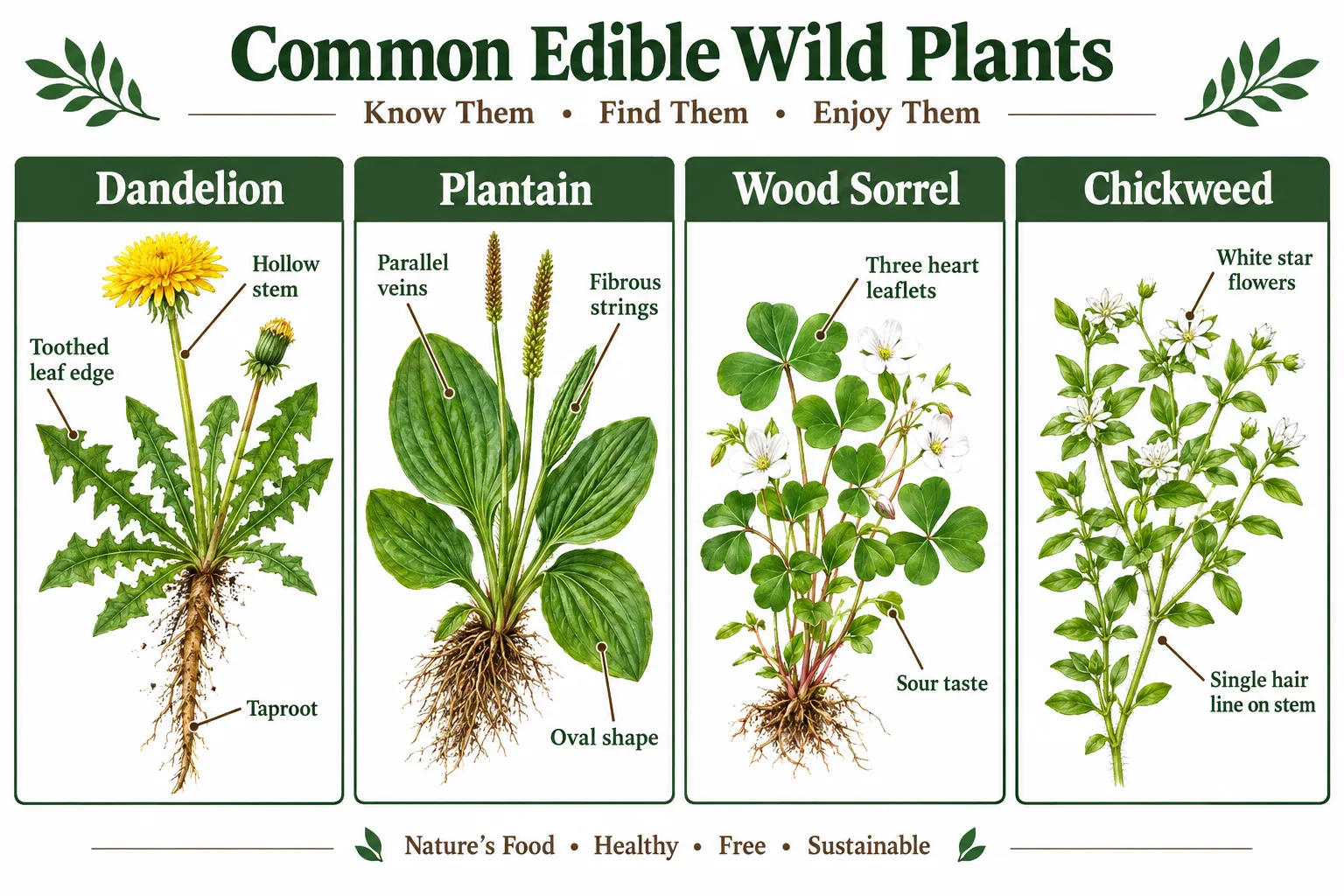
Here is a quick-reference overview of the most reliable beginner plants:
| Plant | Edible Parts | Habitat | Identifying Feature |
|---|---|---|---|
| Dandelion | Leaves, root, flower | Lawns, fields | Toothed leaves, hollow stem, yellow flower |
| Broadleaf Plantain | Leaves, seeds | Disturbed soil, paths | Parallel veins, fibrous strings when torn |
| Chickweed | Whole plant | Moist shaded areas | Single line of hair on stem |
| Wood Sorrel | Leaves, pods | Forest edges | Three heart-shaped leaflets, sour taste |
| Cattail | Shoots, pollen, roots | Wetlands | Brown sausage-shaped head |
| Lamb’s Quarters | Leaves | Gardens, disturbed ground | White powdery coating on young leaves |
| Stinging Nettle | Leaves (cooked) | Moist woodland edges | Fine stinging hairs on stems and leaves |
| Purslane | Whole plant | Gardens, cracks in pavement | Thick succulent leaves, reddish stems |
Practical rule: Start with dandelion and plantain. Both are nearly impossible to misidentify, grow almost everywhere, and are nutritionally valuable. Master these two before moving on.
For a deeper dive into getting started, see the foraging edible wild plants for beginners guide.
How Do You Identify Poisonous Plants vs Edible Ones When Foraging?
The core principle is this: never rely on a single identifying feature. Toxic plants frequently share one or two characteristics with edible ones, so you must confirm at least three distinct features, leaf shape, stem structure, smell, flower type, and habitat, before consuming anything.
The most dangerous identification errors happen when foragers:
- Rely on color alone (many toxic berries are red, but so are edible ones)
- Identify by leaf shape without checking stem, smell, or habitat
- Use a photo match from a phone app without cross-referencing a field guide
- Assume that because an animal ate it, it is safe for humans
Key differentiation techniques:
- Smell test: Wild garlic smells strongly of garlic. Lily of the valley, which looks similar, has no garlic scent. If it doesn’t smell like garlic, don’t eat it.
- Stem cross-section: Queen Anne’s lace (edible) has a hairy stem and smells of carrot. Poison hemlock has smooth, purple-blotched stems and no carrot smell.
- Leaf attachment: Note whether leaves are opposite or alternate on the stem, this rules out many lookalikes.
- Habitat context: Elderberries grow in open woodland edges. Pokeweed, which is toxic, tends to grow in disturbed soil near buildings.
For a comprehensive breakdown of dangerous lookalikes, the avoid poisonous plants guide is essential reading before you head into the field.
Best Edible Plants to Forage by Season
Foraging is not a year-round constant, it shifts dramatically with the seasons, and knowing what to look for when is one of the most practical skills in any bushcraft foraging edible plants identification guide.
Spring (March to May)
Spring is the most productive season for green leafy plants. Look for:
- Dandelion greens (most tender before flowering)
- Stinging nettle tops (harvest with gloves, cook to neutralize sting)
- Chickweed (thrives in cool, moist conditions)
- Ramps (wild garlic/onion, found in forest floors)
- Fiddlehead ferns (harvest tightly coiled, before they unfurl)
Summer (June to August)
- Wood sorrel and lamb’s quarters peak in early summer
- Berries: serviceberries, wild strawberries, blackberries
- Purslane thrives in heat
- Cattail pollen (bright yellow, available in early summer) can be used as flour
Fall (September to November)
- Acorns (require leaching of tannins before eating)
- Hickory nuts, walnuts, hazelnuts
- Rosehips (high in vitamin C, excellent for tea)
- Roots: burdock, chicory, Jerusalem artichoke
Winter (December to February)
- Pine needles (vitamin C tea)
- Inner bark of certain trees (pine, birch) as emergency calories
- Dried berries still on branches
- Roots of cattail and burdock remain accessible under snow
Decision rule: If it’s winter and you’re in a survival scenario, prioritize calorie-dense roots and nuts over leafy greens. Volume of greens won’t sustain energy output in cold conditions.
What’s the Difference Between Foraging and Wildcrafting?
Foraging refers specifically to gathering wild plants (and sometimes fungi) for food. Wildcrafting is a broader practice that includes harvesting wild plants for medicinal, spiritual, or craft purposes, not just eating. For preppers, the distinction matters because wildcrafting expands your plant knowledge to include medicinal herbs like yarrow, plantain poultices, and pine resin for wound care.
Both skills overlap significantly, and learning wildcrafting alongside foraging makes you more capable in a long-term survival situation where medical supplies may be unavailable.
How to Safely Identify Wild Mushrooms for Eating
Wild mushroom identification is a separate and more advanced discipline than plant foraging. Mushrooms have no botanical relationship to plants, and several deadly species, particularly Amanita phalloides (death cap) and Amanita ocreata (destroying angel), closely resemble edible varieties.
Safe mushroom identification requires:
- Learning spore prints (color of spore deposit on paper)
- Checking gill attachment to the stem
- Noting the presence or absence of a volva (cup at the base)
- Confirming habitat and host tree species
- Cross-referencing at least two regional field guides
Beginner-safe mushrooms (high confidence, few dangerous lookalikes):
- Giant puffball (Calvatia gigantea), edible when pure white inside
- Chicken of the woods (Laetiporus sulphureus), bright orange shelf fungus
- Chanterelle, golden, wavy cap, forked ridges (not true gills)
- Morel, distinctive honeycomb cap, hollow stem
Hard rule: Never eat a wild mushroom unless you are 100% certain of the identification. “Pretty sure” is not good enough with mushrooms.
Edible Plants That Look Like Poisonous Ones: Common Mistakes
This is where the bushcraft foraging edible plants identification guide becomes most critical, and where mistakes turn fatal. Several common edible plants have toxic lookalikes that grow in the same habitats.
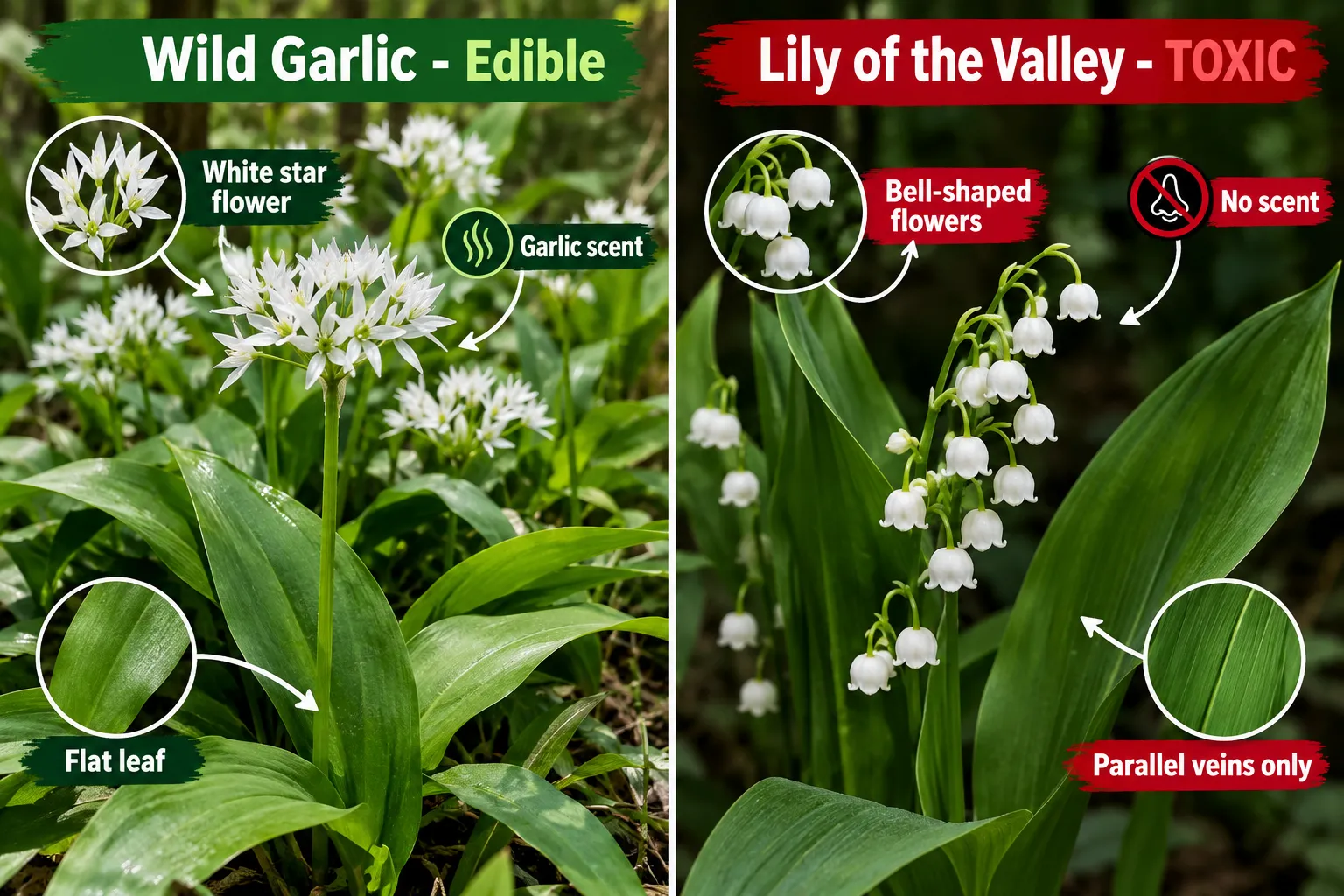
The most dangerous lookalike pairs:
- Wild carrot vs. Poison hemlock: Both have white umbrella-shaped flower clusters. Hemlock has smooth, purple-blotched stems and a musty smell. Wild carrot has hairy stems and smells of carrot.
- Wild garlic vs. Lily of the valley: Wild garlic has a strong garlic scent. Lily of the valley has no scent and bell-shaped flowers. Eating lily of the valley can cause fatal cardiac arrhythmia.
- Elderberry vs. Pokeweed: Elderberries grow in clusters on woody shrubs. Pokeweed has a thick purple-red stem and grows much taller. Pokeweed is toxic.
- Wild strawberry vs. Mock strawberry: Mock strawberry is not toxic, but it is flavorless. The real danger is confusing wild strawberry with white snakeroot, which grows nearby and is highly toxic.
Common beginner mistakes:
- Harvesting from contaminated areas (roadsides, industrial zones, treated lawns)
- Picking from a single photo match without confirming multiple features
- Assuming that a plant is safe because it grows near edible species
- Tasting unknown berries to “test” them
Can You Eat Plants You Find Without Cooking Them First?
Many edible wild plants can be eaten raw, but some require cooking to be safe or palatable. Stinging nettle must be cooked or dried to neutralize the formic acid in its hairs. Elderberries are mildly toxic raw and should be cooked. Acorns require leaching in water to remove bitter tannins before eating.
Generally safe raw:
- Dandelion leaves and flowers
- Wood sorrel
- Chickweed
- Purslane
- Wild strawberries, blackberries, serviceberries
Require processing:
- Stinging nettle (cook or dry)
- Elderberries (cook)
- Acorns (leach tannins in water, then dry or roast)
- Fiddlehead ferns (blanch or cook thoroughly)
- Cattail roots (roast or boil)
Universal Edibility Test (last resort only): If you cannot identify a plant and face starvation, the military universal edibility test involves a multi-hour process of testing small amounts on skin, lips, and then consuming a tiny amount while monitoring for reaction over several hours. This is a last resort, not a standard practice.
What Tools Do You Need for Foraging Edible Plants?
A functional foraging kit doesn’t need to be expensive or heavy. The essentials are a regional field guide, a knife, and a collection bag. Everything else improves efficiency and safety.
Core foraging kit:
- Regional field guide (printed, waterproof preferred), the single most important tool
- Fixed-blade or folding knife for harvesting roots and stems
- Mesh or cloth bag (allows spores to disperse, keeps plants fresh)
- Gloves for handling nettles and unknown plants
- Trowel or digging stick for root harvest
- Magnifying glass for examining small features like stem hairs and leaf veins
Optional but valuable:
- A foraging app as a secondary reference (never primary)
- Small notebook for recording finds and locations
- Camera for documentation
This kit pairs naturally with broader essential survival gear that preppers should already carry in a bug-out scenario.
Best Foraging Apps and Field Guides for Plant Identification
No single app is reliable enough to be your only identification tool. Apps like iNaturalist, PictureThis, and PlantNet use AI image recognition and are useful for narrowing down possibilities, but they make errors, sometimes dangerous ones.
Recommended printed field guides:
- Peterson Field Guide to Edible Wild Plants (Eastern/Central North America), Lee Allen Peterson
- Edible Wild Plants: Wild Foods from Dirt to Plate, John Kallas
- A Field Guide to Western Edible Wild Plants, Lee Allen Peterson
- Foraging the Mountain West, Thomas J. Elpel and Kris Reed (region-specific)
Best apps as secondary tools:
- iNaturalist, community-verified identifications, most accurate
- PlantNet, strong botanical database, good for cross-referencing
- PictureThis, beginner-friendly but less precise
Rule: Always cross-reference an app result with a printed field guide before eating anything. Apps cannot smell a plant, feel its stem texture, or check its habitat context the way you can.
Are There Edible Plants That Grow in Urban Areas?
Yes, and in significant variety. Urban environments are surprisingly productive foraging grounds, with dandelion, plantain, wood sorrel, purslane, lamb’s quarters, and chickweed growing in sidewalk cracks, parks, vacant lots, and garden beds across most cities.
The primary concern in urban foraging is contamination. Plants growing near roads absorb heavy metals from vehicle exhaust. Plants in parks or on lawns may have been treated with herbicides or pesticides. Plants near industrial sites can absorb soil contaminants.
Urban foraging safety rules:
- Avoid harvesting within 50 feet of a busy road
- Do not forage from obviously maintained (sprayed) lawns or parks
- Wash all foraged plants thoroughly before eating
- Prefer elevated planters, community gardens, and unmaintained green spaces
For a full breakdown of what grows where in cities, the urban foraging guide covers this topic in detail. You may also be surprised by what grows in your own yard, the backyard edible weeds guide is a practical starting point.
What Should You Never Forage Even If It Looks Edible?
Some plants are so dangerous, and their lookalikes so common, that most experienced foragers recommend avoiding them entirely until you have advanced training.
Plants to avoid without expert-level training:
- Water hemlock (Cicuta species), considered the most violently toxic plant in North America; looks like wild parsnip or water parsley
- Poison hemlock (Conium maculatum), resembles wild carrot and Queen Anne’s lace
- White snakeroot (Ageratina altissima), caused the “milk sickness” that killed Abraham Lincoln’s mother; looks like several edible plants
- Monkshood/Wolfsbane (Aconitum species), all parts are toxic; resembles edible wild parsley relatives
- Datura/Jimsonweed, highly toxic, sometimes mistaken for edible nightshade relatives
General avoidance rules:
- Avoid any plant with milky white sap (many are toxic)
- Avoid umbrella-shaped (Apiaceae family) white flower clusters unless you are certain of the species
- Avoid any berry you cannot positively identify, “red berries” is not an identification
How Much Do You Need to Know About Botany to Forage Safely?
You do not need a botany degree to forage safely, but you do need to understand a handful of core botanical concepts. Knowing how to read a plant’s structure, leaf arrangement, stem cross-section, flower type, and root form, is the foundation of reliable identification.
Minimum botanical knowledge for safe foraging:
- Leaf arrangement: opposite vs. alternate vs. whorled
- Leaf shape terminology: lanceolate, ovate, lobed, toothed
- Stem cross-section: round vs. square vs. hollow
- Flower structure: number of petals, symmetry, cluster type
- Plant families: knowing that the carrot family (Apiaceae) contains both edible and deadly species is more useful than memorizing individual species
Practical approach for beginners: Start with five species that are unmistakable and common in your region. Learn them across all seasons, seedling, mature plant, flower, and seed stage. Then add five more. This incremental approach builds genuine confidence rather than dangerous overconfidence.
The foraging and gardening for emergency food guide provides a solid framework for integrating this knowledge into your overall food preparedness strategy.
How to Preserve Foraged Plants and Store Them
Fresh foraged plants are perishable, but most can be preserved using methods that require minimal equipment, an important advantage in off-grid or emergency scenarios.
Preservation methods by plant type:
- Drying/dehydrating: Works well for leafy greens (nettle, plantain, lamb’s quarters), berries, and roots. Air-dry in a warm, ventilated space or use a dehydrator. Dried plants store for 6-12 months in airtight containers.
- Fermenting: Nettles, dandelion greens, and many wild plants can be lacto-fermented like sauerkraut. This extends shelf life and increases nutrient bioavailability.
- Canning: Berries, fruit, and some root vegetables can be water-bath or pressure canned. See the beginner’s guide to canning for safe techniques.
- Freezing: Blanch leafy greens before freezing to preserve color and nutrients. Works well for nettles, lamb’s quarters, and berries.
- Infusing in oil or vinegar: Herbs like wild garlic, yarrow, and plantain can be preserved in oil or vinegar for culinary and medicinal use.
Storage tip: Always label preserved plants with species name and harvest date. Memory is unreliable over months, and mislabeled stores can cause problems.
FAQ
Do I need a foraging license or permit?
In most of the United States, foraging for personal use on public lands is legal in small quantities, but regulations vary by state, national forest, and park. Always check local rules before harvesting. Commercial harvesting almost always requires permits.
Is it safe to eat plants I find using only a phone app?
No. Apps are useful for narrowing down possibilities but are not reliable enough for sole identification. Always cross-reference with a printed regional field guide and confirm multiple identifying features.
What is the most dangerous foraging mistake beginners make?
Relying on a single identifying feature, usually leaf shape or color, without confirming smell, stem structure, habitat, and flower type. This is how experienced foragers end up in the emergency room.
Can children learn to forage safely?
Yes, with supervision and a structured approach. Start with unmistakable plants like dandelion and plantain. Teach the rule “never eat without asking an adult” from the beginning, and make identification a habit before tasting anything.
How long does it take to become a competent forager?
Most people can confidently identify 10-15 edible species in their region after one full year of practice across all seasons. True competence, knowing plants in all growth stages across multiple habitats, takes 2-3 years of consistent field time.
Are foraged plants nutritious enough to sustain survival?
Foraged plants alone are rarely sufficient for long-term caloric needs, but they provide critical micronutrients, vitamins, and fiber that supplement stored food. Stinging nettle, for example, is exceptionally high in iron, calcium, and vitamins A and C.
What should I do if I think I’ve eaten a toxic plant?
Call Poison Control immediately (in the US: 1-800-222-1222). Do not wait for symptoms. If possible, save a sample of the plant for identification. Do not induce vomiting unless specifically directed by a medical professional.
Can I forage after a wildfire or flood?
Use caution. Post-fire soil can contain elevated heavy metals and ash contaminants. Post-flood plants may have been exposed to sewage, agricultural runoff, or chemical contamination. Wait for soil testing or avoid those areas entirely.
Is foraging in winter actually worth it?
In a survival scenario, yes. Roots, nuts, pine needle tea, and inner bark provide calories and vitamin C when nothing else is available. In a non-emergency context, winter foraging is more effort than reward unless you know your target species well.
What’s the best first plant to learn to forage?
Dandelion. It grows on every continent except Antarctica, every part is edible, it has no truly dangerous lookalikes in North America, and it provides a meaningful nutritional contribution. Start there.
Conclusion: Build This Skill Before You Need It
The hard truth about foraging is that it cannot be learned during an emergency. The time to build a reliable bushcraft foraging edible plants identification guide knowledge base is now, before a grid-down event, before a bug-out scenario, before hunger makes desperation override caution.
Actionable next steps:
- Buy one printed regional field guide this week and read the first 30 pages.
- Go outside and find dandelion and broadleaf plantain. Confirm every identifying feature listed in this guide.
- Add five species to your knowledge base over the next three months, one at a time.
- Take a local foraging walk with an experienced guide at least once, in-person instruction accelerates learning faster than any book.
- Integrate foraging knowledge with your broader preparedness plan, including your bug out plan and long-term food storage strategy.
Foraging is not a backup plan. For serious preppers, it is a primary skill that turns any landscape into a potential food source. The wilderness doesn’t care about your supply chain, but it will feed you, if you know how to ask.
Products, Tools, and Resources
Field Guides Worth Owning:
- Peterson Field Guide to Edible Wild Plants, the gold standard for Eastern North America, widely available in waterproof editions
- Edible Wild Plants: Wild Foods from Dirt to Plate by John Kallas, excellent for understanding plant nutrition alongside identification
- Botany in a Day by Thomas J. Elpel, teaches plant family patterns rather than species-by-species memorization, a faster learning method
Tools:
- A quality fixed-blade knife with a 3-4 inch blade handles most foraging tasks; look for full-tang construction for durability
- Mesh foraging bags (sold by most outdoor retailers) allow seeds to disperse naturally and keep plants fresh longer than plastic bags
- A 10x hand lens (jeweler’s loupe) costs under $15 and reveals stem hairs, leaf veins, and other micro-features that confirm identification
Apps (secondary use only):
- iNaturalist (free), best community verification system available
- PlantNet (free), strong botanical database, good cross-reference tool
Courses:
- Many regional land trusts, nature centers, and foraging educators offer half-day and full-day identification walks. Search for certified ethnobotanists or Master Naturalist instructors in your area.
- Online courses from established foragers like Samuel Thayer or Sergei Boutenko provide structured learning with video identification, useful for off-season study.
Foraging knowledge, once built, never expires and weighs nothing in your pack. That makes it one of the highest-value investments any prepper can make.