
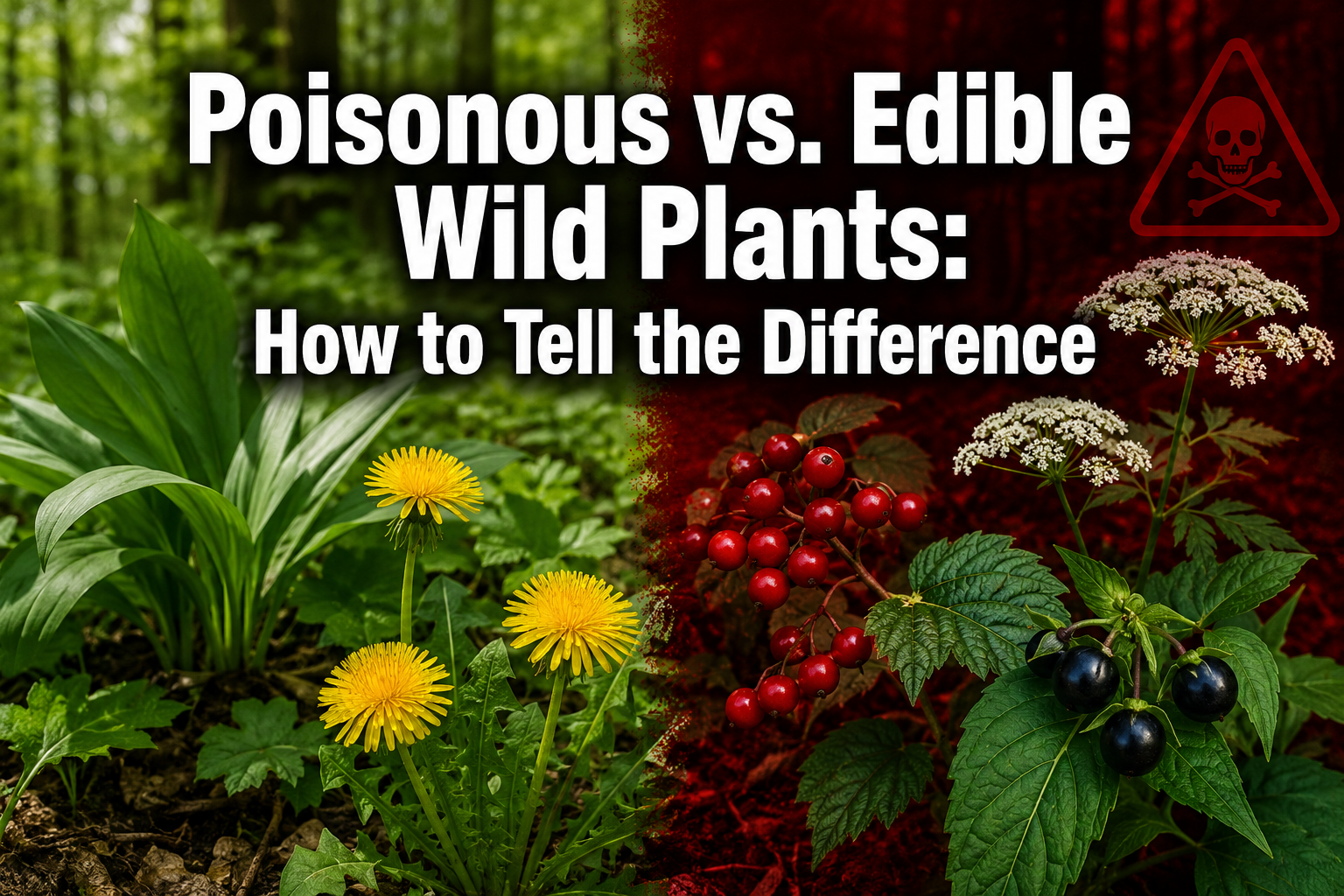
Hey there! Some links on this page may be affiliate links which means that, if you choose to make a purchase, I may earn a commission at no extra cost to you. I greatly appreciate your support. Read the full disclosure here.
Every year, poison control centers across the United States handle thousands of calls related to toxic plant ingestion, and a significant portion involve adults who thought they knew what they were eating. Plant identification errors are not just a beginner’s mistake. They happen to hikers, homesteaders, and even experienced foragers who move too fast or rely on a single identifying feature. Understanding the difference between poisonous and edible wild plants is one of the most consequential skills in any survival toolkit.
Key Takeaways
- Never rely on a single identifying feature. Confirm at least three or four distinct characteristics before consuming any wild plant.
- Several deadly plants closely mimic edible ones, including poison hemlock (which resembles wild carrot) and lily of the valley (which resembles wild garlic).
- The Universal Edibility Test is a last-resort field method, not a reliable identification shortcut.
- Mushrooms require a completely separate identification framework from flowering plants and should never be assessed using plant rules.
- Bitter taste is a useful warning sign, but many toxic plants taste mild or even pleasant.
- Regional knowledge matters, dangerous plants vary significantly by geography across North America.
- A quality field guide matched to your specific region is the single most important foraging tool you can own.
- Taking a hands-on foraging course dramatically reduces identification errors compared to self-study alone.
- In a genuine survival scenario, prioritizing water and shelter over plant foraging is the safer short-term strategy.
- If toxic plant ingestion is suspected, contact Poison Control (1-800-222-1222 in the US) immediately.
Find this useful? Add us as a preferred source on Google and more of what we publish will show up in your results.
What Are the Main Differences Between Poisonous and Edible Wild Plants?
There is no single physical trait that separates all toxic plants from all edible ones. The distinction lies in a combination of characteristics, leaf shape, stem structure, smell, habitat, berry color, and flower arrangement, that must be evaluated together, not in isolation.
Edible plants tend to have well-documented, consistent features that experienced foragers learn to recognize across seasons. Poisonous plants often (but not always) share some of those same features, which is exactly what makes misidentification dangerous.
Key differences to evaluate simultaneously:
- Leaf arrangement and shape: Alternate vs. opposite leaves, lobed vs. smooth edges, leaf texture
- Stem characteristics: Hollow vs. solid, hairy vs. smooth, color markings (poison hemlock has distinctive purple-red blotches)
- Smell: Crushed leaves of wild garlic smell strongly of garlic; lily of the valley does not
- Flower structure: Umbrella-shaped flower clusters (called umbels) appear on both edible wild carrot and deadly poison hemlock
- Berry color and cluster pattern: Red, white, and black berries each carry different risk profiles depending on species
- Habitat and season: Where a plant grows and when it appears are legitimate identification clues
The core principle of understanding poisonous vs. edible wild plants comes down to this: when in doubt, leave it out. No caloric value from a foraged plant is worth a life-threatening mistake.
Foraging Edible Wild Plants for Beginners: 25 Plants You Can Find Anywhere
Common Poisonous Plants That Look Like Edible Ones
This is where foraging becomes genuinely dangerous. Several of the most deadly plants in North America are near-perfect visual mimics of common edibles.
The most dangerous lookalike pairs:
| Edible Plant | Toxic Lookalike | Key Difference |
|---|---|---|
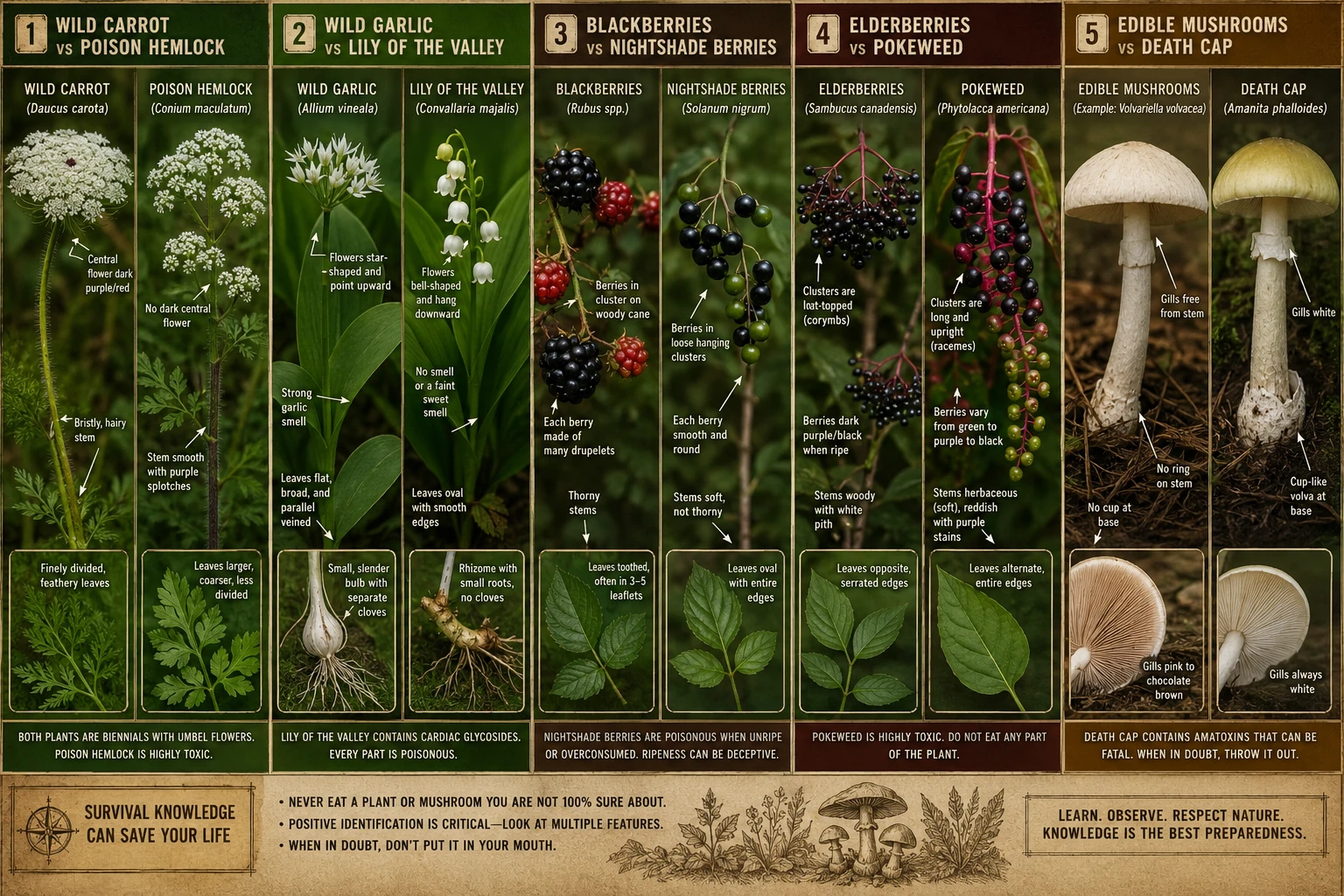
| Wild carrot (Queen Anne’s Lace) | Poison hemlock | Hemlock has purple blotches on stem; carrots smell like carrot when crushed |
| Wild garlic | Lily of the valley | Wild garlic smells strongly of garlic; lily of the valley has no smell |
| Elderberries | Pokeweed berries | Pokeweed has a thick magenta stem; elderberries grow on woody shrubs |
| Blackberries | Nightshade berries | Nightshade berries grow in small clusters on a non-thorny vine |
| Watercress | Water hemlock | Water hemlock has chambered roots; watercress does not |
| Wild onion | Death camas | Death camas has no onion smell whatsoever |
The death camas / wild onion confusion is particularly deadly because the rule is simple and reliable: if it doesn’t smell like onion, it is not an onion. Never eat a bulb that lacks that unmistakable allium scent.
Poison hemlock deserves special mention. It is responsible for a disproportionate share of serious foraging fatalities. The purple-blotched stem and the musty, unpleasant smell of crushed leaves are the two most reliable distinguishing features from wild carrot.
Are There Universal Rules for Telling Poisonous Plants Apart?
There are useful guidelines, but no single universal rule that works across all species. The idea that “bright red berries are always toxic” or “if an animal eats it, you can too” are dangerous myths that have caused real harm.
Guidelines that hold up most of the time:
- White or yellow berries are toxic in the vast majority of cases (with exceptions like white mulberry and snowberries in some contexts)
- Plants with milky or latex sap should be avoided unless positively identified as safe
- Umbrella-shaped flower clusters (umbels) include both edible species (wild carrot, angelica) and deadly ones (poison hemlock, water hemlock), never eat an umbel plant without full identification
- Bitter, burning, or numbing sensations in the mouth are warning signs
- Plants growing near industrial sites, roadsides, or contaminated water may be safe species but carry chemical contamination
The Universal Edibility Test, a field method involving skin contact, lip contact, and small taste tests over several hours, is a last-resort survival tool. It can identify acute irritants but will not protect against cumulative toxins or delayed-onset poisons like those in water hemlock. Use it only when no other option exists.
How Can You Identify Edible Wild Plants Safely?
Safe plant identification requires a systematic, multi-feature approach. Experienced foragers confirm at least three to four independent characteristics before consuming any wild plant, especially one they have not positively identified before.
A practical identification process:
- Start with a regional field guide. Use a guide specific to your geographic area, not a general North American overview.
- Identify the plant family first. Knowing a plant belongs to the carrot family (Apiaceae), for example, immediately raises caution flags.
- Check multiple features simultaneously: leaf shape and arrangement, stem structure, root appearance, flower type, smell, and habitat.
- Cross-reference with at least two sources. A field guide plus a verified plant identification app (like iNaturalist or PlantNet) is a reasonable baseline.
- Photograph the plant before harvesting. Document stem, leaves, flowers, and roots separately.
- Taste-test only after full visual confirmation. Take a tiny amount, wait 15 minutes, and watch for any reaction.
For preppers building their wilderness survival skills, plant identification belongs in the same category as fire-starting and water procurement, it takes real practice before it becomes reliable under stress.
Which Wild Plants Are Safest for Beginners to Forage?
Beginners should start with plants that have no dangerous lookalikes in their region. These species are visually distinctive, widely distributed, and well-documented.
Beginner-safe edible plants (North America):
- Dandelion (Taraxacum officinale): Entirely edible, leaves, flowers, and roots. No dangerous lookalike in North America.
- Cattail (Typha spp.): Found near water, highly distinctive, multiple edible parts depending on season.
- Lamb’s quarters (Chenopodium album): A common “weed” with distinctive powdery white coating on young leaves.
- Blackberries and raspberries: Thorny canes with distinctive fruit, just confirm you’re not on a nightshade vine.
- Clover (Trifolium spp.): Recognizable three-leaf structure, edible flowers and leaves.
- Plantain (Plantago major): The broad-leaved lawn weed, not the banana relative, parallel-veined leaves, grows in disturbed soil.
Avoid starting with any member of the carrot family (Apiaceae), any mushroom, or any plant with white berries until you have solid field experience and proper training.
What’s the Difference Between Toxic and Edible Mushrooms?
Mushrooms require a completely separate identification framework from flowering plants. The rules that apply to plants do not transfer to fungi, and the consequences of error are severe.
The death cap mushroom (Amanita phalloides) is responsible for the majority of fatal mushroom poisonings worldwide. It looks unremarkable, pale, smooth, and inoffensive. It has no warning smell or taste. By the time symptoms appear (often 6 to 24 hours after ingestion), liver damage is already underway.
Key mushroom identification principles:
- Spore prints are essential. The color of a mushroom’s spore print is one of the most reliable identification features and takes only a few hours to produce.
- Check the base of the stem. A cup-like structure (volva) at the base is a hallmark of deadly Amanita species.
- Gills, pores, or teeth? The underside structure of a mushroom cap is a primary identification feature.
- Never eat a white-gilled mushroom without expert confirmation. Many deadly species have white gills.
- “If it peels, it’s safe” and “if it doesn’t turn a silver spoon black, it’s safe” are myths. Both have no scientific basis.
Beginners should limit mushroom foraging to species with absolutely no dangerous lookalikes, chanterelles, giant puffballs, and chicken of the woods are commonly cited as relatively safer starting points. Even then, in-person instruction from an experienced mycologist is strongly recommended.
Do Poisonous Plants Taste Bitter or Give Warning Signs?
Bitterness is a useful but unreliable warning sign. Many toxic plants do taste bitter or cause immediate oral irritation, and those sensations should always be taken seriously. But a meaningful number of poisonous plants taste neutral or even pleasant, which is part of what makes them dangerous.
Warning signs that should stop you immediately:
- Burning or numbing sensation in the mouth or throat
- Bitter, astringent, or chemical taste
- Milky sap that appears when a stem is broken
- Strong, unpleasant, or chemical smell from crushed leaves
- Skin irritation or rash from handling (contact dermatitis)
Plants that taste fine but are still toxic:
- Water hemlock roots have been described as tasting similar to parsnip
- Autumn crocus bulbs resemble wild garlic bulbs with no obvious warning flavor
- Yew berries (the red aril) are sweet, but the seed inside is highly toxic
The takeaway: never rely on taste as a primary identification method. It is a secondary check at best, and only after visual identification is already complete.
What Should You Do If You Accidentally Eat a Poisonous Plant?
Act immediately. Do not wait for symptoms to appear. The faster treatment begins, the better the outcome for most plant toxins.
Immediate steps:
- Stop eating. Remove any remaining plant material from your mouth.
- Call Poison Control. In the US: 1-800-222-1222. Available 24/7, free, and staffed by toxicologists.
- Save a sample. Photograph or preserve the plant, this helps medical professionals identify the toxin and appropriate treatment.
- Do not induce vomiting unless specifically directed by Poison Control or emergency services. Some toxins cause more damage coming back up.
- Monitor for symptoms: nausea, vomiting, diarrhea, dizziness, difficulty breathing, irregular heartbeat, seizures.
- Get to emergency care if symptoms develop or if a large quantity was consumed.
For anyone building a comprehensive emergency medical kit, the 47 essential prepper first aid kit items guide is a strong companion resource. Activated charcoal is sometimes recommended for plant ingestion cases, but only under medical guidance, it is not appropriate in all situations.
Best Field Guides for Identifying Wild Edible Plants
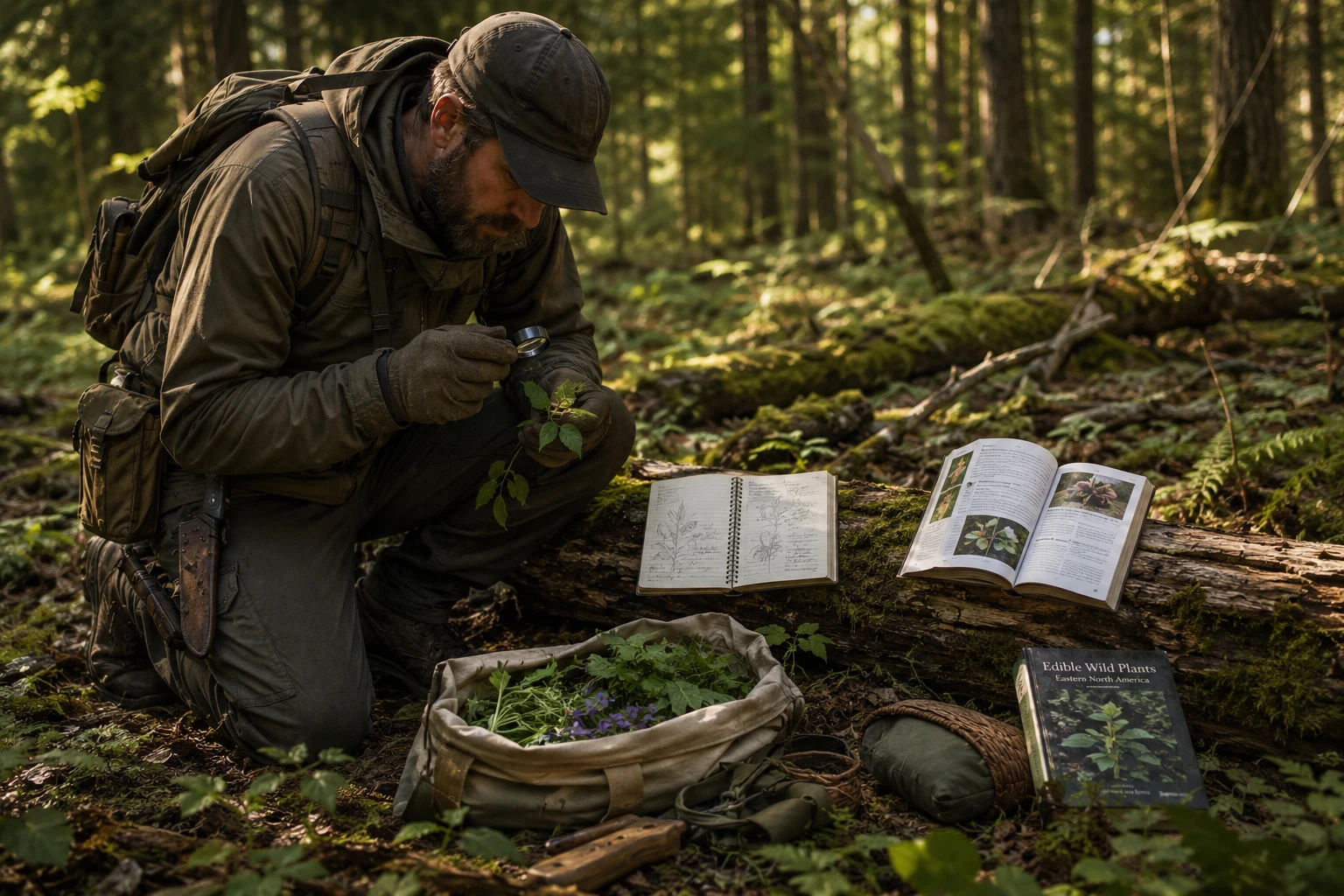
A quality regional field guide is the single most important tool for any forager. General guides covering all of North America are useful references, but they cannot replace a book focused on the specific plants growing in your region.
Widely respected field guides:
- “Edible Wild Plants” by Lee Allen Peterson (Peterson Field Guides series): Covers eastern North America with detailed illustrations and clear lookalike warnings.
- “A Field Guide to Edible Wild Plants” by Samuel Thayer: Considered one of the most thorough and accurate resources available; covers identification in multiple seasons.
- “Foraging the Mountain West” by Thomas J. Elpel: Strong regional focus with practical survival applications.
- “Newcomb’s Wildflower Guide” by Lawrence Newcomb: Excellent for flower-based identification in northeastern North America.
- “Mushrooms Demystified” by David Arora: The standard reference for North American mushroom identification.
Digital tools as supplements (not replacements):
- iNaturalist: Community-verified identifications, strong for cross-referencing
- PlantNet: AI-assisted plant identification, useful but not infallible
- Seek (by iNaturalist): Good for quick field checks
No app replaces a physical field guide in a grid-down scenario. Keep a printed guide in your bug out bag alongside your other core survival resources.
Should You Take a Foraging Class Before Eating Wild Plants?
Yes, and this is not a soft recommendation. Hands-on instruction with an experienced forager or botanist dramatically reduces identification errors compared to self-study alone. Reading about a plant and recognizing it reliably in the field are two different skills.
A single full-day foraging walk with a qualified instructor will teach you more about confident identification than months of solo study. You learn to read the whole plant in context, its habitat, its growth stage, how it looks in different lighting conditions, and how to distinguish it from nearby lookalikes in real time.
How to find quality instruction:
- Local mycological societies often offer guided mushroom walks
- Native plant societies run seasonal foraging programs
- Community colleges and nature centers frequently offer foraging workshops
- Wilderness survival schools (BOSS, Tom Brown Jr.’s Tracker School, and similar programs) include plant identification as a core module
For preppers serious about self-reliance, plant identification training pairs naturally with broader bushcraft skill development. Both require the same patient, observation-based approach.
What Regions Have the Most Dangerous Wild Plants?
Every region of North America has toxic plants, but the density and variety of dangerous species does vary. The southeastern United States, Pacific Northwest, and parts of the upper Midwest have particularly high concentrations of toxic species due to climate conditions that support diverse plant growth.
High-risk plants by region:
- Eastern US: Poison hemlock, water hemlock, pokeweed, jimsonweed, wild parsnip (causes severe skin burns)
- Pacific Northwest: Death camas, false hellebore, western water hemlock (considered the most violently toxic plant in North America)
- Southwest: Locoweed, desert rose (oleander in cultivated areas), death camas
- Southeast: Coral bean, water hemlock, manchineel (coastal areas), moonseed (resembles wild grape)
The Ultimate Geographic Threat Prep Guide provides broader regional risk context that complements plant-specific knowledge for preppers planning by location.
How Long Does It Take to Learn Plant Identification Safely?
Reaching a level of reliable, safe identification for a core set of 10 to 15 edible plants takes most dedicated learners about one to two full growing seasons of active practice. That means regular field time, not just reading.
A realistic learning timeline:
- Month 1-2: Learn 3 to 5 beginner-safe species with no dangerous lookalikes. Focus on dandelion, cattail, lamb’s quarters, plantain, and clover.
- Month 3-6: Add 5 to 8 more species with careful attention to lookalike awareness. Begin attending guided walks.
- Season 2: Expand to more complex species, including members of the carrot family and berry-producing shrubs, with continued guided practice.
- Year 2 and beyond: Develop mushroom identification skills separately, ideally with an experienced mycologist.
The goal is not to memorize hundreds of plants. It is to know a reliable core group with absolute confidence. Ten plants you can identify without hesitation in any light, at any growth stage, are worth more than fifty plants you’re “pretty sure” about.
For preppers integrating foraging into a broader preparedness strategy, this skill development fits naturally alongside other long-term self-reliance goals covered in the complete prepping guide for beginners.
FAQ: Poisonous vs. Edible Wild Plants
Can cooking a poisonous plant make it safe to eat?
Sometimes, but not reliably. Heat destroys some toxins (like those in elderberries and kidney beans) but has no effect on others, including the amatoxins in death cap mushrooms and the cicutoxin in water hemlock. Never assume cooking neutralizes a plant you haven’t positively identified.
Is it true that birds eating berries means they’re safe for humans?
No. Birds and mammals metabolize many plant toxins differently than humans do. American robins eat pokeweed berries without harm; those same berries can cause serious illness in adults. Never use animal feeding behavior as a safety indicator.
What’s the safest way to forage if I’m completely new to it?
Start with three plants only: dandelion, cattail, and lamb’s quarters. All three are visually distinctive, have no dangerous lookalikes in North America, and are nutritious. Master those before adding anything else.
How reliable are plant identification apps?
Useful as a secondary cross-reference, not as a primary identification tool. Apps like iNaturalist and PlantNet can help confirm a suspicion, but they make errors, especially with partial images, unusual growth stages, or regional variants. Always verify with a physical field guide.
Do all poisonous plants cause the same type of symptoms?
No. Plant toxins affect different body systems. Some cause gastrointestinal distress (pokeweed), others attack the nervous system (hemlock), others cause cardiac effects (foxglove, lily of the valley), and some cause liver failure (death cap mushroom). Symptom onset also varies from minutes to 24 hours.
Can I use the Universal Edibility Test to check any plant?
The Universal Edibility Test is a last-resort field method for survival scenarios when no other food source exists. It takes 8 to 24 hours per plant, tests only for acute reactions, and will not detect delayed-onset toxins. It is not a substitute for proper identification.
What’s the most dangerous plant a forager is likely to encounter?
Water hemlock (Cicuta species) is widely considered the most acutely toxic plant in North America. A piece of root the size of a walnut can be fatal. It grows near water and is sometimes confused with edible water plants. Treat any hollow-rooted plant near water with extreme caution.
Should I forage for food during an actual survival emergency?
Only if you have confirmed identification skills and no other food options. The human body can survive three weeks without food but only three days without water. In a genuine emergency, prioritizing clean water procurement and shelter before foraging is the strategically sound choice.
Are there plants I should never eat raw but can eat cooked?
Yes. Elderberries contain cyanogenic glycosides that cause nausea when raw but are neutralized by cooking. Stinging nettles lose their sting when blanched. Some acorns require leaching to remove bitter tannins before eating. Always research preparation requirements for any wild food.
How do I know if a berry is safe to eat?
You don’t, based on appearance alone. Berry safety requires full plant identification, not just the berry color. White and yellow berries are toxic in the overwhelming majority of cases. Red berries vary widely. Black berries include both edible species (blackberries, elderberries) and toxic ones (nightshade, moonseed). Identify the whole plant, not just the fruit.
Conclusion
The difference between poisonous and edible wild plants is not always obvious, and the cost of getting it wrong can be fatal. But this is not a reason to avoid foraging, it is a reason to approach it with the same disciplined preparation that serious preppers bring to every other survival skill.
Start with a handful of beginner-safe species. Invest in a quality regional field guide. Take at least one guided foraging walk before eating anything you’ve identified on your own. Build your knowledge plant by plant, season by season, until identification becomes second nature rather than guesswork.
The confidence that comes from knowing your local edible plants, truly knowing them, not just thinking you recognize them, is a genuine force multiplier in any survival scenario. It is the difference between a forest that feels threatening and one that feels like a resource.
Actionable next steps:
- Purchase a regional field guide specific to your area this week.
- Identify and photograph three beginner-safe plants (dandelion, cattail, lamb’s quarters) in your local environment within the next 30 days.
- Find and register for a local foraging walk or wilderness plant identification course.
- Add a physical field guide and a small plant identification notebook to your bug out bag essentials.
- Save the Poison Control number (1-800-222-1222) in your phone and your emergency preparedness kit documentation.
Products, Tools, and Resources
Field Guides Worth Owning
Samuel Thayer’s foraging guides (“The Forager’s Harvest” and “Nature’s Garden”) are the most frequently recommended by serious foragers for their accuracy and depth. The Peterson Field Guides series offers solid regional coverage at a lower price point and is widely available. For mushrooms specifically, David Arora’s “Mushrooms Demystified” is the standard reference most mycologists recommend.
Plant Identification Apps
iNaturalist (free) offers community-verified identifications and is the most reliable digital tool available. PlantNet (free) works well as a quick visual cross-reference. Both are useful supplements to a physical guide, not replacements for one.
Foraging Courses
The Wilderness Awareness School, Tom Brown Jr.’s Tracker School, and regional mycological societies all offer hands-on plant and mushroom identification training. Many community colleges and cooperative extension programs also run seasonal foraging workshops at low or no cost.
For Broader Preparedness Integration
Plant identification is one piece of a larger self-reliance skill set. The 20 essential bushcraft skills guide and the emergency herbal medicine guide both complement foraging knowledge directly and are worth reading alongside this guide.