
Hey there! Some links on this page may be affiliate links which means that, if you choose to make a purchase, I may earn a commission at no extra cost to you. I greatly appreciate your support. Read the full disclosure here.
Bushcraft fire-making methods relies on spark-based methods like ferro rods and flint and steel, or friction methods such as the bow drill and hand drill. Ferro rods are the easiest and most reliable for beginners, while friction methods require more skill and dry materials. Mastering multiple techniques ensures fire-starting success in all environments and emergencies.
Key Takeaways
- Friction fire methods like the bow drill and hand drill can produce fire with zero modern tools, but they require practiced technique and properly dried wood.
- Flint and steel is one of the oldest and most reliable primitive fire-starting methods, producing sparks hot enough to ignite char cloth and tinder.
- A ferro rod is the easiest primitive-adjacent tool for beginners and should be in every bug-out bag as a backup to lighters.
- Wet conditions are the biggest enemy of primitive fire-starting. Knowing where to find dry tinder inside wet wood is a skill that separates prepared survivalists from unprepared ones.
- Char cloth dramatically improves success rates with flint and steel by catching sparks at much lower temperatures than raw tinder.
- The bow drill is harder to master than the hand drill in dry conditions but more effective in high-humidity environments due to the mechanical advantage it provides.
- Beginners should start with a ferro rod, then progress to flint and steel, and only then attempt friction fire methods.
- Common mistakes include using green or damp wood, building the tinder bundle too loosely, and not preparing a proper notch on the fireboard.
What Are the Best Ways to Start a Fire Without a Lighter in the Wilderness
The most reliable bushcraft fire-making methods without a lighter fall into two categories: spark-based methods (flint and steel, ferro rod) and friction-based methods (bow drill, hand drill). Spark-based methods are faster and easier to learn. Friction-based methods require no manufactured tools at all.
For survivalists and preppers, knowing multiple methods is not optional. Lighters fail in cold temperatures, run out of fuel, and get wet. A person who can only start a fire with a lighter has a single point of failure in a survival situation. Redundancy is the foundation of real preparedness.
Here is a practical overview of the main methods ranked from most accessible to most skill-intensive:
- Ferro rod (easiest, requires a manufactured rod but no fuel)
- Flint and steel with char cloth (moderate skill, highly reliable once learned)
- Bow drill (high skill, zero manufactured tools required)
- Hand drill (highest skill, works best in dry climates)
- Fire piston (specialized tool, extremely fast when it works)
- Solar ignition (lens or reflector, weather-dependent)
If you want a deeper foundation in primitive skills, the guide on 20 essential bushcraft skills for beginners covers the broader skill set that fire-making fits into.

How Do You Make Fire With Flint and Steel
Flint and steel fire-making works by striking a sharp flint edge against a high-carbon steel striker to produce a shower of hot metal sparks. Those sparks are caught in char cloth or a natural tinder fungus, which smolders and is then transferred to a tinder bundle and blown into flame.
What you need:
- A piece of true flint, chert, quartzite, or obsidian with a sharp edge
- A high-carbon steel striker (a carbon steel knife spine works)
- Char cloth, amadou (tinder fungus), or dried bracket fungus
- A prepared tinder bundle of dry grass, cattail fluff, or shredded bark
Step-by-step process:
- Hold the flint in your non-dominant hand with a sharp edge facing upward.
- Place a small piece of char cloth on top of the flint, just behind the striking edge.
- Strike the steel downward across the flint edge in a firm, glancing blow.
- When a spark lands on the char cloth, it will glow orange. Do not blow on it yet.
- Fold the char cloth into the center of your tinder bundle.
- Hold the bundle loosely and blow in slow, steady breaths until it bursts into flame.
Common mistake: Using the wrong rock. Not all rocks spark. True flint is glassy, dark grey to black, and breaks with a conchoidal (shell-like) fracture. If the rock crumbles or produces no sparks, it will not work.
Can You Start a Fire With a Bow Drill and Does It Actually Work
Yes, the bow drill absolutely works, and it has been used by indigenous cultures on every inhabited continent for thousands of years. It produces fire through friction, generating a fine wood powder that eventually ignites into a glowing coal.
The bow drill is one of the most proven bushcraft fire-making methods without a lighter, but it demands correct wood selection, proper form, and a well-prepared notch. When all three align, it produces a coal in under two minutes.
Key components:
- Fireboard (flat piece of dry softwood with a carved depression and notch)
- Spindle (straight, dry hardwood or softwood rod, 18-24 inches long)
- Bow (a curved branch strung with cordage)
- Handhold (a hard socket to press down on the spindle top)
- Tinder bundle (dry, fibrous material to receive the coal)
Best wood combinations: Willow on willow, cottonwood on cottonwood, cedar on cedar. Both pieces must be bone dry. The fireboard should be slightly softer than the spindle.
How long does it actually take? With practiced technique and dry materials, a coal forms in 30 to 90 seconds of drilling. For beginners, expect 5 to 15 minutes of failed attempts before the method clicks. Most people underestimate how much downward pressure is required.
What Is the Difference Between Bow Drill and Hand Drill
The bow drill uses a mechanical bow to spin the spindle, while the hand drill uses only the palms moving downward along a longer, thinner spindle. The bow drill is generally easier to learn because the bow provides consistent speed and the handhold allows strong downward pressure. The hand drill is simpler in terms of equipment but harder to execute.
| Feature | Bow Drill | Hand Drill |
|---|---|---|
| Tools needed | Bow, spindle, fireboard, handhold | Spindle, fireboard only |
| Skill level | Moderate | High |
| Best climate | Works in most conditions | Best in dry, low-humidity climates |
| Speed to coal | 30-90 seconds (practiced) | 45-120 seconds (practiced) |
| Physical demand | Moderate | High (arm fatigue is common) |
| Wood requirements | Softwood pairs | Very dry, light softwood |
Choose the bow drill if you are learning or operating in humid environments. Choose the hand drill if you are in an arid region and want to carry less equipment.
How to Start a Fire With Rocks and What Type of Rocks Work Best
Starting a fire with rocks means striking two specific types of rock together to produce sparks. The key is that one rock must be very hard and capable of fracturing sharply, while the other acts as the striker.
The best rocks for fire-starting are flint, chert, quartzite, and obsidian. These are all silica-rich, extremely hard (7+ on the Mohs scale), and fracture with sharp edges. When struck against high-carbon steel, they shed tiny metal particles that oxidize instantly, producing sparks hot enough to ignite char cloth.
Rocks that do NOT work: Granite, sandstone, limestone, and most river-smoothed rocks will not produce usable sparks. Granite is hard but does not fracture correctly. Limestone is too soft.
Field identification tip: True flint is typically found in chalk and limestone formations. It is dark grey to black, smooth on the surface, and produces a glassy fracture when broken. If you find a rock with a shell-like chip pattern and a sharp edge, test it against a steel knife spine. Visible sparks confirm it is usable.
Fire Starting With Char Cloth and Steel Wool Explained
Char cloth is partially burned cotton or linen fabric that has been carbonized in a low-oxygen environment. It catches sparks at very low temperatures, making it the ideal intermediary between a flint spark and a tinder bundle. Steel wool (grade 0000) can also ignite from a single spark and, when connected to a 9-volt battery terminal, will ignite without any spark at all.
How to make char cloth:
- Cut 100% cotton fabric into 2-inch squares.
- Place them in a small metal tin with a tiny pinhole in the lid.
- Hold the tin over a fire until smoke stops coming from the pinhole.
- Let it cool completely before opening. The result should be black, fragile, and intact.
Steel wool fire-starting: Grade 0000 steel wool ignites from a ferro rod spark easily. In a grid-down emergency, touching steel wool to both terminals of a 9-volt battery produces instant ignition. This method is covered in more detail in the fire kit bug-out bag guide.
What Should Beginners Learn First for Bushcraft Fire-Making
Beginners should start with a ferro rod before attempting any primitive method. A ferro rod bridges the gap between a lighter and true primitive fire-starting, requiring only the skill of striking and a prepared tinder bundle. Once tinder preparation is mastered, flint and steel becomes the logical next step.
Recommended learning progression:
- Ferro rod with commercial tinder (build striking technique)
- Ferro rod with natural tinder (learn tinder preparation)
- Flint and steel with char cloth (learn spark catching)
- Flint and steel with natural tinder fungus (reduce dependency on manufactured materials)
- Bow drill (full primitive fire-making)
This progression builds skills in layers. Each stage reinforces the previous one. Skipping directly to the bow drill without understanding tinder preparation is one of the most common reasons beginners fail repeatedly.
For a broader look at how fire-making fits into overall readiness, the article on how to start a fire without matches is a strong companion resource.
Common Mistakes People Make When Trying Friction Fire Methods
The single most common mistake is using wood that is not dry enough. Wood moisture content above roughly 10-15% will not produce a coal through friction, no matter how good the technique. Other frequent errors include a poorly cut notch, insufficient downward pressure, and stopping drilling too soon.
Top mistakes and how to fix them:
- Damp wood: Split logs open and use the inner wood. Carry pre-dried spindle sets in a sealed bag.
- Wrong notch position: The notch should cut about one-eighth of the way into the depression, not more, not less. Too small and dust cannot collect. Too large and the spindle loses contact.
- Weak downward pressure: The handhold arm should brace against the shin for leverage. This is non-negotiable.
- Stopping too early: Drill until you see steady smoke rising from the notch, then make 10 more strokes before stopping.
- Blowing too hard on the coal: A coal needs oxygen but not a blast. Slow, steady breaths from about 6 inches away.
Reviewing the most common fire-starting mistakes before heading into the field can save hours of frustration.
What Is Easier for Beginners: Flint and Steel or Ferro Rod
A ferro rod is significantly easier for beginners than traditional flint and steel. A ferro rod produces a large shower of sparks at approximately 5,400 degrees Fahrenheit with a single firm stroke, and it works even when wet. Flint and steel requires learning to identify the right rock, strike at the correct angle, and catch sparks in a small piece of char cloth.
Both skills are worth learning. But if a person only has time to practice one before a survival situation, the ferro rod wins on reliability and speed of skill acquisition.
Ferro rod tips for beginners:
- Use the spine of a knife or a dedicated striker, not the blade edge.
- Hold the rod still and draw the striker back, rather than pushing the rod forward (this gives more control).
- Keep the rod tip close to the tinder (1-2 inches) to concentrate the spark shower.
Fire-Making Methods That Work When Everything Is Wet Outside
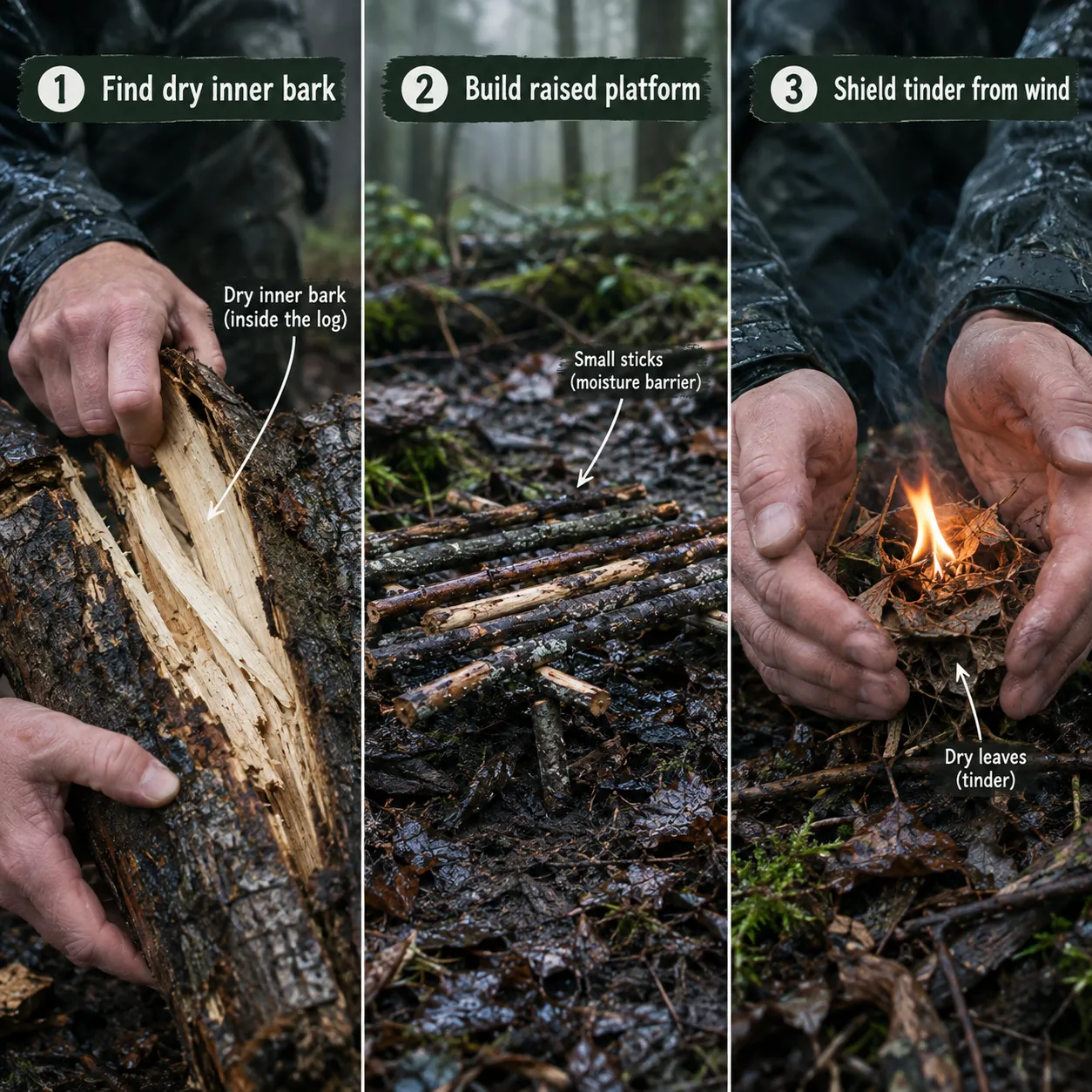
Wet conditions are where most primitive fire-making attempts fail. The key principle is that moisture exists on surfaces, not deep inside wood. Splitting logs open reveals dry inner wood even after days of rain.
For a detailed breakdown of wet-weather fire strategies, the guide on how to start a fire in wet conditions covers every technique in depth. The core tactics are:
- Split your firewood: The interior of any log is almost always dry. Use a knife and baton technique to split logs and expose dry inner material for tinder and kindling.
- Build a raised platform: Lay a base of larger sticks to keep your fire off the wet ground.
- Use a fire lay that protects the flame: The log cabin or star fire lay concentrates heat better than a standard teepee in wet conditions.
- Carry pre-made char cloth in a waterproof container: Char cloth ignites even in high humidity.
- Birch bark is a wet-weather ally: The oils in birch bark make it water-resistant and highly flammable even when the outer surface is damp.
A ferro rod outperforms flint and steel in wet conditions because the sparks are hotter and more numerous. If conditions are extreme, having a backup plan for starting a survival fire in rain is essential knowledge.
Can You Start a Fire With Just Wood and No Tools at All
Yes, but it requires specific knowledge and physical effort. The hand drill and bow drill methods use only wood and natural cordage, making them the purest form of bushcraft fire-making methods without a lighter or any manufactured equipment.
The fire plow is another all-wood method. A hardwood stick is pushed rapidly along a groove carved into a softwood base, generating friction dust that eventually ignites. It is less efficient than the bow drill but requires no cordage.
What makes all-wood fire possible:
- Correct wood species selection (dry softwoods with low resin content)
- A prepared notch or groove to collect friction dust
- Sufficient speed and pressure to raise the dust to ignition temperature (approximately 800 degrees Fahrenheit)
- A dry tinder bundle ready to receive the coal
The hand drill works best in low-humidity environments. In humid climates, the bow drill is more reliable because the mechanical advantage compensates for moisture in the wood.
FAQ
What is the fastest bushcraft fire-starting method without modern tools?
A ferro rod is the fastest option that does not require a lighter or matches. With a prepared tinder bundle, a fire can be started in under 60 seconds. Among fully primitive methods, flint and steel with char cloth is the fastest, often producing a coal in a single strike.
Do you need special skills to use a ferro rod?
No special skills are required, but technique matters. The key is learning to hold the rod steady and scrape the striker back firmly. Most beginners can produce a usable spark shower within minutes of their first attempt.
What wood works best for a bow drill fireboard?
Dry softwoods with low resin content work best. Willow, cottonwood, cedar, and basswood are consistently recommended. The fireboard and spindle should be from the same species or similar density woods.
How do I know if my tinder bundle is good enough?
A good tinder bundle should feel like a bird’s nest: loose enough for air to flow through, but dense enough to hold a coal. Dry grass, cattail fluff, shredded cedar bark, and dried bracket fungus all work well. It should crumble slightly when squeezed and produce no visible moisture.
Can flint and steel work in the rain?
Yes, with limitations. The sparks themselves are not affected by rain, but keeping the char cloth dry is critical. Store char cloth in a waterproof container and shield the tinder bundle from rain with your body while transferring the coal.
Why does my bow drill produce smoke but no coal?
This usually means the notch is positioned incorrectly, the wood is slightly damp, or drilling stopped just before the coal formed. Ensure the notch reaches one-eighth of the depression, drill until smoke is heavy and consistent, then add 10 more strokes before stopping.
Is steel wool a legitimate fire-starting material?
Yes. Grade 0000 steel wool ignites easily from a ferro rod spark and can be ignited by a 9-volt battery without any spark. It is lightweight, compact, and useful as an emergency tinder in a fire kit.
What is char cloth and why does it matter?
Char cloth is carbonized cotton or linen fabric that catches sparks at very low temperatures. It dramatically increases the success rate of flint and steel fire-starting by providing an easy-to-ignite intermediary between the spark and the tinder bundle.
How long does it take to learn the bow drill?
Most people can produce their first coal within 3 to 5 practice sessions if they use correct wood and proper form. Consistent success in varied conditions typically takes several weeks of regular practice.
What is the best all-around fire-starting kit for a bug-out bag?
A ferro rod, a carbon steel striker, pre-made char cloth in a waterproof tin, and a small piece of fatwood or commercial tinder covers most scenarios. Add a pre-dried bow drill set in a sealed bag for true primitive backup capability.
Conclusion
Mastering bushcraft fire-making methods without a lighter is one of the most practical investments a survivalist or prepper can make. Fire is not just warmth. It purifies water, signals rescuers, cooks food, and provides the psychological anchor that keeps people functioning in crisis. Losing the ability to make fire because a lighter ran out or got wet is an avoidable failure.
Start with a ferro rod and learn to prepare natural tinder. Progress to flint and steel with char cloth. Then invest time in the bow drill. Each method builds on the last, and together they create a redundant, tool-independent fire-making capability that no weather event or equipment failure can take away.
Actionable next steps:
- Purchase a quality ferro rod and practice striking technique with natural tinder this week.
- Make a batch of char cloth from cotton fabric and store it in a waterproof tin.
- Source local flint or chert and test it against a carbon steel knife spine.
- Build a bow drill set from locally sourced dry wood and practice the motion before you need it.
- Read the companion guide on how to purify water without tools outdoors because fire and water purification are inseparable survival priorities.
Products, Tools, and Resources
Building a reliable primitive fire kit does not require expensive gear, but a few quality items make the difference between frustration and success.
Ferro rods: Look for rods with a magnesium-ferrocerium alloy and a diameter of at least 3/8 inch. Larger rods produce more sparks and last longer. The Light My Fire Swedish FireSteel and Bayite ferro rods are consistently recommended by experienced bushcrafters for their spark output and durability.
Carbon steel strikers: A dedicated striker made from high-carbon steel outperforms a standard knife spine. Many are sold as part of flint and steel kits. The Condor Tool and Knife carbon steel strikers are a practical option.
Char cloth tins: Any small metal tin with a tight-fitting lid works. Altoids tins are a popular choice. Punch a single pinhole in the lid before use.
Bow drill kits: Pre-made practice kits from companies like Primitive Fire Kits or Woodcraft Supply give beginners correctly matched wood species to learn with, removing one major variable from the learning process.
Reference books: Tom Brown Jr.’s “Tom Brown’s Field Guide to Wilderness Survival” and Mors Kochanski’s “Bushcraft” remain the most thorough printed references for primitive fire-making technique. Both are worth having in a preparedness library.
For broader fire preparedness in non-wilderness contexts, the indoor fire alternatives guide covers safe heating and cooking options when grid power fails at home.