
Hey there! Some links on this page may be affiliate links which means that, if you choose to make a purchase, I may earn a commission at no extra cost to you. I greatly appreciate your support. Read the full disclosure here.
The answer to how long can you survive without clean water is: most healthy adults can survive approximately 3 days without water, though some documented cases extend to 5–7 days under cool, resting conditions. The real danger arrives much sooner — serious organ damage and impaired judgment can begin within 24 hours. Access to clean water matters as much as access to water itself, because contaminated sources can accelerate death through dehydration-inducing illness.
Key Takeaways
- The widely cited “3-day rule” is a ceiling, not a guarantee — heat, exertion, injury, and illness can cut that window to under 24 hours.
- Dehydration becomes life-threatening when the body loses roughly 10% of its total water weight.
- Children and elderly individuals reach critical thresholds faster than healthy adults.
- Drinking urine or seawater does not save you — both accelerate dehydration and can cause kidney failure.
- The human body needs a minimum of 1 liter per day to sustain basic organ function; 2–3 liters is the practical survival baseline.
- Contaminated water kills through diarrhea and vomiting, which drain fluids faster than not drinking at all in some scenarios.
- Boiling, filtration, chemical treatment, and UV purification are all viable emergency options — each with specific strengths and limitations.
- Stored water is always the first line of defense. Finding water in the field is a backup skill, not a primary strategy.
- Desert environments can reduce survival time to hours, not days, without shade and water management.
- Preparedness means storing, purifying, and rationing — all three skills matter equally.
How Many Days Can a Human Live Without Drinking Water?
The honest answer: 3 days is the average, but the range is wide. Under ideal conditions — cool temperatures, minimal physical activity, no illness — some individuals have survived 5 to 7 days without water. Under harsh conditions, that window collapses dramatically.
The “Rule of 3” used in survival training states a person can survive:
- 3 minutes without air
- 3 hours without shelter in extreme weather
- 3 days without water
- 3 weeks without food
Water sits at the critical middle point. Food deprivation is serious but slow. Water deprivation is fast and brutal.
What changes the timeline:
- Heat and humidity — sweating accelerates fluid loss exponentially
- Physical exertion — a person hiking in summer heat may need 6+ liters per day
- Altitude — higher elevations increase respiratory water loss
- Illness or injury — fever, vomiting, and bleeding all drain fluids rapidly
- Body size and age — smaller bodies and older adults have less reserve
Bottom line for preppers: Never plan around the 3-day ceiling. Plan around the 24-hour warning window, because that’s when decision-making starts to degrade.
What Happens to Your Body When You Don’t Have Clean Water
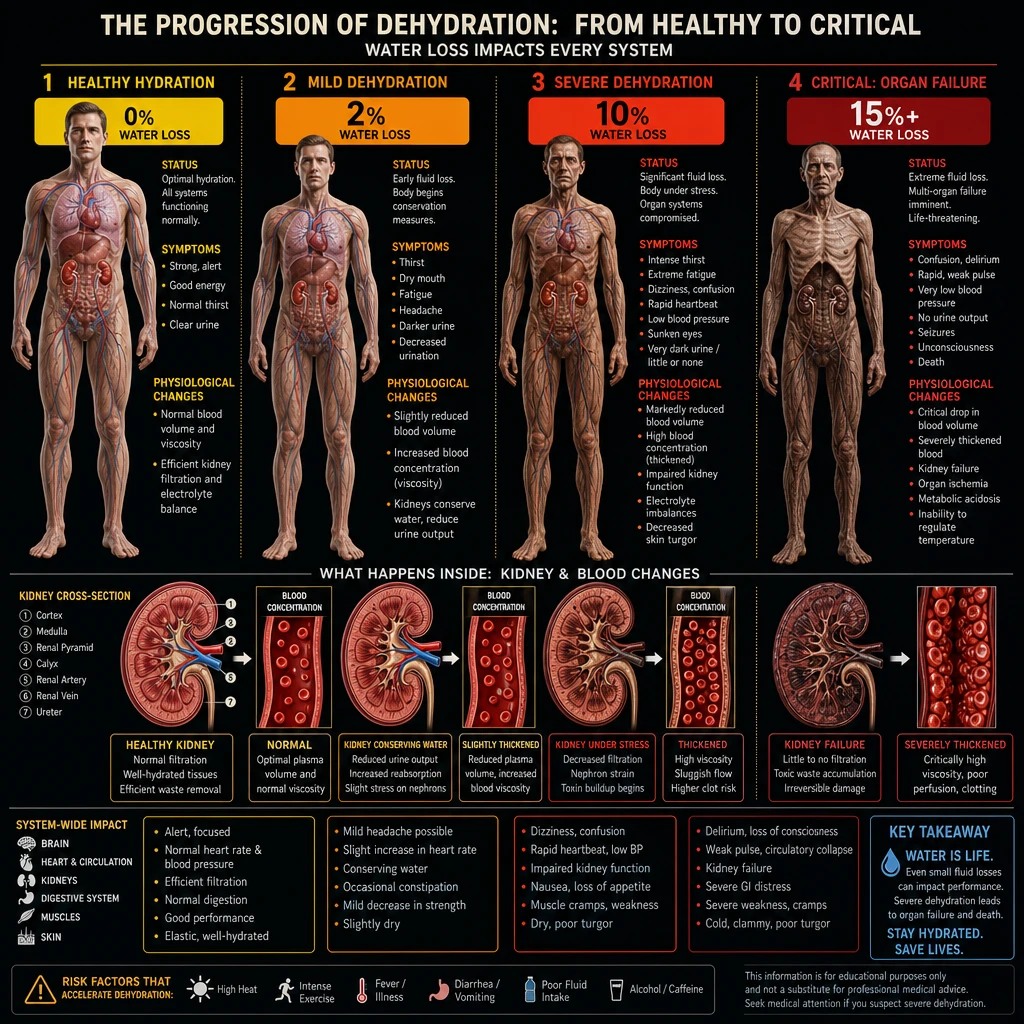
Water deprivation triggers a cascade of physiological failures that follow a predictable sequence. Understanding this sequence is what separates a prepared survivalist from someone who waits too long to act.
The stages of dehydration before death:
| Water Loss (% of body weight) | Symptoms | Severity |
|---|---|---|
| 1–2% | Thirst, slight fatigue | Mild |
| 3–5% | Headache, reduced urine, dry mouth | Moderate |
| 6–8% | Dizziness, confusion, rapid heart rate | Serious |
| 9–11% | Muscle spasms, delirium, organ stress | Critical |
| 12–15%+ | Kidney failure, unconsciousness, death | Fatal |
The insidious part: thirst is not a reliable early warning system. By the time you feel genuinely thirsty in a survival scenario, you’re already at 1–2% dehydration. In hot environments, that gap closes fast.
Contaminated water adds another layer of danger. Waterborne pathogens — Giardia, Cryptosporidium, cholera bacteria, and E. coli — cause diarrhea and vomiting that strip fluids faster than the body can absorb them. In some cases, drinking heavily contaminated water accelerates death compared to abstaining entirely while seeking a clean source.
Signs of Dehydration and When It Becomes Life-Threatening
Dehydration becomes life-threatening when fluid loss reaches approximately 9–10% of body weight. Before that threshold, the signs are manageable. After it, recovery without medical intervention becomes unlikely.
Early warning signs (act now, don’t wait):
- Dark yellow or amber urine
- Dry, sticky mouth and lips
- Reduced urination frequency
- Mild headache or fatigue
- Irritability or difficulty concentrating
Serious signs (emergency territory):
- Rapid, weak pulse
- Sunken eyes
- Skin that doesn’t spring back when pinched
- Confusion or slurred speech
- No urination for 8+ hours
Critical signs (life-threatening):
- Seizures
- Loss of consciousness
- Breathing irregularities
- Extreme weakness or inability to stand
For preppers managing a group, monitor urine color as the simplest field assessment. Clear to pale yellow means hydrated. Dark amber means drink immediately. No output at all means get to medical care or escalate water rationing protocols.
How Does Water Scarcity Affect Survival in Different Climates
Climate is the single biggest variable in how long can you survive without clean water — and this guide would be incomplete without addressing it directly. The same person faces radically different timelines depending on their environment.
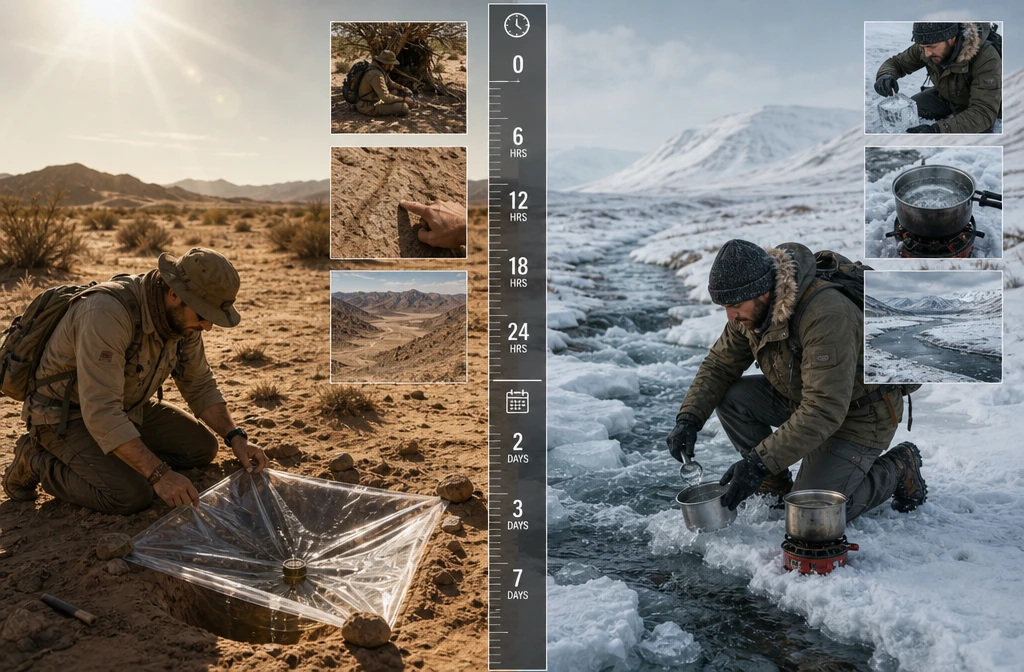
Desert environments: The most unforgiving scenario. Temperatures above 100°F (38°C) combined with low humidity can push sweat rates to 1–1.5 liters per hour during exertion. A person walking in the Mojave Desert without water can reach critical dehydration in 4–6 hours. Shade is not optional — it’s a survival tool. Resting during daylight and moving at night can extend survival time significantly.
Tropical and humid environments: Heat is present but sweating is less efficient because humidity slows evaporation. Fluid loss is still high, but the bigger risk is waterborne illness from abundant but contaminated surface water.
Cold and arctic environments: People underestimate dehydration risk in cold weather. Breathing cold, dry air causes significant respiratory moisture loss. Cold suppresses the thirst response, making it easy to become dehydrated without realizing it. Melting snow for water is viable but energy-intensive.
Temperate climates: The most forgiving conditions. A resting adult in mild temperatures with no illness can approach the upper end of the 3–7 day survival window.
Choose your strategy based on climate:
- Desert: prioritize shade, night movement, and immediate water sourcing
- Tropical: prioritize purification over quantity
- Cold: force regular drinking even when not thirsty; melt snow before consuming
How Much Water Do You Actually Need to Survive Per Day
The minimum for basic organ function is approximately 1 liter (roughly 34 oz) per day for a sedentary adult in moderate temperatures. That’s the floor — not the target.
Practical daily water requirements by scenario:
- Resting, cool environment: 1–2 liters
- Light activity, moderate temperature: 2–3 liters
- Heavy exertion or heat: 4–6 liters
- Illness with fever or diarrhea: Add 0.5–1 liter per degree of fever above normal
The U.S. National Academies of Sciences recommends approximately 3.7 liters total daily water intake for men and 2.7 liters for women under normal conditions — but those figures include water from food. In a survival scenario with no food, the pure drinking requirement increases.
For preppers storing water: FEMA recommends a minimum of 1 gallon (3.8 liters) per person per day for emergency storage, which accounts for drinking and basic sanitation. That’s a solid baseline, though active adults in warm climates should plan for 1.5–2 gallons.
For detailed storage strategies, the Ultimate Emergency Water Storage and Purification Guide covers container selection, rotation schedules, and long-term planning in depth.
How Do Children and Elderly Handle Water Deprivation Differently
Children and elderly individuals are significantly more vulnerable to dehydration than healthy adults, and they reach dangerous thresholds faster. This isn’t a minor difference — it’s a planning priority.
Children:
- Higher surface-area-to-body-weight ratio means faster heat gain and fluid loss
- Smaller total body water volume means smaller margin for error
- Less reliable thirst sensation, especially in young children
- Illness-related dehydration (from diarrhea or vomiting) is the leading cause of child mortality in water-scarce emergencies globally
Elderly adults:
- Reduced kidney efficiency means less ability to concentrate urine and conserve water
- Blunted thirst response — many elderly individuals don’t feel thirsty until severely dehydrated
- Common medications (diuretics, blood pressure drugs) increase fluid loss
- Cognitive decline can mask early dehydration symptoms
Practical adjustments for group preparedness:
- Store at least 1.5x the standard daily water allowance for children and elderly members
- Check hydration status proactively — don’t wait for them to report thirst
- Prioritize oral rehydration solutions (ORS) for any group member showing early dehydration signs
- Review the 9 Essential Disaster Prep Strategies for Seniors for age-specific planning frameworks
Best Ways to Purify Water in Emergency Situations
Finding water is only half the battle. Purifying it is what keeps you alive. The best emergency purification method depends on what’s available, how much time you have, and what contaminants are present.
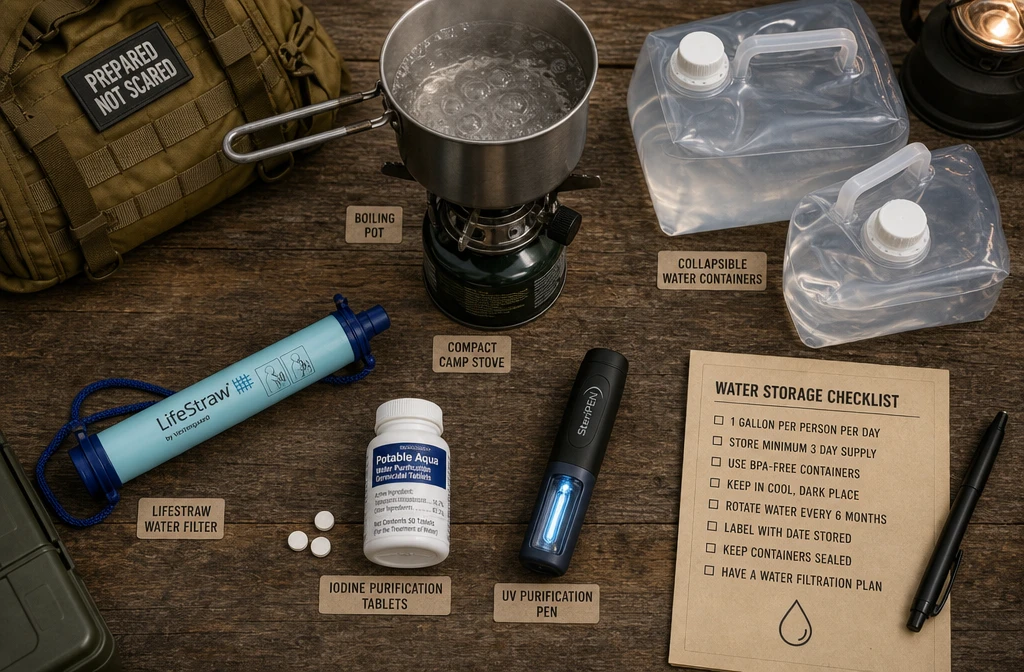
The four primary methods:
1. Boiling The gold standard for killing biological contaminants. Bring water to a rolling boil for 1 minute (3 minutes above 6,500 feet elevation). Boiling kills bacteria, viruses, and protozoa but does not remove chemical contaminants or heavy metals.
2. Chemical treatment Unscented household bleach (sodium hypochlorite, 6–8.25% concentration): add 8 drops per gallon of clear water, 16 drops for cloudy water. Wait 30 minutes before drinking. Iodine tablets work similarly and are more portable. Neither method is effective against Cryptosporidium.
3. Filtration Portable filters like LifeStraw or Sawyer Squeeze remove protozoa and bacteria but generally not viruses. Hollow-fiber filters are reliable for most wilderness water sources. Always pre-filter turbid water through cloth before using a pump or squeeze filter.
4. UV treatment Devices like the SteriPen use ultraviolet light to neutralize pathogens including viruses. Fast and effective for clear water — ineffective in turbid water because particles block UV penetration.
When to combine methods: In high-risk scenarios (flood water, standing water near agriculture), filter first, then boil or chemically treat. Layering methods provides redundancy.
Common mistake: Skipping purification because water “looks clean.” Giardia and Cryptosporidium are invisible to the naked eye and cause severe diarrhea that will dehydrate you faster than the contaminated water hydrates you.
For apartment-based preppers with limited storage, the Apartment Water Storage Complete Guide covers compact purification setups that work in small spaces.
Survival Tips for Finding Water in Desert or Wilderness
When stored water runs out, knowing where to look is a life-saving skill. This section of the how long can you survive without clean water guide covers field-sourcing strategies that actually work.
In desert environments:
- Follow animal trails downhill — they often lead to water sources
- Look for green vegetation, especially willows, cottonwoods, and cattails
- Dig in dry riverbeds at the outside of bends where water pools underground
- Collect morning dew by wiping vegetation with an absorbent cloth and wringing it out
- Solar stills (digging a pit with plastic sheeting) produce small amounts of water but require significant energy to construct — use only if you have the materials and time
In wilderness/forest environments:
- Moving water is generally safer than standing water but still requires purification
- Rain collection is highly reliable — use tarps, ponchos, or any clean surface
- Transpiration bags (clear plastic bags tied around leafy branches) can collect plant moisture
- Snow and ice are viable sources — melt before consuming to avoid core temperature drop
Critical mistakes to avoid:
- Eating snow directly — it lowers core temperature and requires body heat to process, wasting energy
- Drinking from sources downstream of agricultural land without purification
- Assuming fast-moving water is safe — Giardia thrives in mountain streams
The 25 Most Critical Wilderness Survival Skills ranks water sourcing among the top priorities for any field scenario.
Can You Drink Urine or Seawater If You’re Dying of Thirst?
No. Drinking urine or seawater accelerates dehydration and can cause kidney failure. This is one of the most dangerous myths in survival culture, and it needs a direct answer.
Urine: Fresh urine is approximately 95% water but contains urea, creatinine, and dissolved salts that your kidneys already worked to remove. Drinking it forces those kidneys to process the same waste again, increasing their workload and accelerating fluid loss. Recycling urine through a distillation system (solar still or improvised distiller) is a different matter — distilled urine removes the waste products and produces clean water. Drinking it straight does not.
Seawater: Contains roughly 35 grams of salt per liter — far above the 2–3 grams per liter the human kidney can process. The body must use more water to excrete the excess salt than the seawater provides. Net result: you become more dehydrated with every sip. Death from seawater consumption is well-documented in maritime survival cases.
What about other liquids in a pinch?
- Coconut water: A legitimate hydration source, low in sodium, high in potassium — viable in tropical environments
- Cactus water: Pulp from barrel cactus contains some moisture but also oxalic acid that causes nausea and vomiting — not a reliable source
- Plant sap: Some species (maple, birch) provide hydration; most tropical vines with clear sap are safe — avoid milky or colored sap
Alternatives to Drinking Water When Supplies Are Limited
When water is scarce, food choices and behavioral adjustments can meaningfully extend survival time. These aren’t replacements for water — they’re strategies that reduce how much you need.
High-water-content foods:
- Cucumbers, lettuce, and celery: 95–96% water
- Watermelon, strawberries: 90–92% water
- Oranges, peaches: 85–89% water
- Canned vegetables and fruits: retain significant moisture
In a stored food scenario, prioritizing high-moisture foods from your supply can reduce daily drinking water needs by 20–30%.
Behavioral water conservation:
- Rest during peak heat hours (10 AM–4 PM in summer)
- Breathe through the nose, not the mouth — reduces respiratory moisture loss
- Avoid alcohol and caffeine, both of which are diuretics
- Wear loose, light-colored, long-sleeved clothing in heat — reduces sweat rate
- Minimize talking in extreme heat (breathing through the mouth increases loss)
Oral rehydration salts (ORS): When water is available but limited, ORS packets help the body absorb and retain fluid more efficiently than plain water. They’re inexpensive, lightweight, and should be in every bug-out bag and home emergency kit.
For broader emergency food planning that complements water rationing, the Ultimate Survival Pantry List covers high-moisture food storage options alongside dry goods.
Emergency Water Storage Methods for Disaster Preparedness
Stored water is always the most reliable option in a disaster. The goal is to have enough supply to bridge the gap between an emergency event and access to a clean, purified source.
Recommended storage volumes:
- Minimum: 1 gallon per person per day
- Comfortable buffer: 1.5–2 gallons per person per day
- Target storage duration: 2 weeks minimum, 30 days preferred
Storage container options:
| Container Type | Capacity | Pros | Cons |
|---|---|---|---|
| Commercial 5-gallon jugs | 5 gal | Portable, stackable | Frequent rotation needed |
| 55-gallon barrels | 55 gal | High volume, cost-effective | Heavy, needs pump |
| WaterBOB bathtub bladder | 100 gal | Fast fill before disaster | Single use, no storage |
| Mylar bags in buckets | 1–5 gal | Long shelf life | Requires food-grade buckets |
| Commercial water bricks | 3.5 gal | Stackable, space-efficient | Higher cost per gallon |
Rotation schedule: Most stored tap water should be rotated every 6–12 months. Commercially sealed water has a longer shelf life, but containers can degrade and leach chemicals over time. Always store in a cool, dark location away from chemicals or fuel.
Avoid the most common errors preppers make with their water supply — the Worst Water Storage Mistakes Preppers Still Make is required reading before finalizing any storage setup.
Common Mistakes People Make When Trying to Find Water in Survival Scenarios
Even experienced outdoors people make critical errors under stress. These are the most common — and most dangerous.
- Prioritizing food over water. The body can survive weeks without food. Spending energy foraging when dehydrated is a fatal miscalculation.
- Drinking without purifying. Clear, fast-moving water still carries Giardia, Cryptosporidium, and agricultural runoff.
- Ignoring early thirst signals. Waiting until thirst is intense means you’re already significantly dehydrated.
- Overexerting during water search. Sweating heavily while looking for water creates a net deficit. Move slowly, rest often.
- Not pre-filtering turbid water. Running muddy water through a quality filter without pre-filtering clogs the filter quickly and reduces its effectiveness.
- Relying on a single purification method. Filters don’t catch viruses; chemical treatment doesn’t catch Crypto. Layer your methods.
- Underestimating group needs. Planning for one person and then adding others without adjusting water calculations.
For a broader skills framework that addresses these field decisions, the 14 Essential Survival Skills Every Prepper Must Know covers water sourcing alongside shelter, navigation, and first aid.
FAQ
How long can you survive without clean water in extreme heat? In direct sun with high temperatures and physical exertion, survival time can drop to 4–6 hours. Heat dramatically accelerates sweat-based fluid loss, and without shade or water, the body reaches critical dehydration far faster than the standard 3-day estimate.
Is it true you can survive longer without food than without water? Yes. The body can metabolize fat and muscle for energy over weeks. It cannot manufacture water internally in meaningful quantities. Water is the more urgent survival priority in almost every scenario.
What’s the fastest sign that someone needs water immediately? No urination for 8 or more hours, combined with confusion or a rapid weak pulse, indicates critical dehydration requiring immediate fluid intake or medical intervention.
Can you rehydrate too quickly after severe dehydration? Yes. Rapid rehydration after severe dehydration can cause electrolyte imbalances, particularly low sodium (hyponatremia), which can be fatal. Rehydrate gradually with water and oral rehydration salts rather than drinking large volumes all at once.
How much water should be in a bug-out bag? At minimum, carry 2 liters of water plus a reliable purification method (filter + chemical backup). Water is heavy — 1 liter weighs 1 kilogram — so the strategy is to carry enough to reach a source, not to carry all you’ll need.
Does coffee or tea count toward daily water intake in a survival scenario? Caffeinated beverages have a mild diuretic effect. In a survival scenario, they’re not a reliable hydration source and should not replace plain water. In a comfort-rationing scenario, weak tea or coffee contributes some fluid but at a net loss compared to plain water.
Can children drink the same purified water as adults? Yes, purified water is safe for all ages. However, children should not consume water treated with high doses of iodine for extended periods — iodine can affect thyroid function in young children. Boiling or filtration is preferred for children when possible.
What’s the shelf life of stored water? Commercially bottled water is typically safe for 2 years if stored properly. Tap water stored in clean, food-grade containers should be rotated every 6–12 months. Water itself doesn’t “expire,” but containers can degrade and introduce contaminants.
How do I know if water from a stream is safe to drink after filtering? A quality hollow-fiber filter removes protozoa and bacteria but not viruses. For full safety, combine filtration with chemical treatment (bleach or iodine tablets) or UV treatment. Clear water from a fast-moving mountain stream filtered and chemically treated is generally safe; water near agricultural land, livestock, or human settlements requires more aggressive treatment.
What is oral rehydration solution and when should I use it? Oral rehydration solution (ORS) is a mixture of water, salt, and sugar in specific proportions that allows the intestines to absorb fluid more efficiently than plain water. Use it when someone is showing signs of moderate dehydration, especially after illness involving diarrhea or vomiting.
Conclusion: What This Guide Means for Your Preparedness Plan
The answer to how long can you survive without clean water — this guide makes clear — is not a fixed number. It’s a variable shaped by climate, health, age, activity level, and access to purification. The 3-day rule is a starting point, not a safety net.
Actionable next steps:
- Calculate your household water needs — multiply the number of people (adjusting upward for children and elderly) by 1.5 gallons per day, then multiply by 30 days. That’s your storage target.
- Audit your current storage — check container condition, rotation dates, and whether you have a purification backup.
- Build a purification kit — at minimum: a quality hollow-fiber filter, chemical treatment tablets, and knowledge of how to boil water safely.
- Learn field water sourcing — practice identifying water sources and purification methods before you need them.
- Plan for vulnerable members — adjust water allocations for children, elderly, and anyone with medical conditions that increase fluid loss.
Water preparedness is not a one-time purchase. It’s an ongoing system. The Ultimate Emergency Water Storage and Purification Guide is the logical next step for anyone ready to build that system properly.
Confidence in a crisis comes from preparation before it. Start with water — everything else depends on it.
Products, Tools, and Resources Worth Having
These are tools that experienced preppers actually rely on — not a shopping list, but a practical reference based on real-world use.
- LifeStraw Personal Water Filter — Lightweight, no moving parts, filters up to 1,000 gallons. The most reliable single-person field filter available. Keep one in every bug-out bag.
- Sawyer Squeeze Filter — More versatile than LifeStraw; can be used inline with a hydration bladder or to filter into a container. Backflushes for extended life.
- Potable Aqua Iodine Tablets — Compact chemical backup. Pair with neutralizer tablets to remove the iodine taste. Effective against bacteria and most viruses.
- SteriPen Adventurer Opti UV Purifier — Fast and effective for clear water. Treats 1 liter in 90 seconds. Batteries are the weak point — carry spares.
- WaterBOB Emergency Bathtub Bladder — Fill before a storm or grid failure. 100 gallons stored in your bathtub in minutes. Single-use but invaluable for short-notice disasters.
- Oral Rehydration Salts (ORS) packets — Pedialyte powder packets or WHO-formula ORS. Inexpensive, lightweight, and genuinely life-saving for dehydration recovery.
- Aquatabs Water Purification Tablets — Chlorine-based alternative to iodine, effective against Giardia and most bacteria. Safe for children and pregnant women.
- 5-gallon food-grade water jugs — The workhorse of home water storage. Stackable, portable, and widely available. Rotate every 6–12 months.
For a complete overview of how water fits into your broader emergency kit, the Ultimate Emergency Supplies List covers water alongside every other critical category.
References
- U.S. National Academies of Sciences, Engineering, and Medicine. Dietary Reference Intakes for Water, Potassium, Sodium, Chloride, and Sulfate. National Academies Press, 2005.
- Centers for Disease Control and Prevention (CDC). Emergency Water Supply Planning Guide. CDC, 2014. https://www.cdc.gov/healthywater/emergency/
- Federal Emergency Management Agency (FEMA). Food and Water in an Emergency. FEMA, 2004. https://www.ready.gov/water
- Wilderness Medical Society. Practice Guidelines for Wilderness Emergency Care. 5th ed., 2013.
- World Health Organization (WHO). Oral Rehydration Salts: Production of the New ORS. WHO, 2006. https://www.who.int/publications/i/item/WHO-FCH-CAH-06.1
- Popkin, B.M., D’Anci, K.E., & Rosenberg, I.H. “Water, Hydration and Health.” Nutrition Reviews, 2010. https://doi.org/10.1111/j.1753-4887.2010.00304.x