
Hey there! Some links on this page may be affiliate links which means that, if you choose to make a purchase, I may earn a commission at no extra cost to you. I greatly appreciate your support. Read the full disclosure here.
Boiling water kills the vast majority of dangerous pathogens — bacteria, viruses, and protozoa — when held at a rolling boil for 1 minute at elevations below 6,500 feet (2,000 meters). At higher altitudes, extend that to 3 minutes because water boils at a lower temperature. A reliable boiling water survival time-chart gives you the exact temperature-to-time relationship so you never guess when your water is actually safe.
Key Takeaways
- 1 minute of rolling boil is sufficient at sea level to kill all major waterborne pathogens, according to the CDC and WHO.
- 3 minutes is the standard recommendation above 6,500 feet (2,000 meters) elevation.
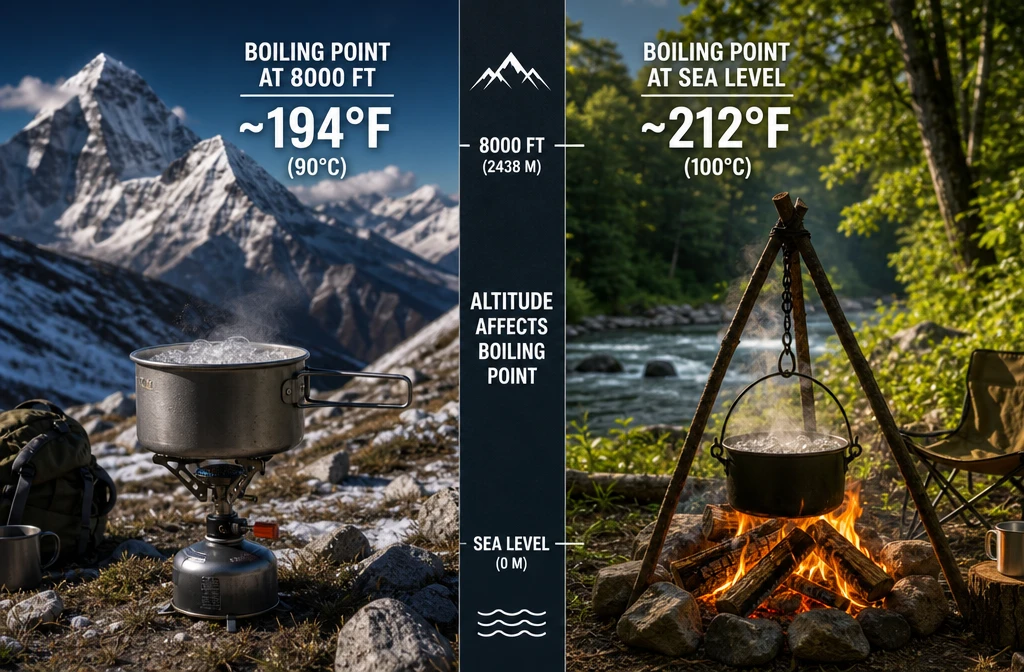
- Water boils at 212°F (100°C) at sea level but only around 194°F (90°C) at 10,000 feet — which is still hot enough to kill pathogens, but requires longer exposure time.
- Pasteurization works at 149°F (65°C) for 6 minutes, meaning water doesn’t need to reach a full boil to become safe.
- Boiling does not remove chemical contaminants, heavy metals, or salt — it only neutralizes biological threats.
- Turbid (cloudy) water should be filtered or settled before boiling for best results.
- Boiled water stored in a clean, sealed container stays safe for up to 24 hours at room temperature.
- Chemical tablets, UV purifiers, and quality filters are viable backup methods when fuel is scarce.
- High-risk water sources include stagnant ponds, floodwater, and water near agricultural runoff.
- Knowing your elevation before a crisis is a critical, often overlooked prep step.
How Long Do You Need to Boil Water to Kill Bacteria?
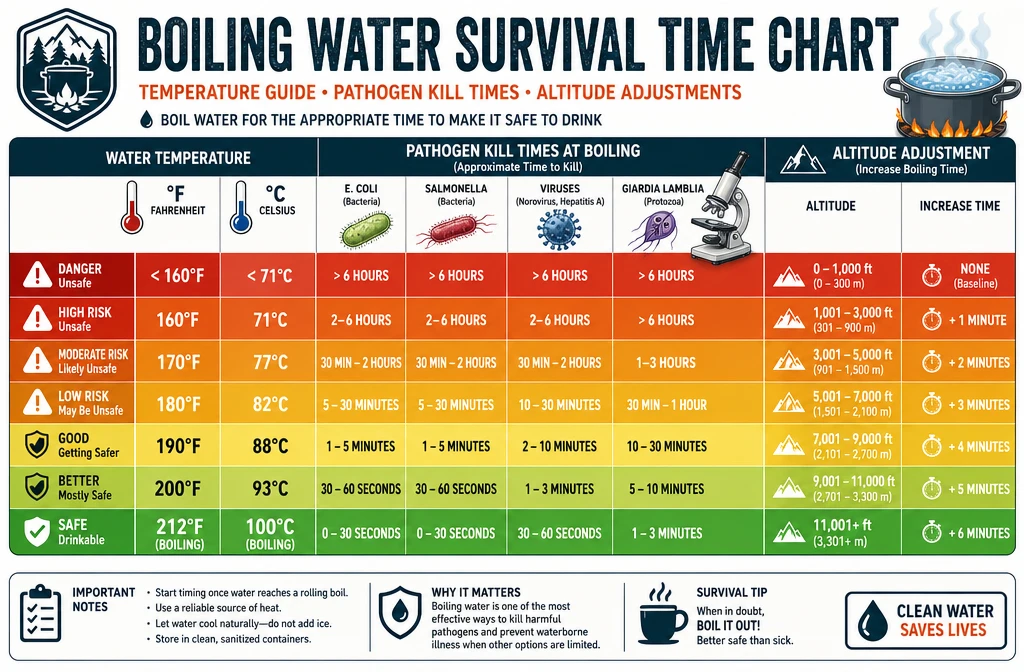
At sea level, a rolling boil for 1 minute kills all bacteria, viruses, and protozoa that cause waterborne illness. This is the consensus recommendation from the CDC, WHO, and the Wilderness Medical Society. For elevations above 6,500 feet, the standard is 3 minutes.
Here’s the core boiling water survival time-chart that every prepper should memorize or laminate for their kit:
| Elevation | Boiling Point | Recommended Boil Time |
|---|---|---|
| Sea level (0–2,000 ft) | 212°F / 100°C | 1 minute |
| Moderate altitude (2,000–6,500 ft) | ~203°F / 95°C | 1 minute |
| High altitude (6,500–10,000 ft) | ~194°F / 90°C | 3 minutes |
| Very high altitude (10,000–14,000 ft) | ~185°F / 85°C | 3–5 minutes |
| Extreme altitude (above 14,000 ft) | ~176°F / 80°C | 5 minutes |
💡 Key insight: The boil time isn’t about reaching a magic temperature — it’s about sustained heat exposure. Even at 185°F, waterborne pathogens die quickly. The extra minutes compensate for the lower boiling temperature at altitude.
Common mistake: Many people bring water to a boil, see bubbles, and immediately take it off the heat. That’s not a rolling boil — that’s just hot water. A rolling boil means large, vigorous bubbles that don’t stop when you stir the water.
What Temperature Actually Kills Waterborne Pathogens?
Most waterborne pathogens are killed at temperatures well below boiling. The critical threshold is around 149°F (65°C), which is the basis for water pasteurization. However, different organisms have different tolerances.
| Pathogen | Kill Temperature | Kill Time |
|---|---|---|
| Giardia lamblia (protozoa) | 131°F / 55°C | Several minutes |
| Cryptosporidium parvum | 140°F / 60°C | Several minutes |
| E. coli (bacteria) | 149°F / 65°C | Seconds at boiling |
| Hepatitis A (virus) | 185°F / 85°C | 1 minute |
| Norovirus | 140°F / 60°C | Several minutes |
The reason boiling is the gold standard isn’t because lower temperatures don’t work — it’s because a rolling boil is a visible, verifiable indicator that you’ve reached a safe temperature. In a field survival situation, you can’t measure 149°F without a thermometer. A boil is something you can see.
For those with a solar water pasteurizer or WAPI (Water Pasteurization Indicator), pasteurization at 149°F for 6 minutes is a legitimate, fuel-efficient alternative.
What’s the Difference Between Boiling and Pasteurization for Water Safety?
Boiling and pasteurization both make water biologically safe, but they work at different temperatures and serve different situations. Boiling reaches 212°F at sea level and kills pathogens almost instantly. Pasteurization uses sustained heat at lower temperatures — typically 149°F (65°C) for 6 minutes — to achieve the same biological result.
When to use each:
- Boiling — Best when you have a fire, stove, or reliable heat source and no thermometer. It’s the default field method because the visual cue (rolling boil) is unmistakable.
- Pasteurization — Best when fuel is limited, such as in solar cooking setups or when using a WAPI device. It uses less energy and works well for larger volumes of water.
The practical difference for preppers: Boiling is faster and requires less precision. Pasteurization is more fuel-efficient but requires either a thermometer or a WAPI indicator to confirm success. Neither method removes chemical contaminants — that’s a critical limitation both methods share.
Why Does Altitude Change Boiling Time for Water Safety?
Altitude reduces atmospheric pressure, which lowers the boiling point of water. At 10,000 feet, water boils at roughly 194°F (90°C) instead of 212°F (100°C). That’s still hot enough to kill pathogens, but the lower temperature means you need more exposure time to achieve the same kill rate.
This is why the boiling water survival time-chart changes with elevation — it’s not that the pathogens become harder to kill, it’s that the water is physically cooler when it boils.
Why this matters for specific survival scenarios:
- Mountain bugging out: If your bug-out plan takes you into high-altitude terrain, your standard 1-minute boil rule no longer applies.
- Wilderness camping above treeline: Snowmelt and glacial streams look pristine but can carry Giardia and Cryptosporidium.
- Off-grid homesteading at elevation: A consistent 3-minute boil should be the default practice if you’re above 6,500 feet.
Quick rule: If you’re high enough that you notice the air is thinner, add 2 extra minutes to your boil time. That’s a conservative, safe margin.
How Does Water Contamination Affect Boiling Effectiveness?
Boiling is highly effective against biological contamination but completely ineffective against chemical contamination. The type of contaminant in your water source determines whether boiling alone is sufficient or whether additional treatment is required.
Boiling handles:
- Bacteria (E. coli, Salmonella, Cholera)
- Viruses (Hepatitis A, Norovirus, Rotavirus)
- Protozoa (Giardia, Cryptosporidium)
Boiling does NOT handle:
- Heavy metals (lead, arsenic, mercury)
- Agricultural chemicals (pesticides, herbicides, nitrates)
- Industrial pollutants (petroleum, solvents)
- Salt or brackish water
- Radioactive particles
Turbidity (cloudiness) is a special case. Murky water contains suspended particles that can physically shield pathogens from heat, reducing boiling effectiveness. The fix is simple: pre-filter turbid water through a cloth, bandana, or coffee filter before boiling. This removes the larger particles and makes boiling far more reliable.
⚠️ Critical warning: Boiling contaminated floodwater or water near industrial sites can actually concentrate chemical contaminants as water evaporates. In those situations, boiling alone is not enough — you need activated carbon filtration or distillation.
For a deeper look at water storage mistakes that compromise safety before you even get to the boiling stage, see The Worst Water Storage Mistakes Preppers Still Make.
What Water Sources Are Most Risky for Contamination?
Not all water sources carry the same risk level. Understanding the threat profile of your water source helps you decide how much treatment is needed and whether boiling alone is sufficient.
Highest risk sources:
- Stagnant ponds and puddles (high bacteria and protozoa load)
- Floodwater (chemical and biological contamination combined)
- Water downstream from agricultural land (nitrates, pesticides)
- Urban runoff and storm drains (heavy metals, chemicals, fecal matter)
- Water near industrial sites or mining operations
Moderate risk sources:
- Slow-moving rivers and streams
- Collected rainwater (especially in urban areas)
- Shallow wells without casing
Lower risk sources (still require treatment):
- Fast-moving mountain streams
- Deep wells with proper casing
- Spring water from a known, tested source
The prepper’s rule of thumb: Treat every unknown water source as high risk. The clearest-looking mountain stream can carry Giardia from upstream wildlife. Visual clarity tells you nothing about biological safety.
Is Boiling Water Enough for Emergency Survival Situations?
In most biological contamination scenarios, yes — boiling is enough. For the vast majority of natural disaster, wilderness, and grid-down situations where the primary concern is waterborne illness from bacteria, viruses, and protozoa, a proper rolling boil following the boiling water survival time-chart is sufficient protection.
But boiling has real limits in specific scenarios:
| Scenario | Boiling Sufficient? | Why |
|---|---|---|
| Flood aftermath (biological only) | Yes | Kills pathogens |
| Flood aftermath (chemical spill nearby) | No | Can’t remove chemicals |
| Wilderness stream | Yes | Biological threat only |
| Water near industrial site | No | Chemical contamination |
| Post-nuclear event | No | Radioactive particles remain |
| Power outage, municipal supply disruption | Yes | Biological safety restored |
For EMP or grid failure scenarios where municipal water treatment stops but the source itself isn’t chemically compromised, boiling is a reliable primary treatment method. The challenge becomes fuel management — boiling water for a family of four over days or weeks consumes significant fuel resources.
This is why experienced preppers layer their water treatment: boiling for immediate needs, stored treated water for the first 72 hours, and filtration systems for longer-term scenarios.
Are There Faster Ways to Make Water Safe Besides Boiling?
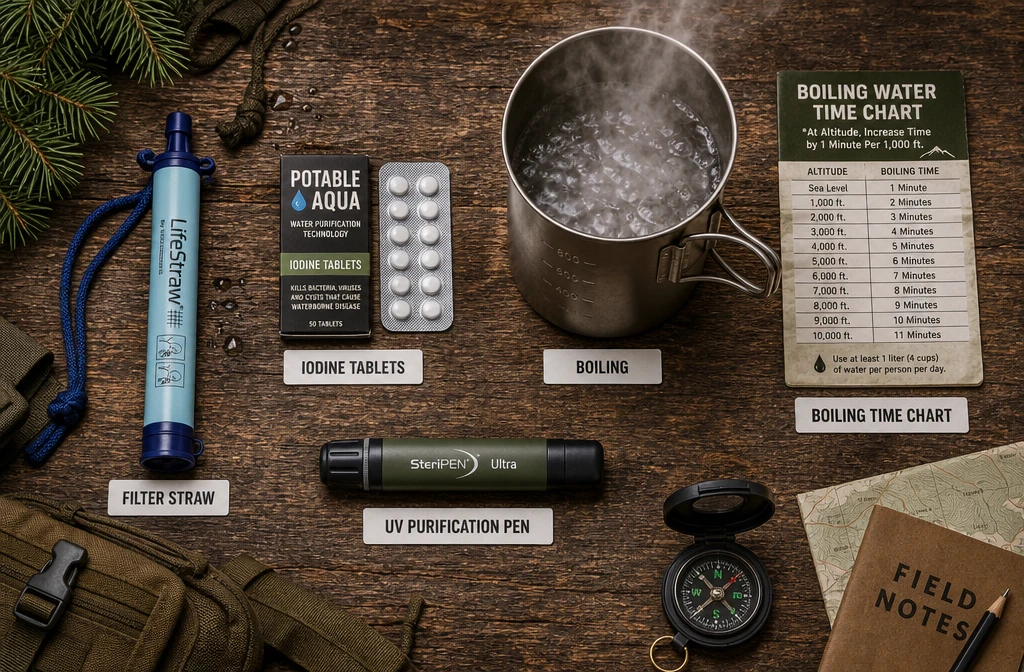
Yes — chemical treatment and UV purification can make water safe in minutes without any heat source. Each method has specific strengths and limitations that make it more or less suitable depending on the survival scenario.
Chemical treatment (iodine or chlorine tablets):
- Effective against bacteria and viruses in 30 minutes
- Cryptosporidium is resistant to iodine — requires 4+ hours or double dosing
- Lightweight, inexpensive, long shelf life
- Leaves a chemical taste (vitamin C tablets neutralize this)
- Not suitable for pregnant women or people with thyroid conditions (iodine)
UV purification (SteriPen and similar devices):
- Destroys pathogens in 60–90 seconds per liter
- Effective against Cryptosporidium (unlike iodine)
- Requires batteries or charging — a vulnerability in long-term grid-down situations
- Does not work well in turbid water (particles block UV light)
Portable water filters (LifeStraw, Sawyer Squeeze, Katadyn):
- Remove bacteria and protozoa mechanically
- Most standard filters do NOT remove viruses — critical in international or high-sewage-contamination environments
- Some advanced filters (hollow fiber + activated carbon) handle viruses and chemicals
The layered approach most preppers use:
- Pre-filter turbid water through cloth
- Boil when fuel is available
- Use chemical tablets or UV as backup when fuel is scarce
- Keep a quality filter for high-volume, ongoing needs
For more on building a complete water preparedness system, the Ultimate Emergency Water Storage and Purification Guide covers long-term storage, container selection, and treatment stacking in detail.
Do Water Filters Work as Well as Boiling?
Quality water filters are highly effective, but they don’t replace boiling in every situation. The comparison depends on what contaminants are present and what type of filter you’re using.
Standard filters (0.1–0.2 micron hollow fiber, like Sawyer Squeeze or LifeStraw):
- Remove 99.9999% of bacteria and 99.9% of protozoa
- Do NOT remove viruses (viruses are smaller than the filter pores)
- Effective for most North American wilderness water sources (low virus risk)
- Not effective in areas with high human sewage contamination
Advanced filters (like Katadyn BeFree or MSR Guardian):
- Some models filter viruses as well as bacteria and protozoa
- MSR Guardian, for example, is rated for virus removal — making it comparable to boiling for biological threats
- Higher cost, but significantly more capable
Boiling advantages over filtration:
- No equipment to break or clog
- Works on all biological threats including viruses
- No filter lifespan limitations
- Works with turbid water (after pre-filtering)
Filter advantages over boiling:
- No fuel required
- Faster for large volumes
- Works continuously without monitoring
The honest answer: For North American wilderness survival, a quality filter handles the realistic threat profile. For international travel, post-flood scenarios, or any situation with potential sewage contamination, boiling or UV treatment is the safer choice. Combining both is the most resilient approach.
How Long Can Boiled Water Stay Safe to Drink?
Boiled water stored in a clean, covered container stays safe for up to 24 hours at room temperature. If refrigerated, it can last 3–5 days. The risk isn’t re-contamination from pathogens surviving the boil — it’s recontamination from the environment after boiling.
Storage rules that matter:
- Let water cool before sealing in a container (hot water creates condensation that can introduce contaminants)
- Use clean containers — ideally ones that haven’t been used for anything other than water
- Keep containers covered and away from direct sunlight
- Don’t pour boiled water back into a container that held untreated water without cleaning it first
- Label containers with the time and date of boiling
The recontamination risk is real. Dipping a dirty cup into boiled water, leaving a container open, or using a container that wasn’t properly cleaned can reintroduce pathogens within hours. Treat your boiled water storage with the same discipline as the boiling process itself.
For apartment-based preppers managing water storage in limited space, the Apartment Water Storage Complete Guide covers container selection and rotation strategies that keep stored water safe long-term.
What Are Common Mistakes People Make When Purifying Water?
The most dangerous mistake is assuming water is safe when it isn’t — usually because of a shortcut taken during treatment. These are the errors that cause illness in real survival situations.
Top purification mistakes:
-
Not reaching a full rolling boil — Simmering or steaming water is not the same as boiling. Only large, vigorous bubbles confirm you’ve hit the required temperature.
-
Ignoring altitude — Using the 1-minute sea-level rule at 8,000 feet leaves a safety margin that doesn’t exist. Know your elevation.
-
Boiling chemically contaminated water — Boiling floodwater near industrial or agricultural areas can concentrate toxins. Boiling is not a universal solution.
-
Skipping pre-filtration on turbid water — Murky water can shield pathogens from heat. Always clarify cloudy water before boiling.
-
Recontaminating treated water — Using dirty containers, leaving water uncovered, or mixing treated and untreated water undoes all your work.
-
Trusting filters for virus removal when they’re not rated for it — Standard hollow-fiber filters don’t remove viruses. In high-sewage environments, this is a serious gap.
-
Running out of fuel — Boiling requires sustained heat. Not having enough fuel for a multi-day scenario is a planning failure, not a purification failure.
-
Forgetting to treat the container — A clean container is as important as clean water. Rinsing with a small amount of boiled water before filling is a simple but effective habit.
These mistakes are covered in depth in the broader context of 14 Essential Survival Skills Every Prepper Must Know — water treatment is consistently ranked among the most critical.
What Survival Scenarios Require Precise Water Purification Techniques?
Certain survival scenarios demand more than the standard boil-and-drink approach. When the threat profile is complex or resources are constrained, precision matters.
Scenarios requiring careful technique:
- Long-term grid-down situations: Fuel becomes a rationed resource. Switching to solar pasteurization, gravity filters, or chemical treatment conserves fuel for cooking and warmth.
- Wilderness bug-out at altitude: The boiling water survival time-chart changes at elevation, and the water sources (snowmelt, glacial streams) carry specific protozoa risks.
- Post-flood urban survival: Multiple contamination types (biological + chemical) require layered treatment — pre-filtering, activated carbon, then boiling or UV.
- International disaster relief or travel: Virus contamination risk is higher in areas with inadequate sewage infrastructure. Standard filters alone are insufficient.
- Immunocompromised individuals: Children under 6 months, elderly individuals, and those with compromised immune systems need water treated to a higher standard — longer boil times and cleaner storage practices.
The 25 Most Critical Wilderness Survival Skills ranks water treatment as a top-tier life-saving skill precisely because the margin for error in these scenarios is extremely thin.
Where Can You Find a Reliable Boiling Water Survival Time-Chart?
The most authoritative boiling water survival time-charts come from the CDC, WHO, and the Wilderness Medical Society. These organizations publish water treatment guidelines based on peer-reviewed research and field-tested protocols.
Recommended sources for printable/downloadable charts:
- CDC Emergency Water Safety page — covers boiling, chemical treatment, and filtration with clear time/temperature guidelines
- WHO Household Water Treatment guide — detailed coverage of pasteurization and boiling at various elevations
- Wilderness Medical Society Clinical Practice Guidelines — the gold standard for backcountry water treatment, used by wilderness medicine professionals
For preppers: Print a laminated copy of the boiling water survival time-chart and store it in your bug-out bag, water treatment kit, and home emergency binder. Digital resources disappear when the grid goes down. A laminated card costs nothing and lasts years.
FAQ: Boiling Water for Survival
Q: Does boiling water twice make it safer? No. A single rolling boil for the appropriate time (1–3 minutes depending on altitude) is sufficient. Boiling twice doesn’t add safety — it just wastes fuel and increases the concentration of any dissolved minerals.
Q: Can I drink water that’s been boiled and then cooled in an open pot overnight? Technically it’s safe if the environment is clean, but open containers invite recontamination from insects, dust, and airborne particles. Always cover cooling water and transfer it to a sealed container as soon as it’s cool enough to handle.
Q: Is rainwater safe without boiling? Collected rainwater can contain bacteria, pollutants, and particulates depending on your collection surface and local air quality. Treat it as untrusted water and boil or filter before drinking.
Q: Does adding bleach before boiling make water safer? You can use one or the other — not both for the same batch. Bleach (unscented sodium hypochlorite, 8 drops per gallon for clear water) is a standalone treatment method. Boiling is another. Combining them is unnecessary and can create unpleasant taste without additional safety benefit.
Q: How do I know when I’ve reached a rolling boil? A rolling boil produces large, vigorous bubbles across the entire surface that continue even when you stir the water. Small bubbles forming on the bottom of the pot are not a rolling boil — that’s just the water heating up.
Q: Can I boil water in a plastic bottle in an emergency? Yes, if the bottle is food-grade and you keep it submerged or filled to the top (so the plastic above the waterline doesn’t melt). This is an emergency technique, not a regular practice. Metal containers are always preferable for boiling.
Q: Does boiling remove the taste of bad water? Boiling kills pathogens but doesn’t remove the compounds causing bad taste or odor. Activated carbon filtration (before or after boiling) addresses taste and odor issues.
Q: What’s the minimum temperature needed to kill Cryptosporidium? Cryptosporidium is killed at approximately 140°F (60°C) when held for several minutes, according to CDC data. A rolling boil exceeds this threshold comfortably. This is one reason Cryptosporidium is resistant to standard iodine treatment but not to boiling.
Q: Is it safe to boil water in a cast iron pot? Yes. Cast iron is safe for boiling water and is one of the most durable options for campfire cooking. Just be aware that cast iron can leach small amounts of iron into water — generally not harmful and sometimes beneficial, but relevant for those on iron-restricted diets.
Q: How much water should I boil per day per person? The baseline survival requirement is 1 gallon (approximately 4 liters) per person per day — half a gallon for drinking, the rest for sanitation and food preparation. In hot weather, physical exertion, or for nursing mothers, increase this to 1.5–2 gallons per person per day.
Conclusion: Build Your Water Safety System Before You Need It
Water purification isn’t a skill you want to figure out when you’re already thirsty, sick, or in the middle of a crisis. The boiling water survival time-chart is one of the most practical, low-cost tools in any prepper’s knowledge base — but knowing the chart is only the first step.
Actionable next steps:
- Print and laminate the boiling water survival time-chart from this article. Store copies in your bug-out bag, home emergency kit, and vehicle.
- Know your elevation. Look up the elevation of your home, your bug-out location, and any terrain you might travel through. Adjust your boil time accordingly.
- Test your fuel supply. How long can you boil water for your household with the fuel you currently have stored? Run the numbers.
- Build a layered water treatment kit: a quality filter, chemical tablets, and a reliable heat source — not just one method.
- Practice pre-filtering turbid water with materials you already have (cloth, bandana, coffee filters).
- Store clean containers specifically designated for boiled water. Label them. Keep them covered.
Preparedness is about confidence, not fear. Knowing exactly how to make water safe in any scenario — from a weekend camping trip to a multi-week grid-down event — is the kind of foundational knowledge that protects your family when systems fail.
For a complete water preparedness system beyond boiling, explore the Ultimate Emergency Water Storage and Purification Guide and make sure you’re not making the common errors covered in The Worst Water Storage Mistakes Preppers Still Make.
Products, Tools & Resources
These are the tools that experienced preppers actually rely on for water purification — not the cheapest options on the shelf, but the ones that hold up when it matters.
🔥 Heat Sources for Boiling
- MSR PocketRocket 2 Stove — Compact, reliable, and fuel-efficient. A solid choice for bug-out bags where fuel weight matters.
- Solo Stove Lite — Burns twigs and biomass, so you’re not dependent on stored fuel canisters. Excellent for long-term wilderness scenarios.
🧪 Chemical Treatment
- Aquatabs (sodium dichloroisocyanurate) — Widely used by international aid organizations. Effective against bacteria and viruses in 30 minutes. Compact and lightweight.
- Potable Aqua Iodine Tablets — A classic prepper staple. Pair with the neutralizing tablets to eliminate the iodine taste.
💧 Portable Filters
- Sawyer Squeeze Filter — Filters to 0.1 micron, removes bacteria and protozoa, rated for 100,000 gallons. One of the best value-to-performance options available.
- MSR Guardian Purifier — Removes viruses, bacteria, and protozoa. The choice for international use or high-contamination environments. Higher cost, but unmatched capability.
☀️ UV Purification
- SteriPen Adventurer Opti — Purifies 1 liter in 90 seconds using UV light. Lightweight and fast, but requires batteries. Keep spares.
📋 Reference Tools
- WAPI (Water Pasteurization Indicator) — A small wax pellet in a tube that melts at 149°F, confirming pasteurization is complete. Invaluable for solar water pasteurization setups.
- Laminated water purification reference card — Print the boiling water survival time-chart from this article and laminate it. Free, durable, and doesn’t need batteries.
📚 Related Reading
- The Ultimate Emergency Water Storage and Purification Guide
- Apartment Water Storage: Complete Guide
- 25 Most Critical Wilderness Survival Skills
- 14 Essential Survival Skills Every Prepper Must Know
References
- Centers for Disease Control and Prevention (CDC). Making Water Safe in an Emergency. U.S. Department of Health & Human Services. https://www.cdc.gov/healthywater/emergency/making-water-safe.html
- World Health Organization (WHO). Household Water Treatment and Safe Storage. WHO Press, 2011. https://www.who.int/water_sanitation_health/dwq/wsh0207/en/
- Wilderness Medical Society. Wilderness Medical Society Clinical Practice Guidelines for Water Disinfection for Wilderness, International, and Austere Environments. Wilderness & Environmental Medicine, 2020. https://www.wems.org/
- Backer, H. Water Disinfection for International and Wilderness Travelers. Clinical Infectious Diseases, 2002. https://academic.oup.com/cid/article/34/3/355/308833
- U.S. Environmental Protection Agency (EPA). Emergency Disinfection of Drinking Water. EPA, 2022. https://www.epa.gov/ground-water-and-drinking-water/emergency-disinfection-drinking-water