
Hey there! Some links on this page may be affiliate links which means that, if you choose to make a purchase, I may earn a commission at no extra cost to you. I greatly appreciate your support. Read the full disclosure here.
Most people walk past hundreds of calories every single day without realizing it. The dandelion pushing through a sidewalk crack, the chickweed carpeting a shaded lawn, the cattails lining a roadside ditch, these are not weeds. For a prepared survivalist, they are a living food supply that requires no grid, no supply chain, and no refrigeration.
Foraging edible wild plants is one of the most practical survival skills a prepper can develop. It costs nothing to learn, it’s available in virtually every climate zone in North America, and it works whether you’re bugging out through the woods or supplementing your homestead diet between harvests. This guide covers 25 plants beginners can realistically identify and use, along with the safety rules, seasonal timing, and field craft that separate confident foragers from people who get sick.
Key Takeaways
- Dandelion, plantain, chickweed, and lamb’s quarters are among the safest and most widely distributed edible wild plants for beginners to learn first.
- The universal edibility test is a structured, step-by-step method for evaluating unknown plants when a field guide is unavailable, but it is a last resort, not a routine practice.
- Toxic look-alikes exist for many edible species; learning two or three distinguishing features per plant is non-negotiable before consuming anything.
- Spring and early fall offer the best foraging windows for most leafy edible plants; summer is prime for berries and seeds.
- No federal permit is required for personal-use foraging on most public lands in the United States, but regulations vary by state, county, and land management agency.
- Foraging should supplement a prepared food supply, not replace it. It pairs naturally with long-term food storage as a layered resilience strategy.
- Common beginner mistakes include misidentification, foraging near contaminated soil, and harvesting too aggressively from a single patch.
- A quality field guide, a small folding knife, and a cotton collection bag are the only tools required to start.
Find this useful? Add us as a preferred source on Google and more of what we publish will show up in your results.
What Are the Easiest Edible Wild Plants for Beginners to Identify
The easiest edible wild plants for beginners are those with distinctive, hard-to-confuse features and no dangerous look-alikes in the same region. Start with species that are abundant, have multiple identifying characteristics, and are useful in multiple ways.
Here are 25 plants organized by beginner-friendliness and availability across North America:
Tier 1, Start Here (Lowest Risk, Highest Distribution)
-
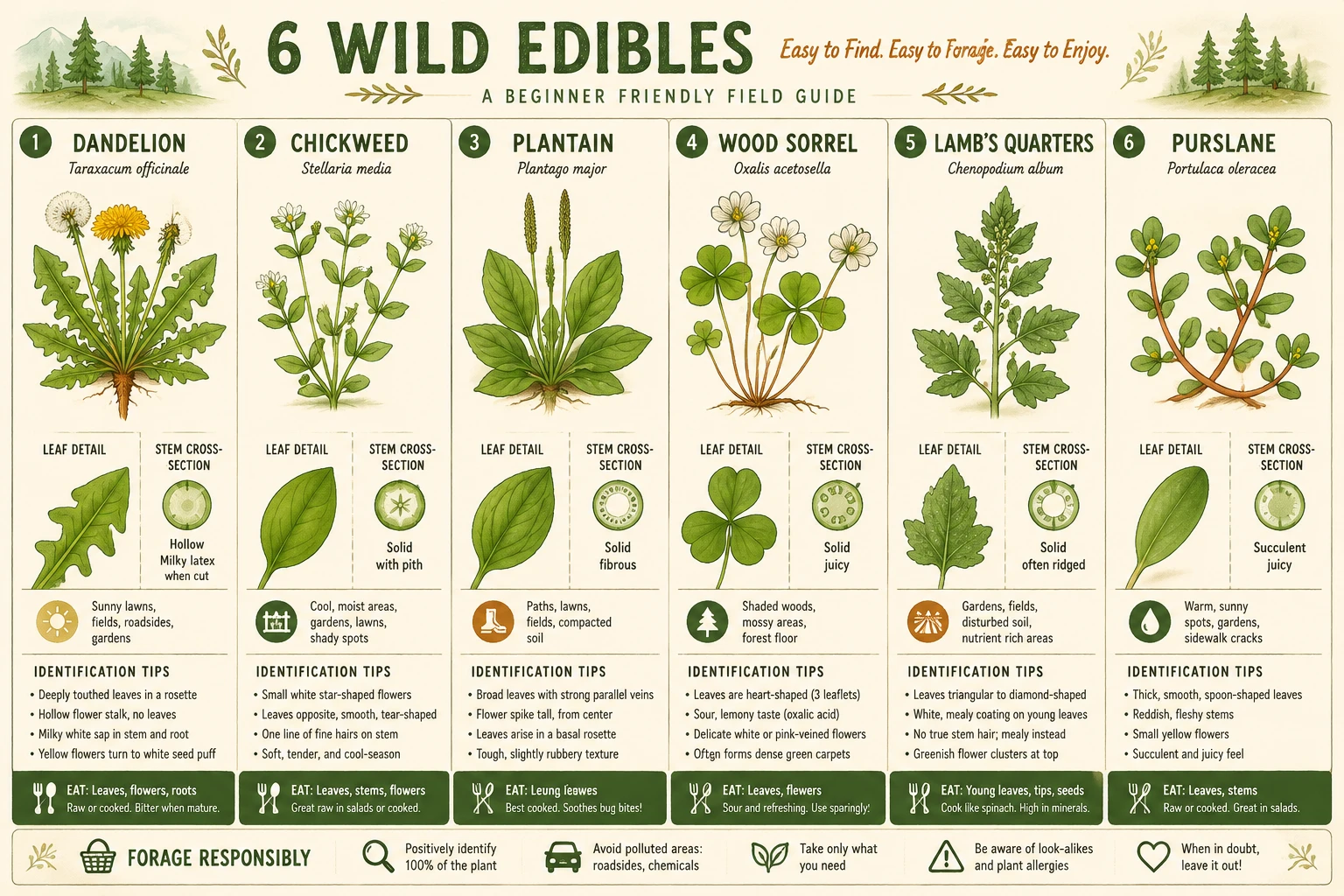
Dandelion (Taraxacum officinale), Entire plant is edible: leaves, flowers, and roots. Toothed leaves grow in a basal rosette; hollow stem produces milky sap; bright yellow composite flower. Found in lawns, roadsides, and disturbed soil across all of North America.
-
Broadleaf Plantain (Plantago major), Oval leaves with parallel veins and fibrous strings when torn. Grows in compacted soil, paths, and lawns. Leaves are edible raw or cooked; seeds are nutritious.
-
Chickweed (Stellaria media), Small, star-shaped white flowers; leaves in opposite pairs; a single line of fine hairs runs along the stem. Mild flavor, excellent raw in salads. Thrives in cool, moist conditions.
-
Wood Sorrel (Oxalis spp.), Heart-shaped leaflets in groups of three, similar to clover but with a distinct lemon-sour taste. Yellow or white flowers. Edible raw; high in vitamin C.
-
Lamb’s Quarters (Chenopodium album), Powdery white coating on young leaves; diamond-shaped leaf with toothed margins. One of the most nutritious wild greens available; tastes like spinach when cooked.
-
Purslane (Portulaca oleracea), Thick, succulent leaves; reddish stems; grows low and spreading. High in omega-3 fatty acids. Common in gardens and disturbed soil.
-
Clover (Trifolium spp.), Three-leaflet structure; round pink or white flower heads. Flowers and young leaves are edible raw or steeped as tea.
-
Cattail (Typha spp.), Tall, distinctive brown seed head; grows in wet areas. Young shoots, pollen, and green seed heads are all edible. One of the most calorie-dense wild plants available.
-
Stinging Nettle (Urtica dioica), Serrated leaves with tiny stinging hairs; cooking or drying neutralizes the sting. Rich in iron, calcium, and protein. Found near streams and disturbed ground.
-
Wild Garlic / Ramps (Allium ursinum / Allium tricoccum), Garlic smell when crushed is the definitive identifier. Broad, smooth leaves; white flowers. Edible bulbs, leaves, and flowers.
Tier 2, Learn After Mastering Tier 1
-
Elderberry (Sambucus nigra), Clusters of small dark purple-black berries; compound leaves with 5-9 leaflets; distinctive smell. Ripe berries are edible cooked; raw berries and all other plant parts are toxic.
-
Wild Raspberry / Blackberry (Rubus spp.), Thorny canes; compound leaves; familiar berry structure. Berries are edible raw; leaves make a useful tea.
-
Watercress (Nasturtium officinale), Grows in clean, flowing water; small rounded leaflets; peppery taste. Excellent raw green, but only harvest from unpolluted water sources.
-
Miner’s Lettuce (Claytonia perfoliata), Distinctive round leaf that appears to wrap around the stem; mild flavor. Common in the western United States.
-
Hawthorn (Crataegus spp.), Thorny shrub or small tree; small red or orange berry-like fruits (haws). Edible raw or cooked into jams; leaves and flowers are also edible.
-
Wild Violet (Viola spp.), Heart-shaped leaves; purple, white, or yellow flowers. Leaves and flowers are edible raw; high in vitamins A and C.
-
Sheep Sorrel (Rumex acetosella), Arrow-shaped leaves with a tart, lemony flavor; reddish seed stalks. Edible raw in small quantities; avoid large amounts due to oxalic acid content.
-
Burdock (Arctium spp.), Very large leaves; round, burr-covered seed heads; thick taproot. Root is edible cooked (similar to parsnip); young stalks and leaves are edible.
-
Amaranth (Amaranthus spp.), Upright plant with dense seed spikes; leaves resemble lamb’s quarters. Seeds and leaves are both edible; seeds are highly nutritious.
-
Pine (Pinus spp.), Inner bark, young needles, and pine nuts are all edible. Pine needle tea provides vitamin C. Needles come in bundles of 2-5 depending on species.
Tier 3, Require More Confident Identification
-
Wild Carrot / Queen Anne’s Lace (Daucus carota), Lacy white flower with a single purple floret in the center; hairy stem; carrot smell from root. Critical: do not confuse with poison hemlock (see identification section below).
-
Chicory (Cichorium intybus), Bright blue flowers; milky sap in stems; basal rosette similar to dandelion. Roots can be roasted as a coffee substitute; leaves are edible but bitter.
-
Mullein (Verbascum thapsus), Tall spike with yellow flowers; large, soft, fuzzy leaves in a basal rosette. Leaves used medicinally as a respiratory herb; not typically eaten but useful to know.
-
Hackberry (Celtis spp.), Tree with distinctive warty bark; small, dark berries with a sweet, date-like flavor. One of the most calorie-dense wild fruits in North America.
-
Acorns (Quercus spp.), All oak species produce acorns. Raw acorns contain bitter tannins and must be leached in water before eating, but processed acorn flour is highly nutritious and calorie-dense.
How Do You Know If a Wild Plant Is Safe to Eat
A wild plant is safe to eat when you have positively confirmed its identity using at least two independent methods and have verified that no toxic look-alikes share the same habitat. Guessing is not a strategy.
The three-step verification method:
-
Use a regional field guide. A guide specific to your geographic area is far more reliable than a general North American guide. Cross-reference the plant’s leaf shape, stem structure, flower color, smell, and habitat.
-
Confirm with a plant identification app. Apps like iNaturalist or PlantNet can provide a second opinion, but treat app results as a starting point, not a final answer. Apps misidentify plants regularly.
-
Apply the universal edibility test as a last resort. This military-derived protocol involves testing small amounts of a plant on skin, lips, and tongue over several hours before consuming any quantity. It does not detect all toxins and should only be used when no other identification method is available.
Common safety rules every beginner must follow:
- Never eat a plant you cannot identify with certainty.
- Avoid plants with milky or colored sap (exceptions: dandelion, wild lettuce, learn these specifically).
- Avoid plants with umbrella-shaped flower clusters unless you are certain of the species (the carrot family contains deadly members).
- Avoid anything that smells like almonds (possible cyanide compounds).
- When in doubt, leave it out.
What Is the Difference Between Edible and Poisonous Look-Alike Plants
Some of the most dangerous poisoning cases in North America involve edible wild plants that closely resemble toxic species. The difference between a safe meal and a medical emergency can come down to a single feature.
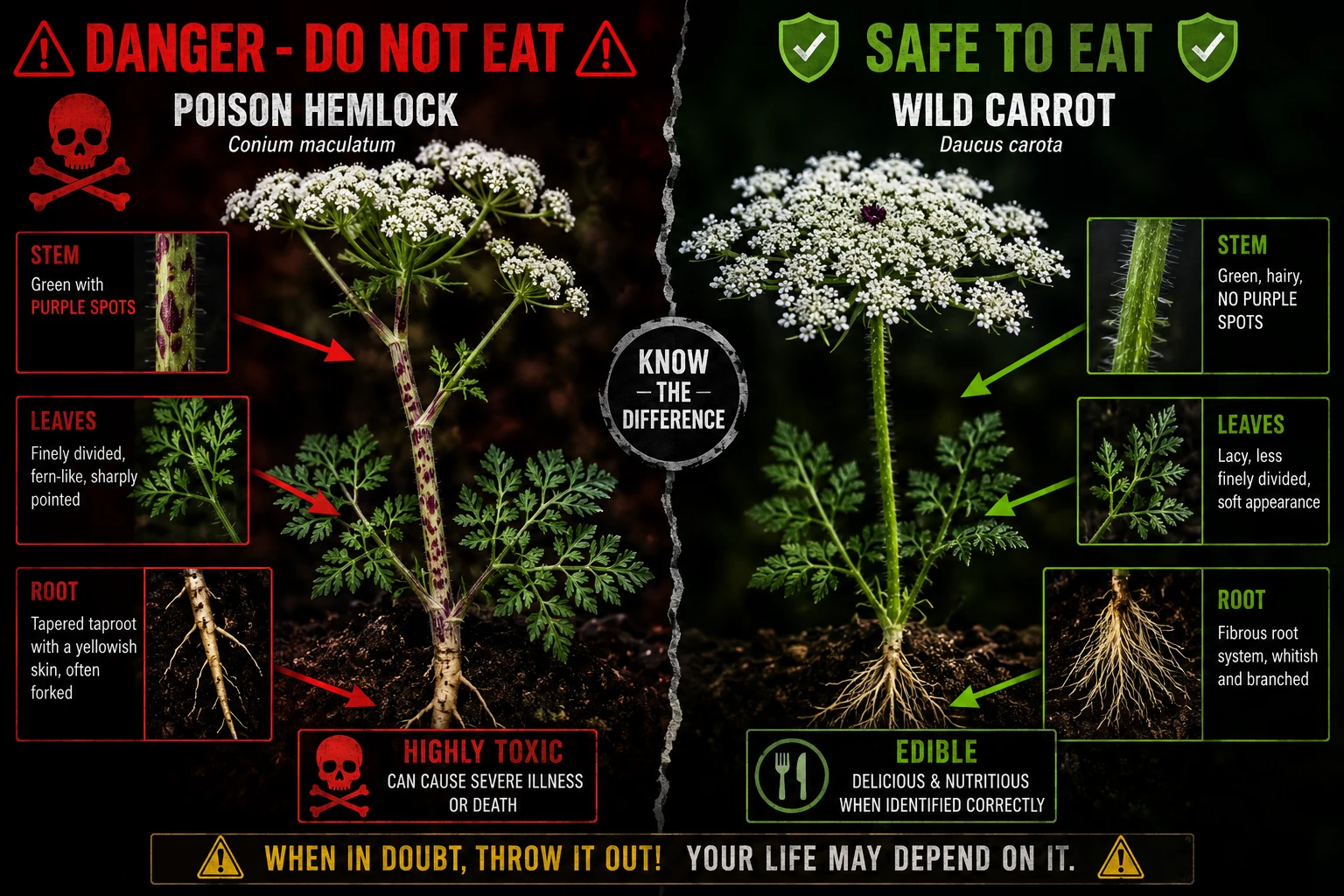
The most critical look-alike pairs every beginner must know:
| Edible Plant | Dangerous Look-Alike | Key Distinguishing Feature |
|---|---|---|
| Wild Carrot (Queen Anne’s Lace) | Poison Hemlock | Hemlock has purple-blotched, hairless stems and no carrot smell. Wild carrot has hairy stems and smells like carrot. |
| Wild Garlic / Ramps | Lily of the Valley / Death Camas | True wild garlic always smells strongly of garlic when crushed. No garlic smell means do not eat it. |
| Elderberry | Pokeweed / Water Hemlock | Elderberry has compound leaves with 5-9 leaflets and a distinctive smell. Pokeweed has simple, large leaves and purple-stained stems. |
| Lamb’s Quarters | Nettleleaf Goosefoot (less toxic but bitter) | Lamb’s quarters has a distinctive white, mealy coating on young leaves. Rub a leaf, if it feels powdery and white comes off, it’s likely lamb’s quarters. |
| Wild Raspberry | Nightshade berries | Raspberries and blackberries have a hollow core when picked and grow on thorny canes. Nightshade berries grow on non-thorny plants and have a different flower structure. |
The rule that saves lives: Learn the dangerous plants in your region before you learn the edible ones. Knowing what to avoid is more important than knowing what to eat.
Best Time of Year to Forage for Wild Edible Plants
The best foraging season depends on the plant and your climate zone, but spring and early fall are the most productive windows for leafy edible wild plants across most of North America.
Seasonal foraging calendar:
- Early spring (March-April): Best for tender leafy greens, chickweed, dandelion, lamb’s quarters, nettles, ramps, and miner’s lettuce. Plants are young, mild, and most nutritious before they bolt.
- Late spring (May-June): Elderflowers, clover flowers, cattail pollen, and wild strawberries. Watercress peaks in cool spring streams.
- Summer (July-August): Berries dominate, raspberries, blackberries, elderberries, and hackberries. Purslane thrives in summer heat. Seeds from amaranth and lamb’s quarters begin to mature.
- Fall (September-October): Acorns, hawthorn berries, rose hips, and burdock root. Root vegetables like burdock and chicory are best harvested in fall when energy is stored below ground.
- Winter: Slim pickings in most climates, but pine needles, inner bark, and overwintering rosettes (plantain, dandelion) remain available in milder zones.
Practical tip for preppers: Build a foraging calendar specific to your bug-out region. Walk the same routes in different seasons and document what’s available. This kind of ground truth is more valuable than any general guide. This skill pairs directly with wilderness survival skills that every prepper should develop before a crisis hits.
Can You Get Sick From Eating Wild Plants You Foraged
Yes, and it happens more often than most people expect. The risks fall into three categories: misidentification, contamination, and individual sensitivity.
Misidentification is the most serious risk and causes the most severe outcomes, including death. Poison hemlock, water hemlock, and death camas have killed experienced foragers. There is no antidote for many plant toxins.
Contamination is the second most common cause of illness. Plants growing near roadsides, agricultural fields, industrial sites, or in urban areas may carry:
- Heavy metals (lead, cadmium) from soil contamination
- Pesticide and herbicide residue
- Fecal coliform bacteria from animal waste or sewage runoff
Individual sensitivity affects a smaller percentage of foragers. Some people react to oxalic acid in sorrel and wood sorrel, or to the latex in dandelion stems. Introduce any new foraged food in small quantities first.
Risk reduction rules:
- Never forage within 50 feet of a heavily trafficked road.
- Avoid areas that show signs of herbicide application (yellowed, dying patches of vegetation).
- Wash all foraged plants thoroughly before eating.
- Cook plants from contaminated-risk areas rather than eating raw.
- If you experience nausea, vomiting, or unusual symptoms after eating a foraged plant, seek medical attention immediately and bring a sample of what you ate.
Edible Wild Plants That Grow in Your Area: How to Find Local Species
Edible wild plants are not evenly distributed. The species available to a forager in the Pacific Northwest are different from those in the Appalachians, the Great Plains, or the Sonoran Desert. Learning your local plant community is the foundation of practical foraging.
How to identify what grows near you:
-
Get a regional field guide. Look for guides organized by state, region, or ecoregion. Samuel Thayer’s Nature’s Garden and The Forager’s Harvest are widely regarded as among the most accurate available for North American foragers.
-
Use iNaturalist. This free platform allows you to explore observations in your specific area, filtered by plant species. It shows you exactly what other foragers and naturalists have documented near your location.
-
Join a local foraging group. Many regions have active foraging communities on social media platforms or through mycological and native plant societies. Walking with experienced local foragers accelerates learning dramatically.
-
Start in your own backyard. Most suburban and rural yards contain at least five to ten edible wild plants. Dandelion, plantain, chickweed, clover, and wood sorrel are present in the vast majority of American lawns.
Regional quick reference:
- Northeast/Mid-Atlantic: Ramps, fiddlehead ferns, black raspberries, elderberry, cattail
- Southeast: Muscadine grapes, pawpaw, persimmon, spiderwort, wood sorrel
- Midwest/Great Plains: Prairie turnip, lamb’s quarters, amaranth, wild plum, hackberry
- Pacific Northwest: Stinging nettle, miner’s lettuce, salal berries, Oregon grape, wood sorrel
- Southwest/Desert: Prickly pear cactus, mesquite pods, purslane, amaranth, cattail
Do You Need a License or Permit to Forage Wild Plants
For personal-use foraging of edible wild plants on most U.S. public lands, no permit is required, but the rules vary significantly depending on who manages the land.
General rules by land type:
- National Forests (USDA Forest Service): Personal-use foraging of plants, berries, and mushrooms is generally permitted without a permit. Commercial harvesting requires a permit.
- National Parks (NPS): Foraging is generally prohibited or severely restricted. The National Park Service’s mandate is preservation, not harvest.
- Bureau of Land Management (BLM) lands: Personal-use foraging is typically allowed; check with the local field office for specific rules.
- State parks and forests: Rules vary widely by state. Some states allow personal-use foraging; others prohibit it entirely.
- Private land: Always obtain permission from the landowner. Foraging without permission is trespassing.
The practical prepper approach: Know the land management rules for your bug-out area before you need them. Include this in your bug out plan so you’re not improvising legal questions during a crisis.
Common Mistakes Beginners Make When Foraging
The most dangerous mistake a beginner forager makes is acting on partial information. Confidence without competence is the fastest path to a medical emergency.
The most common beginner errors:
- Relying on a single identifying feature. One characteristic is rarely enough. Confirm species with leaf shape, stem structure, smell, habitat, and flower or seed characteristics together.
- Using app identification as final confirmation. Plant ID apps have error rates that are unacceptable for food safety decisions. Use them as a starting point, then verify with a printed field guide.
- Foraging in contaminated areas. Roadside ditches, vacant lots in urban areas, and fields adjacent to conventional agriculture carry real contamination risks.
- Over-harvesting a single patch. Sustainable foraging means taking no more than one-third of any plant population in a given area. Stripping a patch eliminates a future food source.
- Ignoring seasonal timing. Some plants are edible only at specific growth stages. Elderberries are safe when ripe and cooked; unripe berries and all other plant parts are toxic. Pokeweed shoots are edible when very young but become increasingly toxic as the plant matures.
- Skipping the smell test. Smell is one of the most reliable identification tools available. Wild garlic smells like garlic. Poison hemlock has a musty, unpleasant odor. Carrots smell like carrots.
This connects directly to broader bushcraft skills that take time to develop, foraging is a practiced skill, not a one-time lesson.
How to Properly Clean and Prepare Foraged Wild Plants
Cleaning foraged plants properly removes contaminants, parasites, and surface residue that can cause illness even when the plant itself is safe to eat.
Standard cleaning protocol:
- Remove damaged, discolored, or insect-damaged portions in the field before packing.
- Soak in cold water for 10-15 minutes to loosen soil and dislodge insects.
- Rinse under running water while agitating leaves gently.
- For plants from areas with any contamination risk, a brief soak in a diluted vinegar solution (1 part vinegar to 3 parts water) for 5 minutes adds a layer of surface decontamination.
- Pat dry or spin dry before eating raw or storing.
Preparation methods by plant type:
- Tender greens (chickweed, wood sorrel, miner’s lettuce): Best raw in salads; heat destroys texture and some nutrients.
- Tougher greens (lamb’s quarters, nettles, dandelion leaves): Blanch or sauté to improve palatability and reduce bitterness. Boiling nettles for 2 minutes fully neutralizes the sting.
- Roots (burdock, chicory): Peel, slice, and cook like any root vegetable. Burdock root benefits from a 20-minute simmer.
- Acorns: Grind into meal, then leach tannins by soaking in multiple changes of cold water over 12-24 hours, or hot water over 2-3 hours. Taste-test for bitterness; leach further if needed.
- Berries (elderberry, hackberry): Cook elderberries before eating. Other berries can be eaten raw when fully ripe.
Are Wild Plants More Nutritious Than Store-Bought Vegetables
In many cases, yes. Several studies have found that wild-harvested edible plants contain significantly higher concentrations of vitamins, minerals, and antioxidants compared to commercially grown equivalents. This is partly because wild plants grow without artificial fertilizers, are not bred for yield at the expense of nutrient density, and are typically consumed fresh.
Notable nutritional comparisons:
- Dandelion greens contain more beta-carotene than carrots and more calcium than milk, per gram.
- Lamb’s quarters have higher protein content than spinach and comparable iron levels.
- Purslane is one of the richest plant-based sources of omega-3 fatty acids available anywhere.
- Stinging nettle contains iron levels that rival meat sources per serving.
The honest caveat: Nutritional content varies significantly based on soil quality, plant age, and preparation method. Boiling leaches water-soluble vitamins. Foraging supplements nutrition, it does not guarantee it. For long-term food security, wild plants work best as part of a broader strategy that includes long-term food storage and a diversified food supply.
Edible Wild Plants vs. Supplements and Vitamins
Edible wild plants provide bioavailable nutrients in forms the body absorbs efficiently, but they cannot reliably replace a structured supplement regimen during extended survival scenarios.
Where wild plants outperform supplements:
- Fresh wild greens provide fiber, hydration, and phytonutrients that no pill replicates.
- Pine needle tea delivers vitamin C in a form the body uses immediately, critical for preventing scurvy during long-term grid-down situations.
- Wild plants provide calories, which supplements do not.
Where supplements have the edge:
- Supplements are consistent, measurable, and not subject to seasonal availability.
- Certain nutrients, vitamin D, B12, iodine, are difficult or impossible to obtain reliably from wild plants in most regions.
- Supplements don’t require identification, preparation, or contamination risk management.
The prepper’s practical position: Maintain a supplement stockpile for nutrients that wild plants cannot reliably provide (B12, D3, iodine, zinc), and build foraging knowledge as a calorie and micronutrient supplement for scenarios where your stored supply is depleted. This also connects well with emergency herbal medicine knowledge, which overlaps significantly with foraging skills.
What Equipment Do You Need to Start Foraging
Foraging requires minimal gear. The most important tool is knowledge, not equipment.
Essential starter kit:
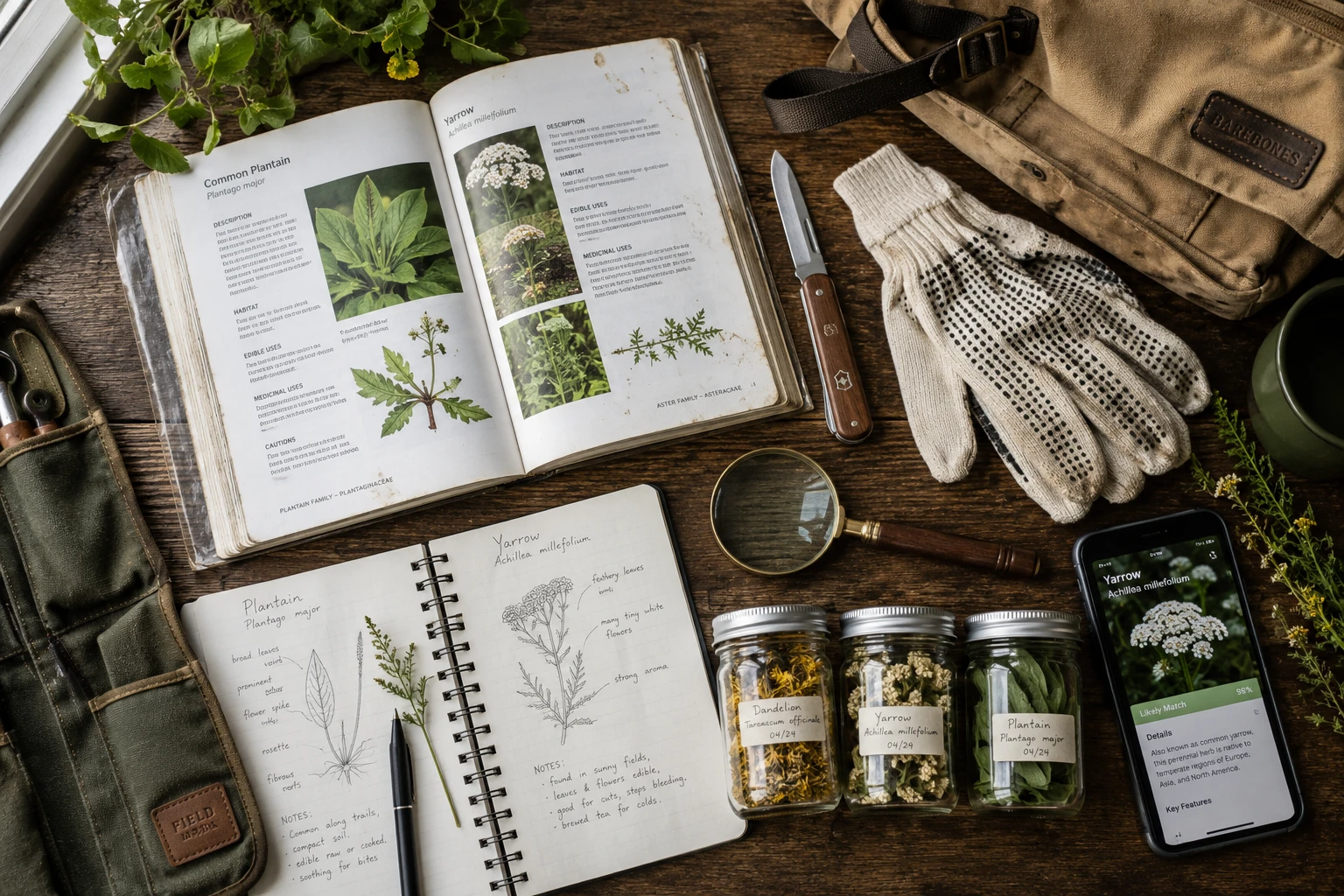
- Regional field guide: One printed, waterproof or laminated guide for your specific area. Do not rely solely on digital resources that require battery power.
- Small folding knife or garden snips: For clean harvesting without damaging root systems.
- Cotton or mesh collection bag: Breathable material keeps plants fresh longer than plastic bags.
- Cotton or nitrile gloves: For handling plants like stinging nettle or plants in potentially contaminated areas.
- Magnifying glass: Useful for examining fine identifying features like stem hairs and leaf margins.
- Permanent marker and small paper bags: For separating and labeling different species when harvesting multiple plants.
Optional but useful:
- Smartphone with iNaturalist installed for secondary identification support
- Small trowel for harvesting roots
- Notebook for documenting locations, seasons, and observations
The total cost of a functional foraging kit is under $50. This is one of the most cost-effective survival skill investments available. If you’re building out your bug-out bag, a laminated regional plant guide and a small folding knife take up almost no space and add significant capability.
Can Kids Safely Forage for Wild Edible Plants
Children can safely participate in foraging when supervised by a knowledgeable adult and taught clear, non-negotiable rules before going into the field. Foraging is actually an excellent way to build nature literacy and self-reliance in children.
Safety rules for foraging with kids:
- Establish a firm rule: never eat anything without adult confirmation, no exceptions.
- Start with plants that are unmistakable and have no dangerous look-alikes in your area, dandelion, clover, and plantain are ideal first plants.
- Teach children to recognize the most dangerous plants in your region before teaching edible ones.
- Make identification a game: have children describe what they see before you confirm or deny.
- Keep emergency contact information and a photo of any plant consumed available when foraging with children.
Children who learn foraging young develop pattern recognition for plant identification that adults take much longer to build. For more on involving children in preparedness, see kids emergency preparedness for age-appropriate approaches to building resilient skills.
Where Can You Learn to Identify Edible Wild Plants in Person
In-person instruction is the single most effective way to learn plant identification. Reading about plants and seeing them in the field are fundamentally different experiences.
The best options for in-person learning:
- Local foraging walks and workshops: Many naturalist organizations, native plant societies, and community colleges offer guided foraging walks led by experienced instructors. These are typically low-cost or free.
- Wilderness survival courses: Courses that include plant identification as part of broader wilderness skills training provide context that standalone foraging classes often miss.
- Native plant society field trips: These organizations focus on plant identification accuracy and often include edibility information as part of their programming.
- Permaculture and homesteading communities: Many homesteading communities and permaculture design courses include foraging as a core module.
- State and county extension services: USDA cooperative extension offices often run programs on wild edibles and native plants, particularly in rural areas.
Online resources that complement in-person learning:
- Samuel Thayer’s books (Nature’s Garden, The Forager’s Harvest, Incredible Wild Edibles) are the most rigorously accurate English-language foraging references available.
- iNaturalist’s community forum allows you to post photos for expert confirmation.
- Local Facebook and Reddit foraging groups provide regional expertise and community accountability.
The goal is to build a mental library of plants you can identify confidently under field conditions, not just in ideal lighting with a book open. That level of competence requires time in the field with people who already have it.
Frequently Asked Questions About Foraging Edible Wild Plants
Is it safe to eat dandelions from my lawn? Only if the lawn has not been treated with herbicides or pesticides. Dandelions from untreated lawns are completely safe to eat. If there’s any doubt about chemical application, avoid them or forage from a confirmed untreated area.
How long does it take to become a competent forager? Most beginners can confidently identify 10-15 species after one full year of active learning across all four seasons. Competence with 25+ species typically takes two to three years of consistent practice.
Can I forage in a city or suburb? Yes, but with extra caution around contamination. Urban soils often contain elevated heavy metals, and plants near roads accumulate roadside pollutants. Focus on foraging in parks, greenways, and suburban areas away from heavy traffic.
What should I do if I think I ate something toxic? Call Poison Control immediately (1-800-222-1222 in the United States). Bring a sample or photo of the plant. Do not wait for symptoms to worsen before calling.
Are all mushrooms covered in foraging guides for wild plants? No. Mushrooms are fungi, not plants, and require entirely separate identification knowledge. Do not apply plant identification rules to mushrooms. Mushroom foraging has its own set of risks and requires dedicated study.
Can I forage the same plants I see in grocery stores as “wild” herbs? Some cultivated herbs have wild relatives that are edible, but they are not always the same species. Wild plants can differ significantly from their cultivated counterparts in potency, taste, and safety.
Is it true that animals eating a plant means it’s safe for humans? No. This is a dangerous myth. Many animals can safely consume plants that are toxic to humans. Deer, birds, and squirrels regularly eat berries and plants that would seriously harm a person.
How do I store foraged plants in a survival situation without refrigeration? Tender greens last 1-2 days in a cool, shaded location in a breathable bag. Roots store for weeks in cool, dry conditions. Berries can be dried in the sun or over low heat. Seeds from amaranth and lamb’s quarters store for months when fully dry.
What’s the single most important rule in foraging? Positive identification before consumption, every time, without exception. No hunger, urgency, or confidence level justifies eating a plant you cannot identify with certainty.
Do foraged plants need to be organic to be safe? The organic certification system applies to cultivated crops, not wild plants. What matters for wild plants is the contamination history of the specific location where they grow, soil quality, proximity to roads, and land use history.
Can I forage year-round in cold climates? Foraging opportunities are significantly reduced in winter in cold climates, but not zero. Pine needles, inner bark, overwintering rosettes, and dried seed heads remain available. Building a four-season foraging map for your region in advance is a worthwhile preparedness exercise.
How does foraging fit into a broader prepper food strategy? Foraging is a supplemental skill, not a primary food strategy. It works best layered on top of stored food supplies, a garden, and other food production methods. Think of it as the skill that keeps you fed when everything else runs out.
Conclusion: Build This Skill Before You Need It
Foraging edible wild plants is not a hobby for the casually curious. For a prepared survivalist, it is a core competency that belongs in the same category as fire-starting, navigation, and water purification. The difference is that foraging requires more time to develop safely, you cannot learn it in a weekend, and you cannot afford to learn it for the first time during a crisis.
Actionable next steps:
- Buy one regional field guide for your area this week. Read it before you go outside.
- Walk your yard or nearest green space and identify every plant you can using the guide. Start with dandelion, plantain, and chickweed.
- Find one local foraging walk or workshop in your area and attend it within the next 60 days.
- Add a laminated plant identification card and a small folding knife to your bug-out bag.
- Document the edible plants available in your bug-out corridor across all four seasons.
- Build foraging into your broader preparedness plan alongside your survival pantry and stored food supply.
The land around you is not empty. It never was. The question is whether you have the knowledge to use what’s already there.
Recommended Tools and Resources
- Nature’s Garden by Samuel Thayer, the most accurate and comprehensive North American foraging reference available. Thayer’s writing is detailed, honest about risks, and regionally specific.
- Incredible Wild Edibles by Samuel Thayer, a companion volume covering additional species with the same rigorous approach.
- A Field Guide to Edible Wild Plants by Lee Allen Peterson (Peterson Field Guides series), a classic, widely available, and organized by plant part for field use.
- iNaturalist (free app and website), for community-verified plant identification and local species mapping.
- A quality folding knife such as the Opinel No. 8 or Victorinox Farmer, compact, affordable, and well-suited for harvesting plant material cleanly.
- Cotton mesh produce bags, reusable, breathable, and ideal for keeping foraged greens fresh in the field.
Foraging knowledge compounds over time. Every plant you learn this season is one more resource available to you when the supply chain isn’t. Start now, learn carefully, and build the kind of confidence that comes only from real field experience.