
Hey there! Some links on this page may be affiliate links which means that, if you choose to make a purchase, I may earn a commission at no extra cost to you. I greatly appreciate your support. Read the full disclosure here.
Knowing how to purify water without tools outdoors can save your life when gear fails or runs out. The most reliable tool-free method is boiling water over an open fire for at least one minute (three minutes above 6,500 feet elevation). When fire isn’t possible, solar disinfection (SODIS) using a clear plastic bottle and direct sunlight for six or more hours is the next best option. Natural filtration using layered charcoal, sand, and gravel can remove sediment and some contaminants, but it must be combined with heat or sunlight to eliminate biological threats.
Key Takeaways
- Boiling is the gold standard for tool-free water purification — one rolling minute kills bacteria, viruses, and protozoa in most wilderness scenarios.
- SODIS (Solar Water Disinfection) works without fire but requires a clear plastic or glass container and at least six hours of direct sunlight.
- Natural filtration using charcoal, sand, and gravel removes sediment and improves taste but does NOT make water microbiologically safe on its own.
- Moving water from high-elevation sources carries lower biological risk than stagnant ponds, but no surface water should ever be consumed untreated.
- Cold climates slow solar disinfection significantly — in overcast or cold conditions, SODIS may require 48 hours or may not work at all.
- Avoid water that smells of sulfur, shows oily sheens, has unusual coloring, or sits near industrial or agricultural land.
- Dehydration kills faster than contaminated water in most short-term survival situations — if you must choose, drink and treat symptoms later.
- Transpiration bags placed over leafy vegetation can collect clean condensation without any purification step.
- Common mistakes include drinking unfiltered water assuming it “looks clean,” skipping the boil after filtering, and misjudging solar disinfection time in partial cloud cover.
- Backpackers who run out of purification tablets should immediately prioritize finding fire-starting materials as a backup purification method.
What Are the Safest Ways to Make Water Drinkable in the Wilderness?
The safest ways to make water drinkable without tools are boiling, solar disinfection, and natural filtration — used in that order of reliability. Boiling eliminates virtually all biological threats. Solar disinfection handles what fire cannot when the sun cooperates. Natural filtration alone is never enough to make water safe, but it dramatically improves the effectiveness of the other two methods by removing sediment and particulates first.
Here’s how each method ranks in a tool-free survival context:
| Method | Kills Pathogens? | Requires Fire? | Time Required | Reliability |
|---|---|---|---|---|
| Boiling | Yes — all biological threats | Yes | 1–3 minutes | Very High |
| Solar Disinfection (SODIS) | Yes — most pathogens | No | 6–48 hours | High (sun-dependent) |
| Natural Filtration Only | No | No | 30–60 min setup | Low (prep step only) |
| Transpiration Collection | N/A (clean source) | No | 1–4 hours | Moderate |
| Rain Collection | Mostly safe | No | Weather-dependent | Moderate–High |
The practical rule: Filter first to remove sediment, then apply heat or UV (sunlight) to eliminate biological threats. Doing both gives you the best outcome in a genuine survival situation.
For a deeper look at water preparedness beyond the wilderness, the Ultimate Emergency Water Storage and Purification Guide covers long-term strategies worth building into your overall prep plan.
How Do Different Water Purification Methods Compare When You Have No Equipment?
When gear is gone, every method has trade-offs. The right choice depends on your environment, available materials, and time pressure.
Boiling is the most dependable. According to the U.S. Centers for Disease Control and Prevention (CDC), bringing water to a rolling boil for one minute — or three minutes at elevations above 6,500 feet — is sufficient to kill bacteria, viruses, and protozoa. The limitation: you need fire and something to hold water over it, even if that container is a large leaf folded into a cone or a birch bark vessel.
Solar disinfection (SODIS) requires no fire but demands a clear container, direct sunlight, and patience. The World Health Organization (WHO) has documented SODIS as an effective low-cost water treatment method for clear water in transparent plastic or glass containers exposed to full sunlight for a minimum of six hours.
Natural filtration — layering charcoal, sand, and gravel inside a hollow log, bark cone, or woven grass basket — removes visible sediment, reduces turbidity, and can improve taste. It does not kill pathogens. Think of it as pre-treatment, not purification.
Transpiration collection involves tying a clear plastic bag (or large leaf bundle) over a leafy tree branch in direct sunlight. The plant releases moisture, which condenses and collects. This water is generally clean and requires no further treatment — but yields are small, typically less than a cup per hour per bag.
Rain collection is the cleanest natural source available. Catch it in broad leaves, bark, or any natural depression. Avoid collecting runoff from surfaces contaminated by animal waste or industrial residue.
💡 Decision rule: Choose boiling if you can start a fire. Choose SODIS if you have a clear container and full sun. Use natural filtration as a first step before either method. Collect rain or transpiration water when time allows and direct contamination risk is low.
Can Boiling Really Kill All the Dangerous Bacteria in Stream Water?
Yes — boiling kills the biological threats that make wilderness water dangerous, including bacteria, viruses, and protozoa like Giardia lamblia and Cryptosporidium. The CDC confirms that one minute of rolling boil (not a gentle simmer) is sufficient at most elevations. At altitudes above 6,500 feet, water boils at a lower temperature, so three minutes is the recommended standard.
What boiling does NOT remove:
- Heavy metals (lead, arsenic, mercury) — these concentrate as water evaporates
- Chemical contaminants (pesticides, industrial runoff)
- Sediment and turbidity — filter first for best results
Common mistake: Many survivalists stop heating water the moment they see small bubbles. A rolling boil means large, vigorous bubbles that can’t be stirred down. Anything less may not reach the temperature needed to destroy all pathogens.
Edge case: If the water source is near agricultural land, mining operations, or shows an oily sheen, boiling alone is not enough. Chemical contamination requires activated charcoal filtration, which natural charcoal from a campfire can partially address — but it’s not a guaranteed fix.
For a broader look at survival skill priorities in the field, the 25 Most Critical Wilderness Survival Skills article ranks water procurement as one of the top life-saving competencies every prepper needs.
What Natural Materials Can Filter Water If You’re Lost in the Woods?
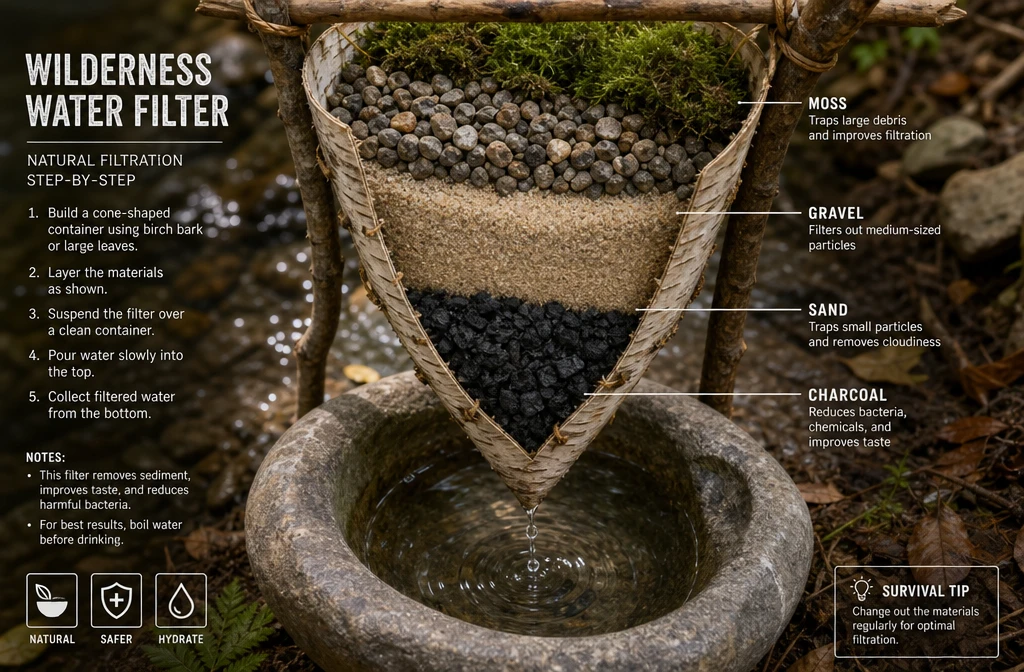
Natural filtration is one of the most practical answers to how to purify water without tools outdoors. The key materials are charcoal, fine sand, coarse gravel, and moss — all commonly found in wilderness environments.
How to Build a Natural Filter (No Tools Required)
What you need:
- A hollow log, large folded bark cone, or woven grass container
- Coarse gravel or small stones (bottom layer — first contact with water)
- Coarse sand or fine grit (middle layer)
- Crushed charcoal from a cooled campfire (top layer — last contact before collection)
- Moss or green grass (optional pre-filter at the very top to catch large debris)
Steps:
- Allow campfire charcoal to cool completely. Crush it into small pieces.
- Construct your container — birch bark folded into a cone works well, as does a hollowed section of soft wood.
- Layer from bottom to top: gravel → sand → charcoal → moss.
- Pour water slowly through the top. Collect filtered water at the bottom.
- Run the water through twice if it still appears cloudy.
- Always boil or apply SODIS after filtering — this step removes sediment only.
What each layer does:
- Gravel: Catches large debris, insects, and organic matter
- Sand: Traps smaller particles and some bacteria mechanically
- Charcoal: Adsorbs some chemicals, improves taste and odor, reduces some organic contaminants
- Moss: Acts as a biological pre-filter for surface debris
What it won’t do: Remove viruses, most bacteria, or dissolved chemicals reliably. This is a pre-treatment step, not a standalone solution.
How Long Does It Take to Make Water Safe by Solar Disinfection?
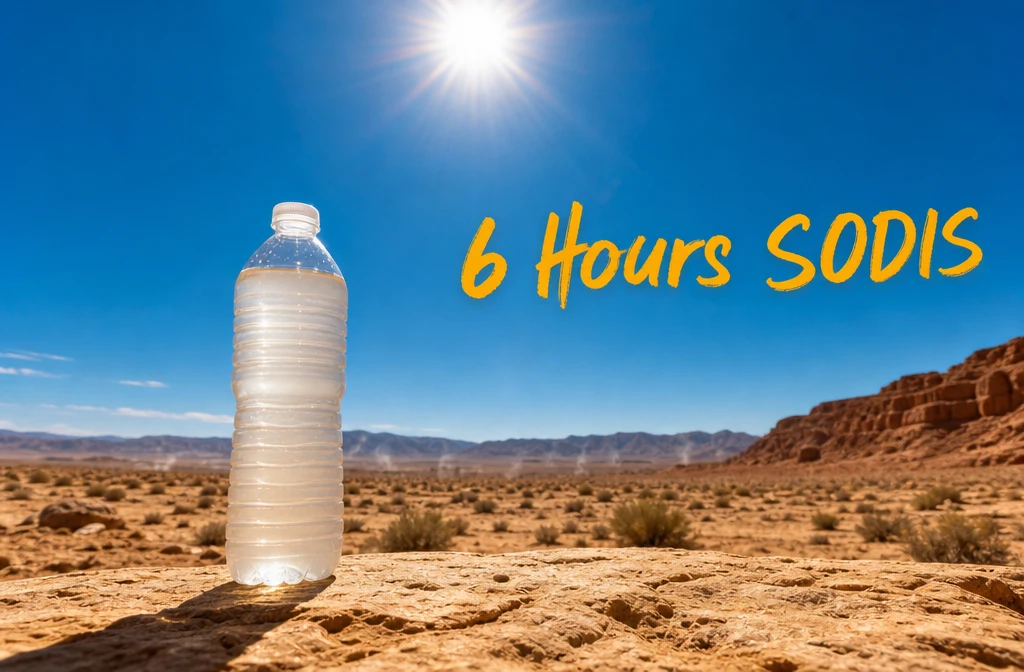
Solar disinfection (SODIS) takes a minimum of six hours in full, direct sunlight for clear water in a transparent container. For cloudy water or overcast skies, the WHO recommends extending exposure to 48 hours.
The science: UV-A radiation from sunlight damages the DNA of pathogens, preventing reproduction. The process is temperature-assisted — when water in the container reaches above 50°C (122°F), disinfection time drops significantly.
Factors that affect SODIS effectiveness:
- Water clarity: Turbid (cloudy) water blocks UV penetration. Always filter first.
- Container type: Clear PET plastic or glass works. Colored, opaque, or scratched bottles reduce effectiveness.
- Cloud cover: More than 50% cloud cover requires doubling the exposure time to 48 hours.
- Temperature: Warmer climates accelerate the process. Cold climates slow it considerably.
- Altitude: Higher UV intensity at elevation can slightly reduce required time.
Practical tip for cold climates: Place the bottle on a reflective surface (aluminum foil, a smooth rock face, or snow in bright conditions) to maximize UV exposure and heat gain. In genuinely cold, overcast conditions, SODIS may not be reliable — prioritize boiling instead.
Which Water Sources Are Least Likely to Make You Sick When Camping?
The safest natural water sources, ranked from lowest to highest contamination risk:
- Rainwater collected directly (not runoff) — lowest biological risk
- Transpiration collection from non-toxic vegetation
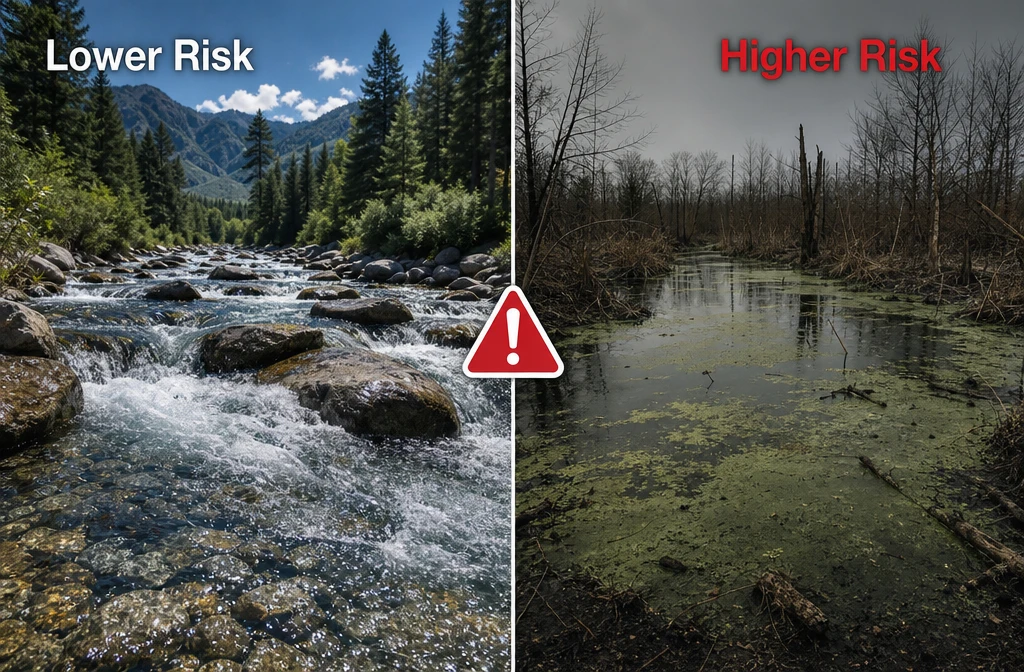
- High-elevation mountain streams above human and animal habitation
- Fast-moving rivers and streams with visible flow
- Springs emerging directly from the ground
- Low-elevation rivers near trails, farms, or settlements
- Lakes and large bodies of still water
- Stagnant ponds, swamps, and marshes — highest risk
Choose higher-elevation sources whenever possible. Water flowing downhill accumulates contamination from animal waste, decaying organic matter, and human activity. A stream sourced above the treeline is meaningfully safer than one running through a valley campsite — though neither is safe to drink untreated.
Is It Safe to Drink Water from a Moving River Versus a Stagnant Pond?
Moving water is generally safer than stagnant water, but neither is safe to drink without treatment. A fast-moving river has higher oxygen content, less algae growth, and lower concentrations of some pathogens compared to a still pond — but it still carries Giardia, Cryptosporidium, and bacterial contamination from upstream sources.
Stagnant water presents additional risks:
- Blue-green algae (cyanobacteria) blooms, which produce toxins that boiling does NOT neutralize
- Higher concentrations of organic matter and bacteria
- Mosquito larvae and other biological contaminants
Warning: If a pond or still water source shows a blue-green, reddish, or brownish surface scum, do not use it for drinking — even after boiling. Cyanotoxins are heat-stable and potentially fatal.
The practical rule: Moving water from a high-elevation source is your first choice. Stagnant water is a last resort, and even then, it requires filtration, boiling, and ideally a second-pass treatment.
What Should Backpackers Do If They Run Out of Water Purification Tablets?
Running out of purification tablets is a genuine survival scenario — and knowing how to purify water without tools outdoors becomes critical at that moment. The immediate priority is fire.
Step-by-step fallback plan:
- Assess your fire-starting capability. A lighter, matches, or friction fire gives you boiling as the primary backup.
- Find the cleanest available source — prioritize moving water at higher elevation.
- Build a natural filter using charcoal, sand, and gravel to pre-treat the water before boiling.
- Boil for one full minute (three minutes above 6,500 feet).
- If fire is impossible, use SODIS with any clear container available in your pack.
- Collect rain or transpiration water as a clean-source alternative while you work on the above.
What not to do: Don’t assume filtered water is safe to drink without a heat or UV step. Don’t drink directly from a “clear-looking” stream — clarity has no relationship to microbial safety. And don’t ration water to the point of dehydration while waiting for a purification method to work — dehydration impairs judgment, which makes every other survival decision harder.
For anyone building a bug-out kit, reviewing common bug out bag mistakes is worthwhile — running out of water treatment is one of the most avoidable errors in the field.
What Warning Signs Mean Water Is Definitely Not Safe to Drink?
Some water sources are dangerous beyond what boiling or natural filtration can fix. Recognize these red flags immediately:
Visual warning signs:
- 🔴 Blue-green, red, or brown surface scum (algae bloom — cyanotoxins)
- 🔴 Oily rainbow sheen on the surface (petroleum or chemical contamination)
- 🔴 Unusual coloring — orange, yellow, or milky white water
- 🔴 Dead fish, animals, or vegetation at the water’s edge
- 🔴 Foam that persists after agitation (not natural aeration foam)
Smell-based warning signs:
- 🔴 Strong sulfur odor (rotten egg smell) — may indicate bacterial activity or volcanic minerals
- 🔴 Chemical or petroleum smell
- 🔴 Ammonia-like odor near agricultural areas
Environmental context warning signs:
- 🔴 Located downstream from a mine, factory, or industrial site
- 🔴 Near heavy agricultural land with visible runoff
- 🔴 In an area with known contamination history
The hard truth: No field purification method — boiling, SODIS, or natural filtration — reliably removes heavy metals, cyanotoxins, or industrial chemicals. If a source shows these signs, move on and find another. Drinking chemically contaminated water can cause acute poisoning that no survival skill will reverse in the field.
Are There Differences in Water Purification for Hot Versus Cold Climates?
Yes — climate significantly affects which tool-free purification methods are practical and how long they take. Hot and cold environments require different approaches.
In hot climates:
- SODIS is highly effective — UV intensity is higher, water heats faster, and six hours is often sufficient
- Natural water sources may be scarce, making collection and conservation critical
- Transpiration bags work well in sunny, leafy environments
- Risk of algae blooms is higher in standing water
In cold climates:
- SODIS becomes unreliable — UV intensity is lower, water stays cold, and overcast skies are common
- Boiling is the primary reliable method
- Snow and ice are generally clean sources but must still be melted and ideally boiled (animal contamination is possible)
- Water from under ice in streams is often cleaner than surface water
Melting snow: Snow is not automatically safe to drink. It can harbor animal waste, airborne pollutants, and surface contamination. Melt and boil it. Also, eating snow directly accelerates hypothermia — always melt it first.
Temperate and mixed climates: Use the season as your guide. Summer months favor SODIS. Winter and overcast fall/spring conditions favor boiling as the primary method.
Understanding climate-specific threats is part of a broader geographic preparedness strategy — the Ultimate Geographic Threat Prep Guide breaks this down by U.S. region in detail.
What Are the Most Common Mistakes People Make Purifying Water in Survival Situations?
The biggest mistake is assuming that clear water is safe water. Clarity has absolutely no connection to microbial safety. Giardia and Cryptosporidium are invisible to the naked eye and present in pristine-looking mountain streams.
Other critical mistakes:
- Skipping filtration before boiling: Turbid water takes longer to reach effective temperatures throughout. Filter first, then boil.
- Not boiling long enough: A gentle simmer is not a rolling boil. Watch for vigorous, sustained bubbling.
- Drinking from the wrong side of the container: If you used a natural filter, the output side is still not sterile. Boil or apply SODIS after filtering.
- Trusting SODIS in cloudy conditions without extending time: Partial cloud cover requires doubling exposure to 48 hours. Many people don’t account for this.
- Collecting water near dead animals: Even a stream can be heavily contaminated if a carcass is decomposing upstream.
- Ignoring chemical contamination signs: Boiling water with an oily sheen or near industrial sites concentrates rather than removes chemical contaminants.
- Waiting too long to treat water: Dehydration impairs decision-making. Start purifying water before you’re desperate.
The Worst Water Storage Mistakes Preppers Still Make covers related errors in a home preparedness context — many of the same judgment failures apply in the field.
FAQ: How to Purify Water Without Tools Outdoors
Q: Can I drink water straight from a waterfall? It looks clean. No. Waterfalls aerate water and look pristine, but they still carry Giardia, Cryptosporidium, and bacteria from upstream sources. Always treat waterfall water before drinking.
Q: How do I boil water if I don’t have a pot or container? Large, thick leaves folded into a cone can hold water briefly, but they’re not ideal for boiling. Better options: a birch bark vessel (birch bark is naturally water-resistant), a hollowed green log (green wood doesn’t burn as quickly), or a large flat rock with a natural depression used as a solar heating surface. In genuine emergencies, a rock boiling method works — heat rocks in fire, then drop them into a water-filled bark or clay vessel.
Q: Is morning dew safe to drink? Generally yes, if collected from non-toxic plants and clean surfaces. Wipe leaves with a cloth or absorbent material and wring it out. Dew collected from grass near roads or agricultural land carries contamination risk.
Q: Does muddy water become safe after filtering through sand and charcoal? It becomes clearer and tastes better, but it is not microbiologically safe. Natural filtration removes sediment and some contaminants but does not kill pathogens. Always follow filtration with boiling or SODIS.
Q: Can I use river sand for filtration, or does it need to be a specific type? Fine river sand works well. Avoid sand from areas with obvious contamination. Rinse the sand before using it in your filter to remove finer particles that would cloud the output water.
Q: How do I know if SODIS has worked? There’s no field test without equipment. Follow the time guidelines strictly: six hours in full sun for clear water, 48 hours for cloudy water or overcast skies. If in doubt, extend the time or switch to boiling.
Q: Is it safe to drink from a cactus in a desert survival situation? Some cacti, like the barrel cactus, contain a bitter, mildly toxic fluid — not clean water. The fluid can cause nausea and diarrhea, worsening dehydration. The saguaro cactus pulp contains more usable moisture but is still not a reliable hydration source. Transpiration collection from desert vegetation is a safer approach.
Q: What’s the fastest way to get safe drinking water with absolutely nothing? Collect rainwater directly in a large leaf or natural depression. If it’s raining, that’s your fastest clean source. If not, find a moving stream, build a basic natural filter, and boil the output using a friction fire or any available ignition source.
Q: Can I purify water by burying it in the ground? No. Soil filtration occurs naturally over long periods, producing groundwater — but manually burying surface water in a hole does not replicate that process. You’d be adding soil contamination to surface contamination.
Q: Does altitude affect how long I need to boil water? Yes. At elevations above 6,500 feet, water boils at a lower temperature (around 194°F / 90°C instead of 212°F / 100°C). The CDC recommends boiling for three minutes at these elevations to compensate.
Q: Are there plants that naturally purify water? Some plants have mild antimicrobial properties — moringa seeds, for example, have been studied for their ability to clarify turbid water. However, no plant-based method reliably eliminates pathogens to a safe level in a field setting. Use plants as a supplementary step, not a standalone solution.
Q: What if I have to choose between drinking contaminated water and severe dehydration? In most short-term survival scenarios (under 72 hours), drinking contaminated water and dealing with illness later is preferable to fatal dehydration. Gastrointestinal illness from Giardia typically takes days to manifest. Severe dehydration impairs cognition within hours. Make the call based on your timeline and proximity to rescue.
Conclusion: Build the Skill Before You Need It
Knowing how to purify water without tools outdoors is not a niche survival trick — it’s a foundational life skill. Gear fails. Tablets run out. Filters clog. The wilderness doesn’t wait for you to figure it out under pressure.
Actionable next steps:
- Practice building a natural filter in your backyard or on your next camping trip — before you need it in an emergency.
- Learn to start a fire reliably using multiple methods. Boiling is your most dependable purification option, and it requires fire. Check out the 14 Essential Survival Skills Every Prepper Must Know for a full breakdown of complementary competencies.
- Always carry a backup purification method in your pack — even a small fire-starting kit dramatically expands your options. Review the 72-Hour Bug Out Bag Checklist to ensure water treatment is covered at every tier.
- Know your water sources before you enter the field. Study the terrain, identify elevation, and note potential contamination upstream.
- Memorize the warning signs of chemically contaminated water — these are the scenarios where no field method is enough and relocation is the only safe answer.
Preparedness isn’t about having the perfect gear. It’s about having the knowledge to act when the gear isn’t there. Water is non-negotiable — and the skills to make it safe, with nothing but your environment and your training, are worth every minute of practice.
Products, Tools, and Resources Worth Knowing
These aren’t sponsorships — they’re honest recommendations based on what experienced survivalists actually use as backups and training tools.
For learning natural filtration: A basic bushcraft skills guide will cover fire-starting, natural container construction, and field filtration in detail. Practice the physical skill, not just the theory.
For SODIS practice: Keep a 1-liter clear PET plastic bottle in your bug-out bag. It weighs almost nothing, and it’s your solar disinfection unit if everything else fails. Label it clearly so it doesn’t get used for anything else.
For fire-starting reliability: A ferro rod is the most durable ignition tool available — no batteries, works wet, lasts for thousands of strikes. Pair it with knowledge of natural tinder materials (birch bark, dry grass, cattail fluff) so you can start a fire and boil water with what the environment provides.
For deeper water preparedness: The Ultimate Emergency Water Storage and Purification Guide covers the full spectrum — from field improvisation to long-term home storage — and is worth bookmarking as a reference resource.
For survival skill building: The Survival Skills Checklist: 7 Core Skills Every Prepper Needs gives a structured framework for building competency across all critical areas, with water procurement near the top of the list.
The goal at Preppers HQ is simple: give you the knowledge to be confident, not just cautious. Water purification without tools is one of those skills that, once learned and practiced, removes an enormous amount of uncertainty from any outdoor or emergency scenario. Build it now.