

Hey there! Some links on this page may be affiliate links which means that, if you choose to make a purchase, I may earn a commission at no extra cost to you. I greatly appreciate your support. Read the full disclosure here.
The Atlantic hurricane season kills an average of 1,500 people per year and causes tens of billions of dollars in damage annually, according to NOAA, yet most households living in coastal zones still scramble to buy water and plywood 48 hours before landfall. That reactive pattern is exactly what this Complete Hurricane Prep Calendar: Month-by-Month Planning Guide is designed to break.
This guide is built for preppers and survivalists who understand that real readiness isn’t a weekend project. It’s a system. A calendar-based approach spreads the work, the cost, and the mental load across twelve months so that when a storm is named and bearing down on your coast, you’re already done.
Key Takeaways
- The Atlantic hurricane season officially runs June 1 through November 30, with peak activity between mid-August and mid-October.
- January through May is your preparation window, use it to audit gear, stock supplies, and harden your home before prices spike.
- A hurricane emergency kit should cover at minimum 72 hours of self-sufficiency, but serious preppers target 14 days of independent operation.
- Hurricane watches mean conditions are possible within 48 hours; hurricane warnings mean conditions are expected within 36 hours, the difference determines when you act.
- Apartment dwellers, elderly individuals, people with disabilities, and pet owners all need customized plans that go beyond the standard FEMA checklist.
- Insurance review, document gathering, and financial preparation should happen by April 1, before the season opens.
- Updating your hurricane emergency plan annually is the minimum; after any major storm event, review it immediately.
- The single biggest mistake most people make is waiting until June to start preparing.
Find this useful? Add us as a preferred source on Google and more of what we publish will show up in your results.
When Does Hurricane Season Start and End?
The Atlantic hurricane season officially runs from June 1 to November 30 each year. Peak activity concentrates between mid-August and mid-October, when warm ocean temperatures and favorable atmospheric conditions fuel the most intense storms.
That said, named storms have formed outside this window, some as early as May. The Eastern Pacific hurricane season runs May 15 through November 30. If you live in a Gulf Coast, Atlantic Coast, or Caribbean-adjacent region, treating the entire June-through-November stretch as high-alert time is the right posture.
The six-month season length is exactly why a month-by-month readiness calendar outperforms a single pre-season checklist. You can’t do everything in one weekend, and you shouldn’t try.
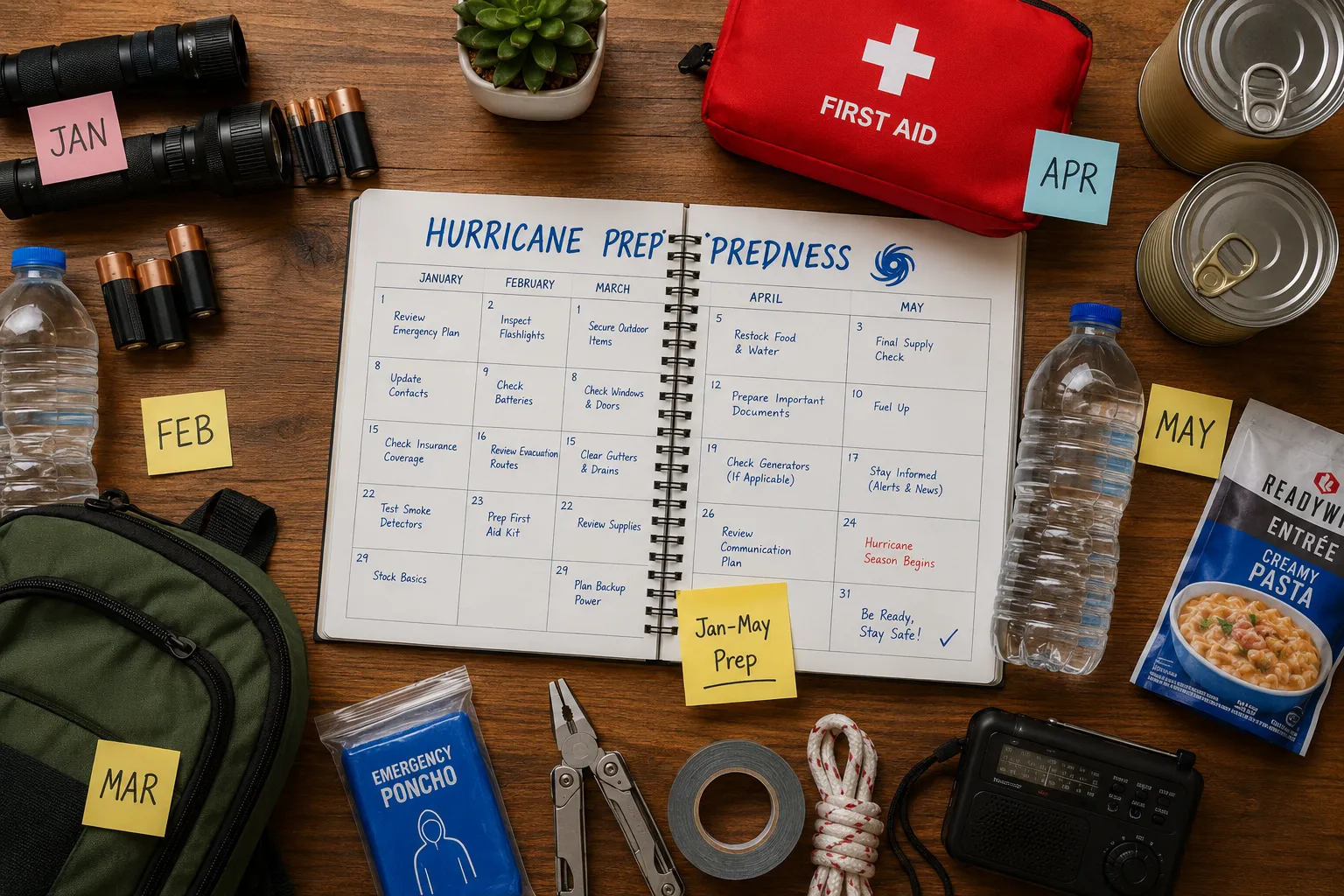
The Full Hurricane Prep: Month-by-Month Readiness Calendar
This calendar covers all twelve months because preparation doesn’t stop when the season ends. Use it as a rolling checklist, not a one-time event.
January: Debrief and Audit
- Review last season’s performance. Did your plan hold? What ran out?
- Rotate and replace any expired food, water, or medications from your emergency kit.
- Check your 72-hour bug-out bag for worn gear, missing items, or outdated documents.
- Assess your home for storm damage from the prior season that needs repair.
February: Financial and Insurance Review
- Pull out your homeowner’s or renter’s insurance policy and read the hurricane/flood coverage sections carefully.
- Note your deductible amounts, hurricane deductibles are often separate and percentage-based.
- Consider whether a flood insurance policy through NFIP is appropriate. Flood damage is not covered under standard homeowner’s policies.
- Review your financial preparedness plan and ensure you have accessible cash reserves.
March: Document Gathering and Hardening Assessment
- Gather critical documents: insurance policies, property deeds, passports, birth certificates, medical records, and prescription lists. Store copies in a waterproof container and a secure cloud backup.
- Walk your property and identify vulnerabilities: roof condition, window quality, garage door strength, and drainage around the foundation.
- Get contractor quotes for any needed work now, before the May rush.
April: Supply Restocking and Kit Building
- This is the best time to buy hurricane supplies. Prices are lower, shelves are full, and you have time to shop strategically.
- Build or restock your emergency food supply. Target at minimum a two-week supply for every household member. For detailed guidance, see the 3-month emergency food supply guide.
- Address water storage. FEMA recommends one gallon per person per day, serious preppers store two gallons minimum. Review emergency water storage best practices to avoid common mistakes.
May: Plan Finalization and Communication
- Finalize your family evacuation plan, including two routes out of your area and a designated out-of-state contact.
- Establish your emergency communication plan, what happens if cell networks go down?
- Install or test storm shutters, hurricane film on windows, and door reinforcements.
- Charge and test all battery-powered devices: weather radios, flashlights, and backup power banks.
June: Season Opens, Final Readiness Check
- Conduct a full kit inspection. Everything should be in place before June 1.
- Brief all household members on the evacuation plan and shelter-in-place procedures.
- Download your local emergency management agency’s app and sign up for wireless emergency alerts.
- Identify your nearest shelter and confirm it accepts pets if applicable.
July, October: Active Monitoring
- Monitor the National Hurricane Center (NHC) at nhc.noaa.gov daily during peak season.
- When a tropical disturbance forms, begin tracking it immediately, don’t wait for a named storm.
- Keep your vehicle’s gas tank above half-full throughout this window. Gas stations run dry within hours of an evacuation order.
- Avoid depleting your emergency supplies during this period.
November: Season Wind-Down
- The season officially closes November 30, but remain alert through mid-November.
- Begin post-season debrief: what worked, what didn’t, what needs replacement.
December: Rest, Reflect, and Plan Ahead
- Use December to research any gear upgrades or skill gaps identified during the season.
- Schedule any home hardening work for the January, March window.
How to Create a Hurricane Emergency Kit Checklist
A complete hurricane emergency kit covers water, food, shelter, communication, medical needs, and documentation for a minimum of 72 hours, though 14 days is the target for serious preppers.
Core kit components:
| Category | Minimum Quantity | Notes |
|---|---|---|
| Water | 1 gal/person/day | Store 2 gal/day for heat and hygiene |
| Food | 3-day supply | Target 14 days; shelf-stable, no-cook options |
| First Aid | Full kit | Include prescription meds (30-day supply) |
| Light/Power | 2 flashlights + radio | Hand-crank or battery weather radio |
| Documents | Waterproof pouch | Copies of all critical IDs and policies |
| Tools | Multi-tool, wrench | Shut off gas and water lines |
| Cash | Small bills | ATMs fail during power outages |
| Communication | Written contact list | Don’t rely solely on your phone |
For a deeper breakdown, the ultimate disaster preparedness checklist covers 50 essential items across all categories.
Best Time to Buy Hurricane Supplies Before Season
April is the optimal month to purchase hurricane supplies. Demand is low, store inventory is high, and retailers haven’t yet marked up generators, plywood, or water storage containers.
By late May, hardware stores in hurricane-prone regions begin selling out of key items. By the time a storm is named and within 5 days of landfall, generators are sold out region-wide, water shelves are empty, and fuel lines stretch for miles.
Buy these items in April, not June:
- Portable generator or solar power station
- Extra fuel containers and fuel stabilizer
- Hurricane shutters or plywood
- Water storage containers (WaterBOB bathtub bladders, 5-gallon jugs)
- Battery-powered or hand-crank weather radio
- Extended first aid supplies
Difference Between a Hurricane Watch and a Hurricane Warning
A hurricane watch means hurricane conditions (sustained winds of 74 mph or higher) are possible within 48 hours. A hurricane warning means those conditions are expected within 36 hours.
This distinction matters enormously for timing your response:
- Hurricane Watch issued: Begin final preparations. Fill vehicles with gas. Confirm your evacuation decision. Charge all devices. Secure loose outdoor items.
- Hurricane Warning issued: Execute your plan. If you’re evacuating, leave now. If sheltering in place, move to your interior safe room and do not leave until authorities declare it safe.
Waiting for a warning to start preparing is too late. The watch is your action trigger.
How to Hurricane-Proof Your Home on a Budget
Budget-conscious home hardening focuses on the three most common failure points: windows, garage doors, and roofs. You don’t need to spend $20,000 on impact windows to meaningfully reduce your risk.
High-impact, lower-cost measures:
- Plywood shutters: Cut and pre-drill panels for every window in March. Store them in your garage. Cost: under $200 for most homes.
- Garage door bracing kits: The garage door is the largest and most vulnerable opening on most homes. Bracing kits run $50,$100 and install in under an hour.
- Roof-to-wall connectors: If your home was built before 1994, adding hurricane straps where the roof meets the wall structure dramatically reduces uplift risk. A contractor can assess this affordably.
- Caulk and weatherstripping: Seal gaps around windows and doors to reduce water intrusion.
- Trim trees proactively: Dead branches and overhanging limbs become projectiles. Trim them in March before the season.
What Documents Should You Gather Before Hurricane Season
Before June 1, every household should have a waterproof document kit assembled and accessible within 60 seconds.
Essential documents to gather:
- Government-issued IDs (passports, driver’s licenses, birth certificates)
- Social Security cards
- Insurance policies (homeowner’s, flood, auto, health, life)
- Property deed or mortgage documents
- Vehicle titles
- Medical records and current prescription lists
- Bank account information and recent statements
- Contact list (doctors, insurance agents, out-of-state family)
- Pet vaccination records
Store originals in a fireproof, waterproof safe. Keep photocopies in a ziplock bag in your go-bag. Upload digital scans to an encrypted cloud service. This three-layer approach ensures access even if your home is destroyed.
Do You Need Hurricane Insurance and When to Get It
Standard homeowner’s insurance does not cover flood damage, the leading cause of hurricane-related deaths and property loss. If you live in a FEMA-designated flood zone, flood insurance through the National Flood Insurance Program (NFIP) is likely required by your mortgage lender. If you’re outside a designated zone, it’s still worth serious consideration.
Key insurance timing rules:
- NFIP flood policies have a 30-day waiting period before coverage takes effect. Do not wait until a storm is named to apply, it will be too late.
- Review your hurricane deductible now. In many coastal states, it’s calculated as a percentage of your home’s insured value (often 2-5%), not a flat dollar amount.
- Wind damage coverage is typically included in homeowner’s policies, but verify your policy’s specific exclusions.
Purchase or review flood insurance by April 1 at the latest.
How to Prepare for Hurricanes If You Live in an Apartment
Apartment dwellers face unique challenges: limited storage space, no control over building structure, and potential mandatory evacuation orders that override shelter-in-place plans.
Apartment-specific hurricane prep steps:
- Know your building’s construction type. High-rise concrete buildings above the flood zone are generally safer than ground-floor wood-frame structures.
- Identify whether your unit is in a flood-prone area. Ground floor and basement units should plan to evacuate, not shelter in place.
- Build a compact emergency kit suited to limited space. The ultimate guide to apartment food storage and apartment water storage guide offer space-efficient solutions.
- Know your building’s evacuation policy and whether the management has a storm protocol.
- Identify a friend or family member outside the storm zone where you can shelter.

Common Mistakes People Make Preparing for Hurricanes
The most dangerous mistake is treating hurricane prep as a single event rather than an ongoing system. The second most dangerous is underestimating how quickly conditions deteriorate.
Mistakes to avoid:
- Waiting for a named storm to start preparing. By then, stores are stripped and roads are jammed.
- Relying solely on bottled water. Understand bottled water shelf life and rotate your supply.
- No cash on hand. Power outages disable card readers and ATMs for days.
- Ignoring the garage door. It’s the most common structural failure point in residential hurricane damage.
- Assuming you’ll evacuate. Plan for both scenarios: evacuation and shelter-in-place.
- Forgetting medications. A 30-day supply of all critical prescriptions should be part of every kit.
- No communication plan. Cell networks overload within hours of a major storm. Have a written plan and a designated out-of-state contact.
- Letting your go-bag expire. Food, water, and batteries have shelf lives. Check them every January.
Hurricane Prep for Elderly People and People with Disabilities
Elderly individuals and people with disabilities require customized hurricane plans that account for mobility limitations, medical equipment dependencies, and potential communication barriers.
Key considerations include:
- Register with your local special needs registry. Most counties maintain a list of residents who need evacuation assistance. Register before June 1.
- Plan for power-dependent medical equipment. Oxygen concentrators, CPAP machines, and powered wheelchairs all require electricity. Identify backup power options and notify your power company of your medical equipment dependency.
- Identify accessible shelters. Not all emergency shelters are ADA-compliant. Locate designated special needs shelters in your county in advance.
- Build a support network. Identify at least two neighbors or community members who can assist with evacuation if needed.
For a comprehensive framework, see the emergency preparedness guide for disabled individuals and the disaster prep strategies for seniors.
How Often Should You Update Your Hurricane Emergency Plan
Update your hurricane emergency plan at minimum once per year, ideally in January or February. After any major storm event, whether it directly affected you or not, conduct an immediate review.
Life changes that require plan updates:
- New household members (including newborns, elderly relatives moving in, or new pets)
- Change of address or new home
- New medical conditions or medications
- Change in employment that affects your daytime location
- Changes to local evacuation routes or shelter locations
A plan that was accurate two years ago may have critical gaps today. Treat the annual review as a non-negotiable appointment.
What to Do If You Can’t Evacuate During a Hurricane
If evacuation is impossible, due to mobility limitations, a storm that accelerated faster than expected, or road closures, shelter in place with a specific strategy, not just a hope.
Shelter-in-place protocol:
- Move to an interior room on the lowest floor that is above flood level. Avoid rooms with windows.
- If flooding threatens, move to the highest floor, but never into an attic without a way to escape through the roof.
- Keep your emergency kit, documents, and communication devices with you.
- Monitor your battery-powered weather radio continuously.
- Do not go outside during the eye of the storm. The back eyewall brings a second surge of violent winds.
- After the storm passes, do not enter floodwater. Six inches of moving water can knock a person down; two feet can sweep away a vehicle.
Pre-position a hatchet or axe in your attic if you live in a flood-prone area. It may be your only way out if water rises faster than expected.
Hurricane Prep for Pet Owners
Pets require their own emergency plan, and that plan must be made before hurricane season opens, not during an evacuation order.
Pet-specific prep steps:
- Identify pet-friendly evacuation shelters or hotels along your evacuation route in advance. Most public emergency shelters do not accept pets.
- Keep a 2-week supply of pet food, water, and any medications in your emergency kit.
- Ensure all pets have current ID tags and microchips with up-to-date contact information.
- Have carriers, leashes, and familiar comfort items ready to grab within minutes.
- Carry vaccination records in your document kit, many pet-friendly shelters require them.
The ultimate pet emergency preparedness checklist covers 45 items specifically for pet owners in disaster scenarios.

Frequently Asked Questions
When is the most dangerous part of hurricane season? Mid-August through mid-October is statistically the most active period. The peak of the Atlantic hurricane season is September 10, according to NOAA’s historical data. During this window, maintain your highest state of readiness.
How much water should I store for a hurricane? Store a minimum of one gallon per person per day, but two gallons per person per day is more realistic when you account for cooking, hygiene, and hot weather. For a family of four, a 14-day supply means 112 gallons minimum.
Can I shelter in place in a mobile home during a hurricane? No. Mobile homes are not safe shelter during any hurricane, regardless of category. Evacuate to a sturdy structure before the storm arrives. Even a Category 1 storm can destroy a mobile home.
What’s the difference between a tropical storm watch and a hurricane watch? A tropical storm watch means tropical storm conditions (39-73 mph winds) are possible within 48 hours. A hurricane watch means hurricane-force winds (74+ mph) are possible within 48 hours. Both require immediate preparation, but a hurricane watch demands evacuation decisions be made now.
Should I fill my bathtub with water before a hurricane? Yes, but use a WaterBOB bladder if possible, it keeps the water clean and holds up to 100 gallons. Without a bladder, a standard tub loses water to evaporation and contamination quickly. This water is for flushing and hygiene, not drinking, unless properly treated.
How long do I need to wait after a hurricane before going outside? Wait for official all-clear from local emergency management. Never go outside during the eye of the storm, the back eyewall arrives with little warning. After the storm fully passes, avoid standing water, downed power lines, and structurally compromised buildings.
What if my evacuation route is flooded? Identify at least two evacuation routes before the season opens and check conditions via your local emergency management agency’s traffic and flood monitoring tools. Never drive into flooded roads, just 12 inches of water can float most vehicles.
Do I need a generator for hurricane prep? A generator significantly improves your shelter-in-place capability, especially for medical equipment, refrigeration, and communication. If a full generator isn’t in your budget, a portable solar power station can handle critical low-draw devices like phones, radios, and CPAP machines.
How do I prepare my pets if I have to evacuate? Identify pet-friendly shelters and hotels along your evacuation route before June 1. Keep carriers, food, water, and vaccination records in your go-bag. Never leave pets behind, they cannot survive storm surge or prolonged flooding.
What’s the biggest financial mistake people make with hurricane prep? Failing to review flood insurance coverage before the season opens. Standard homeowner’s policies don’t cover flood damage, and NFIP policies have a 30-day waiting period. By the time a storm is named, it’s too late to get coverage.
How do I know if my neighborhood will be under a mandatory evacuation order? Sign up for your county’s emergency alert system and download the local emergency management app. Evacuation zones are typically labeled A through D or 1 through 5, with Zone A or Zone 1 being the highest risk. Know your zone before June 1.
Is a Category 1 hurricane worth evacuating for? It depends on your location. A Category 1 storm in a low-lying coastal flood zone can produce life-threatening storm surge even with relatively modest wind speeds. Category does not equal danger level, storm surge, flooding, and your specific location matter more than the wind speed category alone.
Conclusion
The difference between a household that weathers a major hurricane with confidence and one that scrambles in panic comes down to one thing: whether they treated preparation as a year-round system or a last-minute reaction. This Hurricane Season Prep: Month-by-Month Readiness Calendar gives you the framework to build that system, one manageable task at a time, spread across twelve months.
Start in January with an honest audit. Use the February-through-May window to harden your home, gather your documents, review your insurance, and stock your supplies before prices spike and shelves empty. Brief your household before June 1. Monitor actively from July through October. Debrief and reset in November and December.
The calendar approach works because it removes the overwhelming feeling of “I need to do everything at once.” You don’t. You need to do the right thing at the right time.
Actionable next steps:
- Identify which month you’re in right now and complete that month’s tasks from the calendar above before moving forward.
- Review your current emergency kit against the checklist in this article and note what’s missing.
- Pull out your homeowner’s insurance policy this week and read the hurricane and flood sections.
- Set a recurring calendar reminder every January 15 for your annual plan review.
- Share this calendar with every adult in your household, preparedness only works when everyone knows the plan.
For a broader preparedness foundation, the ultimate guide to home emergency preparedness and the natural disaster preparedness step-by-step guide are strong next reads.
Products, Tools, and Resources
Building out your hurricane prep system doesn’t require spending a fortune all at once, it requires spending strategically across the January-through-May window.
Recommended tools and supplies:
- WaterBOB Emergency Bathtub Water Storage Bladder (100 gal): One of the most cost-effective water storage solutions for any home. Fill it when a storm watch is issued.
- Midland ER310 Emergency Hand Crank Weather Radio: Battery-powered, solar-assisted, and NOAA-certified. A non-negotiable item for any hurricane kit.
- Portable solar power station (Jackery Explorer 500 or similar): Handles CPAP machines, phones, LED lights, and small fans during multi-day outages without the fuel and carbon monoxide risks of a gas generator.
- SentrySafe Waterproof Document Case: Keeps your critical documents dry even in full submersion. Under $30 and worth every cent.
- WaterBrick stackable water containers: Modular, stackable 3.5-gallon containers that work in apartments and tight spaces.
- NOAA Weather Radio app (free): Real-time alerts, storm tracking, and official NHC forecasts directly to your phone.
- National Hurricane Center (nhc.noaa.gov): The authoritative source for storm tracking, watches, and warnings. Bookmark it and check it daily from June through November.
For those building a complete preparedness system from scratch, the complete prepping guide for beginners provides a structured 30-day foundation that pairs well with this seasonal calendar.
References
- National Oceanic and Atmospheric Administration (NOAA). Atlantic Hurricane Season. https://www.noaa.gov
- Federal Emergency Management Agency (FEMA). Hurricane Preparedness. https://www.ready.gov/hurricanes
- National Hurricane Center (NHC). Tropical Cyclone Climatology. https://www.nhc.noaa.gov/climo/
- National Flood Insurance Program (NFIP). Flood Insurance. https://www.floodsmart.gov