

Hey there! Some links on this page may be affiliate links which means that, if you choose to make a purchase, I may earn a commission at no extra cost to you. I greatly appreciate your support. Read the full disclosure here.
Survival Psychology For Beginners Explained covers one of the most overlooked aspects of emergency readiness: your mind will either be your greatest asset or your most dangerous liability when a crisis hits. Most preppers invest heavily in gear, food storage, and physical skills, but the research on survival incidents consistently shows that mental and emotional factors determine who lives and who doesn’t, often more than equipment does.
Key Takeaways
- Survival psychology is the study of how the human mind responds to extreme stress, danger, and uncertainty, and how to train it to respond effectively.
- The fight-or-flight response is automatic and can hijack rational thinking; understanding it lets you work with it rather than against it.
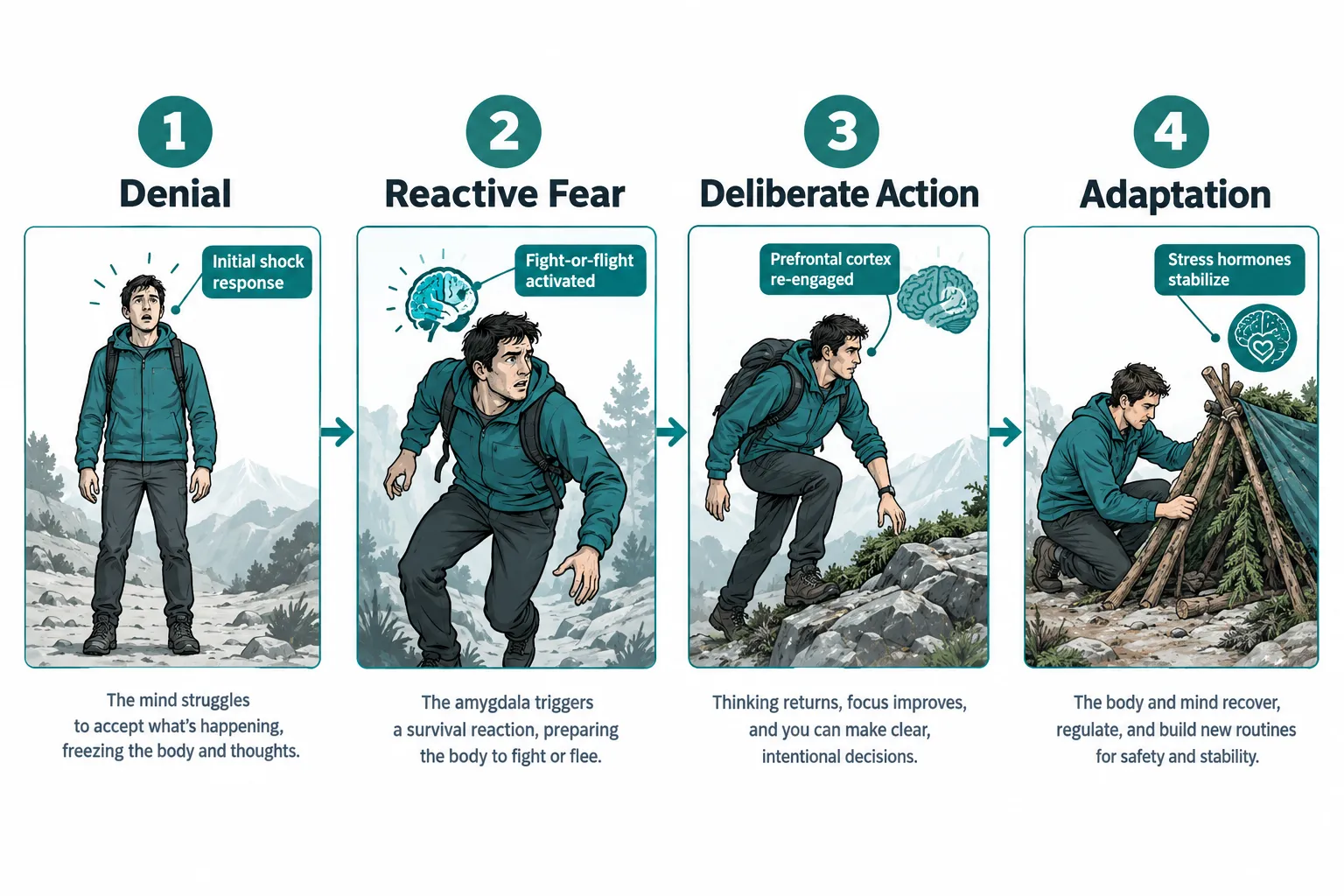
- People move through predictable psychological stages during a crisis: denial, reactive fear, deliberate action, and adaptation.
- The most common psychological mistake in emergencies is panic-driven tunnel vision, which causes people to fixate on one problem and ignore everything else.
- Military and first responder training works because it builds procedural memory through repetition, not because those people are naturally braver.
- Survival psychology skills transfer directly to daily life, including managing anxiety, making better decisions under pressure, and building resilience.
- You can begin developing a survival mindset today through scenario rehearsal, stress inoculation, and deliberate mental practice, no special equipment required.
- Building physical preparedness alongside mental training produces the strongest overall readiness profile.
Find this useful? Add us as a preferred source on Google and more of what we publish will show up in your results.
What Is Survival Psychology and Why Does It Matter
Survival psychology is the field that examines how human beings think, feel, and behave when facing life-threatening situations. It matters because physical skills and gear mean nothing if your mind shuts down before you can use them.
The core insight is straightforward: the brain under extreme stress does not operate the same way it does under normal conditions. Stress hormones flood the system, fine motor skills degrade, and the prefrontal cortex, the part responsible for rational planning, partially disengages. Understanding this isn’t academic. It’s the difference between a trained response and a frozen one.
For survivalists and preppers, survival psychology provides the mental framework that makes every other skill more reliable. You can know how to build a fire in wet conditions or execute a bug-out plan perfectly in practice, but if panic takes over during the real event, that knowledge becomes inaccessible. Mental preparation is what keeps the knowledge accessible.
How Does the Fight-or-Flight Response Work in Survival Situations
The fight-or-flight response is the body’s automatic alarm system, triggered when the brain perceives a serious threat. It is fast, powerful, and largely outside conscious control, which is exactly why understanding it matters so much for anyone serious about emergency preparedness.
When a threat is detected, the amygdala (the brain’s threat-detection center) sends an immediate signal to the adrenal glands. Within seconds, adrenaline and cortisol flood the bloodstream. Heart rate spikes. Blood moves to large muscle groups. Vision narrows. Hearing sharpens in some frequencies and dulls in others. The body is preparing to run or fight, not to think strategically.
The problem for modern survival situations is that most emergencies require complex decision-making, not just physical action. A house fire, a grid-down scenario, or a medical emergency all demand clear thinking at the exact moment the brain is most compromised.
What actually happens during acute stress:
- Tunnel vision reduces peripheral awareness
- Short-term memory becomes unreliable
- Time perception distorts (events feel faster or slower than they are)
- Fine motor skills degrade significantly
- Verbal communication becomes harder under extreme stress
The practical takeaway: procedures that are drilled into muscle memory remain accessible even when the thinking brain is partially offline. That’s why rehearsal matters more than reading.
What Are the Main Psychological Stages People Go Through During a Crisis
Most people move through four recognizable psychological stages during a crisis: denial, reactive fear, deliberate action, and adaptation. Knowing these stages in advance dramatically reduces the time spent in the first two.
Stage 1, Denial: The initial response to a sudden emergency is often disbelief. People describe hearing an explosion and assuming it was a car backfiring, or seeing floodwater rising and assuming it will stop. This stage can last seconds or minutes, and it costs time.
Stage 2, Reactive Fear: Once the threat registers as real, fear activates. This is the fight-or-flight window. Without training, people either freeze, flee without a plan, or make impulsive decisions that worsen the situation.
Stage 3, Deliberate Action: With training or strong mental anchors, people move into purposeful behavior. They recall a plan, focus on the next immediate step, and begin solving the problem. This is where preparedness pays off.
Stage 4, Adaptation: Over time, even in extended emergencies, the nervous system recalibrates. People find routines, establish small goals, and begin functioning more effectively. This is the stage that long-term disaster survivors describe in retrospect.
For a deeper look at what happens psychologically over extended emergencies, the guide on psychological effects of long-term disaster survival covers this territory in detail.
Survival Psychology vs. Regular Psychology: What’s the Difference
Regular psychology focuses broadly on human mental health, behavior, and emotional well-being across everyday life. Survival psychology is a specialized application that focuses specifically on performance and decision-making under extreme, life-threatening stress.
The distinction matters for preppers because the skills are different. General mental health practices, therapy, mindfulness, emotional processing, are valuable, but they don’t directly train the brain to perform under acute physical danger. Survival psychology draws more heavily from performance psychology, military psychology, and stress inoculation research.
That said, the two fields overlap more than most people realize. Emotional regulation, cognitive reframing, and resilience-building appear in both. Someone who has done serious work on their mental health will often have better baseline stress tolerance, which directly benefits survival performance.
Can Survival Psychology Training Actually Help You in a Real Emergency
Yes, and the evidence from military, law enforcement, and first responder communities is consistent: trained individuals perform significantly better under acute stress than untrained ones, even when the training was conducted in simulated rather than real conditions.
The mechanism is stress inoculation, controlled, repeated exposure to stressful scenarios that gradually raises the threshold at which the fight-or-flight response overwhelms rational thinking. Over time, the nervous system learns that high-stress situations are manageable, and the brain retains more cognitive function during them.
For civilians, this doesn’t require military-grade training. Practical steps include:
- Running through emergency scenarios mentally in detail (mental rehearsal)
- Practicing emergency procedures under mild time pressure
- Deliberately exposing yourself to controlled discomfort (cold showers, physical training, obstacle courses)
- Rehearsing your bug-out bag pack and deployment sequence until it’s automatic
The survival mindset guide at Preppers HQ covers the specific mental frameworks that translate most directly to real-world performance.
What Are Common Psychological Mistakes People Make When They Panic
Panic produces predictable errors. Knowing them in advance is one of the most practical things a beginner can do, because recognition is the first step toward interruption.
The most common psychological mistakes in emergencies:
- Tunnel vision: Fixating on one problem (the smoke, the locked door, the missing person) while ignoring other critical information. This is a direct result of stress-narrowed attention.
- Normalcy bias: Underestimating the severity of a threat because the brain defaults to “this will probably be fine.” This is what keeps people in buildings during early fire alarms.
- Herd behavior: Following the crowd without assessing whether the crowd’s direction is correct. Crowds in emergencies are often wrong.
- Decision paralysis: Facing multiple options and choosing none of them because the brain can’t process fast enough under stress.
- Premature problem-solving: Jumping to solutions before assessing the full situation, which often creates new problems.
The antidote to most of these is a simple mental anchor: stop, breathe, observe, then act. Even a five-second pause before reacting can re-engage enough prefrontal function to avoid the worst errors.
How Do You Train Your Mind for Survival Situations
Mental training for survival is a skill, not a personality trait. Anyone can develop it through consistent, deliberate practice, and it doesn’t require dramatic or dangerous scenarios to be effective.
Practical training methods for beginners:
- Scenario rehearsal: Sit down and walk through specific emergency scenarios in your mind with as much sensory detail as possible. Where are you? What do you hear? What’s your first action? Elite athletes and military operators use this technique extensively.
- Stress inoculation: Gradually expose yourself to controlled discomfort. Physical training under fatigue, cold exposure, and timed drills all raise your stress threshold over time.
- Pre-commitment planning: Decide in advance what you will do in specific situations. “If X happens, I will do Y.” This bypasses the decision-paralysis problem entirely.
- Breathing techniques: Box breathing (inhale 4 counts, hold 4, exhale 4, hold 4) is used by Navy SEALs and first responders to manually lower heart rate and restore cognitive function during acute stress. It works, and it takes minutes to learn.
- After-action review: After any stressful event, even a minor one, review what you did, what worked, and what you’d change. This builds self-awareness and refines your responses over time.
Pairing mental training with physical preparedness skills, like those covered in the guide on how to build mental toughness for survival situations, produces the most durable results.
What Do Military and First Responders Know About Survival Psychology That Civilians Don’t
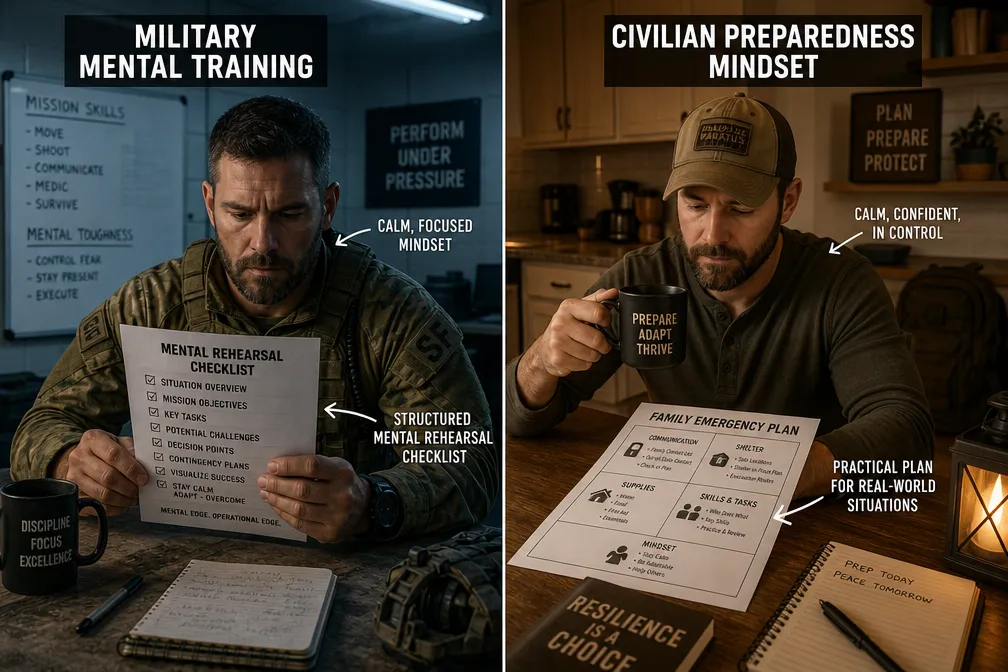
The single most important thing military and first responder training teaches is that courage is not the absence of fear, it’s the ability to act despite fear through trained, automatic responses. Civilians often assume that soldiers and paramedics are simply less afraid. They’re not. They’ve just trained their responses until those responses are more powerful than the fear.
Key lessons from professional training that apply directly to civilian preparedness:
- Procedural memory beats willpower: When procedures are drilled to automaticity, they execute even when the thinking brain is compromised. This is why first responders run the same scenarios hundreds of times.
- Team accountability improves individual performance: People perform better under stress when they feel responsible to others. Building a preparedness group or family plan leverages this directly.
- Debrief culture accelerates learning: Military units debrief after every exercise. Reviewing what happened, without blame, builds faster skill development than experience alone.
- Controlled breathing is a tactical tool: Tactical breathing is standard in law enforcement and military training. It’s not a wellness trend; it’s a performance tool with measurable physiological effects.
Civilians who incorporate even a fraction of these principles into their preparedness routines will respond more effectively than those who rely on gear alone.
What’s the Difference Between Survival Psychology and Wilderness Survival Training
Wilderness survival training focuses on physical skills: shelter building, fire starting, navigation, water procurement, and foraging. Survival psychology focuses on the mental and emotional framework that allows those skills to be executed under pressure.
The two are complementary, not competing. Physical skills without psychological preparation often fail in real emergencies because stress degrades performance. Psychological preparation without physical skills leaves you mentally composed but practically helpless.
The strongest preppers develop both in parallel. Physical skills like those covered in the 25 most critical wilderness survival skills guide become far more reliable when paired with the mental training to deploy them under stress.
A useful rule: if you’ve never practiced a skill under any form of pressure or fatigue, assume it will degrade significantly in a real emergency. The solution is to add stress to your practice, not just add more skills.
Can Survival Psychology Help With Anxiety and Fear Management in Daily Life
Yes, and this is one of the most underappreciated benefits for preppers who feel anxious about potential threats. The same techniques used to manage fear in emergencies, controlled breathing, cognitive reframing, pre-commitment planning, and stress inoculation, are clinically recognized tools for managing everyday anxiety.
There’s also a direct psychological benefit to preparedness itself. Research in anxiety management consistently shows that perceived control reduces fear. When you have a plan, supplies, and practiced skills, the uncertainty that drives anxiety diminishes. Preparedness is, in a meaningful sense, an anxiety management strategy.
For preppers who find that fear or worst-case thinking is driving their preparedness rather than confidence, it’s worth revisiting the foundational mindset: being prepared isn’t about expecting disaster. It’s about building the confidence to handle whatever comes. That shift in framing changes everything.
How Long Does It Take to Develop Survival Psychology Skills
Basic survival psychology skills, controlled breathing, scenario rehearsal, pre-commitment planning, can be learned and practiced within days. Meaningful stress inoculation that actually raises your performance threshold under acute stress takes weeks to months of consistent practice.
Deep, durable psychological resilience, the kind that holds under extended, severe emergencies, develops over years of deliberate preparation, physical training, and real-world stress exposure. But the good news is that the curve is steep early on: the first few weeks of deliberate mental training produce disproportionate gains.
A practical starting point for beginners: spend 10 minutes per day for 30 days on scenario rehearsal and breathing practice. Pair that with the prepper checklist for beginners 30-day system to build physical and mental preparedness simultaneously.
What’s the Best Book or Course to Learn Survival Psychology
Several well-regarded resources exist for beginners who want to go deeper on survival psychology:
Books:
- Deep Survival: Who Lives, Who Dies, and Why by Laurence Gonzales, widely considered the best civilian introduction to survival psychology, drawing on real accident case studies.
- The Unthinkable: Who Survives When Disaster Strikes, and Why by Amanda Ripley, focuses on civilian disaster response and the psychology of survival in modern emergencies.
- On Combat by Lt. Col. Dave Grossman, examines the physiological and psychological effects of extreme stress from a law enforcement and military perspective.
Courses:
- FEMA’s free online courses (available at training.fema.gov) include community emergency response training with psychological components.
- Wilderness First Responder (WFR) courses include significant stress management and decision-making training in realistic field scenarios.
- Many survival schools now offer dedicated mental resilience modules alongside physical skills training.
The most effective learning combines reading with applied practice. A book that changes how you think about fear is valuable; a book plus weekly scenario rehearsal is transformative.
Does Survival Psychology Work for All Types of Emergencies
The core principles of survival psychology apply across virtually all emergency types: natural disasters, grid-down scenarios, medical emergencies, civil unrest, and wilderness survival. The specific application varies, but the underlying mechanisms, stress response management, decision-making under pressure, resilience building, are universal.
Where context matters: urban emergencies involve different social dynamics (crowds, authority figures, infrastructure) than wilderness emergencies (isolation, physical environment, resource scarcity). Mental preparation should account for the specific scenarios most relevant to your geography and lifestyle.
For urban preppers, the urban survival situational awareness guide covers how psychological awareness applies specifically to city environments. For those preparing for extended grid-down scenarios, the mental demands differ significantly from short-term disasters, planning for both is the most complete approach.
Frequently Asked Questions
Is survival psychology only for extreme situations like wilderness emergencies?
No. The principles apply to any high-stress scenario, including house fires, medical emergencies, power outages, and civil unrest. The mental skills developed through survival psychology training are broadly useful across all emergency types.
Do I need to be physically fit to benefit from survival psychology training?
No. Mental training, scenario rehearsal, breathing techniques, pre-commitment planning, requires no physical fitness. That said, physical fitness does improve stress tolerance and cognitive performance under pressure, so the two are worth developing together.
Can children learn survival psychology concepts?
Yes, age-appropriately. Simple concepts like staying calm, having a plan, and knowing what to do in specific emergencies can be taught to children effectively. The 12 essential survival skills for kids guide covers how to introduce these ideas to younger family members.
What’s the fastest way to calm down during an emergency?
Box breathing is the most evidence-supported rapid intervention: inhale for 4 counts, hold for 4, exhale for 4, hold for 4. Even one or two cycles can measurably lower heart rate and restore cognitive function.
Is it normal to freeze during an emergency even if I’ve prepared?
Yes. Freezing is a normal biological response to sudden, severe threat. It typically lasts seconds to a few minutes. Training shortens the freeze response and accelerates the transition to deliberate action, it rarely eliminates the initial freeze entirely.
How is survival psychology different from just being brave?
Bravery implies acting despite fear through force of will. Survival psychology provides trained, automatic responses that execute regardless of fear level. The goal isn’t to feel less afraid, it’s to act effectively even when you do feel afraid.
Does having a detailed emergency plan really make a psychological difference?
Yes. Research on anxiety and preparedness consistently shows that having a concrete, rehearsed plan reduces fear and improves performance under stress. The plan itself is less important than the confidence and mental clarity that comes from having made decisions in advance.
Can survival psychology training backfire and make me more anxious?
It can, if the approach is fear-driven rather than confidence-driven. Training that focuses on worst-case outcomes without building practical competence can increase anxiety. The healthiest approach builds skills first, which naturally reduces fear as competence grows.
What’s the single most important mental skill for a survival beginner to develop?
The ability to pause before reacting. A deliberate 3-5 second pause before taking action in any stressful situation re-engages rational thinking and prevents the most common panic-driven errors. It costs nothing and works immediately.
Does survival psychology apply to economic or financial emergencies?
Yes. The same principles, pre-commitment planning, stress tolerance, clear decision-making under pressure, apply to financial crises. The financial survival checklist pairs well with the mental framework covered here.
Conclusion
Survival Psychology For Beginners Explained comes down to one core truth: gear and skills are only as reliable as the mind using them. The most well-stocked prepper with no mental training will underperform a less-equipped person who has practiced staying calm, thinking clearly, and executing under pressure.
The good news is that survival psychology is trainable. It doesn’t require military service, extreme experiences, or a psychology degree. It requires consistent, deliberate practice, scenario rehearsal, breathing techniques, stress inoculation, and pre-commitment planning, applied regularly over weeks and months.
Actionable next steps for beginners:
- Start a daily 10-minute scenario rehearsal practice this week
- Learn and practice box breathing until it’s automatic
- Write down pre-commitment decisions for your three most likely emergency scenarios
- Pair mental training with the complete prepping guide for beginners to build physical and mental readiness together
- Read Deep Survival by Laurence Gonzales as your first dedicated survival psychology resource
Preparedness built on both physical readiness and mental resilience is the most complete form of preparedness. Start with the mind. Everything else gets stronger because of it.
Resources and Recommended Reading
Books
- Deep Survival: Who Lives, Who Dies, and Why, Laurence Gonzales. The most accessible and well-researched civilian introduction to survival psychology available.
- The Unthinkable: Who Survives When Disaster Strikes, and Why, Amanda Ripley. Focuses on real-world civilian disaster response and the psychology behind survival decisions.
- On Combat, Lt. Col. Dave Grossman. Essential reading for understanding the physiological and psychological mechanics of extreme stress response.
Online Resources
- FEMA Emergency Management Institute (training.fema.gov), Free courses including Community Emergency Response Team (CERT) training with applied stress management components.
- Preppers HQ guides on survival mindset and mental preparation and building mental toughness for survival situations, practical, beginner-accessible frameworks.
Training Programs
- Wilderness First Responder (WFR) certification program, combine physical first aid with high-stress decision-making in realistic field scenarios.
- Local CERT (Community Emergency Response Team) program, free, FEMA-backed training available in most U.S. communities.