
Hey there! Some links on this page may be affiliate links which means that, if you choose to make a purchase, I may earn a commission at no extra cost to you. I greatly appreciate your support. Read the full disclosure here.
The complete, vet-approved Pet’s Emergency Preparedness checklist for your pet’s Go-Bag and Shelter-in-Place kit. Covers food, water, medical, documents, and comfort for any crisis.
In the chaotic moments of a real emergency, you will not rise to the occasion. You will fall to the level of your training and your preparation.
It’s a hard truth, one that first responders know intimately. And it applies to every aspect of our lives, especially to the silent, trusting members of our family who depend on us for everything: our pets.
When the evacuation order comes, when the floodwaters rise, when the wildfire crests the ridge, the difference between a story of survival and a story of heartbreak is not luck. It is a plan. It is a bag packed and waiting by the door. It is the quiet, deliberate work you do today, in the calm, that determines what happens in the chaos.
This is not just another checklist. This is a complete system, built from the hard-won experience of veterinarians, disaster rescue teams, and pet owners who have lived through the unthinkable. It is designed to move you from a state of anxious uncertainty to one of quiet, sovereign confidence. Because your pet is not a possession. They are family. And family protects their own.
Why Your Pet’s Survival Depends on a Plan You Make Today
In the aftermath of every major disaster, from Hurricane Katrina to the California wildfires, the stories are tragically the same. Families forced to make impossible choices. Pets left behind with a bowl of food and a prayer. Shelters are overwhelmed with animals who have no name, no records, and no way to find their way home.
The “they’ll be fine” fallacy is a coping mechanism, not a strategy. In a real crisis, unattended pets face dehydration, starvation, injury, and the terror of abandonment. The 72-hour window is the critical survival period—the time before organized relief typically becomes available, and the time during which your pet’s survival depends entirely on the resources you have on hand.
This guide is built around two core scenarios: Evacuation (the “Go-Bag”) and Shelter-in-Place (the “Stay-at-Home Kit”). Your pet needs a plan for both.
The short version: A complete pet’s emergency preparedness plan requires both a portable “Go-Bag” for evacuation and a “Shelter-in-Place” kit for home emergencies. The Go-Bag should contain a 3-7 day supply of food and water, a pet first-aid kit, copies of medical records and proof of ownership, and comfort items. The plan must be audited twice yearly to ensure all supplies are fresh and up-to-date.
Key Takeaways:
– Prepare both a portable 3-7 day Go-Bag and a home-based Shelter-in-Place kit with food, water, medical supplies, documents, and comfort items tailored to your pet’s needs.
– Maintain a twice-yearly audit schedule to rotate food and water, check medications, replace batteries, and update identification documents and photos.
– Include essential identification materials in a waterproof Reunification Packet: veterinary records, microchip info, current photos, and emergency contacts to prove ownership during evacuation.
– Customize your emergency plan according to your pet’s species, breed, and temperament, incorporating specific gear, diet, and calming aids as needed.
– Research and prepare pet-friendly evacuation shelters and accommodations ahead of time to avoid surprises during a crisis.
The Go-Bag: Your Pet’s Lifeline When You Have to Leave
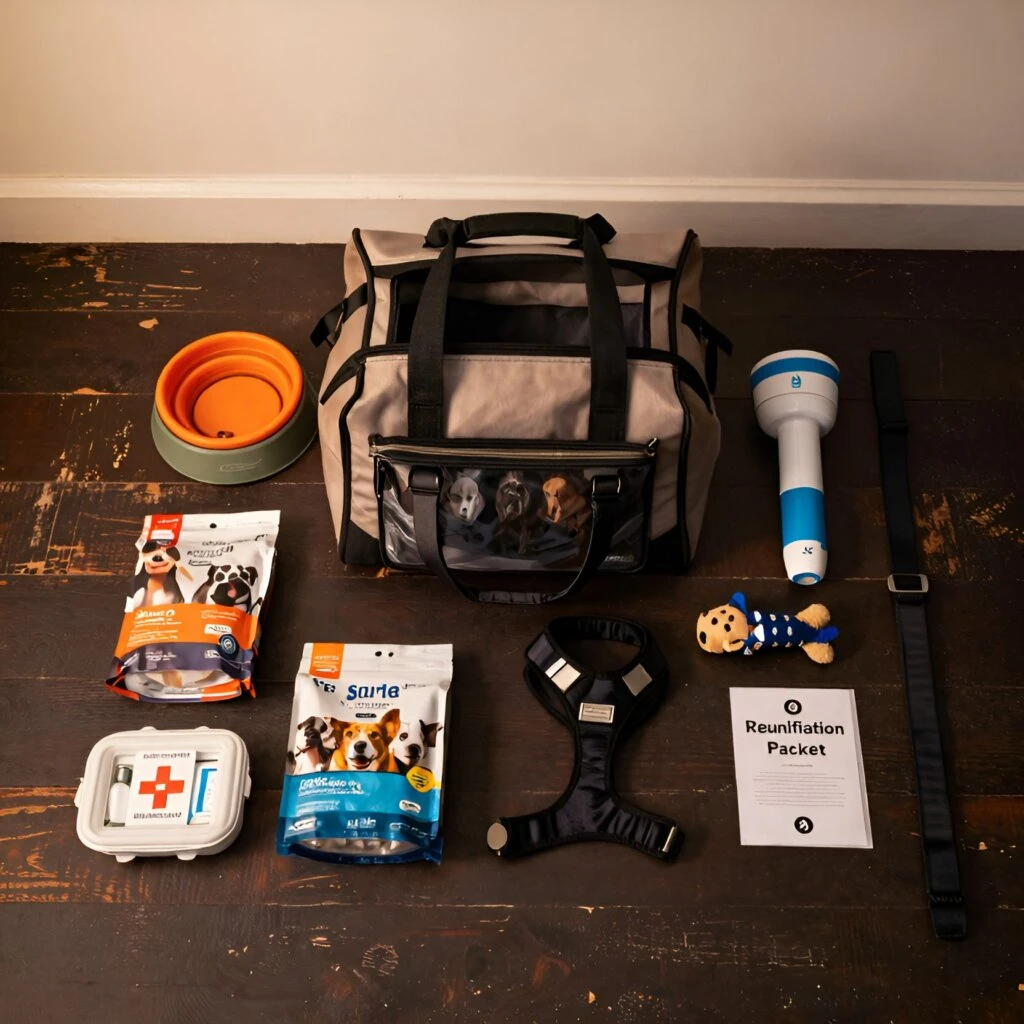 Your pet’s Go-Bag is a dedicated emergency kit, packed and ready, that contains everything your dog or cat needs to survive for 3 to 7 days if you are forced to evacuate your home. It should be stored in a cool, dark place where you can grab it in seconds.
Water & Food: The Non-Negotiables
1. Bottled Water (3-7 Day Supply): Do not assume you will find clean water. Pack a minimum of three days’ worth of water specifically for your pet. A good rule of thumb is 8-16 ounces per 10 pounds of body weight, per day.
2. Collapsible Water and Food Bowls: Lightweight, space-saving, and essential for providing food and water on the go.
3. Calorie-Dense, Lightweight Pet Food (3-7 Day Supply): Pack your pet’s regular food in waterproof, pre-portioned bags. If you use wet food, opt for foil pouches over heavy cans. High-calorie emergency food bars for dogs are an excellent, space-saving supplement.
4. Manual Can Opener: If you pack any canned food, this is the most commonly forgotten item. Do not rely on pull-tabs, which can break.
5. High-Value Treats: In a high-stress situation, a familiar, high-value treat can be a powerful tool for coaxing a frightened animal into a carrier or calming them during travel.
Medical & Sanitation: The Health Essentials
6. Pet First-Aid Kit: You can buy a pre-made kit or build your own. It must contain: * 7. Gauze pads and rolls * 8. Self-adhering bandages (Vet Wrap) * 9. Medical tape * 10. Antiseptic wipes (povidone-iodine) * 11. Saline eye wash * 12. Styptic powder (to stop bleeding nails) * 13. Tweezers and tick remover * 14. Digital rectal thermometer * 15. Pet first-aid manual
16. Prescription Medications (30-Day Supply): This is the most critical and most overlooked medical item. Talk to your vet about obtaining an extra month’s supply for your kit. Include medications for anxiety, pain, and any chronic conditions.
17. Flea, Tick, and Heartworm Preventatives: Disasters can displace wildlife and increase exposure to pests.
18. Sanitation Supplies: * 19. Poop bags (for dogs) * 20. Collapsible litter box and lightweight litter (for cats) * 21. Puppy pads (for lining carriers) * 22. Pet-safe cleaning wipes
Documents & Identification: The Proof of Life
 In the chaos of a disaster, you may need to prove that your pet is yours. This packet is your pet’s identity.
23. The “Reunification Packet”: Store these in a waterproof, sealed bag. * 24. Laminated copy of veterinary records: Including vaccination proof, especially for rabies. Many emergency shelters will not admit pets without this. * 25. Laminated copy of microchip information: Include the chip number and the company’s phone number. * 26. Current photos of you with your pet: This is the fastest and most effective way to prove ownership if you are separated. * 27. Laminated copy of your pet’s registration information. * 28. A waterproof tag on your pet’s collar with your name, your cell number, and the phone number of your out-of-area emergency contact.
29. Emergency Contact List: * 30. Your veterinarian’s 24-hour emergency number. * 31. The ASPCA Animal Poison Control Center: (888) 426-4435. * 32. A list of pet-friendly hotels, boarding facilities, and animal shelters along your evacuation route.
Shelter & Comfort: The Stress Reducers
33. Lightweight Carrier or Crate: It must be large enough for your pet to stand up and turn around in. Label it clearly with your contact information.
34. Familiar Bedding: A small blanket or t-shirt that smells like home can significantly reduce your pet’s anxiety in a strange environment.
35. Favorite Toys: A familiar toy provides a sense of normalcy and a way to expend nervous energy.
36. Muzzle (for dogs): Even the friendliest dog can bite when injured or terrified. A muzzle protects your pet, you, and any first responders who may need to help.
37. Secure Harness and Extra Leash: Collars can slip off a panicked animal. A well-fitted harness is more secure. Always have a backup leash.
The “Shelter-in-Place” Kit: When Home is the Safest Place to Be
 If you are not forced to evacuate, you will need to shelter in place. This requires a larger, more robust supply of essentials stored at home.
38. Water Storage (2-Week Supply): Store a minimum of two weeks’ worth of water for your pets, in addition to your family’s supply.
39. Long-Term Pet Food Storage: Store a 2-week to 1-month supply of your pet’s food in a cool, dark, dry place. Rotate this stock into your regular feeding schedule to ensure it stays fresh.
40. Waste Management Without Utilities: * For dogs: Extra poop bags and a designated waste area in your yard. * For cats: A large bag of cat litter and a plan for disposing of used litter in sealed bags.
41. Anxiety and Enrichment: * Pheromone diffusers or sprays (Feliway for cats, Adaptil for dogs): Can help reduce stress during storms or confinement. * Puzzle toys and long-lasting chews: Provide mental stimulation and a way to relieve anxiety when normal routines are disrupted.
Customizing Your Plan for Your Four-Legged Family Member
Not all pets are the same. Your plan must be tailored to your specific animal.
For the Dogs
- Breed-Specific Needs: Brachycephalic (flat-faced) breeds like Pugs and Bulldogs are more susceptible to heat stress. Herding breeds may have higher anxiety and energy levels that need to be managed.
- Tie-Out Stake and Cable: For securing your dog safely in an area without a fence.
- Booties: To protect paws from hot pavement, sharp debris, or ice.
For the Cats
- The Carrier is Key: Most cats hate their carrier because it only appears when something bad is about to happen. Leave the carrier out in your home, open, with comfortable bedding inside. Feed your cat treats in it. Make it a safe space before the emergency.
- Harness and Leash Training: A harness-trained cat is significantly easier and safer to manage during an evacuation.
- Secure Hiding Places: During a shelter-in-place event, ensure your cat has access to a safe, enclosed space where they feel secure.
For the Exotics: Birds, Reptiles, and Small Mammals
- Temperature Control: Reptiles and many birds require specific temperature ranges. Plan for a power outage with battery-powered heat lamps, heat packs, or a small generator.
- Secure, Appropriate Transport: A standard cat carrier may not be suitable. Have a dedicated, secure travel enclosure for your specific pet.
- Specialized Diet: Pack a 1-week supply of your exotic pet’s specific food, which may not be available in an emergency.
The Twice-Yearly Audit: Keeping Your Pet’s Emergency Preparedness Kit Ready
 A preparedness kit you pack and forget is a liability. It creates a false sense of security. A functional kit is a living system that requires maintenance.
The Rotation Schedule (Every 6 Months):
- Food: Rotate the food in your Go-Bag into your regular feeding schedule and replace it with a fresh supply.
- Water: Replace all stored water.
- Medications: Check expiration dates on all medications and replace as needed.
The Annual Check-Up:
- Photos and Documents: Take new photos of you with your pet. Update veterinary and microchip records.
- Fit and Function: Check that harnesses, collars, and carriers still fit properly.
- Batteries: Replace batteries in any electronic items, like a microchip scanner or pet tracker.
The Ultimate Guide to Create a Bug Out Plan
The Questions That Keep Pet Owners Up at Night
How much water does my dog or cat actually need in an emergency kit?
A good baseline is 8-16 ounces of water per 10 pounds of body weight, per day. A 70-pound Labrador needs about half a gallon per day, while a 10-pound cat needs about 8-16 ounces. Always err on the side of packing more, especially in hot climates.
What’s the most overlooked item in a pet emergency kit?
Proof of ownership. In the chaos of a large-scale evacuation, shelters can be overwhelmed. A current, clear photo of you with your pet is the fastest and most undeniable way to prove ownership and get your best friend back. Laminated copies of vet and microchip records are a close second.
How do I find a pet-friendly shelter during an evacuation?
Do not wait until the evacuation order is given. Research this now. Call hotels along your potential evacuation routes and ask about their pet policies. Check with your local emergency management agency for a list of pet-friendly public shelters. Keep this list in your “Reunification Packet.”
Can I just use human first-aid supplies on my pet?
Some items, like gauze and medical tape, are interchangeable. However, many human medications are toxic to pets. Never give your pet human pain relievers like ibuprofen or acetaminophen. Your pet’s first-aid kit should be separate and contain pet-specific supplies and medications.
My cat absolutely hates her carrier. What can I do?
This is one of the biggest obstacles to cat evacuation. The solution is to change your cat’s association with the carrier. Leave it out in your living room, open, with a soft blanket inside. Randomly drop high-value treats in it. Feed your cat her meals near it, then in it. The goal is to transform the carrier from a scary box that predicts a vet visit into a safe, familiar den. This process takes weeks, so start today.
Products / Tools / Resources
These are the specific items and resources that consistently come up in serious pet preparedness conversations—selected for reliability, value, and real-world effectiveness.
Carriers & Transport
- Sleepypod Mobile Pet Bed: A top-rated, crash-tested carrier that doubles as a comfortable bed. Helps reduce travel anxiety by being a familiar space.
- Pet-A-Roo Front Carrier: For small dogs or cats, a front-style carrier keeps your hands free and your pet secure and calm against your body.
Food & Water
- Kurgo Collapsible Dog Bowls: Made from food-grade silicone, these bowls are lightweight, durable, and clip easily to a pack.
- Grizzly Gear Emergency Dog Food: High-calorie, nutrient-dense food bars with a 5-year shelf life. An excellent, space-saving addition to any Go-Bag.
First Aid & Medical
- Adventure Medical Kits Trail Dog First-Aid Kit: A comprehensive, well-organized kit designed specifically for dogs, with supplies for common trail injuries.
- Kwik Stop Styptic Powder: Essential for stopping bleeding from a torn nail, a common and surprisingly bloody injury.
- Vetericyn Plus All Animal Wound and Skin Care: A safe, non-toxic spray for cleaning cuts, abrasions, and skin irritations.
Comfort & Anxiety
- Feliway Classic Calming Diffuser for Cats: Releases a synthetic version of the feline facial pheromone, creating a sense of calm and security.
- Adaptil Calm On-the-Go Collar for Dogs: A pheromone collar that helps reduce stress and anxiety in new or frightening situations.
- ThunderShirt Classic Dog Anxiety Jacket: Applies gentle, constant pressure to calm anxious dogs. Highly effective for storm phobia and travel anxiety.
Identification & Tracking
- GoTags Stainless Steel Pet ID Tags: Deeply engraved and durable. Include your pet’s name, your cell number, and your out-of-area contact’s number.
- Whistle GO Explore Health & Location Tracker: A GPS-enabled tracker that attaches to your pet’s collar, allowing you to track their location from your smartphone.
Planning Resources
- FEMA Ready.gov – Pets and Animals: The official government resource for pet preparedness, with downloadable checklists and planning guides.
- The American Red Cross Pet First Aid App: A free app with step-by-step instructions for common pet emergencies. Download it before you need it.
- BringFido.com: An excellent resource for finding pet-friendly hotels, restaurants, and attractions along your evacuation route.