
Hey there! Some links on this page may be affiliate links which means that, if you choose to make a purchase, I may earn a commission at no extra cost to you. I greatly appreciate your support. Read the full disclosure here.
Apartment Water Storage: The Complete Guide to Storing 30+ Gallons in 500 Square Feet
Apartment water storage feels impossible. You look at your cramped studio, your shared one-bedroom, your urban rental with zero storage space, and think: “Where would I even put 30 gallons of water? How do I store emergency water when I can barely fit my regular groceries?”
But here’s the reality: you can survive three weeks without food. You can only survive three days without water. And when a water emergency hits—broken water main, contamination, natural disaster, infrastructure failure—stores sell out in hours. Your neighbors will be fighting over the last case of bottled water while you’re standing there with nothing.
The good news? You don’t need a basement or a garage to store adequate emergency water. You need a strategy. A 500-square-foot apartment can comfortably hold 30+ gallons of water using vertical space, hidden storage, and smart container choices. You just need to know where to look and what to buy.
This is your complete guide to water security in small spaces.
Find this useful? Add us as a preferred source on Google and more of what we publish will show up in your results.
Why Apartment Water Storage Is Non-Negotiable (The 3-Day Reality)
 Before you dismiss water storage as “something preppers do,” understand what you’re actually risking.
The Urban Water Vulnerability Most Apartment Dwellers Ignore
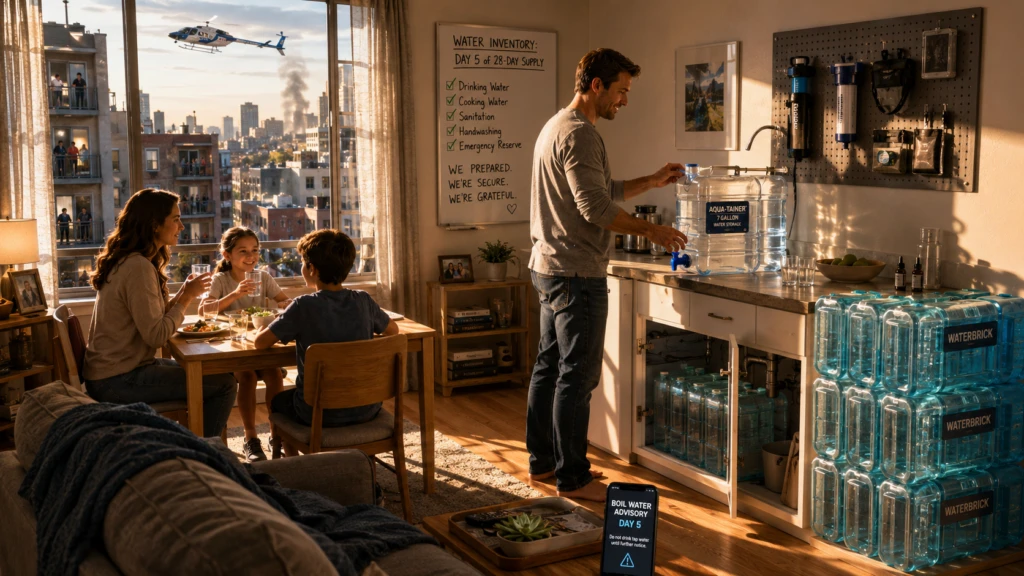
Urban water systems are fragile. A single broken water main can leave thousands without water for days. Contamination events require boil-water notices that many people ignore or don’t hear about. Natural disasters—earthquakes, hurricanes, floods—can disrupt water treatment and distribution for weeks.
And apartment dwellers are uniquely vulnerable:
- No well or alternative water source
- Higher population density = faster resource depletion
- Dependence on municipal systems with no backup
- Limited ability to collect rainwater or access natural sources
How Long Can You Actually Survive Without Water?
The “Rule of Threes” in survival medicine:
- 3 minutes without air
- 3 hours without shelter (in harsh conditions)
- 3 days without water
- 3 weeks without food
Water isn’t just important—it’s the second most critical survival need after oxygen. Dehydration kills faster than starvation, and the effects are brutal: confusion, organ failure, death.
Why “I’ll Just Buy Water When I Need It” Fails During Emergencies
When a water emergency is announced, stores are emptied within 6 hours. Not 6 days. Not 24 hours. Six hours.
During Hurricane Harvey, Houston stores ran out of water in the first afternoon. During the 2014 Toledo water crisis, stores were stripped bare before most people even heard about the contamination. During COVID-19, bottled water disappeared alongside toilet paper.
If you don’t have water stored before the emergency, you won’t get it during the emergency.
The Psychological Peace of Having Water Security
The most immediate benefit of water storage isn’t the water itself—it’s the calm that comes from knowing you have it. Every gallon you store is one less thing to panic about when crisis hits. You’re not scrambling. You’re not fighting crowds. You’re not vulnerable.
That peace of mind is worth the effort.
The short version: Water storage for apartments requires 1 gallon per person per day. For a 3-day emergency supply, store 3 gallons per person. For a 2-week supply, store 14 gallons per person. Use food-grade containers like Aqua-Tainer (7-gallon) or WaterBrick (3.5-gallon stackable). Store in cool, dark locations: under beds, in closets, under sinks, or behind furniture. Rotate every 6 months if untreated, or every 5 years with water preserver.
Key Takeaways:
– Store at least 1 gallon of water per person per day; aim for a 3-day minimum (3 gallons) and ideally 2 weeks (14 gallons) in apartments using vertical and hidden spaces.
– Use food-grade, BPA-free containers such as Aqua-Tainer (7 gallons) or WaterBrick (3.5 gallons) for safe, stackable, and space-efficient storage.
– Distribute water storage across multiple rooms to prevent overloading floors and avoid a single point of failure.
– Treat tap water with water preservers for long-term storage (up to 5 years) and rotate supplies regularly to maintain safety.
– Always have a backup purification method (portable filter, tablets, or boiling) for emergencies when stored water runs out.
How Much Water Do You Actually Need in an Apartment?
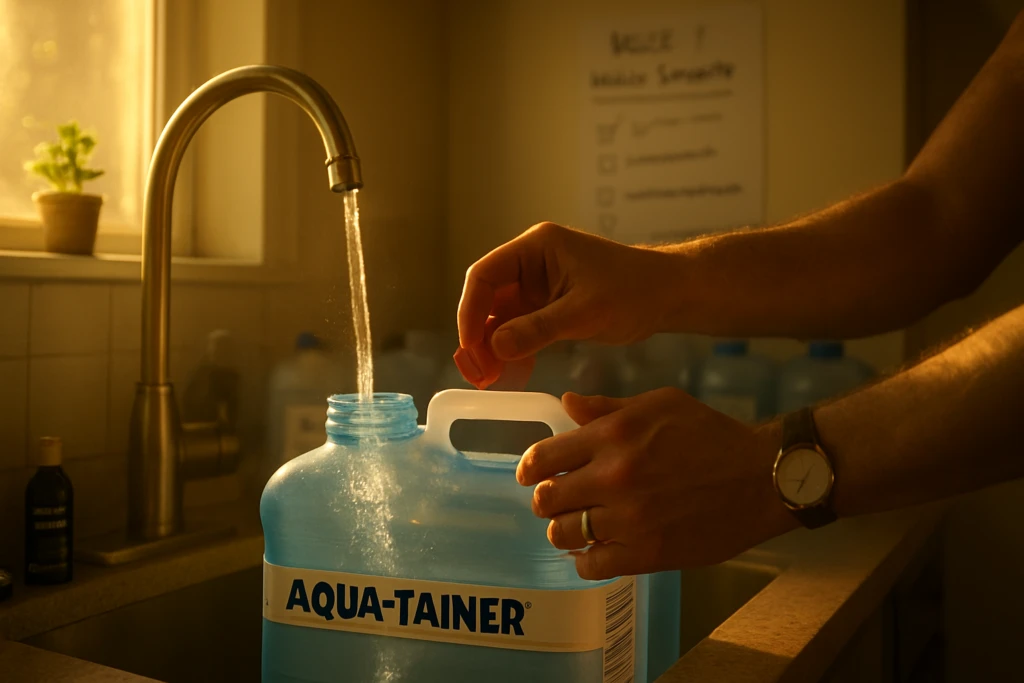 The first step in apartment water storage is calculating your actual needs. Not what sounds good. Not what you think you can fit. What you actually need to survive.
The 1-Gallon-Per-Day Rule Explained
The standard recommendation is 1 gallon of water per person per day. This breaks down into:
Drinking water requirements (half gallon minimum)
The human body needs a minimum of half a gallon (64 ounces) of drinking water per day under normal conditions. In hot weather, during physical activity, or when sick, this increases to 1 gallon or more just for drinking.
Hygiene and sanitation needs (half gallon minimum)
The other half gallon covers:
- Handwashing
- Face washing
- Tooth brushing
- Basic hygiene
- Cleaning dishes and utensils
Cooking and food preparation
If you’re cooking dried foods (rice, pasta, beans), you’ll need additional water beyond the 1-gallon baseline. Plan for an extra 1-2 quarts per day if cooking from dry goods.
Calculating Your Apartment Water Storage Needs
Single person: 3-day vs. 2-week supply
- 3-day minimum: 3 gallons (absolute baseline)
- 1-week supply: 7 gallons (recommended minimum)
- 2-week supply: 14 gallons (optimal for most emergencies)
Couples and families: Scaling your storage
- Couple (2 people): 6 gallons (3 days), 28 gallons (2 weeks)
- Family of 4: 12 gallons (3 days), 56 gallons (2 weeks)
Special considerations (pets, medical needs, climate)
Add extra water for:
- Pets: 1 ounce per pound of body weight per day (a 50-pound dog needs 0.4 gallons/day)
- Medical needs: Dialysis, wound care, medication preparation
- Hot climates: Double the baseline in extreme heat
- Infants: Formula preparation requires additional clean water
The Realistic Apartment Water Storage Target
Minimum viable: 3 gallons per person (72 hours)
This is your absolute minimum. It covers basic drinking and hygiene for 3 days. It fits under a bed or in a closet. No excuses.
Recommended: 14 gallons per person (2 weeks)
This is the sweet spot for apartment dwellers. Most emergencies resolve within 2 weeks. This amount is achievable in a small apartment with smart storage.
Optimal: 30 gallons per person (1 month)
This is for those who want maximum security or live in high-risk areas (earthquake zones, hurricane regions). It requires dedicated storage planning but is absolutely achievable in apartments.
The Best Water Storage Containers for Apartments
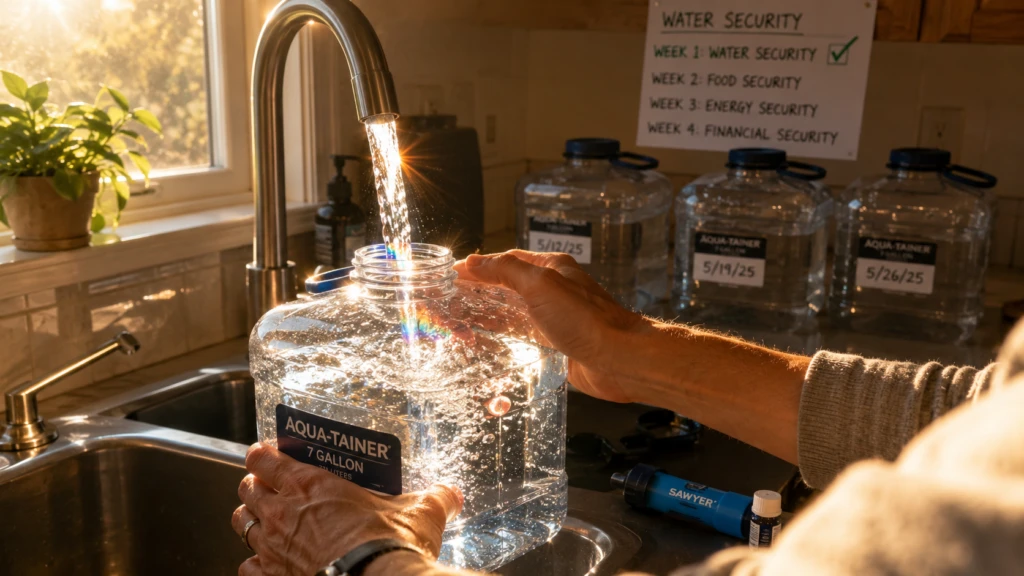 Not all water containers are created equal. The wrong container can contaminate your water, leak, or waste precious space.
Rigid vs. Collapsible: Choosing Your Container Type
Rigid containers (Aqua-Tainer, Reliance, Arrow)
Pros:
- Durable and long-lasting
- Stackable (with proper design)
- Built-in spigots for easy dispensing
- Better for long-term storage
Cons:
- Take up space even when empty
- Heavier when full
- Less flexible for odd storage spaces
Best for: Primary long-term storage in dedicated spaces (closets, under beds, pantries)
Collapsible containers (WaterBrick, Platypus, Reliance Fold-A-Carrier)
Pros:
- Collapse when empty (massive space savings)
- Lightweight when empty
- Fit in irregular spaces
- Easy to transport
Cons:
- Less durable than rigid containers
- Can be harder to clean
- May not stack as efficiently when full
Best for: Backup storage, seasonal use, or when space is extremely limited
Hybrid solutions (stackable and space-efficient)
WaterBrick containers are the best of both worlds: rigid enough to stack like Lego blocks, but designed to maximize space efficiency. They’re the gold standard for apartment water storage.
Container Size Strategy for Small Spaces
1-gallon bottles (maximum flexibility, easy rotation)
Pros:
- Fit anywhere
- Easy to rotate into daily use
- Lightweight and portable
- Cheap (often free if you save bottles)
Cons:
- Inefficient use of space
- More containers to manage
- Higher plastic-to-water ratio
Best for: Distributed storage (one in every room), rotation into daily use
3-7 gallon containers (optimal balance)
Pros:
- Perfect size-to-weight ratio (manageable when full)
- Efficient use of space
- Stackable options available
- Built-in spigots common
Cons:
- Still require dedicated storage space
- 7 gallons = 58 pounds (heavy for some people)
Best for: Primary apartment water storage (this is the sweet spot)
15+ gallon containers (when you have dedicated space)
Pros:
- Maximum water per container
- Fewer containers to manage
- Often the best price per gallon
Cons:
- Extremely heavy when full (15 gallons = 125 pounds)
- Difficult to move once filled
- Require significant floor space
Best for: Apartments with dedicated storage rooms, basements, or balconies
Food-Grade Certification and BPA-Free Requirements
What “food-grade” actually means
Food-grade plastic is certified safe for storing consumables. It doesn’t leach harmful chemicals into water and is resistant to bacterial growth. Look for containers marked:
- “Food-grade”
- “NSF certified”
- “FDA approved for food contact”
BPA, BPS, and plastic safety
- BPA (Bisphenol A): Hormone disruptor, avoid containers with BPA
- BPS (Bisphenol S): BPA replacement, also concerning
- Look for: “BPA-free” and “BPS-free” labels
HDPE vs. other plastics
HDPE (High-Density Polyethylene) is the gold standard for water storage:
- Recycling code #2
- Doesn’t leach chemicals
- Durable and long-lasting
- Resistant to bacteria and algae
Avoid: PET (#1), PVC (#3), and polycarbonate plastics for long-term water storage
Top-Rated Apartment Water Storage Containers
Best overall: Aqua-Tainer 7-Gallon
- Capacity: 7 gallons (58 pounds when full)
- Material: BPA-free, food-grade plastic
- Features: Built-in spigot, stackable, vent cap
- Price: $15-20
- Why it’s best: Perfect size for apartments, durable, easy to use, affordable
Best stackable: WaterBrick 3.5-Gallon
- Capacity: 3.5 gallons (29 pounds when full)
- Material: HDPE, BPA-free
- Features: Stackable like Lego, cross-stacks with food containers, handles
- Price: $20-25
- Why it’s best: Maximum space efficiency, modular system, dual-use (water or food)
Best collapsible: Reliance Fold-A-Carrier 5-Gallon
- Capacity: 5 gallons (41 pounds when full)
- Material: BPA-free plastic
- Features: Collapses flat, built-in spigot, handle
- Price: $10-15
- Why it’s best: Stores flat when empty, affordable, easy to transport
Best budget: Arrow Home Products 5-Gallon
- Capacity: 5 gallons
- Material: Food-grade plastic
- Features: Simple design, spigot, handle
- Price: $8-12
- Why it’s best: Cheapest reliable option, gets the job done
Where to Store Water in Your Apartment (Room-by-Room Strategy)
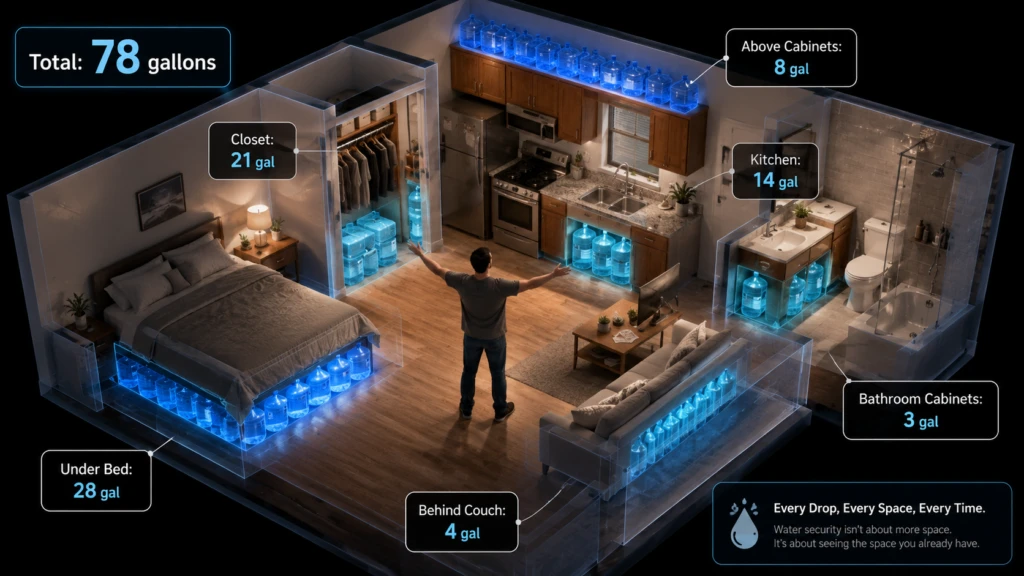 The key to apartment water storage is distributed storage. Don’t put all your water in one place. Spread it throughout your apartment for accessibility and redundancy.
Kitchen and Pantry Water Storage
Under-sink storage (with proper containers)
The space under your kitchen sink can hold 7-14 gallons:
- Use slim containers that fit around plumbing
- Ensure containers are food-grade (cleaning chemicals nearby)
- Use a drip tray to catch any leaks
Pantry floor and shelf optimization
- Floor: Stack 7-gallon containers (2-3 high)
- Shelves: Use 1-gallon bottles to fill gaps
- Above shelves: Place lightweight containers on top of cabinets
Above-cabinet dead space
The space between the top of your cabinets and the ceiling can hold:
- 1-gallon bottles (lightweight)
- Empty collapsible containers
- Water treatment supplies
Bedroom Water Storage Solutions
Under-bed storage (flat containers)
The space under your bed is prime real estate:
- Queen bed: 20-30 gallons in flat containers
- Full bed: 15-20 gallons
- Twin bed: 10-15 gallons
Use:
- Flat 5-gallon containers
- 1-gallon bottles in plastic bins
- Rolling storage containers for easy access
Closet floor and shelf space
- Floor: Stack 7-gallon containers (2-3 high)
- Shelves: 1-gallon bottles or smaller containers
- Hanging organizers: Water treatment supplies, purification tablets
Behind-furniture gaps
That 6-inch gap between your dresser and the wall? That’s storage:
- Slim 5-gallon containers
- 1-gallon bottles
- Collapsible containers
Bathroom Water Storage
Under-sink cabinets
- 7-14 gallons depending on plumbing configuration
- Use containers with spigots for easy access
- Keep separate from cleaning chemicals
Over-toilet storage units
3-tier over-toilet shelves can hold:
- 1-gallon bottles (top shelf)
- Water treatment supplies (middle shelf)
- Backup hygiene supplies (bottom shelf)
Bathtub emergency storage (WaterBOB)
The WaterBOB is a 100-gallon bathtub bladder:
- Stores flat in a shoebox when not in use
- Fills in 20 minutes when you have warning
- Keeps water clean for weeks
- Cost: $35
- When to use: 24-48 hours before predicted emergency
Living Room and Multi-Use Spaces
Behind couches and furniture
- Slim containers fit in 6-12 inch gaps
- 5-7 gallon containers work well
- Keep out of sight, easily accessible
Storage ottomans and furniture
- Ottoman storage: 3-7 gallons
- Coffee tables with storage: 5-10 gallons
- TV stands with cabinets: 7-14 gallons
Decorative container solutions
- Large decorative vases (food-grade liner)
- Decorative bins and baskets (hide 1-gallon bottles)
- Furniture-style storage containers
Balcony and Outdoor Storage (If Available)
UV-resistant containers
If storing water on a balcony:
- Use opaque containers (blocks UV light)
- Avoid clear containers (algae growth)
- Cover with tarp or store in cabinet
Temperature considerations
- Heat: Water stored above 80°F degrades faster
- Cold: Water stored below 32°F can freeze and crack containers
- Solution: Insulated storage or seasonal rotation
Freeze protection strategies
- Bring containers inside during winter
- Use insulated container covers
- Leave 10% air space for expansion if freezing is possible
Water Storage Safety and Maintenance for Apartments
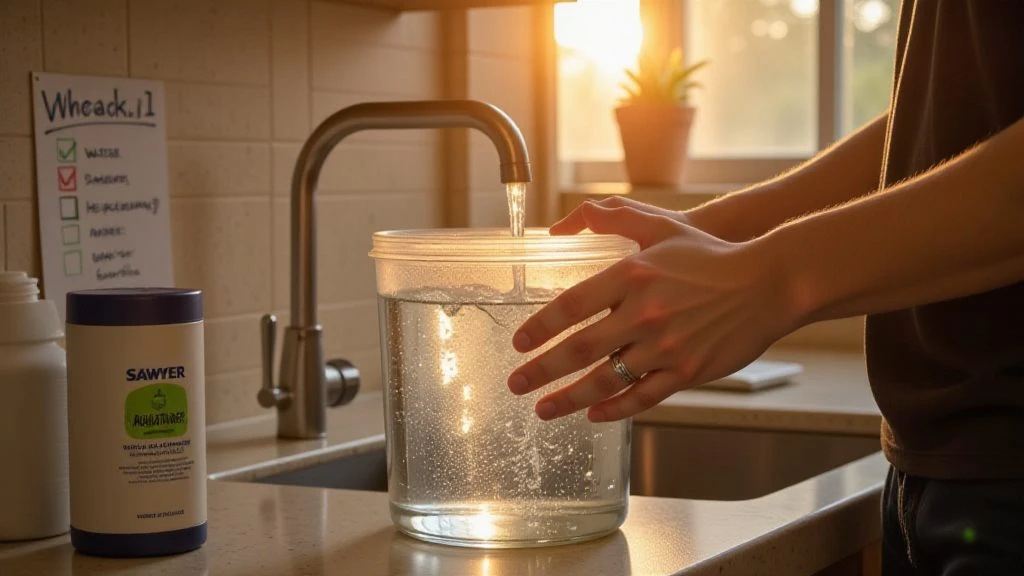 Storing water isn’t “set it and forget it.” Proper treatment and maintenance ensure your water is safe when you need it.
Proper Water Treatment Before Storage
Tap water vs. bottled water storage
Tap water:
- Generally safe to store if your municipal water is chlorinated
- Chlorine provides some protection against bacteria
- Treat with water preserver for long-term storage (5 years)
Bottled water:
- Already treated and sealed
- 2+ year shelf life
- More expensive but requires no treatment
- Best for rotation into daily use
Water preserver concentrate (Aquamira, Water Preserver)
Water preserver extends shelf life to 5 years:
- Dosage: 1 drop per quart, or follow product instructions
- How it works: Prevents bacterial and algae growth
- Cost: $10-15 for enough to treat 55 gallons
- Brands: Aquamira Water Treatment, Water Preserver Concentrate
Bleach treatment method (emergency option)
If you don’t have water preserver:
- Dosage: 8 drops (1/8 teaspoon) of unscented household bleach per gallon
- Wait: 30 minutes before sealing
- Shelf life: 6 months
- Note: Only use unscented, regular bleach (5-6% sodium hypochlorite)
Rotation Schedules and Shelf Life
Untreated tap water: 6 months
If you store tap water without treatment:
- Rotate every 6 months
- Use for watering plants, then refill
- Mark containers with fill date
Treated water: 5 years
Water treated with preserver concentrate:
- Rotate every 5 years
- Inspect annually for leaks or contamination
- Mark containers with treatment date
Commercial bottled water: 2+ years
Commercially bottled water:
- Check expiration dates
- Rotate into daily use before expiration
- Replace as you use
Setting up automatic rotation reminders
- Set calendar reminders for rotation dates
- Use smartphone apps (Prep & Pantry, Preppers Checklist)
- Label containers with fill/treatment dates
Preventing Algae, Bacteria, and Contamination
Light exposure (opaque vs. clear containers)
- Opaque containers: Block UV light, prevent algae growth
- Clear containers: Allow light penetration, promote algae
- Solution: Use opaque containers or store clear containers in dark locations
Temperature control (50-70°F ideal)
- Too hot (80°F+): Accelerates bacterial growth, degrades plastic
- Too cold (32°F-): Risk of freezing and container damage
- Ideal: 50-70°F (room temperature in climate-controlled apartments)
Container cleaning and sanitization
Before filling containers:
- Wash with dish soap and water
- Rinse thoroughly
- Sanitize with 1 tablespoon bleach per gallon of water
- Let sit 2 minutes
- Rinse thoroughly with clean water
- Air dry completely
Apartment-Specific Safety Concerns
Weight distribution and floor load limits
Water is heavy: 1 gallon = 8.34 pounds
Floor load limits:
- Most residential floors: 40 pounds per square foot (live load)
- 30 gallons of water: 250 pounds
- Solution: Distribute weight across multiple locations, avoid concentrating in one spot
Leak prevention and water damage liability
- Use drip trays under containers
- Inspect containers quarterly for cracks or leaks
- Keep water away from electronics and valuables
- Liability: You’re responsible for water damage to your unit and units below
Landlord and lease considerations
- Most leases don’t prohibit water storage
- Excessive amounts (100+ gallons) may violate fire codes
- Check local fire codes and lease terms
- Frame as “emergency preparedness” if asked
Emergency Water Sourcing and Purification for Apartments
Your stored water will eventually run out. Know where to find more and how to make it safe.
When Stored Water Runs Out: Apartment Water Sources
Water heater (30-50 gallons of stored water)
Your water heater is an emergency water source:
- Turn off power/gas to water heater
- Turn off water supply to prevent contamination
- Attach hose to drain valve at bottom
- Drain into clean containers
- Note: First few gallons may be sediment-heavy
Toilet tank water (not bowl – tank only)
The tank (not the bowl) holds 2-3 gallons of clean water:
- Only use if no chemical toilet cleaners are present
- Purify before drinking
- Never use toilet bowl water
Ice cubes and refrigerator water
- Ice maker: 5-10 pounds of ice
- Refrigerator water dispenser: 1-2 gallons in reservoir
- Let ice melt for drinking water
Canned goods liquid
- Canned vegetables and fruits contain water
- Drain and use liquid (already safe)
- Not a primary source, but every bit helps
Portable Water Filters for Apartment Dwellers
Sawyer Squeeze and Mini (best for apartments)
- Filtration: 0.1 micron (removes 99.99999% of bacteria, 99.9999% of protozoa)
- Capacity: 100,000 gallons (Squeeze), 100,000 gallons (Mini)
- Price: $25-40 (Squeeze), $15-25 (Mini)
- Why it’s best: Compact, reliable, long-lasting, affordable
LifeStraw and personal filters
- Filtration: 0.2 micron
- Capacity: 1,000 gallons (personal), 4,000 gallons (family)
- Price: $15-20 (personal)
- Best for: Individual use, bug-out bags
Gravity filters (Platypus GravityWorks)
- Filtration: 0.2 micron
- Capacity: 1,500 gallons
- Price: $100-130
- Best for: Filtering large quantities without pumping
Water Purification Methods Without Equipment
Boiling (most reliable, requires heat source)
Boiling kills all pathogens:
- Bring water to rolling boil
- Boil for 1 minute (3 minutes above 6,500 feet elevation)
- Let cool before drinking
Requires: Heat source (camp stove, fireplace, Sterno)
Purification tablets (Potable Aqua, Aquatabs)
- Active ingredient: Chlorine dioxide or iodine
- Wait time: 30 minutes to 4 hours
- Shelf life: 4-5 years
- Price: $10 for 30-50 tablets
- Kills: Bacteria, viruses, protozoa
Bleach purification (emergency method)
- Use unscented household bleach (5-6% sodium hypochlorite)
- Add 8 drops (1/8 teaspoon) per gallon of clear water
- Add 16 drops (1/4 teaspoon) per gallon of cloudy water
- Mix well and let stand 30 minutes
- Water should have slight chlorine smell; if not, repeat and wait 15 more minutes
The WaterBOB: Emergency Bathtub Storage
How it works (100-gallon bladder)
The WaterBOB is a food-grade plastic bladder that fits in your bathtub:
- Holds up to 100 gallons
- Keeps water clean and protected from contamination
- Includes siphon pump for easy dispensing
- Stores flat in a shoebox when not in use
When to deploy (24-48 hour warning)
Use the WaterBOB when you have advance warning:
- Hurricane approaching
- Severe storm predicted
- Water main break announced
- Contamination warning issued
Pros and cons for apartment use
Pros:
- Massive water storage (100 gallons)
- No permanent storage space required
- Affordable ($35)
- Keeps bathtub water clean
Cons:
- Requires advance warning (can’t deploy after water is shut off)
- Single-use (can’t be refilled once deployed)
- Ties up your bathtub for duration of emergency
Budget-Friendly Apartment Water Storage Strategies
You don’t need hundreds of dollars to store adequate water. Here’s how to do it affordably.
The $50 Water Storage Starter Kit
Total: $50
- Two 7-gallon Aqua-Tainers: $30 (14 gallons total)
- Sawyer Mini water filter: $15
- Water preserver concentrate: $5
This gives you 14 gallons of stored water (2 weeks for one person, 1 week for a couple) plus the ability to purify additional water.
The $150 Comprehensive 2-Week Supply
Total: $150
- Four 7-gallon Aqua-Tainers: $60 (28 gallons total)
- Sawyer Squeeze water filter: $30
- Purification tablets (50-pack): $10
- Water preserver concentrate: $10
- WaterBOB bathtub bladder: $35
- Container cleaning supplies: $5
This provides 28 gallons of stored water (2 weeks for two people) plus backup purification and emergency bathtub storage.
Free and Low-Cost Container Options
Safe options:
- 2-liter soda bottles: Free, food-grade, but inefficient use of space
- 1-gallon juice bottles: Free if you buy juice, rinse thoroughly
- 5-gallon water cooler bottles: $10-15 deposit, reusable
Unsafe options (avoid):
- Milk jugs (degrade quickly, can’t be properly cleaned)
- Non-food-grade containers
- Containers that held chemicals
DIY Water Storage Solutions (With Safety Caveats)
Safe DIY:
- Thoroughly cleaned food-grade containers
- Repurposed commercial water containers
- Food-grade buckets with gamma seal lids
Unsafe DIY:
- Homemade containers from non-food-grade materials
- Containers without proper seals
- Anything that can’t be thoroughly cleaned
Bottom line: The $15 for a proper Aqua-Tainer is worth it. Don’t risk your health with questionable DIY solutions.
Common Apartment Water Storage Mistakes (And How to Avoid Them)
 Learn from others’ mistakes. These are the most common water storage errors apartment dwellers make.
Storing Water in Non-Food-Grade Containers
The mistake: Using milk jugs, non-food-grade buckets, or containers that held chemicals.
Why it’s dangerous:
- Milk jugs degrade quickly and can’t be properly sanitized
- Non-food-grade plastics leach chemicals
- Chemical residue can contaminate water
The fix: Only use containers marked “food-grade,” “NSF certified,” or “FDA approved for food contact.”
Ignoring Weight Distribution and Floor Limits
The mistake: Storing 100+ gallons in one closet or corner.
Why it’s dangerous:
- Exceeds floor load limits (40 lbs/sq ft)
- Risk of structural damage
- Liability for damage to units below
The fix: Distribute water throughout apartment. No more than 30 gallons in any single location.
Never Rotating or Testing Your Water Supply
The mistake: Storing water and forgetting about it for years.
Why it’s dangerous:
- Water can become contaminated
- Containers can leak or degrade
- You don’t know if your system actually works
The fix: Set calendar reminders. Rotate every 6 months (untreated) or 5 years (treated). Test your purification methods before you need them.
Storing All Water in One Location (Single Point of Failure)
The mistake: Keeping all water in one closet or room.
Why it’s dangerous:
- If that area becomes inaccessible (fire, structural damage, flooding), you lose all your water
- Puts all weight in one location
The fix: Distribute water across multiple rooms. Keep some in bedroom, some in kitchen, some in bathroom.
No Backup Purification Method When Storage Runs Out
The mistake: Only storing water with no way to purify additional water.
Why it’s dangerous:
- Stored water eventually runs out
- You’re helpless when it does
The fix: Always have a backup purification method: portable filter ($15-40), purification tablets ($10), or knowledge of boiling.
Storing Water in Direct Sunlight or Extreme Temperatures
The mistake: Storing water on sunny balconies or in unheated storage areas.
Why it’s dangerous:
- UV light promotes algae growth
- Heat accelerates bacterial growth and plastic degradation
- Freezing can crack containers
The fix: Store in cool (50-70°F), dark locations. If balcony storage is necessary, use opaque containers and cover with tarp.
Violating Lease Terms and Risking Eviction
The mistake: Storing excessive amounts of water in violation of fire codes or lease terms.
Why it’s dangerous:
- Eviction
- Fines
- Liability for violations
The fix: Check your lease and local fire codes. Most allow reasonable emergency water storage (30-50 gallons). Frame as “emergency preparedness” if asked.
Frequently Asked Questions
Can I store water in my apartment without my landlord knowing?
Yes, in most cases. Reasonable water storage (14-30 gallons) is legal and doesn’t require landlord notification. It’s no different than storing cases of soda or juice.
However:
- Check your lease for specific restrictions
- Don’t exceed fire code limits (usually 50-100 gallons)
- Be discreet if you’re storing large amounts
- Frame as “emergency preparedness” if asked
Bottom line: 14-30 gallons is completely reasonable and unlikely to cause issues.
How do I store water when I have absolutely no space?
Even the smallest studio has hidden storage:
Under the bed: 20-30 gallons in flat containers Under the sink: 7-14 gallons Closet floor: 14-21 gallons (stacked containers) Behind furniture: 7-14 gallons in slim containers WaterBOB: 100 gallons when needed, stores in a shoebox when not
Minimum viable: 3 gallons fits under any bed or in any closet. Start there.
Is tap water safe to store long-term?
Yes, if your municipal water is chlorinated (most are). The chlorine provides some protection against bacteria.
For best results:
- Treat with water preserver concentrate (5-year shelf life)
- Store in food-grade, opaque containers
- Keep in cool, dark location
- Rotate every 6 months if untreated, 5 years if treated
If your water isn’t chlorinated: Treat with water preserver or bleach before storage.
What’s the best way to store water in a studio apartment?
Priority locations:
- Under the bed: 20-30 gallons (primary storage)
- Closet floor: 14-21 gallons (secondary storage)
- Under the sink: 7-14 gallons (kitchen/bathroom)
- Behind furniture: 7-14 gallons (living area)
Total: 48-79 gallons in a studio apartment
Best containers: 7-gallon Aqua-Tainers or 3.5-gallon WaterBricks (stackable)
How much weight can my apartment floor handle?
Most residential floors are rated for 40 pounds per square foot (live load).
Water weight:
- 1 gallon = 8.34 pounds
- 30 gallons = 250 pounds
- 50 gallons = 417 pounds
Safe practice:
- Distribute weight across multiple locations
- Don’t concentrate more than 30 gallons (250 lbs) in one spot
- Place heavy containers against load-bearing walls
- Avoid placing heavy water storage in the center of rooms
If concerned: Contact your building management or a structural engineer.
Can I store water on my balcony year-round?
It depends on your climate.
Warm climates (no freezing):
- Yes, with UV-resistant (opaque) containers
- Cover with tarp or store in cabinet
- Monitor for excessive heat (80°F+)
Cold climates (freezing temperatures):
- No, water will freeze and crack containers
- Bring containers inside during winter
- Or leave 10% air space for expansion (risky)
Best practice: Store water indoors year-round for maximum safety and longevity.
Taking the Next Step
You now have the complete blueprint for water storage in apartments. You understand how much you need, which containers to buy, where to store them, and how to maintain your supply.
But knowledge without action is just anxiety with extra steps.
This week—not next month, not when you have more money, not when you feel “ready”—buy your first water container. A single 7-gallon Aqua-Tainer costs $15. Fill it. Put it under your bed. That’s 7 gallons more than you had yesterday.
Next week, buy another one. The week after, add a water filter. In 30 days, you’ll have 2 weeks of water security.
Small actions create momentum. Momentum creates confidence. Confidence creates capability.
When the water main breaks, when the contamination warning goes out, when the storm hits, you won’t be fighting crowds at the store. You’ll be calm. You’ll be prepared. You’ll be secure.
That’s not just water storage. That’s peace of mind.
PRODUCTS / TOOLS / RESOURCES
These are the specific items and resources that consistently come up in serious apartment water storage conversations—selected for space efficiency, safety, and real-world effectiveness in small living spaces.
Water Storage Containers (Space-Efficient)
- Aqua-Tainer 7-Gallon Water Container: The gold standard for apartment water storage. Stackable, built-in spigot, BPA-free, food-grade. Perfect size-to-weight ratio ($15-20 each).
- WaterBrick 3.5-Gallon Stackable Container: Stackable like Lego blocks, cross-stacks with food containers, handles for easy transport. Maximum space efficiency ($20-25 each).
- Reliance Fold-A-Carrier 5-Gallon: Collapsible design stores flat when empty, built-in spigot, affordable. Perfect for backup storage ($10-15).
- Arrow Home Products 5-Gallon Container: Budget-friendly option, food-grade, simple design. Gets the job done ($8-12).
Emergency Bathtub Storage
- WaterBOB Bathtub Emergency Water Storage: 100-gallon capacity, food-grade bladder, includes siphon pump. Stores flat in a shoebox. Essential for advance-warning emergencies ($35).
Water Purification & Filtration
- Sawyer Squeeze Water Filter: 0.1-micron filtration, 100,000-gallon capacity, removes 99.99999% of bacteria. The best portable filter for apartments ($25-40).
- Sawyer Mini Water Filter: Compact version, same filtration quality, perfect for bug-out bags and personal use ($15-25).
- Potable Aqua Chlorine Dioxide Tablets: Kills bacteria, viruses, and protozoa. Lightweight backup purification method ($10 for 30 tablets).
- Aquamira Water Treatment Drops: Treats up to 30 gallons, 5-year shelf life, no chlorine taste ($15).
Water Treatment & Preservation
- Water Preserver Concentrate: Extends water storage life to 5 years. One bottle treats 55 gallons ($10-15).
- Unscented Household Bleach (5-6% sodium hypochlorite): Emergency water treatment option. Use 8 drops per gallon ($3-5).
Storage Organization
- Under-Bed Storage Containers (Flat): For storing 1-gallon bottles or flat water containers under beds. Maximize hidden space ($15-25).
- Stackable Storage Bins: For organizing 1-gallon bottles in closets or pantries ($10-20).
- Drip Trays: Place under water containers to catch leaks and prevent water damage ($5-10).
Testing & Maintenance
- Water Quality Test Strips: Test stored water for pH, chlorine, and contaminants ($10-15 for 50 strips).
- Permanent Markers: Label containers with fill dates and treatment information ($3-5).
- Container Cleaning Brush: Long-handled brush for cleaning inside water containers ($8-12).
Education & Planning
- “The Prepper’s Water Survival Guide” by Daisy Luther: Comprehensive guide to water storage, purification, and emergency water sourcing.
- CDC Water Storage Guidelines: Free online resource with official water storage and treatment recommendations (cdc.gov/healthywater).
- The Prepared (theprepared.com): Evidence-based online resource with detailed water storage guides and product reviews.
Apps & Tools
- Prep & Pantry App: Track water storage inventory, set rotation reminders, manage expiration dates (iOS/Android, free).
- Water Calculator: Online tools to calculate exact water needs based on household size and duration (multiple free options available).