
Hey there! Some links on this page may be affiliate links which means that, if you choose to make a purchase, I may earn a commission at no extra cost to you. I greatly appreciate your support. Read the full disclosure here.
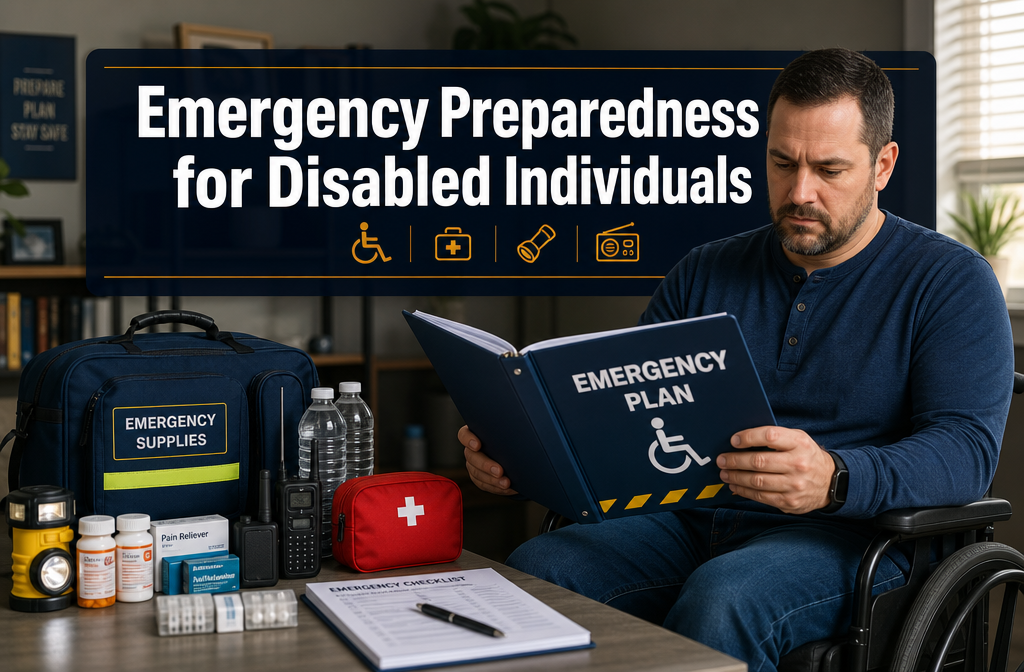
Over 61 million adults in the United States live with some form of disability, according to the CDC — yet most emergency preparedness systems are designed around a single, able-bodied template that leaves this population dangerously exposed when disaster strikes. Emergency preparedness for disabled individuals is not a niche concern. It is a life-or-death planning gap that affects roughly one in four American adults, and the consequences of ignoring it show up in every major disaster after-action report.
This guide covers everything from building a disability-specific emergency kit to navigating government assistance programs, specialized alert systems, and evacuation planning that actually works for people with mobility, sensory, cognitive, or medical challenges. Whether you are preparing for yourself, a family member, or someone in your community, the strategies here are practical, tested, and built for real-world conditions.
Key Takeaways
- People with disabilities need a personalized emergency plan that accounts for their specific medical, mobility, communication, and cognitive needs — a generic kit is not enough.
- A disability-specific emergency kit should include a minimum 7-day supply of medications, backup power for medical equipment, adaptive communication devices, and disability-specific tools.
- Registering with your local emergency management office puts first responders on notice before a disaster happens — this single step can save your life.
- Evacuation plans must include at least two accessible routes, pre-identified accessible shelters, and a support network of at least three people who know your plan.
- Government programs through FEMA, local emergency management agencies, and disability service organizations provide real, actionable assistance — but you must register proactively.
- Technology including vibrating alert systems, captioned emergency broadcasts, GPS trackers, and medical alert devices significantly improves safety outcomes for disabled individuals.
- Common planning mistakes include failing to account for power-dependent medical equipment, not practicing the evacuation plan, and relying on a single contact person.
- Cost for a disability-adapted emergency kit ranges from roughly $150 to $600 depending on medical equipment needs, with many components available through insurance or assistance programs.
What Are the Most Important Emergency Supplies for People with Disabilities
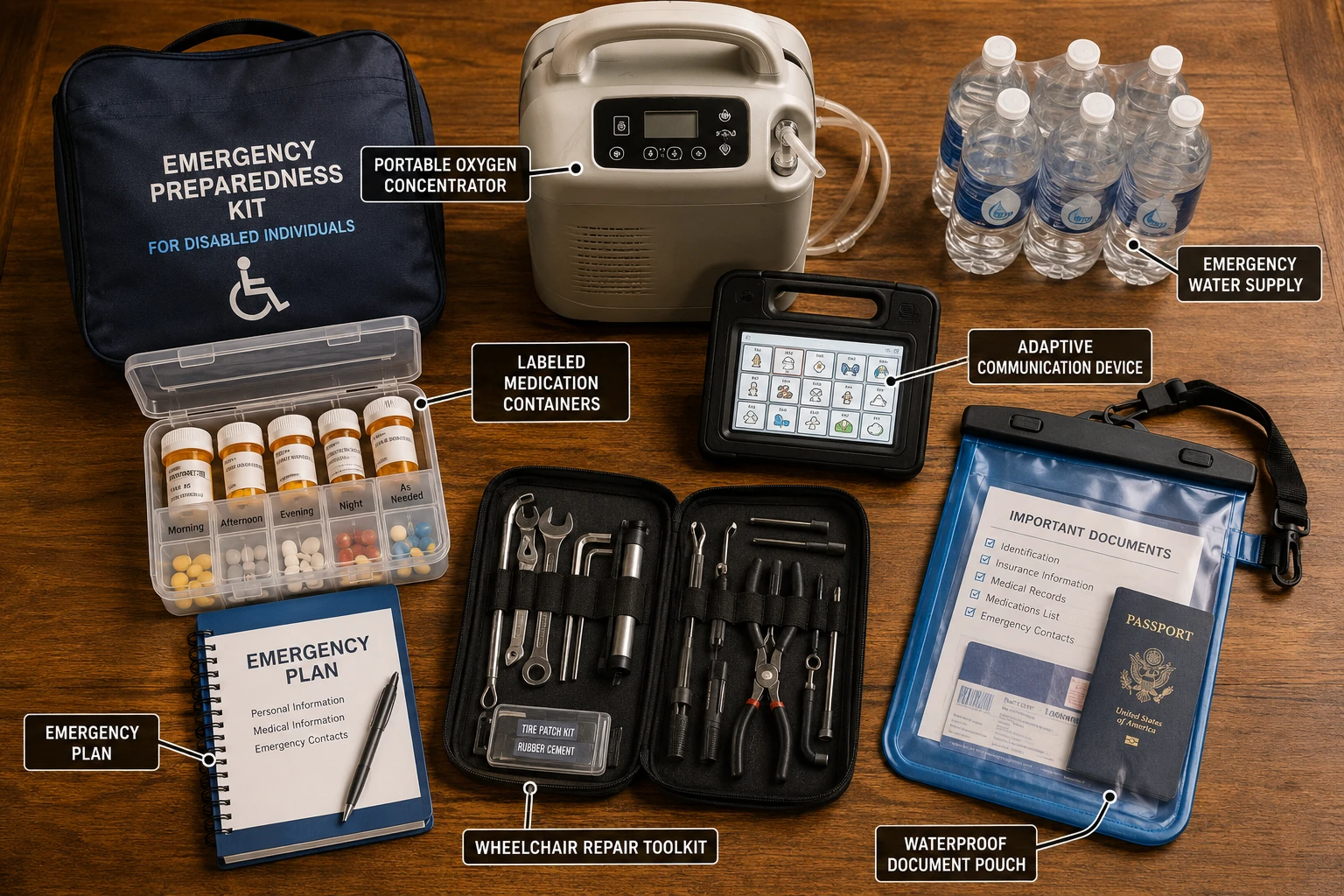
The most important emergency supplies for people with disabilities go beyond the standard water-food-flashlight formula. A disability-specific kit must address medical continuity, communication, mobility support, and power needs that standard kits completely ignore.
Core supplies every disability-adapted kit should include:
- Medications: A minimum 7-day supply (ideally 30 days) of all prescription medications, stored in a waterproof, labeled container. Include a written list of medications, dosages, prescribing physicians, and pharmacy contact information.
- Medical equipment backup power: Portable battery packs, solar chargers, or generator access for CPAP machines, ventilators, oxygen concentrators, powered wheelchairs, and insulin pumps.
- Adaptive communication devices: Backup hearing aids and batteries, a TTY device or captioned telephone, a whiteboard and markers for written communication, or a pre-programmed communication app on a fully charged tablet.
- Mobility aids and repair tools: A manual backup wheelchair if you use a powered chair, wheelchair repair kit (tire patch, pump, spare parts), extra crutches or walking aids, and non-slip gloves for self-propulsion on rough terrain.
- Medical documentation: Copies of prescriptions, insurance cards, physician contacts, medical history, and advance directives stored in a waterproof pouch.
- Sensory support items: Extra glasses or a backup prescription, white cane, tactile maps of your home and local emergency routes, and large-print or Braille emergency instructions.
- Personal care supplies: Catheter supplies, ostomy materials, incontinence products, wound care items, and any specialized hygiene products required for daily function.
For a broader baseline, the Ultimate Emergency Supplies List covers foundational items that apply to every household — layer your disability-specific needs on top of that foundation.
Decision rule: If you depend on any electrically powered device for survival (ventilator, oxygen, insulin pump), backup power is not optional. It is the single highest-priority item in your kit, above food and water.
How Disabled People Create an Emergency Evacuation Plan
An effective evacuation plan for a disabled person requires more structure than a standard family plan. It must account for accessible routes, transportation barriers, shelter accessibility, and the physical or cognitive limitations that affect how fast and how independently someone can move.
Step-by-step evacuation planning for disabled individuals:
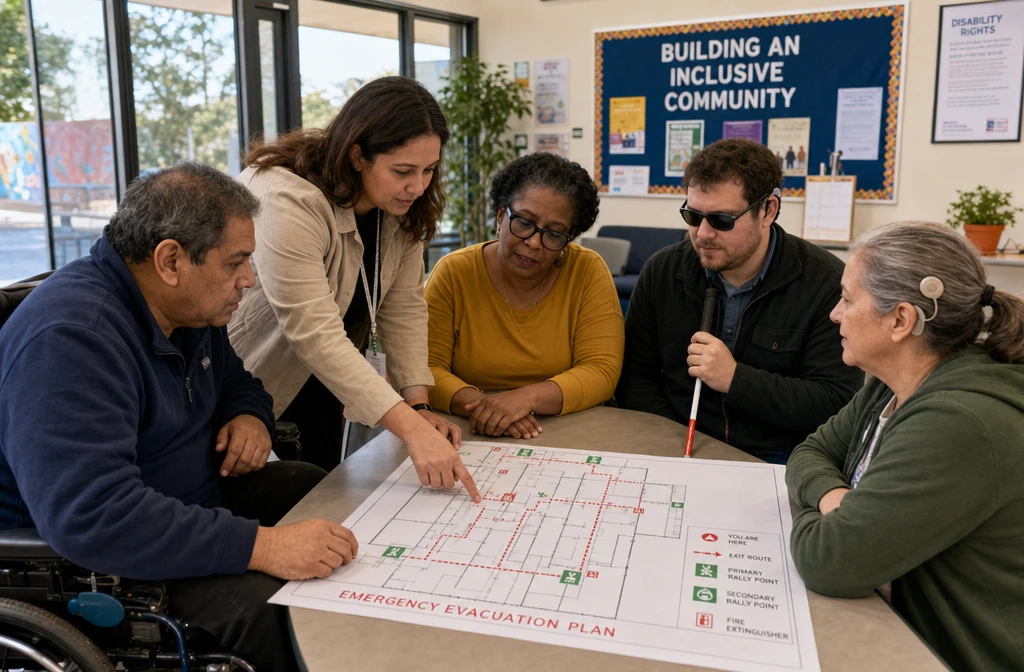
- Identify two accessible exit routes from your home. Walk or wheel through both routes and note any barriers: stairs, narrow doorways, uneven pavement, or locked gates. If stairs are unavoidable, identify who will assist and practice the procedure.
- Select pre-identified accessible shelters. Contact your local emergency management office to get a list of ADA-compliant shelters in your area. Verify that the shelter can accommodate your specific needs (medical equipment power, refrigeration for medications, accessible bathrooms).
- Build a support network of at least three people. Choose neighbors, friends, or family members who know your plan, have a key to your home, and can assist with evacuation. Do not rely on a single person — they may be unavailable or affected by the same disaster.
- Arrange accessible transportation in advance. Identify a backup transportation option if your personal vehicle is unavailable. Contact your local paratransit service, disability transportation network, or a trusted contact with an accessible vehicle.
- Practice the plan at least twice a year. A plan that exists only on paper is not a plan. Run through the full evacuation procedure, including loading equipment, navigating routes, and reaching your designated shelter.
- Create a “go bag” you can actually carry or transport. If you use a wheelchair, attach a small bag to the chair. If you need assistance, pre-pack bags that a helper can grab in under two minutes.
The Ultimate Evacuation Plan Guide provides a detailed framework for building evacuation systems that hold up under real pressure — adapt those principles to your specific mobility and medical situation.
Common mistake: Many disabled individuals plan their evacuation assuming normal conditions — clear roads, working elevators, available helpers. Plan instead for the worst-case version: flooded streets, no power, and a single helper at 2 a.m.
Best Emergency Communication Devices for Deaf or Hearing Impaired Individuals
Deaf and hard-of-hearing individuals face a specific and serious gap in standard emergency alert systems, which rely heavily on audible sirens, radio broadcasts, and verbal instructions. The best emergency communication devices for this population use visual, tactile, and digital channels instead.
Top communication tools for deaf and hearing-impaired emergency preparedness:
- Vibrating and strobe alert systems: Devices like the Bellman & Symfon Visit system or similar whole-home alert systems connect to smoke detectors, doorbells, and weather radios to deliver vibrating bed shakers and strobe light alerts.
- Weather alert radios with visual/vibrating alerts: NOAA weather radios with built-in visual displays and vibrating alerts (such as the Midland WR400) provide real-time emergency broadcasts without relying on sound.
- Wireless Emergency Alerts (WEA) on smartphones: All modern smartphones in the U.S. receive WEA text-based alerts from FEMA and local authorities. Ensure your phone is set to receive these alerts and that it is always charged.
- Captioned telephone services: Services like CaptionCall or InnoCaption provide real-time captions for phone calls, which becomes critical when communicating with emergency services.
- TTY/TDD devices: Teletypewriter devices allow text-based communication with emergency services that have compatible equipment. Always have the TTY-specific emergency numbers for your local area.
- Pre-written communication cards: Simple laminated cards with key phrases (“I am deaf,” “I need medical assistance,” “My address is…”) can bridge communication gaps with first responders who are unfamiliar with sign language.
For a broader look at building a communication system that works when normal channels fail, the Emergency Communication Plan guide covers redundancy strategies that apply across all disability types.
What Medications and Medical Equipment Should You Stockpile for Emergencies
Stockpiling medications and medical equipment for emergencies is one of the most critical and most overlooked aspects of emergency preparedness for disabled individuals. The goal is to maintain medical continuity for at least 7 days, with 30 days being the more resilient target.
Medication stockpile strategy:
- Ask your physician to write prescriptions with a 90-day supply. Many insurance plans allow this, especially for maintenance medications.
- Use the “rotate and replace” method: use your oldest supply first and replace it regularly so nothing expires.
- Store medications at the correct temperature. Many medications degrade in heat. If you need refrigerated medications (insulin, certain biologics), plan for a portable medical cooler and ice packs in your emergency kit.
- Keep a written medication list that includes: drug name (generic and brand), dosage, frequency, prescribing doctor, pharmacy name and phone, and what the medication treats.
Medical equipment considerations:
| Equipment Type | Backup Strategy |
|---|---|
| CPAP/BiPAP machine | Portable battery pack or DC power adapter for car use |
| Powered wheelchair | Manual backup chair; spare batteries |
| Oxygen concentrator | Portable concentrator with battery; compressed oxygen tank |
| Insulin pump | Manual injection supplies as backup; insulated cooler for insulin |
| Hearing aids | Extra batteries (minimum 2-week supply); backup device if available |
| Home dialysis equipment | Pre-arrange with dialysis center for emergency access |
Decision rule: If stopping your medication or losing access to your equipment for 48 hours would create a medical emergency, that item belongs in the highest-priority tier of your preparedness plan.
Also consider that power outages are among the most common emergencies affecting medical equipment users. The Ultimate Power Outage Preparedness Checklist covers backup power strategies that are directly applicable to medical device users.
How Much Does an Emergency Preparedness Kit Cost for Someone with Mobility Challenges
The cost of a disability-adapted emergency preparedness kit ranges from approximately $150 to $600 for most individuals with mobility challenges, with higher costs for those who require powered medical equipment or specialized adaptive tools. This is a wider range than a standard kit because needs vary significantly.
Cost breakdown by category:
- Basic supplies (water, food, first aid, flashlight, radio): $50-$100. This baseline applies to everyone and is the starting point.
- Wheelchair repair kit and adaptive tools: $30-$80. Includes tire patch kit, pump, multi-tool, and non-slip gloves.
- Backup battery power (for devices under 100W): $80-$200. A quality portable power station like the Jackery Explorer 240 or similar handles CPAP machines, phone charging, and small medical devices.
- Communication devices (vibrating alerts, WEA-enabled phone): $50-$150 if not already owned.
- Medication storage (waterproof containers, medical cooler): $20-$60.
- Documentation and adaptive supplies: $10-$30 for waterproof pouches, laminated cards, and printed materials.
Ways to reduce costs:
- Many Medicare and Medicaid plans cover backup medical equipment and supplies. Contact your benefits coordinator specifically about emergency preparedness coverage.
- Disability service organizations, including local Centers for Independent Living, sometimes provide emergency kit components at no cost.
- FEMA’s Hazard Mitigation Grant Program can fund accessibility modifications that improve emergency egress from your home.
Emergency Shelters and Resources for Disabled People During Natural Disasters
Not all emergency shelters are created equal, and for disabled individuals, arriving at an inaccessible shelter during a disaster can be as dangerous as staying home. Emergency preparedness for disabled individuals must include pre-identifying accessible shelter options before a disaster occurs.
What to look for in an accessible emergency shelter:
- ADA-compliant bathrooms with grab bars and roll-in shower access
- Accessible cots or sleeping areas at ground level
- Power outlets for medical equipment
- Refrigeration for temperature-sensitive medications
- On-site medical staff or a designated medical needs area
- Accessible parking and drop-off areas
- Staff trained in disability awareness
Types of specialized shelter resources:
- Medical Needs Shelters (also called Special Needs Shelters): Many counties operate shelters specifically for individuals with medical needs that cannot be met in a general shelter. These require pre-registration — contact your local emergency management office now, before a disaster.
- Functional Needs Support Services (FNSS): FEMA requires that general population shelters provide FNSS, meaning they must accommodate people with disabilities. In practice, quality varies significantly. Pre-registration with your local office gives you more control over placement.
- Disability-specific organizations: Organizations like the National Council on Disability and local Independent Living Centers maintain shelter resource lists and can advocate on your behalf during a disaster.
Action step: Call your county emergency management office and ask specifically: “Do you have a special needs shelter registry, and how do I register?” This single phone call is one of the highest-leverage preparedness actions a disabled person can take.
Common Mistakes Disabled People Make in Emergency Planning
The most dangerous mistakes in emergency preparedness for disabled individuals are not about missing supplies — they are about flawed assumptions that only reveal themselves when a real disaster hits.
The most common and costly mistakes:
- Assuming someone else will come. First responders are overwhelmed during major disasters. Waiting for rescue is not a plan. Build self-sufficiency and a personal support network first.
- Not accounting for power-dependent equipment. If your CPAP, oxygen concentrator, or powered wheelchair loses power, you face a medical crisis on top of a disaster. Backup power is non-negotiable.
- Relying on a single contact person. If your one emergency contact is also affected by the disaster, you have no backup. Build a network of at least three people across different locations.
- Never practicing the plan. A written plan that has never been tested will fail under pressure. Practice evacuation routes, equipment loading, and communication procedures at least twice a year.
- Ignoring shelter accessibility. Showing up at a general shelter with a wheelchair, oxygen equipment, or severe cognitive disability without pre-registration often results in inadequate accommodation.
- Failing to update the plan after changes. New medications, new equipment, a change in physical condition, or a move to a new home all require updating your emergency plan.
- Overlooking caregiver continuity. If you rely on a paid caregiver or home health aide, what happens if that person cannot reach you during a disaster? Have a backup caregiver identified and briefed.
For families supporting a disabled member, the Disaster Preparedness for Families guide addresses how to integrate individual needs into a household-wide plan without leaving anyone behind.
How to Modify Emergency Kits for Specific Disabilities
A one-size-fits-all emergency kit does not exist. Emergency preparedness for disabled individuals requires kit modifications tailored to the specific nature of each disability. Here is how to adapt for the most common situations.
For wheelchair users:
- Attach a small “go bag” directly to the wheelchair frame with essential documents, medications, and communication tools
- Include a manual backup wheelchair if you use a powered chair
- Pack a wheelchair repair kit: tire pump, patch kit, spare inner tubes, multi-tool
- Add heavy-duty work gloves for self-propulsion on rough surfaces
- Pre-identify accessible routes that avoid stairs, curbs, and flooded underpasses
For visually impaired individuals:
- Label all kit items in Braille or with tactile markers
- Include a backup white cane and extra guide dog supplies (food, water, vest, vaccination records)
- Pre-record audio instructions for your emergency plan on a phone or simple voice recorder
- Store a tactile map of your home, neighborhood, and primary shelter route
- Use color-coded and high-contrast labeling for sighted helpers assisting you
For individuals with cognitive disabilities:
- Use picture-based emergency instructions rather than text-heavy documents
- Create a laminated “emergency card” with simple step-by-step visual instructions
- Designate a trusted support person who practices the plan with you regularly
- Use familiar, routine-based language when describing emergency procedures
- Consider a medical ID bracelet that communicates your condition to first responders
For individuals with chronic illness or immune compromise:
- Pack N95 masks and hand sanitizer in addition to standard first aid
- Include a written protocol for what to do if you cannot access your specialist during a crisis
- Store extra supplies of any specialized wound care, IV supplies, or infusion equipment
What Government Assistance Is Available for Disabled People During Emergencies
Government assistance for disabled people during emergencies exists at the federal, state, and local level — but most of it requires proactive registration before a disaster occurs, not after.
Key programs and resources:
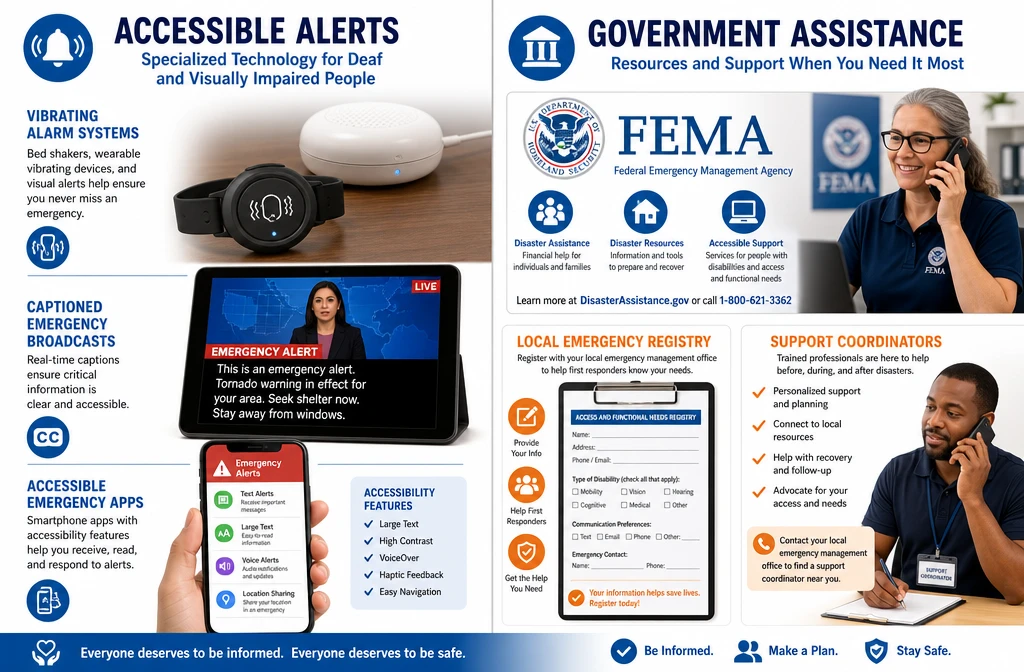
- FEMA Individual Assistance Program: After a federally declared disaster, FEMA’s Individual Assistance program provides grants for temporary housing, home repair, and other disaster-related expenses. Disabled individuals may qualify for additional accommodation support. Register at DisasterAssistance.gov.
- FEMA’s Access and Functional Needs (AFN) Framework: FEMA requires that all federally supported emergency operations address the needs of people with disabilities. This includes accessible shelters, evacuation assistance, and communication in accessible formats.
- Local Special Needs Registries: Most counties and municipalities maintain a voluntary registry of residents with disabilities or medical needs. Registering alerts first responders to your location and needs before a disaster. Contact your county emergency management office to register.
- Social Security Administration (SSA) Emergency Assistance: The SSA has procedures for expedited replacement of lost benefit cards and emergency access to benefits after a disaster.
- State Vocational Rehabilitation Agencies: These agencies can sometimes assist with replacing adaptive equipment lost or damaged in a disaster.
- Centers for Independent Living (CILs): Federally funded CILs provide disability-specific emergency preparedness assistance, including planning support, kit assembly, and post-disaster advocacy. Find your local CIL through the ILRU directory.
- 211 Helpline: Dialing 2-1-1 connects you to local social services, including disaster assistance programs specific to your county.
Important caveat: Government assistance arrives after the disaster. Your personal preparedness plan must cover the first 72 hours to 7 days independently. Government resources are a supplement, not a first line of defense.
Emergency Preparedness Tips for People with Cognitive Disabilities
People with cognitive disabilities, including intellectual disabilities, traumatic brain injury, dementia, and autism spectrum disorder, face unique challenges in emergency preparedness because standard written plans and verbal instructions may not be effective under stress.
Practical strategies that work:
- Simplify the plan. Reduce the emergency plan to three to five clear, simple steps. Use pictures, symbols, or short sentences. Laminate the instructions and post them in visible locations.
- Build on existing routines. Frame emergency procedures in familiar, routine-based language. “When the alarm sounds, we go to the front door” is more effective than a complex multi-step protocol.
- Practice regularly and repeatedly. People with cognitive disabilities often need more repetition to internalize emergency procedures. Practice monthly, not annually.
- Use visual supports. Picture schedules, social stories, and visual emergency cards help individuals understand what will happen and what is expected of them.
- Prepare first responders. Create a one-page information sheet about the individual — communication style, triggers, calming strategies, medications, and emergency contacts — and keep copies in the emergency kit and with support network members.
- Medical ID and communication devices: A medical ID bracelet or wallet card that explains the individual’s disability and communication needs can be critical when first responders are unfamiliar with the person.
- Designate a consistent support person. Consistency reduces anxiety. The same trusted person should practice the plan and, if possible, be the primary emergency contact.
For seniors with cognitive decline, many of these same strategies apply. The 9 Essential Disaster Prep Strategies for Seniors addresses overlapping needs with practical, age-appropriate adaptations.
How to Create an Emergency Contact List and Communication Plan with a Disability
An emergency contact list for a disabled individual is more detailed than a standard list. It must include medical contacts, equipment suppliers, and support network members — not just family phone numbers.
What your emergency contact list should include:
- Primary care physician and specialist contacts with after-hours numbers
- Pharmacy name, phone, and prescription numbers
- Medical equipment supplier with emergency service line
- Home health agency or caregiver contact and backup caregiver
- Three personal support network members (name, phone, address, relationship)
- Local emergency management office
- Local Special Needs Shelter address and pre-registration confirmation number
- Insurance company with policy numbers
- Power company medical baseline program contact (if enrolled)
Communication plan structure for disabled individuals:
- Designate an out-of-area contact. Local phone lines often fail during disasters. An out-of-state contact can serve as a communication hub for your support network.
- Establish check-in times. Agree in advance on specific times to check in with your support network during an emergency (e.g., every 12 hours).
- Use text messaging as primary. Text messages often get through when voice calls cannot. Pre-program key contacts and practice sending texts.
- Have a backup communication method. If your phone dies, what is the plan? A battery-powered two-way radio, a neighbor’s phone, or a pre-arranged meeting point all serve as backups.
- Inform your support network of your needs in advance. Every person in your network should know your medical needs, equipment requirements, and what assistance you will need during evacuation.
Specialized Emergency Alert Systems and Technology for People with Disabilities
Technology has significantly closed the gap in emergency alerting for disabled individuals. The best systems combine multiple channels so that no single point of failure leaves someone uninformed during a crisis.
Alert systems by disability type:
For deaf and hard-of-hearing individuals:
- NOAA weather radios with visual and vibrating alerts
- Whole-home strobe and vibrating alert systems connected to smoke detectors and weather radios
- Wireless Emergency Alerts (WEA) via smartphone
- Social media monitoring of local emergency management accounts
For visually impaired individuals:
- Screen-reader-compatible emergency apps (FEMA app, Weather.gov)
- Audio-based NOAA weather radio
- Smart speakers (Amazon Echo, Google Home) can read emergency alerts aloud
- Accessible emergency notification systems that deliver audio alerts by phone
For individuals with mobility limitations:
- GPS-enabled personal emergency response systems (PERS) with fall detection and two-way communication
- Smartphone-based emergency SOS features (available on most modern smartphones)
- Smart home systems that can trigger alerts and unlock doors remotely
Technology that helps disabled people stay safe during emergencies:
- Medical alert devices: Devices like Life Alert, Medical Guardian, or similar PERS systems connect users to a 24/7 monitoring center that can dispatch emergency services.
- GPS trackers: For individuals with cognitive disabilities or dementia, GPS trackers (worn as watches or attached to clothing) allow caregivers to locate them if they become disoriented.
- Power monitoring apps: Some utility companies offer apps that notify medical baseline customers of planned outages and connect them to priority restoration services.
- Telehealth platforms: During disasters when in-person medical access is disrupted, telehealth platforms allow continued contact with physicians for prescription management and medical guidance.
For backup power solutions that keep all of these devices running during extended outages, the Backup Power for Emergencies guide covers portable power stations, solar options, and generator selection in practical detail.
FAQ-Emergency Preparedness for Disabled
How far in advance should a disabled person start emergency preparedness planning? Start now, regardless of your current situation. The ideal time was before the last disaster. The practical answer is that building a complete disability-specific emergency plan takes 2-4 weeks of focused effort. Begin with the highest-priority items: medication supply, backup power, and registering with your local special needs shelter registry.
Can I register with FEMA before a disaster happens? FEMA’s Individual Assistance program activates after a federally declared disaster, so pre-registration with FEMA itself is not the mechanism. Instead, register with your county or municipal emergency management office’s special needs or access and functional needs registry. That is the pre-disaster registration that matters most.
What if I cannot afford a disability-adapted emergency kit? Contact your local Center for Independent Living (CIL), which can provide free planning assistance and sometimes supplies. Also check with your insurance provider, as many medical supplies in an emergency kit may be covered. FEMA’s Hazard Mitigation Grant Program can fund home modifications that improve emergency egress.
How do I evacuate if I use a power wheelchair and it runs out of battery? This is exactly why a manual backup wheelchair belongs in every powered wheelchair user’s emergency plan. If a manual chair is not feasible, your support network members should be trained in manual transfer techniques, and your evacuation plan should include a vehicle with a wheelchair lift or ramp.
What should I do if my caregiver cannot reach me during a disaster? This is why your support network must include at least three people, not one. Pre-brief all three on your needs, your home layout, your equipment, and your evacuation plan. At least one should have a key to your home. A backup caregiver identified through your home health agency is also worth arranging in advance.
Are emergency shelters required to accommodate people with disabilities? Yes. Under the Americans with Disabilities Act and FEMA’s Functional Needs Support Services framework, emergency shelters receiving federal support must provide reasonable accommodations for people with disabilities. However, quality of implementation varies. Pre-registration with your local emergency management office and specifically requesting a medical needs shelter gives you far better odds of appropriate accommodation.
How do I store medications that require refrigeration in an emergency? Use a quality insulated medical cooler with ice packs as your first line. For insulin specifically, most modern insulin formulations remain stable at room temperature for 28-30 days (check your specific product’s guidelines). For biologics and other temperature-sensitive medications, discuss emergency storage protocols with your prescribing physician before a disaster occurs.
What is the most important single step a disabled person can take for emergency preparedness? Register with your local county emergency management office’s special needs or access and functional needs registry. This single action puts first responders on notice before a disaster, increases your priority for evacuation assistance, and connects you to accessible shelter resources. Everything else builds from that foundation.
How do I find accessible evacuation routes in my area? Contact your local emergency management office and ask for accessible evacuation route maps. Also walk or wheel your planned routes yourself to identify actual barriers — maps do not always reflect real-world conditions like broken curb cuts, steep grades, or construction.
What technology is most useful for someone with both mobility and communication disabilities? A smartphone with accessibility features enabled (voice control, screen reader, emergency SOS) combined with a portable power bank is the highest-value single device. Add a medical alert PERS device as a backup communication and emergency dispatch tool.
Conclusion
Emergency preparedness for disabled individuals is not about fear or limitation — it is about building the kind of confidence and independence that comes from knowing you have a real plan when the unexpected happens. The gap between a standard emergency kit and a disability-adapted one is not as wide as it might seem. It comes down to honest assessment of your specific needs, proactive registration with local emergency systems, a support network that has actually practiced the plan, and the right backup tools for your medical and communication requirements.
Start with the highest-leverage actions: register with your county special needs registry, build a 7-day medication and equipment supply, identify your three-person support network, and locate your nearest accessible shelter. Then build from there.
The Ultimate Emergency Preparedness Guide for Preppers provides a comprehensive baseline that can be adapted to any household’s needs. For families supporting a disabled member, the Family Emergency Plan Template offers a structured system for integrating individual needs into a household-wide response.
Preparedness is not a single event. It is an ongoing practice. Review and update your plan every six months, after any change in your medical condition or living situation, and after every close call. The people who come through disasters intact are not the ones who were lucky — they are the ones who planned.
Products, Tools, and Resources
Portable power stations: The Jackery Explorer 240 and Goal Zero Yeti 200X are reliable options for powering CPAP machines, charging phones, and running small medical devices during outages. Both are quiet, rechargeable via solar panel, and genuinely portable.
Medical alert systems: Medical Guardian and Bay Alarm Medical offer GPS-enabled PERS devices with fall detection and 24/7 monitoring. Both have options for in-home and on-the-go coverage.
Vibrating and strobe alert systems: The Bellman & Symfon Visit system and Sonic Alert products provide whole-home visual and vibrating emergency alerts compatible with smoke detectors and weather radios.
Waterproof document storage: The LifeProof waterproof document bag and similar products from Pelican protect medication lists, insurance cards, and prescriptions from water damage.
Wheelchair repair kits: Park Tool and Slime brand kits provide compact, portable tire repair supplies sized for wheelchair tires.
NOAA weather radios with accessibility features: The Midland WR400 includes visual alerts and a battery backup, making it a strong choice for deaf and hard-of-hearing users.
Centers for Independent Living (CIL) directory: The ILRU (Independent Living Research Utilization) directory at ilru.org connects you to your nearest federally funded CIL for free emergency planning assistance.
For additional preparedness depth, the 15 Things Missing From Your Emergency Kit covers overlooked items that apply across all household types, including many relevant to disabled individuals.