
Hey there! Some links on this page may be affiliate links which means that, if you choose to make a purchase, I may earn a commission at no extra cost to you. I greatly appreciate your support. Read the full disclosure here.
Most people who die in survival situations don’t die from starvation. They die from dehydration, hypothermia, or panic, threats that can kill within hours, not weeks. Understanding the correct order of survival priorities isn’t academic theory. It’s the difference between making smart decisions under pressure and burning energy on the wrong problem at the wrong time.
This guide breaks down Survival Priorities: Water, Food, Shelter Order Explained in full, including when the standard order changes, what the Rule of Threes actually means, and the most common mistakes preppers make when they haven’t thought this through in advance.
Key Takeaways
- The standard survival priority order is: air, warmth/shelter (in extreme cold), water, food, not always water before shelter.
- The human body can survive roughly 3 minutes without air, 3 hours without shelter in harsh conditions, 3 days without water, and 3 weeks without food.
- Water is almost always the most urgent need after immediate physical safety is secured.
- Shelter becomes the top priority when exposure risk (cold, wind, rain) can kill faster than dehydration.
- Food is genuinely the lowest priority in short-term survival, most healthy adults can function for days without eating.
- Injuries change the priority order significantly; bleeding out or airway compromise overrides everything else.
- Climate, season, and environment all affect which need becomes most urgent first.
Find this useful? Add us as a preferred source on Google and more of what we publish will show up in your results.
What Is the Correct Order of Survival Priorities?
The correct order of survival priorities, as taught by wilderness survival instructors and military survival schools, is: Air, Shelter (when exposure is life-threatening), Water, Food. In most temperate conditions, this simplifies to water first, then shelter, then food, but the full picture is more nuanced than any single list.
The reason this order matters: the body fails fastest from oxygen deprivation, then from exposure to extreme temperatures, then from dehydration, and finally from lack of calories. Knowing this hierarchy lets you allocate your energy, time, and resources to the threat most likely to kill you first.
A useful way to remember this is the Rule of Threes, which survival instructors have used for decades as a field-ready mental framework.
What Is the Rule of Threes in Survival Priorities?
The Rule of Threes is a memory framework that maps human physiological limits to survival timelines. It gives you a fast way to rank threats by urgency.
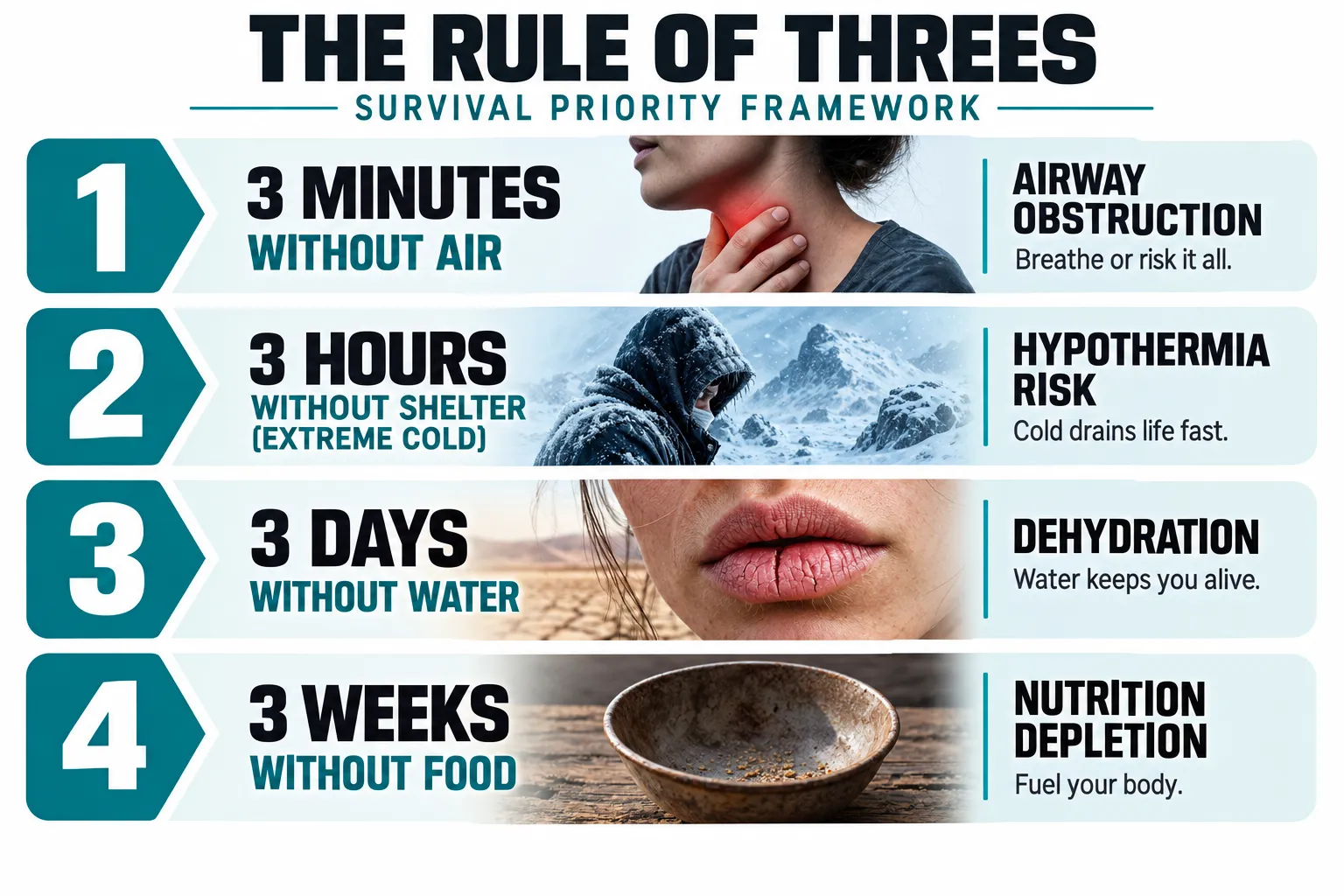
- 3 minutes without air (or in icy water causing cardiac arrest)
- 3 hours without shelter in harsh weather (extreme cold, wind, wet conditions)
- 3 days without water
- 3 weeks without food
These are not precise medical cutoffs, they’re practical guidelines. A healthy adult in mild weather might survive longer without water; someone already dehydrated or injured might deteriorate faster. But the Rule of Threes gives you a reliable decision-making anchor when you’re stressed, exhausted, and need to prioritize fast.
The takeaway: if you’re cold and wet in freezing temperatures, building shelter outranks finding water. If you’re in a warm desert with no exposure risk, water becomes the immediate priority.
Why Is Water More Important Than Food in Survival?
Water is more critical than food because the body’s physiological breakdown from dehydration happens far faster than the breakdown from caloric deficit. Without water, cognitive function degrades within 24 hours, physical performance drops sharply, and organ failure can begin within 2-3 days. Without food, a healthy adult with body fat reserves can remain functional for a week or more.
The body can extract energy from fat and muscle tissue through a process called gluconeogenesis, buying significant time. There is no equivalent backup system for water. Every cellular process, temperature regulation, nutrient transport, waste removal, requires adequate hydration.
For preppers building a water plan, see The Ultimate Emergency Water Storage and Purification Guide and review how long you can actually survive without clean water before assuming your current supply is adequate.
Common mistake: Many preppers stock weeks of food but only a few days of water. Calorie storage is important, but water storage is the more urgent gap to close first.
How Long Can You Survive Without Water, Food, or Shelter?
These timelines apply to a healthy adult in average conditions. Individual variation, climate, and physical exertion all affect actual outcomes.
| Survival Need | Approximate Limit | Key Variable |
|---|---|---|
| Air | ~3 minutes | Water temperature, cardiac response |
| Shelter (extreme cold) | ~3 hours | Wind, wet clothing, temperature |
| Water | ~3 days | Heat, exertion, pre-existing health |
| Food | ~3 weeks | Body fat reserves, hydration status |
Dehydration symptoms appear well before the 3-day mark. Mild dehydration (losing 2% of body weight in fluids) reduces cognitive performance noticeably. At 5-8% loss, serious physical impairment sets in. At 10%+, the situation becomes life-threatening.
Food deprivation, by contrast, causes discomfort and reduced energy but rarely impairs critical thinking or physical survival capacity within the first 48-72 hours for most adults.
Does Shelter or Water Come First? When the Order Changes
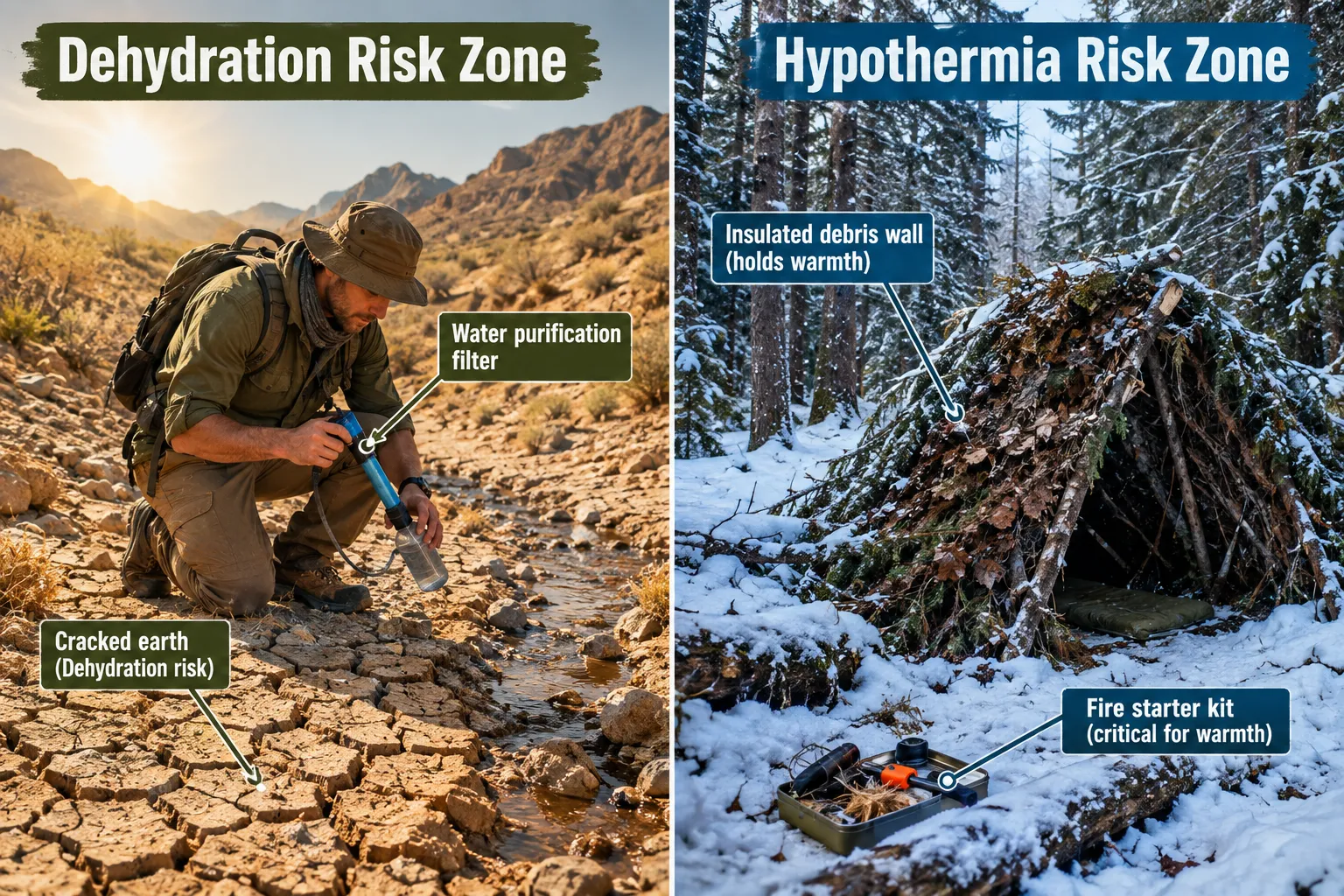
Shelter becomes the top priority when exposure can kill faster than dehydration. In extreme cold, wet, or windy conditions, hypothermia can set in within hours, long before dehydration becomes critical. In those situations, shelter outranks water.
Choose shelter first when:
- Air temperature is below 50°F (10°C) and you’re wet or exposed to wind
- You’re in a blizzard, heavy rain, or high-altitude environment
- Night is approaching and temperatures will drop significantly
- You’re already showing signs of cold exposure (uncontrolled shivering, confusion)
Choose water first when:
- You’re in a warm or temperate climate with no immediate exposure risk
- You’re physically active and sweating heavily
- You’ve already been without water for more than 12-18 hours
- You have natural shelter available or can improvise quickly
For cold-weather scenarios, building fire is often part of the shelter priority. See how to start a fire without matches and how to start a fire in wet conditions for practical fire-starting techniques that apply directly to shelter-warming priorities.
What Counts as Shelter in a Survival Situation?
Shelter in a survival context means anything that reduces your body’s exposure to life-threatening environmental conditions, primarily heat loss, wind, rain, and direct sun. It doesn’t have to be a structure you build from scratch.
Shelter options ranked by effort required:
- Natural features, caves, rock overhangs, dense tree canopies, fallen logs
- Existing structures, abandoned buildings, vehicles, culverts, bridge underpasses
- Improvised from materials, tarps, emergency blankets, ponchos rigged as lean-tos
- Built from natural materials, debris huts, lean-to shelters, snow shelters
The goal isn’t comfort. It’s stopping heat loss and blocking wind. Even a debris hut made from leaves and branches can raise the interior temperature dramatically compared to sleeping exposed on the ground.
For hands-on techniques, bushcraft shelter building methods for wilderness survival covers construction approaches from basic lean-tos to more advanced debris structures.
How Much Water Do You Need to Survive Per Day?
The minimum water intake for survival in a temperate climate at rest is approximately 1 liter (about 34 oz) per day. The commonly cited FEMA recommendation for emergency preparedness is 1 gallon (roughly 3.8 liters) per person per day, which accounts for drinking, basic sanitation, and food preparation.
Factors that increase water requirements:
- Physical exertion (can double or triple needs)
- High temperatures or direct sun exposure
- Illness, fever, or diarrhea
- High-altitude environments
- Dry, low-humidity air
The 1-gallon-per-day guideline is a planning baseline, not a survival floor. In a genuine emergency where water is scarce, prioritize drinking over sanitation use and reduce physical exertion to lower fluid loss.
Avoid common water storage mistakes that leave preppers with less usable water than they think they have, and understand water contamination signs so you don’t consume water that accelerates the problem.
Can You Find Water Before Building Shelter?
Yes, but only if the environmental conditions don’t pose an immediate exposure threat. In mild weather, spending 30-60 minutes locating a water source before setting up shelter is a reasonable trade-off. In cold, wet, or windy conditions, that same 30-60 minutes could push you into hypothermia before you ever drink a drop.
The decision rule: assess your exposure risk first. If you’re warm, dry, and the temperature is manageable, water sourcing can happen before or alongside shelter construction. If you’re cold or wet, get out of the wind and rain first.
When water sourcing is the priority, knowing how to treat what you find is just as important as finding it. Review how to purify water without tools outdoors and improvised water filter methods for survival before you need them.
Is Food Really the Lowest Priority in Survival?
Yes, in short-term and medium-term survival scenarios, food is genuinely the lowest priority among the core four. This surprises many people because hunger is uncomfortable and psychologically distracting, but discomfort is not the same as immediate danger.
A healthy adult with average body fat reserves can go 2-3 weeks without food before organ failure becomes a serious risk. The body shifts to burning fat and then muscle tissue for energy. Mental focus and physical strength decline, but survival capacity remains intact for far longer than most people expect.
Where food priority increases:
- Survival extends beyond 1-2 weeks
- You’re in a cold environment where caloric burn is high (body heat production requires fuel)
- Children, elderly individuals, or diabetics are involved (metabolic reserves differ significantly)
- You’re doing heavy physical labor (building shelter, traveling long distances)
For longer-term scenarios, having a food plan matters enormously. The Ultimate Survival Pantry List and no-cook survival meals for emergency kits are practical starting points.
What About Air and Warmth in the Survival Priority List?
Air is technically the first survival priority, but in most scenarios, it’s not something you actively manage. If you’re breathing normally, air isn’t a decision point. It becomes a priority in situations involving airway obstruction, smoke inhalation, carbon monoxide exposure, or near-drowning.
Warmth overlaps with shelter but deserves its own consideration. In cold environments, maintaining core body temperature is the most urgent survival task. Warmth comes from three sources: shelter (blocking wind and insulating from ground cold), fire (active heat generation), and clothing (insulating the body).
When warmth overrides water as the top priority:
- Wet clothing in temperatures below 60°F (15°C)
- Wind chill pushing effective temperature below freezing
- Any signs of hypothermia: shivering, confusion, slurred speech, loss of coordination
How Do Survival Priorities Change If You’re Injured?
Injury changes the priority order immediately. Severe bleeding, airway compromise, or shock can kill within minutes, faster than any environmental threat. The survival medicine framework taught in wilderness first aid courses uses the acronym ABC: Airway, Bleeding, Circulation as the immediate assessment sequence.
Injury-modified priority order:
- Stop life-threatening bleeding (tourniquets, pressure)
- Secure airway
- Treat for shock (warmth, positioning)
- Then assess: shelter, water, food in the standard order
An injured person’s water needs also increase, particularly if blood loss has occurred. Dehydration accelerates the effects of blood loss, so water priority rises in injury scenarios even in cold environments.
Common Mistakes People Make With Survival Priorities
Even experienced preppers get this wrong under stress. The most common errors:
- Prioritizing food over water in short-term scenarios, hunger is loud, dehydration is quiet until it’s serious
- Ignoring shelter in mild weather, mild temperatures can still drop dangerously at night
- Treating the priority order as fixed, it’s a framework, not a rigid script; conditions change it
- Skipping water treatment, finding water and drinking contaminated water creates a new emergency; always treat before drinking (survival water filtering mistakes are more common than most preppers realize)
- Underestimating psychological needs, panic and poor decision-making kill people in survival situations; a calm, prioritized mindset is itself a survival tool
Frequently Asked Questions
What is the correct survival priority order?
The standard order is air, shelter (when exposure is life-threatening), water, then food. In most temperate conditions without immediate cold exposure, this simplifies to water first, then shelter, then food.
Why does water come before food in survival?
Dehydration impairs cognitive function and causes organ failure within 2-3 days. Food deprivation, while uncomfortable, rarely becomes life-threatening for a healthy adult within the first 1-2 weeks. The body has no backup system for water; it does have one for calories.
Can you survive longer without food or without shelter?
Without food, a healthy adult can survive 2-3 weeks. Without adequate shelter in extreme cold or wet conditions, hypothermia can be fatal within 3 hours. In harsh weather, lack of shelter is far more dangerous than lack of food.
Does the survival priority order change in extreme cold?
Yes. In extreme cold, shelter and warmth move above water as the immediate priority. Hypothermia can kill faster than dehydration in those conditions, so getting out of the wind and wet takes precedence.
How much water do you actually need per day to survive?
The survival minimum in mild conditions at rest is approximately 1 liter per day. FEMA recommends 1 gallon per person per day for emergency preparedness, which covers drinking and basic sanitation. Exertion, heat, and illness increase this significantly.
What counts as shelter in the wild?
Anything that reduces exposure to wind, rain, cold, or sun. Natural features like caves and rock overhangs count. So do vehicles, tarps, emergency blankets, and debris huts built from leaves and branches.
Is food ever the top survival priority?
Rarely in short-term scenarios. Food becomes more urgent in extended survival situations (beyond 1-2 weeks), cold environments with high caloric burn, or when vulnerable individuals like children or diabetics are involved.
What if I’m injured, does the priority order change?
Yes, significantly. Life-threatening bleeding and airway compromise override all other priorities. Stop bleeding first, secure the airway, treat for shock, then address shelter, water, and food in the standard order.
What is the Rule of Threes?
A memory framework for survival priorities: 3 minutes without air, 3 hours without shelter in extreme conditions, 3 days without water, 3 weeks without food. It maps human physiological limits to urgency, helping you decide what to address first.
Can you drink water you find in the wild without treating it?
No. Untreated water from natural sources can contain bacteria, parasites, and chemical contaminants that cause severe illness. Always treat water before drinking using boiling, filtration, chemical treatment, or UV purification.
What’s the biggest mistake preppers make with survival priorities?
Stocking months of food while neglecting water storage. Water is the more urgent survival need, and most preppers significantly underestimate how much they need and how quickly their supply can be compromised.
Does the priority order apply in urban survival situations too?
Yes, with some adaptations. In urban scenarios, shelter is often already available, so water becomes the dominant concern quickly. Urban water sourcing requires different strategies, safe water sources in urban survival scenarios covers this specifically.
Conclusion
Survival Priorities: Water, Food, Shelter Order Explained comes down to one core principle: address the threat that will kill you fastest first. In most situations, that means securing warmth and shelter when exposure is a risk, then finding and treating water, and only then turning attention to food.
The Rule of Threes gives you a fast mental framework under pressure. But the real skill is knowing when conditions change the order, when a desert heat scenario demands water before shelter, or when a winter storm makes warmth the only priority that matters.
Actionable next steps:
- Audit your water storage first. Calculate your household’s 3-day and 2-week water needs, then verify your storage actually meets that number.
- Learn at least two water treatment methods you can apply without modern tools.
- Identify your shelter options for each likely emergency scenario, at home, in your vehicle, and in the field.
- Build your food storage after water is covered, not before.
- Practice the decision-making framework before you need it. Run through the Rule of Threes mentally for different scenarios so it becomes automatic.
Recommended resources from Preppers HQ:
- The Ultimate Emergency Water Storage and Purification Guide, comprehensive water planning from storage to purification
- Bushcraft Shelter Building Techniques for Wilderness Survival, practical field shelter construction
- How to Purify Water Without Tools Outdoors, no-equipment water treatment methods
- The Ultimate Survival Pantry List, food storage planning once water is secured
- Survival Skills Checklist: 7 Core Skills Every Prepper Needs, a broader framework for building survival competence
Preparedness isn’t about fear. It’s about knowing exactly what to do when conditions change, and having the knowledge to act on the right priority at the right time.