
Hey there! Some links on this page may be affiliate links which means that, if you choose to make a purchase, I may earn a commission at no extra cost to you. I greatly appreciate your support. Read the full disclosure here.
Most people overestimate how well they’ll perform under pressure, and the research on cognitive performance during acute stress consistently shows that untrained individuals make slower, less accurate decisions precisely when speed and accuracy matter most. This Emergency Decision-Making Under Pressure Guide exists to close that gap. Whether you’re facing a sudden natural disaster, a home intrusion, a medical crisis, or a rapid evacuation, the difference between a good outcome and a catastrophic one often comes down to one thing: whether you’ve trained your mind to act before panic takes over.
Key Takeaways
- Emergency decision-making degrades under stress unless you’ve pre-built mental frameworks and practiced them.
- The brain’s threat response (fight-or-flight) narrows focus and impairs complex reasoning, this is normal and manageable.
- Simple frameworks like STOP (Stop, Think, Observe, Plan) or OODA (Observe, Orient, Decide, Act) work because they reduce cognitive load when it’s highest.
- Most real emergencies give you more time than you think, but that window closes fast without a plan.
- Common mistakes include freezing, over-gathering information, and second-guessing a sound decision after the fact.
- Pre-made decisions (pre-loaded plans, checklists, rehearsed routes) are the single most effective tool for better emergency outcomes.
- Training and repetition build the mental pathways that hold up when adrenaline spikes.
- You don’t need perfect information to act, you need enough information to make a reasonable call and commit.
Find this useful? Add us as a preferred source on Google and more of what we publish will show up in your results.
What Is Emergency Decision-Making and Why Does It Matter
Emergency decision-making is the process of choosing a course of action under time pressure, incomplete information, and elevated stress. It matters because the decisions made in the first minutes of a crisis often determine whether the situation improves or spirals.
Unlike everyday decisions, where you can sleep on it, consult others, or reverse course easily, emergency decisions carry immediate consequences. A wrong call during a house fire, a flash flood, or a grid-down scenario can cost lives. A good call, made fast and with confidence, can save them.
For preppers and survivalists, this isn’t abstract. Every piece of gear you’ve stocked, every route you’ve mapped, and every supply you’ve cached only becomes useful if you can make clear decisions about when and how to use them. Preparedness without decision-making ability is just expensive storage.
What’s the Difference Between Emergency Decisions and Regular Planning
Regular planning happens before a crisis, with time, calm, and full information. Emergency decision-making happens during a crisis, with none of those luxuries.
The critical distinction is this: good planning reduces the number of decisions you have to make under pressure. When you’ve already decided your evacuation trigger point, your rally location, and your primary route, you don’t have to think through those things when smoke is filling the hallway. You execute. That’s why resources like The Ultimate Emergency Preparedness Guide for Preppers and The Ultimate Family Emergency Plan Template are so valuable, they front-load the thinking so you don’t have to do it in the worst moment.
The practical difference:
- Planning = deliberate, slow, thorough, reversible
- Emergency decisions = fast, high-stakes, often irreversible, emotionally charged
The goal of this Emergency Decision-Making Under Pressure Guide is to help you bridge both: plan well in advance, and perform well when plans fall apart.
How Do You Make Good Decisions When You’re Stressed or Panicked
Good decisions under stress come from pre-built mental frameworks, not raw willpower. When adrenaline floods your system, your prefrontal cortex, the part of the brain responsible for complex reasoning, becomes less effective. You can’t think your way out of panic in real time. But you can train responses that bypass the panic.
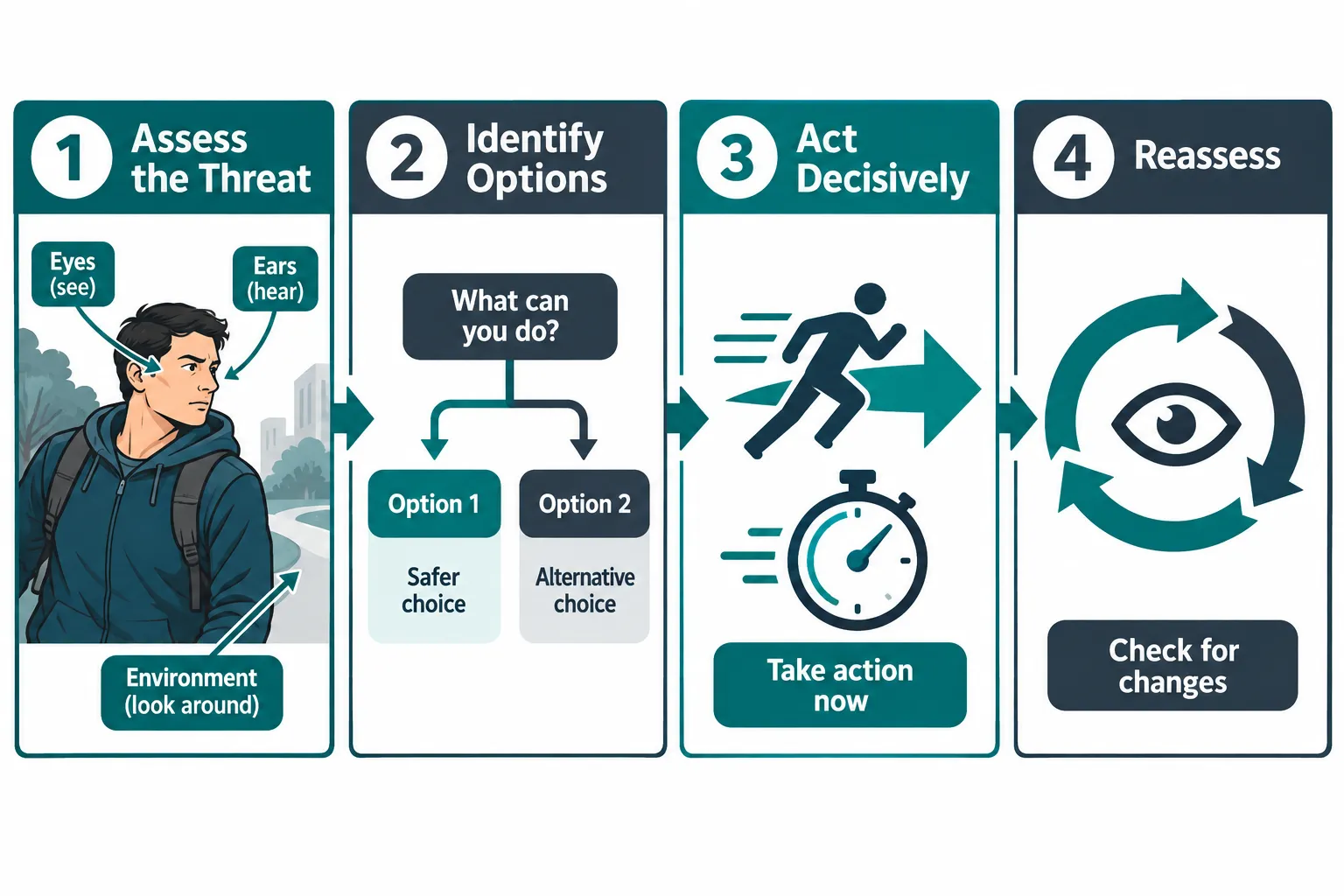
The most field-tested framework for survival situations is STOP:
- Stop, Physically pause for 3-5 seconds. Don’t move until you’ve done the next steps.
- Think, What is the immediate threat? What are my options?
- Observe, What resources, hazards, and people are around me right now?
- Plan, Choose the best available option and commit.
Another widely used model is OODA (Observe, Orient, Decide, Act), developed by military strategist John Boyd. It’s especially useful when the situation is changing rapidly, because it’s designed as a loop, you cycle back through it as new information arrives.
Common mistake: Skipping “Stop” because it feels like wasted time. Those 3-5 seconds almost always improve the outcome. Freezing for 30 seconds in paralysis is the real time waster.
How Much Time Do You Actually Have to Decide in a Real Emergency
It depends entirely on the emergency type, but most people have more time than they believe, and waste it on indecision rather than action.
Here’s a rough breakdown by scenario type:
| Emergency Type | Typical Decision Window | Key Factor |
|---|---|---|
| House fire | 2-4 minutes before conditions become lethal | Smoke, not flames, is the primary killer |
| Flash flood | 5-30 minutes after warning | Terrain and proximity to water source |
| Home intrusion | 30-90 seconds to initial contact | Entry point and layout of home |
| Medical emergency | Varies widely; cardiac arrest = ~4 minutes | Bystander CPR changes outcome dramatically |
| Evacuation order | Hours to days, usually | Threat type and proximity |
| Grid failure | Days to weeks before critical supply issues | Preparation level |
The takeaway: the window is real, but it’s not always as short as fear makes it feel. What collapses the window is indecision, not the emergency itself.
What Are Common Mistakes People Make When Deciding Fast
The most damaging mistakes in emergency decision-making aren’t about choosing the wrong option, they’re about failing to choose at all, or choosing based on emotion rather than assessment.
The most common errors:
- Freezing, The brain’s threat response can produce temporary paralysis. This is the most dangerous outcome and the one most directly addressed by training.
- Tunnel vision, Stress narrows attention. You may fixate on one threat and miss a more critical one nearby.
- Over-gathering information, Waiting for certainty that will never come. Good enough information, acted on fast, beats perfect information acted on too late.
- Defaulting to normal, People in emergencies often behave as if the situation will resolve itself. They stay in buildings, delay evacuations, and minimize threats until it’s too late.
- Social proof paralysis, Waiting to see what others do before acting. In a crowd, this can be lethal.
- Post-decision second-guessing, Reversing a sound decision mid-execution because of new anxiety, not new information.
For preppers, the antidote to most of these is the same: a pre-built plan that removes the decision from the moment. Knowing your emergency communication plan and evacuation plan before the event means fewer decisions to make during it.
Can You Use a Framework or Checklist During an Actual Emergency
Yes, but only if it’s been practiced enough to feel automatic. A laminated checklist you’ve never reviewed is nearly useless under stress. A mental framework you’ve rehearsed dozens of times becomes a reflex.
The key is keeping it short. Under stress, working memory shrinks. A 12-step checklist is not going to help you. A 3-step mental anchor will.
What works in practice:
- Pre-loaded decisions: Decide in advance what triggers which action. “If there’s smoke in the hallway, we go out the window.” That’s a decision already made.
- Laminated quick-reference cards: Kept in your go-bag or bug-out bag, covering only the most critical steps for specific scenarios.
- Verbal rehearsal with family: Running through scenarios out loud so everyone knows their role.
- Physical drills: Fire drills, evacuation drills, and shelter-in-place practice. The body remembers what the mind forgets under stress.
This is exactly why building a solid 72-hour emergency kit matters, not just for the supplies, but because assembling and reviewing it is itself a form of decision rehearsal.
What If You Don’t Have All the Information You Need to Decide
Act anyway, on the best available information, with the most reversible option you have. Waiting for complete information in an emergency is a decision in itself, and it’s usually the wrong one.
Military and emergency management professionals use a concept called the “70% solution”: if you have roughly 70% of the information you’d want, and a reasonable course of action, act now. Waiting for the remaining 30% costs more than it gains.
Decision rules for incomplete information:
- Choose the option that preserves the most future options (don’t burn bridges unless you must).
- Choose the option that avoids the worst irreversible outcome, not necessarily the best possible outcome.
- If two options seem equal, choose the one that keeps people moving, inaction compounds risk.
- Reassess as you go. The OODA loop is designed for exactly this, cycling back through observation as new information arrives.
How Do You Stay Calm Enough to Think Clearly in a Crisis
Staying calm under pressure is a trainable skill, not a personality trait. The physiological stress response is involuntary, but your reaction to it is not.
Proven techniques that work in real emergencies:
- Tactical breathing (box breathing): Inhale for 4 counts, hold for 4, exhale for 4, hold for 4. Used by military and law enforcement to reduce heart rate within 60-90 seconds.
- Verbal anchoring: Saying a short phrase out loud (“Stop. Assess. Act.”) activates the prefrontal cortex and interrupts the panic loop.
- Physical grounding: Pressing your feet firmly into the floor or gripping a solid object redirects nervous system activation.
- Prior mental rehearsal: Visualizing yourself handling specific emergencies, in detail, with sensory specificity, builds neural pathways that activate during the real event.
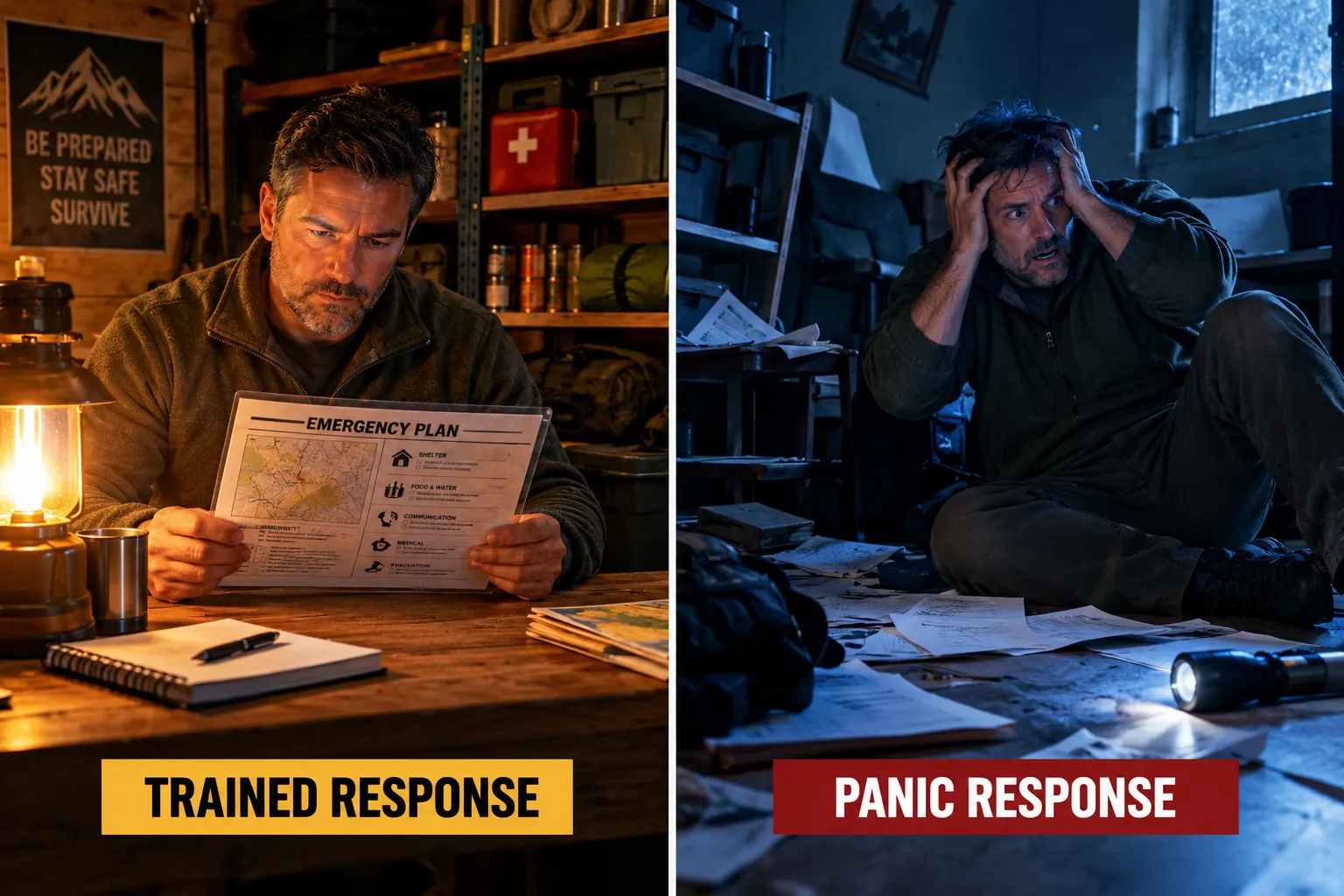
The most important factor, though, is confidence built through preparation. People who know they have supplies, a plan, and practiced skills are measurably calmer in emergencies. That’s the core argument for everything covered in a resource like this Emergency Decision-Making Under Pressure Guide, preparation isn’t just physical, it’s psychological.
Are Some People Naturally Better at Emergency Decisions Than Others
Some people do have natural advantages, higher baseline stress tolerance, prior trauma exposure that built resilience, or personality traits associated with decisive action. But the research on expert performance consistently shows that training matters far more than innate ability.
Emergency responders, military personnel, and experienced survivalists aren’t calmer under pressure because they’re wired differently. They’re calmer because they’ve been in enough simulated and real high-stress situations that the threat response is less intense and the decision pathways are more automatic.
The practical implication: don’t assume you’ll perform well under pressure just because you’re calm in everyday life. And don’t assume you’ll perform poorly just because you feel anxious during drills. Train consistently, and the performance gap closes.
What Training or Practice Helps You Get Better at This
The most effective training combines mental rehearsal, scenario practice, and real-world skill building. Passive reading helps, but it doesn’t build the reflexes that hold up under stress.
High-value training approaches for preppers:
- Scenario-based drills: Run through specific emergencies with your household. Assign roles. Time yourselves. Debrief afterward.
- First aid and CPR certification: These courses are specifically designed to build calm, sequential action under pressure.
- Wilderness survival courses: Environments where consequences are real accelerate decision-making skill faster than any classroom.
- Stress inoculation: Deliberately practicing skills under mild stress (time pressure, physical fatigue, noise) builds tolerance for the real thing.
- After-action reviews: After any drill or real event, ask: What happened? What should have happened? What do we change?
Pairing decision-making training with your physical preparedness, your bug-out bag, your home emergency preparedness setup, your food and water stores, creates a complete system. Gear without decision skill is half a plan.
How Do You Handle Second-Guessing Yourself After an Emergency Decision
Second-guessing after an emergency is nearly universal and almost always unproductive. It’s also a sign that you’re processing the experience, which is healthy, as long as it doesn’t become paralysis.
A useful post-event framework:
- Ask: “Did I act on the best information I had at the time?” If yes, the decision was sound regardless of outcome.
- Ask: “Was there a better option I genuinely knew about and didn’t take?” If yes, that’s a learning point, not a character flaw.
- Separate outcome from process. A good decision can lead to a bad outcome due to factors outside your control. A bad decision can lead to a good outcome by luck. Judge the process, not just the result.
- Document what you learned and update your plan.
The goal isn’t to feel good about every decision. It’s to get better at the next one.
When Should You Ask Others for Input Instead of Deciding Alone
Consult others when you have time, when they have relevant expertise you lack, or when the decision directly affects them and their buy-in matters for execution. Decide alone when time is critical and delay increases risk.
In a household or group survival situation, the best model is a clear pre-assigned decision structure: one person has final authority in time-critical situations, with input sought when the situation allows. This is why family emergency planning matters so much, the time to decide who leads is before the emergency, not during it.
Practical rule: If a decision needs to be made in under 2 minutes, one person decides and everyone executes. If you have 10+ minutes, brief consultation improves the outcome. If you have hours or days, collaborative planning is almost always better.
What’s the Difference Between a Life-Threatening Emergency and a Business Crisis Decision
The core difference is consequence type and reversibility. Life-threatening emergencies involve irreversible physical harm and operate on seconds-to-minutes timescales. Business crises involve financial, reputational, or operational harm and typically operate on hours-to-days timescales.
For survivalists and preppers, this distinction matters because the decision frameworks aren’t identical. The STOP and OODA frameworks are calibrated for physical emergencies where speed dominates. Business or logistical crises, like deciding whether to relocate, how to allocate limited resources over weeks, or whether to bug out versus shelter in place for a prolonged event, benefit from slower, more deliberate frameworks that incorporate more input and longer-range thinking.
The mistake is applying the wrong framework to the wrong situation: panicking and deciding in 30 seconds what should take 30 minutes, or deliberating for 30 minutes when you had 30 seconds.
Frequently Asked Questions
What is the OODA loop and how does it apply to survival situations?
The OODA loop (Observe, Orient, Decide, Act) is a decision cycle developed by military strategist John Boyd. In survival situations, it helps you process changing conditions rapidly and cycle back through assessment as the situation evolves, rather than committing blindly to a single plan.
Can stress actually improve decision-making in some cases?
Mild to moderate stress can sharpen focus and speed reaction time. Severe stress degrades complex reasoning. The goal of training is to keep your stress response in the productive range, alert and focused, not overwhelmed.
How do I make emergency decisions when I’m responsible for children or elderly family members?
Pre-assign roles and practice them. Children can be taught specific responses for specific scenarios. For elderly or disabled family members, build their needs into the plan in advance. Resources like emergency preparedness for disabled individuals provide specific guidance.
Is it better to have one decision-maker in a group emergency or make decisions collectively?
One designated decision-maker with clear authority works best in time-critical situations. Collective input works better for longer-horizon planning. Decide the structure before the emergency.
What’s the biggest mental mistake preppers make in actual emergencies?
Defaulting to normalcy bias, the tendency to assume the situation will resolve itself or isn’t as serious as it appears. This delays action and closes the decision window.
How long does it take to improve emergency decision-making skills?
Meaningful improvement is measurable after 4-6 weeks of consistent scenario-based practice. Significant skill development, the kind that holds up under real stress, typically takes 3-6 months of regular training.
Should I write down my emergency decisions in advance?
Yes. Written, laminated decision trees for your most likely scenarios are one of the highest-value preparedness tools available. They reduce cognitive load exactly when it’s highest.
What if my emergency plan fails and I have no backup?
Apply the STOP framework, identify what resources you actually have (not what you wish you had), and choose the most reversible option available. Improvisation is a skill, and it’s trainable.
Does having more gear make emergency decisions easier?
It reduces the number of resource-based decisions you have to make, which helps. But gear without a plan and practiced decision skills doesn’t translate directly to better outcomes.
How do I know if I made the right emergency decision?
Judge the process, not just the outcome. If you acted on the best available information using a sound framework, the decision was right, even if the outcome was imperfect due to factors outside your control.
Conclusion
Emergency decision-making is a skill, and like every survival skill, it rewards those who prepare for it before they need it. The frameworks covered in this Emergency Decision-Making Under Pressure Guide, STOP, OODA, the 70% solution, pre-loaded decisions, and post-event review, aren’t complicated. They’re simple enough to use when your hands are shaking and your heart rate is 160.
Actionable next steps:
- Review your current emergency plan and identify every decision that could be pre-made and documented.
- Run one scenario-based drill with your household this month. Time it. Debrief it.
- Learn box breathing and practice it daily for two weeks until it’s automatic.
- Build or audit your emergency kit, because knowing your supplies are solid is itself a source of calm.
- Schedule a first aid or CPR certification course. The structured decision-making practice alone is worth it.
Preparedness isn’t about fear. It’s about building the confidence to act clearly when everyone else is frozen. That confidence comes from planning, practicing, and knowing, before the moment arrives, exactly what you’re going to do.
Products, Tools, and Resources
For building your decision-ready emergency system:
- The Ultimate Emergency Preparedness Guide for Preppers, A comprehensive foundation for every layer of preparedness planning.
- The Ultimate Family Emergency Plan Template, Pre-builds the decisions your household needs before a crisis hits.
- Emergency Communication Plan: The Complete Preppers Guide, Eliminates one of the most common points of failure in group emergency response.
- The Complete Bug Out Bag Guide, Gear that’s organized and familiar reduces in-the-moment decisions significantly.
- The Ultimate Evacuation Plan Guide, Routes and triggers decided in advance, so you execute instead of deliberate.
Recommended physical tools:
- Laminated scenario cards (DIY or commercially available) for your most likely emergency types
- A quality first aid kit with a reference guide, not just supplies, but decision support
- A battery-powered or hand-crank emergency radio for real-time situational awareness
- A dedicated notebook or binder for your written emergency plan, stored with your kit
The best emergency decision you’ll ever make is the one you make right now: to train, prepare, and build the mental muscle that holds up when it counts.