
Hey there! Some links on this page may be affiliate links which means that, if you choose to make a purchase, I may earn a commission at no extra cost to you. I greatly appreciate your support. Read the full disclosure here.
The Complete Prepping Guide for Beginners: Your 30-Day Plan to Build Resilience, Not Fear
Let’s be honest. The word “prepping” often conjures images of bunkers, tinfoil hats, and a grim obsession with doomsday scenarios.
But that’s not you. And it’s certainly not what genuine preparedness is about.
You’re here because a quiet unease has started to settle in. Maybe it was that week-long power outage last winter. Maybe it was the news of a distant natural disaster, or the unsettling feeling that the systems we rely on—the ones that bring us water, power, and food—are more fragile than we once believed. You’re not looking for a bunker. You’re looking for peace of mind. You’re looking for a way to protect your family, your home, and your sense of security when the unexpected inevitably happens.
This isn’t a guide to surviving the apocalypse. This is your practical, step-by-step blueprint to building resilience. It’s about transforming that quiet unease into quiet confidence. It’s about moving from “what if” to “I’ve got this.”
We’ll break down the overwhelming world of prepping into manageable, actionable steps. No judgment, no jargon, just a clear path to becoming a capable, confident individual ready for whatever life throws your way.
Find this useful? Add us as a preferred source on Google and more of what we publish will show up in your results.
What Prepping Actually Is (And What It Isn’t)
 Let’s clear the air. The modern prepper isn’t a fringe extremist. They’re your neighbor, your colleague, the parent at your child’s school. They’re simply someone who understands that relying solely on external systems for survival is a gamble.
Redefining Preparedness: From Paranoia to Practical Resilience
Genuine preparednessisn’t about fear-mongering; it’s about risk management. It’s the adult equivalent of having car insurance or a smoke detector. You hope you never need it, but you’re profoundly grateful it’s there if you do. It’s about taking proactive steps to mitigate potential disruptions to your life, your family’s well-being, and your financial stability.
The Real Threats: Power Outages, Natural Disasters, Economic Shifts
The “big one” isn’t always a Hollywood-style catastrophe. More often, it’s a week-long power outage after a severe storm, a localized flood, a job loss, or a supply chain disruption that leaves grocery shelves empty for a few days. These are the everyday emergencies that preparedness addresses.
The Psychological Payoff: Reducing Anxiety Through Action
The most immediate benefit of starting your prepping journey isn’t a full pantry; it’s a calmer mind. Taking concrete steps to prepare directly combats anxiety. Each item you acquire, each skill you learn, is a small victory against uncertainty, building a profound sense of control and peace.
The “Rule of Threes”: Prioritizing Survival Needs
Survival experts often refer to the “Rule of Threes” to prioritize needs in an emergency. This framework helps us understand what to focus on first:
- 3 minutes without air
- 3 hours without shelter in a harsh environment
- 3 days without water
- 3 weeks without food
This guide will follow a similar priority, ensuring you address the most critical needs first.
Key Takeaways:
– Start with the essentials: secure a 72-hour water supply first, using food-grade storage and a reliable filter or purification tablets.
– Build your prep gradually: focus on manageable phases, starting with foundational supplies and skills before expanding to long-term resilience.
– Prioritize practical preparedness: stock calorie-dense, non-perishable food, a comprehensive first aid kit, and reliable light and communication tools.
– Develop skills and community: practice emergency techniques, plan financially, and build relationships with neighbors for shared resources and support.
– Maintain a calm, adaptable mindset: consistency and flexibility are key to managing stress and responding effectively when emergencies occur.
Phase 1: The Foundational Five (Your First 30 Days)
Overwhelm is the biggest enemy of new preppers. This first phase breaks down the most critical survival needs into bite-sized, achievable tasks. Focus on these five pillars, and by the end of 30 days, you’ll have a solid 72-hour foundation.
Pillar 1: Water (The Absolute Priority)
You can survive weeks without food, but only days without water. Clean, safe drinking water is your absolute top priority.
72-hour water supply: Storage and purification basics
Aim for 1 gallon of water per person, per day, for drinking and basic hygiene. For a family of four, that’s 12 gallons. Store it in food-grade containers in a cool, dark place.
Water filters vs. purification tablets: What to buy first
A portable water filter (like a Sawyer Squeeze) is excellent for filtering natural water sources. Purification tablets (chlorine dioxide) are a lightweight backup. Get both if you can, but a filter offers more long-term utility.
Pillar 2: Food (Calorie-Dense & Shelf-Stable)
Once water is secured, focus on food that requires no cooking, no refrigeration, and is calorie-dense.
72-hour food supply: Non-perishables and comfort foods
Think canned goods (tuna, chicken, beans), protein bars, dried fruit, nuts, and peanut butter. Don’t forget a few comfort items like hard candy or chocolate—morale is a survival tool.
Manual can opener: The most forgotten essential
If you’re stocking canned goods, a manual can opener is non-negotiable. Buy two.
Pillar 3: First Aid (Basic Medical Readiness)
Minor injuries can become major problems without proper care. A well-stocked first aid kit is crucial.
Building a comprehensive first aid kit for beginners
Start with a pre-made kit and then customize it. Include bandages, antiseptic wipes, gauze, medical tape, pain relievers, and any personal prescription medications.
Essential over-the-counter medications
Antihistamines, antidiarrheals, antacids, and fever reducers are vital.
Pillar 4: Light & Communication (Staying Connected & Safe)
When the power goes out, the world goes dark. And silent.
Emergency lighting: Headlamps, lanterns, and glow sticks
Headlamps keep your hands free. LED lanterns provide ambient light. Glow sticks are safe for children and provide a low-light option.
NOAA weather radio: Your lifeline to information
A battery-powered or hand-crank NOAA weather radio provides critical information when cell towers and internet are down.
Pillar 5: Shelter & Warmth (Immediate Protection)
Even if you’re sheltering in place, a power outage can mean no heat.
Emergency blankets and sleeping bags: Beyond the basics
Mylar emergency blankets are compact and retain body heat. Sleeping bags rated for cold temperatures are essential if your heat source fails.
Basic shelter-in-place considerations
Identify an interior room in your home that can be easily heated or cooled, and where you can gather your family.
Phase 2: Expanding Your Core (The Next 60 Days)
 With your 72-hour foundation in place, it’s time to expand your capabilities to cover a 2-week period and introduce more complex systems.
Water Expansion: 2-Week Supply and Long-Term Storage Solutions
Building a 2-week water supply: This means 14 gallons per person. Consider larger containers (55-gallon drums) or a rainwater harvesting system if space allows.
Water purification methods: Learn how to boil water safely. Understand the difference between filtration (removes particulates, bacteria, protozoa) and purification (kills viruses).
Food Expansion: 2-Week Supply, Rotation, and Cooking Without Power
Expanding your food stores: Focus on more variety and bulk items like rice, beans, and oats.
Food rotation: First-in, first-out (FIFO): Use and replace your stored food regularly to ensure freshness.
Cooking without power: Invest in a propane camp stove, a rocket stove, or a solar oven. Practice using it.
Sanitation & Hygiene: Waste Management, Personal Hygiene, and Disease Prevention
Emergency sanitation: A 5-gallon bucket with a toilet seat lid and waste bags can serve as an emergency toilet.
Personal hygiene: Stock up on soap, hand sanitizer, baby wipes, and feminine hygiene products.
Disease prevention: Good hygiene is your best defense against illness in a crisis.
Power Solutions: Portable Power Banks, Solar Chargers, and Backup Batteries
Portable power banks: High-capacity power banks can recharge phones and small electronics multiple times.
Solar chargers: Small, portable solar panels can keep your power banks and devices charged indefinitely.
Backup batteries: Stock up on lithium batteries for your flashlights and radios; they have a longer shelf life and perform better in cold.
Security Basics: Home Hardening, Situational Awareness, and Self-Defense Fundamentals
Home hardening: Simple steps like reinforcing doors and windows, and having a plan for securing your home.
Situational awareness: Pay attention to your surroundings. Know your neighborhood.
Self-defense fundamentals: Consider basic self-defense training or non-lethal options like pepper spray.
Go-Bags: Building Your Personalized 72-Hour Evacuation Kit
The “Bug-Out Bag” (BOB): A backpack containing 72 hours of essentials for each family member, ready to grab and go.
Customization: Each BOB should be tailored to the individual’s needs (medications, clothing, comfort items).
Phase 3: Beyond the Basics (Long-Term Resilience)
Once you’ve mastered the core 2-week preparedness, it’s time to think about long-term self-reliance and community.
Fire starting: Learn to start a fire with a ferro rod, not just a lighter. Practice in various conditions.
Water sourcing: Identify natural water sources in your area.
Basic navigation: Learn to read a map and use a compass without relying on GPS.
Financial Preparedness: Emergency Cash, Document Vault, and Financial Backups
Emergency cash: Keep a supply of small bills ($500-$2000) in multiple, secure locations.
Document vault: Create a fireproof/waterproof vault for critical documents (birth certificates, deeds, insurance policies).
Financial backups: Have copies of bank account numbers, credit card info, and contact numbers for financial institutions.
Community Building: The Most Overlooked Survival Asset
Connect with neighbors: Identify who has medical skills, who has tools, who has a well.
Form a mutual aid network: Share resources and skills. Community is resilience.
Gardening & Food Production: Sustainable Long-Term Food Security
Start a garden: Even a small container garden can provide fresh produce.
Learn food preservation: Canning, dehydrating, and fermenting extend your food supply.
Advanced Medical: Wilderness First Aid and Prescription Stockpiling
Wilderness First Aid (WFA) course: Learn to treat injuries and illnesses when professional medical help is unavailable.
Prescription stockpiling: Work with your doctor to obtain an extra 30-90 day supply of critical medications.
The Prepping Mindset: Cultivating Calm in Chaos
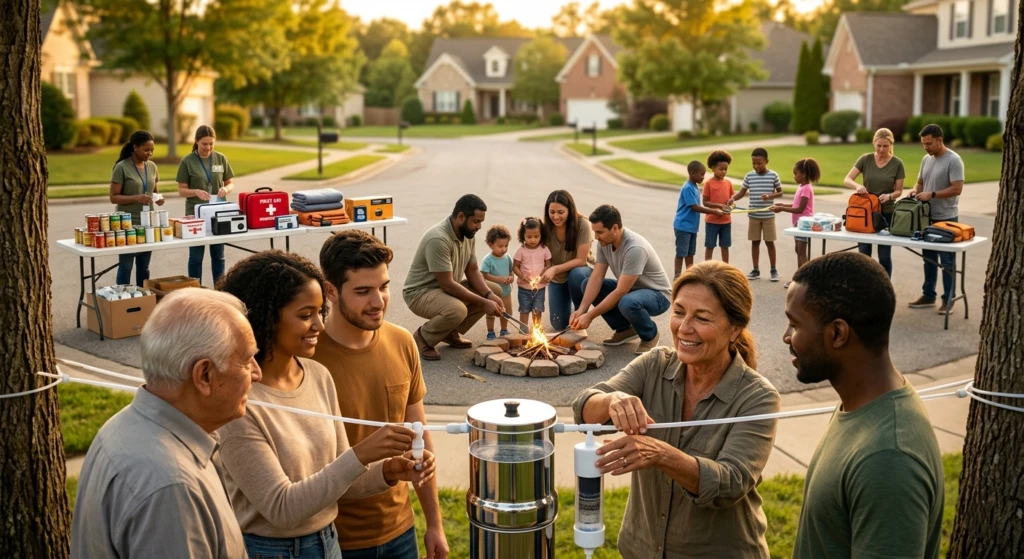 Preparedness isn’t just about gear; it’s about your mental state. The goal is to be calm, capable, and confident when others are panicking.
Overcoming Overwhelm: The “Start Small” Philosophy
Don’t try to do everything at once. Pick one item from Phase 1, Pillar 1, and get it done this week. Then move to the next. Small, consistent actions build momentum and prevent burnout.
Regular Practice: Turning Knowledge into Muscle Memory
A skill you’ve only read about is not a skill you possess. Practice fire starting. Practice using your water filter. Practice your family communication plan. Repetition builds muscle memory, allowing you to act effectively under stress.
Adapting to Change: Flexibility in an Uncertain World
No plan survives first contact with reality. Be flexible. Be adaptable. The goal isn’t to predict the future perfectly, but to build a broad base of resources and skills that allow you to respond effectively to any challenge.
Frequently Asked Questions
What’s the absolute first thing a beginner prepper should do?
The absolute first thing you should do is secure your water supply. Start by storing 1 gallon of water per person, per day, for 3 days. Then, buy a reliable portable water filter. Water is the most critical and immediate need.
How much does it cost to start prepping?
You can start prepping for free. Begin by creating a family emergency plan, identifying meeting points, and gathering copies of critical documents. Then, incrementally add supplies. A basic 72-hour kit can be assembled for under $100 if you’re resourceful. Preparedness is a journey, not a single purchase.
Is prepping just for doomsday scenarios?
Absolutely not. While some preppers focus on extreme events, the vast majority prepare for common disruptions like power outages, natural disasters (hurricanes, floods, wildfires), economic downturns, or even personal emergencies like job loss or illness. It’s about being ready for life’s inevitable curveballs.
How do I talk to my family about prepping without scaring them?
Frame preparedness as a responsible, proactive step for family safety and peace of mind. Focus on practical benefits: “We’ll be comfortable if the power goes out,” or “We’ll know what to do if there’s a big storm.” Involve them in age-appropriate tasks, like packing their own comfort items in a Go-Bag.
What’s the difference between a bug-out bag and an emergency kit?
An “emergency kit” (or “shelter-in-place kit”) is typically stored at home and contains supplies for 2 weeks or more, designed for when you stay put. A “bug-out bag” (BOB) is a portable 72-hour kit for each family member, designed to be grabbed quickly if you need to evacuate. You need both.
Products / Tools / Resources
These are the specific items and resources that consistently come up in serious preparedness conversations—selected for reliability, value, and real-world effectiveness.
Water Storage & Purification
- Aqua-Tainer 7-Gallon Rigid Water Container: These stackable, food-grade containers are perfect for building your initial 72-hour to 2-week water supply. They’re durable and have a built-in spigot.
- Sawyer Squeeze Water Filter: The gold standard for portable water filtration. It’s lightweight, highly effective, and rated for 100,000 gallons. Essential for filtering natural water sources.
- Potable Aqua Chlorine Dioxide Tablets: A compact, lightweight backup for water purification. These kill viruses, bacteria, and protozoa, making water safe to drink when boiling isn’t an option.
Food & Cooking
- Augason Farms Emergency Food Supply: A great starting point for shelf-stable food. They offer a wide variety of calorie-dense, long-lasting options, from individual meals to larger buckets.
- P-38 Can Opener: Don’t laugh. This tiny, military-issue can opener is virtually indestructible, weighs almost nothing, and will open any can. Keep one in every kit.
- Solo Stove Lite: A compact, efficient wood-burning stove that uses twigs and leaves as fuel. Perfect for cooking small meals without relying on propane or electricity.
First Aid & Medical
- Adventure Medical Kits Mountain Series Hiker Medical Kit: A comprehensive, well-organized first aid kit designed for outdoor use, but perfect for home emergencies. It includes a first aid manual and supplies for common injuries.
- QuikClot Advanced Clotting Sponge: For serious bleeding, this can be a life-saving addition to your first aid kit. Requires training to use effectively.
Light & Communication
- Black Diamond Spot Headlamp: Bright, durable, water-resistant, and features a red-light mode to preserve night vision. A headlamp keeps your hands free for tasks.
- Midland ER310 Emergency Crank Weather Radio: This multi-functional radio provides NOAA weather alerts, AM/FM radio, a powerful flashlight, and a USB charging port for your phone. It can be powered by battery, hand-crank, or solar.
Tools & Security
- Mora Companion Fixed Blade Knife: An incredibly versatile, durable, and affordable knife. Essential for everything from food prep to fire starting.
- Leatherman Wave+ Multi-Tool: A compact, lightweight multi-tool with spring-action pliers, a knife, scissors, and more. Indispensable for repairs and tasks.
Planning & Training Resources
- FEMA Ready.gov: The official government website for emergency preparedness. It offers free guides, checklists, and information on various disaster scenarios.
- American Red Cross First Aid/CPR/AED Course: Hands-on training is invaluable. Find a local course to learn life-saving skills.
- The Prepared (theprepared.com): A highly respected, evidence-based online resource for all aspects of preparedness, offering in-depth guides and product reviews.