
Hey there! Some links on this page may be affiliate links which means that, if you choose to make a purchase, I may earn a commission at no extra cost to you. I greatly appreciate your support. Read the full disclosure here.
A 72 hour bug out bag checklist covers every essential item a person needs to survive independently for three days following a forced evacuation or disaster scenario. The standard framework organizes gear across six core categories: water, food, shelter, communications, medical, and security. Building a well-balanced bag under 35 lbs is achievable for most adults and represents the baseline standard recommended by emergency preparedness authorities.
Key Takeaways
- 🎒 A complete 72 hour bug out bag checklist should address water, food, shelter, first aid, navigation, communications, and self-defense as distinct categories.
- 💧 Water is the most critical resource — plan for a minimum of 1 liter per person per day, plus filtration capability.
- 🔦 Redundancy matters: carry at least two fire-starting methods, two light sources, and two navigation tools.
- 🏥 Customize your first aid kit to your household’s specific medical needs, including prescription medications for a 72-hour supply.
- 📻 A hand-crank or battery-powered NOAA weather radio is non-negotiable for situational awareness during grid-down events.
- ⚖️ Total bag weight should stay at or below 25–30% of the carrier’s body weight to maintain mobility under stress.
- 📋 Review and rotate perishable items (food, medications, batteries) every six months.
- 👨👩👧 Distribute gear across multiple bags in a family unit — never concentrate all critical supplies in one pack.
- 🗺️ Paper maps and a compass remain essential even when GPS devices are included.
- 💰 A quality, purpose-built bug out bag can be assembled for $300–$600 without sacrificing performance.
What Exactly Is a 72 Hour Bug Out Bag?
 A 72 hour bug out bag (BOB) is a pre-packed emergency kit designed to sustain one person for three days after a rapid evacuation. The “72 hours” threshold reflects the widely cited window during which emergency services are typically overwhelmed and individuals must rely on their own resources.
The concept is endorsed by FEMA’s Ready.gov program, which advises all Americans to maintain at minimum a three-day emergency supply kit. The bug out bag format specifically emphasizes portability — everything fits in a single backpack so the carrier can move quickly on foot if vehicles become unavailable.
Who needs one: Anyone living in a region subject to natural disasters (hurricanes, wildfires, earthquakes, floods), civil unrest, or infrastructure failure. This isn’t exclusively for hardcore survivalists; it’s practical preparedness for any household.
Who may need a modified version: Elderly individuals, those with chronic medical conditions, and families with young children will need adjusted loadouts that prioritize medications, comfort items, and child-specific supplies.
The Core 72 Hour Bug Out Bag Checklist by Category
The most effective way to build a bug out bag is by category, not by randomly accumulating gear. Each category below addresses a specific survival need, and no category should be skipped.
💧 Water and Hydration
Water is the single highest-priority item. Dehydration impairs cognitive function within hours, and physical exertion during an evacuation accelerates fluid loss significantly.
| Item | Quantity | Notes |
|---|---|---|
| Water (stored) | 3 liters per person | Collapsible bottles save space |
| Water filter (e.g., Sawyer Squeeze) | 1 | Filters up to 100,000 gallons |
| Iodine or chlorine tablets | 1 pack | Backup to filter |
| Collapsible water container | 1–2 | For resupply at water sources |
| Stainless steel bottle | 1 | Doubles for boiling water |
Common mistake: Relying solely on stored water without a filtration backup. If your stored supply is lost or contaminated, you need a secondary method immediately.
🍱 Food and Nutrition
Caloric density matters more than variety when packing emergency food. Target 1,500–2,000 calories per day per adult, prioritizing foods that require minimal preparation.
- Freeze-dried meals (Mountain House, Backpacker’s Pantry): lightweight, long shelf life
- Energy bars (Clif, RXBAR, Datrex emergency rations): no cooking required
- Peanut butter packets: high calorie-to-weight ratio
- Instant oatmeal or ramen: low cost, easy preparation
- Hard candy or glucose tablets: quick energy, morale boost
Pack a lightweight backpacking stove (e.g., MSR PocketRocket) and fuel canister only if weight budget allows. A folding spork and a small titanium pot round out the cooking kit.
🏕️ Shelter and Warmth
Exposure kills faster than hunger. Even in mild climates, nighttime temperatures can drop dangerously, and wet conditions accelerate hypothermia.
- Emergency mylar blankets (2 minimum): reflect 90% of body heat
- Lightweight bivy sack or tarp: 8×10 ft silnylon tarp covers most shelter needs
- 550 paracord (50 ft): shelter construction, gear repair, multiple uses
- Compact sleeping bag (rated to 20°F): worth the weight in cold climates
- Rain poncho: doubles as ground cover or improvised shelter
- Work gloves: hand protection during shelter building and debris clearing
Choose a bivy over a tent if: weight and pack space are critical constraints and solo travel is the plan. Choose a lightweight tent if traveling with family or in environments with sustained precipitation.
🩺 First Aid and Medical
A basic first aid kit is insufficient for a 72-hour scenario. The medical loadout should address trauma, infection, and chronic health management.
Trauma supplies:
- Israeli bandage (pressure dressing)
- CAT tourniquet
- Hemostatic gauze (QuikClot)
- Nitrile gloves (2 pairs minimum)
General medical:
- Adhesive bandages (assorted sizes)
- Moleskin (for blisters during extended walking)
- Antibiotic ointment
- Antiseptic wipes
- SAM splint
- Medical tape
Medications:
- 72-hour supply of all prescription medications
- Ibuprofen and acetaminophen
- Antihistamine (Benadryl)
- Anti-diarrheal medication
- Electrolyte packets
Critical note: Store prescription medications in a clearly labeled, waterproof container. Rotate stock every 90 days to maintain potency.
🔦 Tools, Light, and Fire
Redundancy is the operating principle here. Every critical function should have at least two methods.
Lighting:
- Headlamp with extra batteries (Black Diamond Spot is a reliable benchmark)
- Backup flashlight or glow sticks
Fire starting:
- Bic lighter (2)
- Waterproof matches in a sealed container
- Ferro rod and striker
Tools:
- Multi-tool (Leatherman Wave+ or Gerber Center-Drive)
- Fixed-blade knife (4–5 inch blade)
- Duct tape (small roll)
- Zip ties (assorted)
- Paracord (additional 25 ft)
During a grid-down event, situational awareness is a survival asset. Knowing where emergency shelters are, which roads are passable, and what weather is incoming directly affects decision-making.
- NOAA hand-crank weather radio (Midland ER310 is a well-regarded option)
- Paper maps of your local region and likely evacuation routes
- Compass (Suunto A-10 or similar baseplate compass)
- Backup battery pack (20,000 mAh minimum) for phone charging
- Waterproof document pouch containing: copies of ID, insurance cards, emergency contacts, cash ($200 minimum in small bills)
🔒 Personal Security
Security needs vary by individual, legal jurisdiction, and threat environment. Address this category according to personal training, legal permissions, and risk assessment.
- Personal defense firearm (if legally permitted and trained): with appropriate ammunition
- Pepper spray: non-lethal deterrent, widely legal
- Whistle: signaling and deterrence
- Tactical flashlight: high-lumen models serve dual purpose
How Heavy Should a 72 Hour Bug Out Bag Actually Be?
 Keep total loaded weight at or below 25–30% of the carrier’s body weight. For a 160 lb adult, that means a maximum of 40–48 lbs — but targeting 25–30 lbs is more realistic for sustained movement over 8–12 hours.
Weight-saving strategies:
- Replace cotton clothing with merino wool or synthetic base layers (lighter, moisture-wicking)
- Choose a titanium or aluminum cook kit instead of stainless steel
- Opt for a silnylon tarp over a tent
- Use concentrated or tablet-form hygiene products
Edge case: Individuals with physical limitations, older adults, or those evacuating with young children should target 15–20 lbs and distribute additional gear across multiple bags or a wheeled cart for vehicle-based evacuation.
What Clothing and Personal Items Belong in a Bug Out Bag?
Clothing is often under-packed or packed incorrectly. The layering system used by backpackers and military personnel applies directly to bug out bag clothing selection.
Clothing checklist:
- Moisture-wicking base layer (top and bottom)
- Insulating mid-layer (fleece or down jacket)
- Waterproof outer shell (rain jacket)
- Sturdy broken-in boots (already worn, not new)
- Two pairs of wool or synthetic socks
- Lightweight gloves and a wool beanie
- Bandana or shemagh (multi-use)
Personal hygiene and sanitation:
- Travel-size toothbrush and toothpaste
- Biodegradable soap
- Toilet paper and a small trowel
- Hand sanitizer
- Feminine hygiene products (as applicable)
- Prescription eyeglasses or extra contacts
How to Organize and Pack a Bug Out Bag Efficiently
Organization directly affects how quickly gear can be accessed under stress. A disorganized bag costs critical seconds and elevates anxiety during an already high-pressure situation.
Packing system:
- Bottom of bag: Sleeping bag, bivy, or tarp (bulky, infrequently accessed)
- Main compartment: Food, water, clothing, shelter items
- Top lid or quick-access pocket: First aid kit, headlamp, multi-tool, documents
- Hip belt pockets: Energy bars, phone, compass
- External attachment points: Water bottles, trekking poles, sleeping pad
Use color-coded dry bags or stuff sacks to separate categories. Red for medical, blue for water, orange for fire/light. This system allows retrieval by color in low-light conditions without unpacking the entire bag.
Recommended bag platforms:
- 5.11 RUSH72 (55L): popular among preppers for its MOLLE system and durability
- Osprey Atmos AG 65: superior ergonomics for extended carry
- Mystery Ranch 3-Day Assault Pack: military-grade construction, excellent organization
What Are the Most Common Bug Out Bag Mistakes?
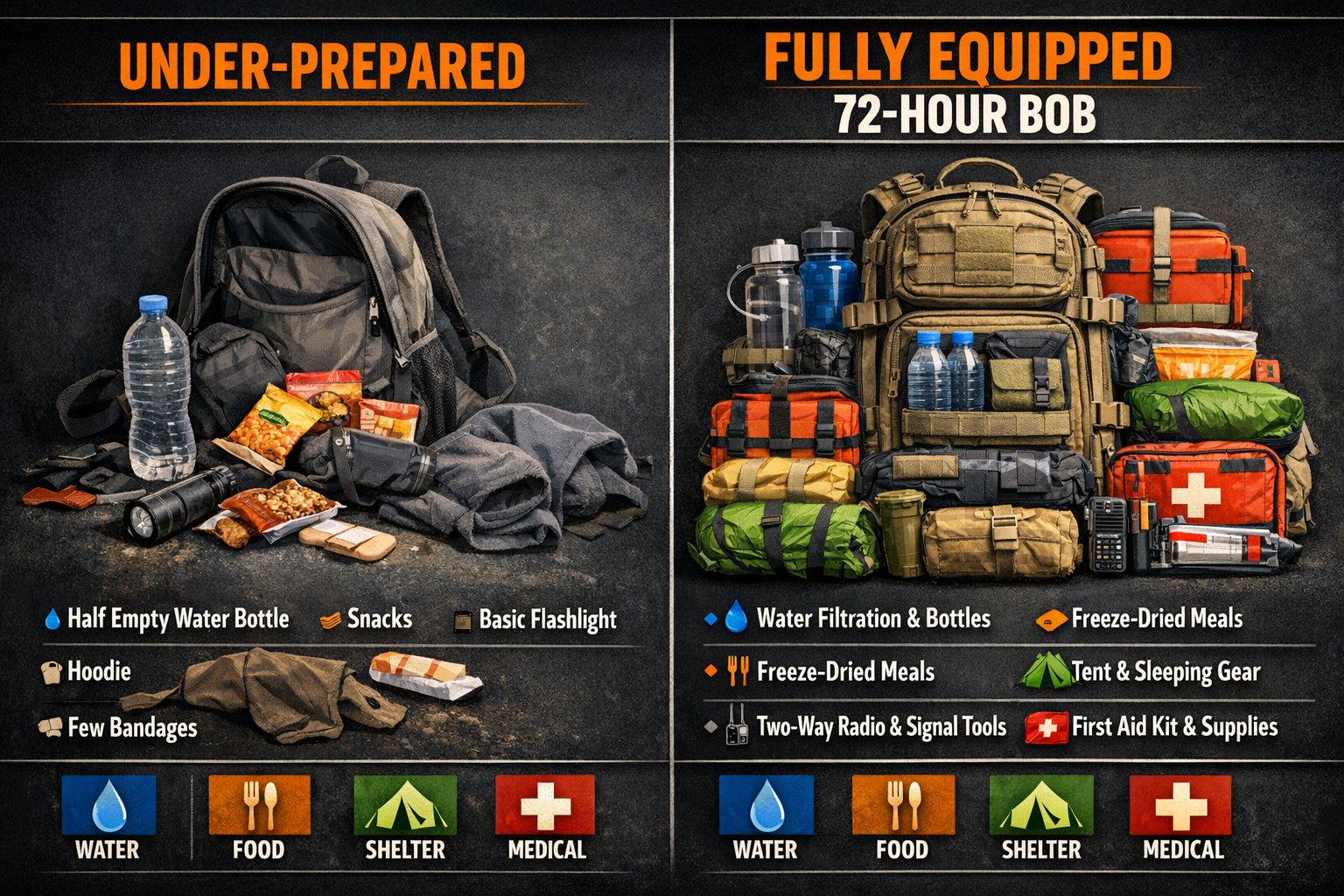
Even experienced preppers make errors that compromise their 72 hour bug out bag checklist. Knowing the most common failure points allows for proactive correction.
Mistake 1: Packing gear you’ve never used. A water filter is useless if the carrier has never practiced using it under pressure. Every item in the bag should be tested before it’s needed.
Mistake 2: Ignoring the “get home bag” distinction. A bug out bag assumes you’re already home when disaster strikes. A separate get-home bag in the vehicle addresses the scenario where evacuation begins from work or school.
Mistake 3: Neglecting digital and document preparedness. Copies of insurance policies, medical records, and identification can be critical for accessing emergency services or financial accounts after a disaster.
Mistake 4: Over-packing weapons, under-packing medical supplies. Statistically, medical emergencies are far more likely than armed confrontations during disaster scenarios. Balance the loadout accordingly.
Mistake 5: Forgetting to account for children and pets. Children need their own age-appropriate items: comfort objects, snacks, medications, and entertainment for extended waits. Pets require food, water, leash, and vaccination records.
How Often Should a 72 Hour Bug Out Bag Be Updated?
A bug out bag is not a set-and-forget system. Perishable and time-sensitive items require scheduled rotation.
Every 6 months:
- Rotate food and water supplies
- Check and replace batteries
- Inspect medications for expiration dates
- Test electronics (radio, flashlight, backup battery)
Annually:
- Reassess clothing for fit and seasonal appropriateness
- Review and update document copies (ID, insurance, emergency contacts)
- Evaluate gear condition for wear, corrosion, or damage
- Update the bag’s contents to reflect changes in household size, medical needs, or threat environment
A simple calendar reminder set for April and October handles the biannual rotation effectively.
FAQ: 72 Hour Bug Out Bag Checklist
Q: What’s the difference between a bug out bag and a go bag?
A: The terms are often used interchangeably, but a bug out bag typically implies a more comprehensive 72-hour survival kit, while a “go bag” sometimes refers to a lighter, faster-grab kit for short-term evacuations. Both serve the same core purpose.
Q: How much does a complete bug out bag cost?
A: A functional, quality bug out bag can be assembled for $300–$600. Budget builds using military surplus and mid-tier gear can come in under $200, while premium setups with name-brand tactical gear can exceed $1,000.
Q: Should children have their own bug out bags?
A: Yes, with age-appropriate modifications. Children over 8 can carry a small pack (5–10 lbs) with their own snacks, water, comfort items, and a whistle. Younger children’s items should be distributed among adult bags.
Q: Is a 72-hour kit enough for a major disaster?
A: Three days is the minimum baseline. Many experienced preppers extend their planning to 7–14 days or longer. The 72-hour kit is the starting point, not the ceiling.
Q: What’s the best backpack for a bug out bag?
A: The 5.11 RUSH72 (55L) and Osprey Atmos AG 65 are consistently recommended for their durability, organization, and carry comfort. The right pack depends on body size, weight budget, and intended use.
Q: Can a bug out bag be stored in a car?
A: Yes, but heat cycles in a parked vehicle degrade food, medications, and batteries faster. Use a separate, heat-tolerant vehicle kit and store the primary bug out bag in a climate-controlled location.
Q: Do I need a firearm in my bug out bag?
A: This depends on legal jurisdiction, personal training, and risk assessment. Pepper spray and a tactical flashlight provide non-lethal security options that are legal in most jurisdictions.
Q: What food has the longest shelf life for a bug out bag?
A: Freeze-dried meals (25-year shelf life), Datrex emergency ration bars (5-year shelf life), and commercially sealed hard candies offer the best longevity. Avoid canned goods due to weight.
Q: How do I waterproof my bug out bag contents?
A: Use a pack rain cover for the exterior and dry bags or heavy-duty zip-lock bags for interior contents. Prioritize waterproofing for documents, electronics, and fire-starting materials.
Q: What’s the most overlooked item in a bug out bag?
A: Cash in small bills. ATMs and card readers fail during power outages, making physical currency essential for purchasing supplies or services during an evacuation.
Products, Tools, and Resources
Building a credible 72 hour bug out bag checklist means selecting gear that performs under real conditions, not just gear that looks tactical on a shelf. These recommendations reflect what the preparedness community consistently returns to after field use:
Bags: The 5.11 RUSH72 remains a go-to for preppers who want MOLLE compatibility and durability without the premium price of military-issue packs. For those prioritizing comfort on long carries, the Osprey Atmos AG 65is worth the extra cost.
Water filtration: The Sawyer Squeeze filter is compact, lightweight, and rated for 100,000 gallons — it’s become the standard recommendation over older pump-style filters. Pair it with Aquatabs chlorine tablets as a chemical backup.
Communications: The Midland ER310 hand-crank emergency radio covers NOAA weather alerts, AM/FM, and includes a USB charging port. It’s a practical, well-priced option that doesn’t require batteries to function.
Medical: The North American Rescue CAT tourniquet is the same model used by U.S. military personnel. It’s worth the investment over cheaper alternatives. For a complete first aid kit base, the MyMedic MyFAK offers a solid pre-assembled starting point that can be customized.
Multi-tool: The Leatherman Wave+ has a 25-year warranty and covers the majority of field repair and utility tasks. It’s heavier than some alternatives but the tool selection justifies the weight.
Reference materials: FEMA’s Ready.gov emergency preparedness guides are freely available and provide a credible baseline for household emergency planning. The SAS Survival Handbook by John “Lofty” Wiseman remains one of the most practical printed references for field survival techniques.
Conclusion
A well-executed 72 hour bug out bag checklist is one of the most tangible investments a prepper can make in household resilience. The framework is straightforward: address water, food, shelter, medical, communications, tools, and security in a portable, organized system that can be grabbed and deployed within minutes.
Actionable next steps:
- Audit what you already own against the category checklist above before purchasing anything new.
- Set a weight target based on the carrier’s body weight and build toward it incrementally.
- Test every piece of gear at least once before the bag is considered ready — use the water filter, start a fire with the ferro rod, practice setting up the tarp.
- Schedule a biannual review (April and October work well) to rotate perishables and update documents.
- Build redundancy into critical systems — two fire methods, two light sources, two water treatment options.
The difference between a functional bug out bag and a false sense of security comes down to preparation, practice, and honest assessment of actual needs. Start with the essentials, test under realistic conditions, and refine from there.
References
- FEMA Ready.gov. (2021). Build A Kit. https://www.ready.gov/kit
- Wiseman, J. (2009). SAS Survival Handbook (3rd ed.). HarperCollins.
- American Red Cross. (2022). Emergency Preparedness & Safety Tips. https://www.redcross.org/get-help/how-to-prepare-for-emergencies.html
- Centers for Disease Control and Prevention (CDC). (2022). Emergency Preparedness and You. https://www.cdc.gov/niosh/topics/emres/default.html