
Hey there! Some links on this page may be affiliate links which means that, if you choose to make a purchase, I may earn a commission at no extra cost to you. I greatly appreciate your support. Read the full disclosure here.
You already know the feeling. You’re standing in your kitchen — maybe it’s late, maybe the news has been unsettling, maybe you just got through a week where the grocery shelves looked thinner than usual — and you think: what would we actually do if this got worse?
Then you look around your apartment and think: there’s nowhere to put anything.
That’s the moment this Apartment Food Storage guide was written for.
Not for the homesteader with a root cellar. Not for the prepper with a dedicated storage room and a truck to haul supplies. For the person living in a one-bedroom, a studio, a rental with a landlord who does walk-throughs — who wants to be genuinely prepared without dismantling their life to do it.
This is that guide. And it’s going to change how you see your apartment.
The Preparedness World Has Been Ignoring You — Here’s Why That Ends Today
Over 44 million Americans live in apartments. Search “long term food storage” and you’ll find thousands of guides. Almost none of them acknowledge that fact. The advice is always the same: buy 50-pound buckets, store them in your basement, build a root cellar, rotate your stock in the garage.
It’s maddening if you rent.
Urban apartment dwellers face concentrated risk during supply chain disruptions, power outages, and civil emergencies — often more than rural homeowners do. And yet the preparedness community has largely left them without a practical roadmap. The result is a massive population of people who want to prepare, know they should, and have no idea how to do it within the actual constraints of their lives.
That gap ends here.
What “Without Anyone Knowing” Really Means
Let’s be honest about something. The phrase in this guide’s title isn’t about paranoia or secrecy for its own sake. It’s about something more human than that.
In urban environments, preparedness carries a social weight it doesn’t carry elsewhere. Tell your neighbors in rural Montana you’re building a 6-month food supply and they’ll probably ask what you’re storing. Tell your neighbors in a Brooklyn apartment building and you’ll spend the next month explaining yourself. The urban prepper exists in a social ecosystem where emergency preparedness is often met with raised eyebrows, nervous laughter, or the quiet assumption that you’ve gone somewhere strange online.
“Without anyone knowing” means preparing on your own terms. It means building a supply that doesn’t visually dominate your living space. It means storing food in ways that blend into normal apartment life — not because you’re hiding something shameful, but because preparation is a private act of self-reliance that doesn’t require an audience.
That’s not paranoia. That’s wisdom.
The short version: A 6-month apartment food supply is achievable using under-bed storage, closet systems, and dual-purpose furniture — with calorie-dense, long-shelf-life foods sealed in compact containers. The key is knowing where your hidden space actually is, and what to fill it with.
Key Takeaways:
– A 6-month food supply in small apartments is feasible by maximizing overlooked storage: under-bed bins, closets, and multifunctional furniture with compact, calorie-dense foods in sealed containers.
– Prioritize foods with a high calorie-to-space ratio and long shelf life, such as white rice, hard wheat berries, dried legumes, and freeze-dried vegetables; avoid bulky or short-lived items like brown rice or bulk nuts.
– Manage temperature and humidity risks by choosing interior, cooler storage spots; use desiccants, mylar bags with oxygen absorbers, and insulated containers to prolong shelf life.
– Practical organization—with uniform containers, clear labeling, and rotation (FIFO)—makes food storage look intentional, preserves quality, and prevents waste.
– Build your supply gradually with a monthly plan, employing discreet storage solutions that comply with renter lease agreements and keep preparations private and painless.
Your Apartment Has More Storage Than You Think — Here’s How to Find It
 Before you buy a single can of food, stop. The first step isn’t shopping — it’s auditing. Most apartment dwellers dramatically underestimate the available space in their homes, not because the space doesn’t exist, but because it’s being used inefficiently or not at all.
Walk through your apartment right now with fresh eyes. What you’re about to find will surprise you.
Under Your Bed — The Most Wasted Space in Any Apartment
The average queen-size bed sits 13 to 15 inches off the floor. That creates a storage cavity of roughly 60 cubic feet beneath it. Most people use this space for nothing. Or for things they forgot they owned.
For food storage, under-bed space is genuinely excellent. It’s temperature-stable at floor level. It’s dark. It’s completely invisible to anyone who visits. And it requires zero modification to your apartment.
Flat storage bins with tight-fitting lids — IRIS USA makes food-safe options that slide easily under most bed frames — can hold canned goods, sealed mylar bags, or vacuum-sealed packages stacked two layers deep. Add bed risers (4 to 6 inches) and you dramatically increase that vertical clearance, which means dramatically more food.
One practical note on weight: a standard bed frame handles 500 to 1,500 pounds depending on construction. Food is dense. A flat bin filled with canned goods can weigh 50 to 60 pounds. Distribute weight across multiple bins and check your frame’s capacity before you go heavy.
What belongs under the bed: canned goods, sealed mylar bags of rice and beans, vacuum-sealed dry goods — anything that doesn’t need temperature control beyond what your apartment’s climate already provides.
Your Closet Is Using Maybe 40% of Its Actual Capacity
Think about how your closet is organized right now. Clothes hanging at one level. Shoes on the floor. Something on the upper shelf you haven’t touched in two years. The space between your hanging clothes and the ceiling? Empty. The floor beneath your hanging items? Mostly empty. The back corners? Definitely empty.
A systematic closet reorganization for food storage doesn’t mean removing your wardrobe. It means making your wardrobe share.
The upper shelf gap: Most closets have 12 to 18 inches of clearance above the standard shelf. Install a second shelf in that space. Use it for lightweight, long-shelf-life items — mylar bags of rice and oats, sealed containers of sugar and salt, boxes of pasta. Nothing heavy. Nothing you need daily.
The floor beneath hanging clothes: Hanging clothes typically end 36 to 48 inches from the floor. That’s significant floor space, completely hidden when the closet door is closed. Stackable storage bins, food-grade buckets with lids, or low-profile rolling carts fit perfectly in that zone.
The back wall: In a walk-in closet, a narrow shelving unit — 6 to 8 inches deep — against the back wall holds canned goods and sealed packages without touching your main closet floor space.
The compression trick: Vacuum storage bags compress seasonal clothing to a fraction of its normal volume. One bag of winter sweaters becomes the size of a throw pillow. That freed closet space becomes food storage space. No sacrifice required.
Furniture That Hides Food in Plain Sight
This is where apartment food storage gets genuinely elegant. The right furniture serves double duty — it looks completely normal to any visitor while concealing a meaningful supply of food.
Storage ottomans are the unsung heroes of apartment preparedness. A large ottoman (24 to 36 inches) holds 2 to 4 cubic feet of storage. Fill it with sealed mylar bags of rice or dried beans. It functions as a coffee table, extra seating, and foot rest. Nobody knows. Nobody asks.
Platform bed frames with built-in drawers are one of the highest-capacity storage solutions available to apartment dwellers. A queen-size platform bed with integrated drawers can hold 6 to 8 large drawers, each capable of storing 20 to 30 pounds of food. That’s potentially 240 pounds of food storage, completely invisible, built into furniture you’d buy anyway.
Bench seating with lift-top storage — entryway benches, window seat benches, dining benches — each holds 2 to 6 cubic feet. They look like home décor. They function as a pantry.
Bookshelves, honestly, are underrated. Canned goods, mason jars, and sealed containers placed on open shelves look like intentional kitchen organization. A standard 6-shelf bookcase holds 150 to 200 pounds of canned goods when properly loaded. Style it with uniform containers and a few plants and it reads as a design choice, not a survival strategy.
Your Kitchen Cabinets Are Probably Half Empty — You Just Can’t Tell
Most apartment kitchens are organized for convenience, not capacity. A systematic reorganization focused on storage density can double or triple what your cabinets hold without adding a single inch of space.
The vertical space problem is the biggest culprit. Standard cabinet shelves are spaced 12 to 15 inches apart, but most canned goods are only 4 to 5 inches tall. The space above each can is wasted. Stackable can organizers and tiered shelf risers solve this by creating multiple levels within a single shelf — effectively doubling your cabinet’s canned goods capacity.
The inside of cabinet doors is almost universally unused. Over-door organizers designed for cabinet interiors hold spice jars, small canned goods, and sealed packets. That’s a full shelf’s worth of storage you’re currently leaving empty.
Corner cabinets are notoriously inefficient. A lazy Susan turntable maximizes that space and makes everything accessible without reaching into the back of the cabinet.
And the “decant and store” method is worth adopting immediately: transfer dry goods from their original bulky packaging into uniform, stackable containers. A 5-pound bag of flour in its original packaging takes up significantly more space than the same flour in a square, stackable container. Uniform containers stack efficiently. They also look intentional — which matters more than you might think.
The Vertical Dimension Nobody Uses
Apartments are constrained horizontally. Vertically, most have 8 to 10 feet of ceiling height — and most of that space above eye level is completely unused.
Floating shelves installed above doorways or along hallway walls add significant storage capacity without consuming any floor space. A single 8-foot floating shelf above a doorway holds 40 to 60 pounds of canned goods or sealed containers. It’s above eye level. It’s out of the way. It’s invisible to anyone who isn’t specifically looking for it.
Floor-to-ceiling shelving units — freestanding, no drilling required — maximize vertical space in any room. In a bedroom corner, a living room wall, or a hallway, a floor-to-ceiling unit holds 200 to 400 pounds of food storage while occupying only 12 to 18 inches of floor depth.
The “pantry wall” concept takes this further: dedicate one wall of a spare room or hallway to a floor-to-ceiling shelving system. Styled with uniform containers, labeled jars, and organized categories, a pantry wall looks like a deliberate interior design choice. Because it is one.
Apartments Food Storage Selection Guide
 Not all food storage foods work equally well in apartment settings. The selection criteria here differ from standard prepper recommendations in one critical way: space efficiency matters as much as shelf life. You’re not just asking “how long does this last?” You’re asking “how many calories does this give me per cubic inch of storage space?”
The ideal apartment food storage food is calorie-dense, long-lived, compact, familiar enough that your household will actually eat it, and available at normal grocery stores without special ordering.
The Foundation Foods — Start Here, Always
These are the calorie-dense, ultra-long-shelf-life staples that form the backbone of any food storage system. For apartment dwellers, they’re particularly valuable because they store in compact, sealed containers that fit anywhere.
| Food | Calories/lb | Shelf Life (Sealed) | Storage Footprint |
| White rice | ~1,700 | 25–30 years | Very compact |
| Hard wheat berries | ~1,500 | 25–30 years | Very compact |
| Rolled oats | ~1,700 | 20–30 years | Compact |
| Dried lentils | ~1,600 | 25–30 years | Very compact |
| Dried black beans | ~1,500 | 25–30 years | Very compact |
| White pasta | ~1,600 | 8–10 years | Moderate |
| White sugar | ~1,700 | 30+ years | Very compact |
| Iodized salt | N/A | Indefinite | Minimal |
| Honey | ~1,400 | Indefinite | Moderate |
A quick note on white rice versus brown rice, because this question comes up constantly: brown rice contains natural oils in its bran layer that go rancid within 6 to 12 months, even in ideal conditions. White rice, stripped of those oils, stores for decades. For long term storage, white rice is always the right choice. Always.
The Protein Layer — Don’t Skip This
| Food | Calories/lb | Shelf Life | Notes |
| Canned tuna | ~500 | 3–5 years | High protein, compact |
| Canned chicken | ~500 | 3–5 years | Versatile, compact |
| Peanut butter (sealed) | ~2,600 | 1–2 years | Highest calorie density |
| Peanut butter powder | ~2,400 | 4–5 years | More compact than jarred |
| Powdered eggs | ~2,700 | 5–10 years | Complete protein |
| TVP (textured veg protein) | ~1,500 | 15–20 years | Extremely compact |
| Canned sardines | ~900 | 3–5 years | Omega-3 rich |
| Powdered whole milk | ~2,300 | 2–10 years | Calcium, protein |
The Micronutrient and Comfort Layer
| Food | Primary Benefit | Shelf Life | Storage Notes |
| Freeze-dried vegetables | Vitamins, minerals | 25–30 years | Lightweight, compact |
| Freeze-dried fruits | Vitamins, morale | 25–30 years | Lightweight, compact |
| Multivitamins | Nutritional insurance | 2–3 years | Minimal space |
| Coffee/tea | Morale, normalcy | 2–5 years | Compact |
| Spices and seasonings | Palatability | 2–4 years | Minimal space |
| Dark chocolate (sealed) | Morale, calories | 1–2 years | Compact |
Foods That Sound Good But Waste Your Space
Some foods appear on standard prepper lists but are poor choices for apartment storage because their calorie-to-space ratio is too low, their storage requirements are too demanding, or their shelf life is too short to justify the footprint.
Brown rice: Goes rancid in 6 to 12 months. Takes the same space as white rice but delivers a fraction of the shelf life. Skip it.
Whole wheat flour: 1 to 2 year shelf life. Takes significant space. Hard wheat berries store longer and can be ground fresh when you need flour.
Bulk nuts and seeds: Healthy fats, yes — but those fats go rancid within 6 to 12 months at room temperature. Small quantities are fine. Bulk storage is inefficient.
Freeze-dried complete meal kits: Expensive per calorie, bulky packaging, and often contain foods your family won’t enjoy. Build your own supply from individual components instead.
Large #10 cans: Once opened, a #10 can must be used within days. For apartment-scale storage, standard 15-ounce cans are far more practical.
Complete guide to emergency food rationing and cooking
The Math Behind a 6-Month Supply — Calculated for Real Life
 Before buying anything, you need to know exactly how much food a 6-month supply actually requires. This calculation is the foundation of an efficient apartment storage system — because buying too much wastes money and space, and buying too little defeats the purpose.
Step 1: Calculate What Your Household Actually Needs
The baseline for emergency food storage is 2,000 calories per person per day for adults. Adjust for your household:
- Children under 12: 1,200 to 1,800 calories per day
- Teenagers: 2,000 to 2,800 calories per day
- Pregnant or nursing women: 2,300 to 2,500 calories per day
- Elderly adults: 1,600 to 2,000 calories per day
- Physically active adults: 2,500 to 3,000 calories per day
Example — a household of three:
- 2 adults at 2,000 calories each: 4,000 calories/day
- 1 child age 8 at 1,500 calories: 1,500 calories/day
- Total daily need: 5,500 calories
- 6-month total: 5,500 × 180 days = 990,000 calories
Step 2: Break That Down by Food Category
| Category | % of Calories | Total Calories | Approximate Quantity |
| Grains (rice, oats, wheat) | 50% | 495,000 | ~290 lbs |
| Legumes (beans, lentils) | 20% | 198,000 | ~130 lbs |
| Fats and oils | 10% | 99,000 | ~25 lbs |
| Proteins (canned, dried) | 10% | 99,000 | ~100 lbs canned |
| Sugars and sweeteners | 5% | 49,500 | ~30 lbs |
| Fruits and vegetables | 5% | 49,500 | ~50 lbs freeze-dried |
Step 3: Translate That Into Storage Volume
This is where apartment planning gets specific. Those quantities translate to approximately:
- Grains (290 lbs): 6 to 7 five-gallon buckets, roughly 12 to 14 cubic feet
- Legumes (130 lbs): 3 to 4 five-gallon buckets, roughly 6 to 7 cubic feet
- Fats (25 lbs): 3 to 4 gallons of oil, roughly 2 cubic feet
- Canned proteins: 200 to 250 standard cans, roughly 8 to 10 cubic feet
- Sugars (30 lbs): 1 to 2 five-gallon buckets, roughly 2 to 3 cubic feet
- Freeze-dried fruits/veg: Roughly 4 to 6 cubic feet
Total estimated storage volume for a 3-person, 6-month supply: approximately 35 to 45 cubic feet.
Here’s what that means in practical terms. The space under a queen-size bed with risers provides 15 to 20 cubic feet. A standard closet floor provides 8 to 12 cubic feet. Two large storage ottomans provide 4 to 6 cubic feet. A floor-to-ceiling bookshelf provides 15 to 25 cubic feet.
A 6-month supply for a family of three fits comfortably within the hidden storage capacity of a typical 2-bedroom apartment. It requires intentional organization. It does not require a basement.
The Environmental Threats Nobody Warns Apartment Preppers About
 Apartment food storage faces environmental challenges that rural storage systems don’t. Understanding these challenges before they ruin your supply is the difference between a system that lasts 25 years and one that quietly degrades in 3.
Heat — The Silent Destroyer
Most apartments are climate-controlled, which is an advantage. But “climate-controlled” doesn’t mean “optimally temperature-stable for food storage.”
Upper-floor apartments run warmer than ground-floor units, particularly in summer. Closets on south and west-facing exterior walls can run 5 to 10°F warmer than the ambient room temperature. Storage near refrigerators, ovens, or HVAC units experiences temperature fluctuations that accelerate food degradation. And apartments without central air conditioning can reach 85 to 95°F in summer — temperatures that significantly reduce shelf life for most stored foods.
The ideal storage temperature for long term food is 50 to 70°F. Every 10°F above that range roughly halves effective shelf life. This isn’t a minor variable. It’s the most important one.
Apartment-specific solutions:
- Interior closets on interior walls maintain more stable temperatures than any other storage location in most apartments
- Floor-level storage is consistently cooler than shelf-level storage
- Insulated storage containers buffer temperature fluctuations for items stored in warmer locations
- If you run AC in summer, ensure your storage areas benefit from the cooling — don’t store food in rooms you keep closed and uncooled
Humidity — The Problem That Sneaks Up on You
High humidity enables mold growth, accelerates oxidation, and causes clumping and degradation in dry goods. And apartments have specific humidity risks that most guides ignore entirely.
Closets near bathrooms experience elevated humidity from shower steam and moisture migration. Cabinets near the stove or sink experience more moisture exposure than other storage locations. Ground-floor apartments often run higher ambient humidity than upper floors. Poorly ventilated spaces trap moisture.
The solutions:
- Desiccant packets (silica gel) placed in storage containers and storage areas absorb ambient moisture — replace or recharge every 6 to 12 months
- Compact plug-in dehumidifiers (Eva-Dry is the most recommended brand for closet use) work without drainage
- Mylar bags with oxygen absorbers create a sealed environment that humidity simply cannot penetrate — the most effective solution available
The Best Storage Locations in Your Apartment — Ranked Honestly
- Interior bedroom closet (away from exterior walls): Best overall. Stable temperature, dark, protected from humidity.
- Under the bed (interior bedroom): Excellent. Floor-level temperature stability, dark, protected.
- Interior hallway closet: Very good. Central location, stable temperature, typically dark.
- Living room storage furniture: Good. Climate-controlled space, stable temperature.
- Kitchen cabinets (away from stove and sink): Acceptable for shorter-shelf-life items. Monitor for humidity.
- Bathroom-adjacent closets: Avoid for long term storage. Humidity risk is significant.
- Exterior wall closets: Use with caution. Temperature fluctuations reduce shelf life.
The Social Layer — Preparing Without the Friction
Most preparedness guides skip this entirely. They shouldn’t. The social and psychological dimension of preparing in an urban environment is real, and ignoring it leads to abandoned supply systems and uncomfortable conversations.
The Roommate Situation
If you live with roommates who aren’t interested in preparedness, you have two options: have the conversation, or build a system that makes the conversation unnecessary.
The conversation approach works better than most people expect — if you frame it correctly. “I’m trying to save money by buying in bulk” is universally relatable. “I want to make sure we have food if there’s a supply chain disruption” is reasonable and non-threatening. “I’m building a year’s supply of food for the apocalypse” is the conversation you want to avoid.
The no-conversation approach: store your supply in your personal space — your bedroom, your personal closet, under your bed. Use furniture storage that looks like normal home décor. Keep your supply in containers that don’t announce their purpose. A row of matching glass jars on a shelf looks like intentional kitchen organization. It doesn’t look like emergency preparedness.
What Your Lease Actually Says About This
Most standard lease agreements don’t prohibit food storage. What they prohibit is structural modification — drilling into walls, installing permanent shelving, making changes that affect the property.
Generally permitted without landlord approval:
- Freestanding shelving units (no wall attachment required)
- Storage furniture (ottomans, bed frames with drawers, benches)
- Under-bed storage bins
- Over-door organizers that use existing door hardware
- Tension-mounted shelving systems (no drilling required)
May require landlord approval:
- Wall-mounted shelving (requires drilling)
- Floating shelves (requires drilling)
- Any modification to existing cabinetry
The practical approach: build your storage system entirely from freestanding furniture and non-permanent solutions. This is landlord-compliant and portable — which matters when you eventually move.
Making It Look Like You Live There, Not Survive There
The aesthetic dimension of apartment food storage is underappreciated. A storage system that looks organized and intentional reads as “this person is thoughtful about their home.” The same food in mismatched bags and original grocery packaging reads as something else entirely.
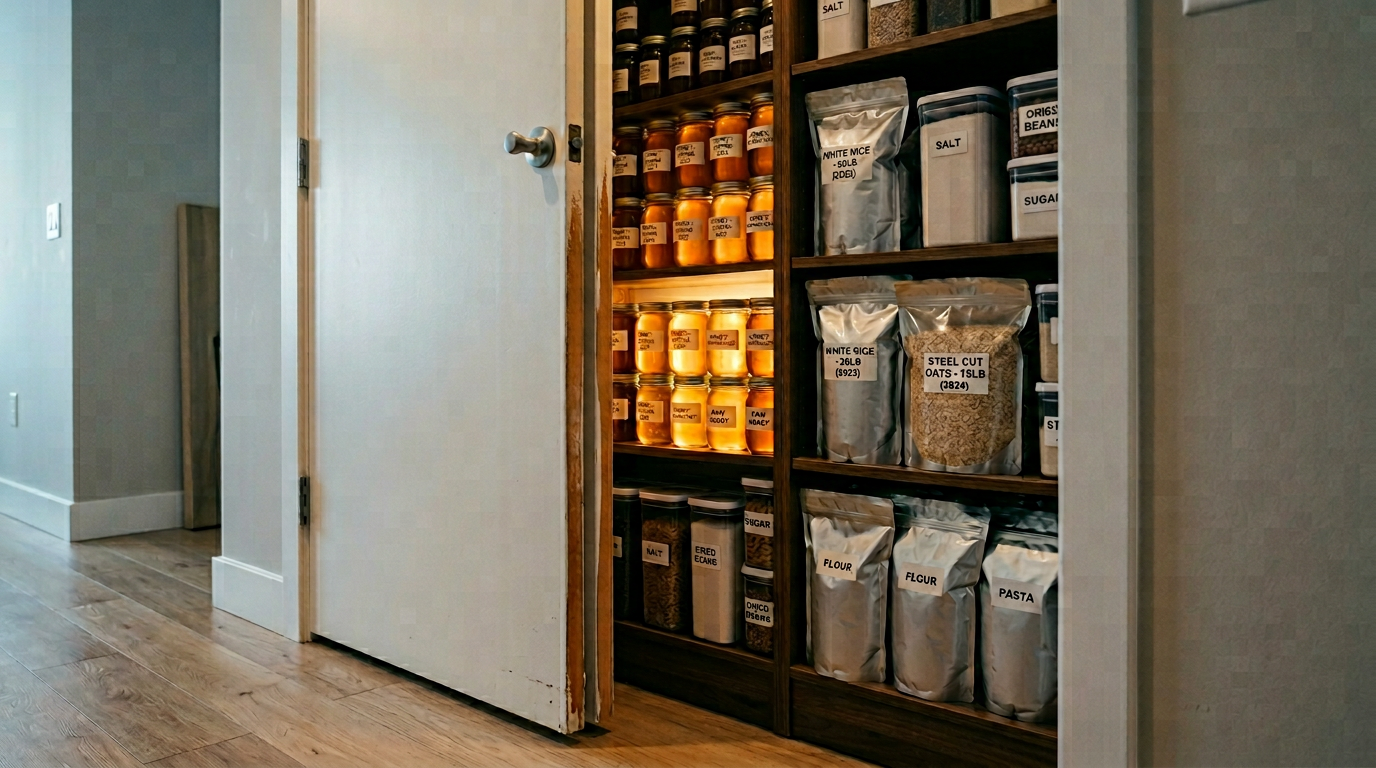
The uniform container strategy: Transfer dry goods from their original packaging into matching, labeled containers. A row of identical glass jars filled with rice, oats, lentils, and pasta looks like a well-organized pantry. The same foods in their original grocery store bags look like a problem.
The label system: Clear, consistent labels on all containers signal organization and intentionality. A label maker or hand-lettered tags on mason jars look deliberate. They look like a choice.
The “pantry as décor” approach: Open shelving in kitchens and living spaces is a mainstream interior design trend. A well-styled open shelf with uniform containers, a few plants, and some cookbooks looks like a design decision — not a survival strategy.
The Month-by-Month Plan — From Zero to Six Months
 The most common reason people fail to build a food storage supply isn’t lack of motivation. It’s lack of a specific, actionable plan that fits their budget and their space. This plan is built for a 2-person apartment household with a $50 to $75 monthly food storage budget. Adjust quantities proportionally for larger households or higher budgets.
Month 1 — Build the Caloric Foundation ($50–$60)
Don’t overthink this month. Buy the highest-calorie, lowest-cost, most space-efficient staples. Nothing else.
- White rice (25 lbs): ~$12
- Dried lentils (10 lbs): ~$8
- Rolled oats (10 lbs): ~$6
- Iodized salt (5 lbs): ~$3
- White sugar (10 lbs): ~$6
- Mylar bags (5-gallon, 5-mil, 10-pack): ~$12
- Oxygen absorbers (300cc, 50-pack): ~$8
Seal the rice, lentils, and oats in mylar bags with oxygen absorbers. Store under the bed or in the closet. Set up your inventory tracking system — even a handwritten list works.
End of Month 1: Approximately 3 to 4 weeks of calories for 2 adults.
Month 2 — Add Protein ($55–$65)
- Dried black beans (10 lbs): ~$8
- Canned tuna (12 cans): ~$15
- Canned chicken (6 cans): ~$12
- Peanut butter powder (2 lbs): ~$10
- Powdered eggs (2 lbs): ~$12
Seal the beans in mylar bags. Organize canned goods in under-bed bins or cabinet organizers.
End of Month 2: Approximately 6 to 7 weeks of food for 2 adults.
Month 3 — Fats, Variety, and Micronutrients ($60–$70)
- Refined coconut oil (2 quarts): ~$16
- Freeze-dried vegetable variety pack: ~$25
- Multivitamins (365-count): ~$15
- Vitamin C tablets (500-count): ~$8
Store coconut oil in a cool, dark cabinet. Freeze-dried vegetables in closet storage.
End of Month 3: Approximately 10 to 11 weeks of food for 2 adults.
Month 4 — Depth and Comfort ($55–$65)
This is the month that makes the supply livable rather than just survivable.
- White pasta (10 lbs): ~$8
- Honey (3 lbs): ~$12
- Coffee or tea (3-month supply): ~$15
- Spice collection (10 essential spices): ~$15
- Dark chocolate (sealed, 2 lbs): ~$10
Pasta in mylar bags. Honey in original sealed containers. Spices in uniform labeled jars.
End of Month 4: Approximately 14 to 15 weeks of food for 2 adults.
Month 5 — Redundancy and Special Needs ($60–$75)
- Additional white rice (25 lbs): ~$12
- Freeze-dried fruit variety pack: ~$25
- Powdered whole milk (5 lbs): ~$15
- Additional canned proteins (tuna, sardines, salmon): ~$20
Complete your under-bed storage organization. Conduct your first inventory audit.
End of Month 5: Approximately 19 to 20 weeks of food for 2 adults.
Month 6 — Completion and Water ($65–$80)
- Final staple quantities to reach 6-month targets: ~$30
- Water storage containers (7-gallon Aqua-Tainers, 2): ~$25
- Water purification tablets (emergency backup): ~$10
- Sawyer Squeeze water filter: ~$30
Complete your final inventory. Establish water storage in the bathroom or a closet. Create a printed inventory binder.
End of Month 6: A complete 6-month food and water supply for 2 adults, stored entirely within your apartment, organized and invisible to casual visitors.
Managing What You’ve Built — Rotation, Inventory, and the Twice-Yearly Audit
A food storage supply that isn’t actively managed becomes a graveyard of expired food and wasted money. The management system doesn’t need to be complicated. It needs to be used.
FIFO — The Principle That Keeps Everything Working
First In, First Out. The oldest food in your supply should always be the first food consumed. New purchases go to the back. Oldest items come to the front.
For canned goods: use a gravity-fed can organizer that automatically rotates cans forward as new ones are added at the back. These run $15 to $30 and fit in standard kitchen cabinets.
For dry goods in mylar bags: label each bag with the seal date. When you open a bag for use, replace it with a newly sealed bag at the back of your storage area.
For shorter-shelf-life items: integrate them into your regular cooking rotation. Use the oldest items first and replace them with new purchases. This is how your storage supply becomes a living system rather than a static stockpile.
The Inventory System That Actually Gets Used
The most sophisticated inventory system is worthless if it’s too complicated to maintain. For apartment-scale storage, simplicity wins.
The physical binder: A three-ring binder with one page per food category. Each page lists the item, quantity stored, seal date, and estimated use-by date. Update it during your twice-yearly audit. Takes 20 minutes twice a year.
The spreadsheet: A Google Sheets document with the same information, accessible from your phone. Add a “reorder threshold” column — the quantity at which you need to replenish.
The app: Pantry Check and OurGroceries both allow inventory tracking by item with expiration dates and quantity alerts.
The minimum viable system: a handwritten list taped inside a cabinet door. It’s better than nothing. The goal is knowing what you have, how much of it, and when it expires.
How Often to Actually Check on Things
Twice-yearly audit, minimum. The spring and fall equinoxes work well as a built-in reminder — easy to remember, naturally spaced.
During each audit: check all items for damage, swelling in cans, or pest infiltration. Update your inventory with current quantities. Identify items approaching expiration and move them into active meal rotation. Calculate what needs replenishing. Assess whether your storage conditions — temperature, humidity — remain optimal.
Monthly spot-check: a quick visual inspection of your storage areas for signs of pest activity, moisture, or damaged containers. Five minutes. Catches problems early.
When the Standard Advice Doesn’t Fit Your Household
Solo Apartment Dwellers
Building a 6-month supply for one person is the most achievable version of apartment food storage. The quantities are smaller, the space requirements are lower, and the decision-making is simpler.
A 6-month supply for one adult requires approximately:
- Grains: 90 to 100 lbs
- Legumes: 40 to 50 lbs
- Fats: 8 to 10 lbs
- Canned proteins: 60 to 80 cans
- Sugars: 10 lbs
- Freeze-dried fruits/veg: 15 to 20 lbs
Total storage volume: approximately 12 to 18 cubic feet. Easily accommodated under a single bed and in one closet.
Couples With Different Dietary Preferences
One partner is vegetarian. One has a gluten intolerance. One won’t eat canned fish. This is more common than any preparedness guide acknowledges.
Build a shared foundation of foods both partners eat — rice, oats, beans, honey, salt, sugar — and maintain separate supplementary supplies for individual dietary needs. Store them in clearly labeled, separate containers. The shared foundation handles 80% of your caloric needs. The individual supplements handle the rest.
Apartment Dwellers With Pets
Pets need emergency food supplies too. A 6-month supply of dry dog food for a medium-sized dog requires approximately 50 to 75 lbs of kibble — roughly 2 to 3 cubic feet of storage space. Dry kibble has a shelf life of 12 to 18 months when properly sealed in food-grade containers. Rotate regularly.
Frequent Movers
If you move apartments regularly, your food storage system needs to be portable. Avoid wall-mounted storage that can’t be removed. Use standardized containers that stack and transport efficiently. Keep an updated inventory that makes packing and unpacking systematic. Choose storage furniture — ottomans, platform beds with drawers — that serves double duty in any apartment you move into.
The Questions That Actually Keep Apartment Preppers Up at Night
Can I really store food under my bed long term without it going bad?
Yes — with the right containers and conditions. Under-bed storage is one of the best locations in an apartment for long term food storage because it’s dark, relatively cool, and protected from humidity. Use food-grade bins with tight-fitting lids, or sealed mylar bags inside hard containers. If your apartment has any moisture issues, place a thin pallet or shelf liner beneath containers to create airflow. Don’t store directly on concrete floors in ground-floor units.
I live in a studio. Is any of this realistic for me?
More realistic than you think. For a studio apartment where space is at an absolute premium, prioritize the highest calorie-per-cubic-inch foods: white rice in sealed mylar bags, dried lentils, rolled oats, peanut butter powder, and freeze-dried vegetables. A studio apartment can realistically store a 2 to 3 month supply for one person using under-bed storage and closet space alone. That’s not a full 6-month supply — but it’s infinitely better than 72 hours.
How do I actually keep pests out of apartment food storage?
The most effective pest prevention strategy is sealed, hard-sided containers. Mylar bags inside food-grade buckets are rodent-resistant and insect-proof when properly sealed. Additional measures: freeze all grains for 72 hours before storage to kill any insect eggs present in the original packaging. Place bay leaves throughout your storage areas as a natural insect deterrent. Inspect all incoming food before adding it to your storage. Seal any gaps or cracks in your storage area walls.
Is my landlord going to have a problem with this?
In virtually all cases, no. Standard lease agreements prohibit property damage and structural modification — not the storage of food. Food storage in sealed containers creates no property damage, no odor issues, and no lease violations. The only potential concern is weight — extremely heavy storage concentrations in one area could theoretically stress flooring in older buildings. Distribute weight across multiple storage locations to avoid this.
My apartment gets really hot in summer and I don’t have AC. What do I do?
Heat is the most significant threat to apartment food storage in non-climate-controlled units. Prioritize storage in the coolest locations available: interior closets, under beds on lower floors, north-facing rooms. Use insulated containers to buffer temperature fluctuations. Focus on foods with the highest heat tolerance: white rice, dried beans, honey, salt, and sugar maintain quality better at elevated temperatures than oils, nuts, or whole grain products. If summer temperatures regularly exceed 80°F in your storage areas, consider a small window AC unit for your primary storage room. The cost is worth it.
What if I need to cook from my storage supply but I’m not used to these foods?
This is the most underrated question in apartment food storage. The solution is to practice cooking from your storage supply regularly — at least once a month — before you ever need to rely on it. Cook a pot of lentil soup. Make oatmeal from your stored oats. Bake bread from your stored flour. This builds cooking familiarity, identifies palatability issues before they become emergencies, and naturally rotates your supply. The best food storage is the food you already know how to cook.
The Moment That Changes Everything
Somewhere around Month 3 or 4 of building your supply, something happens that nobody in the preparedness world talks about.
You open your closet to grab something, and you see it. The organized rows of sealed containers. The labeled jars. The quiet, unhurried abundance of a supply that didn’t exist six months ago. And something shifts.
It’s not pride exactly. It’s not smugness. It’s something quieter and more fundamental — the specific peace of knowing that your household is not one paycheck, one supply chain disruption, or one emergency away from food insecurity.
That feeling doesn’t require a basement. It doesn’t require a homestead. It doesn’t require anyone else’s approval or awareness.
It just requires a plan, a budget, and the willingness to use the space you already have more intentionally than you did before.
The apartment you live in right now — whatever its size, whatever its limitations — is enough.
Products / Tools / Resources
These are the items that consistently come up in serious apartment food storage conversations — not because they’re sponsored, but because they actually work in small spaces.
Storage Containers and Sealing
Mylar bags (5-mil, 1-gallon and 5-gallon) — Wallaby and PackFreshUSA are the most consistently recommended brands. Buy a variety pack to start. You’ll use both sizes more than you expect.
Oxygen absorbers (300cc) — Oxy-Sorb 300cc absorbers work for most dry goods. The critical detail: store unused absorbers immediately in a sealed mason jar after opening the package. They start working the moment they hit air.
IRIS USA flat storage bins with lids — The best under-bed storage containers for food. Food-safe, stackable, and available in sizes that fit standard bed clearances. The lids actually seal.
Gamma-seal lids — Convert any standard 5-gallon bucket into an easy-access storage container. Worth every dollar for buckets you’ll open regularly. The threading mechanism is genuinely satisfying to use.
Space Optimization
Bed risers (4–6 inch, heavy-duty) — Simple, inexpensive, and dramatically increase under-bed storage capacity. Look for versions rated for 1,000+ lbs. The cheap ones crack.
Gravity-fed can organizers — Automatically bring oldest cans to the front as new ones are added at the back. Fit inside standard kitchen cabinets. The FIFO system built into furniture.
Over-door cabinet organizers — Add a full shelf’s worth of storage to the inside of any cabinet door. Ideal for spices, small cans, and sealed packets. Most people don’t know these exist.
Vacuum storage bags (Spacesaver brand) — Compress seasonal clothing to free closet space for food storage. Reliable, widely available, and genuinely effective.
Freestanding floor-to-ceiling shelving (tension-mounted) — No drilling required. Fits in closets, hallways, and bedroom corners. Seville Classics and Whitmor make apartment-friendly options that don’t require a landlord conversation.
Food Sources
Mountain House — Bulk organic grains, legumes, and pantry staples at co-op pricing. Excellent for building the foundation layer at the lowest possible cost. Worth looking up whether they deliver to your area.
Augason Farms — The most accessible freeze-dried and dehydrated food supplier for beginners. Wide variety, reasonable pricing, available on Amazon with Prime shipping.
ReadyWise — Higher-quality freeze-dried options with a subscription model that makes building a supply more budget-manageable over time.
Costco / Sam’s Club — The most underrated food storage resource available. Bulk rice, oats, canned goods, cooking oils, and honey at 30 to 50% below grocery store pricing. If you don’t have a membership, the annual fee pays for itself in food storage savings alone.
Water Storage
Aqua-Tainer 7-gallon rigid water containers — Stackable, food-grade, and sized for apartment storage. Two containers provide a 2-week water supply for one person. They fit in a bathroom corner or closet floor without drama.
WaterBOB bathtub bladder— Holds up to 100 gallons in a standard bathtub during an emergency. Inexpensive insurance that stores completely flat until needed. One of the best preparedness purchases available for apartment dwellers.
Sawyer Squeeze water filter — Rated for 100,000 gallons, lightweight, and the most versatile portable filtration option available. Fits in a drawer. Works anywhere.
Humidity and Pest Control
Eva-Dry E-333 mini dehumidifier — Compact, renewable, and ideal for closet storage spaces. No drainage required — recharge in an electrical outlet when saturated. Quiet enough to forget it’s there.
Silica gel desiccant packets (bulk) — Place in storage containers and storage areas to absorb ambient moisture. Rechargeable in a low-temperature oven. Buy in bulk — you’ll use more than you think.
Bay leaves (bulk dried) — A natural insect deterrent that actually works. Place throughout storage areas and inside containers to discourage pantry moths and other insects. Inexpensive and effective.
Inventory Management
Pantry Check app— Simple, effective inventory tracking with expiration date alerts. The free version handles most apartment-scale storage needs without requiring a subscription.
DYMO label maker — Makes consistent, professional-looking labels for all containers. The single best investment for making your storage look intentional rather than improvised. Once you use one, you’ll label everything.
The Prepper’s Long-Term Survival Guide by Jim Cobb — One of the most practical and readable books on food storage for people who don’t identify as preppers. Apartment-friendly perspective throughout. No bunker required.