
Hey there! Some links on this page may be affiliate links which means that, if you choose to make a purchase, I may earn a commission at no extra cost to you. I greatly appreciate your support. Read the full disclosure here.
Commercially sealed bottled water doesn’t technically “expire” — but the plastic containers it comes in absolutely degrade over time, especially under heat. For survival prep purposes, most store-bought bottles are reliable for 1–2 years when stored properly, while purpose-built emergency water containers can last 5–25+ years. Knowing the difference between container degradation and actual water contamination is the most important bottled water shelf-life survival prep fact you can internalize right now.
Find this useful? Add us as a preferred source on Google and more of what we publish will show up in your results.
Key Takeaways
- The expiration date printed on water bottles refers to the plastic container, not the water itself
- Heat is the single biggest threat to stored water quality — temperatures above 70°F accelerate chemical leaching from plastic
- Store-bought bottles are acceptable for short-term emergency rotation (1–2 years); dedicated emergency containers are better for long-term prep
- FEMA and the American Red Cross recommend a minimum of 1 gallon per person per day for at least 72 hours — most experienced preppers store 2 weeks to 3 months
- Sealed water doesn’t “go bad” biologically — but opened or improperly stored water can harbor bacterial growth within days
- Plastic bottles stored near gasoline, cleaning products, or direct sunlight can absorb chemical vapors and odors
- Water purification tablets (like Aquatabs) are a cost-effective backup that genuinely work when used correctly
- Rotating your water supply every 6–12 months is the simplest way to stay safe without overthinking shelf life
- Stainless steel and food-grade HDPE containers outperform standard PET plastic for long-term survival storage
- Never store water directly on concrete floors — temperature fluctuation and off-gassing are real concerns
How Long Can Bottled Water Really Last in Emergency Storage?
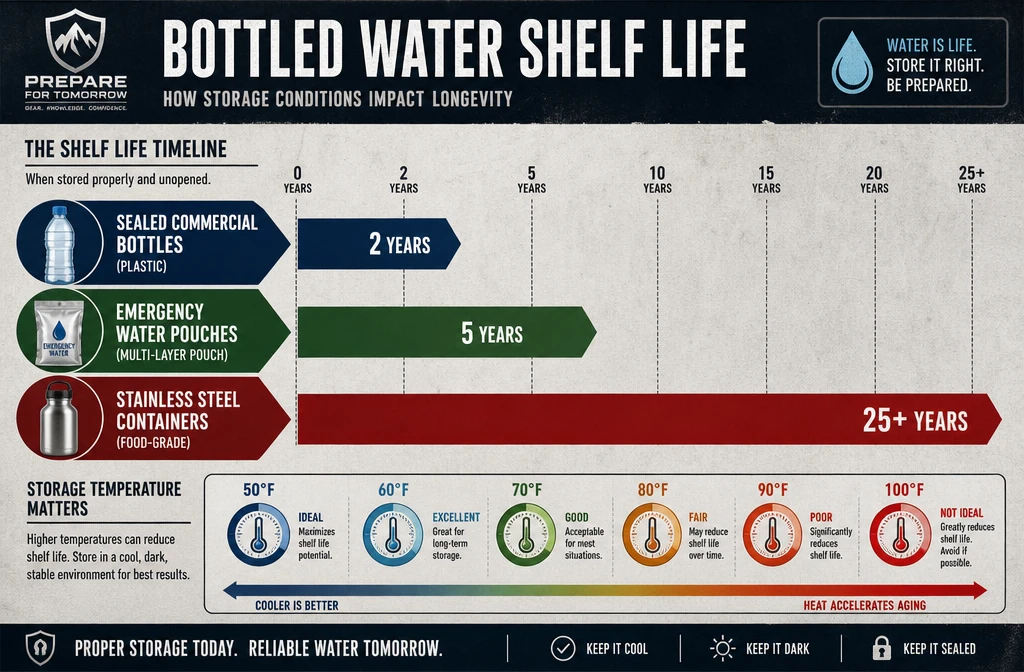
Commercially sealed, unopened bottled water stored in a cool, dark location remains safe to drink indefinitely from a microbial standpoint. The practical storage window for most preppers is 1–2 years for standard PET plastic bottles and up to 5 years for purpose-built emergency water pouches. Dedicated food-grade polyethylene containers (like WaterBricks or 55-gallon barrels) can store treated water safely for 25+ years when properly sealed and maintained.
Here’s the breakdown by container type:
| Container Type | Practical Storage Life | Best Use Case |
|---|---|---|
| Standard PET plastic bottles (store-bought) | 1–2 years | Short-term rotation stock |
| Emergency water pouches (e.g., SOS brand) | 5 years | Bug-out bags, grab-and-go kits |
| Food-grade HDPE barrels (55-gallon) | 25+ years (with treatment) | Home base long-term storage |
| Stainless steel containers | Indefinitely (water-dependent) | Active use, bug-out scenarios |
| Mylar bags with oxygen absorbers | Not recommended for water | N/A — use for food only |
The key distinction: water itself doesn’t expire. What degrades is the container, and that degradation can affect the water inside. This is the core bottled water shelf-life survival prep fact that most beginners miss entirely.
💡 Prepper rule of thumb: If you’re storing water for more than two years, move beyond standard grocery-store bottles and invest in purpose-built emergency containers.
What Makes Bottled Water Go Bad or Expire?
Bottled water doesn’t “expire” the way food does, but several factors genuinely compromise its quality and safety. The primary culprits are heat, light, chemical contamination, and biological introduction (the last one only applies after a bottle is opened).
What actually causes problems:
- Heat exposure: Temperatures above 70°F cause PET plastic to leach antimony and BPA-adjacent compounds into the water. Studies cited by the FDA have flagged this concern, particularly for bottles stored in hot cars or garages (source: FDA, 2014 consumer guidance on bottled water)
- UV light: Direct sunlight degrades plastic faster and can promote algae growth if any biological material is present
- Chemical vapor absorption: Plastic bottles stored near gasoline, paint, pesticides, or cleaning agents can absorb those vapors through the container walls — this is a real and underappreciated risk
- Opened containers: Once opened, water is exposed to airborne bacteria and should be consumed within 2–3 days if not refrigerated
- Improper sealing: Homemade storage using containers not rated for long-term water storage can leach plasticizers or allow microbial entry
What does NOT make water go bad:
- Age alone (in a sealed, food-grade container)
- Being stored in the dark
- Being stored in a cool basement or climate-controlled space
The expiration date stamped on commercial bottles is a regulatory and marketing requirement — it reflects the manufacturer’s confidence in the container integrity, not a biological expiration of the water itself.
Best Brands of Water for Long-Term Survival Storage
For general emergency rotation, any sealed commercial water brand works fine in the short term. For serious survival prep, purpose-built emergency water products are worth the investment.
Top options by category:
Short-term rotation (1–2 years):
- Kirkland Signature (Costco) — large volume, affordable, consistent quality
- Dasani, Aquafina — widely available for bulk purchase
- Store-brand spring water — cost-effective for building initial stock fast
Purpose-built emergency water:
- SOS Emergency Water Pouches — Coast Guard-approved, 5-year shelf life, compact for bug-out bags
- Datrex Emergency Water Packets — similar 5-year rating, used by military and emergency responders
- Blue Can Premium Emergency Water — 50-year shelf life claim (aluminum can, hermetically sealed), expensive but legitimate for true long-term storage
Storage containers (fill your own):
- WaterBrick Stackable Containers — 3.5-gallon BPA-free HDPE, stackable, excellent for home storage
- Reliance Aqua-Tainer — 7-gallon food-grade plastic, affordable and widely available
- 55-gallon food-grade polyethylene barrels — best cost-per-gallon for stationary home prep
Choose purpose-built emergency water if: you’re building a 3-month or longer supply, you live in a hot climate, or you need water storage that can survive being forgotten for years without rotation.
For a deeper look at how water fits into your overall food and water strategy, the Ultimate Emergency Water Storage and Purification Guide covers purification methods alongside storage in detail.
How to Properly Store Bottled Water for Emergency Preparedness
Proper storage is what separates a reliable water supply from a false sense of security. The core bottled water shelf-life survival prep facts around storage come down to five controllable variables: temperature, light, location, container quality, and rotation schedule.
Step-by-step storage protocol:
-
Choose the right container. Use food-grade HDPE (marked with recycling code #2) or purpose-built emergency water containers. Avoid repurposing milk jugs — they’re designed for short-term use and degrade quickly.
-
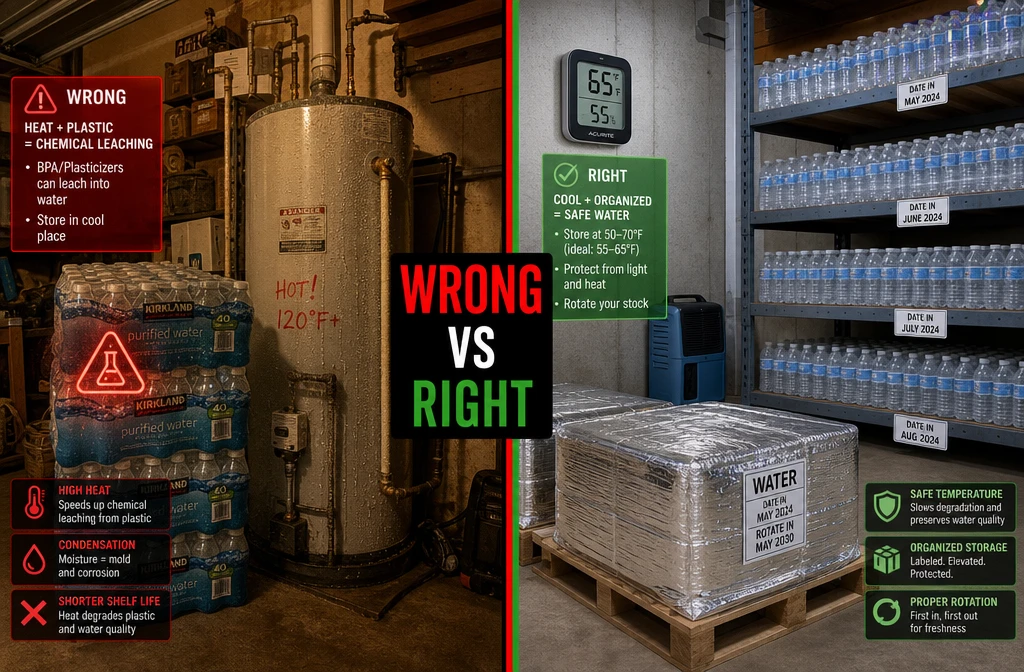
Store in a cool, dark location. Target 50–70°F consistently. A basement, interior closet, or climate-controlled space is ideal. Avoid garages in hot climates.
-
Keep water off concrete floors. Place containers on wooden pallets or shelving. Concrete can fluctuate in temperature significantly and may transfer trace chemicals in certain conditions — it’s a low-risk but easily avoided issue.
-
Separate from chemicals. Never store water near gasoline, paint, pesticides, or cleaning supplies. Plastic is permeable to volatile organic compounds.
-
Label with storage date. Use a permanent marker or label on every container. Rotate store-bought bottles every 6–12 months; dedicated emergency containers every 2–5 years depending on manufacturer guidance.
-
Treat bulk water before sealing. If filling your own containers from tap water, add unscented liquid chlorine bleach (8.25% sodium hypochlorite) at a rate of 8 drops per gallon, then seal immediately. This is the CDC-recommended method for home water storage (CDC, 2023).
Common mistake: Storing water in a hot garage because it’s convenient. A garage in summer can reach 120°F+ — that’s the fastest way to degrade plastic and accelerate chemical leaching into your supply.
For more on what can go wrong, The Worst Water Storage Mistakes Preppers Still Make is required reading before you build your storage system.
Can Old Bottled Water Make You Sick?
Old sealed bottled water is extremely unlikely to make you sick. The risk of illness from stored water comes almost entirely from contamination introduced during handling, improper storage near chemicals, or biological growth in opened containers — not from age alone.
When old water CAN pose a risk:
- Stored near chemical vapors: Plastic absorbs volatile organic compounds. Water stored in a garage next to gasoline for years may have absorbed trace chemicals. If the water smells off, don’t drink it.
- Opened and left unsealed: Once opened, bacteria from hands, air, and surfaces can colonize water within 24–72 hours at room temperature. Refrigerated opened water is generally safe for 2–3 days.
- Containers that weren’t food-grade: Non-food-grade plastics may leach harmful compounds over time, especially under heat stress.
- Algae or biological growth: If stored water appears cloudy, green, or has visible particles, treat it before drinking or discard it.
When old water is safe:
- Sealed commercial bottles stored in cool, dark conditions — even past the printed date — are generally safe to drink. The taste may be flat (dissolved CO2 dissipates over time), but the water itself is not harmful.
- Sealed emergency water pouches within their rated shelf life are safe by design.
Bottom line: Smell it, look at it, and consider where it’s been stored. Those three checks will tell you more than any expiration date.
Difference Between Store-Bought and Emergency Water Storage Containers
Store-bought bottled water and dedicated emergency water containers serve different roles in a preparedness system. Understanding the difference helps preppers allocate budget and storage space more effectively.
| Factor | Store-Bought Bottles | Emergency Storage Containers |
|---|---|---|
| Shelf life | 1–2 years practical | 5–25+ years |
| Cost per gallon | $0.50–$2.00 | $0.05–$0.50 (bulk fill) |
| Portability | High (individual bottles) | Low–Medium (bulk containers) |
| BPA/chemical risk | Moderate (thin PET plastic) | Low (food-grade HDPE) |
| Rotation required | Every 6–12 months | Every 2–5 years |
| Best for | Short-term rotation, grab-and-go | Home base long-term storage |
Store-bought water is fine as a starter supply and rotation stock. Dedicated emergency containers are the right choice for anyone building a supply beyond 2–4 weeks. The cost difference is significant — filling a 55-gallon food-grade barrel from tap water costs roughly $3–5 total versus $100+ to fill the same volume with commercial bottles.
If you’re prepping in a limited space, the Apartment Water Storage Complete Guide covers how to maximize storage in small living situations without sacrificing quality.
How Much Water Should a Family Keep for an Emergency Kit?
The baseline recommendation from FEMA and the American Red Cross is 1 gallon per person per day for drinking and basic sanitation. For a family of four, that’s 4 gallons per day — meaning a 72-hour kit requires 12 gallons minimum.
Most experienced preppers consider that baseline a floor, not a ceiling. Here’s a more realistic planning framework:
Water storage targets by prep level:
| Prep Level | Duration | Per Person | Family of 4 |
|---|---|---|---|
| Minimum (FEMA baseline) | 3 days | 3 gallons | 12 gallons |
| Intermediate | 2 weeks | 14 gallons | 56 gallons |
| Serious prepper | 1 month | 30 gallons | 120 gallons |
| Advanced | 3 months | 90 gallons | 360 gallons |
Adjust upward for:
- Hot climates or summer emergencies (add 50% for hydration needs)
- Infants or nursing mothers
- Medical conditions requiring extra hydration
- Pets (dogs need roughly 1 ounce per pound of body weight per day)
- Cooking, hygiene, and wound care beyond drinking
The honest reality: Most preppers who’ve actually lived through a multi-day emergency — a hurricane, ice storm, or extended power outage — report that 1 gallon per person per day felt tight. Two gallons per person per day is a more comfortable real-world target.
This connects directly to your overall preparedness system. If you’re building out your full emergency kit, the 72 Hour Bug Out Bag Checklist covers water allocation alongside every other critical supply.
Signs That Bottled Water Has Gone Bad
Most stored water that’s genuinely unsafe gives clear signals. Knowing what to look for prevents both unnecessary waste (discarding perfectly good water) and real health risks (drinking compromised water).
Check these five things before drinking stored water:
-
Smell: Safe water has no odor. A chemical smell (plastic, fuel, solvent) indicates vapor absorption. A musty or earthy smell suggests biological growth. Either is a discard signal.
-
Appearance: Water should be completely clear. Cloudiness, floating particles, or any color tint (green, brown, yellow) means the water needs treatment or should be discarded.
-
Taste: Flat or slightly stale taste is normal in long-stored water (CO2 dissipates) — it’s safe. Chemical, metallic, or off tastes are warning signs.
-
Container condition: Bulging, cracked, or heavily scratched containers can indicate pressure buildup (rare but possible with biological activity) or compromised integrity. Inspect before opening.
-
Storage history: Did it spend two summers in a hot garage near paint cans? That context matters more than the expiration date.
When in doubt, treat it. Boiling for 1 minute (3 minutes above 6,500 feet elevation) kills biological threats. Water purification tablets handle chemical disinfection when boiling isn’t an option.
Plastic vs. Metal Water Storage for Survival Situations
Both plastic and metal containers have legitimate roles in a prepper’s water storage system. The right choice depends on your scenario: home base storage, bug-out mobility, or active field use.
Plastic (food-grade HDPE):
- ✅ Lightweight relative to capacity
- ✅ Low cost for large-volume storage
- ✅ Widely available (WaterBricks, 55-gallon barrels)
- ❌ Degrades under UV and heat over time
- ❌ Can absorb chemical vapors if stored improperly
- ❌ Not suitable for heating water in the container
Stainless steel:
- ✅ No chemical leaching
- ✅ Can be used to boil water directly (single-wall containers)
- ✅ Indefinite lifespan with proper care
- ✅ Resistant to UV and temperature extremes
- ❌ Heavy — not practical for large-volume home storage
- ❌ Higher cost per gallon of capacity
- ❌ Can dent and affect seal integrity
Aluminum (like Blue Can emergency water):
- ✅ Hermetically sealed, 50-year shelf life claims
- ✅ Compact for long-term archival storage
- ❌ Very expensive per gallon
- ❌ Single-use — not refillable
Choose plastic if: you’re building a stationary home base supply and need maximum volume at minimum cost. Choose stainless steel if: you need portable, field-ready water storage that can double as a cooking vessel. Choose aluminum emergency cans if: you want a set-and-forget archive supply that requires zero maintenance for decades.
Cheapest Ways to Stock Up on Water for Disaster Prep
Building a substantial water supply doesn’t require a big budget. The most cost-effective approach combines bulk container investment with tap water filling, strategic retail purchasing, and smart rotation.
Cost-effective water stocking strategies:
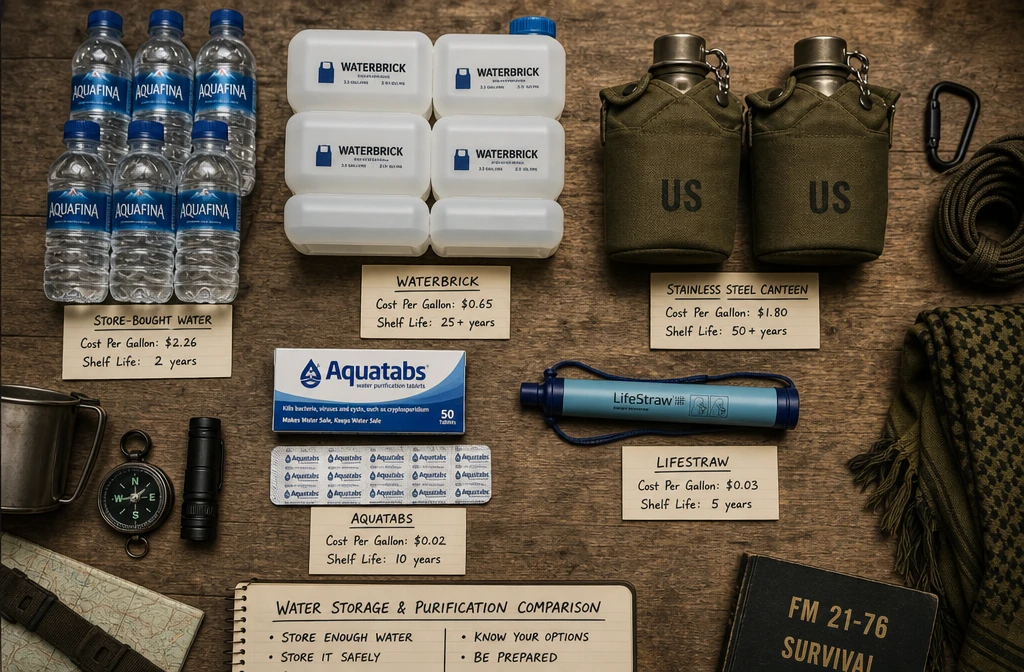
1. Fill your own containers from tap water. A 55-gallon food-grade polyethylene barrel costs $20–$40 and can be filled from any municipal tap for essentially free. Add water treatment (bleach drops or a Water Preserver concentrate) and you have 55 gallons of safe water for under $50 total. Cost per gallon: under $1.
2. Buy store-brand water in bulk. Warehouse stores like Costco and Sam’s Club sell water at $0.10–$0.25 per bottle. A pallet of 48 cases (576 half-liter bottles = ~72 gallons) runs roughly $60–$80. Rotate annually.
3. Use WaterBricks strategically. WaterBrick 3.5-gallon containers cost about $25–$30 each. They stack, they’re stackable in tight spaces, and they’re reusable for years. Buy 10–15 and fill from tap for a 35–52-gallon supply at reasonable cost.
4. Repurpose 2-liter soda bottles (short-term only). Clean, food-grade 2-liter PET bottles can be filled with tap water (treated with bleach) for short-term storage. Free to acquire, but rotate every 6 months and don’t use for multi-year storage.
5. Watch for sales on emergency water pouches. SOS and Datrex pouches go on sale regularly. Buying a case of 64 pouches (about 8 gallons worth) for $20–$30 gives you reliable 5-year shelf life water for bug-out bags and vehicle kits.
Avoid: Buying expensive “survival water” at specialty prices when the same quality is available at warehouse stores. The water inside a $4 “survival bottle” is often identical to a $0.25 store-brand bottle.
For context on how water fits into your broader food storage system, see The Ultimate Survival Pantry List for a complete picture of what to stock alongside your water supply.
Do Water Purification Tablets Actually Work?
Yes — water purification tablets are genuinely effective and represent one of the best cost-to-benefit ratios in any prepper’s kit. They work by releasing chlorine or iodine into water, killing bacteria, viruses, and most protozoa within 30–60 minutes.
The main options:
| Tablet Type | Active Ingredient | Effective Against | Wait Time | Cost per Liter |
|---|---|---|---|---|
| Aquatabs | Sodium dichloroisocyanurate (NaDCC) | Bacteria, viruses | 30 min | ~$0.10 |
| Potable Aqua | Iodine | Bacteria, viruses | 30 min | ~$0.15 |
| Katadyn Micropur | Chlorine dioxide | Bacteria, viruses, Giardia, Cryptosporidium | 4 hours | ~$0.50 |
Important limitations:
- Standard chlorine and iodine tablets do not reliably kill Cryptosporidium — for that, you need chlorine dioxide tablets (Katadyn Micropur) with a 4-hour wait time
- Tablets don’t filter sediment or improve taste — pre-filter visibly dirty water through a cloth before treating
- Iodine tablets are not recommended for pregnant women, people with thyroid conditions, or long-term use
- Effectiveness drops in very cold water (below 40°F) — extend wait time or warm the water slightly
Shelf life of tablets: Most water purification tablets have a shelf life of 4–5 years sealed. Once opened, use within 1 year. Store in a cool, dry location away from moisture.
Tablets are a backup, not a primary storage solution — but every bug-out bag, vehicle kit, and emergency cache should have at least one pack. They weigh almost nothing and cost almost nothing relative to the security they provide.
What Temperatures Will Damage Bottled Water Storage?
Temperature is the most controllable and most neglected factor in water storage quality. Both extreme heat and freeze-thaw cycles cause real problems for stored water.
Heat (above 70°F):
- Above 70°F, PET plastic begins releasing trace amounts of antimony and other compounds into water at a measurably faster rate
- Above 100°F (common in cars and garages in summer), degradation accelerates significantly
- The FDA has noted concerns about heat-stored bottled water, particularly for bottles left in hot vehicles for extended periods (FDA, 2014)
- Practical threshold: Water stored consistently above 80°F should be rotated more frequently — every 3–6 months rather than annually
Freezing (below 32°F):
- Freezing water in sealed plastic bottles can cause containers to crack or deform as water expands
- Freeze-thaw cycling weakens container integrity over time
- Frozen water itself is safe to drink once thawed — the concern is container damage, not water quality
- Practical threshold: Don’t store water in uninsulated outdoor spaces where hard freezes are common
Ideal storage temperature: 50–70°F, consistent. A basement, interior closet, or climate-controlled storage room is the gold standard.
Vehicle storage note: Water bottles stored in a car are fine for a few days but should not be treated as a long-term emergency supply. A car in summer can reach 130–160°F internally — that’s a chemical leaching environment, not a storage environment. For vehicle emergency kits, use purpose-built emergency water pouches rated for temperature extremes. The Ultimate Car Emergency Kit List covers this in full.
FAQ: Bottled Water Shelf-Life Survival Prep Facts
Q: Does bottled water actually expire? The water itself doesn’t expire. The expiration date on commercial bottles reflects the manufacturer’s confidence in the container’s integrity — typically 1–2 years for PET plastic. Sealed water in a food-grade container is safe indefinitely from a microbial standpoint.
Q: Can I drink water that’s been stored for 5 years? Yes, if it was stored in a food-grade container, kept in a cool dark location, and shows no signs of contamination (no odor, no cloudiness, no color). Purpose-built emergency water pouches are specifically rated for 5-year storage. Standard PET bottles at 5 years in good conditions are likely fine but should be inspected and smell-tested first.
Q: Is it safe to drink water from a bottle left in a hot car? For a day or two, yes. For weeks or months in a hot car, the concern is chemical leaching from the plastic — not biological contamination. The water won’t make you immediately sick, but it’s not ideal for regular consumption. Use it in a genuine emergency, then replace your vehicle supply with fresh stock.
Q: How do I know if my stored water has gone bad? Check for unusual odor (chemical, musty, or fuel-like), cloudiness, discoloration, or floating particles. Safe stored water should be clear, colorless, and odorless. Flat taste is normal and harmless.
Q: Should I add bleach to store-bought bottled water before storing it? No. Commercial bottled water is already treated and sealed. Adding bleach to sealed commercial bottles is unnecessary. Only add bleach when filling your own containers from tap water.
Q: How much water do I actually need for a 2-week emergency? For one person: 14 gallons minimum (1 gallon/day). For a family of four: 56 gallons minimum. Add 50% buffer if you live in a hot climate or have high-activity needs.
Q: Are water purification tablets safe to use on stored water that smells slightly off? Tablets disinfect biologically contaminated water but won’t neutralize chemical contamination. If your water smells like chemicals (plastic, fuel, solvent), tablets won’t help — that water should be discarded or run through an activated carbon filter.
Q: What’s the best container to store water long-term? Food-grade HDPE containers (55-gallon barrels or WaterBrick-style stackable containers) are the best combination of cost, durability, and safety for home base storage. For portability, stainless steel is the most durable option.
Q: Can I store water in the freezer for long-term prep? Freezing water preserves it indefinitely and can also help keep a freezer efficient during a power outage. Leave headspace in containers for expansion. This is a legitimate storage strategy for homes with chest freezers and reliable power, but shouldn’t be your only water supply.
Q: Do LifeStraw and similar filters replace the need for stored water? No. Filters like LifeStraw are field tools for treating available water sources — they require a water source to filter. They don’t create water. Stored water and filtration tools serve different functions and both belong in a complete prep system.
Products, Tools, and Resources Worth Having
Building a reliable water storage system doesn’t require expensive gear — but a few specific products make a real difference in how long your supply stays viable and how easy it is to maintain.
For home base storage:
- WaterBrick Stackable Water Containers (3.5-gallon) — These are the most practical containers for most households. They stack tightly, fit in closets, and are made from food-grade HDPE. A set of 8–10 covers a solid 2-week supply for one person.
- 55-Gallon Food-Grade Polyethylene Barrel — Best cost-per-gallon option for families. Pair with a hand-pump siphon for easy dispensing. Available from emergency supply retailers and farm supply stores.
- Reliance Aqua-Tainer (7-gallon) — Affordable, widely available, and easy to fill and transport. Good entry-level option for new preppers.
For water treatment and backup:
- Aquatabs Water Purification Tablets — The most widely used purification tablets globally. Compact, affordable, and effective against bacteria and viruses. Every emergency kit should have a pack.
- Katadyn Micropur Tablets — The upgrade option when Cryptosporidium is a concern (wilderness water sources, flood scenarios). Slower acting but broader spectrum.
- Liquid chlorine bleach (8.25% sodium hypochlorite, unscented) — The CDC-recommended treatment for home water storage. Cheap, effective, and widely available. Use 8 drops per gallon when filling bulk containers.
For bug-out and vehicle kits:
- SOS Emergency Water Pouches — Coast Guard-approved, 5-year shelf life, compact and lightweight. Ideal for bug-out bags and car emergency kits.
- LifeStraw Personal Water Filter — Not a replacement for stored water, but an essential field backup for filtering from streams, lakes, or questionable sources during an extended emergency.
For monitoring storage conditions:
- Thermometer/hygrometer combo — A basic digital unit ($10–$20) mounted in your storage area lets you track temperature and humidity year-round. If your storage space regularly exceeds 75°F, you’ll know to rotate more frequently.
For everything beyond water — food, gear, and the full picture of what a serious prep system looks like — the Complete Prepping Guide for Beginners and the Prepper Checklist for Beginners 30-Day System are the best starting points on this site.
Conclusion: Build Your Water Supply Around Facts, Not Fear
The most important bottled water shelf-life survival prep facts aren’t complicated: water doesn’t expire, containers do; heat is the primary enemy; and the difference between a 72-hour supply and a 3-month supply is mostly a matter of planning, not budget.
Here’s what to do this week:
- Audit what you have. Check your current water storage — note the dates, inspect the containers, and identify any stored near heat or chemicals.
- Calculate your actual need. Use 2 gallons per person per day as your planning number. Multiply by the number of days you want to cover.
- Upgrade your containers if needed. If you’re relying entirely on store-bought bottles in a hot garage, move them or replace them with food-grade HDPE containers.
- Add purification tablets to every kit. Bug-out bag, car kit, home cache — Aquatabs weigh almost nothing and cost almost nothing.
- Set a rotation reminder. Calendar a date every 6–12 months to inspect and rotate your supply. This single habit prevents most water storage problems.
Preparedness is built on reliable systems, not stockpiles of supplies you hope you never need. Water is the one supply you genuinely cannot improvise around. Get this right first, then build everything else around it.
References
- U.S. Food and Drug Administration (FDA). Bottled Water Everywhere: Keeping It Safe. 2014. https://www.fda.gov/consumers/consumer-updates/bottled-water-everywhere-keeping-it-safe
- Centers for Disease Control and Prevention (CDC). Making Water Safe in an Emergency. 2023. https://www.cdc.gov/healthywater/emergency/making-water-safe.html
- Federal Emergency Management Agency (FEMA). Water. Emergency Supply List Guidance. https://www.ready.gov/water
- American Red Cross. Water Safety. Emergency Preparedness Resources. https://www.redcross.org/get-help/how-to-prepare-for-emergencies/survival-kit-supplies.html
- International Bottled Water Association (IBWA). Bottled Water Code of Practice. 2022. https://www.bottledwater.org
Related Reading: