
Hey there! Some links on this page may be affiliate links which means that, if you choose to make a purchase, I may earn a commission at no extra cost to you. I greatly appreciate your support. Read the full disclosure here.
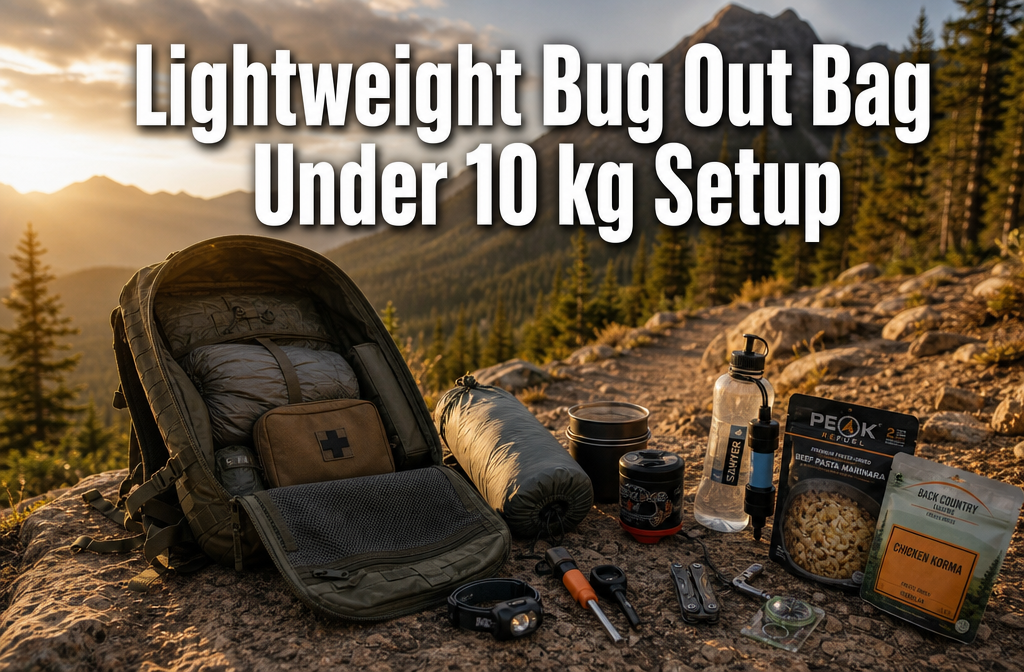
A lightweight bug out bag under 10 kg setup is a pre-packed emergency evacuation kit that keeps total loaded weight at or below 10 kilograms (22 lbs), covering survival needs for 72 hours or more. Staying under 10 kg is achievable by choosing ultralight gear, cutting redundant items, and prioritizing multi-use tools. This weight threshold lets most adults move quickly over distance without physical breakdown — which is the entire point of bugging out.
Key Takeaways
- 10 kg (22 lbs) is the practical upper limit for a bug out bag most adults can carry 20+ km per day without injury.
- The five non-negotiables are: water filtration, shelter, fire, first aid, and food — everything else is secondary.
- Ultralight backpacking gear (not military surplus) is the best foundation for a sub-10 kg kit.
- Urban and wilderness scenarios require slightly different gear priorities, but the weight discipline stays the same.
- Skills matter more than gear — a lighter bag forces you to rely on knowledge, which never runs out of batteries.
- Budget builds under $150–200 are realistic; premium ultralight setups can run $400–700 but save 2–3 kg.
- The single biggest mistake preppers make is packing for comfort instead of mobility.
- Waterproofing gear adds almost no weight but prevents catastrophic gear failure in wet conditions.
- Medical supplies should cover bleeding control, blister management, and medication — not a full clinic.
- Review and repack your bag every six months to catch expired items and seasonal gear mismatches.
What Exactly Is a Bug Out Bag and Why Do You Need One?
A bug out bag (BOB) is a pre-packed portable kit designed to sustain you for 72 hours or longer during a forced evacuation or emergency. The core idea is simple: when staying home is no longer safe, you grab one bag and go — without wasting time gathering supplies.
The need for one isn’t theoretical. Wildfires, hurricanes, floods, chemical spills, and civil unrest have all forced mass evacuations with little or no warning. According to FEMA’s preparedness guidance, households should be ready to evacuate on short notice with supplies for at least 72 hours. A well-built bug out bag is how you meet that standard without scrambling.
A bug out bag differs from a general emergency kit in one critical way: it’s built for mobility. It goes on your back. That distinction drives every gear decision in this guide.
For a broader look at how a bug out bag fits into a full emergency system, see the complete bug out bag guide for building a 72-hour kit.
How Much Should a Bug Out Bag Realistically Weigh?
The target is 10 kg (22 lbs) or less, fully loaded with water. Most fitness and military research suggests that carrying more than 25–30% of body weight over distance causes fatigue, injury risk, and reduced decision-making speed. For an average adult weighing 75 kg, that puts the ceiling around 18–22 lbs.
Here’s why 10 kg is the right benchmark for a bug out bag specifically:
- You may be moving fast, not hiking leisurely.
- Terrain may be unpredictable — stairs, debris, uneven ground.
- Stress and adrenaline deplete energy faster than a normal hike.
- You may need to carry a child or assist someone else.
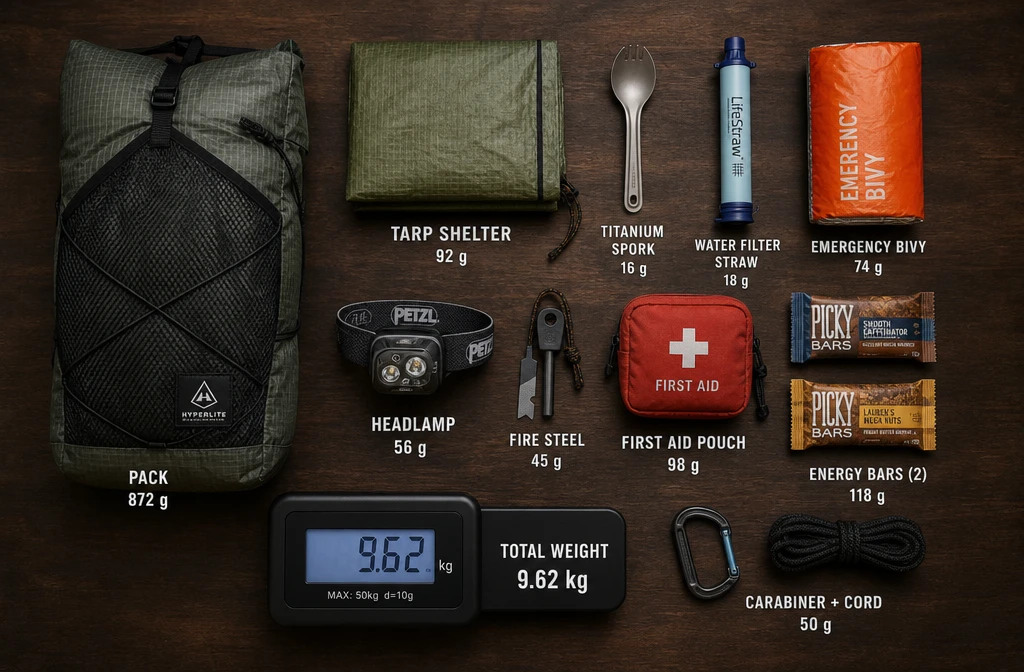
Weight Budget Breakdown (Target: Under 10 kg)
| Category | Target Weight |
|---|---|
| Backpack (empty) | 0.8 – 1.2 kg |
| Water + filtration | 1.5 – 2.0 kg |
| Shelter (tarp/bivy) | 0.4 – 0.7 kg |
| Sleep system | 0.5 – 0.9 kg |
| Fire + light | 0.2 – 0.3 kg |
| Food (72-hour supply) | 1.2 – 1.8 kg |
| First aid kit | 0.3 – 0.5 kg |
| Clothing layers | 0.8 – 1.2 kg |
| Navigation + comms | 0.2 – 0.3 kg |
| Tools + misc | 0.3 – 0.5 kg |
| Total | ~6.2 – 9.4 kg |
This is achievable. The math works — if you choose the right gear.
Best Ultralight Gear for a Bug Out Bag Under 10 kg Setup
The best ultralight gear for a sub-10 kg bug out bag comes from the backpacking world, not the military surplus market. Modern ultralight backpacking has solved the weight problem already. Brands like Zpacks, Sea to Summit, and MSR build shelter, sleep, and cooking systems that weigh a fraction of traditional survival gear.
Here are the high-impact swaps that make the biggest weight difference:
Shelter
- Replace: Heavy dome tent (2.5 kg) → Choose: Silnylon tarp or Dyneema bivy (0.3–0.6 kg)
- A simple 8×10 ft silnylon tarp with 4 stakes and 20 ft of paracord covers most shelter needs.
Sleep System
- Replace: Synthetic sleeping bag (1.5 kg) → Choose: Down quilt or emergency bivy + fleece liner (0.5–0.8 kg)
- Choose down only if your bag will stay dry (more on waterproofing below).
Water
- Replace: 3L water bladder (full) → Choose: 1L soft flask + Sawyer Squeeze filter (0.1 kg) + purification tabs
- Carry 1 liter, filter as you go. The Sawyer Squeeze weighs 85 grams and filters 100,000 gallons.
Fire and Light
- A ferro rod (35g), a BIC lighter (17g), and a headlamp with lithium batteries (80g) cover fire and light for under 150 grams total.
Food
- High-calorie, low-weight options: freeze-dried meals, nut butter packets, pemmican bars, and hard candies. Target 400–500 calories per 100 grams of food weight.
For a detailed breakdown of what to eat in a bug out scenario, the ultimate bug out bag food list covers calorie density and shelf life in depth.
What Survival Items Should You Pack First?
Pack in order of survival priority, not convenience. The classic survival priority order — shelter, water, fire, food, first aid, navigation — should guide what goes in your bag before anything else.
Here’s the “must-pack first” checklist for a lightweight bug out bag under 10 kg setup:
Tier 1 — Non-Negotiable (pack these before anything else):
- ✅ Water filtration (Sawyer Squeeze or LifeStraw)
- ✅ Emergency shelter (tarp, bivy, or emergency blanket)
- ✅ Fire starting (ferro rod + lighter)
- ✅ First aid kit (bleeding control, blister care, medications)
- ✅ 72-hour food supply (calorie-dense, no-cook options)
- ✅ Navigation (paper map + compass — GPS batteries die)
- ✅ Knife (fixed blade, 3–4 inch, full tang)
Tier 2 — High Value, Low Weight:
- Headlamp + spare batteries
- Emergency poncho or rain shell
- Paracord (50 ft)
- Duct tape (small flat wrap)
- Emergency whistle
- Cash (small bills) + copies of critical documents
Tier 3 — Add Only If Weight Allows:
- Compact stove + fuel canister
- Warm hat and gloves (season-dependent)
- Solar charger or hand-crank radio
For a full ranked list, the 72-hour bug out bag checklist walks through every category with weight estimates.
How to Choose the Right Backpack for a Lightweight Bug Out Setup
The right pack for a sub-10 kg bug out bag is a 30–40 liter frameless or semi-frame backpack weighing under 1.2 kg. Military-style MOLLE packs look tactical but often weigh 2–3 kg empty, burning your weight budget before a single piece of gear goes in.
Key criteria when choosing a pack:
- Volume: 30–40L is the sweet spot. Bigger packs invite overpacking.
- Empty weight: Under 1.2 kg. Ultralight options like the Osprey Exos 38 (1.0 kg) or Granite Gear Crown2 (0.9 kg) are proven choices.
- Hip belt: Essential for loads over 7 kg. Transfers weight to your hips and reduces shoulder fatigue.
- Rain cover: Either built-in or add a pack liner (a large trash compactor bag weighs 40g and works perfectly).
- Low profile: A bag that doesn’t scream “I have supplies” matters in urban evacuation scenarios.
Choose a frameless pack if: your total load will stay under 7 kg and you’re comfortable with minimalist setups. Choose a semi-frame pack if: you’re carrying close to 10 kg or have back issues.
Urban vs. Wilderness Bug Out Scenarios: What Gear Works Best?
Urban and wilderness bug outs share the same weight discipline but require different gear priorities. In a city, your threats are human-related (civil unrest, infrastructure failure, crowd dynamics). In the wilderness, your threats are environmental (exposure, dehydration, getting lost).
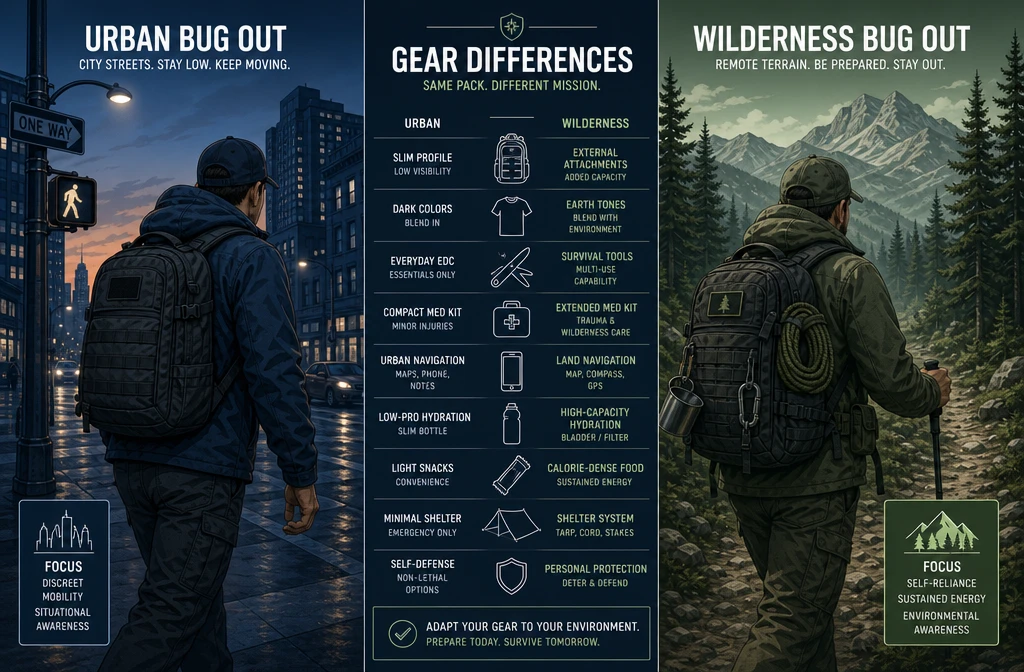
Urban Bug Out Priorities
- Cash and documents (ATMs fail, digital records disappear)
- Dust mask or N95 (fire, chemical exposure, debris)
- Sturdy footwear (broken glass, rubble)
- Basic self-defense tools (legal in your jurisdiction)
- Phone battery bank (navigation, communication)
- Inconspicuous bag (blend in, don’t attract attention)
For a deeper look at city-specific survival tactics, the ultimate urban survival guide for preppers covers movement, situational awareness, and resource acquisition.
Wilderness Bug Out Priorities
- Navigation tools (map, compass, altimeter)
- Fire starting (multiple methods — wet conditions are brutal)
- Shelter system (exposure kills faster than hunger)
- Water filtration (streams and lakes are your supply)
- Signaling (whistle, mirror, bright-colored gear)
The core overlap: water filtration, shelter, fire, first aid, and food are essential in both scenarios. Those five categories should never be compromised regardless of where you’re going.
What Are Common Mistakes People Make With Bug Out Bags?
The most common mistake is building a bug out bag like a storage unit — packing everything “just in case” until it weighs 20+ kg and can’t be carried more than a mile. Weight discipline is the hardest skill in bug out bag prep, and most people fail it.
Other frequent mistakes include:
- Packing gear you’ve never used. A tent you’ve never pitched in the dark is a liability, not an asset.
- Ignoring water weight. Carrying 3 liters of water adds 3 kg. A filter lets you carry 1 liter and resupply.
- Buying cheap knockoffs. A $5 ferro rod that fails in wet weather is worse than none.
- No seasonal rotation. A summer setup in a January evacuation is dangerous.
- Forgetting medications. A 7-day supply of any prescription medication is critical and often overlooked.
- No plan to go with the bag. Gear without a route and destination is just weight.
The bug out bag mistakes guide covers the full list with specific fixes for each error.
Can You Build a Bug Out Bag on a Budget?
Yes — a functional lightweight bug out bag under 10 kg setup is achievable for $150–200 if you prioritize correctly. You don’t need premium ultralight gear to hit the 10 kg target. Budget-friendly options exist in every category.
Budget Build: Under $200
| Item | Budget Option | Approx. Cost |
|---|---|---|
| Backpack (35L) | Teton Sports Scout 3400 | $50–70 |
| Water filter | Sawyer Squeeze | $25–30 |
| Emergency shelter | SOL Emergency Bivy | $15–20 |
| Fire starting | BIC lighter + ferro rod | $5–8 |
| First aid kit | Basic trauma kit | $20–30 |
| Food (72 hrs) | Cliff bars + instant oatmeal | $20–25 |
| Headlamp | Petzl Tikkina | $20–25 |
| Navigation | USGS paper map + Silva compass | $15–20 |
| Total | ~$170–228 |
Where to spend more if budget allows: The water filter and footwear are the two areas where quality directly affects survival outcomes. Don’t cut corners there.
How Military and Survival Experts Recommend Packing a Lightweight Emergency Kit
Military packing doctrine uses a “load list” approach: every item earns its place by function, and redundancy is only allowed for life-critical systems (fire, water, navigation). The U.S. Army’s field manual approach to individual load management emphasizes keeping fighting load under 22 lbs (10 kg) for sustained operations — the same benchmark used here.
Survival instructors like those trained through SERE (Survival, Evasion, Resistance, Escape) programs consistently emphasize three principles:
- Skills over gear. A person with fire-starting skills and a $2 ferro rod will outperform someone with $500 of gear they’ve never practiced with.
- Layered redundancy for critical systems only. Carry two fire-starting methods. Carry a filter AND purification tabs. Don’t carry two knives.
- Pack for the mission, not the fantasy. Your bug out bag should reflect your actual route, terrain, and likely threats — not a Hollywood survival scenario.
For the skills side of the equation, the 10 critical bug-out survival skills every prepper must master is essential reading before you ever need to use your bag.
What Medical Supplies Are Essential Without Adding Too Much Weight?
A bug out bag first aid kit should focus on three things: stopping bleeding, preventing infection, and managing blisters. A full trauma kit can be assembled for under 400 grams if you skip the unnecessary items.
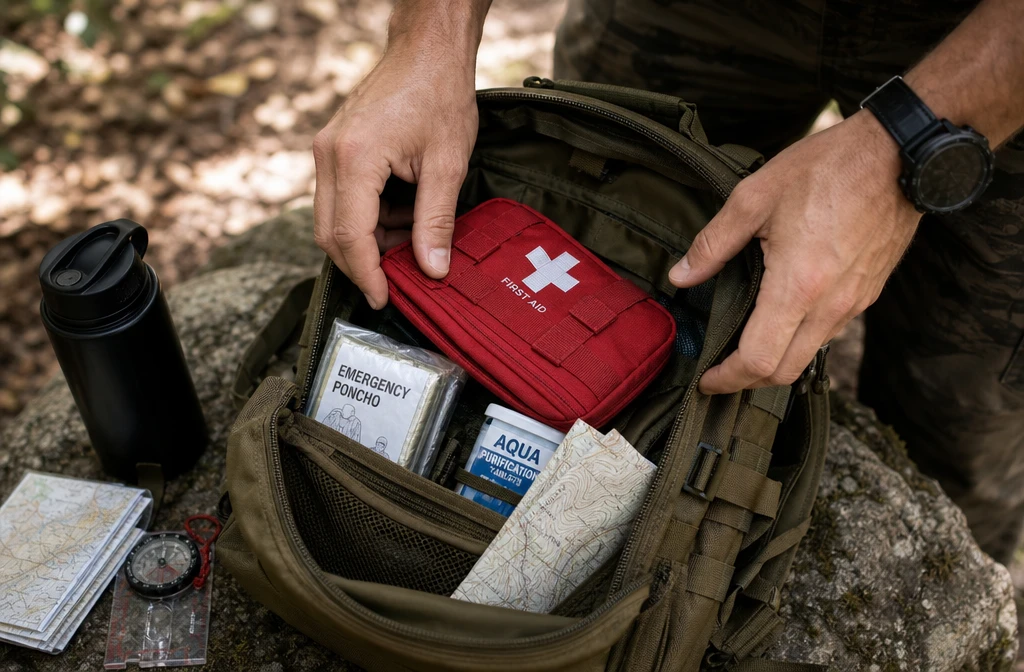
Lightweight First Aid Kit Checklist (~300–400g)
Bleeding control:
- 1x Israeli bandage (pressure dressing) — 80g
- 1x CAT tourniquet — 75g
- Hemostatic gauze (QuikClot) — 50g
- Nitrile gloves (2 pairs) — 30g
Wound care:
- Assorted adhesive bandages — 30g
- Alcohol wipes (10 packets) — 20g
- Medical tape — 20g
- Closure strips (butterfly bandages) — 10g
Blister and foot care:
- Moleskin or blister pads — 20g
- Needle (for draining blisters) — 1g
Medications (personal):
- 7-day supply of any prescriptions
- Ibuprofen, antihistamine, anti-diarrheal — 30g combined
- SAM splint — 40g
Total: approximately 400–450g — well within the weight budget.
What to leave out: bulky CPR masks, large SAM splints (one is enough), excessive bandage rolls, and anything you don’t know how to use.
How to Waterproof and Protect Gear in a Lightweight Bug Out Bag
Waterproofing a bug out bag adds almost no weight but prevents the kind of gear failure that turns a manageable situation into a crisis. Wet sleeping bags lose insulation value. Wet fire-starting materials fail. Wet documents are gone.
Simple waterproofing system that weighs under 100 grams total:
- Pack liner: A large trash compactor bag (40g) inside your pack keeps everything dry even if your pack cover fails.
- Dry bags by category: Use Sea to Summit Ultra-Sil dry sacks (15–30g each) to separate electronics, fire kit, and sleep system.
- Ziploc bags: For documents, medications, and fire-starting materials. Cost: near zero.
- Silicone seam sealer: Apply to any silnylon tarp seams before you need them.
One rule: Never put your fire kit, sleep system, or medications anywhere they can get wet. These three categories are non-negotiable dry zones.
What Skills Do You Need to Actually Use a Bug Out Bag Effectively?
Gear without skills is just expensive dead weight. The most important skills for using a bug out bag effectively are: navigation without GPS, fire starting in wet conditions, water sourcing and filtration, basic first aid, and shelter building.
A lightweight bag forces skill reliance by design — you can’t carry a solution to every problem, so you need to know how to improvise. The 25 most critical wilderness survival skills ranks these by life-saving priority if you want a structured learning path.
Minimum skill set before relying on any bug out bag:
- Read a topographic map and use a compass
- Start a fire with a ferro rod (practice in rain)
- Purify water using a filter and chemical backup
- Apply a tourniquet and pressure dressing
- Set up your specific shelter in under 10 minutes, in the dark
Practice matters more than gear upgrades. Spend one weekend camping with only what’s in your bag before you trust it in a real emergency.
For a structured approach to building these skills, the survival skills checklist covering 7 core skills every prepper needs is a practical starting point.
Bug Out Bag vs. Everyday Emergency Kit: What’s the Difference?
A bug out bag is built for mobility and evacuation. An everyday emergency kit is built for sheltering in place. They serve different scenarios and should be packed differently.
| Feature | Bug Out Bag | Home Emergency Kit |
|---|---|---|
| Primary use | Evacuation, on foot | Shelter-in-place |
| Weight limit | 10 kg max | No limit |
| Duration | 72 hours minimum | 2 weeks or more |
| Water approach | Filtration + small carry | Large stored volume |
| Food approach | Calorie-dense, no-cook | Variety, storable |
| Location | On your back | Home storage |
The two systems complement each other. Your bug out bag is what you grab when you can’t stay. Your home kit is what sustains you when you can. For building out the home side of that system, the home emergency preparedness guide covers the full setup.
Frequently Asked Questions
Q: Can a lightweight bug out bag under 10 kg actually sustain me for 72 hours? Yes. The 10 kg target is specifically calibrated for a 72-hour self-sufficient kit. With a water filter, 1,800–2,000 calories of food per day, shelter, and fire-starting capability, 72-hour survival is well within reach at this weight.
Q: What’s the single heaviest item most people should cut from their bug out bag? A heavy tent. Most preppers carry a 2–3 kg dome tent when a 400g silnylon tarp and a 200g emergency bivy provide adequate shelter at a fraction of the weight.
Q: Should I include a firearm in my bug out bag weight calculation? Yes. If you carry a firearm, include it in your total weight. A compact handgun with one spare magazine adds roughly 1.0–1.5 kg. Factor that in and reduce weight elsewhere, typically from food or clothing.
Q: How often should I repack or review my bug out bag? Every six months minimum, and after any emergency event where you accessed it. Check food and medication expiration dates, test electronics, and adjust clothing layers for the upcoming season.
Q: Is a 10 kg bug out bag realistic for women and older adults? The 10 kg target is appropriate for most healthy adults. For smaller frames, older adults, or those with physical limitations, targeting 7–8 kg is more realistic. Prioritize water filtration and shelter — those save lives. Cut food weight and comfort items first. See the 9 essential disaster prep strategies for seniors for age-specific guidance.
Q: Do I need a separate bug out bag for each family member? Adults should each carry their own bag. Children over 10 can carry a small pack (2–3 kg) with personal items. Younger children’s supplies should be distributed across adult bags. For a full family approach, the family bug out bag guide covers age-specific load distribution.
Q: What’s the best water strategy for staying under 10 kg? Carry 1 liter of water (1 kg) plus a Sawyer Squeeze filter (85g) and 10 purification tablets (10g). This gives you safe drinking water from any freshwater source while keeping water-related weight under 1.2 kg total.
Q: Can I use my hiking daypack as a bug out bag? Yes, if it’s 30–40 liters and fits well. A good-fitting hiking pack you’ve already worn for miles is often better than a new tactical pack you’ve never tested. Fit and familiarity matter more than aesthetics.
Q: What navigation tools should I carry if I rely on my phone? Always carry a paper topographic map of your likely bug out area and a baseplate compass. Phone batteries die, signals fail, and screens crack. Navigation without GPS is a core survival skill — the complete beginner’s guide to navigation without GPS covers everything from map reading to celestial navigation.
Q: How do I know if my bug out bag is actually ready? Do a shakedown: load the bag, put it on, and walk 5 miles. If you can’t complete that without stopping or adjusting, something needs to change — either the weight, the fit, or your fitness level. Real readiness requires testing.
Conclusion: Build It Light, Practice It Hard
A lightweight bug out bag under 10 kg setup isn’t a compromise — it’s a deliberate choice to prioritize mobility over comfort. The preppers who actually make it to safety in an emergency are the ones moving fast, thinking clearly, and not pinned down by a 20 kg bag that destroys their knees by mile three.
Actionable next steps:
- Weigh everything you currently have in your bag. Most people are shocked by the number.
- Apply the weight budget table in this guide and identify your heaviest categories.
- Make one gear swap this week — start with shelter or the backpack itself.
- Practice at least one skill from your kit before you need it: set up your tarp, use your filter, apply your tourniquet.
- Build your bug out plan alongside your bag — gear without a destination is just weight. The ultimate guide to creating a bug out plan walks through route planning, rally points, and communication protocols.
- Do a shakedown hike with your fully loaded bag before you trust it in a real emergency.
Preparedness isn’t about fear. It’s about the confidence that comes from knowing exactly what you’d do and exactly what you’d carry when it matters most.
Products, Tools, and Resources Worth Knowing
These aren’t paid recommendations — they’re the tools that consistently appear in serious lightweight bug out bag builds:
- Sawyer Squeeze Water Filter — The gold standard for ultralight water filtration. Under 90 grams, rated for 100,000 gallons. Nothing else at this weight comes close.
- SOL Escape Bivvy — A step up from a basic emergency blanket. Breathable, reusable, and weighs 170 grams. Pairs well with a silnylon tarp.
- Petzl Actik Core Headlamp — Rechargeable via USB, 450 lumens, weighs 95 grams. The rechargeable battery saves weight over carrying spare AAs.
- Silva Ranger Compass — Trusted by orienteers and military navigators. Baseplate design works with topographic maps. Under $50, weighs 65 grams.
- Osprey Exos 38 Pack — One of the best semi-frame ultralight packs available. 1.0 kg empty, excellent hip belt, fits loads up to 12 kg comfortably.
- CAT Tourniquet (North American Rescue) — The only tourniquet worth trusting. Cheap knockoffs fail under pressure. This one doesn’t.
- Freeze-dried meal pouches (Mountain House or Backpacker’s Pantry) — 500–700 calories per 100g, 25-year shelf life, just-add-water simplicity. For more on long-term food options, the ultimate prepper’s guide to freeze-dried food covers brands, calorie density, and storage strategy in detail.
References
- U.S. Army Field Manual FM 21-18: Foot Marches — guidance on load management and sustainable carry weight for dismounted soldiers.
- FEMA Ready.gov — Build A Kit (2023): https://www.ready.gov/kit — recommended 72-hour emergency supply guidelines.
- Sawyer Products — Sawyer Squeeze Filter specifications (2022): https://www.sawyer.com/products/squeeze-water-filtration-system
- North American Rescue — CAT Tourniquet clinical validation data (2021): https://www.narescue.com
- Wilderness Medical Society — Wilderness Medicine 6th Edition, Auerbach et al. (2017): standard reference for field medical protocols.