
Hey there! Some links on this page may be affiliate links which means that, if you choose to make a purchase, I may earn a commission at no extra cost to you. I greatly appreciate your support. Read the full disclosure here.
A well-prepared women’s bug out bag is a lightweight, ergonomically designed emergency kit tailored to female physiology, hygiene needs, and personal safety. It prioritizes essential items like menstrual supplies, hormonal medications, and compact self-defense tools within a practical weight limit for extended mobility. This checklist ensures women are fully equipped to handle diverse emergency scenarios confidently and comfortably.
A bug out bag (BOB) is a pre-packed emergency kit designed to keep you safe and self-sufficient for 72 hours during sudden evacuations. Women need bug out bags tailored to their unique physiological, ergonomic, and safety needs—standard kits often miss critical items like menstrual supplies, hormone medications, and personal protection tools. Women’s packs also require different sizing and weight considerations to prevent fatigue and injury.
This guide provides a clear, practical checklist that addresses these female-specific essentials. Whether you face natural disasters, urban emergencies, or wilderness scenarios, this optimized kit ensures you carry what you truly need in a manageable, well-fitting pack. Use this overview alongside universal prep checklists to build a bug out bag that works for your body, health, and safety.
Key Takeaways
- A women’s bug out bag should weigh no more than 15-20% of her body weight, typically between 20-30 lbs fully loaded.
- Female-specific items — including menstrual supplies, hormone medications, and personal safety tools — are non-negotiable additions that generic checklists consistently overlook.
- A smaller frame calls for a pack with a shorter torso length and adjustable hip belt, not just a smaller version of a men’s bag.
- The total cost to build a complete, quality women’s bug out bag ranges from $150 to $400, depending on gear choices.
- Personal protection items such as pepper spray, a personal alarm, and a fixed-blade knife belong in every woman’s emergency kit.
- A well-built bag covers 72 hours of self-sufficiency and adapts to natural disasters, urban evacuations, and wilderness scenarios alike.
- Common mistakes include overpacking, skipping feminine hygiene planning, and choosing a bag that fits poorly on a female frame.
- Lightweight, compact alternatives exist for nearly every standard item, making a functional bag achievable even for women with limited physical strength.
Find this useful? Add us as a preferred source on Google and more of what we publish will show up in your results.
What Exactly Is a Bug Out Bag and Why Do Women Need a Special One
A bug out bag (BOB) is a pre-packed emergency kit designed to sustain you for at least 72 hours when you must leave home fast. Women need a purpose-built version because standard checklists are written around male physiology, male body proportions, and male health needs — leaving critical gaps that could compromise survival.
The differences go beyond just adding tampons to a generic list. Women face distinct physiological needs (menstrual cycles, hormonal medications, pregnancy considerations), different ergonomic requirements (shorter torso, narrower shoulders, wider hips), and different personal safety concerns in emergency environments. A bag that ignores these realities isn’t a complete kit — it’s an incomplete one with a false sense of security.
For a solid foundation on the universal elements every bug out bag needs, the 72-hour bug out bag checklist at Preppers HQ is an excellent starting point before layering in the female-specific additions covered here.
How Much Does a Complete Bug Out Bag Cost to Put Together
Building a complete women’s bug out bag costs between $150 and $400 for a functional, quality kit. Budget builds hover around $150-200 using mid-range gear; a more durable, long-term setup with quality water filtration, a reliable pack, and premium medical supplies typically lands between $250-400.
Here’s a realistic cost breakdown by category:
| Category | Budget Range |
|---|---|
| Backpack (women’s fit) | $40 – $120 |
| Water filtration + storage | $25 – $60 |
| Food (72-hour supply) | $20 – $50 |
| First aid + medical | $30 – $70 |
| Feminine hygiene supplies | $15 – $30 |
| Shelter + warmth | $25 – $60 |
| Navigation + communication | $20 – $50 |
| Personal protection | $20 – $50 |
| Clothing + footwear extras | $15 – $40 |
The biggest cost mistake is buying cheap gear that fails under real stress. Prioritize water filtration, the pack itself, and footwear — these three items carry the most consequence if they fail.
What Are the Must-Have Female-Specific Items for Emergency Preparedness
The must-have female-specific items for a women’s bug out bag fall into four categories: hygiene and menstrual management, medical and hormonal needs, personal safety, and ergonomic fit. These are the items that transform a generic emergency kit into one that actually works for a woman’s body and safety profile.
Feminine Hygiene and Menstrual Supplies
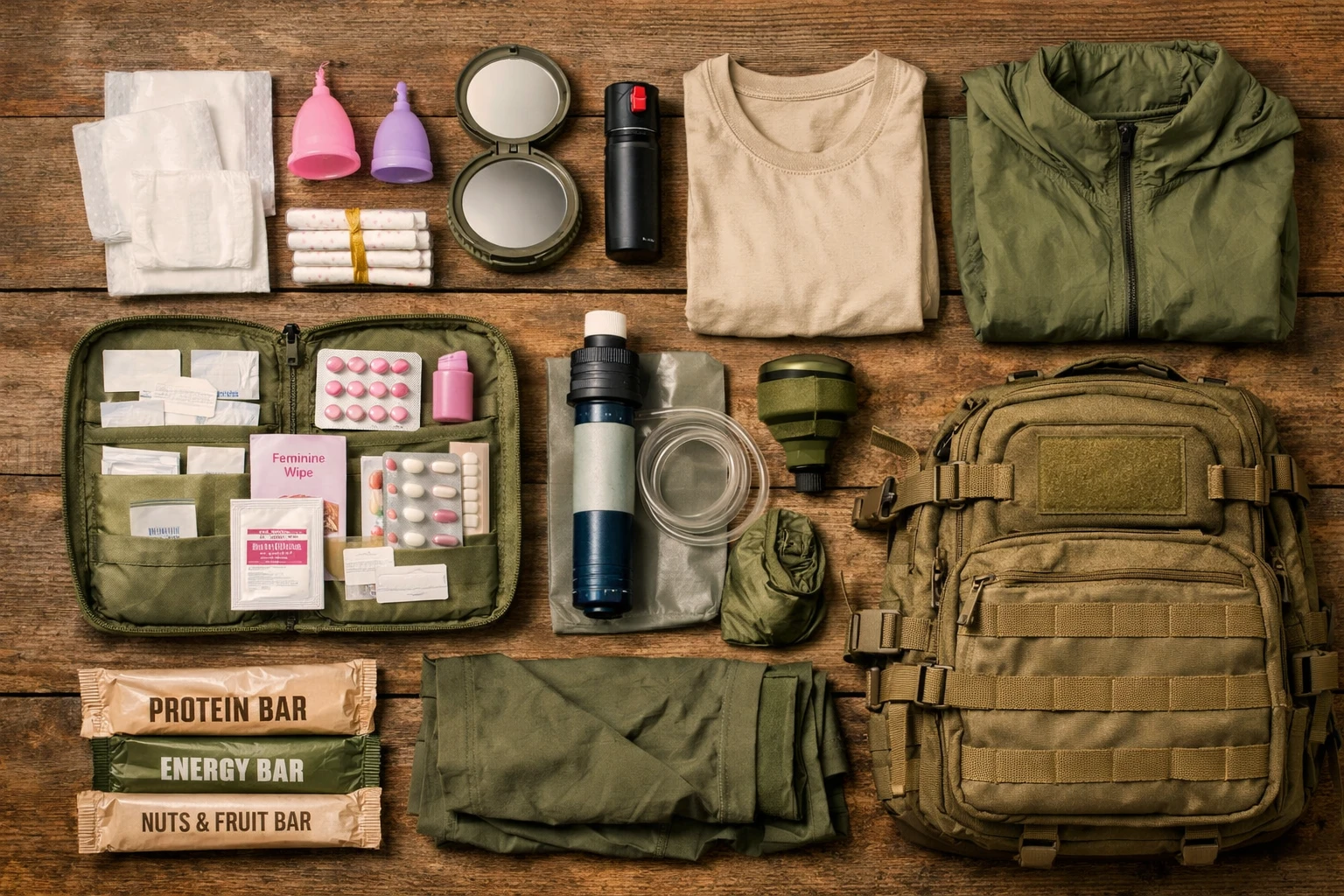
- Menstrual cup (reusable, no waste, lasts years) — the single best long-term option
- Period underwear (2-3 pairs, doubles as regular underwear)
- Organic cotton pads or tampons (backup supply, 1-week worth minimum)
- Unscented wet wipes for hygiene when water is scarce
- Small bar of unscented soap
- Hand sanitizer (travel size, multiple)
Medical and Hormonal Needs
- Prescription medications (30-day supply minimum, rotated regularly)
- Hormonal contraceptives or HRT medications
- UTI treatment (over-the-counter, such as AZO or phenazopyridine)
- Yeast infection treatment (single-dose oral or topical)
- Prenatal vitamins if applicable
- Iron supplements (women of menstruating age are at higher risk of deficiency under stress)
Personal Safety Items
- Pepper spray (check local laws; gel formula reduces blowback)
- Personal safety alarm (130dB minimum)
- Fixed-blade knife or tactical folding knife
- Whistle (Fox 40 or equivalent)
Ergonomic and Comfort Items
- Properly fitted sports bra (2 pairs, moisture-wicking)
- Compression shorts or base layer
- Blister prevention products (BodyGlide or moleskin)
What’s Different Between a Male and Female Bug Out Bag
The core survival categories are identical — water, food, shelter, fire, navigation, first aid, and communication. What differs is the gear selection within those categories, the pack geometry, weight targets, and the addition of female-specific health and safety items.
Key differences at a glance:
- Pack fit: Women’s packs have shorter torso lengths (typically 15-18 inches vs. 18-21 inches for men), narrower shoulder straps, and hip belts contoured for wider hips. Using a men’s pack on a female frame causes shoulder and back strain that becomes dangerous over miles.
- Weight targets: The standard 20-25% of body weight rule applies to both, but because average female body weight is lower, the absolute weight ceiling is also lower — typically 20-28 lbs vs. 30-40 lbs for men.
- Medical supplies: Female bags include menstrual management, UTI and yeast infection treatment, and hormonal medications that have no equivalent in a standard male kit.
- Personal safety emphasis: Women face statistically higher risks of targeted violence in disaster scenarios, making personal protection tools a higher-priority category.
- Caloric needs: Women generally require fewer calories at rest but the gap narrows significantly under physical exertion. Plan for 1,800-2,200 calories per day during active evacuation.
For families building multiple bags, the family bug out bag guide covers how to coordinate individual kits across different body types and ages.
How Do I Pack a Bug Out Bag If I Have Limited Physical Strength
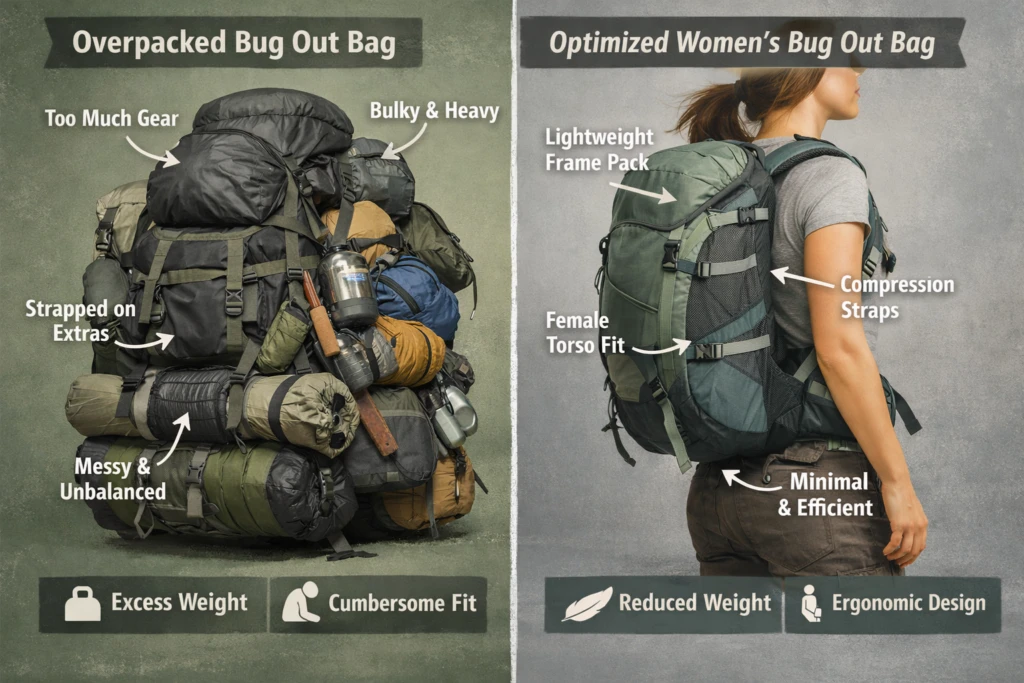 Women with limited physical strength should prioritize ruthless weight reduction, load distribution, and lightweight gear substitutions — not a smaller bag with fewer essentials. The goal is a functional 72-hour kit that can actually be carried for miles.
Weight reduction strategies:
- Start with a kitchen scale. Weigh every item before it goes in.
- Replace heavy items with ultralight equivalents (titanium cookware vs. steel, a Sawyer Squeeze vs. a gravity filter system).
- Cut redundancies. One fire-starting method is not enough; three is too many.
- Choose multi-use items (a bandana serves as a tourniquet, water pre-filter, head covering, and signal cloth).
- Use compression sacks to reduce bulk without adding weight.
- Pack heaviest items closest to your back and centered between shoulder blades.
- Use the hip belt — it transfers 60-80% of the load from shoulders to hips, which is biomechanically more efficient for most women.
Lightest-weight substitutions by category:
| Standard Item | Lightweight Alternative | Weight Saved |
|---|---|---|
| Steel water bottle | Platypus collapsible bottle | ~8 oz |
| Full first aid kit | Curated trauma kit | ~6 oz |
| Wool blanket | Emergency mylar blanket | ~3 lbs |
| Hardcover notebook | Rite in the Rain pocket pad | ~4 oz |
| Full-size flashlight | Headlamp (Petzl Tikkina) | ~4 oz |
If you’re new to building a kit and want a structured starting point, the bug out bag guide for beginners walks through the process step by step.
What Medical Supplies Should Women Specifically Include
Beyond a standard first aid kit, women’s bug out bags need supplies that address female-specific health vulnerabilities that spike during physical stress and disrupted hygiene conditions. UTIs, yeast infections, and menstrual complications are not minor inconveniences in a survival scenario — they can become debilitating without treatment.
Female-specific medical additions:
- UTI treatment: Phenazopyridine (pain relief) and ideally a course of antibiotics if a physician will prescribe them for emergency use. UTIs progress to kidney infections rapidly without treatment.
- Yeast infection treatment: Fluconazole (single oral dose) or a topical azole cream. Stress, antibiotics, and disrupted hygiene all increase risk.
- Wound care: Extra gauze and medical tape (menstrual products can serve as wound dressings in emergencies, but dedicated supplies are better).
- Pain management: Ibuprofen (addresses menstrual cramps, inflammation, and fever) plus acetaminophen.
- Prescription medications: At minimum a 30-day supply of any hormonal medications, thyroid medications, or antidepressants. These cannot be improvised.
- Pregnancy test: For women of reproductive age, knowing early matters for decision-making.
- Electrolyte packets: Heavy menstrual flow combined with physical exertion accelerates dehydration. Electrolytes are not optional.
Pair your medical kit with solid knowledge of how to purify water in the field, since waterborne illness compounds any medical situation fast.
Can I Use a Bug Out Bag for Different Types of Emergencies Like Natural Disasters
Yes — a well-built women’s bug out bag is designed to function across multiple emergency types, including natural disasters, urban evacuations, power grid failures, and wilderness survival scenarios. The core contents remain the same; what changes is which items you prioritize reaching first.
For natural disasters (hurricanes, wildfires, earthquakes), the bag’s 72-hour supply of water, food, shelter, and first aid covers the critical window before emergency services restore order. For urban emergencies, personal safety tools and navigation materials move to the top of the access priority. For extended wilderness scenarios, water filtration and fire-starting capability become the most critical systems.
The natural disaster preparedness guide covers scenario-specific planning that pairs well with a personal bug out bag.
Organize your pack in layers by scenario:
- Top/outer pockets: Items needed within the first hour (documents, phone charger, medications, personal alarm)
- Mid-section: Items needed within 24 hours (food, water filter, first aid kit, feminine hygiene)
- Bottom/inner: Items needed for extended scenarios (shelter, extra clothing, fire kit)
What Are Common Mistakes Women Make When Preparing Emergency Kits
The most common mistake is building a bag based on a generic checklist without accounting for female physiology, pack fit, or personal safety. The second most common mistake is building a bag and never testing it.
Mistakes that compromise the kit:
- Skipping feminine hygiene planning entirely. This is the most frequent omission on standard checklists, and it’s a serious gap.
- Using a men’s or unisex pack. Poor fit causes pain and fatigue that limits how far you can travel.
- Overpacking. A 45-lb bag that can’t be carried more than a mile is worse than a 22-lb bag that can be carried all day.
- No personal protection items. Women are disproportionately targeted in high-stress, low-oversight emergency environments. This is not paranoia — it’s documented reality.
- Expired medications and food. A kit that isn’t rotated annually becomes unreliable. Set a calendar reminder.
- No copies of critical documents. Waterproof copies of ID, insurance cards, prescriptions, and emergency contacts belong in every bag.
- Ignoring footwear. Blisters and foot injuries are among the most common reasons people stop moving during evacuations. Break in your evacuation footwear before you need it.
The bug out bag mistakes guide covers the full spectrum of packing errors that preppers make regardless of gender.
How Heavy Should a Bug Out Bag Be for an Average Woman
A women’s bug out bag should weigh no more than 15-20% of her body weight when fully loaded. For a 140-lb woman, that’s a maximum of 21-28 lbs. For a 120-lb woman, the ceiling is 18-24 lbs.
These aren’t arbitrary numbers. Carrying more than 20% of body weight over extended distances significantly increases fatigue, joint stress, and injury risk — particularly to knees and ankles on uneven terrain. In a real evacuation, you may be moving for 6-12 hours. The bag that gets you there is the one you can actually carry.
Weight benchmarks by body weight:
| Body Weight | Max Recommended Pack Weight |
|---|---|
| 110 lbs | 16-22 lbs |
| 130 lbs | 19-26 lbs |
| 150 lbs | 22-30 lbs |
| 170 lbs | 25-34 lbs |
Test your fully loaded bag by walking 3-5 miles on varied terrain. If you’re exhausted by mile two, it’s too heavy. Cut weight before the emergency, not during it.
What Personal Protection Items Should I Include as a Woman
Every women’s bug out bag should include at least two personal protection tools: a non-lethal deterrent (pepper spray or personal alarm) and a fixed-blade knife. Whether to add a firearm depends on training, legal status, and personal comfort — but the non-lethal options are non-negotiable regardless.
Personal protection essentials:
- Pepper spray: Choose a gel formula (reduces wind blowback), 2% Major Capsaicinoids minimum, with a safety mechanism. Sabre Red and POM are reliable brands. Check expiration dates annually.
- Personal alarm: A 130dB+ alarm draws attention and disorients attackers. Attaches to a bag zipper for instant access.
- Fixed-blade knife: Serves dual purpose as a survival tool and last-resort defense. A 3-4 inch blade is sufficient and legal in most jurisdictions.
- Tactical flashlight: A 500+ lumen flashlight can temporarily blind an attacker and is legal everywhere.
- Whistle: Fox 40 or similar pealess whistle carries over 100 yards and signals distress to rescuers.
If you carry a firearm, ensure it’s secured in an accessible but protected compartment, and that your training is current. An unfamiliar weapon under stress is a liability, not an asset.
Are There Lightweight Bug Out Bag Options for Urban vs. Rural Environments
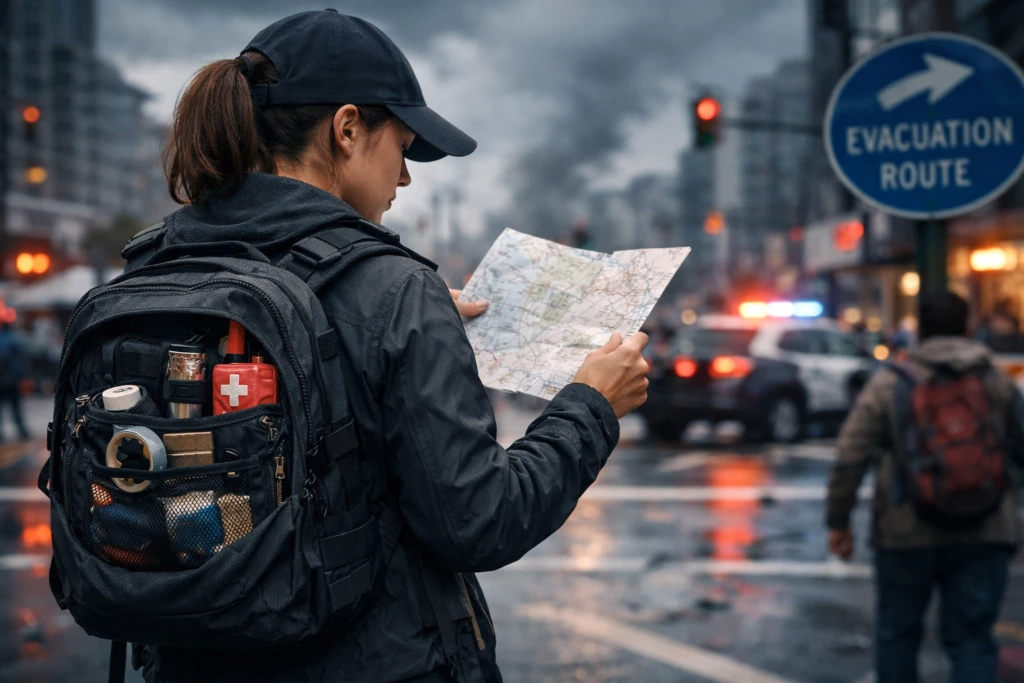 Urban and rural bug out bags share the same core contents but differ in emphasis. Urban bags prioritize navigation tools, cash, personal protection, and compact shelter options. Rural bags weight more toward water filtration, fire-starting, and extended food supply.
Urban women’s bug out bag emphasis:
- Physical maps of the city and surrounding routes (GPS fails in grid-down scenarios)
- Cash in small bills (ATMs go offline during disasters)
- Compact personal protection tools
- Dust mask or N95 respirator (building collapses, smoke)
- Lighter pack overall (30-60 minute evacuation window to a vehicle or shelter)
Rural women’s bug out bag emphasis:
- High-capacity water filtration (Sawyer Squeeze or LifeStraw with reservoir)
- Fire kit (waterproof matches, ferro rod, tinder)
- Extended food supply (5-7 days vs. 72 hours)
- Navigation tools including compass and topographic maps
- Heavier shelter system (bivy or lightweight tent vs. emergency blanket)
For those navigating without GPS in either environment, the complete guide to navigation without GPS is essential reading before an emergency happens.
What Feminine Hygiene Products Work Best in Survival Situations
Reusable products outperform disposables in survival scenarios because they eliminate resupply dependency. The menstrual cup is the gold standard for emergency preparedness — one cup lasts years, requires only water to clean, and takes up almost no pack space.
Ranked by survival suitability:
- Menstrual cup (DivaCup, Saalt, or Lunette) — best overall; reusable, compact, no waste
- Period underwear (Thinx or Bambody) — excellent backup, doubles as regular underwear
- Organic cotton pads — biodegradable, can double as wound dressings, no applicator waste
- Tampons — functional but create waste and require clean hands; bring fewer than you think you need
- Disposable pads — lowest priority; bulky, non-reusable, and waste-generating
Pack a combination: one menstrual cup as primary, 2-3 pairs of period underwear, and a small backup supply of organic pads. This covers all scenarios including situations where cleaning the cup isn’t immediately possible.
How Do I Choose the Right Backpack for My Bug Out Bag If I’m Smaller Framed
Women with smaller frames need a pack with a torso length of 15-17 inches, a women’s-specific hip belt, and padded shoulder straps contoured for narrower shoulders. Using an oversized pack on a small frame shifts weight onto the shoulders instead of the hips, causing fatigue and injury.
How to measure your torso length: Stand straight and measure from the C7 vertebra (the bony bump at the base of your neck) to the top of your hip bones (iliac crest). This number determines your pack size.
What to look for in a women’s pack:
- Torso fit: 15-17 inches for XS/S frames, 17-19 inches for M frames
- Hip belt: Should sit on the iliac crest, not the waist
- Shoulder straps: S-curve design for chest clearance
- Capacity: 30-45 liters is the sweet spot for a 72-hour women’s bag
- Weight: The empty pack should weigh under 3 lbs for a lightweight build
Reliable women’s-specific pack options in 2026:
- Osprey Aura AG 36 (women’s fit, anti-gravity suspension)
- Gregory Jade 38 (excellent hip belt, affordable)
- REI Co-op Trail 40 (women’s version, budget-friendly)
- Mystery Ranch Coulee 40 Women’s (burly, for heavier loads)
Try the pack on with weight in it before committing. A pack that feels fine empty can be miserable at 25 lbs.
The Complete Women’s Bug Out Bag Checklist: Full Item List
Use this as your master reference. Check off items as you build your kit.
Water
- Water filter (Sawyer Squeeze or LifeStraw)
- 2-liter collapsible water reservoir
- Water purification tablets (backup)
- Stainless steel water bottle (32 oz)
Food
- 72-hour calorie supply (1,800-2,200 cal/day)
- High-calorie bars (Clif, LÄRABAR, or emergency ration bars)
- Freeze-dried meals (2-3 pouches)
- Electrolyte packets (6-10)
- Lightweight camp spork
Shelter and Warmth
- Emergency mylar blanket (2)
- Lightweight bivy or emergency sleeping bag
- Compact tarp or poncho
- Fire kit: ferro rod, waterproof matches, lighter, tinder
Clothing
- Moisture-wicking base layer (top and bottom)
- Insulating mid-layer
- Rain jacket (packable)
- Wool or synthetic socks (3 pairs)
- Broken-in hiking boots or trail runners
- Gloves and beanie (climate-dependent)
- 2 sports bras (moisture-wicking)
- Compression shorts or base layer
First Aid and Medical
- Trauma kit (tourniquet, Israeli bandage, chest seal
FAQ – Complete Women’s Bug Out Bag Checklist
Why do women need a specially designed bug out bag instead of a generic one?
Women’s bug out bags account for female physiology (menstrual cycles, hormonal needs), ergonomic differences (shorter torso, wider hips), and higher personal safety risks. Generic bags often miss essential female-specific items like menstrual supplies, hormone medications, and tailored pack fits, which can jeopardize survival and comfort
How heavy should a bug out bag be for an average woman?
A fully loaded bug out bag should not exceed 15-20% of a woman’s body weight. For example, a 140-lb woman’s pack should weigh between 21-28 lbs. Keeping weight within this range helps avoid fatigue, joint strain, and injury during extended evacuations.
What female-specific medical supplies should be included in a bug out bag?
Include UTI treatment (phenazopyridine and, if possible, antibiotics), yeast infection medication (fluconazole or topical creams), a 30-day supply of hormonal or prescription medications, prenatal vitamins if applicable, pain relievers for cramps, electrolyte packets, and pregnancy tests for reproductive-age women.
What are the best feminine hygiene products for survival situations?
The menstrual cup is the top choice for longevity and packability. Complement it with 2-3 pairs of period underwear and a backup supply of organic cotton pads. Avoid bulky disposable products; reusable items reduce waste and resupply needs.
How can women with limited physical strength effectively pack a bug out bag?
Prioritize ultralight gear substitutions (e.g., titanium cookware, compact water filters), multi-use items, and ruthless weight reduction. Proper pack fit, distributing the load close to the back and using a hip belt, plus cutting redundancies, help keep the kit manageable without sacrificing essentials.