
Hey there! Some links on this page may be affiliate links which means that, if you choose to make a purchase, I may earn a commission at no extra cost to you. I greatly appreciate your support. Read the full disclosure here.
Ultimate Power Outage Preparedness Checklist
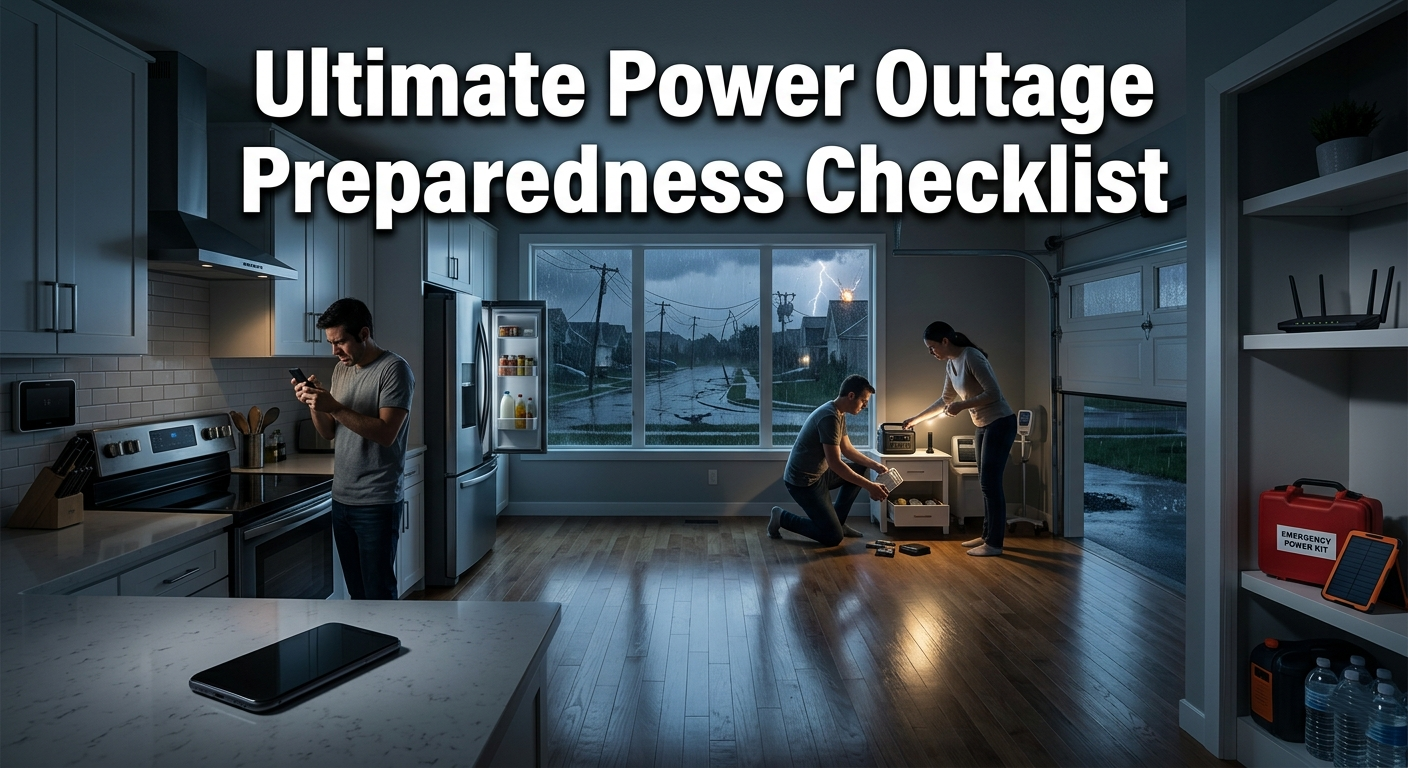
Power outage preparedness isn’t just about having flashlights and candles anymore. When the grid fails—whether from a winter storm, summer heat wave, or infrastructure failure—modern life stops in ways most people don’t anticipate until it’s too late.
The lights go out. That’s expected. But then your phone dies because you forgot to charge it. The food in your refrigerator starts warming. Your electric stove won’t work. If it’s winter, your furnace stops. If it’s summer, your AC quits. Your well pump stops drawing water. Your garage door won’t open. Your medical devices lose power. Your internet router goes dark, cutting you off from information exactly when you need it most.
This isn’t a doomsday scenario. This is a Tuesday afternoon in Texas during a winter storm, or a Wednesday evening in California during fire season, or a Thursday morning anywhere when a transformer blows. The average American experiences 8 hours of power outages per year, but when a major storm hits, that can stretch to days or even weeks.
Most people are dangerously unprepared. They have a flashlight somewhere, maybe some batteries that might still work, and a vague plan to “figure it out” if the power stays out. That’s not preparedness. That’s hope. And hope is not a strategy.
Find this useful? Add us as a preferred source on Google and more of what we publish will show up in your results.
The Hidden Vulnerabilities: What Actually Fails When the Grid Goes Down
 The modern home is an intricate web of electrical dependencies. When power fails, the cascade effect reveals vulnerabilities most people never considered.
Beyond the Lights: The Cascade Effect of Power Loss
Losing electricity doesn’t just mean darkness. It means:
- No heating or cooling: Your furnace, AC, and heat pump all require electricity, even gas furnaces (for the blower and ignition).
- No water (for many): If you’re on a well, your pump stops. Even municipal water can lose pressure during extended outages.
- No refrigeration: Food spoilage begins within 4 hours if the door stays closed, 2 hours if opened frequently.
- No communication: Cell towers have backup batteries, but these typically last only 4-8 hours. Landlines (if you still have one) may work longer.
- No medical device power: CPAP machines, oxygen concentrators, nebulizers, and medication refrigeration all fail.
- No financial access: ATMs don’t work. Card readers don’t work. If you don’t have cash, you can’t buy anything.
How Long Can You Actually Survive Without Electricity?
The answer depends on the season, your health, and your preparation level.
- In extreme cold: Hypothermia can set in within 3 hours in an unheated home during winter.
- In extreme heat: Heat stroke risk increases significantly after 6-12 hours without cooling, especially for the elderly and young children.
- With medical dependencies: Some individuals have hours, not days, before power loss becomes life-threatening.
The 72-Hour Window: Why This Timeframe Is Critical
Emergency management agencies use 72 hours as the standard preparednessbenchmark because:
- Most outages resolve within this timeframe: According to the U.S. Energy Information Administration, the median power outage duration is 3.5 hours, but severe weather events can extend this to 24-72 hours.
- Emergency services are overwhelmed: During widespread outages, first responders prioritize life-threatening emergencies. You’re on your own for basic needs.
- Supply chains break down: Stores can’t restock. Gas stations can’t pump fuel. Pharmacies can’t fill prescriptions.
If you can survive comfortably for 72 hours, you can weather most power outages without external help.
Regional Differences: Urban vs. Rural Power Outage Challenges
Urban challenges:
- High-rise living without elevators
- Limited storage space for supplies
- Dependence on municipal water and sewer
- Higher population density competing for resources
Rural challenges:
- Longer power restoration times (utilities prioritize population centers)
- Well water dependence (no power = no water)
- Greater distances to stores and services
- Potential isolation during severe weather
Key Takeaways:
– Prepare for power outages beyond lighting: prioritize communication, temperature regulation, water, food preservation, and medical device power.
– The critical 72-hour window requires sufficient supplies and backup power to maintain safety and comfort without external help.
– Tailor preparedness to your living environment—urban and rural challenges differ significantly in restoration times and resource access.
– Build your kit progressively using the 30-day plan, starting with emergency lighting, water, and food, then adding power backups and communication tools.
– Invest in reliable products including headlamps, portable power stations, emergency radios, and water purification to ensure effectiveness during outages.
The Power Outage Preparedness Hierarchy: Prioritizing Your Needs
 Not all preparedness needs are equal. This hierarchy ensures you address the most critical vulnerabilities first.
Tier 1: Immediate Survival (First 3 Hours)
These are the items and systems you need within minutes of power loss.
Emergency lighting: Headlamps, lanterns, and backup batteries
- Headlamps: Keep your hands free for tasks. LED headlamps provide 50-200 hours of light on a single set of batteries.
- Recommended: Black Diamond Spot (300 lumens, waterproof, red-light mode)
- LED lanterns: Provide ambient light for rooms. Look for models with 300+ lumens and 24+ hour runtime.
- Recommended: Goal Zero Lighthouse 400 (rechargeable, doubles as phone charger)
- Backup batteries: Stock lithium AA and AAA batteries (10-year shelf life, better cold-weather performance than alkaline)
Avoid candles as primary lighting. They’re a fire hazard, provide poor illumination, and produce carbon monoxide in enclosed spaces.
Communication: Staying informed when cell towers fail
- NOAA Weather Radio: Battery-powered or hand-crank models provide emergency alerts and information when internet and cell service fail.
- Recommended: Midland ER310 (AM/FM/NOAA, hand-crank, solar, USB charging)
- Portable phone chargers: High-capacity power banks (20,000+ mAh) can recharge smartphones 4-6 times.
- Recommended: Anker PowerCore 26800
- Two-way radios: FRS/GMRS radios for family communication if separated (range: 1-2 miles in urban areas, 5-10 miles in open terrain)
Temperature regulation: Heating and cooling without power
For cold weather:
- Layering strategy: Base layer (moisture-wicking), mid layer (insulation like fleece), outer layer (wind/water protection)
- Emergency blankets: Mylar blankets reflect 90% of body heat
- Sleeping bags: Rated for 20°F below your expected low temperature
- Propane heater (with caution): Mr. Heater Buddy (indoor-safe, but requires ventilation and CO detector)
For hot weather:
- Battery-powered fans: Provide air circulation
- Cooling towels: Evaporative cooling when dampened
- Hydration: Increase water intake by 50-100% in heat
Tier 2: Short-Term Sustainability (3-24 Hours)
Once immediate safety is secured, focus on sustaining basic needs.
Food preservation: What to eat first, what to save
The 4-hour rule: A full refrigerator stays cold for about 4 hours if unopened, 2 hours if opened frequently.
Priority eating order:
- Hours 0-4: Eat refrigerated items that spoil fastest (dairy, meat, leftovers)
- Hours 4-24: Move to freezer items (a full freezer stays frozen 48 hours if unopened)
- Hours 24+: Rely on shelf-stable foods
Cooler strategy:
- Transfer critical refrigerated items (medications, insulin, essential foods) to a cooler with ice
- Keep cooler in the coolest part of your home (basement in summer, unheated room in winter)
- Minimize opening
Water access: When municipal systems lose pressure
Storage:
- Minimum: 1 gallon per person per day for 3 days (drinking and basic hygiene)
- Recommended: 2 gallons per person per day (allows for cooking and additional hygiene)
- Store in food-grade containers in a cool, dark place
Purification (if you need to source water):
- Portable filter: Sawyer Squeeze (0.1-micron filtration, 100,000-gallon capacity)
- Purification tablets: Potable Aqua chlorine dioxide (kills viruses, bacteria, protozoa)
- Boiling: 1 minute at rolling boil (3 minutes above 6,500 feet elevation)
Medication and medical device backup power
Critical medications requiring refrigeration:
- Insulin
- Some antibiotics
- Certain biologics and injectables
Solution: Transfer to cooler with ice packs immediately. Monitor temperature (should stay below 46°F/8°C).
Medical devices:
- CPAP machines: Portable power station (500Wh minimum) provides 2-3 nights of use
- Oxygen concentrators: Require significant power (300-600W continuous). Consider backup oxygen tanks.
- Nebulizers: Battery-powered models available, or use portable power station
Tier 3: Extended Outage (24-72+ Hours)
For outages lasting beyond 24 hours, sanitation, cooking, and financial access become critical.
Sanitation without running water
Toilet flushing:
- Fill bathtub with water before outage (if you have warning)
- Use 1-2 gallons of water per flush (pour directly into bowl, not tank)
- Alternative: 5-gallon bucket with toilet seat lid and waste bags
Personal hygiene:
- Baby wipes or hygiene wipes
- Dry shampoo
- Hand sanitizer (60%+ alcohol)
Alternative cooking methods
Safe indoor options:
- Butane camp stove: Single-burner portable stove (use with ventilation)
- Alcohol stove: Compact, lightweight, safe for indoor use with ventilation
Outdoor options:
- Propane camp stove: Two-burner models for family cooking
- Charcoal grill: For extended outages (stock charcoal)
Never use outdoor grills or generators indoors. Carbon monoxide poisoning kills.
Financial preparedness: Cash and payment alternatives
Cash reserve:
- Minimum: $500 in small bills ($1, $5, $10, $20)
- Recommended: $1,000-$2,000 for extended outages
- Store in fireproof safe
Why small bills matter: During outages, stores may not have change. A $100 bill is useless if you’re buying $15 of supplies.
Building Your Power Outage Kit: Room-by-Room Essentials
A comprehensive power outage kit isn’t stored in one location. It’s distributed throughout your home for easy access.
Kitchen & Food Storage
Essential items:
- Manual can opener (the most forgotten item)
- Coolers (2-3 for different purposes)
- Ice packs (freeze in advance)
- Shelf-stable foods (canned goods, dried fruits, nuts, protein bars)
- Disposable plates, cups, utensils (conserves water)
- Trash bags (for waste management)
Food selection strategy:
- Choose foods you actually eat (don’t buy canned sardines if you hate sardines)
- Rotate stock every 6-12 months
- Include comfort foods (chocolate, cookies) for morale
Bathroom & Sanitation
Essential items:
- Water storage (5-gallon containers)
- Toilet paper (extra supply)
- Baby wipes or hygiene wipes
- Hand sanitizer
- Feminine hygiene products
- Trash bags with ties
- Bucket with lid (emergency toilet)
Bedroom & Comfort
Essential items:
- Headlamp (one per person, stored on nightstand)
- Extra blankets or sleeping bags
- Battery-powered fan (summer)
- Warm clothing layers (winter)
- Books, cards, games (entertainment without electricity)
Home Office & Communication
Essential items:
- Portable power station or high-capacity power bank
- Charging cables for all devices
- NOAA weather radio
- Two-way radios
- Printed emergency contact list
- Physical maps of your area
Power Backup Solutions: From Budget to Premium
 Backup power systems range from $100 portable power banks to $30,000 whole-home solar installations. Choose based on your needs and budget.
Portable Power Stations (Battery Generators)
These are rechargeable battery packs with AC outlets, USB ports, and sometimes DC outputs.
Capacity calculations: Matching watt-hours to your needs
Watt-hour (Wh) capacity determines how long a power station can run your devices.
Formula: (Device wattage × Hours of use) = Wh needed
Example:
- LED light (10W) for 10 hours = 100Wh
- Laptop (50W) for 4 hours = 200Wh
- CPAP machine (40W) for 8 hours = 320Wh
- Total: 620Wh needed
Choose a power station with 20-30% more capacity than your calculation to account for efficiency losses.
Top models for different budgets:
Budget ($200-$400):
- Jackery Explorer 240 (240Wh, 200W output): Powers phones, laptops, small devices
- EcoFlow River 2 (256Wh, 300W output): Fast charging, lightweight
Mid-range ($500-$1,000):
- Jackery Explorer 500 (518Wh, 500W output): Powers CPAP, mini-fridge, multiple devices
- Goal Zero Yeti 500X (505Wh, 300W output): Expandable with solar panels
Premium ($1,000-$2,500):
- EcoFlow Delta 2 (1,024Wh, 1,800W output): Powers refrigerator, power tools, medical devices
- Bluetti AC200P (2,000Wh, 2,000W output): Extended runtime, multiple output options
Traditional Generators
Gas or propane generators provide more power for longer periods but require outdoor use and fuel storage.
Inverter vs. conventional generators
Inverter generators:
- Cleaner power (safe for sensitive electronics)
- Quieter operation
- More fuel-efficient
- More expensive
- Recommended: Honda EU2200i, Yamaha EF2000iSv2
Conventional generators:
- Higher wattage output
- Lower cost per watt
- Louder operation
- Less fuel-efficient
- Recommended: Champion 3800-Watt Dual Fuel
Safe operation and carbon monoxide prevention
Critical safety rules:
- Never run generators indoors (garage, basement, enclosed porch)
- Place at least 20 feet from windows, doors, and vents
- Install battery-powered CO detectors on every floor
- Never refuel while running (let cool for 15 minutes)
- Use heavy-duty outdoor extension cords (12-gauge minimum)
Solar Charging Systems
Solar power provides renewable energy but depends on sunlight availability.
Portable solar panels and power banks
Entry-level:
- Goal Zero Nomad 20 (20W panel): Charges phones, power banks
- Anker 21W Solar Charger: Foldable, USB outputs
Mid-range:
- Jackery SolarSaga 100 (100W panel): Pairs with Jackery power stations
- Renogy 100W Suitcase: Portable, built-in kickstand
Whole-home solar with battery backup
Premium solution ($15,000-$30,000+):
- Tesla Powerwall (13.5kWh): Powers essential circuits for 24+ hours
- LG Chem RESU (9.8kWh): Modular, expandable system
Considerations:
- Requires professional installation
- May qualify for federal tax credits (26% as of 2026)
- Provides energy independence beyond outage preparedness
The 30-Day Power Outage Preparedness Plan
 Building comprehensive preparedness doesn’t happen overnight. This phased approach prevents overwhelm.
Week 1: Assessment and Basic Supplies
Day 1-2: Assess your vulnerabilities
- List all electrical dependencies in your home
- Identify medical device power needs
- Note seasonal considerations (heating/cooling)
Day 3-4: Acquire emergency lighting
- Purchase headlamps (one per person)
- Buy LED lanterns (one per room)
- Stock batteries (lithium AA and AAA)
Day 5-7: Start water and food storage
- Buy 5-gallon water containers (fill and store)
- Purchase 3-day supply of shelf-stable food
- Acquire manual can opener
Week 2: Power Backup and Communication
Day 8-10: Choose and purchase backup power
- Calculate your power needs
- Research portable power stations or generators
- Make purchase decision
Day 11-12: Communication systems
- Buy NOAA weather radio
- Purchase portable phone chargers
- Consider two-way radios for family
Day 13-14: Test your systems
- Charge all power banks and stations
- Test radios and communication devices
- Practice using equipment
Week 3: Food, Water, and Sanitation Systems
Day 15-17: Expand food storage
- Increase to 7-day supply
- Organize by expiration date
- Create rotation system
Day 18-20: Water purification
- Purchase portable water filter
- Buy purification tablets
- Identify local water sources (if needed)
Day 21: Sanitation planning
- Set up emergency toilet system
- Stock hygiene supplies
- Plan waste management
Week 4: Practice Drills and System Testing
Day 22-24: Conduct a practice outage
- Turn off main breaker for 4 hours
- Use only your emergency supplies
- Identify gaps and weaknesses
Day 25-27: Refine your plan
- Address issues discovered during drill
- Purchase missing items
- Update emergency contact lists
Day 28-30: Document and maintain
- Create written emergency plan
- Schedule quarterly reviews
- Set calendar reminders for battery checks
Special Considerations: Vulnerable Populations
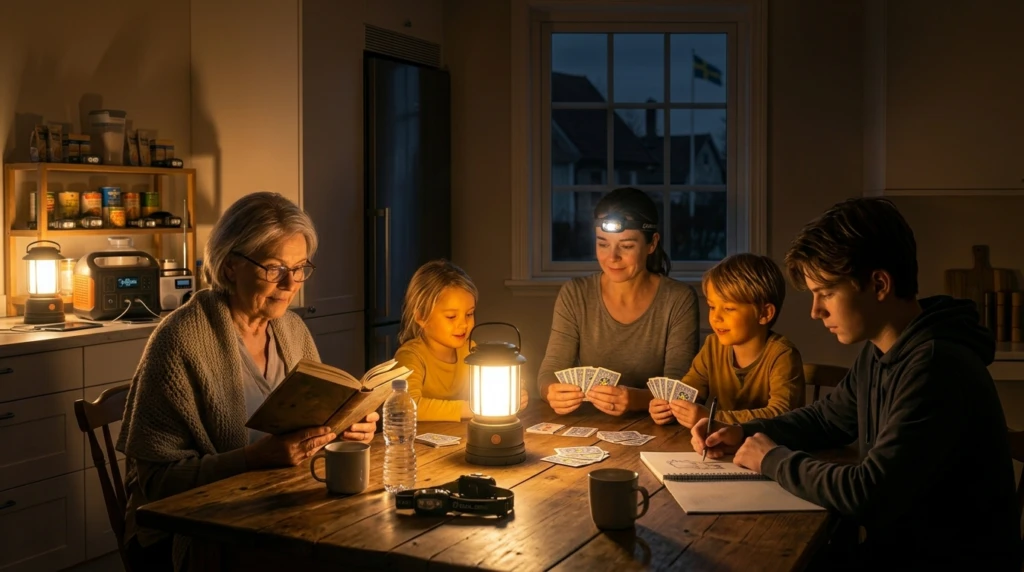 Certain family members require additional planning and resources.
Infants and Young Children: Formula, Diapers, and Comfort
Critical supplies:
- Formula: 7-day supply (powder lasts longer without refrigeration)
- Water for mixing: Bottled or purified water
- Diapers: 10-12 per day minimum
- Wipes: For hygiene without running water
- Comfort items: Favorite toys, blankets (reduces stress)
Temperature considerations:
- Infants can’t regulate body temperature effectively
- Monitor for signs of hypothermia or heat stress
- Maintain skin-to-skin contact for warmth
Elderly Family Members: Medication and Mobility
Medication management:
- 30-day supply of all prescriptions (work with doctor)
- Cooler with ice packs for refrigerated medications
- Written list of medications, dosages, and prescribing doctors
Mobility considerations:
- Flashlights in every room (prevent falls in darkness)
- Avoid stairs during outages if possible
- Keep mobility aids (canes, walkers) accessible
Medical Equipment Dependence: CPAP, Oxygen, Dialysis
CPAP machines:
- Power requirement: 30-60W (varies by model and pressure settings)
- Solution: Portable power station (500Wh minimum for 2 nights)
- Alternative: Battery backup specifically designed for CPAP (Medistrom Pilot-24 Lite)
Oxygen concentrators:
- Power requirement: 300-600W continuous
- Solution: Generator or large power station (2,000Wh+)
- Alternative: Backup oxygen tanks (coordinate with medical supplier)
Dialysis:
- Home dialysis patients: Contact dialysis center for emergency protocols
- May require evacuation to facility with backup power
Pets: Food, Water, and Temperature Needs
Essential supplies:
- 7-day supply of pet food
- 1 gallon of water per day per pet
- Medications (30-day supply)
- Leash, carrier, comfort items
Temperature considerations:
- Pets are vulnerable to temperature extremes
- Provide cooling (wet towels, fans) or warming (blankets, body heat)
- Monitor for signs of distress
Frequently Asked Questions
How long do most power outages last?
According to the U.S. Energy Information Administration, the median power outage duration is 3.5 hours. However, this varies significantly by cause:
- Equipment failure: 1-4 hours (localized, quick repair)
- Severe weather: 12-72 hours (widespread damage, slower restoration)
- Major storms (hurricanes, ice storms): 3-14 days (extensive infrastructure damage)
The 72-hour preparedness standard covers 95% of outage scenarios.
What’s the first thing I should do when the power goes out?
Immediate actions (first 5 minutes):
- Check if it’s just your home: Look outside—are neighbors’ lights on? Check your breaker panel.
- Report the outage: Call your utility company or use their app
- Turn off major appliances: Prevents power surge damage when electricity returns
- Keep refrigerator and freezer closed: Preserves cold
- Gather your family: Account for everyone, distribute flashlights
Can I run my refrigerator on a portable power station?
Yes, but with limitations.
Power requirements:
- Modern refrigerators: 100-800W running, 1,200-2,000W startup surge
- Energy-efficient models: 100-300W running
Portable power station requirements:
- Minimum: 1,000Wh capacity with 1,500W+ surge capacity
- Recommended: 2,000Wh capacity for extended runtime
Runtime calculation:
- A 1,000Wh power station running a 150W refrigerator = approximately 6-7 hours
- Refrigerators cycle on/off, so actual runtime varies
Better strategy: Use power station for critical items (medications, medical devices). Let refrigerator stay closed and use coolers with ice.
How much does it cost to prepare for a power outage?
Budget tier ($200-$400):
- Basic lighting (headlamps, lanterns): $50-$100
- Small portable power station: $200-$300
- 3-day food and water: $50-$100
- Total: $300-$500
Mid-range tier ($500-$1,000):
- Comprehensive lighting: $100-$150
- Mid-size portable power station (500Wh): $500-$700
- 7-day food and water: $100-$150
- NOAA radio and communication: $50-$100
- Total: $750-$1,100
Premium tier ($2,000-$5,000+):
- Professional lighting systems: $200-$300
- Large portable power station (2,000Wh) or generator: $1,500-$3,000
- 30-day food and water: $300-$500
- Solar panels: $500-$1,000
- Total: $2,500-$4,800
Whole-home backup ($10,000-$30,000+):
- Whole-home generator or solar + battery system
Should I buy a generator or a battery backup system?
Choose a generator if:
- You need high wattage (running well pump, whole-home AC, multiple appliances)
- You have outdoor space for safe operation
- You can store fuel safely
- You’re comfortable with maintenance (oil changes, spark plugs)
- Budget: $500-$3,000
Choose a battery backup (portable power station) if:
- You need moderate power (phones, laptops, CPAP, small appliances)
- You live in an apartment or have limited outdoor space
- You want silent, indoor-safe operation
- You prefer low maintenance
- You want to pair with solar panels
- Budget: $200-$2,500
Best solution: Many households benefit from both—a portable power station for immediate needs and a generator for extended outages.
Taking the Next Step
Power outage preparedness isn’t about fear. It’s about freedom—the freedom from anxiety when the forecast shows severe weather, the freedom to help your neighbors when they’re struggling, the freedom to know that your family will be safe and comfortable no matter what happens to the grid.
You don’t need to do everything at once. Start with Week 1 of the 30-day plan. Buy a headlamp and a case of water. Test your flashlights. Write down your emergency contacts. Each small step builds momentum and confidence.
The next time the power goes out—and it will—you won’t be scrambling in the dark, hoping your phone has enough battery to last. You’ll calmly reach for your headlamp, check on your family, and settle in knowing you’ve got this handled.
That’s the difference between hoping and preparing. And that difference could save your life.
PRODUCTS / TOOLS / RESOURCES
These are the specific items and resources that consistently come up in serious power outage preparedness conversations—selected for reliability, value, and real-world effectiveness.
Emergency Lighting
- Black Diamond Spot Headlamp: 300 lumens, waterproof (IPX8), red-light mode for preserving night vision, runs on AAA batteries. The standard for reliability ($40).
- Goal Zero Lighthouse 400 Lantern: 400 lumens, rechargeable via USB or hand-crank, doubles as a phone charger. Provides 48 hours of light on low setting ($60).
- Energizer Ultimate Lithium AA Batteries (24-pack): 10-year shelf life, performs in extreme temperatures (-40°F to 140°F). The best long-term storage battery ($30).
Portable Power Solutions
- Jackery Explorer 500: 518Wh capacity, 500W output, powers CPAP machines, laptops, phones, and small appliances. Pairs with solar panels for recharging. The best mid-range option ($500).
- EcoFlow Delta 2: 1,024Wh capacity, 1,800W output (3,000W surge), fast charging (80% in 50 minutes), expandable capacity. Powers refrigerators and medical devices ($1,000).
- Anker PowerCore 26800 Power Bank: 26,800mAh capacity, charges phones 6-7 times, compact and portable. Essential for communication devices ($60).
Generators
- Honda EU2200i Inverter Generator: 2,200W output, ultra-quiet (48-57 dB), fuel-efficient, clean power for electronics. The gold standard for reliability ($1,100).
- Generac 2,500 Watt Gas Powered Portable Inverter Generator: Runs on gasoline or propane, electric start, 9-hour runtime on gasoline. Best budget option for high wattage ($450).
Communication & Information
- Midland ER310 Emergency Radio: NOAA weather alerts, AM/FM, hand-crank and solar charging, flashlight, USB phone charging. The most versatile emergency radio ($60).
- Midland GXT1000VP4 GMRS Two-Way Radio: Waterproof, 35-mile range (in ideal conditions), 22 channels, rechargeable. Essential for family communication ($80).
Water Storage & Purification
- Aqua-Tainer 7-Gallon Water Container: Food-grade, stackable, built-in spigot, BPA-free. The standard for home water storage is $15 each.
- Sawyer Squeeze Water Filter: 0.1-micron filtration, 100,000-gallon capacity, removes 99.99999% of bacteria and protozoa. Lightweight and versatile ($25).
- Potable Aqua Chlorine Dioxide Tablets: Kills viruses, bacteria, and Giardia. Lightweight backup purification (30 tablets for $10).
Heating & Cooling
- Mr. Heater Buddy Portable Propane Heater: 4,000-9,000 BTU, indoor-safe with automatic shutoff, heats 225 sq ft. Requires ventilation and CO detector ($100).
- Koonie 10000mAh Battery Operated Fan: Runs 3-24 hours depending on speed, USB rechargeable, quiet operation. Essential for summer outages ($30).
Food & Cooking
- Coleman Classic Propane Stove: Two-burner, 20,000 BTU, runs 1 hour per 16.4 oz propane cylinder. The standard for outdoor cooking ($50).
- Mountain House Essential Bucket: 32 servings of freeze-dried meals, 25-year shelf life, just add water. Convenient long-term food storage ($100).
Safety & Monitoring
- Kidde Battery-Operated Carbon Monoxide Detector: Essential if using any combustion heating or cooking. Replace batteries annually ($25).
- First Alert 10-Year Sealed Battery Smoke & CO Detector: No battery changes for 10 years, dual detection ($45).
Planning Resources
- FEMA Ready.gov: Free downloadable guides, checklists, and emergency planning tools from the federal government.
- Red Cross Emergency App: Free smartphone app with weather alerts, emergency preparedness information, and first aid guidance.
- “When Technology Fails” by Matthew Stein: Comprehensive manual for self-reliance covering power, water, food, and shelter systems.