
Hey there! Some links on this page may be affiliate links which means that, if you choose to make a purchase, I may earn a commission at no extra cost to you. I greatly appreciate your support. Read the full disclosure here.
Family Bug Out Bag: The Complete Age-Specific Guide
Family bug out bag isn’t just a bigger version of a solo survival pack—it’s a completely different system. When you’re responsible for keeping children alive during an evacuation, every ounce matters, every item serves multiple people, and every decision multiplies across ages, sizes, and needs that change by the year.
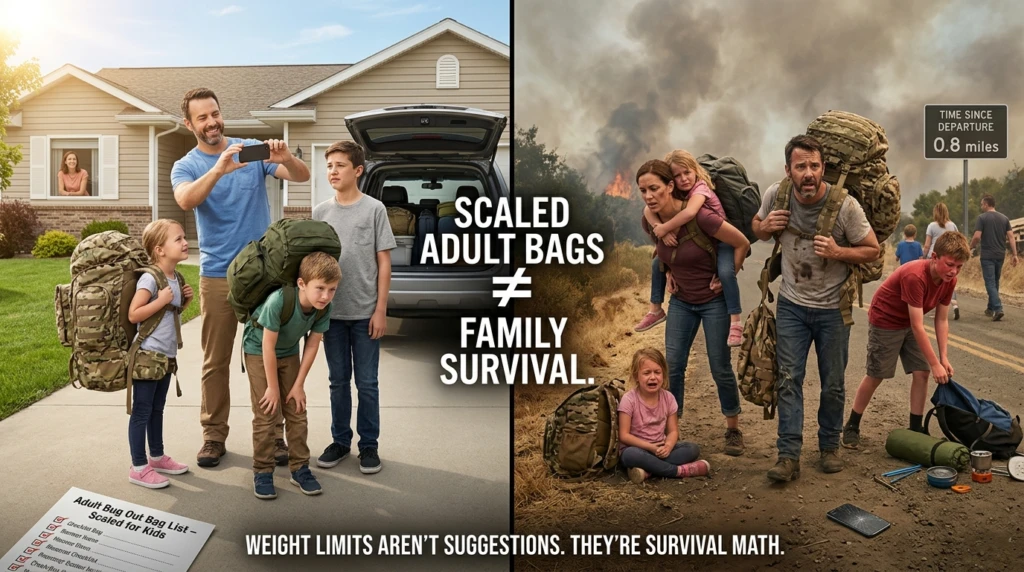
Most families make the same critical mistake: they scale up adult bug out bag lists without accounting for the reality that a 6-year-old can’t carry 20 pounds, an infant needs formula every 3 hours, and a teenager going through a growth spurt needs different clothing sizes than they did six months ago. The result? Bags that are too heavy to carry during actual evacuation, missing critical age-specific supplies, and children who break down psychologically because nobody packed their comfort items.
This is your complete guide to building a bug out bag system for families—from infants to teens, from single parents to families of six, from the weight calculations that determine what each person can actually carry to the psychological survival items that keep children calm during crisis. Because when disaster strikes and you have 15 minutes to evacuate, your family’s survival depends on having the right supplies for every member, distributed correctly, and practiced enough that everyone knows exactly what to grab.
Why Family Bug Out Bag Isn’t Just a Bigger Backpack?
Before you start buying supplies, understand why family preparednessis fundamentally different from individual survival.
The Fatal Flaw of Scaling Adult Bags for Children
The common approach: Take an adult bug out bag checklist, buy smaller versions of everything, and call it done.
Why it fails:
- Weight capacity mismatch: Adults can carry 20-25% of body weight; children can carry 10-15% maximum
- Caloric needs differ: Children need different food types and quantities than adults
- Psychological needs: Children require comfort items that adults can skip
- Medical complexity: Pediatric medications have different dosing, formulations, and requirements
- Size variations: A family with kids aged 2, 7, and 14 needs three completely different clothing sizes
Real consequence: During Hurricane Katrina, families who packed “scaled-down adult bags” for children discovered their kids couldn’t carry the weight beyond the first mile. Parents ended up carrying multiple bags, exhausting themselves, and having to abandon supplies to keep moving.
Age-Specific Needs That Generic Lists Miss
What generic lists include:
- Water (1 gallon per person per day)
- Food (2,000 calories per person per day)
- First aid kit
- Flashlight and batteries
What they miss for families:
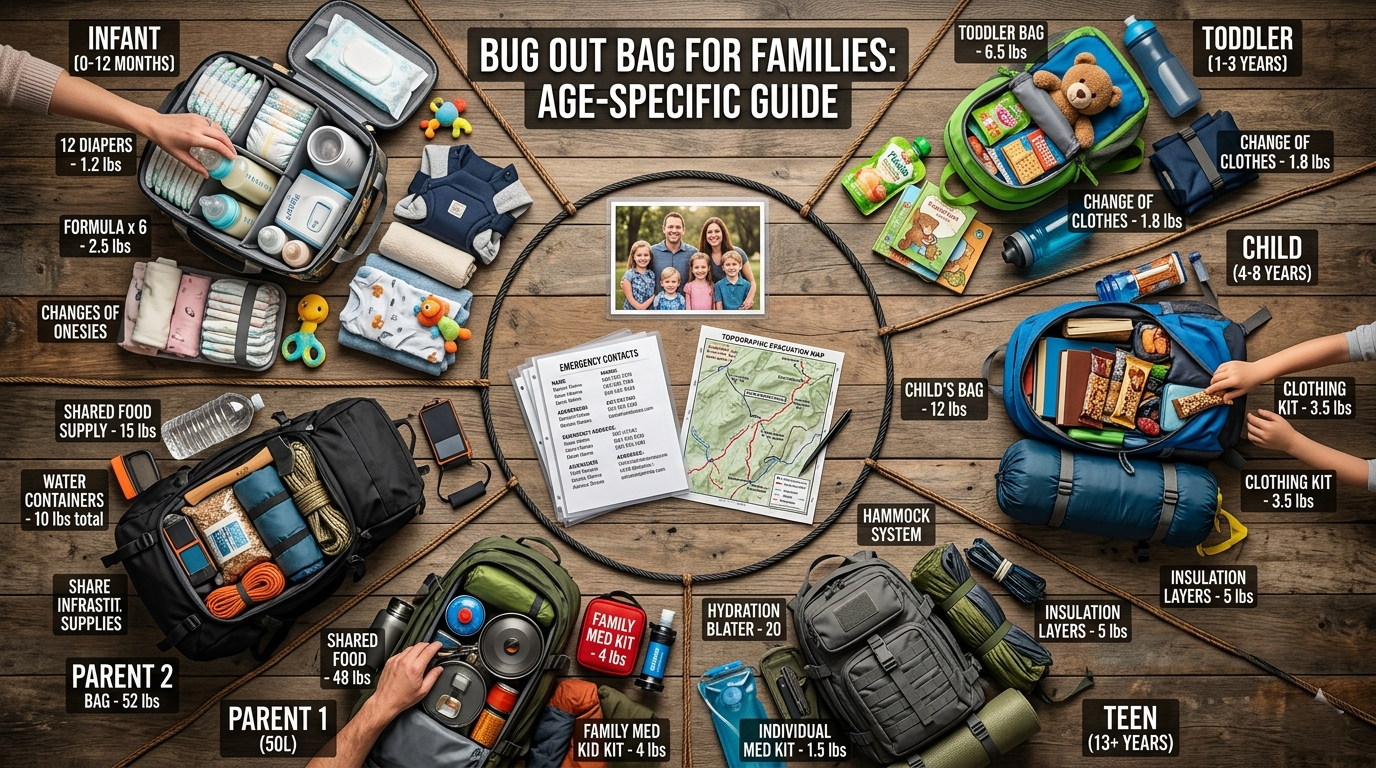
- Infants (0-12 months): Formula, bottles, sterilization, diapers (8-10 per day), diaper cream, infant Tylenol, pacifiers
- Toddlers (1-4 years): Pull-ups, sippy cups, age-appropriate snacks, comfort toys, child carrier for parent
- Children (5-12 years): Smaller clothing sizes, child-sized sleeping bags, entertainment items, familiar foods they’ll actually eat
- Teens (13-17 years): Adolescent hygiene products, larger food portions, personal electronics for morale
Example: A family with a 2-year-old needs 24-30 diapers for 72 hours. That’s 5-7 pounds of weight that doesn’t appear on any adult bug out bag list. Miss this, and you’re dealing with diaper rash, infection risk, and a screaming toddler in a crisis situation.
The Weight Distribution Mistake That Slows Families Down
The mistake: Packing each family member’s supplies in their own bag based on equal distribution.
Why it fails:
- Children can’t carry their full share: A 50-pound 7-year-old can carry 5-7 pounds maximum, but their 72-hour supplies weigh 15+ pounds
- Parents become pack mules: Trying to carry their own bag plus children’s overflow leads to exhaustion and injury
- Evacuation speed drops: Overloaded parents move slowly; underloaded children could carry more
The right approach:
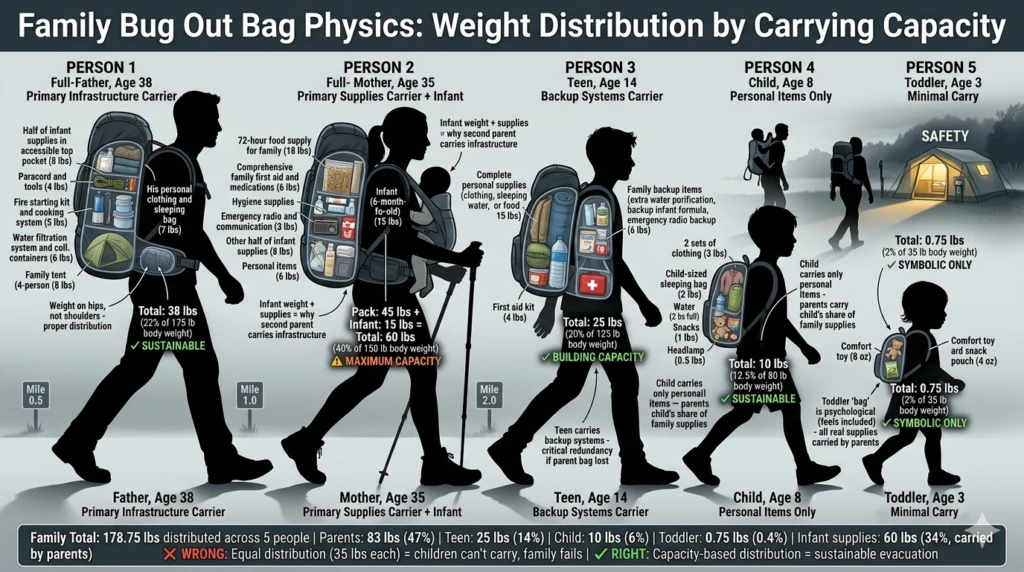
- Parent primary bags: 35-45 pounds (shelter, water purification, fire, tools, shared supplies)
- Teen bags (13-17): 20-30 pounds (their personal supplies plus family backup items)
- Child bags (5-12): 5-15 pounds (personal clothing, comfort items, light snacks)
- Toddler supplies (1-4): Carried by parents in dedicated child carrier or integrated into parent bags
- Infant supplies (0-12 months): Carried by parents in accessible pockets and compartments
The short version: A family bug out bag system distributes weight based on carrying capacity, not equal division. Parents carry 35-45 pounds of shared survival gear (shelter, water purification, fire, tools), teens carry 20-30 pounds of personal supplies plus backup items, children aged 5-12 carry 5-15 pounds of clothing and comfort items, and parents carry all supplies for children under 5 in dedicated carriers or integrated compartments.
Key Takeaways:
– Family bug out bags must be tailored by age and weight, avoiding the common mistake of simply scaling down adult packs; children’s carrying capacities range from 5 to 30 pounds depending on age and size.
– Effective family preparedness involves multiple, coordinated bags: adults carry heavy shared supplies, teens carry full personal plus backup items, school-age children carry light personal bags, and parents carry infant/toddler supplies.
– Psychological needs are crucial—packing comfort items (2-3 pounds per child) significantly improves children’s cooperation, morale, and sleep during emergencies.
– Regular practice drills, age-appropriate training, and quarterly maintenance of sizes, medications, and food ensure the family can efficiently execute evacuation plans under stress.
– Prioritize purchasing critical survival gear first (water, food, medications, basic shelter), build the family system gradually, and use budget-friendly alternatives without compromising essential items like water purification and footwear.
The Family Bug Out Bag System (Not Just One Bag)
 Effective family preparedness requires multiple bags working together as a system.
Parent Primary Bags (Capacity and Critical Supplies)
Parent 1 Primary Bag (Shelter & Water):
- Capacity: 40-50 liter backpack
- Weight target: 35-40 pounds
- Contents:
- Family-sized tent or tarp shelter (4-6 person)
- Sleeping bags or emergency blankets (family quantity)
- Water filtration system (Sawyer Mini or LifeStraw Family)
- Water storage (collapsible containers, 6+ liters)
- Fire starting kit (waterproof matches, ferro rod, tinder)
- Cooking system (portable stove, fuel, pot)
- Rope and cordage (50+ feet paracord)
Parent 2 Primary Bag (Food & Medical):
- Capacity: 40-50 liter backpack
- Weight target: 35-40 pounds
- Contents:
- 72-hour food supply for entire family
- Complete family first aid kit
- Prescription medications for all family members
- Hygiene supplies (toilet paper, soap, sanitizer)
- Tools (multi-tool, knife, duct tape)
- Emergency radio and communication
- Flashlights and batteries (multiple)
Why this division:
- Redundancy: If one parent is separated, they have either shelter/water OR food/medical
- Specialization: Each parent becomes expert in their bag’s contents
- Load balancing: Distributes weight evenly between two adults
Teen Supplementary Bags (Age 13-17)
What teens can carry:
- Weight capacity: 20-30 pounds (depending on size and fitness)
- Bag size: 30-40 liter backpack
Contents:
- Personal supplies:
- 72-hour clothing (3 sets)
- Personal hygiene items
- Sleeping bag or blanket
- Water bottle (2 liters)
- Personal medications
- Flashlight and batteries
- Family backup items:
- Extra food rations (family backup)
- Additional first aid supplies
- Backup water purification (tablets or filter)
- Entertainment items (cards, books)
Why teens carry backup supplies:
- Capacity: Teens can carry more than children but less than adults
- Responsibility: Builds confidence and preparedness skills
- Redundancy: Creates backup if parent bags are lost or damaged
Child Comfort Bags (Age 5-12)
What children can carry:
- Weight capacity: 5-15 pounds (10-15% of body weight)
- Bag size: 15-25 liter backpack (child-sized)
Contents:
- Personal items:
- 2-3 sets of clothing (appropriate for weather)
- Underwear and socks (3+ pairs)
- Jacket or warm layer
- Personal water bottle (1 liter)
- Comfort items (stuffed animal, blanket, photos)
- Entertainment (small toys, coloring book, crayons)
- Snacks they enjoy (granola bars, crackers)
- Flashlight (child-sized, easy to use)
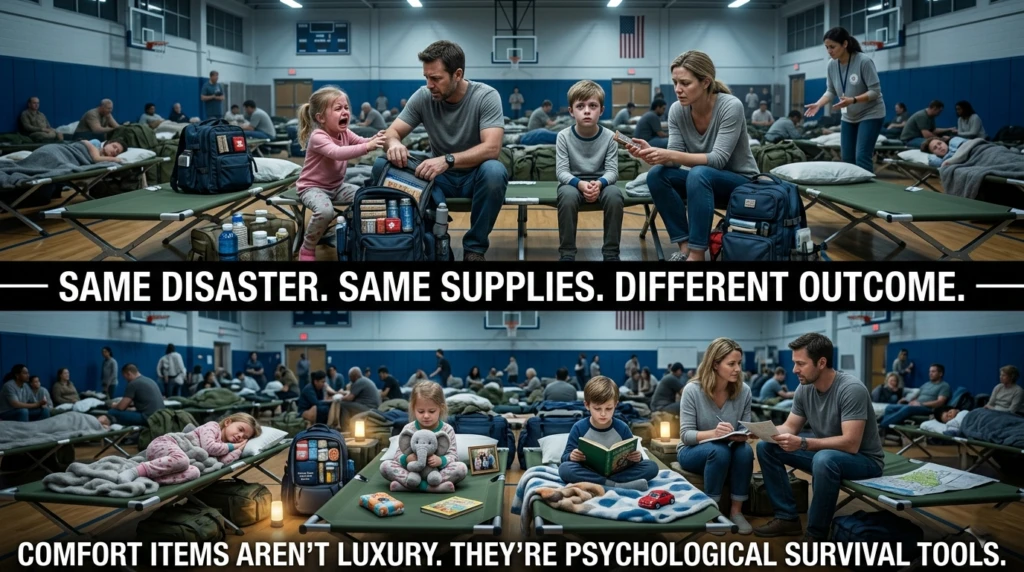
Why comfort items are critical:
- Psychological stability: Familiar items reduce trauma and anxiety
- Cooperation: Children who feel secure are easier to manage during crisis
- Sleep: Comfort items help children sleep in unfamiliar environments
Teaching children to pack:
- Involvement: Let children choose some items (within guidelines)
- Ownership: Children who pack their own bags know what’s inside
- Practice: Regular drills teach children to carry their bags
Toddler Parent-Carried Essentials (Age 1-4)
Carrying method:
- Child carrier backpack: Osprey Poco or Deuter Kid Comfort (if child needs to be carried)
- Parent bag integration: Toddler supplies in accessible pockets of parent bags
Essential supplies (72 hours):
- Diapers/Pull-ups: 24-30 (8-10 per day)
- Wipes: 1-2 packs (diaper changes, cleaning)
- Diaper cream: Prevent rash
- Change of clothes: 3-4 sets (accidents, weather)
- Sippy cups: 2 (one in use, one backup)
- Toddler food: Pouches, crackers, familiar snacks (easy to eat, no prep)
- Comfort items: Favorite toy, blanket, pacifier
- Medications: Infant/toddler Tylenol, any prescriptions
Weight consideration:
- Supplies alone: 10-15 pounds
- Child weight: 25-40 pounds (if carried)
- Total parent load: 45-60 pounds (if carrying child + supplies)
Strategy:
- Rotate carrying: Two parents alternate carrying toddler
- Encourage walking: Toddlers walk when possible, carried when tired
- Lightweight supplies: Choose lightest diaper brands, minimal packaging
Infant Survival Kit (0-12 Months)
Carrying method:
- Baby carrier: Ergobaby, BabyBjörn, or wrap (hands-free carrying)
- Diaper bag integration: Infant supplies in dedicated diaper bag carried by parent
Essential supplies (72 hours):
- Formula: 72+ ounces (if formula-fed) or breastfeeding supplies
- Bottles: 3-4 bottles (rotation for cleaning)
- Bottle brush and soap: Cleaning supplies
- Water for formula: 1 gallon+ (separate from drinking water)
- Diapers: 30-36 (10-12 per day for newborns)
- Wipes: 2-3 packs
- Diaper cream and ointment
- Burp cloths: 4-6
- Receiving blankets: 3-4 (warmth, swaddling, changing surface)
- Change of clothes: 4-6 onesies and sleepers
- Infant medications: Tylenol, gas drops, any prescriptions
- Pacifiers: 3-4 (easy to lose)
- Thermometer
Special considerations:
- Breastfeeding mothers: Nursing cover, breast pads, manual pump, storage bags
- Formula preparation: Pre-measured formula portions, clean water source
- Temperature regulation: Infants can’t regulate body temperature—extra blankets critical
Weight reality:
- Infant supplies: 15-20 pounds (formula, diapers, clothing)
- Infant weight: 8-20 pounds (age-dependent)
- Parent carrying: 25-40 pounds total (infant + supplies)
The 72-Hour Family Survival Calculation
 Understanding how much you actually need prevents both under-packing and over-packing.
Water Requirements by Age and Activity Level
Standard calculation: 1 gallon per person per day
Family-specific reality:
Adults (2 parents):
- Baseline: 1 gallon per day per adult = 2 gallons/day
- Activity level: Evacuation is high-exertion = add 50% = 3 gallons/day
- 72 hours: 9 gallons total for 2 adults
Teens (13-17):
- Baseline: 0.75-1 gallon per day
- Activity level: High metabolism + exertion = 1 gallon/day
- 72 hours: 3 gallons per teen
Children (5-12):
- Baseline: 0.5-0.75 gallons per day
- Activity level: Moderate = 0.75 gallons/day
- 72 hours: 2.25 gallons per child
Toddlers (1-4):
- Baseline: 0.5 gallons per day (includes food prep)
- 72 hours: 1.5 gallons per toddler
Infants (0-12 months):
- Formula preparation: 0.5-0.75 gallons per day
- 72 hours: 1.5-2.25 gallons per infant
Example family (2 adults, 1 teen, 2 children, 1 toddler):
- Adults: 9 gallons
- Teen: 3 gallons
- Children: 4.5 gallons
- Toddler: 1.5 gallons
- Total: 18 gallons (144 pounds of water)
Solution (you can’t carry 144 pounds):
- Carry: 2-3 gallons per person (initial supply)
- Purify: Water filtration system (Sawyer, LifeStraw, tablets)
- Source: Plan route with water sources (streams, lakes, ponds)
Caloric Needs for Children vs. Adults
Adult caloric needs:
- Baseline: 2,000 calories/day
- High activity: 2,500-3,000 calories/day
- 72 hours: 6,000-9,000 calories per adult
Teen caloric needs (13-17):
- Baseline: 2,000-2,500 calories/day (growth + activity)
- 72 hours: 6,000-7,500 calories per teen
Child caloric needs (5-12):
- Baseline: 1,400-2,000 calories/day
- 72 hours: 4,200-6,000 calories per child
Toddler caloric needs (1-4):
- Baseline: 1,000-1,400 calories/day
- 72 hours: 3,000-4,200 calories per toddler
Infant caloric needs (0-12 months):
- Formula: 24-32 ounces per day (varies by age)
- 72 hours: 72-96 ounces formula
Example family total (2 adults, 1 teen, 2 children, 1 toddler):
- Adults: 12,000-18,000 calories
- Teen: 6,000-7,500 calories
- Children: 8,400-12,000 calories
- Toddler: 3,000-4,200 calories
- Total: 29,400-41,700 calories
Packing strategy:
- High-calorie density: Peanut butter, nuts, energy bars, freeze-dried meals
- Child-friendly: Familiar foods children will actually eat (not just survival rations)
- Variety: Different textures and flavors prevent food fatigue
Medication and Medical Supplies Per Family Member
Prescription medications:
- Minimum: 72-hour supply (3 days)
- Recommended: 7-day supply (in case evacuation extends)
- Critical medications: Asthma inhalers, insulin, EpiPens, seizure medications
Age-specific medical supplies:
Infants (0-12 months):
- Infant Tylenol (acetaminophen drops)
- Infant Motrin (ibuprofen drops, 6+ months)
- Gas drops (simethicone)
- Diaper rash cream
- Saline drops (nasal congestion)
- Thermometer (rectal for infants)
Toddlers (1-4 years):
- Children’s Tylenol (liquid)
- Children’s Motrin (liquid)
- Benadryl (allergic reactions)
- Hydrocortisone cream (rashes, bug bites)
- Antibiotic ointment
- Band-aids (character designs for cooperation)
Children (5-12 years):
- Children’s pain reliever (chewable or liquid)
- Allergy medication (if needed)
- Any prescription medications
- Inhaler (if asthmatic)
- EpiPen (if allergic)
Teens and Adults:
- Adult pain relievers (ibuprofen, acetaminophen)
- Prescription medications (full supply)
- Antihistamines
- Anti-diarrheal
- Antacids
- Personal medical needs
Family first aid kit:
- Bandages (various sizes)
- Gauze and medical tape
- Antiseptic wipes
- Antibiotic ointment
- Tweezers and scissors
- Thermometer
- Instant cold packs
- Elastic bandages
- Splint materials
- CPR mask
- Medical gloves
Clothing and Shelter for Multiple Body Sizes
Clothing challenge: A family with children aged 2, 7, and 14 needs sizes 2T, 7/8, and adult small—completely different dimensions.
Clothing per person (72 hours):
- Base layers: 2-3 sets (underwear, socks, shirt, pants)
- Insulation layer: 1 fleece or sweater
- Outer layer: 1 waterproof jacket
- Footwear: Sturdy shoes or boots (worn) + backup pair
- Hat and gloves: Weather-appropriate
- Sleepwear: 1 set (if different from base layer)
Size-specific considerations:
- Infants: Grow rapidly—pack next size up
- Toddlers: Extra sets (accidents, spills)
- Children: Durable, comfortable (will be worn continuously)
- Teens: May be between sizes—pack larger
Shelter for families:
- Family tent: 4-6 person capacity (actual sleeping space for family size)
- Sleeping bags: Age-appropriate temperature ratings
- Infant: Sleep with parent or in wearable blanket
- Toddler: Child-sized sleeping bag (shorter length)
- Child: Junior sleeping bag (fits better than adult)
- Teen/Adult: Full-sized sleeping bag
- Sleeping pads: Insulation from ground (critical for children)
- Emergency blankets: Backup warmth (lightweight, compact)
Weight consideration:
- Family tent: 5-8 pounds
- Sleeping bags: 2-3 pounds each × family size
- Pads: 1 pound each × family size
- Total shelter weight: 15-25 pounds (carried by parents)
Age-Specific Bug Out Bag Essentials
 Different ages require completely different supplies and approaches.
Infant Bag (0-12 Months)
Formula, bottles, and feeding supplies
If formula-feeding:
- Formula: 72+ ounces (pre-measured portions in ziplock bags or formula dispenser)
- Bottles: 3-4 bottles (8-ounce capacity)
- Nipples: Extra nipples (different flow rates as backup)
- Bottle brush: Cleaning between uses
- Dish soap: Small travel size
- Water for formula: 1+ gallon (separate from drinking water, purified)
If breastfeeding:
- Nursing cover: Privacy and warmth
- Breast pads: Prevent leaking
- Manual breast pump: If separation from baby occurs
- Milk storage bags: Store expressed milk
- Nipple cream: Prevent cracking and pain
Feeding strategy:
- Pre-measure formula: Speeds preparation, reduces errors
- Room temperature feeding: Eliminates need to heat bottles
- Sterilization: Boiling water when possible, sanitizing wipes as backup
Diapers and hygiene (72-hour supply)
Diaper calculation:
- Newborn (0-3 months): 10-12 diapers per day = 30-36 diapers
- Infant (3-12 months): 8-10 diapers per day = 24-30 diapers
Diaper supplies:
- Diapers: 30-36 (size-appropriate)
- Wipes: 2-3 packs (diaper changes, cleaning hands, faces)
- Diaper cream: Prevent and treat rash (Desitin, A&D)
- Changing pad: Portable, waterproof surface
- Diaper bags: Disposal bags for used diapers
- Hand sanitizer: Clean hands before/after changes
Hygiene strategy:
- Frequent changes: Prevent rash (every 2-3 hours minimum)
- Wipe conservation: Use sparingly, supplement with water rinse
- Disposal: Sealed bags to contain odor
Infant medications and first aid
Essential medications:
- Infant Tylenol: Acetaminophen drops (fever, pain)
- Infant Motrin: Ibuprofen drops (6+ months, fever, pain)
- Gas drops: Simethicone (colic, gas discomfort)
- Gripe water: Natural colic relief
- Saline drops: Nasal congestion
- Diaper rash cream: Treatment (zinc oxide)
First aid:
- Thermometer: Rectal (most accurate for infants)
- Medicine dropper: Accurate dosing
- Nail clippers: Infant-sized
- Bulb syringe: Nasal suction
- Petroleum jelly: Thermometer lubrication, skin protection
Dosing chart:
- Weight-based dosing: Infant medications dose by weight, not age
- Chart in bag: Laminated dosing chart for reference
- Consult pediatrician: Pre-evacuation dosing guidance
Comfort items and sleep essentials
Sleep items:
- Swaddle blankets: 2-3 (helps infant sleep)
- Sleep sack: Wearable blanket (safer than loose blankets)
- White noise: Battery-powered sound machine or app
- Pacifiers: 3-4 (easy to lose or drop)
- Lovey: Small comfort object (if age-appropriate)
Comfort strategy:
- Familiar items: Maintain routine as much as possible
- Scent: Parent’s worn shirt in sleep area (comforting scent)
- Routine: Bedtime routine even in crisis (signals sleep time)
Toddler Additions (1-4 Years)
Pull-ups and potty training supplies
For potty-training toddlers:
- Pull-ups: 24-30 (same quantity as diapers)
- Portable potty: Foldable travel potty or potty seat
- Toilet paper: Small roll
- Hand sanitizer: Clean hands after potty
- Rewards: Small stickers or treats (positive reinforcement)
For fully potty-trained:
- Underwear: 6-8 pairs (accidents happen in stress)
- Portable potty: Still useful (no bathrooms available)
- Wipes: Cleaning after potty
Age-appropriate food and snacks
Toddler food requirements:
- Familiar foods: Toddlers are picky—pack foods they’ll actually eat
- No-prep options: Pouches, crackers, dry cereal, fruit cups
- Protein: Peanut butter, cheese sticks, meat sticks
- Variety: Different textures and flavors
Toddler-friendly options:
- Pouches: Fruit, vegetable, yogurt pouches (no spoon needed)
- Crackers: Goldfish, animal crackers, graham crackers
- Dry cereal: Cheerios, Chex (easy to eat, no milk needed)
- Fruit cups: Individual servings (no refrigeration)
- Cheese: String cheese, cheese crackers
- Peanut butter: Individual packets or small jar
- Granola bars: Soft varieties (choking hazard awareness)
Feeding supplies:
- Sippy cups: 2 (spill-proof)
- Spoons: 2-3 (toddler-sized)
- Bowls: 1-2 (lightweight, unbreakable)
- Bibs: 2-3 (messy eaters)
Comfort toys and distraction items
Why critical for toddlers:
- Attention span: Toddlers can’t sit still for hours
- Emotional regulation: Toys provide comfort and distraction
- Cooperation: Entertained toddlers are easier to manage
Recommended items:
- Favorite stuffed animal: 1 (primary comfort item)
- Small toys: 2-3 (cars, dolls, action figures)
- Books: 2-3 board books (durable, familiar stories)
- Crayons and paper: Coloring (quiet activity)
- Stickers: Reusable sticker books (hours of entertainment)
- Bubbles: Small bottle (outdoor entertainment)
Weight consideration:
- Limit toys: 2-3 pounds maximum
- Multi-use items: Books that also teach, toys that comfort
Child carrier or hiking backpack
When toddlers need to be carried:
- Fatigue: Can’t walk long distances
- Speed: Evacuation requires faster pace than toddler can maintain
- Safety: Dangerous terrain or situations
Carrier options:
- Soft structured carrier: Ergobaby, Tula (up to 45 pounds, front or back carry)
- Hiking backpack: Osprey Poco, Deuter Kid Comfort (up to 48 pounds, back carry only)
- Hip seat carrier: LÍLLÉbaby (shorter carries, less back strain)
Carrier considerations:
- Weight limit: Check manufacturer limits
- Comfort: Padded straps and hip belt (long-distance carrying)
- Storage: Pockets for toddler supplies
- Weather protection: Sunshade and rain cover
Strategy:
- Encourage walking: Toddler walks when possible
- Carry when needed: Parent carries when toddler tires
- Rotate carriers: Two parents alternate carrying
Child Bag (5-12 Years)
What kids can carry (weight guidelines)
Weight capacity by age:
- Age 5-7: 5-10 pounds (10-15% of body weight)
- Age 8-10: 10-15 pounds (10-15% of body weight)
- Age 11-12: 15-20 pounds (15-20% of body weight)
Factors affecting capacity:
- Fitness level: Active children can carry more
- Distance: Longer evacuations require lighter loads
- Terrain: Difficult terrain reduces capacity
- Weather: Heat reduces capacity
Testing capacity:
- Practice hikes: Load bag, walk 1-2 miles, assess comfort
- Adjust weight: Remove items if child struggles
- Build gradually: Increase weight over time as child strengthens
Child-sized clothing and footwear
Clothing for children:
- Base layers: 2-3 sets (underwear, socks, shirt, pants)
- Insulation: 1 fleece or hoodie
- Rain jacket: Waterproof outer layer
- Hat: Sun protection or warmth
- Gloves: If cold weather
Footwear:
- Primary shoes: Sturdy sneakers or hiking shoes (worn during evacuation)
- Backup shoes: Sandals or lightweight shoes (if primary gets wet)
- Socks: 3-4 pairs (keep feet dry and blister-free)
Sizing strategy:
- Current size: Pack current size (not “room to grow”)
- Comfort: Shoes must fit well (blisters disable children)
- Durability: Quality over quantity (one good pair better than two cheap pairs)
Entertainment and morale items
Why entertainment matters:
- Boredom: Children can’t sit idle for hours
- Stress relief: Play reduces anxiety
- Cooperation: Entertained children are easier to manage
- Sleep: Familiar activities signal bedtime
Recommended items:
- Books: 1-2 favorite books (comfort and entertainment)
- Small toys: 1-2 (action figures, dolls, small cars)
- Cards or travel games: Uno, card games (family activity)
- Journal and pencil: Drawing, writing (processing emotions)
- Comfort item: Stuffed animal or blanket (sleep aid)
Weight limit: 2-3 pounds maximum for entertainment
Teaching responsibility through packing
Benefits of child involvement:
- Ownership: Children who pack their bags know what’s inside
- Confidence: Builds self-reliance and preparedness skills
- Cooperation: Children are more likely to carry bags they packed
How to involve children:
- Age 5-7: Parent packs, child helps choose comfort items
- Age 8-10: Child packs with parent supervision and checklist
- Age 11-12: Child packs independently, parent reviews
Teaching process:
- Explain purpose: Why we have bug out bags
- Show checklist: What needs to be packed
- Let child choose: Within guidelines (which shirt, which toy)
- Practice packing: Teach organization and accessibility
- Practice carrying: Walk with loaded bag, adjust as needed
Teen Bag (13-17 Years)
Full adult-level supplies they can carry
Teen capacity:
- Weight: 20-30 pounds (approaching adult capacity)
- Bag size: 30-40 liter backpack
- Responsibility: Can manage their own complete survival needs
Teen bag contents:
- Clothing: 3 sets base layers, insulation, rain gear
- Sleeping: Sleeping bag, pad
- Water: 2-liter bottle, purification tablets
- Food: 72-hour supply (high-calorie, teen-approved)
- Hygiene: Toothbrush, toothpaste, soap, deodorant, menstrual products (if applicable)
- First aid: Personal first aid kit
- Light: Flashlight, headlamp, batteries
- Tools: Multi-tool, knife (if trained)
- Electronics: Phone, charger, portable battery
- Documents: Copy of ID, emergency contacts
Skill-building tools and responsibilities
Why teens need responsibilities:
- Capability: Teens can perform adult-level tasks
- Confidence: Responsibilities build self-reliance
- Family support: Teens can assist parents with younger children
Teen responsibilities:
- Navigation: Map reading, compass use, GPS
- Fire starting: Safely start and maintain fire
- Water purification: Filter and purify water for family
- First aid: Administer basic first aid
- Child care: Help with younger siblings
- Communication: Operate emergency radio
Tools for skill-building:
- Map and compass: Navigation practice
- Fire starter kit: Matches, ferro rod, tinder
- Water filter: Personal filter (Sawyer Mini)
- First aid manual: Reference guide
- Multi-tool: Practical tool use
Personal hygiene for adolescents
Adolescent-specific needs:
- Body odor: Deodorant (stress increases odor)
- Acne: Face wash, acne treatment (if used regularly)
- Menstruation: Pads, tampons, menstrual cup, pain reliever
- Privacy: Teens need privacy for hygiene and changing
Hygiene supplies:
- Toothbrush and toothpaste
- Soap: Bar or liquid
- Deodorant: Stick or travel size
- Shampoo: Dry shampoo or small bottle
- Menstrual products: 1 cycle supply minimum
- Pain reliever: For cramps, headaches
- Wipes: Body wipes for no-shower days
- Towel: Small quick-dry towel
Privacy considerations:
- Changing clothes: Tarp or privacy shelter
- Bathroom: Portable privacy tent or designated area
- Respect: Acknowledge teen need for dignity
Parent Bug Out Bags (The Family Anchor)
 Parents carry the critical shared supplies that keep the entire family alive.
Primary Parent Bag (Shelter, Fire, Water Purification)
Why one parent carries shelter/water:
- Specialization: Expertise in setup and use
- Weight distribution: Balances load between parents
- Redundancy: If separated, one parent has shelter/water capability
Shelter system:
- Family tent: 4-6 person capacity (actual sleeping space)
- Options: MSR Habitude 4, REI Kingdom 4, Coleman Sundome 6
- Weight: 5-8 pounds
- Setup: Practice setup in under 10 minutes
- Alternative: Tarp shelter (lighter, requires skill)
- Tarp: 10×12 feet minimum
- Cordage: 100 feet paracord
- Stakes: 8-10 stakes
- Weight: 2-3 pounds
Sleeping system:
- Sleeping bags: One per family member (temperature-appropriate)
- Sleeping pads: Insulation from ground (critical for children)
- Emergency blankets: Mylar blankets (backup warmth)
Water purification:
- Primary filter: Sawyer Mini or LifeStraw Family (filters bacteria, protozoa)
- Backup: Water purification tablets (Aquatabs, iodine)
- Storage: Collapsible water containers (6+ liters)
- Bottles: Reusable water bottles for each family member
Fire starting:
- Waterproof matches: 2-3 boxes
- Ferro rod: Backup fire starter (works when wet)
- Lighter: BIC lighters (2-3)
- Tinder: Dryer lint, cotton balls with petroleum jelly, commercial tinder
Cooking system:
- Stove: Portable camping stove (MSR PocketRocket, Jetboil)
- Fuel: Fuel canisters (2-3 for 72 hours)
- Pot: Lightweight pot (1-2 liter capacity)
- Utensils: Spork or spoon for each family member
Cordage and tools:
- Paracord: 100+ feet (shelter, repairs, lashing)
- Duct tape: 1 roll (repairs, first aid, everything)
- Multi-tool: Leatherman or Gerber (pliers, knife, screwdrivers)
Secondary Parent Bag (Food, Medical, Tools)
Why one parent carries food/medical:
- Specialization: Expertise in meal prep and first aid
- Weight distribution: Balances load between parents
- Redundancy: If separated, one parent has food/medical capability
Food system (72 hours for entire family):
- Calculation: See “72-Hour Family Survival Calculation” section above
- Food types:
- Freeze-dried meals: Mountain House, Backpacker’s Pantry (lightweight, high-calorie)
- Energy bars: Clif Bars, KIND bars (quick energy)
- Nuts and trail mix: High-calorie, protein
- Peanut butter: Individual packets or small jar (protein, calories)
- Crackers: Whole grain crackers (carbs, filling)
- Dried fruit: Raisins, apricots (natural sugars, fiber)
- Infant/toddler food: Formula, pouches, crackers (if applicable)
Medical system:
- Family first aid kit: Comprehensive kit (see “Medication and Medical Supplies” section)
- Prescription medications: 72-hour minimum supply for all family members
- OTC medications: Pain relievers, antihistamines, anti-diarrheal, antacids
- Pediatric medications: Age-appropriate formulations and dosing
Hygiene supplies:
- Toilet paper: 1-2 rolls
- Soap: Biodegradable soap (washing hands, dishes, bodies)
- Hand sanitizer: Alcohol-based (when water unavailable)
- Toothbrushes and toothpaste: One per family member
- Feminine hygiene: Pads, tampons (if applicable)
- Diapers/wipes: If infants or toddlers in family
Tools and equipment:
- Knife: Fixed-blade knife (Mora, Ka-Bar)
- Multi-tool: Backup to primary parent’s multi-tool
- Duct tape: Backup roll
- Sewing kit: Repairs to clothing, gear
- Safety pins: Multiple uses
Communication and navigation:
- Emergency radio: NOAA weather radio, AM/FM (Midland, Eton)
- Whistle: Signal for help (each family member should have one)
- Map: Local area map (waterproof)
- Compass: Backup to GPS
- Flashlights: LED flashlights (one per family member)
- Batteries: Extras for all devices
Weight Distribution Between Two Adults
Total family supplies: 80-100+ pounds
Distribution strategy:
- Parent 1 (Shelter/Water): 35-40 pounds
- Parent 2 (Food/Medical): 35-40 pounds
- Teens (if applicable): 20-30 pounds (personal + backup supplies)
- Children: 5-15 pounds (personal items only)
- Infants/toddlers: Supplies carried by parents
Load balancing:
- Equal weight: Both parents carry similar weight
- Fitness consideration: Stronger parent may carry slightly more
- Rotation: Switch bags periodically to prevent fatigue
- Adjustment: Redistribute weight if one parent struggles
Single-Parent Family Adaptations
Challenge: One adult carrying all critical supplies plus managing children
Strategies:
Prioritize ruthlessly:
- Shelter: Lightweight tarp instead of tent (saves 3-5 pounds)
- Food: High-calorie, lightweight options only
- Water: Carry minimal water, rely heavily on purification
- Eliminate redundancy: One of everything (no backups)
Maximize teen/older child capacity:
- Teens carry more: Push toward 30-pound capacity
- Older children carry more: 15-20 pounds if capable
- Distribute critical items: Teens carry backup food, water purification
Use wheeled options (if terrain allows):
- Wheeled cart: Folding cart for supplies (if roads/paths available)
- Stroller wagon: Heavy-duty stroller for toddlers + supplies
Build community support:
- Buddy system: Partner with another family for mutual aid
- Pre-arranged help: Identify friends/family who will assist in evacuation
Simplify:
- Fewer supplies: 48-hour supply instead of 72-hour
- Lighter gear: Ultralight backpacking gear (expensive but necessary)
- Minimal comfort items: Only most critical items for children
Critical Family-Specific Supplies
These supplies are unique to families and often overlooked in generic bug out bag lists.
Medical and Medications
Prescription medications (72-hour minimum)
Critical importance:
- Life-threatening conditions: Asthma, diabetes, seizures, severe allergies
- Chronic conditions: ADHD, anxiety, depression, thyroid
- Acute needs: Antibiotics, pain management
How to pack:
- Original bottles: Keep in original prescription bottles (proof of prescription)
- Waterproof container: Ziplock bag or waterproof case
- Dosing information: Include dosing schedule and instructions
- Backup supply: 7-day supply if possible (in case evacuation extends)
Medication list:
- Document: List of all medications, dosages, prescribing doctors
- Allergies: List of drug allergies for each family member
- Pharmacy information: Pharmacy name and phone number (for refills)
Pediatric vs. adult dosing
Critical differences:
- Weight-based dosing: Children’s medications dose by weight, not age
- Formulations: Liquid, chewable, or dissolvable (not pills for young children)
- Concentrations: Infant vs. children’s formulations have different concentrations
Dosing chart:
- Laminated chart: Weight-based dosing for common medications
- Include in bag: Quick reference during crisis
- Consult pediatrician: Pre-evacuation dosing guidance
Common pediatric medications:
- Acetaminophen (Tylenol): Infant drops, children’s liquid, chewable tablets
- Ibuprofen (Motrin/Advil): Infant drops (6+ months), children’s liquid, chewable tablets
- Antihistamine (Benadryl): Children’s liquid, chewable tablets
- Hydrocortisone cream: Rashes, bug bites, skin irritation
Chronic condition management (asthma, diabetes, allergies)
Asthma:
- Rescue inhaler: Albuterol (2 inhalers minimum)
- Controller medication: Daily medication (72-hour supply)
- Spacer: Inhaler spacer for children
- Peak flow meter: Monitor lung function
- Action plan: Written asthma action plan
Diabetes:
- Insulin: 72-hour supply (refrigeration if possible, cool storage if not)
- Syringes or pens: Sufficient for 72 hours
- Blood glucose meter: Meter, test strips, lancets
- Fast-acting sugar: Glucose tablets, juice boxes (hypoglycemia treatment)
- Snacks: Regular snacks to maintain blood sugar
Severe allergies:
- EpiPen: 2 EpiPens minimum (one may fail or second dose needed)
- Antihistamine: Benadryl (liquid or chewable)
- Medical alert bracelet: Worn by child
- Allergy action plan: Written instructions for EpiPen use
Family first aid kit essentials
Wound care:
- Bandages: Assorted sizes (Band-Aids, large pads)
- Gauze: Sterile gauze pads (multiple sizes)
- Medical tape: Secure bandages
- Antiseptic wipes: Clean wounds
- Antibiotic ointment: Prevent infection (Neosporin)
- Butterfly closures: Close small cuts
Medications:
- Pain relievers: Acetaminophen, ibuprofen (adult and pediatric)
- Antihistamine: Allergic reactions (Benadryl)
- Anti-diarrheal: Loperamide (Imodium)
- Antacid: Heartburn, upset stomach (Tums, Pepto-Bismol)
- Hydrocortisone cream: Rashes, itching
Tools:
- Tweezers: Remove splinters, ticks
- Scissors: Cut tape, gauze, clothing
- Thermometer: Check for fever
- CPR mask: Barrier for rescue breathing
- Medical gloves: Protect from bodily fluids
- Instant cold pack: Reduce swelling, pain
Specialized items:
- Splint materials: SAM splint (fractures, sprains)
- Elastic bandage: Sprains, support
- Moleskin: Blister prevention and treatment
- Burn gel: Burn treatment
- Eye wash: Flush eyes
Food for All Ages
Infant formula and baby food
Formula-fed infants:
- Formula: 72+ ounces (pre-measured portions)
- Formula type: Same brand/type baby uses (don’t switch during crisis)
- Preparation: Pre-measured in ziplock bags or formula dispenser
- Water: 1+ gallon purified water (separate from drinking water)
Breastfed infants:
- Mother’s nutrition: Extra calories and water for milk production
- Backup formula: Small supply in case mother can’t breastfeed (stress, separation)
- Pumping supplies: Manual pump, storage bags
Baby food (6-12 months):
- Pouches: Fruit, vegetable, meat pouches (no spoon needed, no refrigeration)
- Cereal: Infant cereal (mix with water or formula)
- Crackers: Baby crackers, teething biscuits
- Variety: Different flavors and textures
Toddler-friendly non-perishables
Toddler food challenges:
- Picky eaters: Will refuse unfamiliar foods
- Texture preferences: May reject certain textures
- Small portions: Can’t eat large servings
Toddler-approved options:
- Pouches: Fruit, vegetable, yogurt pouches (familiar, easy to eat)
- Crackers: Goldfish, animal crackers, graham crackers (favorite snacks)
- Dry cereal: Cheerios, Chex (no milk needed, easy to eat)
- Fruit cups: Individual servings (no refrigeration)
- Cheese: String cheese, cheese crackers (protein)
- Peanut butter: Individual packets (protein, calories)
- Pasta: Individual mac and cheese cups (comfort food)
Child-approved emergency foods
Child food challenges:
- Unfamiliar foods: Will refuse “weird” survival foods
- Stress eating: May eat less during crisis
- Comfort foods: Need familiar foods for psychological comfort
Child-friendly options:
- Granola bars: Favorite brands and flavors
- Trail mix: Custom mix with favorites (M&Ms, chocolate chips)
- Crackers: Ritz, Wheat Thins, Triscuits
- Peanut butter: Jif or Skippy (familiar brands)
- Jerky: Beef jerky, turkey jerky (protein)
- Dried fruit: Raisins, apricots, mango
- Candy: Small amounts for morale (Skittles, gummy bears)
- Instant oatmeal: Individual packets (warm, filling)
Adult high-calorie rations
Adult caloric needs: 2,500-3,000 calories/day during high-exertion evacuation
High-calorie options:
- Freeze-dried meals: Mountain House, Backpacker’s Pantry (600-800 calories per meal)
- Energy bars: Clif Bars, KIND bars (200-300 calories each)
- Nuts: Almonds, cashews, peanuts (160-200 calories per ounce)
- Peanut butter: 190 calories per 2 tablespoons
- Trail mix: 150-200 calories per ounce
- Jerky: 80-100 calories per ounce (protein)
- Chocolate: Dark chocolate (150-170 calories per ounce, morale boost)
Meal planning:
- Breakfast: Instant oatmeal, granola bar, coffee/tea
- Lunch: Energy bar, trail mix, jerky
- Dinner: Freeze-dried meal, crackers, chocolate
- Snacks: Nuts, dried fruit, candy
Clothing and Shelter
Layering systems for multiple sizes
Layering principle: Base layer + insulation layer + outer layer
Base layer (moisture-wicking):
- Infants: Onesies, footed pajamas
- Toddlers: Underwear, undershirt, leggings
- Children: Underwear, undershirt, long underwear (if cold)
- Teens/Adults: Underwear, undershirt, long underwear (if cold)
Insulation layer (warmth):
- Infants: Fleece sleeper, warm onesie
- Toddlers: Fleece jacket, hoodie
- Children: Fleece jacket, hoodie, sweater
- Teens/Adults: Fleece jacket, down vest, sweater
Outer layer (weather protection):
- Infants: Bunting, snowsuit (cold), light jacket (mild)
- Toddlers: Rain jacket, winter coat
- Children: Rain jacket, winter coat
- Teens/Adults: Rain jacket, winter coat
Size-specific considerations:
- Infants: Pack next size up (rapid growth)
- Toddlers: Extra sets (accidents, spills)
- Children: Durable, comfortable (worn continuously)
- Teens: May be between sizes (pack larger)
Family-sized tent or shelter
Tent sizing:
- Rated capacity vs. actual: 4-person tent sleeps 3 adults comfortably
- Family sizing: Add 1-2 to family size for comfort
- Family of 4: 5-6 person tent
- Family of 5: 6-8 person tent
Tent options:
- MSR Habitude 4: 4-person, 3-season, 6 lbs 14 oz
- REI Kingdom 4: 4-person, 3-season, 9 lbs 15 oz (more space)
- Coleman Sundome 6: 6-person, budget option, 10 lbs
Tarp shelter (lightweight alternative):
- Tarp: 10×12 feet minimum (family coverage)
- Cordage: 100 feet paracord
- Stakes: 8-10 stakes
- Weight: 2-3 pounds (vs. 7-10 pounds for tent)
- Skill required: Practice setup before emergency
Sleeping bags by age and temperature
Temperature ratings:
- Summer (50°F+): 40-50°F rated bags
- 3-season (20-50°F): 20-30°F rated bags
- Winter (below 20°F): 0-20°F rated bags
Size by age:
- Infants: Sleep with parent or in wearable blanket (no loose blankets)
- Toddlers: Child-sized sleeping bag (shorter length, fits better)
- Children: Junior sleeping bag (fits better than adult, less dead space)
- Teens/Adults: Full-sized sleeping bag (appropriate temperature rating)
Sleeping bag options:
- Budget: Coleman sleeping bags (affordable, heavier)
- Mid-range: Kelty, REI Co-op (good quality, reasonable weight)
- Lightweight: Western Mountaineering, Feathered Friends (expensive, ultralight)
Sleeping pads:
- Importance: Insulation from ground (critical for children)
- Types: Foam pads (cheap, durable), inflatable pads (comfortable, lighter)
- Size: Child-sized pads available (lighter, cheaper)
Extra clothing for growing children
Growth challenge: Children outgrow clothing rapidly
Strategy:
- Check quarterly: Review clothing sizes every 3 months
- Pack current size: Don’t pack “room to grow” (won’t fit now)
- Next size up: Consider packing one next-size-up outfit (if close to outgrowing)
- Hand-me-downs: Older sibling’s outgrown clothes for younger siblings
Seasonal updates:
- Spring: Switch to lighter clothing, rain gear
- Summer: Shorts, t-shirts, sun protection
- Fall: Add layers, warmer clothing
- Winter: Heavy coats, hats, gloves, boots
The Psychological Survival Kit (Family Morale)
Physical survival is only half the battle. Psychological survival determines whether your family cooperates or breaks down.
Why Comfort Items Aren’t Optional for Children
The science of childhood stress:
- Trauma response: Children experience disasters as traumatic events
- Regression: Stress causes children to regress to younger behaviors
- Attachment needs: Children need familiar objects for security
Comfort items provide:
- Security: Familiar objects reduce anxiety
- Routine: Maintaining routines signals safety
- Control: Choosing comfort items gives children sense of control
- Sleep: Familiar items help children sleep in unfamiliar environments
What happens without comfort items:
- Increased crying: Children are inconsolable
- Sleep disruption: Can’t sleep without familiar items
- Behavioral problems: Acting out, tantrums, non-cooperation
- Parental stress: Parents spend energy managing distressed children
Recommended comfort items:
- Stuffed animal: Primary comfort object (1 per child)
- Blanket: Familiar blanket or lovey
- Photos: Family photos (remind of home, loved ones)
- Favorite book: 1-2 familiar books
- Special toy: One special toy (not too large or heavy)
Weight allowance: 2-3 pounds per child for comfort items
Entertainment That Doesn’t Require Batteries
Why battery-free entertainment:
- Battery scarcity: Batteries needed for critical items (flashlights, radios)
- Sustainability: Battery-free entertainment lasts indefinitely
- Simplicity: No charging, no technical failures
Recommended items:
For toddlers (1-4 years):
- Board books: Durable, familiar stories
- Crayons and paper: Coloring (quiet activity)
- Stickers: Reusable sticker books
- Small toys: Cars, dolls (familiar play)
For children (5-12 years):
- Books: Chapter books, graphic novels
- Journal and pencils: Drawing, writing, processing emotions
- Card games: Uno, Go Fish, Old Maid
- Travel games: Magnetic chess, checkers, tic-tac-toe
- Activity books: Crosswords, mazes, puzzles
For teens (13-17 years):
- Books: Novels, non-fiction
- Journal: Writing, sketching
- Card games: Poker, Rummy, Solitaire
- Puzzle books: Sudoku, crosswords
For families:
- Card games: Games everyone can play together
- Storytelling: Oral storytelling (no materials needed)
- Songs: Singing together (morale boost)
- Nature observation: Identifying plants, animals, stars
Familiar Items That Reduce Trauma
The power of familiarity:
- Predictability: Familiar items create sense of normalcy
- Safety cues: Brain associates familiar items with safety
- Emotional regulation: Familiar items help children self-soothe
Familiar items to pack:
- Favorite foods: Familiar snacks and meals (not just survival rations)
- Bedtime items: Stuffed animal, blanket, bedtime book
- Clothing: Favorite shirt, pajamas
- Photos: Family photos, pet photos
- Scents: Parent’s worn shirt (comforting scent for young children)
Maintaining routines:
- Bedtime routine: Same routine even in crisis (signals sleep time)
- Meal routine: Eat together as family when possible
- Morning routine: Maintain morning rituals (brushing teeth, getting dressed)
Family Bonding Activities During Crisis
Why bonding matters:
- Unity: Strengthens family cohesion during stress
- Morale: Positive interactions boost morale
- Distraction: Takes minds off crisis
- Memories: Creates positive memories even during difficult times
Bonding activities:
- Storytelling: Share family stories, memories
- Games: Play card games, travel games together
- Singing: Sing favorite songs, camp songs
- Cooking together: Involve children in meal preparation
- Nature walks: Explore surroundings together (if safe)
- Stargazing: Identify constellations, planets
- Gratitude sharing: Each person shares something they’re grateful for
Daily family time:
- Morning check-in: How is everyone feeling today?
- Evening reflection: What went well today? What was hard?
- Bedtime: Bedtime stories, songs, prayers (depending on family traditions)
Training Your Family to Use Their Bug Out Bags
Having bags packed is only half the battle. Your family needs to know how to use them.
Age-Appropriate Practice Drills
Why practice matters:
- Muscle memory: Repeated practice creates automatic responses
- Confidence: Practice builds confidence in abilities
- Problem identification: Reveals issues before real emergency
- Timing: Establishes realistic evacuation timelines
Drill frequency:
- Quarterly: Full evacuation drill (4 times per year)
- Monthly: Bag check and discussion
- Weekly: Review evacuation plan and meeting locations
Age-appropriate drills:
Toddlers (1-4 years):
- Practice: Getting shoes on quickly
- Practice: Going to designated meeting spot
- Practice: Staying with parent during evacuation
- Keep it fun: Make it a game, not scary
Children (5-12 years):
- Practice: Grabbing their bug out bag
- Practice: Walking with loaded bag (short distances)
- Practice: Following evacuation route
- Practice: Using flashlight, whistle
- Teach: Why we practice, what emergencies might happen
Teens (13-17 years):
- Practice: Full evacuation with loaded bag
- Practice: Navigation with map and compass
- Practice: Fire starting, water purification
- Practice: First aid skills
- Responsibility: Help with younger siblings during drills
Parents:
- Practice: Carrying full load plus assisting children
- Practice: Setting up shelter, purifying water
- Practice: Administering first aid
- Practice: Operating emergency radio, communication
Teaching Children to Carry Their Own Bags
Age to start: 5-6 years old (when child can walk steadily with light load)
Teaching progression:
Step 1: Introduction (age 5-6)
- Empty bag: Child carries empty bag around house
- Short distances: Walk around block with empty bag
- Build comfort: Make it fun, praise effort
Step 2: Light load (age 6-8)
- Add weight gradually: Start with 3-5 pounds
- Increase distance: Walk 0.5-1 mile
- Check comfort: Adjust straps, remove items if struggling
Step 3: Full load (age 8-12)
- Target weight: 10-15% of body weight
- Longer distances: Walk 1-2 miles
- Realistic conditions: Practice in different weather, terrain
Step 4: Independence (age 12+)
- Full responsibility: Child packs and carries own bag
- Problem-solving: Child identifies and solves issues (too heavy, uncomfortable)
- Confidence: Child knows they can handle their bag
Teaching tips:
- Proper fit: Adjust straps so bag sits on hips, not shoulders
- Weight distribution: Heaviest items close to back, high in bag
- Breaks: Take breaks during practice (realistic for actual evacuation)
- Positive reinforcement: Praise effort and improvement
Family Evacuation Scenarios and Timing
Why scenario practice:
- Realistic expectations: Understand how long evacuation actually takes
- Problem identification: Discover issues before real emergency
- Confidence: Reduces panic during actual evacuation
Scenarios to practice:
Scenario 1: Daytime evacuation (everyone home)
- Trigger: Fire alarm, evacuation order
- Action: Grab bags, evacuate to meeting spot
- Timing: 5-10 minutes from alarm to departure
- Debrief: What went well? What was difficult?
Scenario 2: Nighttime evacuation (everyone sleeping)
- Trigger: Alarm in middle of night
- Action: Wake up, get dressed, grab bags, evacuate
- Timing: 10-15 minutes from alarm to departure
- Challenge: Darkness, grogginess, children scared
Scenario 3: Separated family (parents at work, children at school)
- Trigger: Emergency during work/school hours
- Action: Each person goes to designated meeting location
- Communication: How will family reunite?
- Plan: Primary and secondary meeting locations
Scenario 4: Vehicle evacuation
- Trigger: Need to evacuate by car
- Action: Load bags in vehicle, drive to safe location
- Timing: 15-20 minutes from decision to departure
- Consideration: Traffic, fuel, route planning
Timing benchmarks:
- Grab bags: 2-3 minutes
- Get dressed: 3-5 minutes
- Load vehicle: 5-10 minutes
- Total: 10-20 minutes from alarm to departure
Realistic expectations:
- With children: Everything takes longer
- At night: Add 5-10 minutes
- Under stress: Add 25-50% to practice times
Building Confidence Through Repetition
The confidence curve:
- First drill: Chaos, confusion, stress
- Second drill: Slightly better, still stressful
- Third drill: Starting to feel routine
- Fourth+ drill: Confident, automatic
How repetition builds confidence:
- Familiarity: Repeated actions become automatic
- Problem-solving: Each drill reveals and solves issues
- Mastery: Competence builds confidence
- Family cohesion: Working together builds trust
Confidence indicators:
- Children: Less crying, more cooperation
- Teens: Taking initiative, helping younger siblings
- Parents: Calm, organized, efficient
- Family: Working as team, supporting each other
Maintaining confidence:
- Regular practice: Quarterly drills minimum
- Positive reinforcement: Praise improvements
- Realistic expectations: Accept that drills won’t be perfect
- Continuous improvement: Each drill is opportunity to improve
Bug Out Bag Mistakes Families Make
 Learn from others’ failures to avoid making the same mistakes.
Overpacking Children’s Bags (Weight Limits)
The mistake: Packing children’s bags with full 72-hour supplies without considering weight capacity
Why it happens:
- Equal distribution assumption: Thinking each person should carry equal share
- Underestimating weight: Not weighing bags before practice
- Overestimating capacity: Assuming children can carry more than they actually can
Real consequence:
- Child can’t carry bag: Bag is too heavy, child refuses or can’t walk
- Parent carries multiple bags: Parent exhausted, slowed down
- Supplies abandoned: Have to leave supplies behind to keep moving
The fix:
- Weight limits: 10-15% of child’s body weight maximum
- Weigh bags: Use scale to verify weight before packing
- Practice: Walk with loaded bag, adjust if child struggles
- Realistic distribution: Parents carry majority of weight, children carry light personal items
Weight guidelines:
- Age 5-7: 5-10 pounds maximum
- Age 8-10: 10-15 pounds maximum
- Age 11-12: 15-20 pounds maximum
Forgetting Age-Specific Medications
The mistake: Packing adult medications but forgetting pediatric formulations or dosing
Why it happens:
- Generic checklists: Adult-focused lists don’t include pediatric needs
- Assumption: Thinking adult medications can be used for children
- Oversight: Forgetting to check children’s medication needs
Real consequence:
- No treatment: Can’t treat child’s fever, pain, allergic reaction
- Dangerous dosing: Adult medications at wrong dose can harm children
- Medical emergency: Untreated conditions worsen
The fix:
- Pediatric medications: Pack age-appropriate formulations (drops, liquid, chewable)
- Dosing chart: Include weight-based dosing chart
- Prescription medications: Don’t forget children’s prescriptions (asthma, ADHD, etc.)
- Consult pediatrician: Get guidance on emergency medications before crisis
Essential pediatric medications:
- Infant Tylenol: Acetaminophen drops (0-12 months)
- Children’s Tylenol: Liquid or chewable (1+ years)
- Infant Motrin: Ibuprofen drops (6+ months)
- Children’s Motrin: Liquid or chewable (1+ years)
- Benadryl: Children’s liquid or chewable
- Prescription medications: Asthma inhalers, EpiPens, etc.
No Comfort Items (Psychological Breakdown)
The mistake: Packing only “survival essentials” and skipping comfort items as “unnecessary”
Why it happens:
- Survival mindset: Thinking only physical survival matters
- Weight concerns: Trying to minimize weight
- Tough it out mentality: Expecting children to “be tough”
Real consequence:
- Inconsolable children: Crying, tantrums, non-cooperation
- Sleep disruption: Children can’t sleep without familiar items
- Parental exhaustion: Parents spend all energy managing distressed children
- Family breakdown: Stress fractures family cohesion
The fix:
- Pack comfort items: 2-3 pounds per child for comfort items
- Involve children: Let children choose their comfort items
- Prioritize sleep items: Stuffed animal, blanket (critical for sleep)
- Understand psychology: Comfort items aren’t luxury—they’re survival tools
Recommended comfort items:
- Stuffed animal: Primary comfort object
- Blanket: Familiar blanket or lovey
- Favorite book: 1-2 familiar books
- Photos: Family photos
- Special toy: One special toy
Bags Too Heavy for Realistic Evacuation
The mistake: Packing comprehensive supplies without considering whether family can actually carry them
Why it happens:
- Checklist mentality: Trying to pack everything on checklist
- No practice: Never practicing with loaded bags
- Overestimating capacity: Thinking “we can handle it”
Real consequence:
- Can’t evacuate: Bags too heavy to carry beyond first mile
- Exhaustion: Family exhausted, slowed down, vulnerable
- Supplies abandoned: Have to leave supplies behind
- Injury: Back strain, falls from overloading
The fix:
- Weight limits: Strict weight limits per person
- Practice: Walk 2-3 miles with loaded bags
- Prioritize: Pack essentials first, luxuries only if weight allows
- Realistic expectations: Accept that you can’t carry everything
Weight limits:
- Adults: 35-45 pounds maximum (20-25% body weight)
- Teens: 20-30 pounds maximum
- Children: 5-15 pounds maximum (10-15% body weight)
Not Practicing With Loaded Bags
The mistake: Packing bags and storing them without ever practicing evacuation
Why it happens:
- Procrastination: “We’ll practice later”
- Assumption: “We know what to do”
- Busy schedules: Hard to find time for practice
Real consequence:
- Discover problems during emergency: Bags too heavy, items missing, children can’t carry
- Slow evacuation: Don’t know where items are, fumbling in dark
- Panic: Unfamiliar with process, stress increases
The fix:
- Quarterly drills: Practice full evacuation 4 times per year
- Realistic conditions: Practice at night, in bad weather
- Time it: Establish realistic evacuation timeline
- Adjust: Fix problems discovered during practice
Practice checklist:
- Grab bags: Can everyone find and grab their bag quickly?
- Carry bags: Can everyone carry their bag for 1-2 miles?
- Use items: Does everyone know how to use critical items (flashlight, water filter)?
- Timing: How long does evacuation actually take?
Maintenance and Updates for Growing Families
Bug out bags aren’t “set it and forget it.” They require ongoing maintenance.
Quarterly Clothing Size Checks
Why quarterly:
- Rapid growth: Children grow quickly, especially during growth spurts
- Seasonal changes: Different seasons require different clothing
- Wear and tear: Clothing wears out, needs replacement
Quarterly check process:
Every 3 months:
- Try on clothing: Have each child try on all clothing in their bag
- Check fit: Does it still fit? Is it too small?
- Replace: Remove too-small items, add current-size items
- Seasonal update: Switch to appropriate seasonal clothing
Size tracking:
- Document sizes: Keep record of each child’s current sizes
- Anticipate growth: If child is close to next size, consider packing next size up
- Hand-me-downs: Move outgrown clothing to younger sibling’s bag
Seasonal clothing updates:
- Spring (March): Lighter clothing, rain gear
- Summer (June): Shorts, t-shirts, sun protection
- Fall (September): Add layers, warmer clothing
- Winter (December): Heavy coats, hats, gloves, boots
Medication Expiration Monitoring
Why critical:
- Effectiveness: Expired medications lose potency
- Safety: Some medications become dangerous when expired
- Compliance: Pharmacies won’t refill expired prescriptions
Monitoring system:
Monthly check:
- Review expiration dates: Check all medications in bag
- Rotate stock: Use oldest medications first, replace with fresh
- Document: Keep list of expiration dates
Medication rotation:
- Use from bag: Use medications from bug out bag in daily life
- Replace immediately: When you use medication from bag, replace it same day
- First in, first out: Oldest medications used first
Prescription medication strategy:
- Request extra: Ask doctor for extra prescription for emergency kit
- Refill early: Refill prescriptions slightly early to build buffer
- Rotate: Use bug out bag medications before they expire, replace with fresh refill
Expiration guidelines:
- Prescription medications: Follow expiration date exactly
- OTC medications: Generally safe 1-2 years past expiration, but less effective
- EpiPens: Replace at expiration (life-saving medication)
- Infant medications: Replace at expiration (dosing critical)
Food Rotation for Changing Tastes
Why rotation matters:
- Expiration: Food expires, loses nutritional value
- Taste changes: Children’s food preferences change
- Variety: Prevents food fatigue during crisis
Rotation system:
Every 6 months:
- Check expiration dates: Review all food in bags
- Taste test: Have children taste foods to ensure they still like them
- Replace expired: Remove expired food, replace with fresh
- Update preferences: Replace foods children no longer like
Food rotation strategy:
- Use and replace: Eat food from bug out bags during camping trips, replace immediately
- First in, first out: Oldest food used first
- Variety: Rotate different flavors and types to prevent boredom
Taste preference tracking:
- Annual review: Once per year, review all foods with children
- Favorites: Identify current favorite snacks and meals
- Dislikes: Remove foods children refuse to eat
- New options: Try new emergency foods to find favorites
Shelf life guidelines:
- Freeze-dried meals: 25-30 years (unopened)
- Energy bars: 1-2 years
- Nuts: 6-12 months (vacuum-sealed longer)
- Crackers: 6-12 months
- Infant formula: 1 year (unopened)
Upgrading Bags as Children Grow
Why upgrades necessary:
- Capacity: Children can carry more as they grow
- Responsibility: Older children can handle more complex items
- Independence: Teens need full adult-level supplies
Upgrade timeline:
Age 5-7 (first bag):
- Bag size: 15-20 liter child’s backpack
- Weight: 5-10 pounds
- Contents: Clothing, comfort items, light snacks
Age 8-10 (upgrade #1):
- Bag size: 20-25 liter backpack
- Weight: 10-15 pounds
- Contents: Add water bottle, flashlight, more food
Age 11-12 (upgrade #2):
- Bag size: 25-30 liter backpack
- Weight: 15-20 pounds
- Contents: Add sleeping bag, personal first aid kit
Age 13-17 (adult-level bag):
- Bag size: 30-40 liter backpack
- Weight: 20-30 pounds
- Contents: Full adult-level supplies, family backup items
Upgrade indicators:
- Outgrows bag: Bag is too small for supplies
- Carries easily: Current bag is too light, child can handle more
- Responsibility: Child demonstrates maturity for more complex items
Budget-Friendly Family Bug Out Bag Building
Building bug out bags for an entire family is expensive. Here’s how to do it affordably.
Prioritization Matrix (Buy This First)
Total cost: $500-1,000+ for family of 4
Prioritization strategy: Buy critical items first, add nice-to-haves later
Priority 1 (Buy immediately – $200-300):
- Water: Water bottles, basic filter (Sawyer Mini, $25)
- Food: 72-hour supply (freeze-dried meals, energy bars, $100-150)
- Medications: Prescription medications, basic first aid kit ($50-75)
- Light: Flashlights and batteries ($25-50)
Priority 2 (Buy within 1 month – $150-250):
- Shelter: Budget tent or tarp ($50-100)
- Sleeping: Sleeping bags (budget options, $100-150)
- Clothing: Extra clothing sets for each family member ($50-100)
Priority 3 (Buy within 3 months – $100-200):
- Fire: Fire starting kit ($20-30)
- Tools: Multi-tool, knife ($30-50)
- Hygiene: Toilet paper, soap, toothbrushes ($20-30)
- Communication: Emergency radio ($30-50)
- Comfort items: Books, toys, games ($20-40)
Priority 4 (Buy when budget allows – $50-150):
- Upgrades: Better tent, sleeping bags, backpacks
- Redundancy: Backup water filter, extra batteries
- Specialized items: Child carrier, GPS, better tools
DIY Alternatives for Expensive Items
Expensive items and DIY alternatives:
Tent ($100-200) → Tarp shelter ($20-40):
- Tarp: 10×12 feet ($20-30)
- Paracord: 100 feet ($10)
- Stakes: 8-10 stakes (make from sticks or buy cheap)
- Savings: $60-160
- Trade-off: Requires skill, less comfortable
Sleeping bags ($50-100 each) → Emergency blankets + layers ($10-20 each):
- Emergency blankets: Mylar blankets ($5-10)
- Fleece blankets: Cheap fleece blankets ($10-15)
- Layers: Extra clothing for warmth
- Savings: $30-80 per person
- Trade-off: Less warm, less comfortable
Water filter ($25-100) → Boiling + bleach ($5-10):
- Pot: For boiling water (already have)
- Bleach: Unscented bleach ($5)
- Coffee filters: Pre-filter sediment ($5)
- Savings: $15-90
- Trade-off: Slower, requires fuel for boiling
First aid kit ($50-100) → DIY kit ($20-30):
- Bandages: Buy in bulk ($10)
- Medications: Generic OTC medications ($10)
- Supplies: Gauze, tape, antiseptic ($10)
- Savings: $20-70
- Trade-off: Time to assemble
Backpacks ($50-150 each) → School backpacks ($20-40 each):
- Use existing: School backpacks, old hiking packs
- Thrift stores: Used backpacks ($5-15)
- Savings: $30-110 per person
- Trade-off: Less durable, less comfortable
Gradual Building Over 3-6 Months
Month-by-month build plan:
Month 1 ($75-100):
- Water: Water bottles for family ($20)
- Food: 1 week supply (rotate and build) ($30-40)
- Medications: Basic first aid supplies ($15-20)
- Light: Flashlights ($10-20)
Month 2 ($75-100):
- Food: Add another week supply ($30-40)
- Clothing: Extra clothing sets ($30-40)
- Hygiene: Toilet paper, soap, toothbrushes ($15-20)
Month 3 ($100-150):
- Shelter: Budget tent or tarp ($50-100)
- Food: Complete 72-hour supply ($30-40)
- Fire: Fire starting kit ($20-30)
Month 4 ($100-150):
- Sleeping: Sleeping bags (budget options) ($100-150)
Month 5 ($50-75):
- Tools: Multi-tool, knife ($30-50)
- Communication: Emergency radio ($20-30)
Month 6 ($50-75):
- Comfort items: Books, toys, games ($20-30)
- Upgrades: Replace cheapest items with better versions ($30-50)
Total: $450-650 over 6 months
Benefits of gradual building:
- Manageable budget: $75-150 per month vs. $500+ upfront
- Learning curve: Time to learn how to use items
- Adjustment: Can adjust based on what works
- Less overwhelming: Builds momentum and confidence
Where to Save vs. Where to Invest
Where to save (buy budget options):
Shelter:
- Budget tent: Coleman, Ozark Trail ($50-100)
- Tarp: Cheap tarp instead of expensive tent ($20-40)
- Savings: Can upgrade later when budget allows
Sleeping:
- Budget sleeping bags: Coleman, Ozark Trail ($20-40 each)
- Emergency blankets: Mylar blankets as backup ($5-10)
- Savings: Upgrade to better bags later
Clothing:
- Thrift stores: Gently used clothing ($5-15 per item)
- Sales: Buy end-of-season sales (winter coats in spring)
- Hand-me-downs: Older sibling’s outgrown clothes
Backpacks:
- School backpacks: Use existing backpacks
- Thrift stores: Used hiking packs ($10-30)
- Savings: Upgrade to better packs later
Where to invest (buy quality):
Water purification:
- Quality filter: Sawyer Mini, LifeStraw ($20-40)
- Why: Critical for survival, cheap filters fail
- Don’t skimp: Water is life
Medications:
- Name brand: Especially for children (dosing accuracy)
- EpiPens: If allergies, don’t buy generic
- Prescriptions: Don’t skip or substitute
Footwear:
- Quality shoes: Good hiking shoes or boots ($50-100)
- Why: Blisters disable, cheap shoes fall apart
- Don’t skimp: Feet are your transportation
Flashlights:
- LED flashlights: Reliable brands (Streamlight, Fenix, $20-50)
- Why: Cheap flashlights fail when you need them
- Batteries: Quality batteries (Energizer, Duracell)
First aid:
- Quality supplies: Don’t skimp on medical supplies
- Why: Cheap bandages don’t stick, cheap medications don’t work
- Invest: Family’s health is worth it
Frequently Asked Questions
How much should a child’s bug out bag weigh?
Weight guideline: 10-15% of the child’s body weight maximum
By age:
- Age 5-7: 5-10 pounds (child weighs 40-70 pounds)
- Age 8-10: 10-15 pounds (child weighs 60-100 pounds)
- Age 11-12: 15-20 pounds (child weighs 80-130 pounds)
Factors to consider:
- Fitness level: Active, fit children can carry slightly more
- Distance: Longer evacuations require lighter loads
- Terrain: Difficult terrain (hills, rough ground) reduces capacity
- Weather: Heat reduces carrying capacity
How to determine:
- Weigh child: Use bathroom scale
- Calculate 10-15%: Multiply weight by 0.10 to 0.15
- Pack bag: Pack to calculated weight
- Test: Have child walk 1-2 miles with loaded bag
- Adjust: If child struggles, reduce weight
Example:
- Child weight: 60 pounds
- 10% capacity: 6 pounds
- 15% capacity: 9 pounds
- Target: 6-9 pounds
What to pack in child’s bag:
- Clothing: 2-3 sets (3-5 pounds)
- Comfort items: Stuffed animal, book (1-2 pounds)
- Snacks: Granola bars, crackers (1-2 pounds)
- Water bottle: 1 liter (2 pounds when full)
- Flashlight: Small flashlight (0.5 pounds)
- Total: 7.5-11.5 pounds
Bottom line: Start light (10% of body weight), test with practice walks, increase only if child handles it easily. Better to carry less and move faster than overload and exhaust child.
What if I have an infant and can’t carry everything?
Reality: Infants require 15-20 pounds of supplies but can’t carry anything. Parents must carry infant (8-20 pounds) plus infant supplies plus their own supplies.
Strategies:
- Prioritize ruthlessly
- Essential only: Formula, diapers, wipes, one change of clothes
- Eliminate redundancy: One of everything, no backups
- Minimize packaging: Remove bulky packaging, repack in ziplock bags
- Distribute across family
- Both parents carry: Split infant supplies between both parent bags
- Older children carry: Teens/older children carry some infant supplies
- Example distribution:
- Parent 1: Carries infant in baby carrier + half of infant supplies
- Parent 2: Carries other half of infant supplies + family shelter/water
- Teen: Carries backup infant supplies + their own supplies
- Use efficient carrying systems
- Baby carrier: Ergobaby, BabyBjörn (hands-free carrying)
- Integrated storage: Baby carrier with storage pockets for infant supplies
- Accessible pockets: Keep frequently-needed items (diapers, wipes) in easy-to-reach pockets
- Reduce infant supply weight
- Lightweight diapers: Thinnest diapers available (Pampers Swaddlers, Huggies Little Snugglers)
- Minimal packaging: Remove diapers from box, pack in compression bag
- Formula: Pre-measured portions in ziplock bags (lighter than cans)
- Clothing: Thin layers instead of bulky outfits
- Plan for shorter duration
- 48 hours instead of 72: Reduce supplies to 2 days instead of 3
- Resupply plan: Plan to reach help/supplies within 48 hours
- Trade-off: Less self-sufficiency, but manageable weight
- Consider wheeled options (if terrain allows)
- Stroller wagon: Heavy-duty stroller for infant + supplies (if roads/paths available)
- Wheeled cart: Folding cart for supplies (if terrain allows)
- Limitation: Only works on smooth terrain (roads, paths)
Example load distribution (family with infant):
Parent 1 (carrying infant):
- Infant in carrier: 15 pounds
- Infant supplies: 10 pounds (half of total)
- Personal supplies: 10 pounds (minimal)
- Total: 35 pounds
Parent 2:
- Infant supplies: 10 pounds (other half)
- Family supplies: 25 pounds (shelter, water, food)
- Total: 35 pounds
Teen (if applicable):
- Backup infant supplies: 5 pounds
- Personal supplies: 15 pounds
- Family backup: 5 pounds
- Total: 25 pounds
Bottom line: You can’t carry everything. Prioritize essentials, distribute across family, use efficient carrying systems, and plan for shorter duration or resupply. Accept that infant care limits your carrying capacity and plan accordingly.
Should each family member have their own bag?
Short answer: Yes, with age-appropriate contents and weight.
Why each person needs a bag:
- Redundancy
- Separation: If family gets separated, each person has supplies
- Loss: If one bag is lost or damaged, others have supplies
- Distribution: Spreads weight across multiple people
- Responsibility
- Ownership: Each person is responsible for their own bag
- Independence: Older children/teens can manage their own needs
- Confidence: Knowing you have your own supplies builds confidence
- Organization
- Personal items: Each person’s clothing, medications, comfort items in their own bag
- Accessibility: Don’t have to dig through one giant bag to find one person’s item
- Efficiency: Faster to grab individual bags than pack one large bag
Age-appropriate bag system:
Infants (0-12 months):
- No personal bag: Too young to carry
- Parent carries: Infant supplies in parent’s bag or diaper bag
- Exception: Diaper bag counts as “infant’s bag” but parent carries it
Toddlers (1-4 years):
- Small bag: Very light bag with comfort items only (2-3 pounds)
- Parent carries: Toddler supplies in parent’s bag
- Purpose: Toddler feels included, has comfort items accessible
Children (5-12 years):
- Personal bag: Child-sized backpack (5-15 pounds)
- Contents: Clothing, comfort items, snacks, water bottle
- Parent backup: Parents carry critical supplies (shelter, medical, food)
Teens (13-17 years):
- Full bag: Adult-sized backpack (20-30 pounds)
- Contents: Complete personal supplies + family backup items
- Independence: Can survive independently if separated
Parents:
- Primary bags: Large backpacks (35-45 pounds)
- Contents: Shared family supplies (shelter, water purification, food, medical)
- Responsibility: Carry critical survival items
Exception: Single-parent families
- Parent: One large bag with all critical supplies
- Children: Lighter bags with personal items only
- Trade-off: Less redundancy, but manageable for one adult
Bottom line: Yes, each family member should have their own bag with age-appropriate contents and weight. This provides redundancy, builds responsibility, and distributes weight across the family. Infants and toddlers are exceptions—their supplies are carried by parents.
How do I pack for a family of 5+ people?
Challenge: Large families require massive amounts of supplies, but carrying capacity is limited.
Strategies:
- Leverage older children
- Teens carry more: Push teens toward 30-pound capacity
- Older children carry more: 10-12 year-olds can carry 15-20 pounds
- Distribute family supplies: Older children carry backup food, water purification, first aid
- Prioritize shared supplies
- One family tent: 6-8 person tent instead of multiple small tents
- Shared cooking: One stove, one pot for entire family
- Shared water purification: One filter for family (plus backup)
- Shared tools: One multi-tool, one knife, one fire kit
- Reduce redundancy
- One of everything: No backups unless critical (water filter, medications)
- Share clothing: Siblings close in size share extra clothing
- Minimal comfort items: One comfort item per child (not multiple)
- Efficient packing
- Compression bags: Compress clothing, sleeping bags
- Remove packaging: Repack food in ziplock bags
- Multi-use items: Items that serve multiple purposes
- Realistic duration
- 48 hours instead of 72: Reduce to 2-day supply
- Resupply plan: Plan to reach help within 48 hours
- Trade-off: Less self-sufficiency, but manageable weight
- Wheeled options (if terrain allows)
- Wagon: Heavy-duty wagon for youngest children + supplies
- Cart: Folding cart for supplies
- Limitation: Only works on roads/paths
Example: Family of 6 (2 adults, 4 children ages 3, 7, 10, 14)
Parent 1:
- Shelter: 6-person tent (8 pounds)
- Water: Filter, containers (5 pounds)
- Fire/cooking: Stove, fuel, pot (5 pounds)
- Toddler supplies: Diapers, wipes, clothing (10 pounds)
- Personal: Clothing, sleeping bag (10 pounds)
- Total: 38 pounds
Parent 2:
- Food: 48-hour supply for 6 people (20 pounds)
- Medical: First aid, medications (5 pounds)
- Hygiene: Toilet paper, soap, toothbrushes (3 pounds)
- Tools: Multi-tool, knife, duct tape (3 pounds)
- Personal: Clothing, sleeping bag (10 pounds)
- Total: 41 pounds
Teen (age 14):
- Personal: Clothing, sleeping bag, water (15 pounds)
- Family backup: Extra food, water purification tablets (5 pounds)
- Toddler backup: Extra diapers, wipes (5 pounds)
- Total: 25 pounds
Child (age 10):
- Personal: Clothing, sleeping bag, water (10 pounds)
- Family backup: Extra food (3 pounds)
- Comfort items: Book, toy (2 pounds)
- Total: 15 pounds
Child (age 7):
- Personal: Clothing, water (5 pounds)
- Comfort items: Stuffed animal, book (2 pounds)
- Snacks: Granola bars, crackers (2 pounds)
- Total: 9 pounds
Toddler (age 3):
- Small bag: Comfort toy, snacks (2 pounds)
- Parent carries: All other toddler supplies
- Total: 2 pounds
Family total: 130 pounds distributed across 6 people
Bottom line: Large families require strategic packing, leveraging older children’s carrying capacity, prioritizing shared supplies, reducing redundancy, and potentially reducing duration to 48 hours. Wheeled options can help if terrain allows. Accept that large families can’t carry as much per person as small families.
What’s the minimum age a child can carry their own bag?
Short answer: 5-6 years old for a very light bag (5-7 pounds)
Age-by-age breakdown:
Age 0-4 (too young):
- Carrying capacity: None to minimal
- Bag: No bag or very light bag with comfort items only (2-3 pounds)
- Reality: Parent carries all supplies
Age 5-6 (first real bag):
- Carrying capacity: 5-7 pounds
- Bag size: 15-20 liter child’s backpack
- Contents: 1-2 sets clothing, comfort item, snacks, water bottle
- Supervision: Parent checks bag, helps adjust straps
- Distance: Can carry for 0.5-1 mile before tiring
Age 7-9 (building capacity):
- Carrying capacity: 7-12 pounds
- Bag size: 20-25 liter backpack
- Contents: 2-3 sets clothing, comfort items, snacks, water, flashlight
- Independence: Can pack own bag with checklist
- Distance: Can carry for 1-2 miles
Age 10-12 (approaching teen capacity):
- Carrying capacity: 12-20 pounds
- Bag size: 25-30 liter backpack
- Contents: Full 72-hour personal supplies, sleeping bag
- Independence: Packs and manages own bag
- Distance: Can carry for 2-3+ miles
Age 13+ (adult capacity):
- Carrying capacity: 20-30 pounds
- Bag size: 30-40 liter backpack
- Contents: Full adult-level supplies + family backup items
- Independence: Complete self-sufficiency
- Distance: Can carry for extended distances
Factors affecting minimum age:
- Size: Larger children can carry earlier
- Fitness: Active children can carry earlier
- Maturity: Responsible children can manage bags earlier
- Practice: Children who practice regularly can carry earlier
How to determine if child is ready:
- Pack light bag: Start with 5 pounds
- Test walk: Walk 0.5-1 mile
- Observe: Is child struggling? Complaining? Falling behind?
- Adjust: If struggling, reduce weight or wait 6 months and try again
- Build gradually: Increase weight and distance over time
Signs child is ready:
- Can walk steadily: No stumbling or falling
- Doesn’t complain: Not constantly asking to stop or remove bag
- Keeps pace: Can keep up with family
- Positive attitude: Excited about having own bag
Signs child is not ready:
- Struggles to walk: Stumbling, falling, leaning forward
- Constant complaints: “It’s too heavy,” “I can’t do this”
- Falls behind: Can’t keep pace with family
- Refuses: Doesn’t want to carry bag
Bottom line: Minimum age is 5-6 years for a very light bag (5-7 pounds), but readiness depends on individual child’s size, fitness, and maturity. Start light, test with practice walks, and build gradually. Don’t force a child who isn’t ready—wait 6 months and try again.
Taking the Next Step
You now have the complete blueprint for building a bug out bag system for your family. You understand the weight calculations, the age-specific supplies, the psychological needs, and the training requirements that turn a collection of backpacks into a family survival system.
But knowledge without action is just anxiety with a checklist.
This week—not next month, not when you have more money, not when the kids are older—do one thing. Buy water bottles for each family member. That’s it. Five water bottles. $20-30 total.
Small actions create momentum. Momentum creates preparedness. Preparedness creates the confidence that when disaster strikes and you have 15 minutes to evacuate, your family won’t be the one frantically throwing random items into garbage bags while children cry and precious minutes tick away.
You’ll be the family that grabs their practiced bags, loads the vehicle in 10 minutes, and evacuates calmly because every member knows exactly what to do.
That’s not just emergency preparedness. That’s family leadership.
PRODUCTS / TOOLS / RESOURCES
These are the specific items that consistently come up in serious family preparedness conversations—selected for reliability, age-appropriateness, and real-world performance with children.
Family Water Solutions
- Sawyer Mini Water Filter (4-pack): One for each family member, 100,000-gallon capacity, removes bacteria and protozoa. Lightweight, affordable, reliable ($80-100 for 4).
- Platypus Platy 2L Water Bottles (family set): Collapsible, lightweight, durable. One per family member for water storage ($40-60 for family of 4).
- Aquatabs Water Purification Tablets (100-pack): Backup purification, lightweight, long shelf life. Treats 100 liters ($15-20).
Age-Specific Bags
- Osprey Poco Child Carrier: For toddlers who can’t walk long distances. Carries up to 48 pounds, comfortable for parents, sunshade and rain cover included ($300-350).
- Deuter Junior Backpack (18L): Perfect first bag for children ages 5-8. Adjustable, comfortable, child-sized ($50-70).
- Osprey Ace 50 Youth Backpack: For older children/young teens. 50-liter capacity, adjustable torso, grows with child ($130-150).
- Osprey Atmos AG 50 (Adult): For parents. 50-liter capacity, excellent weight distribution, comfortable for long carries ($270-300).
Infant & Toddler Essentials
- Ergobaby Omni 360 Baby Carrier: Hands-free infant carrying, multiple positions, comfortable for extended wear ($150-180).
- Huggies Little Snugglers Diapers: Thinnest, most compact diapers for bug out bags. Size 1-6 available ($25-35 per box).
- Plum Organics Baby Food Pouches (variety pack): No spoon needed, no refrigeration, 12-month shelf life. Ages 6+ months ($20-30 for 12-pack).
- Enfamil Infant Formula Powder (travel packets): Pre-measured portions, lightweight, easy to prepare ($25-35 for 14 packets).
Family Shelter
- MSR Habitude 4 Family Tent: 4-person (sleeps 3 adults + 1 child comfortably), 3-season, easy setup, 6 lbs 14 oz ($400-450).
- REI Co-op Kingdom 4 Tent: 4-person, spacious, great for families, 9 lbs 15 oz ($450-500).
- Kelty Cosmic 20 Sleeping Bag (adult): 20°F rating, affordable, compressible, 3 lbs ($80-100).
- Kelty Big Dipper 30 (child): Child-sized sleeping bag, 30°F rating, fits kids better than adult bags, 2 lbs ($50-70).
Family Food
- Mountain House Family Meal Pouches: Freeze-dried meals serving 4, just add water, 30-year shelf life ($12-18 per pouch).
- Clif Kid Zbar (variety pack): Child-approved energy bars, organic, 1-year shelf life ($15-20 for 18-pack).
- Justin’s Almond Butter Squeeze Packs: High-calorie, kid-friendly, no refrigeration needed ($12-15 for 10-pack).
- Backpacker’s Pantry Mac & Cheese: Kid-favorite comfort food, freeze-dried, 2 servings ($8-10 per pouch).
Medical & Safety
- Adventure Medical Kits Family First Aid Kit: Comprehensive kit for families, treats 4 people for 7 days, organized compartments ($50-70).
- Children’s Tylenol & Motrin (travel size): Pediatric pain/fever relief, TSA-compliant sizes for bug out bags ($10-15 each).
- Auvi-Q Epinephrine Auto-Injector (2-pack): For severe allergies, compact design, voice instructions ($0-600 depending on insurance).
- Petzl Tikkina Headlamp (family pack): Hands-free lighting, 250 lumens, long battery life. One per family member ($20-25 each).
Communication & Navigation
- Midland ER310 Emergency Radio: Hand-crank, solar, AM/FM/NOAA, flashlight, phone charger. Essential for family communication ($60-70).
- Garmin eTrex 10 GPS: Simple GPS for navigation, long battery life, durable ($100-120).
- Emergency Whistles (5-pack): One per family member for signaling, lightweight, loud ($10-15).
Comfort & Morale
- Melissa & Doug Water Wow! Activity Books: Reusable coloring books, just add water, mess-free entertainment for kids ($5-8 each).
- UNO Card Game (waterproof version): Family entertainment, compact, durable ($8-12).
- Crayola Travel Coloring Kit: Crayons, paper, compact case. Quiet entertainment for children ($10-15).
Training & Education
- “The Disaster Preparedness Handbook” by Arthur T. Bradley: Comprehensive family preparedness guide, age-specific advice ($15-20).
- Red Cross First Aid/CPR/AED Certification (family class): Essential medical skills for parents and teens. In-person or online ($50-110 per person).
- FEMA Community Emergency Response Team (CERT) Training: Free disaster response training for families. Search “[your city] CERT” (Free).