
Hey there! Some links on this page may be affiliate links which means that, if you choose to make a purchase, I may earn a commission at no extra cost to you. I greatly appreciate your support. Read the full disclosure here.
Disaster Preparedness for Families: 12 Strategies Every Prepper Must Know
Effective disaster preparedness strategies for families combine a written emergency plan, a stocked supply kit, communication redundancy, and regular practice drills. Families who prepare across all four areas are significantly better positioned to survive and recover from natural disasters, grid failures, or prolonged emergencies — without relying on government aid that may arrive too late.
Key Takeaways
- Every family needs a written emergency plan that covers evacuation routes, meeting points, and role assignments for each member
- A 72-hour emergency supply kit is the minimum baseline — serious preppers build toward 30-day and 90-day reserves
- Communication fails during disasters; redundant systems (HAM radio, NOAA radio, offline apps) are non-negotiable
- Basic first aid and trauma response skills matter more than gear — training bridges the gap when medical help is unavailable
- Children can and should be part of preparedness planning; age-appropriate drills reduce panic and build confidence
- Mental resilience is a preparedness skill, not an afterthought
- Home hardening, water storage, and off-grid energy reduce dependency on fragile infrastructure
- Insurance and document preparedness protect financial recovery after the disaster ends
- Community networks multiply survival odds — isolated families are more vulnerable
- Regular drills and annual kit reviews keep preparedness from going stale
Understanding the Importance of Being Ready for Disasters
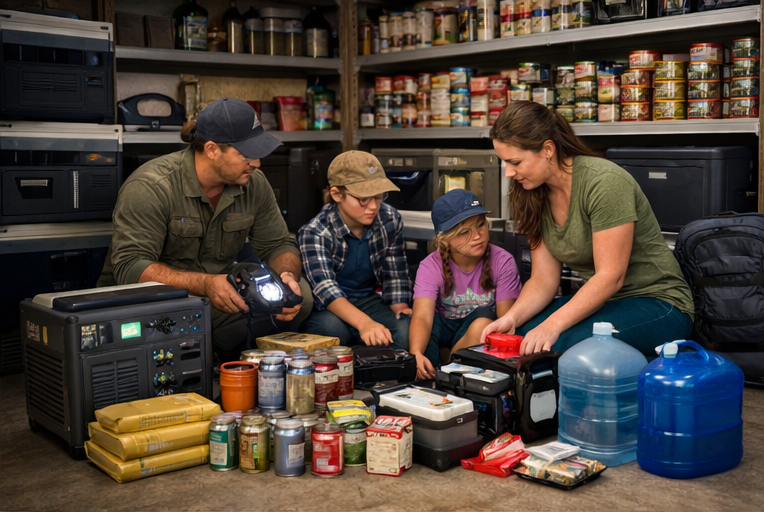
Disaster preparedness for families isn’t a fringe hobby — it’s a rational response to a world where infrastructure fails, weather patterns intensify, and supply chains break down faster than most people expect. Families who prepare beforehand make better decisions under pressure, experience less panic, and recover faster.
The core argument is simple: emergencies don’t wait for convenient timing. A hurricane doesn’t pause while a family figures out where to meet. A wildfire evacuation order doesn’t allow an hour to pack. The families who survive and recover well are the ones who made their decisions before the disaster, not during it.
Beyond physical survival, preparedness delivers something less obvious — psychological stability. Knowing there’s a plan, knowing the kids know what to do, knowing the pantry has three months of food: that certainty reduces anxiety long before any emergency occurs. It also builds community. Families who prepare tend to connect with neighbors, share resources, and create informal mutual aid networks. In a serious disaster, that network is often more valuable than any single piece of gear.
Preparedness isn’t about fear. It’s about competence.
Identifying Potential Disasters and Their Impact
The first step in building preparedness strategies for families is understanding which threats are actually relevant to where the family lives. Not every family needs a hurricane plan. Not every region faces wildfire risk. Threat identification should be geographically specific, not generic.
Common disaster categories and their characteristics:
- Natural disasters (rapid onset): Hurricanes, tornadoes, earthquakes, wildfires, flash floods. These demand immediate action — evacuation, shelter-in-place, or both. Infrastructure damage is often severe and immediate.
- Natural disasters (slow onset): Droughts, prolonged winter storms, extended flooding. These create supply chain pressure, utility failures, and displacement over days or weeks.
- Infrastructure failures: Grid-down events, water system contamination, fuel shortages. Often triggered by weather or cyberattack. Duration is unpredictable. See the EMP attack and grid failure survival guide for a detailed breakdown of this specific threat.
- Public health emergencies: Pandemics, chemical spills, contamination events. Require quarantine planning, supply stockpiling, and medical preparedness.
- Human-made events: Civil unrest, terrorism, industrial accidents. Require situational awareness and security planning.
Decision rule: Start with the three most likely threats for the specific region, then build plans for each. A family in coastal Florida prioritizes hurricanes and flooding. A family in the Pacific Northwest prioritizes earthquakes and wildfires. A family in the Midwest prioritizes tornadoes and winter storms.
The mistake most families make is building a generic “emergency plan” that doesn’t actually address the disasters most likely to affect them. Specificity is what makes a plan functional.
Creating a Comprehensive Family Emergency Plan
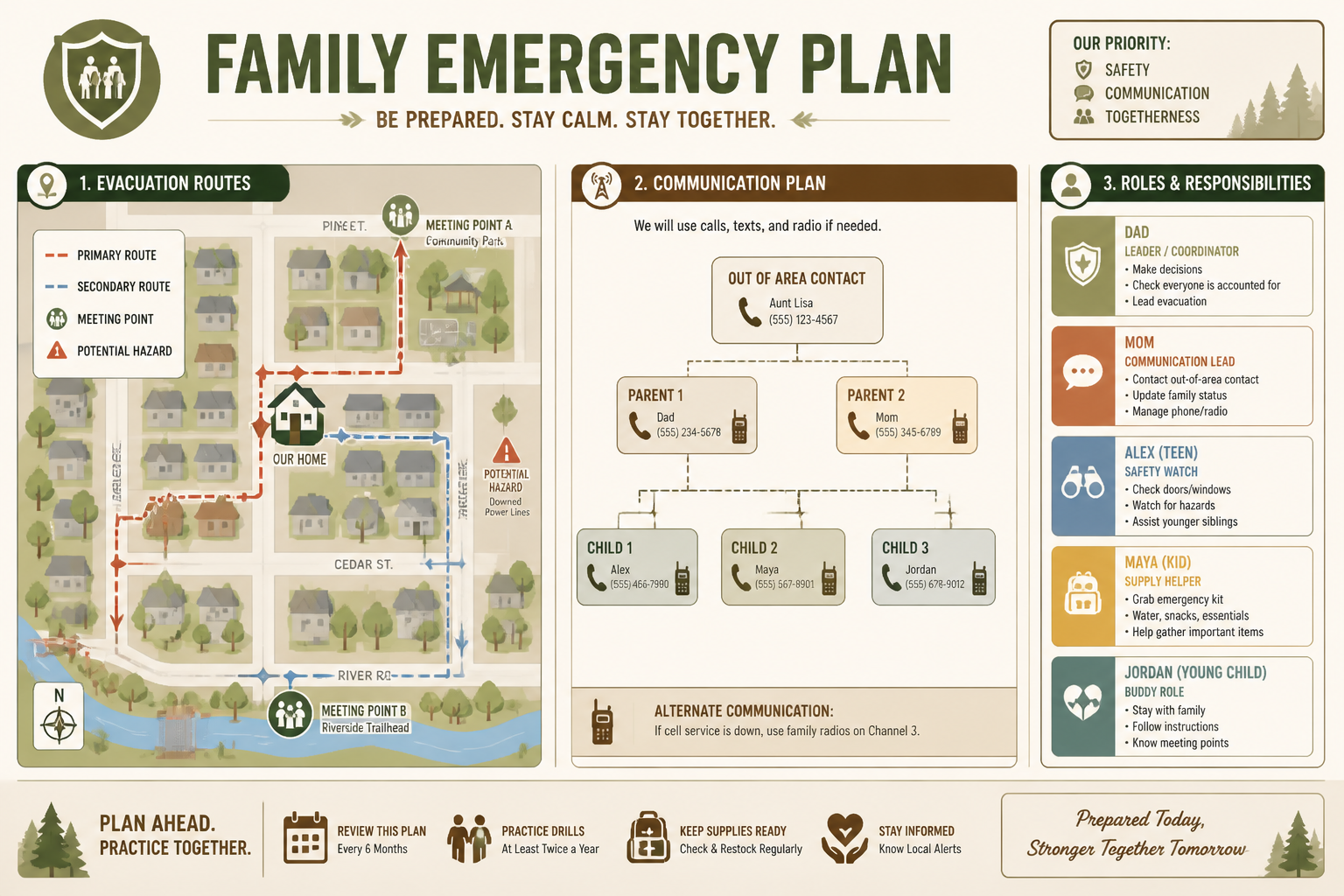
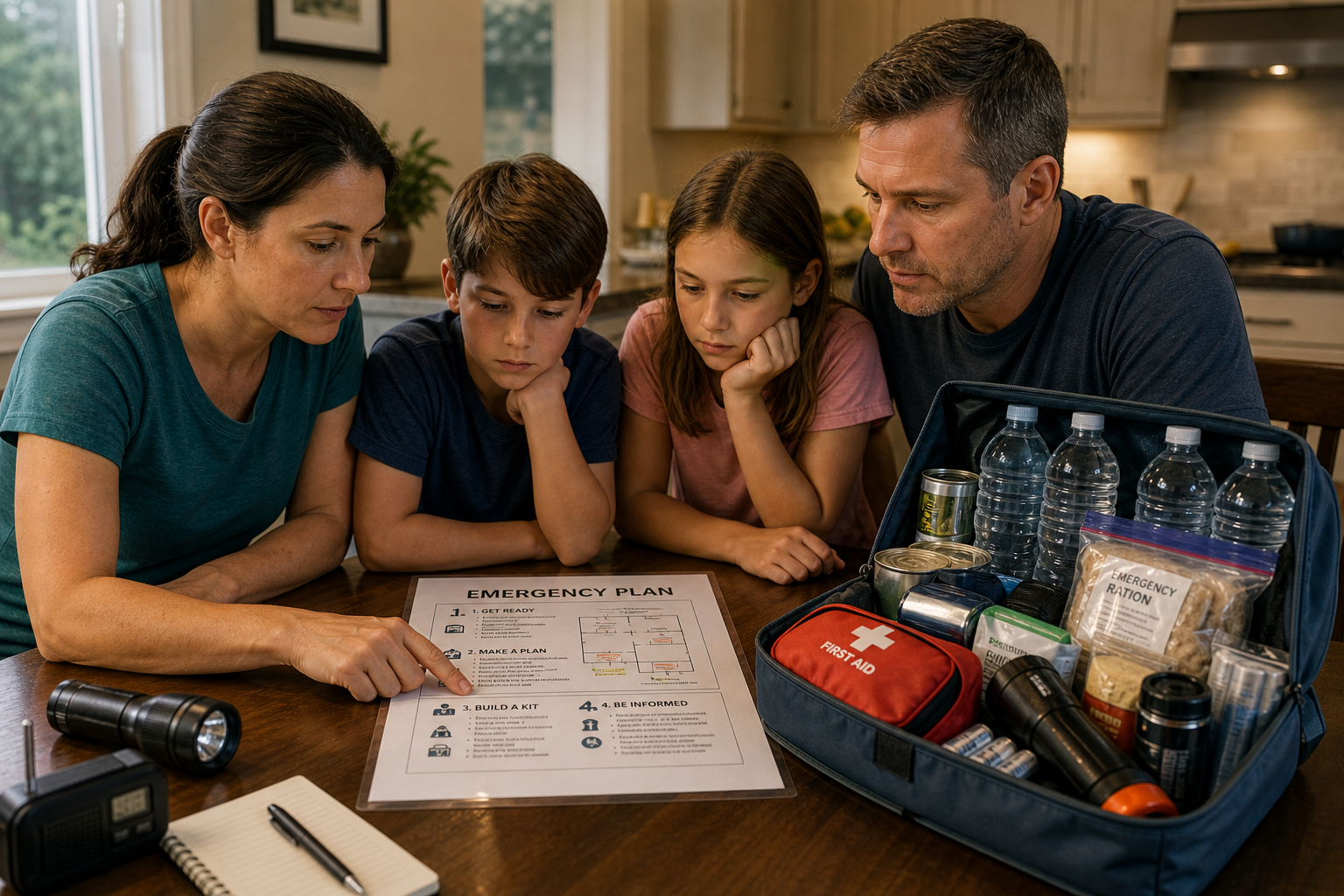 A family emergency plan is the operational backbone of all other preparedness strategies. Without it, supplies sit unused, family members scatter in different directions, and decisions get made under maximum stress with minimum information.
A solid plan covers six core elements:
- Threat scenarios: Identify the specific disasters the plan addresses (e.g., earthquake, house fire, extended power outage, evacuation order)
- Communication protocol: How family members contact each other if cell networks are down or overloaded. Designate an out-of-area contact everyone can reach.
- Meeting points: Two locations — one near the home (e.g., the mailbox or a neighbor’s driveway) and one farther away (e.g., a specific school or community center) in case the neighborhood is inaccessible
- Evacuation routes: At least two routes out of the neighborhood and two routes out of the region, mapped in advance. Check the ultimate evacuation plan guide for route planning specifics.
- Role assignments: Who grabs the go-bag, who gets the kids, who handles the pets, who shuts off utilities
- Special needs considerations: Medications, mobility limitations, infant supplies, pets — all explicitly addressed
The plan should be written down, laminated, and stored in multiple locations: the go-bag, the car, and a trusted neighbor’s home. A plan that only exists in someone’s head is a plan that disappears under stress.
For families with pets, the pets emergency preparedness checklist covers the specific logistics of evacuating with animals — a detail that causes real problems when left unplanned.
Common mistake: Families create a plan once and never revisit it. Phone numbers change. Kids grow up and get their own phones. Neighbors move. The plan needs an annual review, minimum.
The Essentials of an Emergency Supply Kit
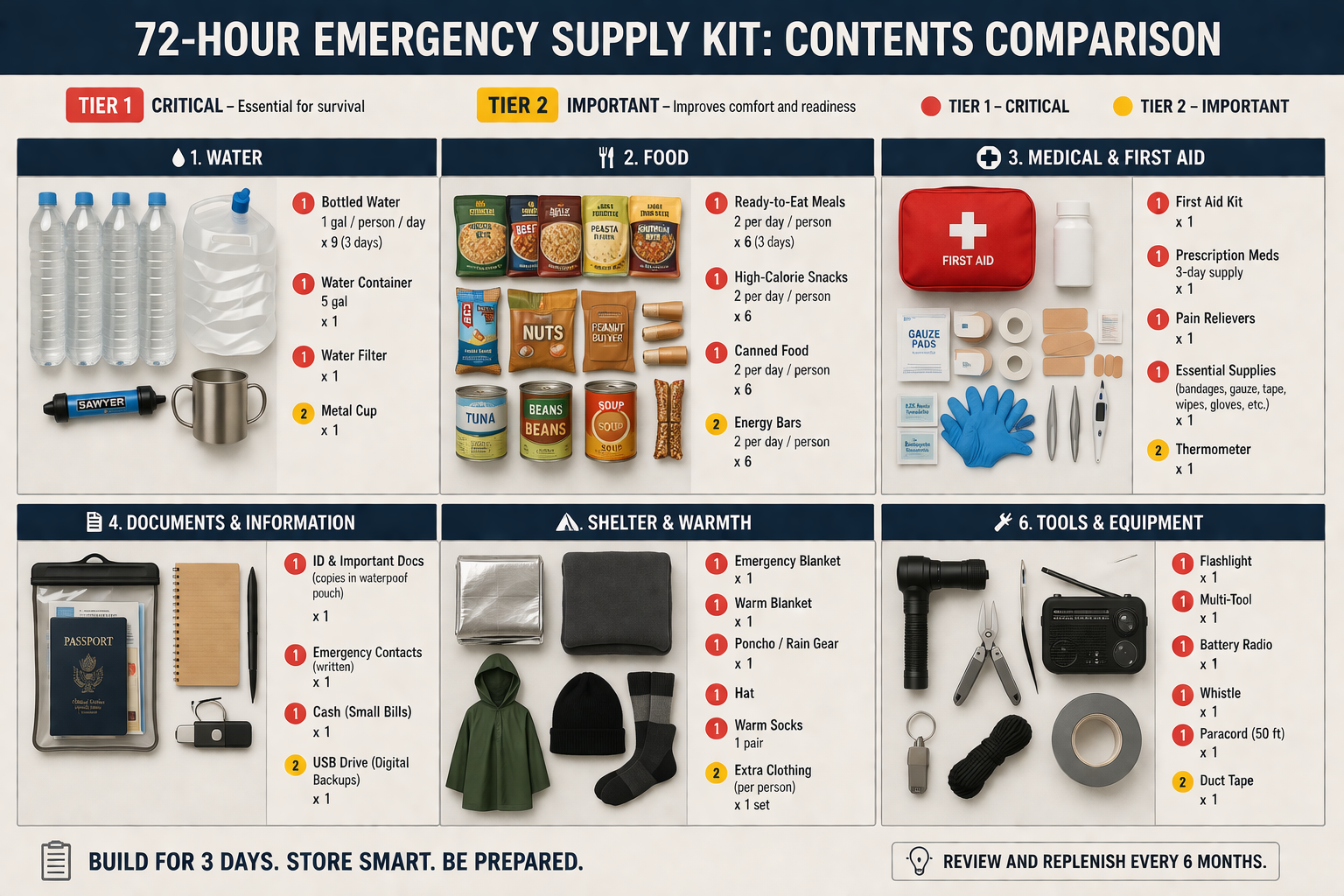
An emergency supply kit is the physical foundation of family preparedness. The 72-hour standard — enough supplies to sustain the family for three days without outside assistance — is the entry point, not the ceiling.
Core kit contents by category:
Water:
- 1 gallon per person per day (minimum)
- Include pets in the calculation
- Water purification backup: filter (Sawyer Squeeze or LifeStraw), iodine tablets, or a portable UV purifier
Food:
- Non-perishable, calorie-dense items: canned goods, freeze-dried meals, energy bars, peanut butter, rice, oats
- Manual can opener (consistently forgotten)
- Comfort foods for children — stress eating is real and managing it matters
Medical:
- Prescription medications (30-day supply rotated regularly)
- Over-the-counter essentials: pain relievers, antihistamines, anti-diarrheal, antacids
- Wound care: bandages, gauze, medical tape, antiseptic wipes, closure strips
- Thermometer, blood pressure cuff if relevant to family health needs
Documents (waterproof container or encrypted USB):
- Copies of IDs, passports, insurance policies, medical records
- Cash in small bills (ATMs fail when the grid goes down)
- Emergency contact list printed on paper
Shelter and warmth:
- Emergency mylar blankets (one per person)
- Rain ponchos
- Lightweight tarp or tube tent
- Work gloves, dust masks (N95 minimum)
Tools and communication:
- Flashlights with extra batteries (or hand-crank)
- Multi-tool or quality fixed-blade knife
- Battery-powered or hand-crank NOAA weather radio
- Portable phone charger (kept charged)
For a thorough review of what most kits are missing, the 15 things missing from your emergency kit is worth reading before finalizing any kit.
Building an Advanced Trauma Kit
Standard first aid kits aren’t designed for disaster scenarios. When emergency services are overwhelmed or unavailable, families need trauma-capable supplies.
An advanced trauma kit adds:
- Tourniquet (CAT or SOFTT-W — TCCC-approved designs)
- Pressure bandages (Israeli bandage style)
- Hemostatic gauze (QuikClot Combat Gauze or Celox)
- Chest seals (vented, for penetrating chest wounds)
- Nasopharyngeal airway (NPA) with lubricant
- Trauma shears
- SAM splint
The critical caveat: tools without training create false confidence. Anyone adding a trauma kit to their supplies should complete a Stop the Bleed course at minimum, and ideally a full TCCC or Wilderness First Aid course.
The Importance of Communication in Disaster Preparedness
 When a disaster hits, communication infrastructure often fails first. Cell towers get overloaded within minutes of a major earthquake or hurricane. Power outages take out landlines and internet. Families who haven’t planned for communication failure find themselves isolated at the worst possible moment.
Effective communication planning means building redundancy into the system — multiple methods, not just one.
Communication and Early Warning Systems
Layer 1 — Early warning (before the disaster):
- NOAA All-Hazards Weather Radio: battery or hand-crank powered, receives official alerts even without internet or cell service
- Wireless Emergency Alerts (WEA): automatic on most smartphones, but requires cell service
- Local emergency alert apps: many counties have opt-in text/email alert systems — register for these in advance
Layer 2 — During the disaster:
- Designated out-of-area contact: it’s often easier to reach someone across the country than across town during a local disaster. Every family member should have this number memorized, not just stored in a phone.
- Written contact list: when phones die, a laminated card with key numbers becomes critical
- HAM radio: for serious preppers, a Technician-class HAM license opens access to local repeater networks and long-range communication. The Baofeng UV-5R is an affordable entry point, though quality radios like the Yaesu FT-60R are more reliable under field conditions.
- GMRS/FRS radios: useful for short-range family communication (1-5 miles depending on terrain)
Layer 3 — Post-disaster:
- Satellite communicators (Garmin inReach, SPOT): allow two-way messaging and SOS when all other networks are down
- Establish a check-in schedule so family members know when to expect contact
Common mistake: Assuming cell phones will work. In virtually every major disaster of the past decade, cellular networks have been overloaded or destroyed within the first hours. Plan as if the phone won’t work.
Learning Basic First Aid Skills and Their Importance
First aid skills are the most underinvested area of family preparedness. Gear is easy to buy. Skills require time and practice — which is exactly why most families skip them.
In a disaster scenario, emergency medical services may be unavailable for hours or days. The ability to control bleeding, manage shock, splint a fracture, or perform CPR is the difference between a survivable injury and a fatal one.
Priority skills for family preparedness:
- Bleeding control: Direct pressure, wound packing, tourniquet application. The Stop the Bleed program (stopthebleed.org) offers free courses nationwide.
- CPR and AED use: American Heart Association and Red Cross both offer in-person and online certifications. Recertify every two years.
- Shock management: Recognition and positioning. Shock kills when untreated.
- Fracture and sprain management: Improvised splinting with SAM splints or field materials
- Burn treatment: Cooling, covering, and knowing when a burn exceeds home treatment capability
- Allergic reaction response: Especially critical for families with known allergies. Carry epinephrine auto-injectors if prescribed.
- Childbirth basics: Relevant for families with pregnant members or in extended grid-down scenarios
Training resources worth pursuing: Wilderness First Responder (WFR) for serious preppers, CERT (Community Emergency Response Team) training through FEMA, and Red Cross First Aid/CPR certification for all adults in the household.
The Importance of Insurance in Disaster Preparedness for Families
Insurance is the financial layer of disaster preparedness — the mechanism that funds recovery after the emergency ends. Most families underestimate how much their coverage gaps will cost them until they’re filing a claim.
Key insurance considerations for preparedness:
- Homeowner’s/renter’s insurance: Review the policy annually. Understand what’s covered and what’s excluded. Most standard policies exclude flood damage.
- Flood insurance: Required separately through the National Flood Insurance Program (NFIP) or private insurers. Relevant even for families not in designated flood zones — a significant percentage of flood claims come from outside high-risk areas.
- Earthquake insurance: Excluded from standard homeowner’s policies in most states. Separate riders or standalone policies are available.
- Umbrella policy: Provides additional liability coverage that standard policies cap out on.
- Document your possessions: A home inventory (video walkthrough stored in the cloud or offsite) dramatically speeds up claims and reduces disputes.
Practical step: Keep digital copies of all insurance policies in a secure cloud account and a printed copy in the go-bag. When filing a claim after a disaster, having policy numbers and agent contacts immediately accessible saves significant time.
The Significance of Mental Preparedness in Times of Disaster
Mental preparedness is the least discussed and most consequential element of disaster readiness. Physical supplies and plans only work if the people using them can think clearly under pressure.
Disasters trigger acute stress responses — elevated cortisol, tunnel vision, impaired decision-making. Families who have rehearsed their plans and mentally pre-committed to specific actions are significantly more functional during actual emergencies than those who haven’t.
Building mental resilience before a disaster:
- Stress inoculation through drills: Repeated practice under mild stress (timed drills, scenario exercises) builds the neural pathways that allow calm action under real stress
- Scenario visualization: Mentally walking through “what would I do if…” scenarios is a technique used in military and emergency services training. It works.
- Acceptance of uncertainty: Rigid plans fail when reality doesn’t match expectations. Mentally preparing for improvisation — accepting that the plan will need adaptation — reduces the psychological shock of unexpected complications.
- Family communication about fear: Children who understand that fear is normal and manageable cope better than those who are shielded from all discussion of risk. Age-appropriate conversations about preparedness reduce anxiety rather than increasing it.
- Post-disaster mental health: Recognize that trauma responses after a disaster are normal. PTSD, grief, and anxiety are common. Having a plan for accessing mental health support post-disaster is part of comprehensive preparedness.
Training for Evacuation: Know When and How to Leave
Evacuation decisions are among the hardest in disaster preparedness — and the most consequential. Leaving too late puts families in danger. Leaving unnecessarily creates its own risks and resource drain.
When to evacuate:
- Official evacuation order issued for the area
- The home is structurally compromised or at immediate risk (fire, flooding, gas leak)
- Staying puts family members at greater risk than moving
When to shelter in place:
- Hazardous materials event where outdoor exposure is more dangerous than staying inside
- Civil unrest where movement increases vulnerability
- Severe weather (tornado, blizzard) where travel is more dangerous than staying put
Evacuation preparation checklist:
- Go-bags packed and accessible for every family member (see the 72-hour bug-out bag checklist for a complete packing list)
- Vehicle fuel kept above half-tank as standard practice
- Two primary and two alternate evacuation routes mapped and driven in advance
- Destination options identified: family/friends, hotels along the route, designated shelters
- Pet carriers and pet supplies staged and ready
- Important documents in go-bag or ready to grab in under two minutes
For families building their first evacuation system, the bug-out bag guide for beginners covers the fundamentals without overwhelming complexity.
Common mistake: Waiting for official confirmation before beginning preparation. By the time an evacuation order is issued for a hurricane, fuel stations are already running dry and roads are already congested. The decision to prepare should happen 24-48 hours before the order, not after.
Preparing Your Home to Withstand Disasters
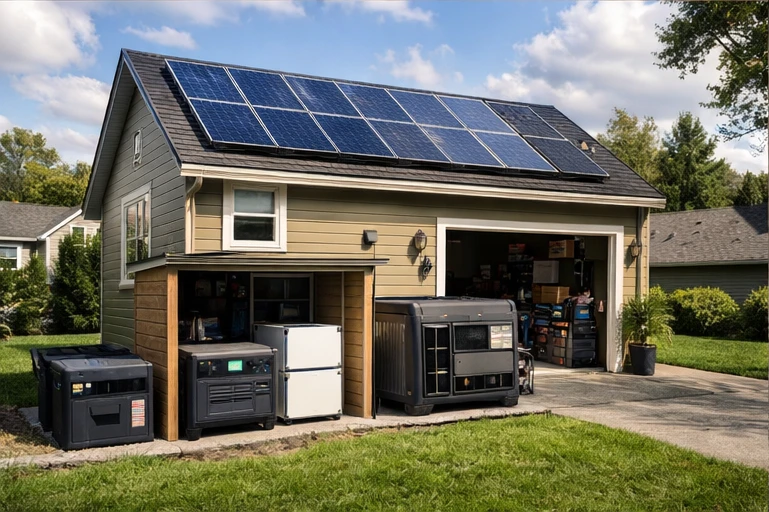 Home hardening reduces both the likelihood of damage and the duration of vulnerability after a disaster. It’s an investment that pays dividends across multiple emergency types.
Structural hardening by threat:
- Hurricane/high wind: Hurricane straps on roof trusses, impact-resistant windows or shutters, reinforced garage doors (the most common failure point in hurricane wind damage), secured outdoor furniture
- Earthquake: Anchor water heaters and large appliances, install flexible gas connectors, secure bookshelves and heavy furniture to walls, keep a wrench near the gas shutoff
- Wildfire: Ember-resistant vents, Class A roofing material, 30-foot defensible space cleared around the structure, metal mesh on gutters and eaves
- Flooding: Sump pump with battery backup, check valve on sewer line, flood-resistant materials in basement, elevation of HVAC equipment
Water Storage and Purification Systems
Water is the most critical supply in any emergency. The human body fails faster without water than without food, and municipal water systems are among the first utilities to be compromised after a major disaster.
Water storage guidelines:
- Minimum: 1 gallon per person per day for drinking and sanitation
- Recommended: 2 gallons per person per day for comfort and cooking
- Storage options: commercial water bricks (stackable, space-efficient), food-grade 55-gallon barrels, WaterBOB bathtub bladder (fills a standard tub with up to 100 gallons)
- Rotate stored water every 6-12 months unless using sealed commercial containers
Purification backup systems:
- Gravity filter (Berkey Big Berkey or Alexapure Pro): filters large volumes without power or pressure
- Portable filter (Sawyer Squeeze, LifeStraw): lightweight, effective for field use
- Chemical treatment: unscented liquid chlorine bleach (8 drops per gallon), iodine tablets
- UV purification: SteriPen for clear water (doesn’t work on turbid water without pre-filtering)
The emergency water storage and purification guide covers long-term water planning in depth, including rainwater harvesting and well water considerations.
Long-Term Food Storage Solutions
A 72-hour kit is a starting point. Serious preparedness strategies for families include building toward a 30-day supply at minimum, with a 90-day supply as the target for extended emergencies.
Food storage priorities:
- Caloric density: Focus on foods that deliver significant calories per pound — rice, oats, dried beans, pasta, peanut butter, cooking oils, freeze-dried meats
- Nutritional balance: Rotate in canned vegetables, fruits, and multivitamins. Pure calorie storage without micronutrients creates health problems over weeks.
- Palatability: Food that family members won’t eat is wasted storage. Include familiar comfort foods and account for children’s preferences.
- Storage conditions: Cool, dark, dry location. Heat is the primary enemy of shelf life. A basement or interior closet is preferable to a garage.
For a detailed breakdown of what to store and how much, the 3-month emergency food supply guide and the 50 best foods for long-term storage are practical starting points.
Off-Grid Energy Systems
Power outages are the most common disaster consequence. Even a 72-hour outage creates significant problems for families dependent on electric heating, refrigeration, medical equipment, or communication devices.
Energy preparedness tiers:
- Tier 1 (entry level): Portable power station (Jackery 1000, EcoFlow Delta) with solar panel. Powers phones, lights, small appliances, CPAP machines. No fuel storage required.
- Tier 2 (intermediate): Dual-fuel generator (runs on gasoline and propane). Powers refrigerator, well pump, larger appliances. Requires fuel storage and safe outdoor operation.
- Tier 3 (serious preparedness): Whole-home standby generator (propane or natural gas) with automatic transfer switch. Seamless transition during outages. Significant upfront investment but minimal operational friction.
- Solar + battery storage: Long-term solution that eliminates fuel dependency. Higher installation cost, but provides indefinite power generation in sunny climates.
Financial and Document Preparedness
Financial preparedness is the recovery layer that most preppers underinvest in. Surviving the disaster is step one. Rebuilding after it requires money, documents, and access to accounts.
Financial preparedness checklist:
- Cash reserve in small bills (ATMs and card readers fail without power)
- Copies of all critical documents: IDs, passports, birth certificates, Social Security cards, insurance policies, mortgage/lease documents, medical records, prescriptions
- Digital backup: encrypted USB drive or secure cloud storage (Tresorit, ProtonDrive)
- Out-of-area financial contact: someone who can wire money or access accounts on the family’s behalf if local banking is disrupted
- Emergency fund: 3-6 months of living expenses in liquid savings, separate from investment accounts
Educating Children About Disaster Preparedness
Children who understand emergency procedures behave more predictably and recover more quickly from disaster trauma than those who are kept in the dark. Age-appropriate preparedness education is one of the most valuable investments a family can make.
By age group:
- Ages 3-5: Teach name, address, and a trusted adult’s phone number. Practice “stop, drop, and roll.” Make drills feel like a game.
- Ages 6-10: Introduce the family emergency plan. Assign simple roles (grab the go-bag, get the pet). Teach how and when to call 911. Practice meeting point drills.
- Ages 11-14: Full participation in emergency planning. Teach basic first aid (bleeding control, CPR). Discuss different disaster scenarios and appropriate responses.
- Ages 15+: Treat as junior adults in the preparedness plan. Assign meaningful responsibilities. Consider Stop the Bleed and CPR certification.
Teaching Situational Awareness to Children
Situational awareness — the habit of noticing what’s happening in the environment and identifying potential threats or exits — is a foundational survival skill that transfers across all emergency types.
Practical ways to build this habit in children:
- Play the “exits game” when entering any building: identify all exits before sitting down
- Discuss what’s happening around them during routine outings — who’s nearby, what’s unusual, where would they go if something happened
- Debrief after drills: ask what they noticed, what confused them, what they’d do differently
- Model the behavior consistently — children learn situational awareness by watching adults practice it
Maintaining Your Preparedness: Regular Drills and Updates
Preparedness isn’t a one-time project. Plans go stale, supplies expire, family circumstances change, and skills fade without practice. A preparedness system that isn’t maintained is a false sense of security.
Practicing Drills and Emergency Scenarios
Recommended drill schedule:
- Monthly: Check phone battery levels, verify go-bag accessibility, confirm everyone knows the out-of-area contact number
- Quarterly: Full family evacuation drill (timed, from different starting points in the house), review and update the contact list
- Annually: Full kit audit (rotate food and water, check medication expiration dates, update documents), review and revise the emergency plan, conduct a tabletop scenario exercise
Tabletop exercise format: Choose a realistic scenario (e.g., “It’s 2 AM. There’s a wildfire 10 miles away and an evacuation order just came through. Cell service is spotty. Walk through what happens.”). Let family members talk through their responses, identify gaps, and problem-solve together. This is how real emergency management organizations train — it works at the family level too.
What to review annually:
- Has the family moved? Do the evacuation routes still make sense?
- Have any family members’ medical needs changed?
- Are the kids old enough to take on new responsibilities?
- Has any gear worn out or been used and not replaced?
- Are the stored phone numbers still accurate?
FAQ
What’s the most important first step in disaster preparedness for families?
Write a family emergency plan before buying any supplies. Knowing where to meet, how to communicate, and who does what under pressure is more valuable than any piece of gear. Supplies without a plan create confusion.
How much food and water should a family store?
The baseline is 72 hours (1 gallon of water per person per day, plus non-perishable food). A realistic preparedness goal is 30 days of food and water for the whole household, including pets. Ninety days is the target for serious preparedness against extended grid failures or supply chain disruptions.
Do children need separate emergency kits?
Older children (10+) should carry age-appropriate go-bags with their own supplies. Younger children’s supplies should be distributed among adult go-bags. Every child should know where the family’s supplies are stored.
What’s the biggest mistake families make in disaster preparedness?
Building a kit and never practicing with it. Supplies that family members don’t know how to use, or plans that have never been rehearsed, fail under real stress. Regular drills are what convert preparation into actual capability.
Is HAM radio really necessary, or is a cell phone enough?
Cell networks fail in virtually every major disaster — they’re overloaded within minutes and physically destroyed in severe events. HAM radio, GMRS radios, and satellite communicators provide communication when cell networks are gone. For serious preparedness, redundancy is the standard.
How do families with special medical needs prepare differently?
Start with a 30-day supply of all prescription medications (work with the prescribing physician to get ahead on refills). Identify backup power sources for any electrically dependent medical equipment (CPAP, oxygen concentrators, insulin refrigeration). Register with the local utility company’s medical baseline program and with local emergency management if a family member requires evacuation assistance.
What’s the difference between sheltering in place and evacuating?
Shelter in place means staying inside the home with windows and doors sealed — used for hazardous materials events, civil unrest, or severe weather where travel is more dangerous than staying. Evacuation means leaving the area entirely — used when the home or neighborhood is at direct risk. The decision depends on the specific threat, not a general preference.
How often should emergency supplies be rotated?
Food: rotate on a first-in, first-out basis and check expiration dates annually. Water: replace every 6-12 months unless using sealed commercial containers. Medications: check expiration dates every 6 months. Batteries: replace annually or switch to rechargeable systems.
Can renters do meaningful disaster preparedness without owning a home?
Absolutely. Go-bags, communication plans, food and water storage, first aid training, and document preparedness are all renter-accessible. The primary limitation is structural hardening — renters can’t install hurricane straps or whole-home generators — but the behavioral and supply layers of preparedness are fully available.
What’s the role of community in family disaster preparedness?
Community networks multiply individual family capability significantly. Neighbors who know each other’s skills, share resources, and check on vulnerable members during disasters consistently outperform isolated households. Building relationships with neighbors before a disaster is a preparedness strategy, not a social nicety.
Products, Tools, and Resources
These are tools and resources that experienced preppers actually use — not a generic shopping list.
Emergency communication:
- Midland WR400 NOAA weather radio: reliable, affordable, covers all 25 weather alert channels with alarm function. A practical first purchase for any household.
- Baofeng UV-5R (entry HAM radio) or Yaesu FT-60R (more durable field radio): both require a Technician-class HAM license to transmit legally, but the license exam is straightforward and worth pursuing.
- Garmin inReach Mini 2: two-way satellite messaging and SOS capability when all other networks fail. Subscription required but modest.
Water storage and purification:
- WaterBOB bathtub bladder: fills a standard tub with up to 100 gallons of clean water before a storm. Inexpensive and highly effective for short-notice situations.
- Berkey Big Berkey gravity filter: the standard recommendation among serious preppers for home water purification. Filters without power or pressure.
- Sawyer Squeeze filter: lightweight, portable, and rated for 100,000 gallons. Ideal for go-bags and evacuation kits.
Power backup:
- EcoFlow Delta 2 portable power station: 1,024Wh capacity, charges via solar, AC, or car. Powers CPAP machines, phones, laptops, and small appliances.
- Goal Zero Yeti 1500X: higher capacity option for families with greater power needs or medical equipment.
Medical and trauma:
- CAT tourniquet (Combat Application Tourniquet): the TCCC-approved standard. Buy genuine, not counterfeit — counterfeits fail under pressure. Purchase from North American Rescue or direct from authorized distributors.
- QuikClot Combat Gauze: hemostatic gauze for wound packing. Requires training to use effectively.
- Stop the Bleed course: free, 2-hour hands-on training available through hospitals, fire departments, and community organizations nationwide. Every adult in the household should complete it.
Food storage:
- Augason Farms and Mountain House freeze-dried meals: both have 25-30 year shelf lives and reasonable taste. Mountain House tends to score higher on palatability; Augason Farms offers better value per calorie.
- Mylar bags + oxygen absorbers: the most cost-effective way to store bulk staples (rice, oats, dried beans) long-term. Pair with food-grade 5-gallon buckets.
Training resources:
- FEMA CERT training: free community emergency response training available through local fire departments. Covers first aid, light search and rescue, and disaster psychology.
- Red Cross First Aid/CPR certification: widely available, recognized, and worth maintaining for every adult.
- Wilderness First Aid (WFA) or Wilderness First Responder (WFR): for preppers who want serious medical capability. NOLS and Wilderness Medical Associates both offer reputable courses.
For a broader foundation in preparedness skills, the 14 essential survival skills every prepper must know covers the behavioral and skill layers that gear alone can’t replace. And for families just starting the preparedness journey, how to get started with a preparedness lifestyle provides a practical, non-overwhelming entry point.
The best preparedness plan is the one that actually gets built, practiced, and maintained. Start with the plan. Add the supplies. Train the skills. Then keep going.