
Hey there! Some links on this page may be affiliate links which means that, if you choose to make a purchase, I may earn a commission at no extra cost to you. I greatly appreciate your support. Read the full disclosure here.
Ultimate Prepper’s Guide to Freeze-Dried Food: The Complete System for 25-Year Food Storage That Actually Tastes Good
Your freeze-dried food guide isn’t about buying the cheapest buckets with the longest shelf life—it’s about building a food storage system that you’ll actually eat when you need it, that provides complete nutrition for your family, and that doesn’t waste thousands of dollars on emergency food that tastes like cardboard and sits unused until it expires. Most people approach freeze-dried food storage backwards: they buy based on shelf life and price, then discover too late that their “25-year supply” is inedible, nutritionally incomplete, or stored incorrectly and already degrading.
The difference between effective freeze-dried food storage and wasted money is the difference between tasting before buying and buying blind, between understanding rehydration techniques and serving mush, and between balanced nutrition and calorie-only thinking. It’s the difference between food that sustains your family during a crisis and food that creates a secondary crisis when you realize you can’t eat it.
This is your complete freeze-dried food guide—from understanding the technology that makes 25-year shelf life possible to selecting the right brands and products, from building a balanced inventory to mastering rehydration techniques, from budget optimization to avoiding the costly mistakes that waste thousands.
Long Term Food Storage: The Complete Beginner’s Guide
Find this useful? Add us as a preferred source on Google and more of what we publish will show up in your results.
Why Most Freeze-Dried Food Storage Fails (And How to Avoid It)
 Before you spend a dollar on freeze-dried food, understand why most people’s storage systems fail when they need them most.
The Taste Trap: When Emergency Food Becomes Inedible
The common approach: Buy freeze-dried food based on shelf life and price, assume it’s edible because it’s “food.”
Why it fails:
- Taste variation: Freeze-dried food quality varies dramatically by brand—some tastes nearly fresh, others taste like salted cardboard
- Texture issues: Poor quality freeze-dried food rehydrates to mush or stays crunchy
- Flavor degradation: Even good freeze-dried food loses flavor over time if stored improperly
- Psychological rejection: During stress, people reject unfamiliar or unpalatable food
Real consequence: Families who bought 1-year supplies of cheap freeze-dried food discovered during emergencies that their children refused to eat it, adults couldn’t stomach it, and they ended up buying fresh food anyway—wasting their entire investment.
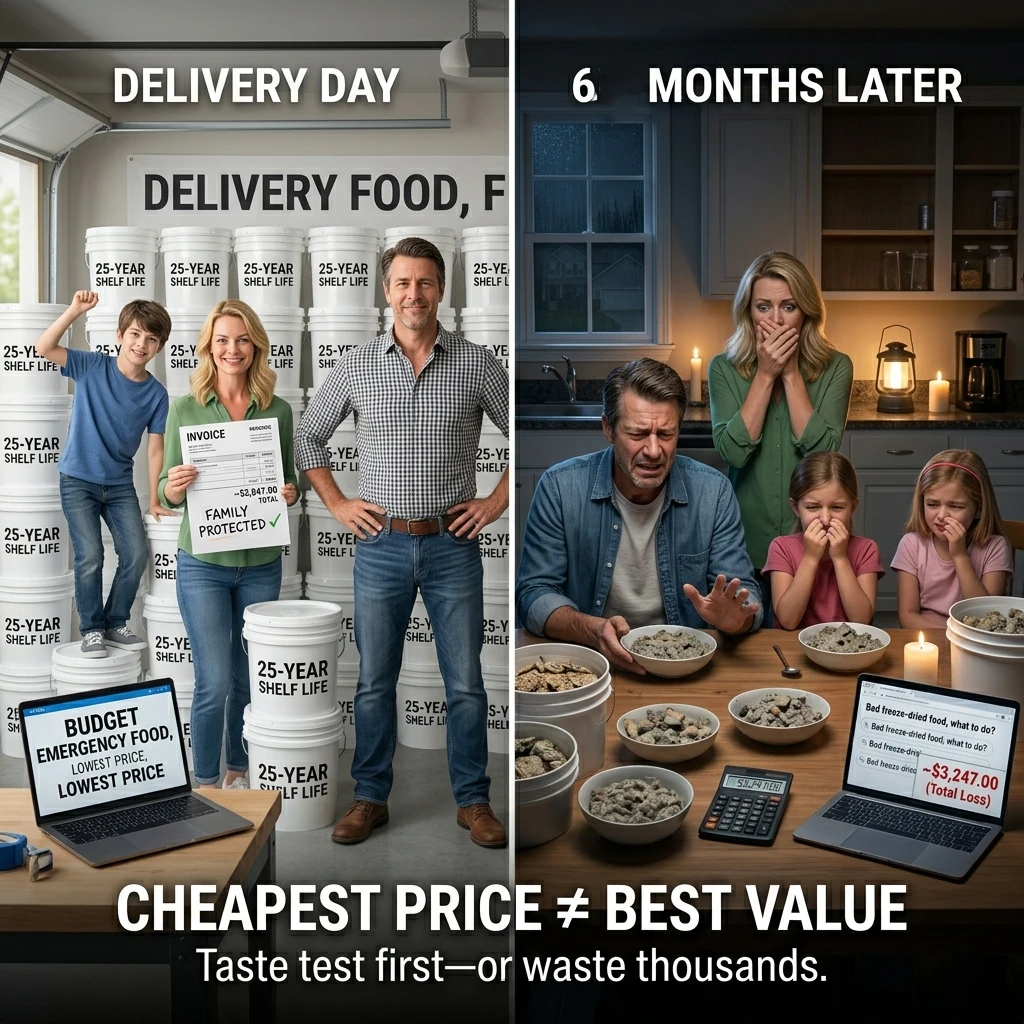
Example: A family spent $2,500 on budget freeze-dried meals (cheapest option, longest shelf life). During a 2-week power outage, they opened their first meal and discovered it was so salty and textureless that even their hungry children refused to eat it. They ended up eating canned food from the pantry, and their $2,500 “emergency supply” sat unused.
The Shelf Life Myth: What 25 Years Really Means
The marketing claim: “25-year shelf life” or “30-year shelf life”
The reality:
- Optimal conditions required: 25-year shelf life assumes storage at 55-70°F, low humidity, no light exposure
- Real-world degradation: Most people store in garages (temperature swings), basements (humidity), or closets (temperature fluctuations)
- Actual shelf life: Under real-world conditions, shelf life is often 10-15 years, not 25-30
- Quality degradation: Even if “safe” to eat after 25 years, quality (taste, texture, nutrition) degrades significantly
The fine print:
- Unopened only: 25-year shelf life applies to unopened containers
- Once opened: Use within 1 year (oxygen exposure starts degradation)
- Temperature sensitivity: Every 10°F above 70°F cuts shelf life in half
Bottom line: “25-year shelf life” is a best-case scenario under perfect conditions. Real-world shelf life is typically 10-15 years, and quality degrades faster than safety.
The Cost of Buying Wrong: $3,000 Wasted on Food You’ll Never Eat
Common buying mistakes and their costs:
Mistake #1: Buying the cheapest option
- Cost: $1,500 for 1-year supply (budget brand)
- Reality: Tastes terrible, family won’t eat it
- Actual cost: $1,500 wasted + $2,500 to replace with quality food = $4,000 total
Mistake #2: Buying without taste testing
- Cost: $3,000 for bulk purchase (no samples)
- Reality: Discover you hate the taste after buying
- Actual cost: $3,000 wasted (can’t return opened food)
Mistake #3: Buying complete meals only
- Cost: $2,000 for meal buckets
- Reality: No flexibility, meal fatigue, limited cooking options
- Actual cost: $2,000 for inflexible system + $1,000 for ingredients to supplement = $3,000 total
Mistake #4: Improper storage
- Cost: $2,500 for quality freeze-dried food
- Reality: Stored in a hot garage, degraded in 5 years instead of 25
- Actual cost: $2,500 wasted + $2,500 to replace = $5,000 total
The smart approach:
- Taste test first: Buy sample packs before bulk purchase ($50-100)
- Buy quality: Mid-tier brands offer the best value (taste + price)
- Mix meals and ingredients: Flexibility and variety
- Store properly: Climate-controlled space, proper containers
The short version: Freeze-dried food is food that has been frozen and then subjected to a vacuum process that removes 98-99% of moisture through sublimation, preserving food for 25-30 years when stored properly. Unlike dehydrated food (which removes 90-95% moisture through heat), freeze-drying preserves original shape, texture, color, and 97% of nutrients. Freeze-dried food weighs 90% less than fresh, rehydrates in minutes with water, and maintains quality for decades when stored at 55-70°F in airtight containers with oxygen absorbers away from light and humidity.
Key Takeaways:
– Prioritize taste and nutrition over shelf life alone: Test sample packs before buying bulk to avoid wasting money on inedible or nutritionally incomplete freeze-dried food.
– Store freeze-dried food in climate-controlled, low-humidity, dark environments at 55-70°F to maximize shelf life and preserve quality for up to 25-30 years.
– Build a balanced inventory combining proteins, fruits, vegetables, and complete meals for variety, nutritional completeness, and meal fatigue prevention.
– Rotate your stock regularly using a FIFO system; consume freeze-dried food monthly to maintain familiarity, prevent waste, and ensure readiness.
– Choose brands strategically: Mix premium (Mountain House), mid-tier (Augason Farms, ReadyWise), and budget options based on taste preferences, budget, and storage goals.
Understanding Freeze-Dried Food Technology
The science behind why freeze-dried food lasts decades and how it differs from other preservation methods.
How Freeze-Drying Preserves Food for Decades
The freeze-drying process:
Step 1: Freezing (-40°F to -50°F)
- Food is flash-frozen to extremely low temperatures
- Ice crystals form within food structure
- Freezing preserves cellular structure
Step 2: Primary drying (vacuum + low heat)
- Food is placed in a vacuum chamber
- Pressure reduced to near-vacuum
- Low heat applied (just enough to sublimate ice)
- Ice converts directly to vapor (sublimation), bypassing the liquid phase
- 95% of the moisture is removed in this phase
Step 3: Secondary drying (higher heat)
- The temperature increased slightly
- Remaining bound water molecules removed
- Final moisture content: 1-2% (vs. 10-20% in fresh food)
Step 4: Packaging
- Food sealed in airtight containers
- Oxygen absorbers added (removes remaining oxygen)
- Nitrogen flushed (inert atmosphere)
Why does it preserve for so long?
- No moisture: Bacteria, mold, yeast need moisture to grow (freeze-dried food has <2%)
- No oxygen: Oxidation requires oxygen (removed by absorbers and nitrogen)
- No light: UV light degrades nutrients (opaque packaging)
- Stable temperature: Prevents chemical reactions (proper storage)
Freeze Dried vs. Dehydrated: Critical Differences
Freeze-dried:
- Moisture removal: 98-99% (1-2% remaining)
- Method: Sublimation (ice to vapor)
- Temperature: Low (preserves nutrients)
- Shelf life: 25-30 years (properly stored)
- Rehydration: 5-15 minutes, returns to near-original texture
- Nutrition: Retains 97% of nutrients
- Weight: 90% lighter than fresh
- Cost: Higher (complex process)
- Texture: Maintains original shape and structure
- Best for: Fruits, vegetables, meats, complete meals
Dehydrated:
- Moisture removal: 90-95% (5-10% remaining)
- Method: Heat evaporation
- Temperature: High (105-145°F, degrades some nutrients)
- Shelf life: 1-5 years (properly stored)
- Rehydration: 20-60 minutes, texture often different from the original
- Nutrition: Retains 60-80% of nutrients (heat-sensitive vitamins lost)
- Weight: 75% lighter than fresh
- Cost: Lower (simpler process)
- Texture: Shrinks, becomes leathery or brittle
- Best for: Jerky, fruit leather, herbs, backpacking food
When to choose freeze-dried:
- Long-term storage (10+ years)
- Maximum nutrition retention
- Best texture and taste
- Lightweight storage/transport
- Quick rehydration needed
When to choose dehydrated:
- Short-term storage (1-5 years)
- Budget constraints
- Specific textures (jerky, fruit leather)
- DIY food preservation (easier at home)
Nutritional Retention in Freeze-Dried Foods
Nutrient retention comparison:
Freeze-dried (97% retention):
- Vitamins: Minimal loss (low temperature preserves heat-sensitive vitamins)
- Minerals: No loss (minerals stable)
- Protein: No loss (structure preserved)
- Fiber: No loss (structure preserved)
- Antioxidants: Minimal loss (low oxygen exposure)
Dehydrated (60-80% retention):
- Vitamins: Moderate loss (heat degrades B vitamins, vitamin C)
- Minerals: No loss (minerals stable)
- Protein: Minimal loss (heat can denature some proteins)
- Fiber: No loss (structure preserved)
- Antioxidants: Moderate loss (heat and oxygen exposure)
Canned (40-60% retention):
- Vitamins: Significant loss (high heat processing)
- Minerals: Some loss (leaching into liquid)
- Protein: Minimal loss
- Fiber: No loss
- Antioxidants: Significant loss (heat and oxygen)
Fresh (100% baseline):
- Degradation: Begins immediately after harvest
- Storage loss: 10-50% nutrient loss within days to weeks
- Cooking loss: Additional 20-50% loss during cooking
Surprising truth: Freeze-dried food often has MORE nutrients than “fresh” food that’s been transported and stored for days or weeks. A freeze-dried strawberry processed at peak ripeness retains more vitamin C than a “fresh” strawberry picked unripe, shipped 2,000 miles, and stored for a week.
Why Freeze Dried Food Weighs 90% Less
Weight reduction breakdown:
Fresh food composition:
- Water: 70-95% of weight (depending on food type)
- Solids: 5-30% of weight (proteins, carbs, fats, fiber, minerals)
Freeze-dried food composition:
- Water: 1-2% of weight
- Solids: 98-99% of weight (same as fresh, just without water)
Weight comparison examples:
Strawberries:
- Fresh: 100g (92% water) → Freeze dried: 8g (1% water)
- Weight reduction: 92%
Chicken:
- Fresh: 100g (75% water) → Freeze-dried: 25g (1% water)
- Weight reduction: 75%
Vegetables (average):
- Fresh: 100g (85% water) → Freeze dried: 15g (1% water)
- Weight reduction: 85%
Practical implications:
- Storage: 10 pounds of freeze-dried food = 100 pounds of fresh food
- Transport: Backpacking, emergency evacuation (lightweight)
- Shelf space: 1 cubic foot of freeze-dried = 10 cubic feet of fresh
- Cost efficiency: Shipping costs based on weight (freeze dried cheaper to ship)
The Complete Freeze-Dried Food Selection Framework
 Different food categories require different selection criteria and serve different purposes.
Category 1: Proteins and Meats
Freeze-dried chicken, beef, and pork
Quality indicators:
- Texture: Should rehydrate to tender, not rubbery
- Flavor: Minimal processing taste, recognizable as meat
- Fat content: Some fat improves flavor (but reduces shelf life slightly)
- Chunk size: Larger chunks = better texture, smaller = faster rehydration
Best freeze-dried meats:
- Chicken: Most versatile, mild flavor, rehydrates well
- Beef: Rich flavor, good for stews and chili
- Pork: Less common, good flavor but higher fat (shorter shelf life)
- Turkey: Similar to chicken, with a slightly different flavor profile
Shelf life by protein:
- Lean meats (chicken breast, turkey): 25-30 years
- Moderate fat (beef, pork): 15-20 years
- High fat (bacon, sausage): 5-10 years (fat oxidizes faster)
Rehydration quality:
- Best: Chicken (returns to near-fresh texture)
- Good: Beef, turkey (slight texture change)
- Fair: Pork (can be slightly tough)
- Poor: Bacon, sausage (texture significantly different)
Freeze-dried eggs and dairy
Eggs:
- Whole eggs: Scrambled egg texture, good for baking
- Egg whites: Protein supplement, baking
- Shelf life: 10-15 years (fat in yolk reduces shelf life)
- Rehydration: 1:1 ratio (1 Tbsp powder + 2 Tbsp water = 1 egg)
Dairy:
- Milk powder: Whole milk, skim milk, buttermilk
- Cheese: Limited options (cheddar, mozzarella), texture different from fresh
- Butter powder: Baking and cooking, not spreadable
- Sour cream: Good for recipes, texture different from fresh milk
- Shelf life: 5-20 years (fat content affects shelf life)
Shelf life and rehydration quality by protein type
Excellent rehydration (near-fresh texture):
- Chicken breast: 25-30 years
- Turkey: 25-30 years
- Egg whites: 15-20 years
Good rehydration (slight texture change):
- Beef: 20-25 years
- Whole eggs: 10-15 years
- Milk powder (skim): 20-25 years
Fair rehydration (noticeable texture change):
- Pork: 15-20 years
- Cheese: 10-15 years
- Milk powder (whole): 10-15 years
Poor rehydration (significant texture change):
- Bacon: 5-10 years
- Sausage: 5-10 years
- Butter powder: 5-10 years
Category 2: Fruits and Vegetables
Best freeze-dried fruits for long-term storage
Top performers (taste + texture + shelf life):
- Strawberries: Excellent flavor retention, crunchy texture, 25-30 years
- Blueberries: Sweet, versatile, 25-30 years
- Raspberries: Delicate but flavorful, 25-30 years
- Apples: Crisp, sweet, 25-30 years
- Bananas: Unique crunchy texture, sweet, 25-30 years
- Peaches: Good flavor, soft texture, 20-25 years
- Mangoes: Tropical flavor, 20-25 years
Good performers:
- Pineapple: Tangy, crunchy, 20-25 years
- Grapes: Sweet, crunchy, 20-25 years
- Cherries: Tart, good flavor, 20-25 years
Uses:
- Snacking: Eat dry (crunchy, concentrated flavor)
- Cereal/oatmeal: Add to breakfast
- Baking: Rehydrate for pies, muffins
- Smoothies: Blend with water or milk
Freeze-dried vegetables: Texture and taste retention
Excellent texture retention:
- Corn: Sweet, crunchy, rehydrates well, 25-30 years
- Peas: Sweet, firm texture, 25-30 years
- Green beans: Crisp, good flavor, 25-30 years
- Bell peppers: Crunchy, sweet, 25-30 years
- Broccoli: Firm, good flavor, 25-30 years
Good texture retention:
- Carrots: Slightly softer than fresh, good flavor, 25-30 years
- Mushrooms: Earthy flavor, texture different but acceptable, 20-25 years
- Onions: Strong flavor, soft texture, 20-25 years
- Tomatoes: Good flavor, soft texture, 20-25 years
Fair texture retention:
- Spinach: Flavor good, texture very different from fresh, 20-25 years
- Potatoes: Starchy, texture acceptable in soups/stews, 20-25 years
Uses:
- Soups and stews: Rehydrate in cooking liquid
- Side dishes: Rehydrate and season
- Casseroles: Add directly to recipes
- Salads: Some vegetables (corn, peas) can be added dry for crunch
Nutritional comparison: Fresh vs. freeze-dried
Vitamin retention:
- Vitamin C: Freeze-dried 90-95%, fresh (after storage) 50-70%
- Vitamin A: Freeze-dried 95-98%, fresh (after storage) 80-90%
- B vitamins: Freeze-dried 90-95%, fresh (after storage) 70-85%
- Vitamin E: Freeze-dried 85-90%, fresh (after storage) 70-80%
Mineral retention:
- All minerals: 100% retention (minerals don’t degrade)
Fiber retention:
- Fiber: 100% retention (structure preserved)
Antioxidants:
- Freeze-dried: 85-95% retention
- Fresh (after storage): 60-80% retention
Key insight: Freeze-dried fruits and vegetables processed at peak ripeness often have MORE nutrients than “fresh” produce that was picked unripe, shipped long distances, and stored for days or weeks.
Category 3: Complete Meals
Freeze-dried meal buckets and pouches
Bucket formats:
- Size: 30-day to 1-year supplies
- Servings: 60-2,000+ servings per bucket
- Variety: 10-20 different meals
- Cost: $0.50-3.00 per serving
- Shelf life: 25-30 years (unopened)
Pouch formats:
- Size: 1-4 servings per pouch
- Variety: Single meal type per pouch
- Cost: $3-12 per pouch
- Shelf life: 25-30 years (unopened), 1 year (opened)
- Convenience: Lightweight, portable, no measuring
Meal types:
- Breakfast: Oatmeal, granola, scrambled eggs, pancakes
- Lunch/Dinner: Pasta dishes, rice dishes, soups, stews, chili
- Sides: Mashed potatoes, rice, beans, and vegetables
- Desserts: Puddings, fruit crisps, cheesecake
Calorie density and nutritional completeness
Calorie requirements:
- Sedentary adult: 1,600-2,000 calories/day
- Moderate activity: 2,000-2,400 calories/day
- High activity: 2,400-3,000+ calories/day
- Children: 1,200-2,000 calories/day (age-dependent)
Freeze-dried meal calorie density:
- Breakfast meals: 200-400 calories per serving
- Lunch/dinner meals: 250-500 calories per serving
- Sides: 100-250 calories per serving
- Snacks: 100-200 calories per serving
Nutritional completeness:
- Protein: Most meals provide 10-25g of protein per serving
- Carbohydrates: Primary calorie source (50-70% of calories)
- Fats: Often low (5-15% of calories) to extend shelf life
- Vitamins/minerals: Variable (check labels)
Nutritional gaps in freeze-dried meals:
- Healthy fats: Often low (add nuts, oils)
- Fresh vegetables: Limited variety (supplement with freeze-dried vegetables)
- Vitamin C: Can degrade over time (supplement with freeze-dried fruits)
- Fiber: Often adequate, but check labels
Taste testing: Which brands deliver
Premium tier (best taste, highest cost):
- Mountain House: Industry standard, excellent taste, $2.50-3.50/serving
- Thrive Life: High quality, customizable, $2.00-3.00/serving
- Peak Refuel: Gourmet quality, $3.00-4.00/serving
Mid-tier (good taste, good value):
- Augason Farms: Solid quality, good variety, $1.50-2.50/serving
- ReadyWise: Decent taste, good variety, $1.50-2.00/serving
- Legacy Food Storage: Good value, acceptable taste, $1.00-2.00/serving
Budget tier (acceptable taste, lowest cost):
- Store brands (Costco, Sam’s Club): Basic quality, $0.75-1.50/serving
- Valley Food Storage: Budget-friendly, $1.00-1.50/serving
Taste test results (subjective but consistent):
- Best overall: Mountain House (consistently rated highest)
- Best value: Augason Farms (good quality at mid-tier price)
- Best variety: ReadyWise (widest meal selection)
- Best budget: Costco/Sam’s Club store brands (acceptable quality, lowest price)
Category 4: Specialty Items
Freeze-dried herbs, spices, and seasonings
Why freeze-dried herbs matter:
- Flavor intensity: 3-4x stronger than dried herbs
- Color retention: Bright green (vs. brown dried herbs)
- Shelf life: 2-5 years (vs. 1-2 years for dried)
- Rehydration: Instant (add directly to recipes)
Best freeze-dried herbs:
- Basil: Bright flavor, Italian dishes
- Parsley: Fresh flavor, garnish, and cooking
- Cilantro: Authentic flavor, Mexican/Asian dishes
- Chives: Mild onion flavor, garnish
- Dill: Pickles, fish, salads
Freeze-dried spices and seasonings:
- Garlic: Convenient, strong flavor
- Onion: Sweet, versatile
- Ginger: Spicy, Asian dishes
- Jalapeño: Heat, Mexican dishes
- Bell pepper: Sweet, colorful
Freeze-dried desserts and comfort foods
Desserts:
- Ice cream: Astronaut ice cream (novelty, not rehydrated)
- Cheesecake: Rehydrates to a creamy texture
- Fruit crisps: Warm dessert option
- Puddings: Chocolate, vanilla, butterscotch
Comfort foods:
- Mac and cheese: Classic comfort food
- Pizza: Freeze-dried pizza (novelty)
- Cookies: Freeze-dried cookie dough
- Candy: Freeze-dried candy (Skittles, etc., novelty)
Freeze-dried ingredients for cooking from scratch
Why ingredients vs. complete meals:
- Flexibility: Create any recipe
- Variety: Unlimited meal combinations
- Cost: Often cheaper per serving
- Customization: Control salt, spices, portions
- Dietary needs: Accommodate restrictions
Essential freeze-dried ingredients:
- Proteins: Chicken, beef, eggs
- Vegetables: Onions, peppers, corn, peas, carrots, broccoli
- Fruits: Strawberries, blueberries, apples, bananas
- Dairy: Milk powder, cheese, butter powder, sour cream
- Starches: Potato flakes, rice (not freeze-dried, but pairs well)
- Herbs/spices: Basil, parsley, garlic, onion
Cooking from scratch advantages:
- Fresh taste: Control ingredients and flavors
- Portion control: Make exactly what you need
- Recipe variety: Not limited to pre-made meals
- Dietary customization: Low-sodium, gluten-free, vegan, etc.
50 Best Foods for Long-Term Storage: The Complete Prepper’s Guide
Freeze-Dried Food Storage Requirements
 Proper storage is the difference between a 25-year shelf life and a 5-year degradation.
Optimal Storage Conditions (Temperature, Humidity, Light)
Temperature:
- Ideal: 55-70°F (13-21°C)
- Acceptable: 40-75°F (4-24°C)
- Avoid: Above 75°F (shelf life cuts in half for every 10°F increase)
- Never: Freezing temperatures (can damage packaging)
Temperature impact on shelf life:
- 55°F: 30+ years
- 70°F: 25-30 years (manufacturer’s claim)
- 80°F: 12-15 years (50% reduction)
- 90°F: 6-8 years (75% reduction)
- 100°F: 3-4 years (87% reduction)
Humidity:
- Ideal: Below 15% relative humidity
- Acceptable: Below 50% relative humidity
- Avoid: Above 50% (moisture can penetrate packaging over time)
- Never: Direct water exposure (immediate damage)
Light:
- Ideal: Complete darkness
- Acceptable: Indirect light, opaque containers
- Avoid: Direct sunlight (UV degrades nutrients and packaging)
- Never: Prolonged UV exposure (accelerates degradation)
Best storage locations:
- Climate-controlled basement: Cool, dry, dark
- Interior closet: Stable temperature, dark
- Under beds: Convenient, dark, stable temperature
- Dedicated storage room: Ideal if climate-controlled
Worst storage locations:
- Garage: Temperature swings, humidity, potential flooding
- Attic: Extreme heat in summer
- Outdoor shed: Temperature swings, humidity, pests
- Near windows: Light exposure, temperature swings
Container Types and Oxygen Absorbers
Original packaging:
- Mylar pouches: Most common, good barrier, 25-30 year shelf life
- #10 cans: Metal cans, excellent barrier, 30+ year shelf life
- Buckets: Plastic buckets with mylar liners, 25-30 year shelf life
- Pros: Designed for long-term storage, oxygen absorbers included
- Cons: Once opened, must transfer to smaller containers
Repackaging opened freeze-dried food:
- Mason jars with oxygen absorbers: 1-2 year shelf life after opening
- Vacuum-sealed bags: 6-12 month shelf life
- Mylar bags with oxygen absorbers: 1-2 year shelf life
- Airtight containers: 3-6 months’ shelf life (without oxygen absorbers)
Oxygen absorbers:
- Purpose: Remove oxygen from sealed containers (prevents oxidation)
- Sizes: 50cc, 100cc, 300cc, 500cc (based on container size)
- Usage: 1-2 absorbers per quart jar, 2-3 per gallon container
- Shelf life: Use within 30 minutes of opening the package (absorbers activate when exposed to air)
- Indicator: Absorbers become hard when activated (soft = still good)
Container sizing guide:
- Quart jar: 1-2 cups freeze-dried food, 100cc absorber
- Half-gallon jar: 3-4 cups freeze-dried food, 300cc absorber
- Gallon jar: 6-8 cups freeze-dried food, 500cc absorber
- 5-gallon bucket: 20-25 pounds freeze-dried food, 2,000cc absorbers
Rotation Strategies for Freeze-Dried Foods
Why rotation matters:
- Quality assurance: Use the oldest food first (best quality)
- Familiarity: Regular use builds cooking skills and familiarity
- Waste prevention: Prevents food from expiring unused
- Inventory management: Know what you have and what you need
FIFO (First In, First Out) system:
- Label everything: Date of purchase on every container
- Organize by date: Oldest in front, newest in back
- Use oldest first: Always pull from the front of storage
- Replace as you use: Maintain consistent inventory
Rotation schedule:
- Monthly: Use 1-2 freeze-dried meals (familiarization)
- Quarterly: Inventory check, verify dates, reorganize
- Annually: Taste test oldest items, replace if quality degraded
- Every 5 years: Consider replacing items approaching 10-15 years (quality degradation)
Practical rotation:
- Camping trips: Use freeze-dried meals (lightweight, convenient)
- Power outages: Use freeze-dried food (no refrigeration needed)
- Busy weeknights: Quick meals (faster than takeout)
- Hiking/backpacking: Lightweight nutrition
Space-Efficient Storage Solutions
Vertical storage:
- Shelving units: Metal shelves, adjustable heights
- Stackable containers: Buckets, bins, boxes
- Wall-mounted racks: Utilize wall space
- Over-door organizers: Closet doors, pantry doors
Under-utilized spaces:
- Under beds: Flat storage containers
- Under stairs: Custom shelving
- Closet floors: Stackable buckets
- Behind furniture: Slim containers
Space-saving tips:
- Remove from original boxes: Boxes waste space; store pouches/cans directly
- Vacuum-seal soft packaging: Reduces volume by 30-50%
- Use every inch: Measure spaces, buy containers that fit exactly
- Vertical stacking: Stack to ceiling (secure top-heavy stacks)
Storage density:
- 1-year supply (1 person): Approximately 40-60 cubic feet
- 1-year supply (family of 4): Approximately 160-240 cubic feet
- Space comparison: 1-year freeze-dried = 1 month fresh food (volume)
Rehydration Techniques for Maximum Quality
Proper rehydration transforms freeze-dried food from mediocre to delicious.
Water-to-Food Ratios by Food Type
Fruits:
- Berries: 1:1 ratio (1 cup berries + 1 cup water)
- Apples: 1:1 ratio
- Bananas: 1:1.5 ratio (more water needed)
- Rehydration time: 5-10 minutes
Vegetables:
- Corn, peas: 1:1 ratio
- Carrots, green beans: 1:1.5 ratio
- Broccoli, cauliflower: 1:2 ratio
- Leafy greens: 1:3 ratio (high water content when fresh)
- Rehydration time: 10-15 minutes
Meats:
- Chicken, turkey: 1:1 ratio
- Beef: 1:1.25 ratio
- Ground meats: 1:1.5 ratio
- Rehydration time: 15-20 minutes
Complete meals:
- Follow package directions: Usually 1:1 to 1:2 ratio
- Adjust to preference: More water = soupier, less water = thicker
- Rehydration time: 10-15 minutes
Eggs and dairy:
- Eggs: 1 Tbsp powder + 2 Tbsp water = 1 egg
- Milk: 1/3 cup powder + 1 cup water = 1 cup milk
- Rehydration time: Instant (whisk until smooth)
Hot vs. Cold Water Rehydration
Hot water (140-180°F):
- Advantages: Faster rehydration (5-10 minutes), better texture, kills any bacteria
- Best for: Meats, vegetables, complete meals, eggs
- Method: Pour boiling water over food, cover, and let sit
Cold water (room temperature):
- Advantages: Preserves heat-sensitive nutrients, no cooking required
- Best for: Fruits, salads, smoothies
- Method: Add water, stir, refrigerate 15-30 minutes
- Disadvantage: Slower rehydration (15-30 minutes)
Boiling water (212°F):
- Advantages: Fastest rehydration (3-5 minutes), sterilizes food
- Best for: Soups, stews, pasta dishes
- Method: Add food to boiling water, simmer 3-5 minutes
- Disadvantage: Can overcook delicate foods
Rehydration temperature guide:
- Fruits: Cold to room temperature (preserves texture)
- Vegetables: Hot water (improves texture)
- Meats: Hot to boiling (ensures safety and texture)
- Complete meals: Hot water (follow package directions)
- Dairy: Cold water (prevents clumping)
Rehydration Time Optimization
Quick rehydration (5 minutes or less):
- Use boiling water: Maximum temperature = fastest rehydration
- Smaller pieces: Break up large chunks
- Stir frequently: Distributes water evenly
- Cover container: Traps heat and steam
Standard rehydration (10-15 minutes):
- Use hot water: 140-180°F
- Correct ratio: Follow guidelines above
- Let sit: Don’t stir too much (disrupts rehydration)
- Cover: Maintains temperature
Slow rehydration (30+ minutes):
- Cold water method: For fruits, salads
- Refrigerate: Improves texture
- Overnight: Maximum rehydration for tough items
Rehydration shortcuts:
- Pre-soak: Add water 30 minutes before cooking
- Microwave: 1-2 minutes on high (stir halfway)
- Pressure cooker: Instant Pot rehydrates in 3-5 minutes
- Slow cooker: Add freeze-dried ingredients directly to recipes
Improving Texture and Flavor During Rehydration
Texture improvements:
- Don’t over-rehydrate: Too much water = mushy texture
- Drain excess water: After rehydration, drain if too wet
- Sauté after rehydrating: Adds texture and flavor (vegetables, meats)
- Add fat: Butter, oil improves mouthfeel
- Combine textures: Mix rehydrated with fresh or crunchy elements
Flavor improvements:
- Season generously: Freeze-dried food often needs more salt and spices
- Add fresh herbs: Brightens flavor
- Use broth instead of water: Adds depth (chicken, beef, vegetable broth)
- Add acid: Lemon juice, vinegar brightens flavors
- Toast spices: Bloom spices in oil before adding to rehydrated food
Common rehydration mistakes:
- Too much water: Results in bland, mushy food
- Too little water: Food stays crunchy and dry
- Not enough time: Crunchy centers, uneven texture
- No seasoning: Bland, unappetizing
- Cold water for meats: Tough, chewy texture
Building Your Freeze-Dried Food Inventory
 Strategic inventory building prevents waste and ensures balanced nutrition.
30-Day Supply Planning
Calorie requirements for a person
Adults:
- Sedentary: 1,600-2,000 calories/day
- Moderate activity: 2,000-2,400 calories/day
- High activity: 2,400-3,000 calories/day
- 30-day total: 48,000-90,000 calories
Children:
- Ages 2-3: 1,000-1,400 calories/day (30,000-42,000 per month)
- Ages 4-8: 1,200-2,000 calories/day (36,000-60,000 per month)
- Ages 9-13: 1,600-2,600 calories/day (48,000-78,000 per month)
- Ages 14-18: 2,000-3,200 calories/day (60,000-96,000 per month)
Family of 4 example (2 adults, 2 children ages 8 and 12):
- Adult 1: 2,200 calories/day × 30 = 66,000 calories
- Adult 2: 1,800 calories/day × 30 = 54,000 calories
- Child 1 (age 8): 1,600 calories/day × 30 = 48,000 calories
- Child 2 (age 12): 2,000 calories/day × 30 = 60,000 calories
- Total: 228,000 calories for 30 days
Meal variety and menu planning
Breakfast variety (7 different options, rotate weekly):
- Oatmeal with freeze-dried fruit
- Granola with freeze-dried berries and milk
- Scrambled eggs with vegetables
- Pancakes with freeze-dried strawberries
- Breakfast skillet (eggs, potatoes, peppers)
- French toast with freeze-dried fruit
- Breakfast burrito (eggs, cheese, peppers)
Lunch variety (7 different options):
- Chicken noodle soup
- Mac and cheese
- Chili with cornbread
- Pasta with marinara and vegetables
- Rice and beans
- Quesadillas with freeze-dried chicken
- Vegetable soup with crackers
Dinner variety (7 different options):
- Beef stew
- Chicken and rice
- Spaghetti with meat sauce
- Teriyaki chicken with vegetables
- Beef stroganoff
- Chicken fajitas
- Lasagna
Snacks:
- Freeze-dried fruit (eat dry or rehydrated)
- Trail mix with freeze-dried berries
- Crackers with cheese powder
- Pudding
- Fruit crisp
Budget breakdown: $300-500 for one person
Budget option ($300):
- Breakfast (30 days): $75 (oatmeal, granola, eggs)
- Lunch (30 days): $75 (soups, pasta, rice)
- Dinner (30 days): $100 (complete meals, bulk ingredients)
- Snacks (30 days): $50 (fruits, desserts)
- Total: $300 (budget brands, simple meals)
Mid-tier option ($400):
- Breakfast: $100 (variety, quality brands)
- Lunch: $100 (variety, quality brands)
- Dinner: $150 (premium meals, variety)
- Snacks: $50 (fruits, desserts)
- Total: $400 (good quality, good variety)
Premium option ($500):
- Breakfast: $125 (premium brands, maximum variety)
- Lunch: $125 (premium brands, maximum variety)
- Dinner: $200 (gourmet meals, maximum variety)
- Snacks: $50 (fruits, desserts)
- Total: $500 (best quality, best variety)
3-Month Supply Planning
Scaling up efficiently
From 30 days to 90 days:
- Simple math: 30-day supply × 3 = 90-day supply
- Bulk discounts: Buying 90 days at once is often 10-20% cheaper
- Storage: 3x the space required
- Budget: $900-1,500 per person (vs. $300-500 for 30 days)
Bulk purchasing strategies
Bucket purchases:
- 30-day buckets: Buy 3 buckets (one per month)
- 90-day buckets: Single purchase, better value
- Cost savings: 10-20% vs. buying monthly
Case purchases:
- #10 cans: Buy by the case (6-12 cans)
- Pouches: Buy variety packs (12-24 pouches)
- Cost savings: 15-25% vs. individual purchases
Timing purchases:
- Sales: Black Friday, emergency preparedness month (September)
- Bulk retailers: Costco, Sam’s Club (year-round low prices)
- Direct from manufacturer: Often, the best prices, free shipping thresholds
Storage space requirements
30-day supply (1 person):
- Volume: 10-15 cubic feet
- Weight: 15-25 pounds
- Space: Under bed, closet shelf, pantry
90-day supply (1 person):
- Volume: 30-45 cubic feet
- Weight: 45-75 pounds
- Space: Dedicated closet, shelving unit, under-stair storage
90-day supply (family of 4):
- Volume: 120-180 cubic feet
- Weight: 180-300 pounds
- Space: Dedicated storage room, multiple closets, and basement shelving
1-Year Supply Planning
Complete nutritional coverage
Macronutrient balance:
- Carbohydrates: 45-65% of calories (grains, fruits, vegetables)
- Protein: 10-35% of calories (meats, eggs, dairy, beans)
- Fats: 20-35% of calories (nuts, oils, butter powder)
Micronutrient considerations:
- Vitamins: Variety of fruits and vegetables
- Minerals: Dairy, meats, and vegetables
- Fiber: Whole grains, fruits, vegetables, beans
- Supplements: Consider a multivitamin for insurance
1-year inventory breakdown (1 person):
- Grains: 300-400 pounds (rice, pasta, oats, flour)
- Proteins: 50-75 pounds freeze-dried (chicken, beef, eggs, beans)
- Fruits: 30-50 pounds freeze-dried
- Vegetables: 50-75 pounds freeze-dried
- Dairy: 20-30 pounds (milk powder, cheese)
- Fats: 10-20 pounds (oils, butter powder, nuts)
- Total weight: 460-650 pounds
- Total volume: 160-240 cubic feet
Psychological factors: Food fatigue prevention
Variety is critical:
- Minimum: 20 different meals
- Recommended: 30-40 different meals
- Ideal: 50+ different meals
Comfort foods:
- Familiar favorites: Mac and cheese, spaghetti, chili
- Treats: Desserts, candy, chocolate
- Spices and seasonings: Transform basic meals
Texture variety:
- Crunchy: Freeze-dried fruits (eat dry), crackers, nuts
- Soft: Oatmeal, mashed potatoes, pudding
- Chewy: Meats, pasta, rice
- Variety prevents monotony
Investment timeline: Building gradually
Year 1: Foundation (30-day supply)
- Month 1-3: $100/month = $300 (30-day supply)
- Month 4-6: Taste test, refine selections
- Month 7-9: $100/month = $300 (second 30-day supply)
- Month 10-12: $100/month = $300 (third 30-day supply)
- End of Year 1: 90-day supply, $900 invested
Year 2: Expansion (6-month supply)
- Month 1-12: $100/month = $1,200
- End of Year 2: 6-month supply, $2,100 total invested
Year 3: Completion (1-year supply)
- Month 1-12: $100/month = $1,200
- End of Year 3: 1-year supply, $3,300 total invested
Accelerated timeline (1 year to 1-year supply):
- Month 1-12: $275/month = $3,300
- End of Year 1: 1-year supply
Freeze-Dried Food Brands Comparison
Different brands serve different needs and budgets.
Mountain House: Pros, Cons, and Best Products
Pros:
- Best taste: Consistently rated highest for flavor
- Best texture: Rehydrates to near-fresh quality
- Proven track record: 50+ years in business
- Variety: 30+ different meals
- Availability: Widely available (REI, Amazon, Walmart)
Cons:
- Highest price: $2.50-3.50 per serving
- Smaller servings: Portions smaller than those of some competitors
- Limited customization: Pre-made meals, not many individual ingredients
Best Mountain House products:
- Chicken and Rice: Classic, reliable, tasty
- Beef Stroganoff: Rich, creamy, popular
- Biscuits and Gravy: Comfort food, breakfast favorite
- Chili Mac: Hearty, filling, kid-friendly
- Lasagna: Surprisingly good texture and flavor
When to choose Mountain House:
- Taste is priority: Worth the premium for best flavor
- Backpacking: Lightweight, proven performance
- Gifts: Premium quality for others
- Small quantities: Buying pouches, not bulk
Augason Farms: Value and Variety Analysis
Pros:
- Best value: Good quality at mid-tier price ($1.50-2.50/serving)
- Huge variety: 100+ products (meals and ingredients)
- Large containers: #10 cans, buckets (economical for bulk)
- Availability: Walmart, Amazon, direct
Cons:
- Taste variability: Some products are excellent, others are mediocre
- Texture inconsistency: Some items rehydrate better than others
- Packaging: Some products in bags (not as durable as cans)
Best Augason Farms products:
- Freeze-dried fruits: Excellent quality, good price
- Freeze-dried vegetables: Good variety, decent quality
- Milk powder: Good value, acceptable taste
- Egg powder: Versatile, good for baking
- Potato products: Mashed potatoes, hash browns (good quality)
When to choose Augason Farms:
- Budget-conscious: Good quality without a premium price
- Bulk buying: Large containers, economical
- Ingredients: Building from scratch, not just complete meals
- Variety: Want many options to choose from
Thrive Life: Quality and Customization
Pros:
- High quality: Premium ingredients, good taste
- Customization: Build your own packages
- Ingredients focus: Emphasis on cooking from scratch
- Consultant support: Personal service and guidance
Cons:
- Price: Premium pricing ($2.00-3.00/serving)
- Availability: Primarily through consultants (MLM model)
- Pressure: Sales tactics can be pushy
- Minimum orders: Often required for best pricing
Best Thrive Life products:
- Freeze-dried fruits: Excellent quality
- Freeze-dried vegetables: Premium quality, good variety
- Freeze-dried meats: High quality, good texture
- Cheese powder: Versatile, good flavor
When to choose Thrive Life:
- Cooking from scratch: Emphasis on ingredients
- Customization: Want to build specific packages
- Quality: Willing to pay for premium
- Consultant relationship: Value personal service
Legacy Food Storage: Budget-Friendly Options
Pros:
- Low price: $1.00-2.00/serving
- Large buckets: Economical bulk purchases
- Variety: Decent meal selection
- Availability: Amazon, direct
Cons:
- Taste: Acceptable but not great
- Texture: Can be mushy or inconsistent
- Sodium: Often high sodium content
- Quality variability: Inconsistent between products
Best Legacy products:
- Breakfast items: Oatmeal, granola (hard to mess up)
- Simple meals: Pasta, rice dishes (basic but acceptable)
- Fruits: Freeze-dried fruits (decent quality)
When to choose Legacy:
- Tight budget: Need maximum servings for minimum cost
- Bulk storage: Building a large inventory quickly
- Not picky: Taste is secondary to quantity
- Backup supply: Secondary storage, not primary
ReadyWise: Meal Variety and Taste
Pros:
- Variety: 50+ different meals
- Decent taste: Mid-tier quality
- Good packaging: Durable pouches and buckets
- Price: $1.50-2.00/serving (good value)
Cons:
- Inconsistency: Some meals are great, others are mediocre
- Sodium: Often high sodium
- Serving size: Smaller than advertised
Best ReadyWise products:
- Teriyaki chicken: Popular, good flavor
- Pasta dishes: Decent quality
- Breakfast items: Oatmeal, granola (reliable)
When to choose ReadyWise:
- Variety: Want many meal options
- Mid-tier budget: Balance of cost and quality
- Convenience: Pre-made meals, easy preparation
Store Brands vs. Premium Brands
Store brands (Costco, Sam’s Club, Walmart):
- Price: $0.75-1.50/serving (lowest)
- Quality: Basic but acceptable
- Availability: In-store, convenient
- Variety: Limited selection
- Best for: Budget-conscious, bulk buying
Premium brands (Mountain House, Peak Refuel, Thrive Life):
- Price: $2.50-4.00/serving (highest)
- Quality: Excellent taste and texture
- Availability: Specialty retailers, online
- Variety: Good selection
- Best for: Taste priority, backpacking, gifts
Recommendation:
- Start with store brands: Test affordability and commitment
- Upgrade to mid-tier: Augason Farms, ReadyWise (better quality, still affordable)
- Splurge on premium: Mountain House for favorites and special occasions
- Mix and match: Combine brands based on meal type and budget
Cost Analysis and Budget Optimization
Smart buying strategies can save hundreds to thousands of dollars.
Price Per Serving Breakdown by Brand
Budget tier ($0.75-1.50/serving):
- Store brands: $0.75-1.25/serving
- Legacy Food Storage: $1.00-1.50/serving
- Valley Food Storage: $1.00-1.50/serving
Mid-tier ($1.50-2.50/serving):
- Augason Farms: $1.50-2.50/serving
- ReadyWise: $1.50-2.00/serving
- Wise Company: $1.50-2.00/serving
Premium tier ($2.50-4.00/serving):
- Mountain House: $2.50-3.50/serving
- Thrive Life: $2.00-3.00/serving
- Peak Refuel: $3.00-4.00/serving
Cost comparison (30-day supply, 1 person, 90 servings):
- Budget: $67-135 (store brands, Legacy)
- Mid-tier: $135-225 (Augason Farms, ReadyWise)
- Premium: $225-360 (Mountain House, Thrive Life)
Cost comparison (1-year supply, 1 person, 1,095 servings):
- Budget: $821-1,643
- Mid-tier: $1,643-2,738
- Premium: $2,738-4,380
Bulk Buying vs. Individual Pouches
Individual pouches:
- Cost: $3-12 per pouch (1-4 servings)
- Price per serving: $2.50-4.00
- Pros: Try before bulk buy, variety, portability
- Cons: Highest cost per serving, more packaging waste
Bulk buckets:
- Cost: $100-300 per bucket (30-90 servings)
- Price per serving: $1.00-2.50
- Pros: Lower cost per serving, long-term storage
- Cons: Committed to one product, high upfront cost
#10 cans:
- Cost: $15-40 per can (10-25 servings)
- Price per serving: $1.50-3.00
- Pros: Durable, stackable, good value
- Cons: Once opened, must use within 1 year
Cost savings (bulk vs. pouches):
- 30-day supply: Bulk saves $50-100 (30-40%)
- 90-day supply: Bulk saves $200-400 (35-45%)
- 1-year supply: Bulk saves $1,000-2,000 (40-50%)
Strategy:
- Start with pouches: Taste test 5-10 different meals
- Buy a bulk of your favorites: Once you know what you like
- Mix formats: Bulk for staples, pouches for variety
Sales Cycles and Best Buying Times
Annual sales:
- Black Friday (November): 20-40% off
- Emergency Preparedness Month (September): 15-30% off
- New Year (January): 10-25% off
- Memorial Day/4th of July (May/July): 15-25% off
Monthly sales:
- Amazon Prime Day (July): 15-30% off
- Costco/Sam’s Club: Rotating sales, check monthly
- Manufacturer direct: Email list for flash sales
Best buying strategy:
- Plan ahead: Know what you need before sales
- Buy big during sales: Stock up during Black Friday
- Set price alerts: CamelCamelCamel for Amazon
- Join email lists: Manufacturer alerts for sales
Price tracking:
- Mountain House pouches: Regular $8-12, sale $5-8 (save 30-40%)
- Augason Farms buckets: Regular $150-200, sale $100-150 (save 25-35%)
- Thrive Life: Consultant sales, 10-20% off periodically
DIY Freeze Drying: Is It Worth It?
Home freeze dryer cost:
- Harvest Right (most popular): $2,500-4,500
- Operating costs: $1-3 per batch (electricity)
- Maintenance: $100-200/year (oil changes, filters)
Cost per pound (DIY):
- Fresh food cost: $2-5/pound (depending on food)
- Processing cost: $1-3/pound (electricity, time)
- Total: $3-8/pound freeze dried
Cost per pound (commercial):
- Budget brands: $15-25/pound
- Mid-tier brands: $25-40/pound
- Premium brands: $40-60/pound
Break-even analysis:
- Machine cost: $3,000 (average)
- Savings per pound: $20-30 (vs. buying commercial)
- Break-even: 100-150 pounds processed
- Timeline: 1-2 years (if processing regularly)
Pros of DIY:
- Customization: Freeze-dry exactly what you want
- Quality control: Choose ingredients, no additives
- Cost savings: Long-term savings after break-even
- Fresh produce: Preserve garden harvest, seasonal sales
Cons of DIY:
- High upfront cost: $2,500-4,500
- Time investment: 24-48 hours per batch
- Learning curve: Trial and error to master
- Maintenance: Regular oil changes, cleaning
- Noise: The vacuum pump is loud
When DIY makes sense:
- Large family: Processing 100+ pounds/year
- Garden: Preserving homegrown produce
- Special diets: Need specific ingredients not available commercially
- Long-term commitment: Plan to use for 5+ years
When to buy commercial:
- Small quantities: Need less than 100 pounds/year
- Convenience: Don’t want a time investment
- Variety: Want many different products
- No upfront capital: Can’t afford a $3,000+ machine
Cooking and Meal Preparation with Freeze-Dried Foods
Freeze-dried food is versatile beyond just “add water and eat.”
Breakfast Recipes Using Freeze-Dried Ingredients
Overnight oats with freeze-dried fruit:
- Ingredients: Oats, freeze-dried strawberries, milk powder, honey
- Method: Mix dry ingredients, add water, refrigerate overnight
- Result: Creamy oats with plump berries
Scrambled eggs with vegetables:
- Ingredients: Freeze-dried eggs, freeze-dried peppers and onions, cheese powder
- Method: Rehydrate eggs and vegetables, scramble in a pan with butter
- Result: Fluffy eggs with vegetables
Pancakes with freeze-dried berries:
- Ingredients: Pancake mix, freeze-dried blueberries, milk powder
- Method: Make pancake batter, fold in dry berries (they’ll rehydrate in batter)
- Result: Berry pancakes with bursts of fruit
Breakfast burrito:
- Ingredients: Freeze-dried eggs, freeze-dried sausage, freeze-dried peppers, cheese, tortilla
- Method: Rehydrate ingredients, scramble together, wrap in a tortilla
- Result: Hearty breakfast burrito
Lunch and Dinner Meal Ideas
Chicken noodle soup:
- Ingredients: Freeze-dried chicken, freeze-dried vegetables (carrots, celery, onions), noodles, broth
- Method: Simmer all ingredients in broth for 15 minutes
- Result: Homemade-tasting soup
Stir-fry:
- Ingredients: Freeze-dried chicken or beef, freeze-dried vegetables (peppers, broccoli, onions), rice, soy sauce
- Method: Rehydrate meat and vegetables, stir-fry with sauce, and serve over rice
- Result: Quick, flavorful stir-fry
Pasta primavera:
- Ingredients: Pasta, freeze-dried vegetables (tomatoes, peppers, zucchini), freeze-dried herbs (basil, parsley), olive oil
- Method: Cook pasta, rehydrate vegetables in pasta water, toss with oil and herbs
- Result: Light, fresh pasta dish
Chili:
- Ingredients: Freeze-dried ground beef, freeze-dried beans, freeze-dried tomatoes and peppers, chili spices
- Method: Rehydrate all ingredients, simmer 20 minutes
- Result: Hearty, warming chili
Snacks and Desserts
Trail mix:
- Ingredients: Freeze-dried fruits (strawberries, blueberries, apples), nuts, and chocolate chips
- Method: Mix, eat dry
- Result: Crunchy, sweet-salty snack
Fruit smoothie:
- Ingredients: Freeze-dried fruit, milk powder, honey, ice
- Method: Blend all ingredients with water
- Result: Thick, fruity smoothie
Apple crisp:
- Ingredients: Freeze-dried apples, oats, brown sugar, butter powder, cinnamon
- Method: Rehydrate apples, top with oat mixture, bake
- Result: Warm, comforting dessert
Yogurt parfait:
- Ingredients: Yogurt powder, freeze-dried berries, granola
- Method: Rehydrate yogurt powder, layer with berries and granola
- Result: Healthy, satisfying snack
Combining Freeze Dried with Fresh Ingredients
Salad with freeze-dried toppings:
- Fresh: Lettuce, cucumbers, tomatoes
- Freeze-dried: Corn, peas (add dry for crunch), cheese powder
- Result: Textured, flavorful salad
Tacos with freeze-dried meat:
- Fresh: Tortillas, lettuce, tomatoes, avocado
- Freeze-dried: Ground beef, cheese, sour cream
- Result: Quick taco night
Pizza with freeze-dried toppings:
- Fresh: Pizza dough, sauce
- Freeze-dried: Peppers, onions, mushrooms, cheese
- Result: Customizable pizza
Pasta with freeze-dried sauce:
- Fresh: Pasta
- Freeze-dried: Tomatoes, herbs, vegetables, cheese
- Result: Quick, flavorful pasta
Common Freeze-Dried Food Mistakes
 Learn from others’ failures to avoid wasting money and food.
Buying Based on Shelf Life Alone (Ignoring Taste)
The mistake: Choosing freeze-dried food solely because it has a “30-year shelf life” without considering taste.
Why does it happen:
- Marketing focus: Shelf life is the primary selling point
- Assumption: All freeze-dried food tastes the same
- Price shopping: Cheapest option with the longest shelf life
Real consequence:
- Inedible food: Family refuses to eat it during an emergency
- Wasted money: $1,000-3,000 spent on food that won’t be eaten
- Secondary crisis: Having to buy fresh food during an emergency
The fix:
- Taste test first: Buy sample packs before bulk purchase
- Read reviews: Check taste ratings, not just shelf life
- Prioritize quality: Mid-tier brands offer the best balance
Inadequate Storage Conditions (Humidity Exposure)
The mistake: Storing freeze-dried food in the garage, attic, or other non-climate-controlled spaces.
Why does it happen:
- Convenience: Garage has space
- Assumption: “Sealed” means impervious to the environment
- Lack of knowledge: Don’t understand temperature/humidity impact
Real consequence:
- Shortened shelf life: 25-year shelf life becomes 5-10 years
- Quality degradation: Taste, texture, and nutrition degrade
- Moisture damage: Humidity penetrates packaging over time
- Wasted investment: Food expires before use
The fix:
- Climate-controlled storage: 55-70°F, low humidity
- Interior spaces: Closets, under beds, basement (if dry)
- Monitor conditions: Thermometer and hygrometer
- Proper containers: Airtight with oxygen absorbers
Not Taste Testing Before Bulk Buying
The mistake: Buying a 1-year supply of freeze-dried food without trying it first.
Why does it happen:
- Bulk discounts: “Save 30% if I buy now!”
- Urgency: Fear-based marketing creates pressure
- Assumption: “It’s food, it’ll be fine”.
Real consequence:
- Discover you hate it: After spending $2,000-3,000
- Can’t return: Opened food not returnable
- Stuck with it: Either force yourself to eat it or waste it
The fix:
- Buy samples first: $50-100 for a variety pack
- Taste test everything: Try each meal before bulk buying
- Start small: 30-day supply, then expand
- Mix brands: Don’t commit to a single brand
Ignoring Nutritional Balance
The mistake: Buying only complete meals or only carbohydrates, ignoring protein, fats, and vitamins.
Why does it happen:
- Convenience: Complete meals are easy
- Cost: Carbs are cheapest (rice, pasta, oats)
- Lack of planning: Don’t think about nutrition
Real consequence:
- Malnutrition: Lacking protein, fats, and vitamins during an extended emergency
- Health issues: Weakness, illness, poor recovery
- Meal fatigue: Monotonous meals, psychological stress
The fix:
- Balance macros: 45-65% carbs, 10-35% protein, 20-35% fats
- Variety: Fruits, vegetables, meats, dairy, grains
- Supplements: Multivitamin for insurance
- Plan meals: Ensure each day has balanced nutrition
Failing to Rotate and Use Inventory
The mistake: Buying freeze-dried food and never using it until an emergency.
Why does it happen:
- “Emergency only” mindset: Saving it for disaster
- Inconvenience: Easier to eat fresh food
- Forgetting: Out of sight, out of mind
Real consequence:
- Unfamiliarity: Don’t know how to prepare it when needed
- Expired food: Discover if it has expired unused
- Wasted money: Food never eaten, money wasted
- No practice: Panic during actual emergency
The fix:
- Monthly use: Eat 1-2 freeze-dried meals per month
- Camping/hiking: Use for outdoor activities
- Rotation system: FIFO (first in, first out)
- Practice: Build familiarity and cooking skills
Special Dietary Considerations
Freeze-dried food can accommodate most dietary restrictions.
Gluten-Free Freeze-Dried Options
Naturally gluten-free freeze-dried foods:
- Fruits: All freeze-dried fruits
- Vegetables: All freeze-dried vegetables
- Meats: Plain freeze-dried meats (check seasonings)
- Eggs: Freeze-dried eggs
- Dairy: Milk powder, cheese (check labels)
Gluten-free complete meals:
- Mountain House: Several gluten-free options (labeled)
- Augason Farms: Gluten-free section
- Thrive Life: Many gluten-free ingredients
Watch out for:
- Pasta dishes: Contain wheat
- Breaded items: Contain wheat
- Sauces: May contain wheat thickeners
- Cross-contamination: Check manufacturing processes
Building gluten-free inventory:
- Base: Rice, quinoa, potatoes (not freeze dried, but pair well)
- Proteins: Freeze-dried meats, eggs, beans
- Vegetables: All freeze-dried vegetables
- Fruits: All freeze-dried fruits
- Meals: Gluten-free labeled complete meals
Vegetarian and Vegan Freeze-Dried Foods
Vegetarian options:
- Fruits and vegetables: All freeze-dried produce
- Dairy: Milk powder, cheese, eggs
- Grains: Rice, pasta, oats (not freeze-dried, but complementary)
- Complete meals: Mac and cheese, pasta primavera, vegetable soups
Vegan options:
- Fruits and vegetables: All freeze-dried produce
- Proteins: Freeze-dried beans, lentils, tofu (limited availability)
- Complete meals: Limited (most contain dairy)
- DIY: Build meals from freeze-dried vegetables and grains
Vegan challenges:
- Limited complete meals: Most contain dairy or eggs
- Protein sources: Fewer freeze-dried vegan proteins
- Cost: May need to buy more ingredients vs. complete meals
Vegan freeze-dried inventory:
- Vegetables: Comprehensive variety
- Fruits: Comprehensive variety
- Beans: Freeze-dried or regular dried beans
- Grains: Rice, quinoa, oats (pair with freeze-dried vegetables)
- Seasonings: Freeze-dried herbs, spices
Low-Sodium Freeze-Dried Selections
Sodium in freeze-dried food:
- Complete meals: Often 600-1,200mg sodium per serving (25-50% daily value)
- Individual ingredients: Usually low sodium (vegetables, fruits, plain meats)
- Reason for high sodium: Flavor enhancement, preservation
Low-sodium strategies:
- Buy ingredients, not meals: Control sodium by cooking from scratch
- Rinse rehydrated food: Reduces sodium by 20-30%
- Add fresh ingredients: Dilutes the sodium concentration
- Season yourself: Use herbs and spices instead of salt
Low-sodium brands:
- Thrive Life: Lower sodium than most
- Augason Farms: Some low-sodium options
- DIY: Freeze-dry your own (complete control)
Low-sodium inventory:
- Plain meats: Unseasoned freeze-dried chicken, beef
- Vegetables: All freeze-dried vegetables (naturally low sodium)
- Fruits: All freeze-dried fruits (naturally low sodium)
- Grains: Rice, pasta, oats (naturally low sodium)
- Seasonings: Herbs, spices (not salt-based blends)
Allergen-Free Freeze-Dried Products
Common allergens in freeze-dried food:
- Dairy: Milk powder, cheese, butter powder (in many complete meals)
- Eggs: Egg powder (in many complete meals)
- Soy: Soy protein, soy lecithin (in some products)
- Wheat: Pasta, breaded items
- Tree nuts: Less common, but check labels
Allergen-free strategies:
- Read labels carefully: All ingredients listed
- Contact manufacturers: Ask about cross-contamination
- Buy single-ingredient items: Plain freeze-dried foods (no hidden allergens)
- Avoid complete meals: Often contain multiple allergens
Building allergen-free inventory:
- Identify allergens: Know what to avoid
- Single ingredients: Freeze-dried fruits, vegetables, plain meats
- Safe grains: Rice, oats (if gluten-free needed)
- DIY meals: Build from safe ingredients
Frequently Asked Questions
How long does freeze-dried food really last?
Manufacturer claims: 25-30 years
Reality: It depends on storage conditions
Under optimal conditions (55-70°F, low humidity, dark):
- Unopened: 25-30 years (manufacturer claim is accurate)
- Quality: Taste and texture degrade slowly but remain acceptable
- Nutrition: 80-90% retention after 25 years
- Safety: Still safe to eat if properly stored
Under real-world conditions (garage, attic, fluctuating temps):
- Actual shelf life: 10-15 years
- Quality degradation: Faster taste and texture decline
- Nutrition: 60-80% retention after 10-15 years
- Safety: Still safe, but quality compromised
Once opened:
- With oxygen absorbers: 1-2 years
- Without oxygen absorbers: 6-12 months
- Refrigerated: Extends to 2-3 years
- Frozen: Extends to 5+ years (but defeatsthe purpose of freeze-dried)
Factors that shorten shelf life:
- Temperature: Every 10°F above 70°F cuts shelf life in half
- Humidity: Above 50% humidity accelerates degradation
- Light: UV exposure degrades nutrients and packaging
- Oxygen: Exposure to air starts oxidation
Bottom line: 25-30 year shelf life is achievable under perfect conditions. Real-world shelf life is typically 10-15 years. Once opened, use within 1-2 years.
Does freeze-dried food lose nutritional value?
Short answer: Minimal loss during freeze drying, gradual loss during storage.
Nutrient retention during freeze drying:
- Vitamins: 90-97% retention (better than canning or dehydrating)
- Minerals: 100% retention (minerals don’t degrade)
- Protein: 100% retention (structure preserved)
- Fiber: 100% retention (structure preserved)
- Antioxidants: 85-95% retention
Nutrient degradation during storage:
- Year 1-10: Minimal loss (95-100% of original)
- Year 10-20: Moderate loss (85-95% of original)
- Year 20-30: Noticeable loss (70-85% of original)
- Most affected: Vitamin C, vitamin A, B vitamins (heat and light-sensitive)
- Least affected: Minerals, protein, fiber (stable)
Comparison to other preservation methods:
- Freeze-dried: 90-97% retention
- Dehydrated: 60-80% retention (heat degrades vitamins)
- Canned: 40-60% retention (high heat processing)
- Frozen: 80-90% retention (but requires continuous freezing)
Surprising truth: Freeze-dried food often has MORE nutrients than “fresh” food that’s been transported and stored. A freeze-dried strawberry processed at peak ripeness retains more vitamin C than a “fresh” strawberry picked unripe, shipped 2,000 miles, and stored for a week.
Bottom line: Freeze drying preserves 90-97% of nutrients. Gradual degradation occurs during storage, but even after 20-30 years, freeze-dried food retains 70-85% of original nutrients—still more than many “fresh” foods.
Can you eat freeze-dried food without rehydrating?
Yes, many freeze-dried foods can be eaten dry.
Best freeze-dried foods to eat dry:
- Fruits: Strawberries, blueberries, raspberries, apples, bananas (crunchy, concentrated flavor)
- Vegetables: Corn, peas (crunchy snack)
- Ice cream: Astronaut ice cream (novelty, designed to be eaten dry)
- Candy: Freeze-dried Skittles, marshmallows (crunchy texture)
Freeze-dried foods that should be rehydrated:
- Meats: Tough and chewy when dry
- Complete meals: Designed to be rehydrated
- Eggs: Powdery, unpleasant dry
- Dairy: Powdery, needs liquid
Benefits of eating dry:
- Convenience: No water needed, no preparation
- Snacking: Crunchy, portable snack
- Concentrated flavor: Intense fruit flavor
- Lightweight: Backpacking, hiking
Considerations:
- Hydration: Freeze-dried food absorbs water in your stomach (drink plenty of water)
- Texture: Crunchy, not like fresh
- Calories: Same calories as rehydrated (just without water weight)
Bottom line: Many freeze-dried foods (especially fruits) are delicious eaten dry. Meats and complete meals should be rehydrated. Always drink plenty of water when eating freeze-dried food.
How much freeze-dried food do I need per person?
Daily calorie requirements:
- Sedentary adult: 1,600-2,000 calories/day
- Moderate activity: 2,000-2,400 calories/day
- High activity: 2,400-3,000 calories/day
- Children: 1,200-2,000 calories/day (age-dependent)
Freeze-dried food servings per day:
- Breakfast: 2-3 servings (400-600 calories)
- Lunch: 2-3 servings (400-600 calories)
- Dinner: 3-4 servings (600-800 calories)
- Snacks: 1-2 servings (200-400 calories)
- Total: 8-12 servings per day (1,600-2,400 calories)
Supply duration calculations:
30-day supply (1 person):
- Servings: 240-360 servings (8-12 per day × 30 days)
- Weight: 15-25 pounds freeze-dried
- Cost: $300-500 (depending on brand)
- Storage: 10-15 cubic feet
90-day supply (1 person):
- Servings: 720-1,080 servings
- Weight: 45-75 pounds freeze-dried
- Cost: $900-1,500
- Storage: 30-45 cubic feet
1-year supply (1 person):
- Servings: 2,920-4,380 servings
- Weight: 180-300 pounds freeze-dried
- Cost: $3,500-6,000
- Storage: 120-180 cubic feet
Family of 4 (1-year supply):
- Servings: 11,680-17,520 servings
- Weight: 720-1,200 pounds freeze-dried
- Cost: $14,000-24,000
- Storage: 480-720 cubic feet
Bottom line: Plan for 8-12 servings per person per day. A 30-day supply for one person requires 240-360 servings, costs $300-500, and weighs 15-25 pounds.
Is freeze-dried food worth the cost?
Cost comparison:
Freeze-dried food:
- Cost per serving: $1.00-3.50
- Shelf life: 25-30 years (properly stored)
- Convenience: Lightweight, no refrigeration, quick preparation
- Nutrition: 90-97% retention
Canned food:
- Cost per serving: $0.50-2.00
- Shelf life: 2-5 years
- Convenience: Heavy, requires storage space, moderate preparation
- Nutrition: 40-60% retention
Fresh food:
- Cost per serving: $1.00-5.00
- Shelf life: Days to weeks
- Convenience: Requires refrigeration, daily shopping, and full preparation
- Nutrition: 100% (when fresh, degrades quickly)
When freeze-dried food is worth it:
- Long-term storage: Need 10+ year shelf life
- Emergency preparedness: Lightweight, no refrigeration, long shelf life
- Backpacking/camping: Lightweight, nutritious, easy preparation
- Convenience: Quick meals, no refrigeration needed
- Nutrition: Maximum nutrient retention for stored food
When freeze-dried food is NOT worth it:
- Short-term storage: Canned food is cheaper for 1-5 years of storage
- Daily meals: Fresh food, better taste,e and nutrition
- Tight budget: Canned and dried food is more economical
- Unlimited refrigeration: Fresh and frozen foods offer better value
Break-even analysis (emergency preparedness):
- Freeze-dried 1-year supply: $3,500-6,000 (lasts 25-30 years)
- Canned 1-year supply: $1,500-2,500 (lasts 2-5 years, must replace 5-15 times)
- Total canned cost over 25 years: $7,500-37,500
- Freeze dried saves: $4,000-31,500 over 25 years
Bottom line: Freeze-dried food is worth the cost for long-term emergency preparedness, backpacking, and situations requiring lightweight, shelf-stable nutrition. For short-term storage or daily meals, canned or fresh food is more economical.
What’s the best freeze-dried food brand?
There is no single “best” brand—it depends on your priorities.
Best overall quality (taste + texture):
- Mountain House: Industry standard, consistently highest rated
- Best for: Taste priority, backpacking, gifts
- Cost: $2.50-3.50/serving (premium)
Best value (quality + price):
- Augason Farms: Good quality at mid-tier price
- Best for: Budget-conscious, bulk buying, variety
- Cost: $1.50-2.50/serving (mid-tier)
Best for cooking from scratch:
- Thrive Life: Emphasis on ingredients, customization
- Best for: Home cooks, dietary restrictions, quality ingredients
- Cost: $2.00-3.00/serving (premium)
Best budget option:
- Store brands (Costco, Sam’s Club): Acceptable quality, lowest price
- Best for: Tight budget, bulk storage, not picky about taste
- Cost: $0.75-1.50/serving (budget)
Best variety:
- ReadyWise: 50+ different meals
- Best for: Meal variety, preventing food fatigue
- Cost: $1.50-2.00/serving (mid-tier)
Recommendation:
- Start with samples: Try Mountain House, Augason Farms, ReadyWise.
- Identify favorites: Taste test 10-15 different meals
- Buy a bulk of favorites: Purchase a 30-90 day supply of what you like
- Mix brands: Mountain House for favorites, Augason Farms for bulk, store brands for budget
Bottom line: Mountain House is the highest quality but most expensive. Augason Farms offers the best balance of quality and price. Start with samples, then buy the bulk of your favorites.
Taking the Next Step
You now have the complete freeze-dried food guide. You understand the technology, the selection framework, the storage requirements, the brands, the costs, and the strategies that separate effective food storage from wasted money.
But knowledge without action is just anxiety with a shopping list.
This week—not next month, not when you have more money, not when you’re “ready”—do one thing. Order a sample pack from two different brands. That’s it. $50-100. Taste test. Find out what you actually like.
Small actions create momentum. Momentum creates preparedness. Preparedness creates the confidence that when a crisis strikes, and grocery stores are empty, you won’t be scrambling for food that doesn’t exist.
You’ll be eating meals you’ve tasted, practiced preparing, and know your family will eat.
That’s not just food storage. That’s food security.
PRODUCTS / TOOLS / RESOURCES
These are the specific freeze-dried food products and resources that consistently come up in serious food storage conversations—selected for taste, value, and real-world performance.
Premium Freeze Dried Meals (Best Taste)
- Mountain House Essential Bucket (32 servings): Industry-standard quality, excellent taste, variety of meals. Best for taste priority ($80-100).
- Mountain House Chicken & Rice (Pouch): Single best-selling freeze dried meal, reliable quality, great for taste testing ($8-12).
- Peak Refuel Beef Pasta Marinara: Gourmet quality, large portions, backpacking favorite ($10-14 per pouch).
Mid-Tier Freeze Dried Meals (Best Value)
- Augason Farms 30-Day Emergency Food Supply (1 person): Good quality, good variety, mid-tier price. Best overall value ($150-200).
- ReadyWise 60-Serving Entree Bucket: Decent taste, good variety, affordable. Good starter bucket ($60-80).
- Augason Farms Breakfast Variety Pail: Oatmeal, granola, pancakes. Solid breakfast options ($40-60).
Budget Freeze Dried Meals (Best Price)
- Costco/Sam’s Club Freeze Dried Food Buckets: Acceptable quality, lowest price, good for bulk storage ($100-150 for 30-day supply).
- Legacy Food Storage 60-Serving Entree Bucket: Budget-friendly, basic quality, large servings ($50-70).
Freeze Dried Ingredients (Cooking From Scratch)
- Augason Farms Freeze Dried Fruit Variety Pack: Strawberries, blueberries, raspberries, apples. Excellent quality ($30-40).
- Augason Farms Freeze Dried Vegetable Variety Pack: Corn, peas, carrots, green beans, broccoli. Good quality ($40-50).
- Thrive Life Freeze Dried Chicken (Can): Premium quality, excellent texture, versatile ($25-35 per can).
- Augason Farms Whole Egg Powder (Can): Good for baking and scrambled eggs, 10-15 year shelf life ($20-30).
- Augason Farms Morning Moo’s Milk Alternative: Milk powder, good taste, long shelf life ($15-25).
Freeze Dried Fruits (Snacking & Cooking)
- Natierra Freeze Dried Strawberries: Organic, crunchy, delicious snack ($8-12 per bag).
- Brothers-All-Natural Freeze Dried Fruit Crisps: Variety pack, kid-friendly, portable ($10-15 for variety pack).
- Augason Farms Freeze-Dried Banana Slices: Sweet, crunchy, versatile ($15-20 per can).
Storage & Organization
- Gamma Seal Lids for 5-Gallon Buckets: Airtight, easy-open lids for bulk storage ($8-12 each).
- PackFreshUSA Oxygen Absorbers (100-pack): Essential for repackaging opened freeze-dried food ($15-20).
- Ball Wide Mouth Mason Jars (12-pack): Perfect for storing opened freeze-dried food ($15-20 for 12).
- Mylar Bags with Oxygen Absorbers (25-pack): For long-term storage of repackaged food ($20-30).
Rehydration & Preparation
- Stanley Adventure Camp Cook Set: Durable pots for rehydrating freeze-dried meals, camping, and home use ($40-60).
- Jetboil Flash Cooking System: Fast boiling for backpacking, perfect for freeze-dried meals ($100-120).
- Primus Lite+ Stove System: Lightweight, efficient, great for freeze-dried meal preparation ($140-160).
Education & Planning
- “The Prepper’s Cookbook” by Tess Pennington: 300+ recipes using freeze-dried and long-term storage foods ($15-20).
- “The Freeze-Drying Cookbook” by Debbie Bruck: Comprehensive guide to freeze-dried food preparation and DIY freeze drying ($20-25).
- Ready Store Food Storage Calculator (Online Tool): Free calculator for planning freeze-dried food inventory (Free at readystore.com).
DIY Freeze Drying (Advanced)
- Harvest Right Home Freeze Dryer (Medium): Most popular home freeze dryer, 7-10 pounds per batch ($2,800-3,200).
- Harvest Right Mylar Bags & Oxygen Absorbers Kit: Packaging supplies for DIY freeze-dried food ($40-60).
Sample Packs (Taste Testing)
- Mountain House Just In Case Classic Bucket (Sample): 12 different meals, perfect for taste testing ($60-80).
- Augason Farms Variety Pail: 11 different products, good for trying variety ($40-60).
- ReadyWise Sample Pack: 6-8 different meals, affordable taste test ($30-40).