
Hey there! Some links on this page may be affiliate links which means that, if you choose to make a purchase, I may earn a commission at no extra cost to you. I greatly appreciate your support. Read the full disclosure here.
The Ultimate Survival Skills Checklist for Preppers and Survivalists in 2026
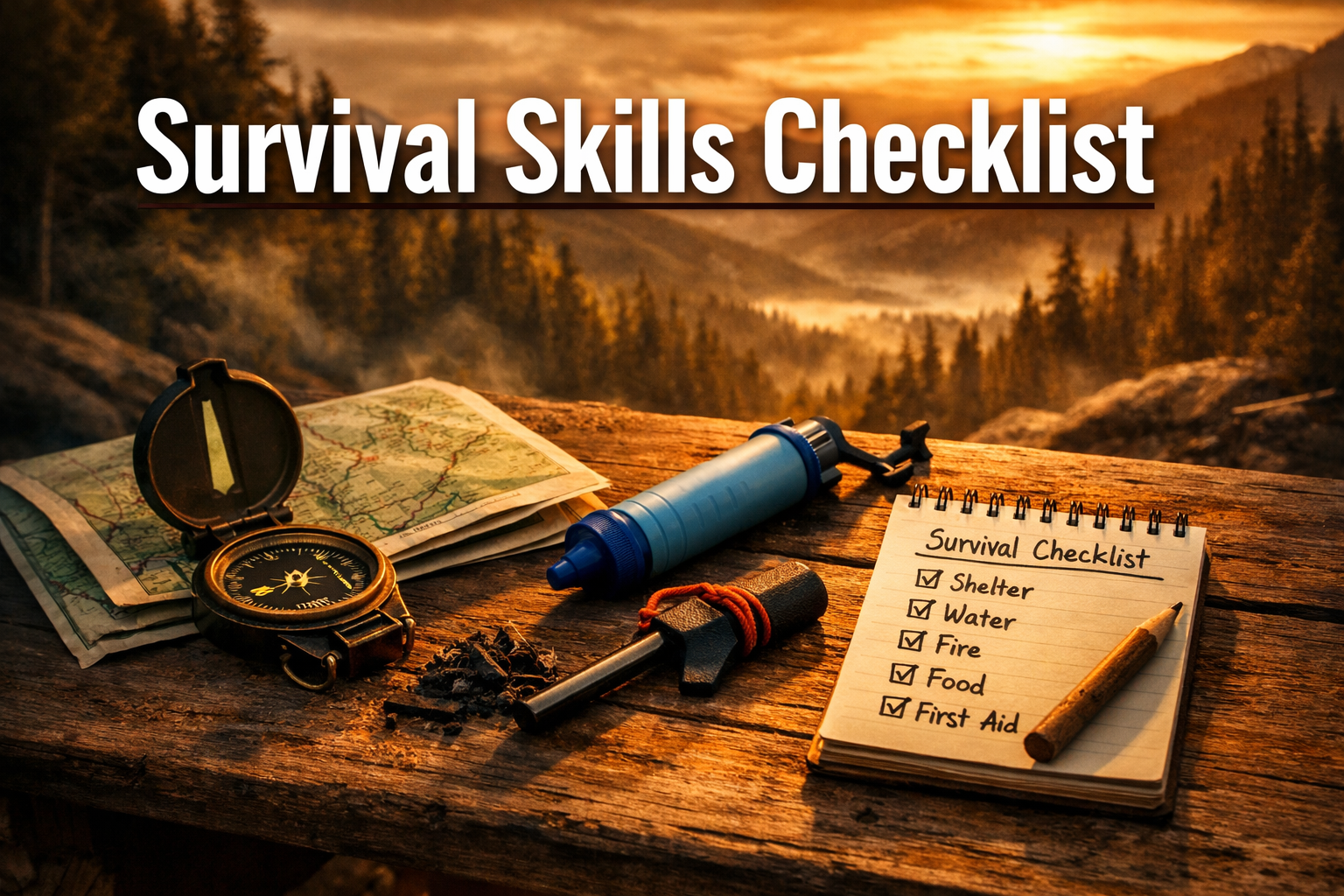
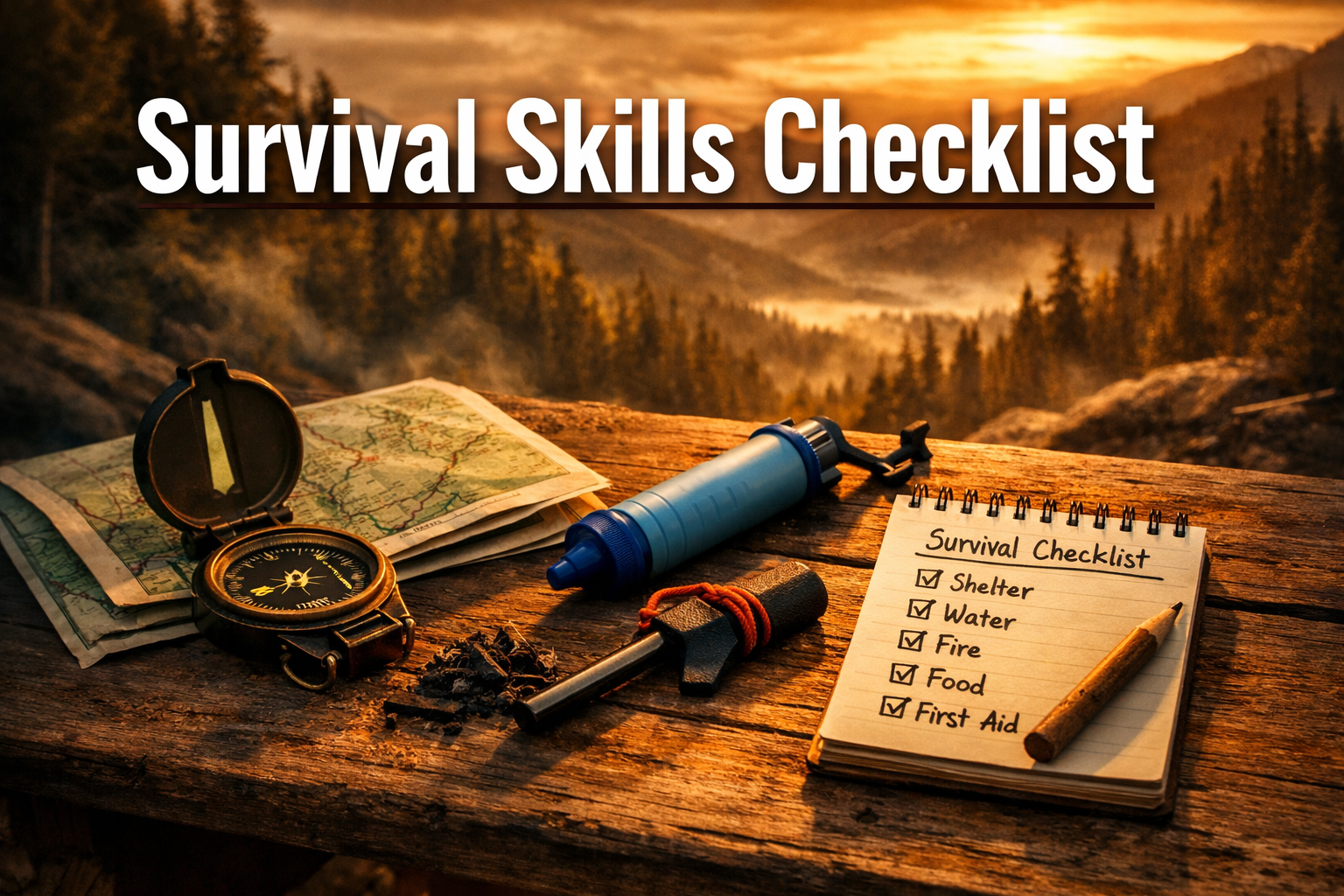
A survival skills checklist is a structured reference tool that helps preppers and survivalists confirm they’ve mastered the core competencies needed to stay alive during emergencies, natural disasters, or grid-down scenarios. The checklist covers shelter, water, fire, food, navigation, first aid, and communication. Reviewing and practicing each skill category regularly is what separates prepared survivors from unprepared victims.
Find this useful? Add us as a preferred source on Google and more of what we publish will show up in your results.
Key Takeaways
- A complete survival skills checklist spans seven core categories: shelter, water, fire, food, navigation, first aid, and communication.
- Skills must be practiced, not just memorized. A checklist you’ve never tested is just a list of good intentions.
- Water procurement and purification is consistently ranked the most critical short-term survival skill, since the human body can only survive roughly three days without water (the “Rule of Threes” framework).
- Shelter-building in your specific local climate is more valuable than generic wilderness survival knowledge.
- First aid and trauma care are often the most neglected skills among preppers, yet they’re among the most likely to be needed.
- Navigation without electronics is a non-negotiable skill as GPS dependence creates a serious vulnerability.
- A layered approach to preparedness, covering everyday carry (EDC), bug-out bag (BOB), and home base skills, gives the most complete coverage.
- Regularly auditing your survival skills checklist against real-world scenarios keeps training relevant and honest.
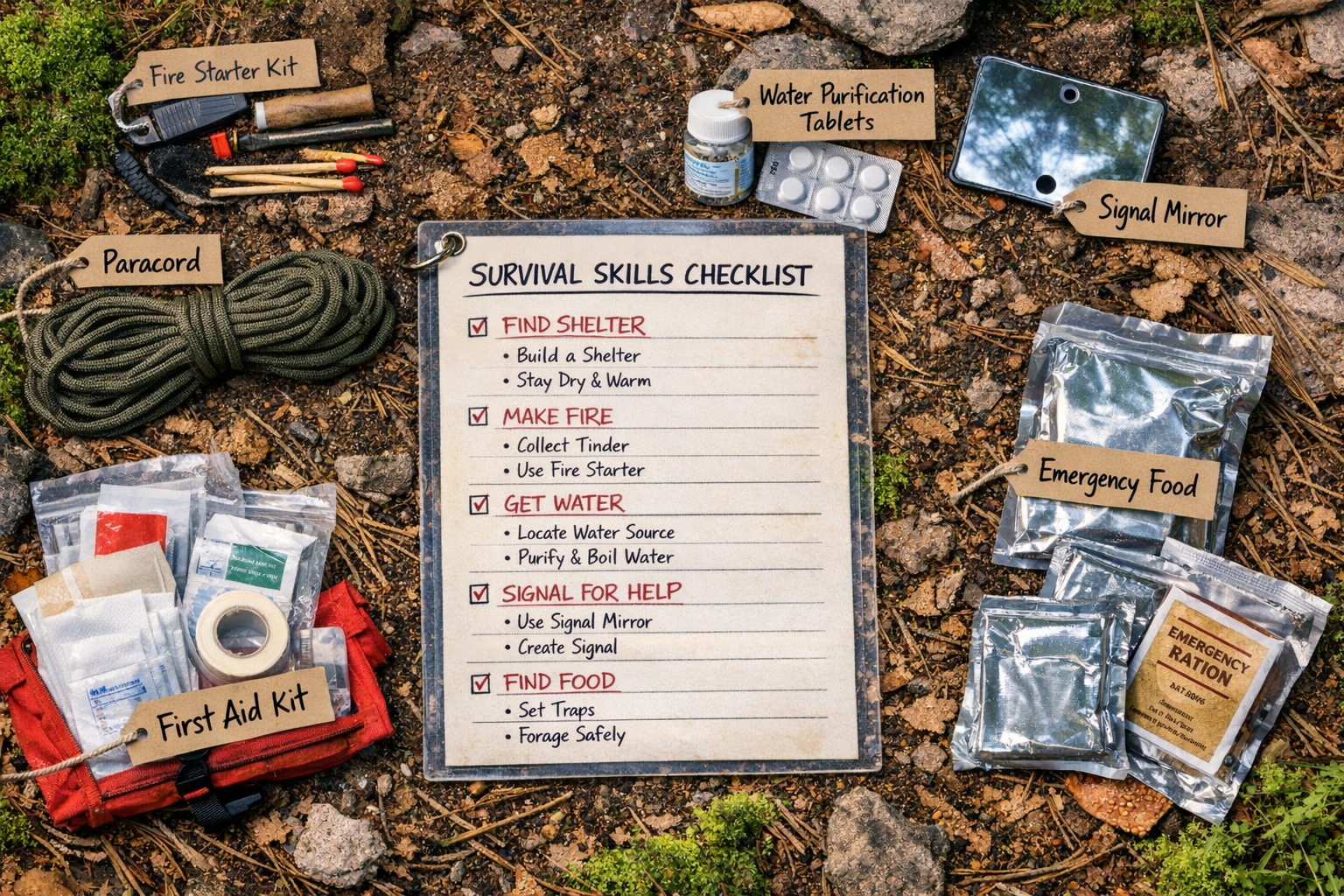
What Is a Survival Skills Checklist and Why Does Every Prepper Need One?
A survival skills checklist is a categorized inventory of the practical abilities a person needs to keep themselves and others alive when normal systems fail. It’s not a gear list. It’s a skills audit.
Most preppers spend significant time and money on equipment but underinvest in the knowledge and muscle memory to use that equipment under stress. A checklist forces an honest reckoning: can you actually start a fire in the rain, or do you just own a ferro rod?
Why structure matters: Without a checklist, training tends to cluster around comfortable skills and skip the hard ones. A written survival skills checklist creates accountability and reveals gaps that could be fatal in a real scenario.
The Rule of Threes: The Framework Behind Every Checklist
The Rule of Threes is the foundational framework for prioritizing survival skills:
| Threat | Survival Window | Skill Category |
|---|---|---|
| Extreme exposure (cold, heat) | ~3 hours | Shelter & fire |
| Without water | ~3 days | Water procurement |
| Without food | ~3 weeks | Food sourcing |
| Without hope/mental focus | Variable | Mindset & communication |
This framework explains why shelter and fire appear at the top of every serious survival skills checklist, not food, which most people instinctively prioritize.
Core Survival Skills Checklist: The Seven Essential Categories
The seven categories below form the backbone of any serious survival skills checklist. Each one includes a skills audit you can run against your current abilities.
1. Shelter and Thermal Regulation
Direct answer: Shelter skills protect against hypothermia and hyperthermia, the two fastest killers in a survival situation.
- Build a debris hut or lean-to using only natural materials
- Identify suitable shelter sites (avoiding flood zones, dead trees, wind funnels)
- Insulate a sleeping area from ground cold
- Construct a tarp shelter using paracord and natural anchor points
- Understand layering systems for cold-weather clothing
Common mistake: Preppers in warm climates often skip shelter training entirely. A single unexpected cold night can be fatal without this skill.
2. Water Procurement and Purification
Direct answer: Finding and making water safe to drink is the single highest-priority short-term skill on any survival skills checklist.
- Locate water sources in your region (springs, streams, dew collection, solar stills)
- Boil water effectively (rolling boil for at least one minute; three minutes above 6,500 feet elevation, per CDC guidance)
- Use a portable filter (Sawyer Squeeze, LifeStraw, or similar)
- Purify with chemical tablets (iodine or chlorine dioxide)
- Collect and filter rainwater
- Recognize signs of contaminated water sources
3. Fire Starting
Direct answer: Fire provides warmth, water purification, signaling, cooking, and psychological comfort. It belongs near the top of every survival skills checklist.
- Strike a ferro rod to produce a spark consistently
- Build and light a fire with wet materials
- Construct a fire lay (teepee, log cabin, star fire)
- Identify and prepare natural tinder (dry grass, birch bark, cattail fluff)
- Use a fire bow drill or hand drill (primitive friction fire)
- Safely extinguish and leave no trace
Choose this if: You live in a wet or cold climate. Fire-starting in the Pacific Northwest or Appalachian winters is a completely different skill than doing it in the Arizona desert.
4. Food Sourcing and Preparation
Direct answer: Food is the lowest-urgency survival skill in the short term but becomes critical in extended scenarios lasting more than a week.
- Identify at least 10 edible wild plants native to your region
- Set and check small game traps (figure-four deadfall, snare loops)
- Fish without commercial tackle (improvised hooks, hand-line fishing)
- Field dress and process small game safely
- Preserve food without refrigeration (smoking, drying, salt curing)
- Understand caloric needs under physical stress (rough estimate: 3,000–4,500 calories per day for active survival work)
Direct answer: Navigation without electronics is a skill most modern preppers have never seriously practiced, making it one of the biggest gaps in the average survival skills checklist.
- Read a topographic map accurately
- Use a baseplate compass for land navigation (shoot a bearing, triangulate position)
- Navigate by sun, stars, and natural indicators (moss growth, prevailing wind)
- Pace-count distances on foot
- Identify terrain features: ridgelines, saddles, drainages, benchmarks
- Plan and execute a route from point A to point B without GPS
6. First Aid and Trauma Care
Direct answer: Medical emergencies are among the most statistically likely survival events, yet first aid is consistently the most undertrained category on preppers’ checklists.
- Control severe bleeding with direct pressure and tourniquets (CAT or SOFTT-W tourniquet application)
- Pack and dress wounds
- Recognize and treat shock
- Splint fractures with improvised materials
- Manage burns, blisters, and hypothermia
- Perform CPR and rescue breathing
- Identify and treat common infections without antibiotics (wound care, hygiene protocols)
- Complete a hands-on first aid or Wilderness First Responder (WFR) course
Edge case: Dental emergencies are a real and often overlooked survival medical issue. Temporary filling kits and clove oil belong in every serious first aid kit.
7. Communication and Signaling
Direct answer: The ability to call for help or coordinate with your group is what separates a manageable crisis from a fatal one.
- Operate a handheld ham radio (Baofeng UV-5R or similar; obtain a Technician license)
- Signal for rescue using a mirror, whistle (three blasts), or ground-to-air signals
- Understand emergency radio frequencies (NOAA weather, 156.8 MHz marine channel 16)
- Use a satellite communicator (Garmin inReach, SPOT) when in remote areas
- Establish communication protocols with family or group members before an emergency
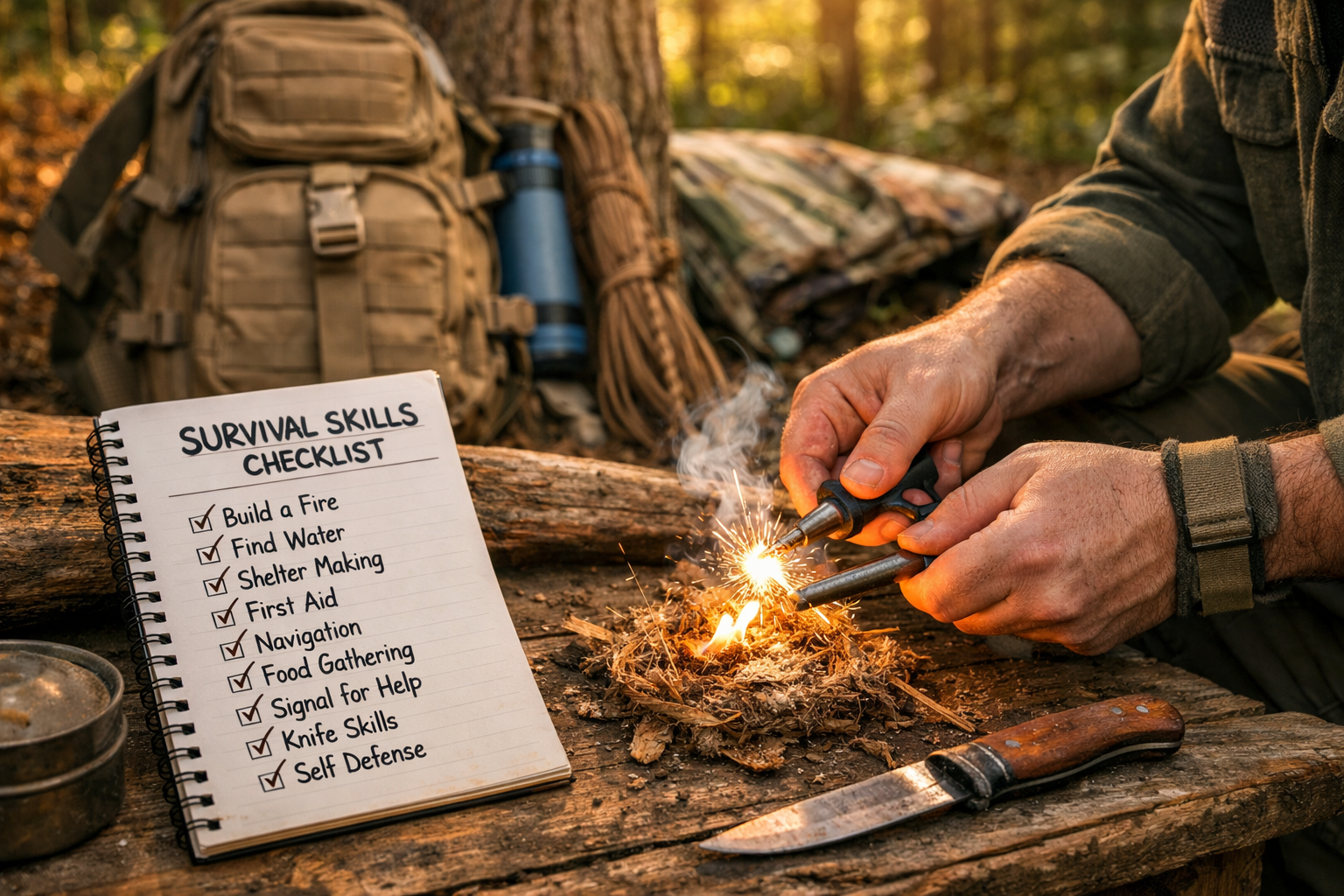
How to Use a Survival Skills Checklist to Audit Your Actual Readiness
Running a real skills audit means testing each item on the checklist under realistic conditions, not just reading about it.
Step-by-step audit process:
- Print or write out your full survival skills checklist across all seven categories.
- Rate each skill honestly: Untrained / Familiar / Practiced / Proficient / Instructor-level.
- Identify your bottom three skills. These are your training priorities for the next 90 days.
- Schedule at least one field exercise per month where you practice skills without gear shortcuts.
- Reassess every quarter. Skills degrade without use, especially fire-starting and navigation.
Pull quote: “A survival skills checklist you’ve never tested in the field is just a list of things you plan to know someday.”
Common audit mistakes:
- Rating yourself “proficient” based on reading rather than doing
- Skipping the skills that feel boring (navigation, water sourcing) in favor of exciting ones (fire, trapping)
- Never practicing under stress, cold, darkness, or fatigue, which are the actual conditions that matter
What Should Be on a Bug-Out Bag Checklist vs. a Skills Checklist?
These are two different tools that work together. A bug-out bag (BOB) checklist covers physical gear. A survival skills checklist covers human capability.
| Bug-Out Bag Checklist | Survival Skills Checklist |
|---|---|
| Water filter (Sawyer Squeeze) | Know how to use and backflush the filter |
| Ferro rod and tinder | Can start fire in rain with this specific rod |
| Topographic map | Can actually read and navigate with it |
| CAT tourniquet | Can apply correctly in under 60 seconds |
| Emergency food rations | Know caloric needs and rationing discipline |
The rule: Never put something in your bug-out bag that you haven’t trained with. Gear without skills is dead weight.
Which Survival Skills Should Beginners Prioritize First?
Beginners should build skills in order of the Rule of Threes: shelter first, water second, fire third. These three address the fastest-moving threats.
Recommended beginner sequence:
- Month 1–2: Water purification (boiling, filter use, chemical treatment)
- Month 2–3: Fire starting (ferro rod, then primitive methods)
- Month 3–4: Shelter building (tarp setups, debris huts)
- Month 4–6: Basic first aid and tourniquet application
- Month 6–9: Navigation (map and compass)
- Month 9–12: Food sourcing (plant ID, trapping basics)
Choose this path if: You’re starting from scratch and want a structured 12-month progression rather than scattered, unfocused training.
How Often Should You Review and Update Your Survival Skills Checklist?
Review the checklist every 90 days at a minimum, and update it after any significant scenario change: moving to a new region, a change in family size, a new threat environment, or after completing new training.
Triggers for an immediate checklist review:
- You moved to a different climate or terrain
- A family member joined or left your group
- A regional threat changed (wildfire risk, flooding, civil unrest patterns)
- You completed a formal course (WFR, ham radio licensing, firearms training)
- More than six months passed without field practice
FAQ: Survival Skills Checklist
Q: How many skills should be on a survival skills checklist?
A: A complete checklist typically covers 40–60 individual skills across seven core categories. Beginners should focus on the top 15–20 most critical skills before expanding.
Q: Can I download a pre-made survival skills checklist?
A: Yes. Organizations like FEMA, the American Red Cross, and prepper communities like SurvivalBlog.com publish free downloadable checklists. Use them as a starting point, then customize for your region and scenario.
Q: Is a survival skills checklist different for urban vs. wilderness scenarios?
A: Yes, significantly. Urban survival emphasizes security, communication, and resource scavenging. Wilderness survival prioritizes shelter, fire, and water from natural sources. A complete prepper checklist should address both.
Q: Do I need formal training to check off survival skills?
A: For most skills, self-directed field practice is enough. For medical skills (tourniquet application, CPR, wound packing), hands-on formal training is strongly recommended because technique errors can cause harm.
Q: What’s the most overlooked skill on most survival checklists?
A: Mental resilience and stress inoculation. Most checklists focus on physical skills but ignore the psychological component. Practicing under discomfort, cold, hunger, and fatigue is what builds real survival capability.
Q: How do I teach survival skills to children?
A: Start with age-appropriate versions of fire safety, water identification, and basic first aid. Organizations like Boy Scouts of America and 4-H have structured curricula that work well as a foundation.
Q: Should my survival skills checklist include self-defense?
A: For most preppers, yes. Basic situational awareness, de-escalation, and defensive skills (firearms safety, hand-to-hand basics) belong in an extended checklist, particularly for bug-out or civil unrest scenarios.
Q: How long does it take to become proficient across all seven skill categories?
A: Realistically, 18–24 months of consistent monthly field practice to reach functional proficiency across all categories. Instructor-level mastery in any single category takes years.
Q: Is there a difference between a survival skills checklist and a prepper checklist?
A: A prepper checklist often includes gear, food storage, and logistics. A survival skills checklist focuses specifically on human capabilities and knowledge. Both are necessary and complement each other.
Q: What’s the single most important item on a survival skills checklist?
A: Water procurement and purification. The human body’s three-day water survival window makes this the highest-stakes, highest-priority skill in virtually every scenario.
Products, Tools, and Resources Worth Using
These recommendations are based on practical utility, not marketing. Each one directly supports building or auditing the skills on your survival skills checklist.
Training Resources:
- Wilderness First Responder (WFR) Course by NOLS or Wilderness Medical Associates — The gold standard for remote medical training. Strongly recommended for any serious prepper.
- FEMA’s Community Emergency Response Team (CERT) Program — Free structured training available in most U.S. counties, covering first aid, light search and rescue, and disaster response.
Navigation Tools:
- Suunto A-10 or Silva Ranger baseplate compass — Reliable, affordable, and purpose-built for land navigation training.
- National Geographic Trails Illustrated topographic maps — Waterproof, detailed, and region-specific. Far more useful than printed Google Maps.
Communication Gear:
- Baofeng UV-5R handheld radio — The most cost-effective entry point for ham radio practice. Pair it with studying for the Technician license exam.
- Garmin inReach Mini 2 — Two-way satellite communication for remote scenarios where cell coverage doesn’t exist.
Medical Supplies:
- North American Rescue CAT Tourniquet (Gen 7) — The tourniquet used by U.S. military and trauma centers. Train with it before you need it.
- Adventure Medical Kits Trauma Pak Pro — A compact, well-organized kit that covers the basics without unnecessary bulk.
Fire Starting:
- Light My Fire Swedish FireSteel Army — Consistent, durable ferro rod that works in wet conditions. A standard recommendation across the prepper community.
Conclusion: Turn Your Checklist Into a Living Training Plan
A survival skills checklist is only as valuable as the training behind it. The goal isn’t to own a list. It’s to build the kind of competence that holds up when everything goes wrong.
Actionable next steps for 2026:
- This week: Download or write a full survival skills checklist covering all seven categories. Rate your current skill level honestly for each item.
- This month: Schedule one field training day focused on your two lowest-rated skills.
- This quarter: Enroll in one formal course, whether that’s a WFR certification, a ham radio licensing class, or a local CERT program.
- This year: Complete at least one 48-hour field exercise where you practice core survival skills without modern conveniences.
The preppers who survive real emergencies aren’t the ones with the most gear. They’re the ones who trained when it was inconvenient, practiced skills that felt unnecessary, and kept an honest checklist that told them exactly where they stood.
Start there.
References
- Centers for Disease Control and Prevention. (2014). Making Water Safe in an Emergency. https://www.cdc.gov/healthywater/emergency/making-water-safe.html
- Federal Emergency Management Agency. (2021). Community Emergency Response Team Program. https://www.ready.gov/cert
- National Outdoor Leadership School (NOLS). (2023). Wilderness Medicine Course Catalog. https://www.nols.edu/en/courses/wilderness-medicine/
- American Red Cross. (2022). Emergency Preparedness Checklist. https://www.redcross.org/get-help/how-to-prepare-for-emergencies.html
- Rawles, J.W. (2009). Patriots: A Novel of Survival in the Coming Collapse. Ulysses Press. [Referenced for foundational prepper framework context]