
Hey there! Some links on this page may be affiliate links which means that, if you choose to make a purchase, I may earn a commission at no extra cost to you. I greatly appreciate your support. Read the full disclosure here.
Most preppers have gear. Far fewer have skills.
There’s a profound and dangerous difference between the two. A bug-out bag full of the right equipment is a starting point — not a survival plan. When the grid goes down, when civil order fractures, when a natural disaster forces you out of your home and into an environment you didn’t choose, the gear in your bag is only as useful as your ability to deploy it correctly under pressure, in the dark, with shaking hands and an elevated heart rate.
The preppers who survive aren’t necessarily the ones with the most expensive kits. They’re the ones who practiced. The ones who built skills before they needed them. The ones who understood that bugging out is not an event — it’s a performance, and performances require rehearsal.
This guide covers the 10 critical bug-out survival skills that separate the prepared from the merely equipped. Master these before SHTF, and you transform your bug-out bag from a collection of objects into a genuine survival system.
What Bug Out Survival Skills Actually Are — And Why Gear Alone Will Fail You
A bug-out scenario is the forced abandonment of your home due to an emergency — natural disaster, civil unrest, infrastructure collapse, or any event that makes your current location more dangerous than the uncertainty of leaving it. The 72-hour window is the critical survival period: the time before organized relief typically becomes available, and the time during which your skills and supplies must sustain you entirely.
The gear vs. skills distinction is not philosophical. It is practical and urgent. A water filter is useless if you don’t know how to find a water source. A compass is useless if you can’t take a bearing. A first aid kit is useless if you don’t know how to treat a wound. In each case, the gear is present. The skill is absent. And in a real bug-out scenario, absent skills kill.
The 10 skills ranked below follow a specific priority logic: the skills that address the most immediate threats to life come first. The Rule of Threes governs this hierarchy: 3 minutes without air, 3 hours without shelter in a harsh environment, 3 days without water, 3 weeks without food. Every skill on this list maps to one of these survival timelines.
The short version: The 10 most critical bug out survival skills, ranked by priority, are: (1) bug out bag building and packing, (2) bug out location selection, (3) emergency shelter building, (4) fire starting with and without modern tools, (5) wilderness first aid, (6) water sourcing and purification, (7) foraging, hunting, and trapping, (8) navigation with and without technology, (9) camp lighting and light discipline, and (10) self-defense and camp security. Skills outperform gear in every real bug-out scenario because skills cannot be lost, stolen, or forgotten.
Key Takeaways:
– Skills trump gear: Mastering practical survival skills is essential because gear alone won’t keep you alive under pressure.
– Prioritize by immediacy: Follow the Rule of Threes—focus first on breathing/air, shelter, water, then food when building your skillset.
– Practice deliberate and scenario-based training regularly to maintain and build genuine bug-out competence.
– Pre-scout and plan: Know your bug-out location and routes well in advance, including water sources, security, and terrain.
– Maintain light and security discipline to avoid detection, and prepare for self-defense realistically to handle human threats.
Skill #1: Building and Packing a Bug Out Bag That Actually Works
 The bug-out bag is the foundation of every other skill on this list. It is the physical system that carries your survival capability — and building it correctly is itself a skill that most preppers dramatically underestimate.
The complete bug-out bag contents framework:
A functional bug out bag contains items across eight categories: water (storage and purification), food (calorie-dense, shelf-stable), shelter (bivvy, tarp, paracord), fire starting (minimum three methods), navigation (paper maps, compass), first aid (complete kit with trauma capability), communication (emergency radio, signaling devices), and tools (multi-tool, fixed blade knife, duct tape, paracord).
The weight calculation: Your bug-out bag should weigh no more than 20 to 25% of your body weight. For a 160-pound person, that’s a maximum of 32 to 40 pounds. A bag you cannot carry over distance is not a bug-out bag — it’s an anchor. This is the calculation most beginners skip, and the one that matters most when mile three becomes mile ten.
Waterproofing: Documents, food, clothing, fire starters, and electronics must be protected from water. Use dry bags, waterproof stuff sacks, or heavy-duty zip-lock bags for critical items. A single rain event can destroy an unprepared bag’s contents — and it will rain.
Organization: Pack heavier items close to your back and centered vertically. Place frequently accessed items (water, first aid, navigation) in exterior pockets. Keep lighter items on top. A bag you can’t navigate under stress is a bag that will fail you when you need it most.
The skill component: Practice packing and unpacking your bag until you can locate every item by touch in darkness. Time yourself. The goal is to access any critical item in 30 seconds or less. This sounds excessive until the moment it isn’t.
Skill #2: Choosing and Evaluating a Bug Out Location — Before You Need One
Your bug-out location is where you’re going. Without a destination, bugging out is just wandering — and wandering in an emergency is how people die.
The six criteria every bug-out location must meet:
1. Water availability: The most critical factor. Your location must be within a reasonable distance of a reliable water source — a well, spring, stream, or river — or have the infrastructure for rainwater harvesting. Research annual rainfall patterns before committing to a location. Water is not a detail. It is the decision.
2. Security: Natural barriers (cliffs, rivers, dense vegetation) provide passive security that doesn’t require active defense. A location protected on multiple sides by natural features is significantly more defensible than open ground.
3. Proximity: Your bug-out location must be reachable on foot if your vehicle is unavailable. Calculate the walking distance and time. Plan for the worst-case scenario — on foot, with a full pack, in adverse weather.
4. Resource availability: Food sources (foraging, hunting, fishing), building materials, and fuel for fire should be available at or near your location.
5. Waste management: Set up your latrine at least 50 meters from your water source and downhill from your camp. Poor waste management creates disease risk that can be more dangerous than the original emergency.
6. Natural disaster protection: Avoid locations near river flood plains, mountain slopes prone to landslides, and coastal areas vulnerable to storm surge. The location that seems ideal in calm conditions may be lethal in an emergency that sends you there.
The pre-scouting protocol: Visit your bug-out location before you need it. Walk the route. Identify the water source. Assess the security. Find the natural shelter sites. The location you’ve visited is infinitely more useful than the location you’ve only mapped.
Skill #3: Building Emergency Shelter — The Skill That Prevents Hypothermia
 Hypothermia kills faster than dehydration. In a 50°F environment with wind and rain, an unprotected person can develop life-threatening hypothermia within 2 to 3 hours. Shelter is the second survival priority after breathing — and the skill most beginners underestimate because it doesn’t feel urgent until it suddenly, catastrophically is.
Shelter site selection:
Choose a location that is naturally protected from wind (behind a rock face, dense vegetation, or hillside), on dry, well-drained ground (never in a depression or dry streambed), away from dead trees and large overhead branches, and close to building materials.
The debris hut — the most important primitive shelter:
- Find a ridgepole (fallen branch or sapling, 9 to 12 feet long)
- Rest one end on a stump or forked branch approximately 2 to 3 feet off the ground; the other end rests on the ground
- Lean branches against both sides of the ridgepole at 45-degree angles
- The interior should be just wide enough for your body — no wider
- Cover the entire structure with leaves, pine needles, bark, and organic debris at least 2 feet thick
- Fill the interior with dry leaves before entering — you’ll sleep inside this material
Ground insulation: The ground conducts heat away from your body faster than cold air. Insulate the ground beneath you with at least 4 to 6 inches of dry debris — leaves, pine needles, dry grass. This single element determines whether you stay warm or develop hypothermia overnight. Most beginners build the roof and forget the floor. Don’t be like most beginners.
The skill component: Build a debris hut in your backyard or local woodland before you need to build one in an emergency. Sleep in it for one night. The experience will reveal every gap in your technique — gaps that are educational now and potentially fatal later.
Skill #4: Fire Starting — With and Without Modern Tools
Fire provides warmth, water purification, food preparation, light, signaling, and psychological comfort. It is the survival skill with the highest psychological value — and the one most people think they know how to do until they try it in cold, wet conditions with shaking hands.
The three-method redundancy rule:
Never rely on a single fire-starting method. Carry three:
- Method 1 — BIC lighter: The most reliable fire-starting tool available. Carry two.
- Method 2 — Ferro rod: Produces sparks at 5,400°F. Works when wet, works in cold temperatures, lasts for thousands of strikes.
- Method 3 — Waterproof matches: UCO Stormproof matches burn for 15 seconds in wind and rain.
Primitive fire starting — the bow drill:
 When modern tools fail or are unavailable, the bow drill is the most reliable primitive fire-starting method. It uses friction between a rotating spindle and a fireboard to create an ember. It requires dry materials, correct technique, and significant practice — most people need 10 to 20 hours of practice before achieving reliable ember production. Start practicing now. Not when you need it.
Natural tinder identification:
The quality of your tinder determines whether your ember becomes a fire. Excellent natural tinder includes: dry grass (crumbled fine), cattail fluff, dry inner bark of cedar or birch (shredded fine), birch bark (contains natural oils that burn even when slightly damp), and amadou fungus from horse hoof fungus.
Fire discipline: In a bug-out scenario involving civil unrest or security threats, fire visibility can compromise your position. Build fires in pits rather than on the ground surface. Use hardwood that produces less smoke. Extinguish fires before dawn and after dusk when smoke is most visible.
The skill component: Practice starting fires with your ferro rod until you can reliably produce a fire in under 5 minutes. Then practice in adverse conditions — wind, light rain, cold. The conditions you practice in are the conditions you’ll face.
Skill #5: Wilderness First Aid — The Medical Gap That Kills More People Than Predators
In a bug-out scenario, injuries are common, and medical help is unavailable. The gap between having a first aid kit and knowing how to use it is the gap between survival and a preventable death.
The complete bug-out first aid kit:
Every bug out bag first aid kit must contain: adhesive bandages (assorted sizes), sterile gauze pads, medical tape, Israeli bandage (emergency pressure bandage), CAT tourniquet, wound closure strips, antiseptic wipes, antibiotic ointment, pain relievers (ibuprofen and acetaminophen), antihistamines, antidiarrheal medication, prescription medications (30-day supply), nitrile gloves (multiple pairs), and a laminated first aid quick reference card.
The critical skills:
Bleeding control: Apply direct pressure with a sterile gauze pad. For severe limb bleeding, apply a tourniquet 2 to 3 inches above the wound. Note the time of application. A properly applied tourniquet can save a life; an improperly applied one can cost a limb.
Wound management: Clean wounds thoroughly with the cleanest water available — boiled and cooled if possible. Remove all visible debris. Close with butterfly closures or Steri-strips. Monitor for infection: increasing redness, warmth, swelling, pus, or red streaking from the wound.
Hypothermia treatment: Remove wet clothing carefully. Insulate from the ground. Apply heat to the core (armpits, groin, neck). Provide warm, sweet liquids if conscious. Never rub the extremities — this drives cold blood to the core and can worsen the condition.
Fracture management: Immobilize the injured area using improvised splints (straight branches, tent poles) padded with soft material. Secure with bandaging material or strips of clothing. Check circulation, sensation, and movement distal to the injury before and after splinting.
The skill component: Complete a Wilderness First Aid (WFA) or Wilderness First Responder (WFR) course before you need these skills. The American Red Cross First Aid/CPR/AED course is the minimum baseline. These skills cannot be learned from reading — they require hands-on practice with real feedback from qualified instructors.
Skill #6: Water Sourcing and Purification — Keeping Your Brain Functional When Everything Else Is Failing
You can survive three days without water. But cognitive function begins deteriorating within 24 hours of inadequate hydration — exactly when you need your thinking to be sharpest. Water sourcing and purification is the skill that keeps your brain functional when everything else is failing.
Finding water in the wilderness:
- Terrain reading: Water flows downhill. Follow valleys and drainages downhill to find water sources.
- Vegetation signals: Willows, cottonwoods, and cattails indicate water within a few feet of the surface.
- Transpiration bags: Tie a clear plastic bag around a leafy branch in direct sunlight. The plant’s transpiration process will collect clean water in the bag over several hours.
- Morning dew: Tie an absorbent cloth around your ankles and walk through grass at dawn. Wring the cloth into a container.
- Dry environment water finding: Look for ravines, gorges, rock depressions, and the base of cliffs or hills.
Water purification methods ranked by reliability:
- Boiling: A rolling boil for 1 minute (3 minutes above 6,500 feet) kills all biological pathogens. The most reliable method — and the one that requires no equipment beyond a container and a fire.
- Chlorine dioxide tablets: Kills bacteria, viruses, and Cryptosporidium. Wait 30 minutes for bacteria and viruses; 4 hours for Cryptosporidium.
- Hollow fiber filters (Sawyer Squeeze): Removes bacteria and protozoa but not viruses. Rated for 100,000 gallons.
- Improvised filtration: A layered filter of grass, sand, charcoal, and gravel removes particulate matter but does not reliably remove pathogens. Always follow with boiling or chemical treatment.
The skill component: Practice locating and purifying water from natural sources before you need to. Use your water filter on a stream or river. Boil water over a fire you’ve built yourself. The combination of skills — finding water, building fire, purifying water — is the chain that keeps you alive.
Skill #7: Foraging, Hunting, and Trapping — When the Food in Your Bag Runs Out
Bug out bag food runs out. In an extended emergency, the ability to source food from your environment is the skill that prevents starvation and maintains the physical energy required for all other survival tasks.
Wild plant identification — the skill that prevents fatal mistakes:
Certain plants are edible. Others are deadly. The gap between them is sometimes a single identifying feature. Before SHTF, invest in a regional plant identification guide and learn the edible plants in your specific area. Start with species that have no dangerous lookalikes: dandelion (entirely edible), cattail (young shoots, pollen, and roots), stinging nettle (highly nutritious when cooked), and plantain (edible raw or cooked).
The universal edibility test: When you encounter an unknown plant, test it systematically — skin contact test (15 minutes), lip test (3 minutes), mouth test (15 minutes without swallowing), swallow test (wait 8 hours). This process takes 24 hours but is the only reliable field method for testing unknown plants. Skipping it is how people die from plants that look edible.
Primitive trapping:
Trapping provides protein with minimal ongoing energy expenditure. The most reliable beginner traps:
- Figure-four deadfall: Requires only sticks and a heavy flat rock. Effective for small game.
- Snare: A simple wire or cordage loop set in an animal trail. Check every 4 to 6 hours.
- Fish trap (weir): A funnel-shaped structure of rocks or sticks built in a stream.
Hunting and fishing without commercial equipment:
Spear fishing in shallow, clear water at dawn and dusk. Gorge hooks made from bone, wood, or metal for fishing. Improvised slingshots for small game. These methods require practice — develop them before you need them, not during the emergency that demands them.
Navigation is the skill that gets you where you’re going — and keeps you from getting fatally lost. GPS dependency is the most dangerous prepper habit because GPS fails in exactly the scenarios that require bug-out bags.
Map and compass fundamentals:
- Topographic map reading: Contour lines represent elevation. Closely spaced lines indicate steep terrain. V-shaped contours pointing uphill indicate valleys; pointing downhill indicate ridges.
- Taking a bearing: Place the compass on the map with one edge connecting your position to your destination. Rotate the housing until the orienting lines align with the map’s north-south grid lines. Read the bearing at the index line.
- Following a bearing: Hold the compass level, rotate your body until the needle aligns with the orienting arrow, and walk toward a landmark in the direction of the travel arrow.
- Magnetic declination: The angular difference between magnetic north and true north. Must be accounted for in accurate navigation. Find your local declination at ngdc.noaa.gov.
- Shadow stick method: Place a stick vertically in the ground. Mark the shadow tip. Wait 15 to 20 minutes. Mark the new shadow tip. The line between the two marks runs approximately east-west (the first mark is west, the second mark is east).
- Solar navigation: The sun rises in the east, reaches its highest point in the south (Northern Hemisphere) at solar noon, and sets in the west.
- Terrain features: Rivers flow downhill and eventually reach human habitation. Following water downstream is the most reliable navigation strategy when lost.
In the Northern Hemisphere, Polaris (the North Star) indicates true north within approximately 1 degree. Find it by locating the Big Dipper and following the pointer stars approximately 5 times the distance between them.
The moon: The moon moves from east to west throughout the night. Draw an imaginary line between the tips of a crescent moon and extend it to the horizon — in the Northern Hemisphere, this point is approximately south.
Pre-planning bug out routes: Before SHTF, plan three routes out of your area — primary, secondary, and tertiary. Drive each route. Walk sections of each route. Mark water sources, shelter locations, and potential obstacles on your paper maps. The route you’ve walked is the route you can navigate in the dark.
Skill #9: Camp Lighting and Light Discipline — Seeing Without Being Seen
Lighting is the survival skill that enables all other camp activities after dark — and the skill that, mismanaged, can compromise your security and reveal your position to people you’d rather not meet.
The three-light-source rule:
Every bug-out bag should contain at a minimum three light sources:
- Primary: A high-quality headlamp (Black Diamond Spot or equivalent) that frees both hands for tasks. Carry extra batteries.
- Secondary: A compact LED flashlight for long-distance illumination and signaling.
- Tertiary: Chemical light sticks (glow sticks) that require no batteries, produce no heat, and are safe around flammable materials.
Light discipline:
In a bug-out scenario involving civil unrest or security threats, light visibility can compromise your position. Practical light discipline:
- Use the lowest light level that allows you to complete the task
- Shield light sources from the direction of potential threats
- Avoid using bright lights after dusk when they’re most visible at a distance
- Use red-light mode (available on most quality headlamps) for camp tasks — red light preserves night vision and is less visible at a distance
- Build fires in pits rather than on the ground surface to reduce the light signature
Battery management: Carry lithium batteries rather than alkaline — they perform significantly better in cold temperatures and have a longer shelf life. Rotate batteries in your bug-out bag every 6 months. Dead batteries in an emergency are worse than no batteries at all, because they create false confidence.
Skill #10: Self-Defense and Camp Security — The Threat Most Preppers Are Uncomfortable Discussing
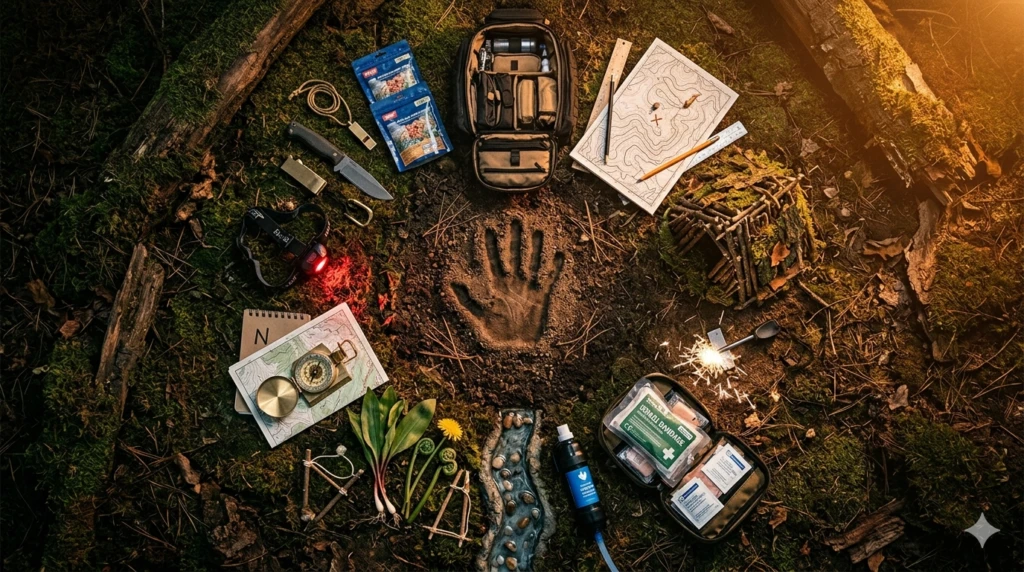 The final critical bug-out survival skill addresses the threat that most preppers are most uncomfortable discussing: other people. In an extended emergency, social order degrades in a predictable pattern. By day 4 or 5 of a severe emergency, opportunistic threats increase significantly. Preparing for this reality is not paranoia — it is the same rational calculation that leads people to lock their doors.
Self-defense tools for bug-out bags:
Carry self-defense tools appropriate to your local laws and your personal training level. Options include: pepper spray (effective, legal in most jurisdictions, requires no special training), a fixed blade knife (multi-purpose tool and last-resort defense), a whistle (for signaling and deterrence), and firearms (for those with appropriate training and legal authorization).
Improvised weapons from wilderness materials:
If you lose your bug-out bag or self-defense tools, the wilderness provides materials for improvised weapons. A slingshot can be constructed from a forked branch and elastic material. A knife can be knapped from flint rock. A staff from a straight, dense hardwood branch provides reach and leverage.
Camp camouflage and concealment:
The most effective security strategy is not being found. Practical camouflage:
- Set up camp under tree cover, away from trails and open areas
- Use a fire pit rather than building a fire on the ground surface — reduces light and smoke signature
- Cover your tracks when approaching and leaving camp
- Ensure hunting traps and snares are not visible from trails
- Camouflage vehicles and any visible equipment
Night security:
If your threat assessment requires active night security, establish a watch rotation if you’re in a group. Use natural alarm systems — dry leaves and sticks arranged around the camp perimeter create noise when disturbed. Position your shelter so you can observe the most likely approach routes.
The Bug Out Skills Training Roadmap — From Zero to Competent
Knowledge without practice is not a survival skill. It is a survival fantasy. The gap between reading about these skills and actually having them is bridged by one thing: deliberate, progressive, scenario-based practice.
The 30-day bug-out skills development plan:
- Week 1: Bug out bag audit and rebuild, bug out location scouting, debris hut construction
- Week 2: Fire starting practice (modern and primitive), water sourcing and purification, basic first aid certification
- Week 3: Plant identification in your local area, primitive trapping practice, map and compass navigation
- Week 4: 48-hour integrated bug-out scenario — combining all skills in a real environment
Free training resources:
- USGS topographic maps (free digital downloads at store.usgs.gov)
- American Red Cross First Aid/CPR/AED course (redcross.org)
- NOAA Magnetic Declination Calculator (ngdc.noaa.gov)
- Primitive Technology YouTube channel (the most accurate primitive skills content available)
The Questions People Actually Ask About Bug Out Survival Skills
What’s the most important bug-out survival skill to learn first?
Bug out bag building and packing — because it is the foundation that enables all other skills. A correctly built and packed bug-out bag ensures you have the tools to apply every other skill on this list. After the bag, the priority sequence follows the Rule of Threes: shelter (3 hours), water (3 days), food (3 weeks). Start with the bag. Build from there.
How long does it actually take to develop genuine bug-out competence?
Basic bug-out competence — enough to survive a 72-hour emergency scenario using primarily your skills and your bag — is achievable in 30 to 60 days of regular practice (2 to 3 sessions per week). Mastery of all 10 skills, including primitive fire starting, advanced foraging, and reliable navigation, takes 6 to 12 months of dedicated practice. The most important thing is to start now, not when the emergency is imminent.
Can I learn bug-out survival skills without going into the wilderness?
Yes — and more effectively than most people realize. Fire starting can be practiced in a backyard fire pit. Knot tying and navigation can be practiced anywhere. First aid can be learned in a classroom. Plant identification can be practiced in local parks. Wilderness practice is valuable for integration and scenario testing, but it is not required for developing foundational competence. Start where you are.
What bug-out skills are most commonly missing from preppers’ training?
Three gaps show up consistently: primitive fire starting (most preppers carry fire starters but have never practiced starting a fire without them), wilderness first aid (most preppers have a first aid kit but have never practiced using it), and navigation (most preppers carry a compass but have never taken a bearing or followed one in the field). These three gaps are the most dangerous because they address the most immediate survival threats.
How do I maintain bug-out skills once I’ve developed them?
Bug-out skills require regular practice to maintain. Schedule monthly practice sessions for your most critical skills — fire starting, navigation, and first aid. Conduct a complete bug-out bag audit twice per year. Complete a 24-hour bug-out scenario annually to test your integrated skill set. Skills that aren’t practiced degrade — and the skills you need most are the ones you can least afford to lose.
Products / Tools / Resources
These are the specific items, courses, and resources that consistently come up in serious bug out skills conversations — selected for genuine usefulness, not for how well they photograph.
Bug Out Bag Essentials
Sawyer Squeeze Water Filter— The standard recommendation for bug-out bag water purification. Rated for 100,000 gallons, weighs 3 ounces, and removes 99.99999% of bacteria and protozoa. If you buy one thing for your bug-out bag before anything else, make it this.
Potable Aqua Chlorine Dioxide Tablets — The most effective chemical water treatment option. Kills bacteria, viruses, and Cryptosporidium. Lightweight, compact, and effective. Keep a supply in every kit.
SOL Escape Bivvy — The most recommended emergency bivvy for bug-out bags. Significantly more durable than standard space blankets, reusable, and genuinely warm. Worth every dollar.
Bayite Ferro Rod (6-inch) — The standard recommendation for bug-out bag fire starting. Produces sparks at 5,400°F, works when wet, lasts for thousands of strikes.
UCO Stormproof Matches — Waterproof, windproof, and burn for approximately 15 seconds each. Reliable backup when a lighter fails.
First Aid
Israeli Bandage (Emergency Pressure Bandage) — The most effective improvised wound closure and pressure bandage available. Used by military and emergency medical personnel worldwide.
CAT Tourniquet (Combat Application Tourniquet) — The standard tourniquet used by military and emergency medical personnel. Requires training to use correctly — pair with a tourniquet training course.
American Red Cross First Aid/CPR/AED Course — The most important supplement to any first aid kit. 4 to 8 hours of instruction that provides skills genuinely capable of saving lives. Find a course at redcross.org.
Suunto A-10 Baseplate Compass — The most recommended entry-level compass for beginners. Accurate, durable, and straightforward to use.
USGS 7.5-Minute Topographic Maps — Free digital downloads at store.usgs.gov. Print them, laminate them, and put them in your bag before you need them.
NOAA Magnetic Declination Calculator — Free online tool at ngdc.noaa.gov. Find your local magnetic declination before you navigate with a compass. Essential for accurate bearings.
Lighting
Black Diamond Spot Headlamp — The most consistently recommended headlamp for emergency preparedness. Bright, durable, water-resistant, and includes red-light mode for light discipline. Headlamps beat handheld flashlights in almost every emergency scenario.
Energizer Ultimate Lithium Batteries — Perform significantly better than alkaline in cold temperatures and have a longer shelf life. The right batteries for your bug-out bag lighting.
Tools
Mora Companion Fixed Blade Knife — The most consistently recommended beginner bug out knife. Fixed blade, full tang, Scandi grind, approximately $15 to $20. The best value in bug-out bag knives.
Leatherman Skeletool — The standard recommendation for bug-out bag multi-tools. Lightweight (5 ounces), durable, and includes the most-used tools.
Training Resources
Wilderness Medical Associates WFA Course— The most accessible wilderness first aid certification for recreational outdoor users. 16 to 20 hours of instruction, widely available, and genuinely useful.
Primitive Technology (YouTube channel)— The most-watched and most accurate primitive skills channel available. Watching someone actually build a debris hut or start a bow drill fire is worth more than reading about it.
Tom Brown Jr.’s Field Guide to Wilderness Survival — One of the most comprehensive and readable wilderness survival books available. Covers primitive skills with the kind of detail that actually translates to field competence.Be Expert with Map and Compass by Björn Kjellström — The classic orienteering and navigation textbook. Clear, practical, and comprehensive. The best single book for beginners learning compass navigation.