Hey there! Some links on this page may be affiliate links which means that, if you choose to make a purchase, I may earn a commission at no extra cost to you. I greatly appreciate your support. Read the full disclosure here.
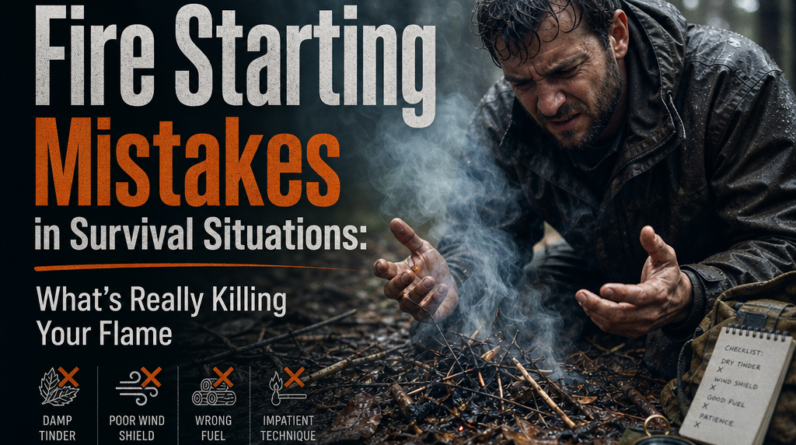
Most people who fail to start a fire in a survival situation don’t fail because they lack matches or a lighter. They fail because of decisions made in the 10 minutes before they ever strike a spark. Fire starting mistakes in survival situations are almost always preparation errors, not ignition errors — and understanding that difference can be the line between a warm, safe night and a dangerous one.
Key Takeaways
- Wet or insufficient tinder is the single most common reason fires fail to catch and sustain
- Wind and moisture management must happen before you attempt ignition, not after
- Carrying three redundant fire-starting tools costs almost nothing and eliminates most failure scenarios
- Desert and forest environments require fundamentally different fire-building approaches
- Friction fire methods (bow drill, hand drill) are learnable but demand dry materials and proper technique
- Injured or mobility-limited survivors can still start fires using modified techniques and pre-prepared materials
- Special forces and survival instructors prioritize tinder preparation over ignition method — every time
- A fire that smokes excessively is almost always a moisture or airflow problem, not a fuel problem
What Are the Most Common Fire Starting Errors in Wilderness Survival?
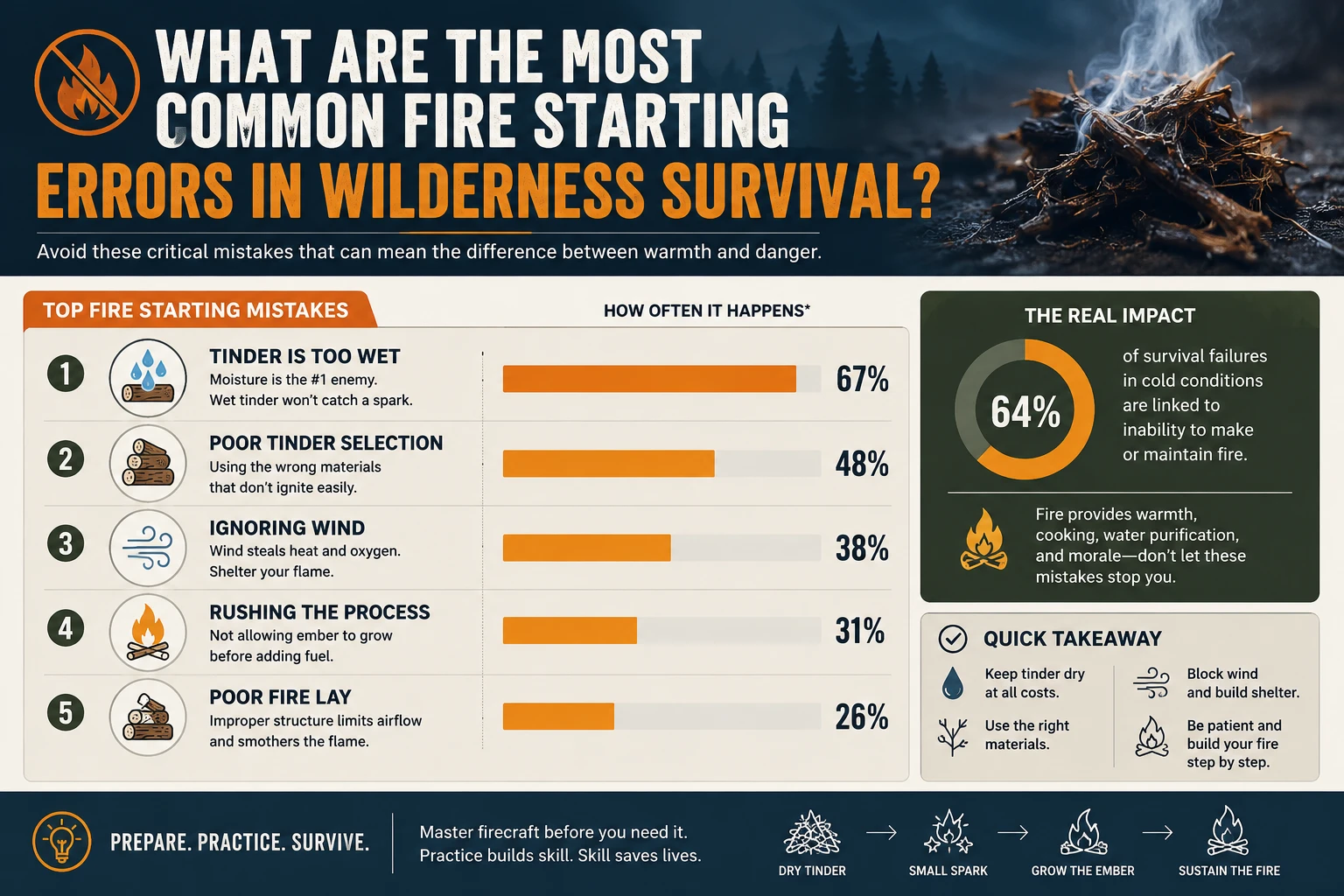
The most common fire starting errors in wilderness survival come down to four categories: poor tinder selection, no wind protection, wrong fire structure, and attempting ignition too quickly. Each one alone can kill a fire before it starts. Together, they guarantee failure.
Here’s what goes wrong most often:
- Using tinder that isn’t truly dry. Leaves, grass, and bark that feel dry to the touch can still hold enough moisture to prevent ignition. Tinder must be bone dry — crinkle-dry, not just cool to the touch.
- Building the fire lay before preparing enough tinder. Most beginners collect what looks like enough tinder, then run out mid-ignition. Prepare three times what you think you need.
- Skipping the graduated fuel structure. Fire needs tinder, then pencil-thin kindling, then finger-thick fuel, then wrist-thick logs — in that order. Jumping straight to large wood smothers the flame.
- No wind break. Even a light breeze scatters heat and dries out the coal before it can transfer to the tinder bundle.
- Choosing the wrong location. Wet ground, exposed ridgelines, and low-lying damp areas all work against you.
“The fire was already lost before the match was struck.” — a phrase used in wilderness survival instruction that captures exactly how preparation errors dominate failure cases.
How Do Beginners Mess Up Making a Fire When Lost in the Woods?
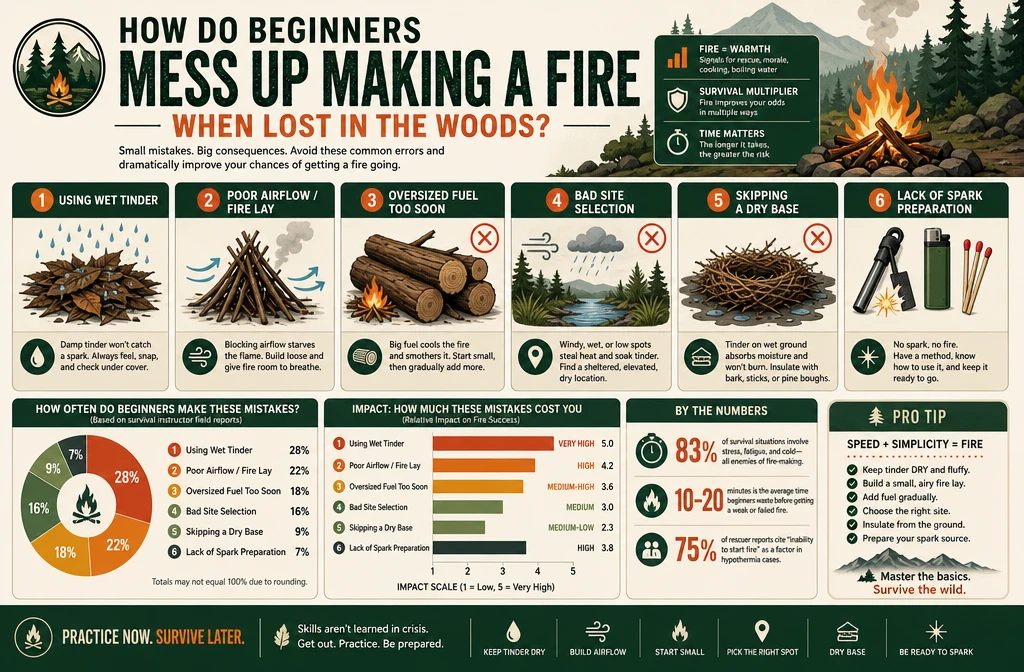
Beginners make fire starting mistakes in survival situations primarily because panic compresses their decision-making. When someone is cold, scared, and losing daylight, they rush — and rushing is the enemy of fire.
The most predictable beginner errors:
- Striking before the structure is ready. The tinder bundle, kindling stack, and fuel supply should all be in place before a single spark is attempted.
- Using green wood as kindling. Green wood contains live moisture and will not catch. Kindling must be dead, dry, and small.
- Smothering the coal with too much material too fast. A new flame needs oxygen. Piling on wood the moment a flame appears is one of the fastest ways to kill it.
- Not protecting the ignition source. Cupping hands around a lighter in wind, or shielding a ferro rod strike, is a basic skill that beginners consistently skip.
- Giving up after one or two attempts. Friction fire methods like the bow drill can require 10 to 20 attempts before producing a coal. Persistence is technique.
For a broader look at the skills that overlap with fire-making in a crisis, the 25 Most Critical Wilderness Survival Skills guide covers fire as part of a complete survival priority framework.
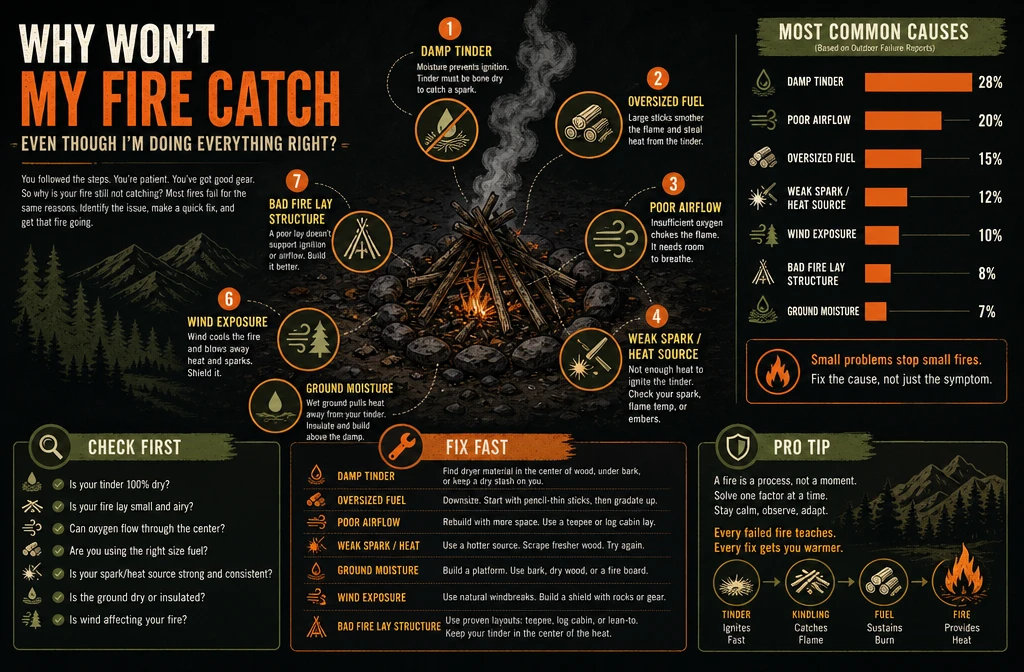
Why Won’t My Fire Catch Even Though I’m Doing Everything Right?
If a fire won’t catch despite apparent correct technique, the problem is almost always moisture — either in the tinder, the kindling, or the ground itself. Secondary causes include insufficient tinder volume and inadequate oxygen flow.
Troubleshooting checklist when fire won’t catch:
| Problem | Likely Cause | Fix |
|---|---|---|
| Tinder ignites but dies immediately | Moisture in tinder | Source drier material; use inner bark or pocket lint |
| Kindling catches but smothers | Too much fuel added too fast | Use pencil-thin sticks first; add gradually |
| Flame dies in wind | No windbreak | Use body, pack, or natural feature as shield |
| Ferro rod produces sparks but nothing catches | Tinder too coarse | Process tinder finer; add petroleum jelly cotton ball |
| Fire starts but ground absorbs heat | Wet or frozen ground | Build a platform of dry sticks first |
One frequently overlooked factor: altitude. Above roughly 8,000 feet, oxygen is thinner, which means fires need finer tinder and more patient flame-feeding. This isn’t intuitive for lowland campers.
Biggest Mistakes That Prevent a Fire From Staying Lit in Wet or Windy Conditions
Wet and windy conditions are where fire starting mistakes in survival situations become genuinely dangerous. The mistakes that kill fires in these environments are different from fair-weather errors.
In wet conditions:
- Failing to build a raised platform of dry sticks before laying the fire (wet ground conducts heat away from the fire base)
- Not sourcing inner wood — the dry core of standing dead wood is protected from rain even when the outer surface is soaked
- Using wet bark as a windbreak, which releases steam and moisture into the fire
In windy conditions:
- Building the fire in an exposed location when a natural windbreak (rock face, fallen log, dense brush) is nearby
- Making the fire too large too fast — a small, established fire survives wind better than a large, fragile one
- Not using a star fire or keyhole fire layout, which concentrates heat and resists wind disruption
The single most underused wet-weather tinder source: fatwood. The resin-saturated heartwood of dead pine stumps ignites even when wet and burns hot enough to dry surrounding fuel. Carrying a few fatwood sticks in a bug out bag is one of the highest-value, lowest-weight decisions a prepper can make. See the Essential Survival Gear Guide for gear ranked by real-world utility.
Best Fire Starting Methods When You Only Have Limited Matches or a Lighter
When ignition sources are scarce, the method matters less than the preparation. A single match can start a fire that lasts all night — but only if the tinder bundle is perfect before that match is struck.
Conserving limited ignition sources:
- Prepare the entire fire lay completely before using any ignition source
- Use a tinder bundle (dry grass, birch bark, cattail fluff, or commercial tinder) that will catch from a single spark
- Shield the flame immediately after ignition — cup it, block wind, and transfer to the tinder bundle without delay
- If using a lighter, use short flicks rather than sustained flame to conserve fuel
- Once a fire is established, maintain a coal bed rather than letting it die and relighting
If down to one match: strike it away from wind, hold it flame-down briefly so the wood catches fully, then transfer to a pre-made tinder bundle held at the same level. Never hold a match flame-up — it burns faster and gives less transfer time.
For preppers building out their kits, the 14 Essential Survival Skills Every Prepper Must Know covers fire-starting alongside other non-negotiable competencies.
Differences Between Survival Fire Starting Techniques for Desert vs. Forest Environments
Desert and forest environments require different fire starting approaches because the primary challenges are opposite: deserts offer dry fuel but scarce material and extreme wind, while forests offer abundant material but frequent moisture and limited airflow in dense canopy.
Desert fire starting:
- Tinder is rarely a problem — dry grasses, dry dung, and dead brush ignite readily
- Wind is the dominant enemy; use rock formations, terrain features, or a dug fire pit to block it
- Fuel burns fast; prepare a larger fuel supply than you think necessary
- Avoid dry washes and canyon floors where wind channels and flash floods are risks
Forest fire starting:
- Moisture is the dominant enemy; prioritize finding dry inner wood and sheltered ground
- Dead standing wood (not fallen) is almost always drier than anything on the ground
- Dense canopy can drip water onto a fire long after rain stops — position fire under natural cover or build a small overhead lean-to
- Hardwood coals last longer and produce less smoke than softwood
The universal rule that applies to both: never build a fire on bare mineral soil if you can help it — use a platform of dry sticks or flat rocks to insulate the fire base from ground moisture or heat-absorbing sand.
Cheapest Emergency Fire Starting Tools That Actually Work Reliably
The most reliable budget fire-starting tools are a Bic-style lighter (around $1–2), a ferro rod with striker (available for $5–15 from reputable brands), and petroleum jelly-soaked cotton balls stored in a small tin or zip-lock bag (cost: pennies per unit). Together, these three items cover ignition in almost any condition for under $20.
Ranked by reliability-to-cost ratio:
- Bic lighter — Works in most conditions, easy to use, widely available. Fails in extreme cold (below about -10°C) and when fuel runs out.
- Ferro rod — Works when wet, produces sparks at around 3,000°F, lasts thousands of strikes. Requires practice and good tinder.
- Waterproof matches — Reliable backup, compact, inexpensive. Limited quantity per box.
- Petroleum jelly cotton balls — Not an ignition source, but dramatically improves catch rate from any spark or flame. Burns for 3–5 minutes per ball.
- Commercial tinder cubes — Windproof, moisture-resistant, consistent. Slightly more expensive but worth carrying a small supply.
What doesn’t work reliably despite the marketing: flint-and-steel kits sold as “survival tools” at gas stations, novelty fire pistons without quality seals, and magnesium blocks used alone without a proper scraping technique.
What Survival Gear Do Experienced Outdoorsmen Recommend for Guaranteed Fire Making?
Experienced outdoorsmen and survival instructors consistently recommend carrying three redundant ignition sources and pre-made tinder as the baseline for guaranteed fire-making. No single tool is foolproof — redundancy is the strategy.
The standard recommended loadout:
- Primary: Bic lighter (stored in an inside pocket to keep it warm in cold weather)
- Secondary: Quality ferro rod (brands like Light My Fire or Exotac are consistently recommended by instructors)
- Tertiary: Waterproof matches in a sealed container
- Tinder: Petroleum jelly cotton balls, fatwood shavings, or commercial fire starters in a waterproof bag
Beyond tools, experienced outdoorsmen emphasize skill over gear. A practiced bow drill user can start a fire with zero carried tools. Someone who has never practiced will fail with a full kit in adverse conditions. The gear buys time and options — the skill is what closes the gap.
For preppers assembling a complete kit, bug out bag mistakes to avoid includes fire-starting redundancy as one of the most commonly overlooked omissions.
How to Start a Fire If You’re Injured or Have Limited Mobility
Injury doesn’t eliminate fire-starting ability — it requires adaptation. The key adjustments for injured or mobility-limited survivors are pre-positioning materials within reach, using ignition methods that require less physical effort, and building smaller, more manageable fires.
Adaptations by injury type:
- Hand or wrist injury: Use a lighter rather than a ferro rod (requires less fine motor control). Pre-process tinder before injury worsens.
- Limited arm mobility: Position the fire lay at a height accessible from a seated or prone position. Use long-handled tools or sticks to arrange fuel.
- Leg injury (can’t gather materials): Prioritize gathering and processing all materials before attempting ignition. Conserve energy — one good fire is better than three failed attempts.
- Hypothermia affecting dexterity: This is the most dangerous scenario. Warm hands first using body heat or warm water if available. A shaking hand cannot operate a ferro rod effectively.
Pre-made tinder bundles — kept dry in a pocket or sealed bag — are the single most important adaptation for any scenario where physical capability is compromised. The bushcraft skills guide covers tinder preparation and other hands-on techniques worth practicing before an emergency.
What Fire Starting Skills Do Special Forces and Survival Experts Teach?
Special forces survival training and professional survival instruction share a consistent philosophy: master the fundamentals under stress before adding complexity. The skills they prioritize are tinder processing, fire lay construction, and friction fire as a zero-tool backup — in that order.
Core skills from professional survival curricula:
- Tinder processing: Learning to identify and prepare tinder from multiple natural sources in any environment. This is practiced more than any other fire skill.
- Fire lay construction: The teepee, log cabin, and star fire lays each have specific applications. Instructors teach when to use each, not just how.
- Bow drill proficiency: The bow drill is the most teachable friction fire method. Military SERE (Survival, Evasion, Resistance, and Escape) training includes it as a baseline skill.
- Fire in adverse conditions: Practicing fire-starting in rain, wind, and cold — not just in ideal backyard conditions. Skills that only work in good weather aren’t survival skills.
- Coal transfer: Getting a coal from a friction fire into a tinder bundle and blowing it to flame is a distinct skill that requires its own practice.
The consistent message from instructors: the person who practices fire-starting 50 times at home will outperform the person with $500 of gear who has never practiced.
Common Rookie Errors That Make Your Fire Smoke Too Much or Go Out Quickly
Excessive smoke and rapid die-out are almost always airflow and moisture problems. A properly built fire with dry fuel produces minimal smoke and sustains itself with minimal intervention.
Why your fire smokes too much:
- Wet or green wood releases steam and unburned gases before it’s hot enough to combust fully
- Insufficient airflow prevents complete combustion (a smoldering fire smokes; a burning fire doesn’t)
- Too much fuel packed too tightly smothers the fire and creates incomplete combustion
Why your fire goes out quickly:
- The tinder-to-kindling transition happened too fast before the kindling was fully established
- The fire base is too small to sustain itself — a fire needs a minimum coal mass to self-sustain
- Fuel was added in large pieces before a proper coal bed developed
The fix for both problems: build smaller and slower. A fire the size of a dinner plate that burns cleanly and hot is more useful than a large smoky pile. Feed it gradually, ensure airflow from below (use a small platform or arrange fuel to allow air underneath), and let each fuel layer establish before adding the next.
How to Start a Fire When You Have Absolutely Zero Traditional Fire Starting Tools
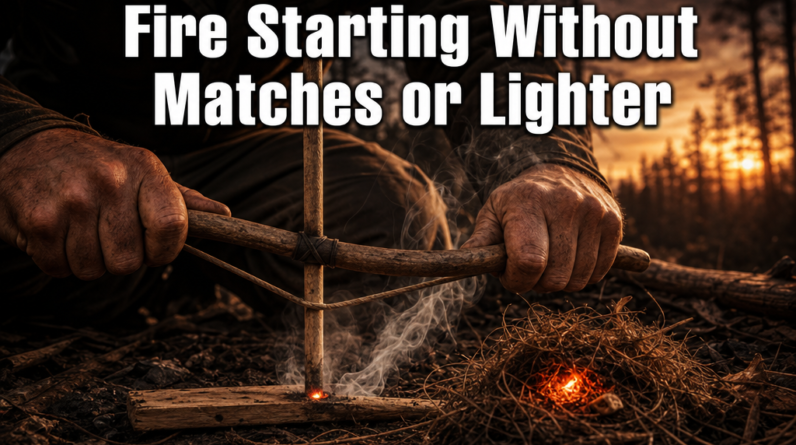
Starting a fire with no tools is possible but requires specific knowledge and the right materials. The three primary no-tool methods are bow drill, hand drill, and fire by percussion (flint and steel using natural materials).
Bow drill (most reliable no-tool method):
- Requires a straight, dry spindle (softwood like cedar, willow, or mullein), a flat fireboard of the same or softer wood, a notch cut into the fireboard, a bow made from a curved branch and cordage, and a handhold piece
- The friction between spindle and fireboard creates a coal in the notch, which is transferred to a tinder bundle
- Success depends almost entirely on wood dryness and proper downward pressure
Hand drill (harder, faster when mastered):
- Same principle as bow drill but uses hands rolling the spindle rather than a bow
- Requires very dry, light wood and produces a coal faster once the technique is mastered
- More physically demanding; not recommended for injured or fatigued survivors
Fire by percussion:
- Strike a hard, sharp-edged rock (quartzite, flint, chert) against a piece of iron pyrite or another hard rock
- Sparks land on a piece of dry char cloth or fine tinder held below the strike point
- Requires practice to identify the right rock types and strike angle
No-tool fire starting is a skill that must be practiced before it’s needed. Attempting a bow drill for the first time in a cold, wet survival situation with no prior experience is an extremely low-probability success scenario. Practice at home, in good conditions, until success is consistent — then practice in adverse conditions.
For preppers who want to build a complete skill foundation, the survival skills checklist is a practical starting point for identifying gaps.
FAQ: Fire Starting Mistakes in Survival Situations
What is the number one fire starting mistake in survival situations?
Starting the ignition process before the tinder bundle and kindling are fully prepared. A fire fails or succeeds in the preparation phase, not the ignition phase.
How do I keep tinder dry in wet conditions?
Store tinder in a sealed waterproof bag inside your clothing or pack. Body heat also helps keep tinder dry. In the field, source inner bark from standing dead wood, which stays dry even after heavy rain.
Is a ferro rod or lighter better for survival?
Carry both. A Bic lighter is faster and easier to use, but fails in extreme cold and runs out of fuel. A ferro rod works when wet and lasts thousands of strikes but requires practice and good tinder. Redundancy beats choosing one.
Can I start a fire in the rain?
Yes, but it requires more preparation. Find or create shelter over the fire site, source dry inner wood, build a raised platform, and use resin-rich tinder like fatwood or petroleum jelly cotton balls. Small, hot fires in sheltered locations outperform large fires in the open.
Why does my fire produce so much smoke?
Wet or green wood is almost always the cause. Smoke is a sign of incomplete combustion — the wood is releasing moisture and unburned gases rather than burning cleanly. Source drier fuel and ensure adequate airflow from below the fire.
How much tinder do I actually need?
More than you think. A tinder bundle for a friction fire should be roughly the size of a softball. For a match or lighter ignition, a bundle the size of a tennis ball is a practical minimum. Prepare extra before attempting ignition.
What’s the easiest fire-starting method for beginners?
A Bic lighter with petroleum jelly cotton balls as tinder. This combination works reliably in most conditions, requires minimal skill, and is inexpensive to assemble. Practice the technique before relying on it.
Can I start a fire without any tools at all?
Yes, using friction fire methods like the bow drill or hand drill. Both require specific wood types, dry conditions, and practiced technique. These methods are learnable but must be practiced before they’re needed.
What wood should I avoid for fire starting?
Avoid green (living) wood, wet wood, and wood from toxic species like poison oak, oleander, or black locust. Burning toxic wood produces harmful smoke. Avoid wood that has been treated or painted.
How do I build a fire in the desert?
Use a dug pit or rock formation as a windbreak. Desert tinder is usually plentiful and dry — dry grasses, dead brush, and dry dung all work well. Prepare extra fuel because desert wood burns fast. Avoid building fires in dry washes where wind channels.
What’s the best fire lay for wet or windy conditions?
The star fire or keyhole fire for wind resistance; a platform fire (fire built on a raised bed of dry sticks) for wet ground. Both concentrate heat and resist the conditions that kill most survival fires.
How long does it take to learn bow drill fire starting?
Most people can produce their first coal within 5–10 practice sessions under good conditions. Consistent success in adverse conditions typically takes 20–30 sessions. Start practicing at home, in dry conditions, before attempting in the field.
Conclusion: Build the Skill Before You Need It
Fire starting mistakes in survival situations are almost entirely preventable — but prevention requires practice, not just gear. The people who fail to start fires when it matters most are usually the ones who assumed the skill would come naturally when the stakes were high. It doesn’t work that way.
Actionable next steps:
- Audit your kit today. Confirm you have three redundant ignition sources and pre-made tinder in a waterproof container. If you don’t, fix it this week.
- Practice tinder processing. Spend 30 minutes identifying and processing natural tinder from your local environment. Learn what works in your specific region.
- Build five fires from scratch in your backyard or a safe outdoor area, using only the tools in your kit. Note what fails and why.
- Learn the bow drill. Watch a quality instructional resource, source appropriate wood, and practice until you can produce a coal consistently. This skill has no expiration date.
- Practice in adverse conditions. Once you can start a fire in good conditions, practice in wind and light rain. That’s where real competency is built.
Preparedness isn’t about having the right gear in a bag. It’s about having the right skills in your hands. Fire is one of the most fundamental survival tools humans have ever had — and it’s one that rewards practice more than any piece of equipment ever will.
For more on building a complete survival skill set, explore the 14 Essential Survival Skills Every Prepper Must Know and the 10 Critical Bug-Out Survival Skills Every Prepper Must Master — both cover fire-starting as part of a broader preparedness framework.
Products, Tools & Resources Worth Having
These aren’t affiliate recommendations dressed up as advice. These are the tools that consistently appear in the kits of experienced survivalists and instructors — the ones that actually get used.
Ferro Rods: Light My Fire Swedish FireSteel and Exotac polySTRIKER are the two most consistently recommended by instructors. Both produce hot, reliable sparks and last thousands of strikes. Avoid cheap unbranded ferro rods — spark temperature and rod durability vary significantly.
Lighters: A standard Bic lighter is genuinely hard to beat for everyday carry. For extreme cold, a Zippo with lighter fluid or a torch-style butane lighter (like the Exotac TitanTORCH) performs better. Keep a lighter in an inside pocket in cold weather — body heat keeps the fuel pressurized.
Tinder: UCO Stormproof Matches are the gold standard for waterproof matches. For commercial tinder, WetFire cubes (by UST) ignite even when wet and burn long enough to establish kindling. Petroleum jelly cotton balls in a small Altoids tin cost almost nothing and outperform most commercial products.
Fatwood: Available in most outdoor and camping stores, fatwood sticks are one of the best wet-weather fire aids available. A small bundle weighs almost nothing and belongs in every bug out bag and emergency kit.
Practice Resources: Tom Brown Jr.’s The Tracker and Mors Kochanski’s Bushcraft are two of the most referenced field manuals for primitive fire skills. Both are practical, not theoretical, and have been in print for decades for good reason.
Related reading from Preppers HQ: