
Hey there! Some links on this page may be affiliate links which means that, if you choose to make a purchase, I may earn a commission at no extra cost to you. I greatly appreciate your support. Read the full disclosure here.
A bug out bag for apartment living is a compact, grab-and-go emergency kit designed specifically for urban evacuation — not wilderness survival. Apartment dwellers face unique constraints: limited storage space, shared exits, elevator dependency, and dense population. A well-built apartment bug out bag covers 72 hours of self-sufficiency and fits in a 25–35 liter backpack stored near your front door.
Find this useful? Add us as a preferred source on Google and more of what we publish will show up in your results.
Key Takeaways
- 🎒 An apartment bug out bag should weigh no more than 20–25% of your body weight — urban evacuation often means walking miles through crowded streets or stairwells
- 💧 Water is your most critical supply; carry at least 1 liter and pack a compact filter or purification tablets for resupply
- 🏙️ Urban bags differ from wilderness kits — prioritize cash, documents, N95 masks, and navigation tools over fire starters and tarps
- 💰 A functional apartment emergency bag can be built for under $100 if you shop smart and prioritize essentials
- 📦 Storage is solvable — a bag near the front door, under the bed, or in a hall closet works well in tight spaces
- 🏥 Medical supplies should cover your personal prescriptions plus basic trauma care — not just a generic first aid kit
- 🔑 Skills matter as much as gear — knowing your evacuation routes, how to shut off utilities, and basic first aid multiplies every item in your bag
- 🏢 High-rise residents need stairwell-specific plans and should never count on elevators during an emergency
- 📋 Review and refresh your bag every 6 months — expired food, dead batteries, and outdated documents are the most common failure points
- 🐾 If you have pets, build a separate companion kit — don’t compromise your own bag’s weight limit
What Exactly Is a Bug Out Bag for Apartment Living?
A bug out bag for apartment living is a pre-packed emergency backpack that lets you leave your home within minutes when disaster strikes — fire, earthquake, flooding, civil unrest, or a mandatory evacuation order. For apartment dwellers, the bag is purpose-built around urban realities: small living spaces, no garage or shed for storage, shared building infrastructure, and evacuation routes that run through stairwells and city streets rather than open countryside.
The core concept is simple: when staying put is no longer safe, everything you need to survive the next 72 hours is already packed and ready. No scrambling. No second-guessing. Just grab the bag and go.
What makes an apartment version different from a generic kit:
- Sized for portability in crowded urban environments (25–35L backpack, not a 70L expedition pack)
- Includes city-specific tools: transit maps, cash in small bills, building keys, N95 respirators
- Lighter on wilderness gear (no tent, no hatchet) and heavier on documentation, communication, and urban navigation
- Designed to be stored in a small space without becoming a tripping hazard
For a deeper dive into the broader framework, the complete bug out bag guide for beginners is a solid starting point.
How Is a City Bug Out Bag Different From Wilderness Bags?
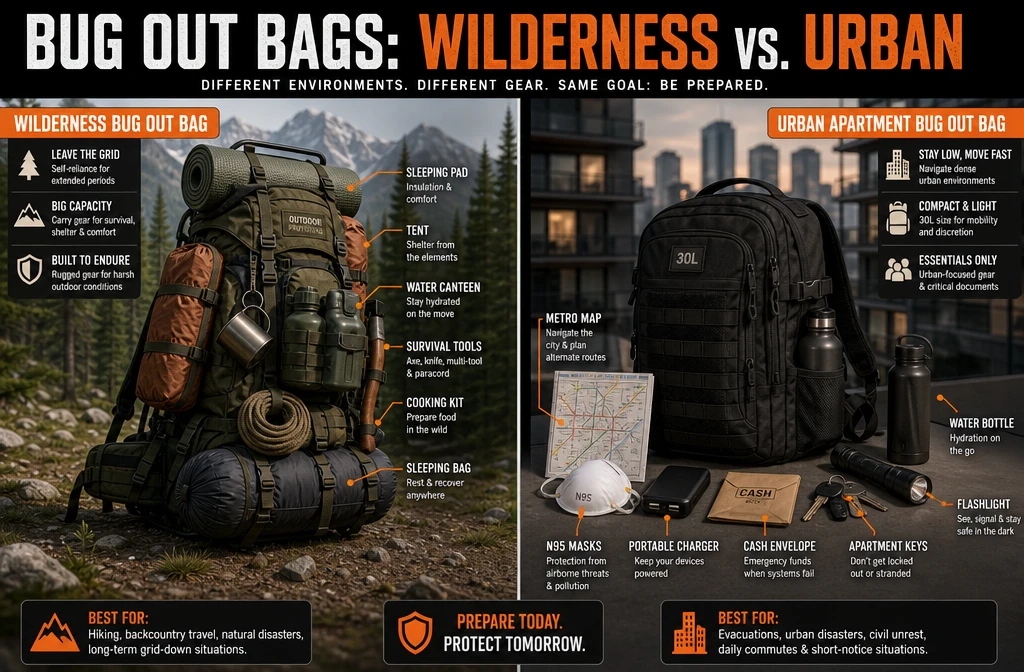
An urban apartment bug out bag and a wilderness survival bag share the same 72-hour goal, but the threats, terrain, and tools are fundamentally different. Wilderness bags assume you’ll be building shelter, starting fires, and foraging. Urban bags assume you’ll be navigating crowds, dealing with infrastructure failure, and potentially sheltering in a car, hotel, or community center.
| Feature | Urban Apartment Bag | Wilderness Survival Bag |
|---|---|---|
| Pack size | 25–35L | 45–70L |
| Weight target | 15–20 lbs | 25–45 lbs |
| Water strategy | Carry + filter/tablets | Filter + collection systems |
| Shelter | Emergency mylar blanket | Tent or tarp + cordage |
| Navigation | City maps, transit routes | Topographic maps, compass |
| Fire-starting | Lower priority | Critical priority |
| Documents | Critical (ID, cash, insurance) | Less critical |
| Masks/PPE | Essential (smoke, chemical) | Rarely needed |
| Communication | Phone charger, NOAA radio | NOAA radio, signaling mirror |
The common mistake: Many apartment preppers copy a wilderness bug out bag list without adapting it. They end up with a 50-pound pack full of fire starters and paracord but no cash, no copies of their lease, and no N95 masks for a smoke or chemical event.
For a full comparison of what a complete 72-hour kit should contain, see the 72-hour bug out bag checklist.
The Complete Bug Out Bag for Apartment Living Checklist
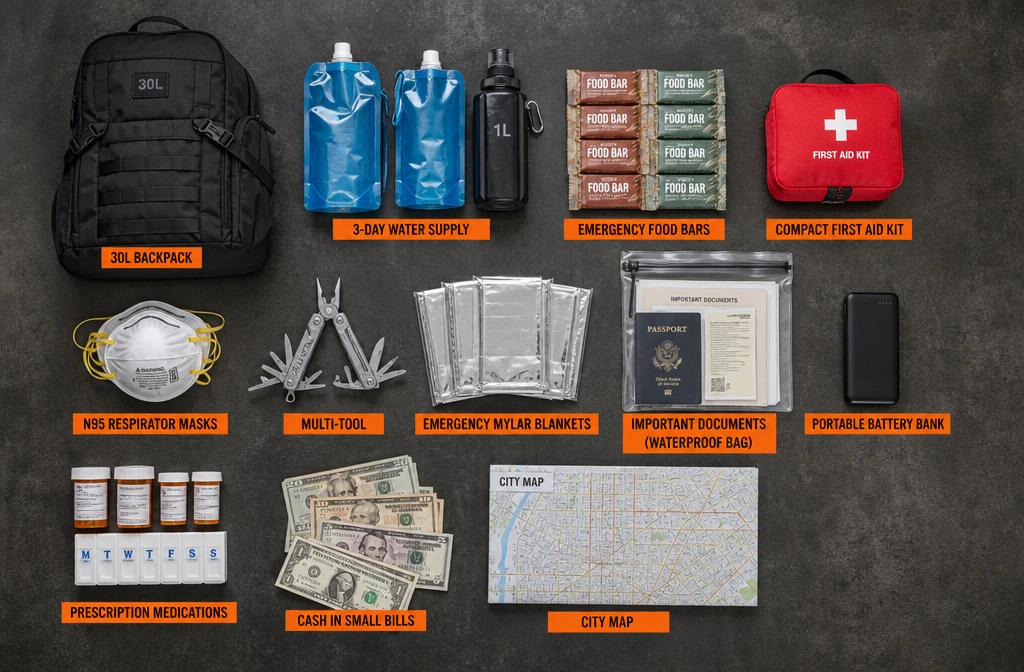
This is the core of what every apartment dweller needs. Organized by category for fast packing and easy auditing.
💧 Water and Hydration
- 1–2 liters of water in a durable, collapsible bottle (Nalgene or Platypus)
- LifeStraw or Sawyer Squeeze compact water filter
- Water purification tablets (iodine or chlorine dioxide) as backup
- Collapsible cup or small pot if using tablets
Rule of thumb: Carry at least 1 liter on your person. Plan to resupply within 24 hours using your filter. Don’t rely on finding bottled water during a mass evacuation — shelves empty within hours.
🍫 Food
- 3,600–4,400 calorie emergency food bars (Datrex or Mayday brands)
- 4–6 high-calorie protein bars or energy bars
- Compact electrolyte packets (Liquid IV or similar)
Avoid canned goods — too heavy. Avoid anything requiring cooking unless you pack a small stove. For a detailed breakdown of what to eat during evacuation, the bug out bag food list covers this thoroughly.
🏥 Medical Supplies
- Compact trauma kit: tourniquet (CAT or SOFTT-W), pressure bandage, hemostatic gauze
- Standard first aid: adhesive bandages, antiseptic wipes, antibiotic ointment, medical tape
- 7-day supply of prescription medications in original bottles (rotate every 6 months)
- OTC medications: ibuprofen, antihistamine, anti-diarrheal, antacid
- Nitrile gloves (2 pairs)
- CPR face shield
🔦 Light and Power
- Headlamp with extra batteries (hands-free is essential in stairwells)
- Small backup flashlight
- 20,000mAh portable battery bank, fully charged
- USB charging cables for your devices
- Crank or solar NOAA emergency weather radio
📄 Documents and Finance
This category is where most apartment preppers fall short. Documents are weightless and irreplaceable.
- Copies of: government-issued ID, passport, birth certificate, insurance cards, lease agreement
- Emergency contact list (printed — don’t rely on your phone)
- $200–$300 cash in small bills (ATMs fail during power outages)
- USB drive with scanned copies of all documents
- Small notebook and waterproof pen
Store originals in a fireproof bag or safe at home. Put copies in your bug out bag.
🧰 Tools and Gear
- Multi-tool (Leatherman Wave or similar)
- Duct tape (small flat roll)
- 550 paracord (25 feet)
- Work gloves (leather or cut-resistant)
- Emergency mylar blankets (2)
- Whistle (Fox 40 or similar)
- Pry bar or tactical pen for debris
👕 Clothing and Personal
- One change of clothes appropriate for the season
- Sturdy closed-toe shoes or boots (stored with the bag, not just “nearby”)
- Rain poncho or lightweight packable jacket
- N95 or P100 respirator masks (minimum 4)
- Dust goggles
- Personal hygiene basics: travel toothbrush, toothpaste, hand sanitizer, wet wipes, toilet paper roll
- Printed city map and regional road map (GPS fails, phones die)
- NOAA emergency radio (hand-crank preferred)
- Fully charged smartphone with offline maps downloaded (Maps.me or Google offline)
- Pre-written note of your evacuation plan and rally points
🔑 Building and Access
- Spare apartment key and building access fob
- Utility shut-off tool (if applicable to your building)
- Stairwell evacuation plan printed and laminated
Which Bug Out Bag Items Are Most Important for Apartment Dwellers?
The five non-negotiables for apartment-specific emergency preparedness are water filtration, cash, documents, N95 masks, and a headlamp. Everything else adds value — but these five items address the most likely urban failure points: infrastructure collapse, power outages, smoke or chemical events, and the need to prove identity at shelters or checkpoints.
Priority tier system for apartment preppers:
Tier 1 — Life-critical (never leave without these): Water filter, emergency food, first aid/medications, headlamp, documents and cash
Tier 2 — High value (include if space allows): Multi-tool, mylar blankets, N95 masks, battery bank, change of clothes
Tier 3 — Situational (depends on your local risks): Pry bar, rain gear, tactical pen, paracord, extra batteries
Are Bug Out Bags Useful If You Live in a High-Rise or Downtown Area?
Yes — in fact, high-rise and downtown apartment residents arguably need a bug out bag more than suburban homeowners. Elevators become unusable during power outages or fires. Stairwells fill with smoke. Dense urban populations mean evacuation routes clog quickly. A well-prepared apartment dweller on the 14th floor who has a headlamp, N95 mask, gloves, and a printed stairwell map is in a dramatically better position than someone scrambling in the dark.
High-rise specific additions:
- Stairwell evacuation hood (protects against smoke inhalation for 15–20 minutes)
- Glow sticks for dark stairwells
- Rope ladder is generally not practical above the 3rd floor — focus on stairwell readiness instead
- Know your building’s designated assembly point and alternative exits
Edge case: Some high-rise buildings have rooftop helicopter pads for emergency evacuation. Check with your building management and include that in your plan.
The ultimate urban survival guide for preppers covers high-density evacuation scenarios in much more depth.
How Much Does It Cost to Build a Basic Apartment Emergency Kit?
A functional apartment bug out bag costs between $75 and $200, depending on what you already own and where you shop. You don’t need premium tactical gear to be prepared. You need the right items in the right categories.
Can You Build a Budget Bug Out Bag for Under $100?
Yes, a usable apartment emergency bag can be assembled for under $100 by prioritizing essentials and shopping smart. Here’s a realistic budget breakdown:
| Item | Estimated Cost |
|---|---|
| 30L backpack (Amazon Basics or thrift store) | $20–$30 |
| LifeStraw water filter | $15 |
| 3,600-cal emergency food bar (Datrex) | $10 |
| Basic first aid kit | $12 |
| Headlamp with batteries | $12 |
| Emergency mylar blankets (4-pack) | $6 |
| N95 masks (10-pack) | $10 |
| Portable battery bank (10,000mAh) | $18 |
| Cash (already yours) | $0 |
| Document copies, printed maps | $2 |
| Total estimate | $105–$115 |
Swap the battery bank for a smaller 5,000mAh model to hit the $100 mark. The cash and documents cost nothing except the time to gather them — and they’re often the most valuable items in the bag.
💡 Pro tip: Don’t buy everything at once. Build your bag over 4–6 weeks by adding one category per week. It’s less overwhelming and easier on the budget.
What Emergency Supplies Do You Need If You Live Alone in an Apartment?
Solo apartment dwellers face a specific challenge: there’s no one to help carry gear, no one to watch the bag while you handle something, and no built-in communication plan. The bug out bag for apartment living checklist for solo preppers should lean heavier on self-sufficiency and communication tools.
Solo-specific priorities:
- A written emergency contact list with at least 3 people outside your immediate area
- A pre-agreed check-in protocol with a trusted contact (text at specific intervals)
- Personal defense tool appropriate to your local laws and comfort level
- Medical alert information card if you have any conditions (laminated, in the bag’s top pocket)
- Enough medication for 7–10 days, not just 72 hours
Common mistake for solo preppers: Assuming someone else will notice if you don’t show up. Build a communication plan before you need it. The emergency communication plan guide walks through exactly how to set this up.
What Medical Supplies Should Go in an Urban Emergency Kit?
Urban emergency medical supplies should cover two scenarios: trauma (injuries from building collapse, falls, or civil unrest) and personal health maintenance (chronic medications, allergies, infections). A generic drugstore first aid kit covers neither adequately.
Trauma essentials:
- CAT tourniquet — for arterial bleeding, the single most life-saving tool you can carry
- Israeli pressure bandage (4-inch or 6-inch)
- QuikClot or Celox hemostatic gauze
- Chest seal (vented, for penetrating chest wounds)
- Nitrile gloves (2+ pairs)
General medical:
- Adhesive bandages (assorted sizes)
- Moleskin for blisters (you’ll be walking)
- Antibiotic ointment
- Antiseptic wipes
- SAM splint
- Medical tape (2-inch cloth)
Personal medications:
- 7-day supply of all prescription medications
- EpiPen if prescribed
- OTC: ibuprofen, diphenhydramine (antihistamine), loperamide (anti-diarrheal), antacids
Critical rule: Rotate medications every 6 months. Expired medications are a liability, not an asset.
How Do You Store a Bug Out Bag in a Small Apartment Space?
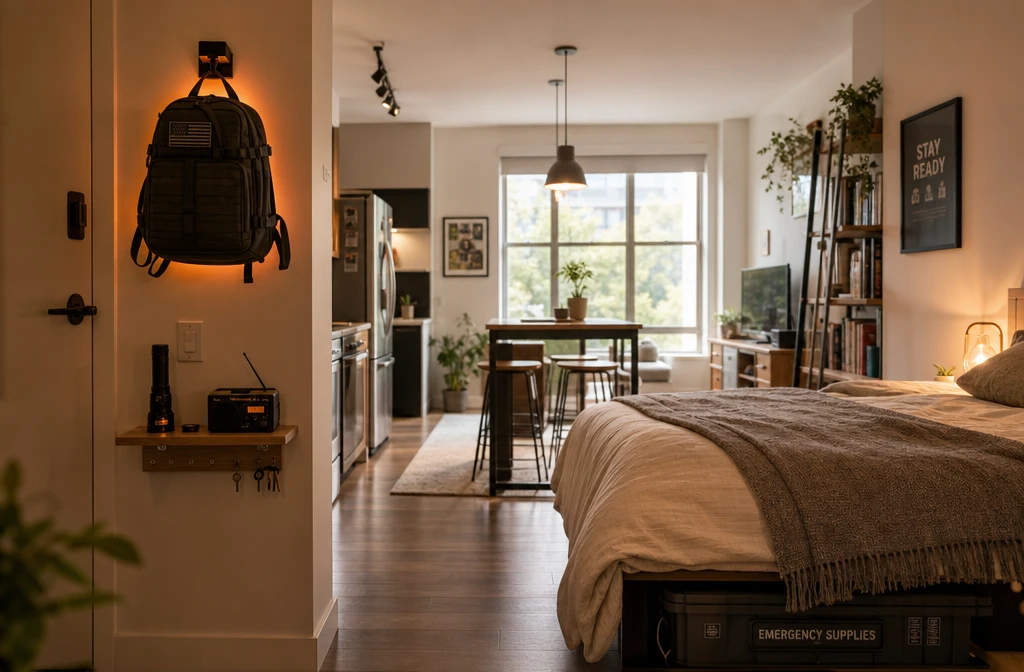
Storage in a small apartment is a real constraint, not an excuse. The goal is accessible, not hidden. Your bag should be reachable within 30 seconds of deciding to leave.
Practical storage solutions:
- Front door hook or rack: The best option — your bag is literally on the way out. A sturdy hook rated for 25+ lbs works perfectly.
- Hall closet floor: Second best. Keep it at the front, not buried behind coats.
- Under the bed: Good for a secondary bag or overflow supplies. Use a flat storage container.
- Behind the bedroom door: Works if you have a dedicated hook or door organizer.
What not to do:
- Don’t store it in a storage unit outside your building — you may not be able to reach it
- Don’t store it in a car trunk as your primary bag if you live in a hot climate (heat degrades food, batteries, and medications)
- Don’t bury it in a closet behind seasonal items — you’ll waste critical minutes digging it out
For more apartment-specific storage strategies, the ultimate guide to prepping in a small apartment covers creative solutions for every room.
What Skills Do You Need to Use a Bug Out Bag Effectively?
Gear without skills is just weight. A bug out bag for apartment living is only as effective as the person carrying it. The most critical skills for urban apartment preppers aren’t wilderness techniques — they’re practical, learnable, and applicable in any city.
Core skills every apartment prepper needs:
- Basic first aid and tourniquet application — Take a Stop the Bleed course (free, widely available). Knowing how to use the trauma gear in your bag could save your life or someone else’s.
- Navigation without GPS — Download offline maps before an emergency. Practice reading a paper map of your city. Know at least two evacuation routes from your building. The complete guide to navigation without GPS is worth bookmarking.
- Utility shut-off — Know where your building’s gas, water, and electrical shut-offs are and how to use them.
- Situational awareness — Recognizing when a situation is deteriorating before it becomes critical. This is the skill that buys you time.
- Water purification — Know how to use your filter and purification tablets correctly. Practice once before you need to do it under stress.
- Basic fire and smoke safety — Know how to move through a smoke-filled stairwell (stay low, feel doors before opening, count floors in the dark).
For a structured approach to building these skills, the 10 critical bug-out survival skills guide covers each one with actionable steps.
Are Bug Out Bags Necessary If You Live in a “Safe” Neighborhood?
Yes. Neighborhood safety has almost nothing to do with whether you need a bug out bag. The emergencies that trigger urban evacuations — earthquakes, wildfires, gas leaks, chemical spills, flooding, extended power outages — don’t check crime statistics before they happen.
In 2026, urban evacuation orders have been triggered by infrastructure failures (water main breaks, gas explosions), natural disasters, and public health events in cities with very low crime rates. A “safe” neighborhood doesn’t have fire-resistant buildings, earthquake-proof infrastructure, or immunity from regional disasters.
The honest framing: A bug out bag isn’t a fear response. It’s the same logic as car insurance — you’re not expecting a crash, but you’re not going to drive without coverage either. Preparedness is confidence, not paranoia.
Common Mistakes People Make With Urban Emergency Bags
Most bug out bag failures come down to the same handful of errors. Knowing them in advance saves money, weight, and potentially your life.
The most common mistakes:
- Overpacking wilderness gear — Fire starters, full-size axes, and 100-foot paracord coils add weight without urban value
- No cash — ATMs and card readers fail during power outages. $200 in small bills is more useful than a $200 piece of gear
- Expired supplies — Food bars, medications, and batteries all have expiration dates. Set a calendar reminder every 6 months
- Bag stored in the wrong place — A bag in a storage unit or buried in a closet might as well not exist
- No printed documents — Phones die. Cloud access requires internet. Paper copies of your ID, insurance, and emergency contacts are irreplaceable
- Wrong bag size — A 70L expedition pack is not an apartment bug out bag. You need something you can carry for hours through a city
- Never practicing — Pack the bag, then do a 30-minute walk with it. You’ll immediately discover what’s too heavy, what’s missing, and what’s in the wrong pocket
For a full breakdown of what goes wrong, the bug out bag mistakes to avoid guide is essential reading.
FAQ: Bug Out Bag for Apartment Living
Q: How big should my apartment bug out bag be? A 25–35 liter backpack is the right size for most apartment dwellers. It’s large enough to hold 72 hours of supplies but small enough to carry through crowded stairwells and transit systems without becoming a liability.
Q: Should I keep my bug out bag packed all the time? Yes. The entire point is instant readiness. A bag that needs to be packed during an emergency isn’t a bug out bag — it’s just a backpack. Keep it packed, check it every 6 months, and store it near your exit.
Q: What’s the most important item in an apartment bug out bag? Water filtration is the single most critical item. You can survive 72 hours without food, but dehydration becomes dangerous within hours, especially under physical and psychological stress.
Q: Do I need a separate bag for my pet? Yes, if possible. Adding pet food, water, a leash, vaccination records, and a carrier to your own bag can push you over a manageable weight limit. A separate small pack for pet supplies keeps your bag functional. See the pet emergency preparedness checklist for a full breakdown.
Q: How often should I update my bug out bag? Every 6 months minimum. Rotate food and medications, recharge battery banks, update document copies (especially if your ID, insurance, or address has changed), and reassess your gear for the current season.
Q: Can I use a regular backpack instead of a tactical bag? Absolutely. A plain, non-tactical backpack is often better in urban environments — it draws less attention and doesn’t signal that you’re carrying valuable gear. Functionality matters more than aesthetics.
Q: What if I have medical conditions or disabilities? Build your bag around your specific needs first. Extra medications, mobility aids, medical alert information, and contact details for your healthcare provider take priority over generic gear. Consult with your doctor about what a realistic 72-hour medical supply looks like for your situation.
Q: Is $100 really enough to build a functional bag? Yes, for a basic but functional kit. You won’t have premium gear, but you’ll have the essentials covered. Start with the life-critical Tier 1 items and add Tier 2 items over time.
Q: Do I need a bug out bag if my building has an emergency plan? Yes. Building emergency plans cover evacuation procedures, not individual survival needs. Your building’s plan gets you out of the building. Your bug out bag keeps you self-sufficient for the 72 hours after that.
Q: What’s the difference between a bug out bag and a get-home bag? A bug out bag is designed to support you after you’ve left home and can’t return. A get-home bag is kept at work or in your car to help you get back to your home base. Both are valuable for apartment dwellers in urban areas.
Q: Should I tell my neighbors I have a bug out bag? Use your judgment. Having a trusted neighbor who knows your plan (and whose plan you know) can be a genuine safety asset. Broadcasting that you have supplies to the wider building is a different calculation.
Q: Where can I learn more about urban-specific preparedness? The complete guide to prepping in a small apartment and the apartment water storage guide are two of the most practical resources for city-based preppers.
Conclusion: Build It Now, Not When You Need It
The bug out bag for apartment living checklist isn’t about worst-case thinking. It’s about making a single, one-time investment of time and money that removes panic from the equation when something unexpected happens — and something unexpected always eventually happens.
Start with the five non-negotiables: water filtration, emergency food, basic medical supplies, cash and documents, and a headlamp. Build from there. Keep the bag near your door. Review it every six months.
Your actionable next steps:
- This week: Gather your documents and make copies. Put $200 in small bills in an envelope. These cost almost nothing and are the most overlooked items.
- This month: Buy a 30L pack, a LifeStraw, emergency food bars, and a headlamp. That’s your functional core.
- Next 60 days: Add medical supplies, a battery bank, N95 masks, and a multi-tool.
- Ongoing: Set a 6-month calendar reminder to rotate food, check batteries, and update documents.
Preparedness isn’t a destination. It’s a practice. The apartment prepper who has a simple, well-maintained 25L bag near their front door is more prepared than someone with a $2,000 wilderness kit stored in a storage unit three blocks away.
Build the bag. Know the plan. Be ready.
Products, Tools, and Resources Worth Knowing
These aren’t paid recommendations — they’re the items experienced urban preppers consistently come back to:
- LifeStraw Personal Water Filter — Lightweight, proven, and under $20. The best single-item value in any urban bug out bag.
- Datrex 3,600-Calorie Emergency Food Bar — Coast Guard-approved, compact, and genuinely palatable. 5-year shelf life.
- CAT Tourniquet (Combat Application Tourniquet) — The standard for civilian trauma kits. Learn to use it before you need it.
- Nitecore NU25 Headlamp — Lightweight, USB rechargeable, and bright enough for dark stairwells.
- Anker PowerCore 26,800mAh Battery Bank — Reliable, widely available, and large enough to charge a phone multiple times.
- Leatherman Wave+ Multi-tool — The most versatile tool-per-ounce option available.
- N95 Respirators (3M 8511 or equivalent) — Essential for smoke, dust, and chemical events. Buy a 10-pack and store 4 in the bag.
- Waterproof document bag — Any zip-lock style waterproof pouch works. Your documents are only useful if they survive the same event you do.
For a broader look at gear priorities across all categories, the essential survival gear guide ranks 50 items by real-world priority.
References
- FEMA. (2021). Build A Kit. Federal Emergency Management Agency. https://www.ready.gov/kit
- American Red Cross. (2023). Emergency Preparedness Checklist. https://www.redcross.org/get-help/how-to-prepare-for-emergencies/survival-kit-supplies.html
- Stop the Bleed Campaign. (2022). Bleeding Control Basics. American College of Surgeons. https://www.stopthebleed.org
- Centers for Disease Control and Prevention. (2022). Emergency Preparedness and You. https://www.cdc.gov/prepyourhealth/index.htm
- National Fire Protection Association. (2023). High-Rise Building Fire Safety. https://www.nfpa.org/Public-Education/Fire-causes-and-risks/Specific-occupancies/High-rise-buildings