Affiliate Disclosure: Hey there! As an Amazon Associate, some links on this page may be affiliate links which means that, if you choose to make a purchase, I may earn a commission at no extra cost to you. I greatly appreciate your support!
A survival pantry list is a prioritized inventory of shelf-stable foods, water, and essential supplies stored to sustain a household through emergencies ranging from a 72-hour power outage to a months-long supply chain disruption. The most effective lists are built around caloric density, nutritional balance, and realistic rotation schedules — not just whatever fills a shelf. Start with a 2-week supply, then expand to 3 months or more.
Key Takeaways
- 🥫 Caloric needs first: The average adult needs roughly 2,000–2,500 calories per day; stock accordingly, not just by item count.
- 💧 Water is non-negotiable: Store at minimum 1 gallon per person per day for drinking and basic sanitation.
- 📦 Shelf life varies widely: White rice can last 25+ years in sealed mylar bags; canned goods typically last 2–5 years.
- 🔄 Rotation prevents waste: A first-in, first-out (FIFO) system keeps your pantry fresh and reduces spoilage.
- 🧂 Don’t forget the basics: Salt, cooking oil, and baking soda are often overlooked but are critical for food preparation.
- 🌡️ Storage conditions matter: Heat, moisture, and light degrade food quality faster than most preppers expect.
- 📋 Build in layers: Start with a 72-hour kit, then scale to 2 weeks, then 3 months.
- 💊 Nutrition gaps are real: A calorie-only focus leads to deficiency; include multivitamins and varied protein sources.
- 🐾 Account for everyone: Pets, infants, and elderly family members have specific dietary needs that standard lists ignore.
- 🛠️ Tools matter as much as food: A manual can opener, camp stove, and fuel are essential companions to any pantry.
What Should Be on Every Survival Pantry List?
 A solid survival pantry list covers four core categories: water, calories, nutrition, and preparation tools. Without all four working together, even a well-stocked pantry can fail during a real emergency.
The foundation of any emergency food supply breaks down like this:
Water
- 1 gallon per person per day (minimum)
- 2 weeks = 14 gallons per person
- Store in food-grade containers; rotate every 6–12 months
- Consider a quality water filter (Sawyer Squeeze or Berkey) as a backup
Calorie-Dense Staples
- White rice (25+ year shelf life in mylar)
- Dried beans and lentils (10+ years sealed)
- Rolled oats (5–10 years in sealed containers)
- Pasta (3–5 years in original packaging; longer vacuum-sealed)
- All-purpose flour (1–2 years; longer if frozen or vacuum-sealed)
Protein Sources
- Canned tuna, salmon, and sardines
- Canned chicken and beef
- Peanut butter (1–2 years; natural varieties shorter)
- Freeze-dried meat (20–25 years from reputable brands)
- Dried eggs (5–10 years sealed)
Fats and Oils
- Coconut oil (2+ years)
- Olive oil (1–2 years; store away from light)
- Ghee (1+ year at room temperature; longer refrigerated)
- Shortening (8–10 years in sealed cans)
Flavor and Preservation Essentials
- Iodized salt (indefinite shelf life)
- Sugar and honey (indefinite if stored dry and sealed)
- Apple cider vinegar
- Soy sauce, hot sauce, bouillon cubes
- Dried herbs and spices (1–3 years for potency)
Common mistake: Many preppers stock calories without tracking macronutrients. A diet of white rice and canned beans alone will cause fatigue, muscle loss, and immune suppression within weeks. Vary protein and fat sources deliberately.
How Much Food Do You Actually Need for a 3-Month Supply?
 For a single adult eating 2,000 calories per day, a 3-month supply requires roughly 180,000 calories total. That sounds like a lot — and it is — but it becomes manageable when broken into food categories.
Estimated quantities for one adult over 90 days:
| Food Item | Quantity | Approx. Calories |
|---|---|---|
| White rice | 25 lbs | ~40,000 |
| Dried beans/lentils | 15 lbs | ~24,000 |
| Rolled oats | 10 lbs | ~17,000 |
| Pasta | 10 lbs | ~16,000 |
| Canned protein (tuna, chicken) | 30 cans | ~9,000 |
| Peanut butter | 6 lbs | ~15,000 |
| Cooking oil | 2 gallons | ~30,000 |
| Canned vegetables/fruit | 30 cans | ~6,000 |
| Miscellaneous (crackers, soups) | Varied | ~15,000 |
Note: These are estimates based on standard USDA caloric values and typical serving sizes. Adjust for activity level, age, and medical needs.
Choose this approach if: You’re building a long-term supply for a household of 2–4 people. Scale quantities by multiplying per-person amounts and account for children (typically 1,200–1,800 calories/day depending on age).
Edge case: Pregnant or nursing women, people with diabetes, and those with food allergies need customized lists. A standard template won’t cover these needs without modification.
What Are the Best Long-Shelf-Life Foods for a Survival Pantry?
The best long-shelf-life foods combine caloric density, nutritional value, and practical storage requirements. Not all “long-shelf-life” claims are equal — storage conditions dramatically affect actual longevity.
Top-tier long-term storage foods (properly sealed and stored):
- White rice — 25–30 years in sealed mylar bags with oxygen absorbers
- Dried beans — 25–30 years sealed; nutritional quality declines before safety does
- Honey — Indefinite; archaeologists have found edible honey in ancient tombs
- Salt — Indefinite; no degradation under any normal storage condition
- Hard winter wheat (whole berries) — 25+ years; requires a grain mill to use
- Freeze-dried fruits and vegetables — 25–30 years (Mountain House, Augason Farms)
- Instant powdered milk — 20–25 years in sealed nitrogen-flush cans
- White sugar — Indefinite if kept dry and sealed
- Pure vanilla extract — Indefinite due to alcohol content
What degrades faster than most people expect:
- Brown rice (oils in the bran go rancid; 6–12 months)
- Whole wheat flour (6–12 months)
- Natural peanut butter (3–6 months)
- Canned goods with dents or rust (inspect before storing)
Decision rule: If you’re storing food for longer than 5 years, invest in mylar bags, food-grade buckets, and oxygen absorbers. For a 1–2 year pantry, original packaging with cool, dark storage is usually sufficient.
How Do You Organize and Rotate a Survival Pantry List?
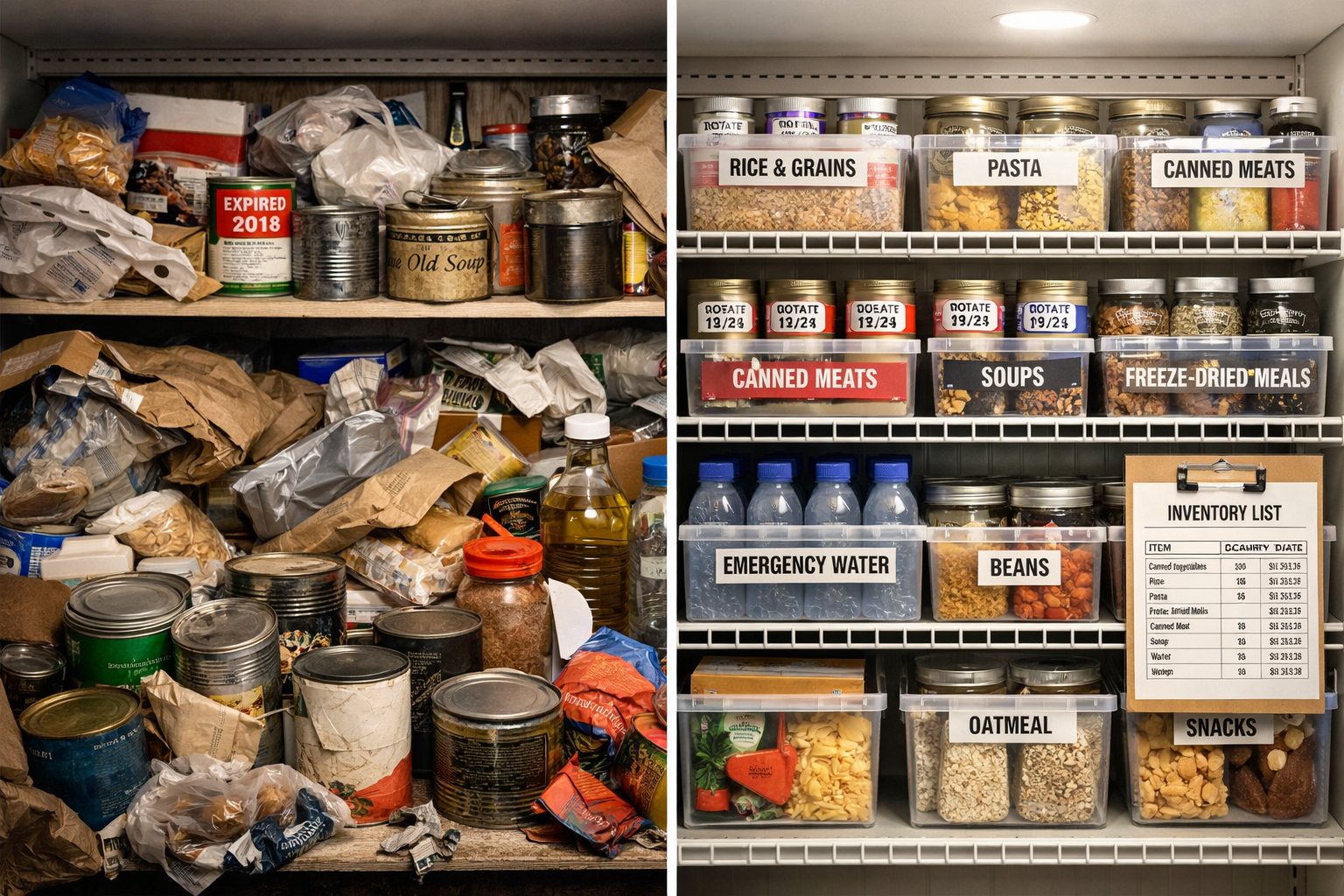
Organization and rotation are what separate a functional survival pantry from a chaotic pile of cans. The FIFO method — first in, first out — is the standard approach used by both preppers and commercial food operations.
Step-by-step rotation system:
- Label everything with purchase date and expiration date using a permanent marker or label maker.
- Shelve new items behind older ones so the oldest stock is always at the front.
- Conduct a quarterly audit — check for expired items, damaged packaging, and gaps in supply.
- Maintain a written or digital inventory (a simple spreadsheet works well) so you know exactly what you have.
- Integrate pantry items into daily cooking to use them before expiration and replace regularly.
Storage environment checklist:
- Temperature: 50–70°F is ideal; avoid garages in hot climates
- Humidity: Below 15% relative humidity when possible
- Light: Dark or opaque containers; avoid direct sunlight
- Pests: Use sealed buckets, bay leaves as a natural deterrent, and regular inspections
Common mistake: Storing a pantry in a hot garage or basement prone to flooding. Temperature swings above 80°F can cut shelf life in half for many foods.
What Foods Should You Avoid Putting on Your Survival Pantry List?
Some foods seem like smart survival choices but create real problems in an emergency. Knowing what to leave off the list is just as valuable as knowing what to include.
Foods to avoid or limit:
- Foods requiring refrigeration after opening — Impractical without power; stick to shelf-stable alternatives
- High-sodium processed foods as a primary staple — Canned soups and ramen have their place, but a diet built on them leads to health issues quickly
- Foods your family won’t eat — A pantry full of unfamiliar foods causes “appetite fatigue,” a real phenomenon where people under-eat because they dislike what’s available
- Glass jars in bulk — They break during earthquakes or when moving supplies; prioritize cans and sealed plastic
- Alcohol-based items as a primary trade good — Storing large quantities creates legal and safety concerns; focus on food first
- Perishable “survival” bars with short shelf life — Some emergency bars marketed as long-term solutions expire in 2–3 years; read labels carefully
Appetite fatigue is a documented problem in disaster response. FEMA and Red Cross field reports have noted that displaced people sometimes refuse to eat unfamiliar emergency rations even when hungry. Stock what your household actually eats.
How Do You Build a Survival Pantry List on a Budget?
Building a survival pantry doesn’t require a large upfront investment. The most cost-effective approach is incremental — adding a few extra items each shopping trip rather than buying everything at once.
Budget-friendly strategies:
- Buy staples in bulk at warehouse stores (Costco, Sam’s Club) — Rice, beans, oats, and canned goods are significantly cheaper per unit in bulk
- Shop sales and use coupons for canned goods; stock up when prices are low
- Prioritize the highest calorie-per-dollar foods first: white rice, dried beans, oats, and pasta consistently offer the best value
- Avoid pre-packaged “survival kits” from online retailers — they’re heavily marked up and often contain foods with poor nutritional profiles
- Grow a small garden to supplement with fresh produce and reduce long-term food costs
Approximate cost to build a 1-month supply for one adult (2026 estimates):
| Category | Estimated Cost |
|---|---|
| Grains (rice, oats, pasta) | $25–$40 |
| Beans and lentils | $15–$25 |
| Canned proteins | $30–$50 |
| Cooking oils and fats | $15–$25 |
| Canned vegetables and fruit | $20–$35 |
| Miscellaneous (salt, sugar, spices) | $15–$20 |
| Total (estimate) | $120–$195 |
Prices vary by region and store. These are rough estimates based on average U.S. grocery prices in 2026.
What Tools and Supplies Belong Alongside Your Survival Pantry List?
Food storage alone isn’t enough. Without the right tools, even a perfectly stocked pantry becomes difficult to use during a power outage or extended emergency.
Essential tools for any prepper pantry:
- Manual can opener — Non-negotiable; keep at least two
- Camp stove with extra fuel (propane or butane) — For cooking when the grid is down
- Water filtration system — Berkey countertop filter or Sawyer Squeeze for portable use
- Food-grade buckets and mylar bags — For long-term grain and bean storage
- Oxygen absorbers — Used with mylar bags to extend shelf life dramatically
- Vacuum sealer — For shorter-term storage of dry goods
- Thermometer for storage area — Helps monitor temperature fluctuations
- Flashlight and backup lighting — Headlamps are more practical than handheld lights
- First aid kit — Injuries during emergencies are common; a basic kit is essential
- Printed inventory and recipe cards — Digital files are useless without power
FAQ: Survival Pantry List
Q: How long should a survival pantry last?
A: The standard recommendation from FEMA is a minimum 72-hour supply, but most experienced preppers target 2 weeks to 3 months. A 1-year supply is considered advanced preparedness.
Q: What’s the single most important item on a survival pantry list?
A: Water. Without it, no food matters. Store at least 1 gallon per person per day and have a filtration backup.
Q: Can canned food really last 5+ years?
A: Yes, in most cases. The USDA notes that commercially canned foods are safe indefinitely if the can is undamaged, but quality and nutrition degrade over time. Most manufacturers recommend consuming within 2–5 years for best quality.
Q: Do I need freeze-dried food, or will canned food work?
A: Canned food works well for most preppers and is significantly cheaper. Freeze-dried food is worth adding for very long-term storage (10+ years) or lightweight bug-out scenarios.
Q: How do I store water long-term?
A: Use food-grade containers (never milk jugs, which degrade). Commercially bottled water is pre-treated. For tap water, add 8 drops of unscented liquid chlorine bleach per gallon and seal tightly. Rotate every 6–12 months.
Q: What about vitamins and supplements in a survival pantry?
A: Multivitamins are a smart addition, especially for extended emergencies. Vitamin C (to prevent scurvy), Vitamin D, and electrolyte packets are worth including. Store in a cool, dark location.
Q: How do I keep pests out of my pantry?
A: Use sealed, hard-sided containers (food-grade buckets with gamma lids). Bay leaves placed near stored grains act as a mild deterrent. Inspect regularly and keep the storage area clean.
Q: Should I store alcohol for trade or bartering?
A: Small quantities of sealed spirits have indefinite shelf life and do have barter value in extended emergencies. However, food, water, and medical supplies should always take priority over trade goods.
Q: Is a survival pantry list different from a bug-out bag?
A: Yes. A survival pantry is a stationary, home-based food supply. A bug-out bag is a portable kit designed for 72 hours of mobility. They serve different scenarios and should both be part of a complete preparedness plan.
Q: How do I account for dietary restrictions in my pantry?
A: Build the list around what your household actually eats and needs. Gluten-free preppers should prioritize rice, quinoa, and certified GF oats. Diabetics should limit high-glycemic staples and include more protein and fat-heavy options.
Q: What’s the biggest mistake preppers make with their survival pantry?
A: Stocking foods they’ve never cooked before. Practice cooking from your pantry regularly so you know how to prepare these meals without stress during an actual emergency.
Q: How often should I audit my survival pantry?
A: At minimum, twice a year — ideally every quarter. Check expiration dates, inspect for damaged packaging, and update your inventory list.
Products, Tools, and Resources Worth Knowing
These recommendations are based on what experienced preppers consistently rely on — not marketing claims.
For bulk food storage:
- Augason Farms and Mountain House are the most consistently reviewed freeze-dried food brands for long-term storage. Mountain House has a verified 30-year shelf life on select products.
- Gamma Seal Lids for 5-gallon food-grade buckets make access easy without compromising the seal — far more practical than standard pry-off lids for active rotation.
For water:
- Berkey Water Filter (countertop) handles large volumes and filters bacteria, viruses, and heavy metals without electricity. The Travel Berkey works for smaller households.
- Sawyer Squeeze Filter is the best portable option for bug-out scenarios — lightweight, durable, and filters to 0.1 micron.
For storage supplies:
- Mylar bags (1-gallon and 5-gallon sizes) combined with 300cc oxygen absorbers are the gold standard for grain and bean storage. Available from PackFreshUSA and similar suppliers.
- FoodSaver vacuum sealers work well for shorter-term dry goods storage and are widely available.
For cooking without power:
- Camp Chef Explorer Two-Burner Stove is a reliable, propane-powered option for home use during outages.
- Solo Stove Titan is a wood-burning option that requires no fuel storage — useful as a backup to propane setups.
For planning and tracking:
- Preppers Pantry spreadsheet templates are available through preparedness communities like The Provident Prepper (YouTube and website) — free, practical, and regularly updated.
- A simple label maker (Brother P-Touch series) pays for itself quickly when managing a large rotating pantry.
Conclusion
A well-built survival pantry list is one of the most practical investments a prepper can make. It doesn’t require a bunker, a large budget, or years of experience — just a clear system, consistent effort, and a realistic understanding of what your household actually needs.
Actionable next steps:
- Start today with a 72-hour supply — water, canned goods, a manual can opener, and a camp stove.
- Calculate your household’s daily caloric needs and use that number to set your 2-week and 3-month targets.
- Add 5–10 extra items per grocery trip until you reach your first milestone.
- Set a calendar reminder for a quarterly pantry audit.
- Cook one meal per month from your pantry to identify gaps, practice skills, and reduce waste.
The goal isn’t perfection — it’s having a meaningful buffer between your family and a crisis. Build the list, rotate the stock, and keep it simple.
References
- FEMA. (2020). Are You Ready? An In-depth Guide to Citizen Preparedness. Federal Emergency Management Agency. https://www.ready.gov
- USDA Food Safety and Inspection Service. (2013). Shelf-Stable Food Safety. United States Department of Agriculture. https://www.fsis.usda.gov
- Red Cross. (2019). Emergency Preparedness and Response: Food and Water in an Emergency. American Red Cross. https://www.redcross.org
- Sawyer Products. (2022). Sawyer Squeeze Water Filter Product Specifications. https://www.sawyer.com
- Mountain House. (2023). Shelf Life Testing and Guarantee Documentation. Oregon Freeze Dry. https://www.mountainhouse.com