
Hey there! Some links on this page may be affiliate links which means that, if you choose to make a purchase, I may earn a commission at no extra cost to you. I greatly appreciate your support. Read the full disclosure here.
The safest water sources in urban survival scenarios are pre-stored tap water (sealed before the disaster), water heater tanks, and commercially bottled water — in that order of reliability. When those run out, rainwater collected from clean surfaces and swimming pools treated with appropriate purification methods become viable secondary options. Every urban water source outside of sealed storage carries contamination risk and must be treated before drinking.
Find this useful? Add us as a preferred source on Google and more of what we publish will show up in your results.
Key Takeaways
- Pre-stored tap water in sealed containers is the single most reliable urban emergency water source — store at least one gallon per person per day for a minimum of 72 hours, ideally 14+ days.
- Water heater tanks hold 30–80 gallons of relatively clean water and are one of the most overlooked emergency reserves in any home.
- Never drink tap water during infrastructure collapse without confirming municipal water pressure and safety — broken pipes allow pathogen backflow.
- Boiling remains the gold standard for killing biological contaminants; bring water to a rolling boil for at least one minute (three minutes above 6,500 feet elevation).
- Rainwater in cities carries pollutants from rooftops, air pollution, and industrial runoff — always filter and purify before drinking.
- Swimming pool water is not safe to drink directly but can be purified with the right filtration and chemical treatment.
- The most dangerous urban water sources are floodwater, storm drains, and water near industrial zones — these may carry sewage, heavy metals, and chemical runoff.
- Portable filters like the Sawyer Squeeze and LifeStraw are affordable, effective, and compact enough for any urban bug-out bag or apartment kit.
- Children, elderly, and immunocompromised individuals need the highest-quality purified water — skip marginal sources entirely for vulnerable family members.
- A WaterBOB or bathtub bladder can store up to 100 gallons of clean tap water if filled immediately when a disaster warning is issued.
What Are the Top 3 Ways to Find Clean Water in a City After a Disaster?
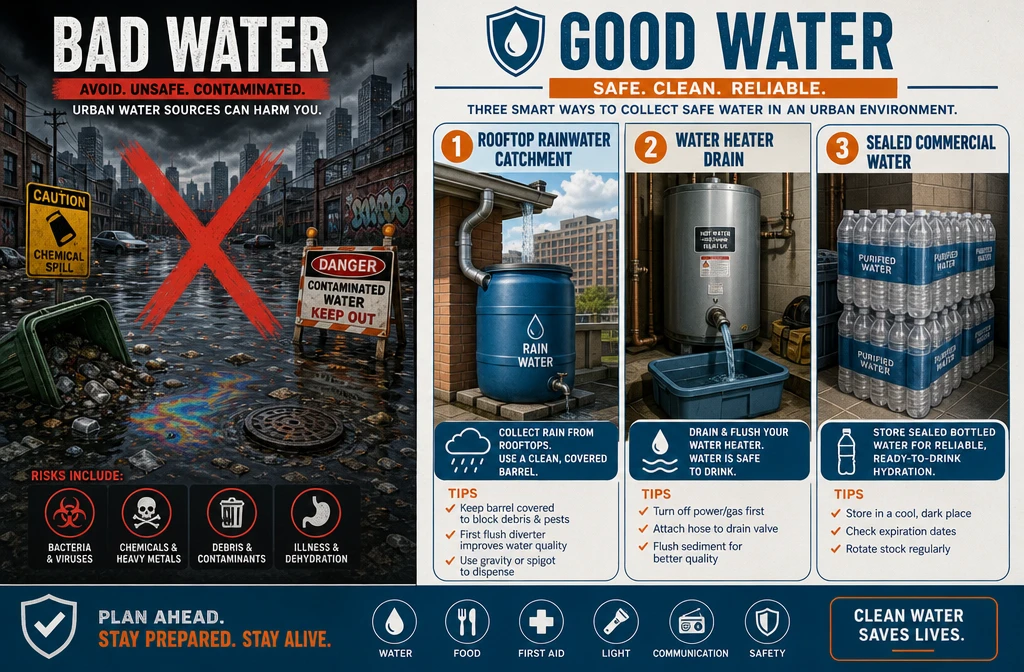
The top three methods for finding clean water in a city after a disaster are: drawing from pre-stored reserves, accessing your water heater tank, and collecting and purifying rainwater. These three approaches cover the most realistic scenarios a city-dweller faces in the first 72 hours to two weeks of an emergency.
1. Pre-Stored Water Reserves
This is the only water source you can fully trust after a disaster — because you controlled it before anything went wrong. Sealed food-grade containers filled from the tap before the event are free of post-disaster contamination. The CDC recommends storing water in clean, food-grade containers with tight-fitting lids, replacing it every six months if using standard tap water without added preservatives.
Decision rule: If you have any warning before a disaster (hurricane, severe storm, civil unrest), fill every available container immediately — including your bathtub using a WaterBOB bladder.
2. Water Heater Tanks
Most residential water heaters hold between 30 and 80 gallons. That water is clean, pressurized municipal water that was stored before the disaster hit. To access it, turn off the gas or electricity to the unit, attach a hose to the drain valve at the bottom, and open a hot water faucet somewhere in the house to break the vacuum. Let gravity do the rest.
Common mistake: Many people forget to turn off the water heater’s power before draining it, which can damage the heating element.
3. Rainwater Collection and Purification
Rainwater is a renewable resource even in cities, but urban collection comes with real contamination risks (more on that below). Collected rainwater should always be filtered and purified before drinking. A clean tarp, food-grade barrel, and a quality filter like the Sawyer Squeeze make this a workable option for extended scenarios.
Risks of Drinking Tap Water During Infrastructure Collapse
During infrastructure collapse, tap water can become dangerous even if it looks and smells normal. When municipal water pressure drops — due to pump failures, broken mains, or power outages — the pressure differential allows bacteria, sewage, and chemical contaminants to backflow into the distribution system.
Key risks include:
- Biological contamination: E. coli, Giardia, Cryptosporidium, and Legionella can enter pipes through cracks and pressure failures.
- Chemical contamination: Industrial facilities near water mains may release toxins during disasters; these don’t boil away.
- Sewage intrusion: Flooded sewer lines and water mains often share underground corridors — a breach in one can contaminate the other.
- Disinfectant failure: Municipal chlorination depends on active infrastructure. Without it, pathogens multiply rapidly in standing pipe water.
⚠️ Critical rule: If you don’t know whether municipal water pressure is maintained and the treatment plant is operational, treat all tap water as potentially contaminated. Boil, filter, or chemically treat it before drinking.
For a deeper look at how grid failure affects water safety, the EMP Attack & Grid Failure Survival Guide covers exactly what happens to utilities when the power grid goes down.
How Can You Tell If Urban Water Is Safe to Drink?
You cannot reliably determine if urban water is safe to drink based on appearance, smell, or taste alone. Many dangerous contaminants — including heavy metals, certain bacteria, and chemical runoff — are colorless and odorless. The only way to be certain is to test it or treat it.
Practical assessment steps for urban survivors:
- Check official communications — emergency broadcasts, local government alerts, and utility company updates are the fastest way to confirm municipal water status.
- Look for visual warning signs — discoloration, unusual odor, visible particles, or oily sheen are immediate red flags.
- Use water test strips — basic strips testing for bacteria, nitrates, pH, and chlorine are inexpensive and compact enough to keep in any emergency kit.
- Assume contamination in flood zones — if floodwater has touched any part of your plumbing or water storage, treat everything as contaminated.
- Treat first, ask questions later — in a genuine emergency, the cost of purification is far lower than the cost of waterborne illness.
Where to Collect Water in an Urban Emergency
The safest water sources in urban survival scenarios beyond your own storage include water heaters, toilet tanks (the tank, not the bowl), canned goods liquid, and carefully collected rainwater. Knowing where to look before you’re thirsty is what separates prepared survivors from desperate ones.
| Water Source | Safety Level | Treatment Needed? | Notes |
|---|---|---|---|
| Pre-stored sealed water | ✅ High | No | Best option; store before disaster |
| Water heater tank | ✅ High | Minimal (filter sediment) | 30–80 gallons available |
| Toilet tank (not bowl) | ✅ Moderate | Filter + purify | Clean if no tank tablets used |
| Canned food liquid | ✅ Moderate | None | Limited volume; good supplement |
| Rainwater (clean surface) | ⚠️ Moderate | Filter + purify | Urban pollution is a factor |
| Swimming pool | ⚠️ Low-Moderate | Heavy treatment required | High chlorine; filter + purify |
| Floodwater | ❌ Dangerous | Avoid if possible | Sewage, chemicals, pathogens |
| Storm drains | ❌ Dangerous | Avoid | Chemical and biological hazards |
| Decorative fountains | ❌ Dangerous | Avoid | Algae, bacteria, chemical treatments |
For apartment-specific water sourcing and storage strategies, the Apartment Water Storage Complete Guide covers how to maximize limited space without compromising on safety.
Best Water Purification Methods When Utilities Are Down
When utilities are down, the four most reliable purification methods are boiling, chemical treatment (bleach or iodine tablets), mechanical filtration, and UV purification — used individually or in combination depending on the contamination type.
Boiling
Boiling kills all biological threats — bacteria, viruses, and protozoa. Bring water to a full rolling boil for one minute (three minutes above 6,500 feet). It does not remove chemical contaminants or heavy metals, so pre-filter visibly dirty water through a cloth before boiling.
Chemical Treatment
- Unscented liquid household bleach (6–8.25% sodium hypochlorite): Add 8 drops per gallon of clear water, 16 drops for cloudy water. Wait 30 minutes before drinking. Per the EPA, this method is effective against most bacteria and viruses.
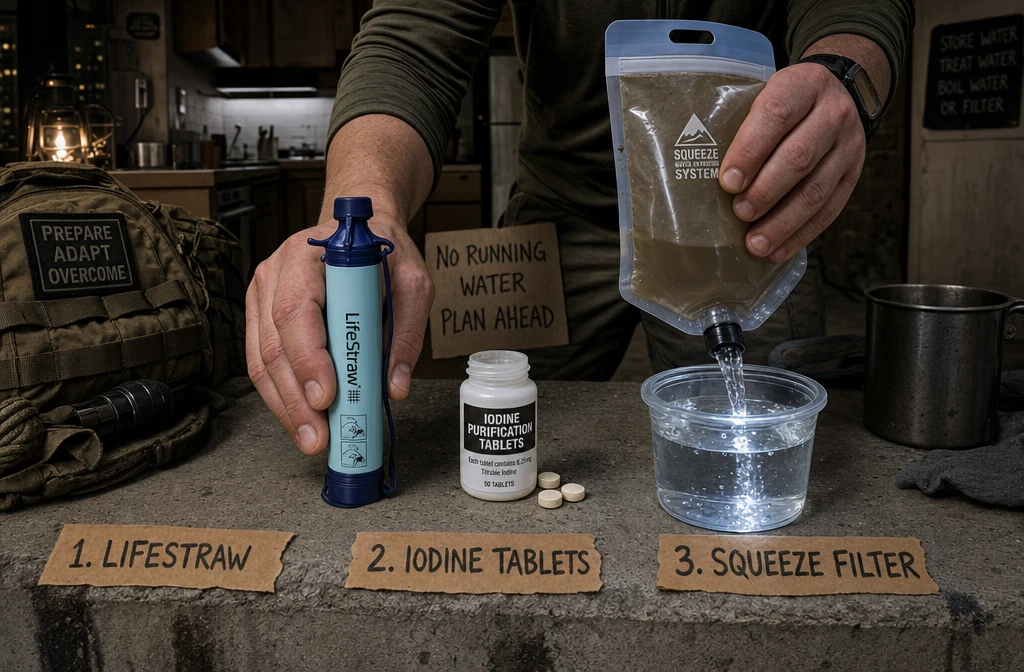
- Water purification tablets (iodine or chlorine dioxide): Compact, cheap, and effective. Chlorine dioxide tablets (like Aquatabs) are more effective against Cryptosporidium than iodine alone.
Mechanical Filtration
Portable filters like the Sawyer Squeeze (filters up to 100,000 gallons, removes bacteria and protozoa) and LifeStraw (personal use, removes 99.9999% of bacteria) are excellent for urban survival kits. They don’t remove viruses, so pair with chemical treatment in areas where sewage contamination is likely.
UV Purification
Devices like the SteriPen use ultraviolet light to neutralize viruses, bacteria, and protozoa in about 90 seconds per liter. Requires batteries — keep spares or a solar charger in your kit.
Choose based on your threat:
- Biological only → boiling or UV
- Biological + chemical uncertainty → filter + boil
- Portability priority → Sawyer Squeeze + purification tablets
- Virus risk (sewage contamination) → chemical treatment or UV + filter
For a thorough breakdown of purification systems, see The Ultimate Emergency Water Storage and Purification Guide.
How to Purify Water Without Electricity
Purifying water without electricity is straightforward using three non-electric methods: boiling over an open flame, chemical disinfection with bleach or tablets, and gravity-fed mechanical filtration. None of these require power, and all three can be combined for layered protection.
Step-by-step process for no-electricity purification:
- Pre-filter: Pour water through a clean cloth, bandana, or coffee filter to remove visible sediment and debris.
- Boil over a camp stove, wood fire, or propane burner for one full minute.
- Cool and store in a sealed, food-grade container away from sunlight.
- Add chemical backup if boiling isn’t possible — use bleach drops or chlorine dioxide tablets per manufacturer instructions.
- Use a gravity filter like the Sawyer Squeeze or Berkey for ongoing filtration without power dependency.
Edge case: Chemical treatment is less effective in very cold water (below 40°F / 4°C). Double the contact time or use boiling instead.
Can You Drink Rainwater or Melted Snow in a City?
Rainwater and melted snow in urban environments are not safe to drink without treatment. While rainwater starts relatively pure, it picks up pollutants as it falls through city air and contacts rooftops, gutters, and collection surfaces. The EPA and environmental health researchers have documented that urban rainwater regularly contains heavy metals (lead, arsenic), pesticides, microplastics, and biological contaminants.
What makes urban rainwater riskier than rural:
- Industrial and vehicle exhaust deposits on collection surfaces
- Roof materials (asphalt shingles, lead flashing) leaching into runoff
- Bird and rodent droppings on rooftops
- Air pollution particulates dissolved into rainfall
Melted snow carries the same risks — plus road salt, de-icing chemicals, and vehicle runoff if collected near streets.
Minimum treatment for collected urban rainwater or snow:
- Filter through a quality mechanical filter (Sawyer Squeeze or equivalent)
- Follow with chemical treatment (chlorine dioxide tablets) or boiling
- Do not use rainwater collected near industrial zones or highways for drinking, even after treatment — chemical contamination may exceed what standard filters can remove
What Water Sources Are Most Dangerous in a City Emergency?
The most dangerous urban water sources are floodwater, storm drain water, water near industrial or chemical facilities, and standing water in low-lying areas. These sources combine biological pathogens with chemical and heavy metal contamination in ways that standard purification methods cannot fully address.
Avoid these sources entirely when possible:
- Floodwater: FEMA and the CDC both classify floodwater as a serious health hazard containing sewage, chemicals, and biological pathogens. Even skin contact can cause infection through open wounds.
- Storm drains and gutters: Designed to carry runoff from streets — oil, pesticides, animal waste, and industrial chemicals all flow through these systems.
- Water near gas stations, dry cleaners, or industrial sites: Petroleum products and solvents can contaminate groundwater and surface water in ways that are invisible and not removable by standard filtration.
- Decorative fountains and ornamental ponds: Treated with algaecides and other chemicals; also harbor Legionella bacteria in warm conditions.
- Swimming pools (untreated): High chlorine levels cause gastrointestinal distress; must be diluted and further treated before drinking.
“In a genuine disaster, the temptation to drink from any available source is real. But consuming contaminated water doesn’t just make you sick — it can incapacitate you at exactly the moment you need to be functional.”
Cheapest Water Filtration Tools for Urban Survival
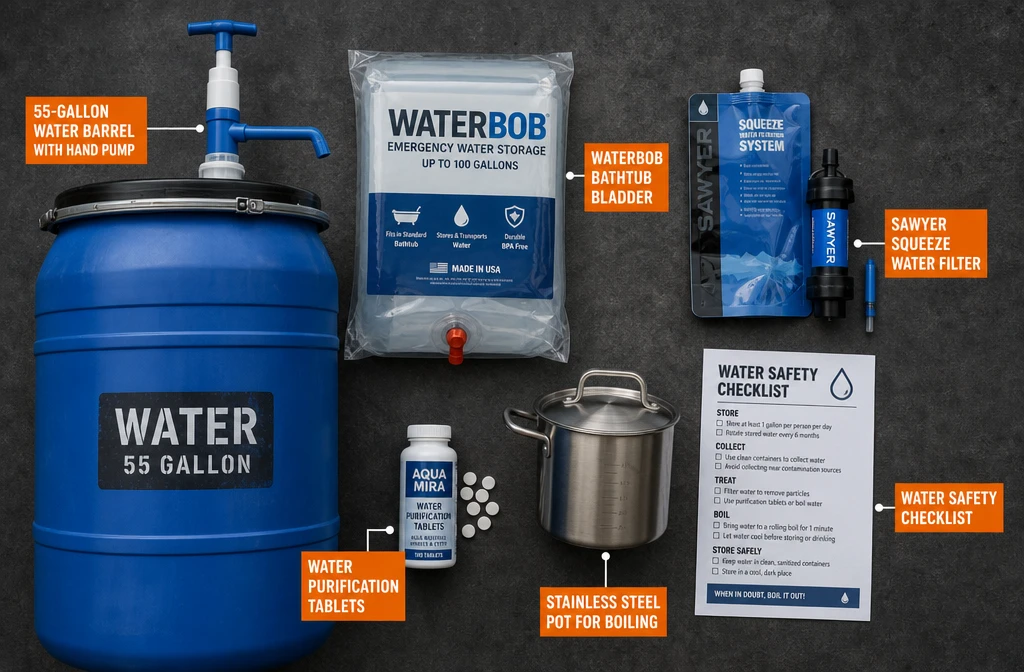
The most affordable and effective water filtration tools for urban survival are the Sawyer Mini (around $20–25), water purification tablets (under $10 for 50 tablets), and unscented household bleach (under $5). These three items together provide comprehensive protection for under $35 and fit in any bag or apartment kit.
Budget-ranked options:
| Tool | Approximate Cost | What It Removes | Limitations |
|---|---|---|---|
| Household bleach | ~$3–5 | Bacteria, viruses | Not for chemicals/heavy metals |
| Iodine/chlorine tablets | ~$5–10 | Bacteria, viruses, some protozoa | Taste; not for Crypto (iodine) |
| Sawyer Mini filter | ~$20–25 | Bacteria, protozoa | Not viruses |
| LifeStraw personal | ~$15–20 | Bacteria, protozoa | Not viruses; single-use design |
| Sawyer Squeeze | ~$30–35 | Bacteria, protozoa | Not viruses |
| SteriPen UV purifier | ~$50–80 | Bacteria, viruses, protozoa | Requires batteries |
| Berkey gravity filter | ~$250–350 | Broad spectrum | High cost; not portable |
Best combination for under $40: Sawyer Squeeze + chlorine dioxide tablets. The filter handles protozoa and bacteria; the tablets cover viruses. Together, they address nearly every biological threat in an urban water source.
Avoid the common pitfalls covered in The Worst Water Storage Mistakes Preppers Still Make — including relying on a single filtration method or using the wrong container type.
How Long Can Water Be Stored Safely in an Apartment?
Commercially sealed bottled water stored in a cool, dark location is safe indefinitely from a microbial standpoint, though manufacturers recommend consuming it within two years for taste quality. Tap water stored in clean, food-grade containers should be replaced every six months.
Storage guidelines by container type:
- Commercially bottled water: 2 years (manufacturer recommendation); microbiologically safe beyond that if seal is intact
- Tap water in food-grade containers: 6 months before refreshing; add 2 drops of unscented bleach per gallon to extend shelf life
- WaterBOB or bathtub bladder: Use within 4 weeks of filling
- 55-gallon water barrels: 6–12 months; treat with a water preserver concentrate to extend to 5 years
Apartment-specific tips:
- Store containers away from direct sunlight and heat sources (both degrade plastic and accelerate bacterial growth)
- Keep water away from gasoline, paint, or chemical storage areas — plastic containers are permeable to vapors
- Label every container with the fill date
For apartment-specific storage strategies, the Apartment Water Storage Complete Guide walks through exactly how to store 30+ gallons in a small space without taking over your living area.
What Water Sources Are Safe for Children During an Emergency?
For children, the elderly, and immunocompromised individuals, only the highest-confidence water sources should be used: pre-stored sealed water, commercially bottled water, and water that has been both filtered and boiled. These groups are significantly more vulnerable to waterborne pathogens and chemical contaminants than healthy adults.
Standards for vulnerable family members:
- Use commercially bottled water as the first choice whenever available
- If purifying collected water, use a two-step process: mechanical filter followed by boiling (not just one or the other)
- Avoid chemical-only treatment (bleach or tablets) as the sole method for children’s drinking water when boiling is possible
- Do not give children water from swimming pools, rainwater, or any source with unknown contamination history, even after basic treatment
- Watch for signs of waterborne illness (diarrhea, vomiting, fever) within 24–72 hours of consuming any treated water source
Edge case: Infants on formula require water that meets the highest safety standard. If boiled water is used, allow it to cool fully before mixing formula. Never use chemically treated water for infant formula without also boiling.
For families building a comprehensive emergency plan, the Ultimate Guide to Home Emergency Preparedness covers water planning alongside food, shelter, and communication for every household member.
Differences Between Water Filters for Home vs. Emergency Use
Home water filters (like countertop Berkey systems or under-sink RO units) are designed for continuous use with relatively clean municipal water, while emergency filters (like Sawyer Squeeze or LifeStraw) are built for portability, durability, and use with untreated natural or collected water. Choosing the wrong type for your scenario can leave dangerous gaps in protection.
| Feature | Home Filter (e.g., Berkey) | Emergency Filter (e.g., Sawyer) |
|---|---|---|
| Portability | Low (heavy, stationary) | High (fits in a pocket) |
| Flow rate | High (gravity-fed, gallons/hour) | Low-moderate (squeeze/sip) |
| Virus removal | Yes (with Black Elements) | No (requires chemical addition) |
| Lifespan | 3,000+ gallons per element | 100,000 gallons (Sawyer Squeeze) |
| Cost | $250–$350+ | $20–$35 |
| Best for | Shelter-in-place, home base | Bug-out, mobile, field use |
Decision rule: If you’re sheltering in place with a reliable water source nearby, a gravity-fed home filter provides better throughput and broader contaminant removal. If you’re mobile or bugging out, a Sawyer Squeeze plus purification tablets is the better combination.
Common Mistakes People Make Finding Water in Urban Disasters
The most common and dangerous mistake urban survivors make is assuming visible clarity means safety. Clear water can still carry viruses, bacteria, dissolved chemicals, and heavy metals. Other frequent errors include:
- Relying on a single purification method — filters don’t kill viruses; chemical treatment doesn’t remove heavy metals; boiling doesn’t remove chemicals
- Ignoring the water heater tank — this is often the largest clean water reserve in any home and is consistently overlooked
- Collecting rainwater from contaminated surfaces — gutters, asphalt shingles, and painted surfaces add contaminants to collected water
- Using decorative fountains or ornamental ponds — these are treated with chemicals and harbor dangerous bacteria
- Drinking floodwater in desperation — the consequences (cholera, E. coli, chemical poisoning) can be fatal
- Forgetting to store water before a predicted disaster — most people wait until it’s too late to fill containers
- Using containers that aren’t food-grade — chemicals from non-food-grade plastics leach into stored water over time
For a full breakdown of what not to do with water storage, The Worst Water Storage Mistakes Preppers Still Make is essential reading before your next prep session.
FAQ: Safest Water Sources in Urban Survival Scenarios
Q: How much water do I actually need per day in an emergency? The CDC and FEMA both recommend one gallon per person per day for drinking and basic sanitation. In hot weather, heavy physical activity, or for nursing mothers, that figure doubles to two gallons minimum.
Q: Is toilet tank water safe to drink? The water in the toilet tank (not the bowl) is generally the same water as your tap supply and is safe to drink if the tank doesn’t use chemical tablets or dyes. Filter it and purify it as a precaution before drinking.
Q: Can I use pool shock (calcium hypochlorite) to purify water? Yes. Pool shock at 68–78% calcium hypochlorite can be used to purify water. Use approximately 1/8 teaspoon per gallon of clear water. This is a more concentrated option than liquid bleach and stores longer. Confirm the product contains no additional chemicals before use.
Q: How do I know if my water heater water is safe? Water heater tanks accumulate sediment over time, but the water itself is generally safe. Drain a little from the bottom first to flush sediment, then filter through a cloth or portable filter before drinking. If the heater hasn’t been maintained in years, treat the water as you would any collected source.
Q: Does boiling water remove chemicals or heavy metals? No. Boiling kills biological contaminants but does not remove dissolved chemicals, heavy metals, or pharmaceutical compounds. If chemical contamination is suspected, use activated carbon filtration (like a Berkey with carbon elements) in addition to boiling.
Q: How long does purified water stay safe in storage? Water purified by boiling and stored in a sealed, food-grade container in a cool, dark location stays safe for up to six months. After that, re-purify or replace it.
Q: Is it safe to drink water from a vending machine or office water cooler during a disaster? Sealed commercial water bottles from a vending machine are safe as long as the seal is intact. Office water cooler jugs are also safe if sealed. Once opened and exposed to air, treat them as you would any stored water.
Q: What’s the fastest way to purify water in an emergency? Boiling is the fastest reliable method for biological threats — one minute at a rolling boil. Chemical tablets (chlorine dioxide) are faster if you can’t build a fire, with most effective within 30 minutes for clear water.
Q: Can I drink water from a natural spring or creek in an urban area? Urban creeks and springs are among the most contaminated water sources in any city — they collect runoff from roads, lawns, and industrial areas. Treat them as high-risk sources requiring both mechanical filtration and chemical or UV treatment before drinking.
Q: What’s the best water source if I have to bug out from a city? Pre-filled water containers in your bug-out bag are the first choice. After that, look for commercially sealed water at abandoned stores or distribution centers. Natural sources (streams, rain) are last resort and must be treated. See the Ultimate Urban Survival Guide for Preppers for a full bug-out water strategy.
Q: How do I purify water for a baby or toddler? Boil water and allow it to cool completely before use. Do not rely on chemical treatment alone for infants. Use commercially bottled water whenever possible, and avoid any water source with unknown contamination history.
Q: What’s the shelf life of water purification tablets? Most water purification tablets have a shelf life of 4–5 years when stored in a sealed container away from heat and moisture. Check the expiration date on your tablets and rotate them as part of your regular prep maintenance.
Conclusion: Build Your Urban Water Plan Before You Need It
The safest water sources in urban survival scenarios are the ones you’ve already secured before a disaster strikes. That’s the core truth behind everything covered in this guide. Pre-stored water, a full water heater tank, and a reliable purification kit aren’t luxuries — they’re the difference between functioning confidently in a crisis and making desperate decisions that put your family at risk.
Actionable next steps to take this week:
- Calculate your household’s 14-day water requirement (1 gallon × number of people × 14 days) and begin filling that gap with food-grade containers or commercial water.
- Locate your water heater tank and confirm you know how to drain it safely — practice it once so it’s not a mystery when the pressure is on.
- Build a basic purification kit: Sawyer Squeeze filter + chlorine dioxide tablets + unscented bleach. Under $40 total and covers nearly every urban water threat.
- Purchase a WaterBOB and keep it in your bathroom cabinet — when a disaster warning comes, you fill it immediately and gain up to 100 gallons of clean water.
- Review your storage setup against the common mistakes outlined above and in The Worst Water Storage Mistakes Preppers Still Make.
Water isn’t one item on a preparedness checklist. It’s the foundation everything else is built on. Get this right, and you’ve solved the most urgent survival problem in any urban emergency.
For a complete view of your urban preparedness posture, the Ultimate Urban Survival Guide for Preppers is the logical next step — covering shelter, security, communication, and food alongside your water strategy.
Products, Tools, and Resources Worth Having
These are practical, field-tested tools that align with the strategies in this guide. No fluff — just what actually works.
-
Sawyer Squeeze Water Filter (~$30): The best all-around portable filter for urban and field use. Filters up to 100,000 gallons, weighs 3 oz, and pairs perfectly with chemical tablets for virus coverage. A staple in any serious prep kit.
-
Aquatabs Chlorine Dioxide Tablets (~$8–10 for 50 tablets): More effective than iodine against Cryptosporidium, taste better than bleach, and have a 5-year shelf life. Keep a pack in every bag.
-
WaterBOB Bathtub Emergency Water Storage (~$30): Holds up to 100 gallons of clean tap water in your bathtub. Fill it the moment a disaster warning is issued. One of the highest-value, lowest-cost preps available for apartment dwellers.
-
Berkey Travel Water Filter (~$250): The best countertop gravity filter for shelter-in-place scenarios. Removes bacteria, viruses, heavy metals, and chemicals. Slow but thorough — ideal for a home base setup.
-
SteriPen Adventurer Opti UV Purifier (~$70–80): Fast, battery-powered UV purification for viruses, bacteria, and protozoa. Treat one liter in 90 seconds. Keep spare batteries or pair with a small solar charger.
-
Food-Grade Water Storage Barrels (55-gallon, ~$60–80): For households with storage space, a 55-gallon barrel with a hand pump and bung wrench provides the largest single-container water reserve available for home use.
-
Basic Water Test Strips (~$15–20 for 100 strips): Test for bacteria, nitrates, chlorine, pH, and hardness. Not a substitute for professional testing, but a fast field assessment tool when you’re evaluating an unknown source.
Related Reading
- The Ultimate Emergency Water Storage and Purification Guide
- Apartment Water Storage: Complete Guide
- The Worst Water Storage Mistakes Preppers Still Make
- The Ultimate Urban Survival Guide for Preppers
- EMP Attack & Grid Failure Survival Guide
References
- Centers for Disease Control and Prevention (CDC). Emergency Water Storage and Treatment. Retrieved from cdc.gov. (2023)
- U.S. Environmental Protection Agency (EPA). Emergency Disinfection of Drinking Water. Retrieved from epa.gov. (2022)
- Federal Emergency Management Agency (FEMA). Water: How to Store and Purify It. FEMA Publication. (2021)
- World Health Organization (WHO). Drinking-Water Quality Guidelines, 4th Edition. WHO Press. (2017)
- American Red Cross. Safe Drinking Water in an Emergency. redcross.org. (2022)