
Hey there! Some links on this page may be affiliate links which means that, if you choose to make a purchase, I may earn a commission at no extra cost to you. I greatly appreciate your support. Read the full disclosure here.
More than 44 million Americans live in rental apartments — and the vast majority of them have no documented plan for getting out fast when disaster strikes. Not a vague idea. Not a mental note. No actual plan. That gap between intention and preparation is exactly where lives are lost and families are separated.
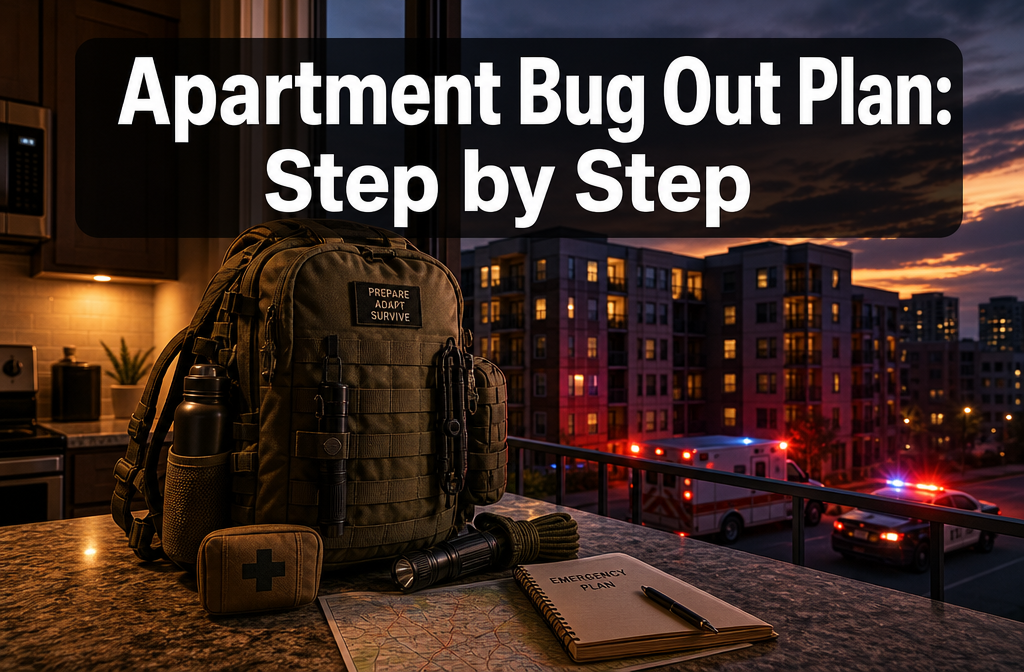
An apartment bug out plan step by step is not a luxury reserved for hardcore survivalists with rural retreats. It’s a practical, buildable system that any apartment dweller can put together in a weekend — and one that could be the difference between a controlled evacuation and a panicked scramble down a smoke-filled stairwell.
This guide covers everything: what the plan actually is, how to build your bag, what supplies to stock, how to handle pets, where to go, and how to do it all without breaking the bank.
Key Takeaways
- An apartment bug out plan requires specific adaptations that a standard house-based plan doesn’t account for — shared exits, elevator dependency, and limited storage all change the equation.
- Your bug out bag should be pre-packed, weigh no more than 20–25% of your body weight, and be reachable within 90 seconds of deciding to leave.
- The most common apartment evacuation mistake is waiting too long to trigger the plan — most people wait for official confirmation that never comes in time.
- Budget-conscious preppers can build a functional emergency kit for $75–$150 using a phased approach.
- Pet owners need a parallel plan: carrier, documents, food, and a pre-confirmed pet-friendly destination.
- Communication protocols — a pre-agreed out-of-state contact, rally points, and offline maps — matter more in urban evacuations than almost any piece of gear.
- Practice drills cut evacuation time dramatically. One timed walkthrough per season is the minimum standard.
What Exactly Is a Bug Out Plan for Apartments?
An apartment bug out plan is a documented, practiced protocol for evacuating your home quickly and safely when staying is no longer viable. For apartment dwellers specifically, it addresses the unique constraints of urban vertical living: shared hallways, single stairwells, no private vehicle access, limited gear storage, and proximity to large populations doing the same thing at the same time.
Unlike a general emergency plan, a bug out plan has a clear trigger (the moment you decide to leave), a pre-packed bag, at least two exit routes, a destination, and a communication protocol. It’s not about surviving indefinitely in the wilderness — it’s about getting from your apartment to a safer location with everything you need, in the shortest time possible.
For a deeper foundation, the complete guide to bug out planning for survival preparedness covers the broader strategic framework that this apartment-specific plan builds on.
Who this plan is for: Anyone living in a multi-unit residential building — studio apartments, high-rise condos, urban lofts — who wants a realistic, executable evacuation system.
Who it’s not for: People with private homes and direct vehicle access have more flexibility. Their plan looks different. This guide is written specifically for the constraints of apartment living.
What Emergency Scenarios Should Apartment Dwellers Prepare For?
Apartment residents face a specific set of threats that should drive every decision in their bug out plan. The most common and most dangerous scenarios include:
- Building fire — the most statistically likely reason to evacuate an apartment fast
- Earthquake or structural damage — particularly relevant in the Western U.S. and along fault lines
- Flooding and flash floods — ground-floor and basement units are especially vulnerable
- Extended power grid failure — high-rise buildings become uninhabitable without elevator access, water pressure, or climate control
- Civil unrest or urban violence — concentrated urban populations can escalate quickly
- Hazmat or chemical incident — industrial areas, highways, and rail lines near apartments increase this risk
- Pandemic or quarantine orders — requiring rapid relocation before lockdowns take effect
The step-by-step guide to natural disaster preparedness breaks down threat-specific responses in detail. For region-specific risks, the geographic threat prep guide is worth bookmarking.
Decision rule: Build your plan around the two or three most likely threats in your specific area first. A prepper in Miami prioritizes hurricane evacuation. One in Los Angeles prioritizes earthquake response. Start with what’s statistically probable, then layer in the rest.
Differences Between a Bug Out Plan for Apartments vs. Houses
The core difference is constraint. House-based preppers control their exits, have garages for vehicle staging, can store large quantities of supplies, and typically have yard space for secondary equipment. Apartment dwellers have none of that.
| Factor | House | Apartment |
|---|---|---|
| Exit routes | Multiple doors, windows, yard | Shared hallways, one or two stairwells |
| Storage space | Garage, basement, attic | Closet, under-bed, small pantry |
| Vehicle access | Direct from garage | Parking structure or street |
| Neighbor coordination | Optional | Often critical (shared exits) |
| Elevator dependency | None | High-rise residents may rely on it |
| Landlord/HOA rules | Self-governed | May restrict certain preps |
| Bug out bag weight | Can carry more to vehicle | Must carry everything on foot initially |
The practical result: apartment bug out plans must be leaner, faster, and more dependent on pre-planning than house-based plans. Every pound in the bag matters. Every minute of delay matters more.
How to Build an Apartment Bug Out Plan Step by Step
Building a functional apartment bug out plan step by step takes roughly one focused weekend. Here’s the process broken into clear phases:
Step 1: Map Your Building
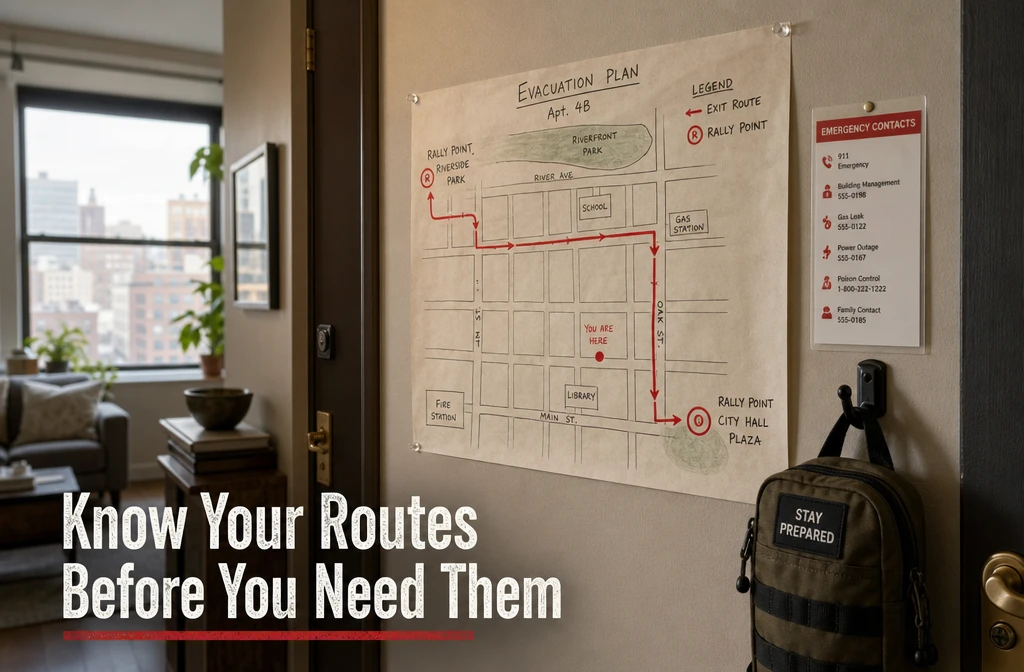
Walk every exit in your building — stairwells, fire escapes, roof access if applicable, parking exits. Identify which exits are likely to be blocked in a fire (typically the one nearest the source) and which are your primary and secondary routes. Write this down. Laminate it.
Step 2: Identify Your Triggers
Pre-decide the conditions that will make you leave without waiting for official orders. Examples: fire alarm plus visible smoke, mandatory evacuation order issued, loss of power exceeding 48 hours in extreme weather, confirmed civil unrest within a one-mile radius. Vague triggers lead to fatal hesitation.
Step 3: Choose Your Destinations
You need three: a nearby rally point (parking lot, park, or intersection where your household meets), a short-term destination (friend or family within 50 miles), and a longer-term bug out location. The bug out route planning guide covers how to map and pre-drive these routes.
Step 4: Build Your Bug Out Bag
(Covered in full in the next section.)
Step 5: Create a Communication Protocol
Designate an out-of-state contact who all household members check in with. Pre-agree on rally points. Download offline maps. Store emergency contacts on paper, not just in a phone.
Step 6: Practice
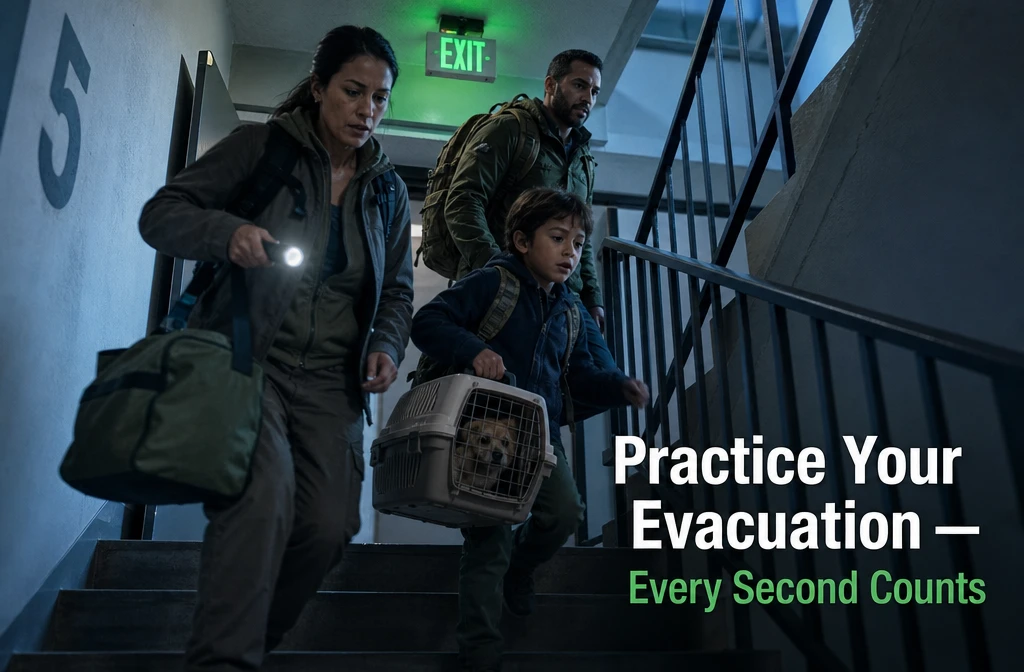
Run a timed drill at least once per season. The goal is to be out the door, bag in hand, within 90 seconds of the decision to leave.
How Do I Make a Bug Out Bag for Apartment Living?
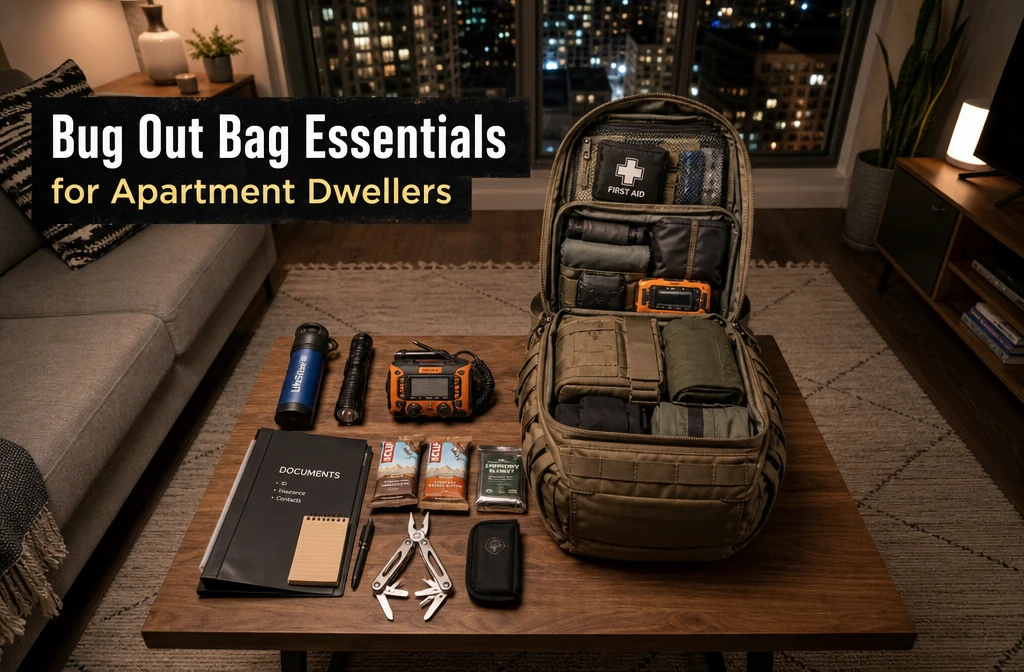
A well-built apartment bug out bag is compact, lightweight, and covers 72 hours of independent survival. The target weight is 20–25% of the carrier’s body weight — roughly 25–35 lbs for most adults.
Core categories and what to include:
- Water: One liter minimum on your person, plus a portable filter (Sawyer Squeeze or LifeStraw) and purification tablets. For more on water prep in small spaces, see the apartment water storage guide.
- Food: 3-day supply of calorie-dense, no-cook options — energy bars, freeze-dried meals, jerky, nut butter packets. Aim for 1,800–2,000 calories per day.
- Shelter: Emergency mylar blanket, lightweight tarp, 50 feet of paracord.
- Fire: Waterproof matches, lighter, ferrocerium rod.
- First aid: (Covered separately below.)
- Navigation: Paper maps of your city and surrounding region, compass. Do not rely solely on a phone.
- Communication: Hand-crank or battery-powered emergency radio, backup phone battery.
- Documents: Copies of ID, insurance, medical records, cash in small bills.
- Tools: Multi-tool, flashlight with extra batteries, duct tape, N95 masks.
For a complete breakdown with gear recommendations, the 72-hour bug out bag checklist and the complete bug out bag guide under $200 are the best starting points.
Common mistake: Overpacking. An apartment prepper who loads a 60-lb bag will abandon it on the third floor stairwell. Ruthlessly prioritize.
What Supplies Do I Need for Emergency Apartment Evacuation?
Beyond the bug out bag itself, apartment evacuation readiness includes supplies staged in your unit and in your vehicle (if you have one).
In-apartment staging:
- Bug out bag stored near the front door or in the main closet — never buried in storage
- Shoes and a change of weather-appropriate clothing near the bag
- A go-folder with physical copies of critical documents
- A flashlight on the nightstand (fires often start at night)
In-vehicle staging (if applicable):
- Secondary water supply (4–6 liters)
- Additional food for 72 hours
- Car emergency kit with jumper cables, tire repair, and basic tools
- Paper road atlas for your region
What medical supplies should be in my apartment emergency kit?
A functional apartment first aid kit goes beyond bandages. Include:
- Tourniquets (CAT or SOFTT-W) — not optional for serious trauma
- Hemostatic gauze (QuikClot or equivalent)
- Pressure bandages
- Nitrile gloves (multiple pairs)
- SAM splint
- Prescription medications (minimum 2-week supply)
- OTC medications: ibuprofen, antihistamine, anti-diarrheal, antacid
- Blister treatment (critical for urban foot evacuation)
- Copies of prescriptions and medical history
How Quickly Can I Realistically Pack and Leave My Apartment During an Emergency?
Most people dramatically underestimate how long it takes to leave. Without a pre-packed bag and a practiced plan, the average person takes 8–15 minutes to gather belongings, locate documents, find keys, and exit. In a building fire, that window may not exist.
With a pre-packed bug out bag and one prior drill, most individuals can be out the door in under 2 minutes. With regular practice, 90 seconds is achievable.
The 90-second rule: Everything critical to your survival should be grabbable in a single motion — bag on back, shoes on feet, keys in hand, phone in pocket. Anything that requires searching, deciding, or packing in the moment is a liability.
Edge case: High-rise residents above the 10th floor face a specific problem — elevator failure during a fire means descending 20+ flights of stairs with a loaded pack. Factor this into your fitness preparation and bag weight decisions.
Best Bug Out Locations Near Urban Apartments
The best bug out location for an apartment dweller is one that is pre-arranged, reachable by multiple routes, and appropriate to the threat duration.
Three-tier location system:
-
Tier 1 (0–10 miles): A friend or family member’s home, a hotel outside the immediate threat zone, or a community shelter. Used for short-duration events like building fires or localized flooding.
-
Tier 2 (10–100 miles): A pre-arranged location outside the metro area — a relative’s rural property, a campground, or a small-town motel. Used for city-wide emergencies, extended power failures, or civil unrest.
-
Tier 3 (100+ miles): A longer-term bug out location, ideally with some self-sufficiency capacity. This is the destination for extended SHTF scenarios.
Pre-drive your routes. Know at least two ways to reach each destination. Urban road networks collapse fast during mass evacuations — the highway everyone uses will be gridlocked within hours. Know the back roads.
What Are the Most Common Mistakes People Make With Apartment Emergency Plans?
The most common and most dangerous mistake is having a plan that only exists in your head. A mental plan evaporates under stress. Write it down, laminate it, and store a copy in your bag.
Other frequent mistakes:
- Waiting for official evacuation orders — by the time they’re issued, roads are often already congested
- Relying on elevators — they shut down in fires and power outages
- No communication plan — family members in different locations with no agreed contact point or rally location
- Bag stored in a hard-to-reach place — in a storage unit, buried in a closet, or in a car parked three blocks away
- Ignoring building-specific constraints — not knowing which stairwells are accessible, where fire escapes lead, or whether the parking structure has a manual exit
- No cash on hand — ATMs and card readers fail during power outages; small bills are essential
For a thorough breakdown of gear-related errors, the bug out bag mistakes to avoid guide is required reading.
How to Bug Out If You Have Pets in Your Apartment
Pets require a parallel plan that is just as detailed as the human plan. Improvising pet evacuation in the moment leads to either abandonment or dangerous delays.
The pet bug out checklist:
- A carrier that fits your pet and can be carried or attached to your pack
- 72-hour supply of pet food and a collapsible water bowl
- Copies of vaccination records and microchip documentation
- Any medications your pet requires
- A leash, harness, and muzzle (stressed animals behave unpredictably)
- Pre-confirmed pet-friendly destinations at all three tiers
Critical pre-step: Call your Tier 1 and Tier 2 destinations now and confirm they will accept your pet before an emergency occurs. Many hotels and shelters do not.
The ultimate pet emergency preparedness checklist covers this in full detail with a 45-item checklist.
Decision rule: If your pet cannot be ready to move within the same 90-second window as your human household members, practice separately until it can. A pet carrier that requires assembly, or a cat that hides when stressed, is a plan failure point.
How to Communicate With Family During Apartment Emergency Evacuation
Communication plans fail most often because they’re never actually established before the emergency. Phones lose signal during disasters. Cell networks get overloaded. Batteries die.
Build a communication protocol with these components:
-
Out-of-state contact: Choose one person outside your metro area who all household members will check in with. It’s often easier to reach out-of-state numbers during local disasters because local networks are overloaded.
-
Pre-agreed rally points: Two locations — one near the building (a specific corner or parking lot), one farther away (a specific landmark or intersection). Everyone knows both without needing to communicate.
-
Check-in schedule: Agree on specific times to attempt contact — every 2 hours, for example — so no one is waiting by the phone continuously.
-
Offline communication tools: A hand-crank emergency radio, and ideally a pair of GMRS/FRS radios for household members who may separate.
-
Written plan: Every household member carries a laminated card with the out-of-state contact number, rally points, and destination addresses.
For a complete system, the emergency communication plan guide covers every layer of this in detail.
How Much Does It Cost to Prepare a Basic Emergency Kit? Budget-Friendly Ways to Build Your Apartment Bug Out Plan
A functional apartment bug out plan step by step does not require a large upfront investment. A basic but genuinely effective kit can be assembled for $75–$150 using a phased approach.
Phase 1 — $0–$30 (Week 1):
- Repurpose a sturdy backpack you already own
- Gather documents (photocopies cost almost nothing)
- Fill reusable bottles with water
- Pull together any existing first aid supplies
- Print offline maps
Phase 2 — $30–$75 (Weeks 2–4):
- Water filter ($20–$30 for a Sawyer Squeeze)
- Emergency food bars or 3-day food supply ($15–$25)
- Mylar emergency blankets ($5–$10 for a pack)
- Basic first aid additions: tourniquet ($25–$30), extra medications
Phase 3 — $75–$150+ (Month 2–3):
- Hand-crank emergency radio ($25–$40)
- Quality flashlight and batteries
- Multi-tool ($20–$40)
- Upgraded food supply
The key insight: A $150 kit built thoughtfully outperforms a $500 kit assembled without a plan. Gear without a practiced protocol is just weight.
For those building broader apartment preparedness on a budget, the ultimate guide to prepping in a small apartment is the most practical resource available.
Frequently Asked Questions
Do I need a bug out plan if I live on a high floor?
Yes — especially so. High-floor residents face greater risks during fires and power outages because elevators become unavailable. A bug out plan for a 15th-floor apartment must specifically account for stair descent with a loaded pack and include a fitness component.
How often should I update my apartment bug out plan?
Review it every six months and after any significant life change — new family member, new pet, new vehicle, new job location, new medications, or a move to a different apartment or city.
Can I store my bug out bag in my car instead of my apartment?
Only if your car is within 60 seconds of your apartment door and you can reach it during any likely emergency scenario. If a fire forces you out through a stairwell exit that’s 200 meters from your parking spot, a bag in the car doesn’t help.
What if my apartment building has strict rules about storage?
Most rules restrict items in hallways and common areas, not inside your unit. A bug out bag stored in a closet near your front door is almost universally compliant. Check your lease for specifics.
Should I tell my neighbors about my bug out plan?
Knowing one or two trusted neighbors can be genuinely valuable — you can coordinate exits, check on each other, and share information during an emergency. You don’t need to share every detail of your plan.
How do I handle medications that need refrigeration in a bug out scenario?
Talk to your pharmacist now about emergency supplies and travel protocols. Some medications have short unrefrigerated windows; others tolerate room temperature for longer than most people realize. Get the specific guidance for your medication before you need it.
Is a bug out plan the same as a 72-hour kit?
Not exactly. A 72-hour kit is a supply cache. A bug out plan is the full system — triggers, routes, destinations, communication, and the kit. The kit is one component of the plan.
What’s the biggest difference between bugging out and sheltering in place?
Sheltering in place means staying in your apartment and riding out the emergency. Bugging out means leaving. Your plan should include clear criteria for each decision. Most apartment emergencies — building fires, gas leaks, structural damage — require bugging out. Extended power outages in mild weather may favor sheltering in.
Do I need weapons as part of my apartment bug out plan?
This is a personal and legal decision. What’s non-negotiable is situational awareness and a plan for personal security during transit. Know your local laws, train appropriately, and don’t let the weapons question paralyze the rest of your preparation.
How do I practice my bug out plan without alarming neighbors?
A timed walkthrough doesn’t require full gear or urgency. Walk your exit routes calmly. Time how long it takes to grab your bag and reach the street. Practice with your household members on a weekend morning. No drama required.
Conclusion: Build the Plan Before You Need It
The hardest part of an apartment bug out plan step by step isn’t the gear or the budget — it’s the decision to actually build it. Most people know they should. Most people don’t. And the gap between those two groups becomes visible the moment a real emergency hits.
Start this weekend. Map your building exits. Pre-decide your triggers. Assemble the first layer of your bag with what you already own. Write down your rally points and your out-of-state contact. Then run one timed walkthrough.
That single afternoon of preparation puts you ahead of the vast majority of your neighbors — and it gives you something more valuable than any piece of gear: the confidence that comes from knowing exactly what you’ll do when things go wrong.
Actionable next steps:
- Walk every exit in your building today and photograph the routes
- Set a $50 budget and order a water filter and emergency food bars this week
- Text your designated out-of-state contact and confirm they’re willing to serve that role
- Download offline maps of your city and surrounding region
- Set a calendar reminder for a timed evacuation drill within the next 30 days
For the broader preparedness framework that supports this plan, the family emergency plan template and the ultimate evacuation plan guide are the logical next reads.
Products, Tools, and Resources
These are the categories and specific tools that apartment preppers consistently rely on — not a sponsored list, just what actually works in small-space, urban evacuation scenarios.
Bug out bag: A 30–40L tactical or hiking backpack with a hip belt. Osprey Farpoint 40, 5.11 Rush 24, and Mystery Ranch Coulee 25 are all proven options across different budget levels.
Water filtration: The Sawyer Squeeze ($25–$30) is the gold standard for weight-to-performance ratio. Pair it with Aquatabs for chemical backup.
Emergency food: Datrex 3,600-calorie emergency ration bars are compact and shelf-stable for 5 years. Mountain House freeze-dried pouches work well if you have access to water.
First aid: North American Rescue’s IFAK (Individual First Aid Kit) is the benchmark for trauma-capable kits. The CAT tourniquet is the only tourniquet worth trusting.
Communication: The Midland ER310 hand-crank emergency radio handles NOAA weather alerts and AM/FM. For household communication, Midland GMRS radios offer solid range in urban environments.
Navigation: DeLorme/Garmin state atlas books for your region. Download the Maps.me app with your region cached offline as a digital backup.
Documents: A waterproof document pouch (like the ENGEL waterproof case) protects copies of ID, insurance, medical records, and cash from water damage during evacuation.
Lighting: Fenix and Nitecore make compact, high-lumen flashlights that hold up under real use. Keep one on your nightstand and one in your bag.
The essential survival gear guide with 50 items ranked by priority covers gear selection across every category if you want a more comprehensive equipment reference.