
Hey there! Some links on this page may be affiliate links which means that, if you choose to make a purchase, I may earn a commission at no extra cost to you. I greatly appreciate your support. Read the full disclosure here.
Bug out without a car means evacuating on foot, by bicycle, or through alternative transport using pre-planned routes, a manageable pack, and basic wilderness skills. A solid car-free bug-out plan covers route selection, realistic distance goals, lightweight gear, water sourcing, and group mobility — all prepared before a crisis forces the decision.
Find this useful? Add us as a preferred source on Google and more of what we publish will show up in your results.
Key Takeaways
- Most healthy adults can walk 10–15 miles per day with a loaded pack; plan your routes around that reality, not best-case scenarios.
- A car-free bug-out plan requires at least two pre-walked alternate routes to your destination — never rely on a single path.
- Your bug-out bag should weigh no more than 20–25% of your body weight; overpacking is the most common and most dangerous mistake.
- Water is the non-negotiable priority: carry a minimum of 2 liters and know where to resupply every 5–8 miles along your route.
- Bicycles, canoes, and cargo carts are the best vehicle alternatives when roads are gridlocked or fuel is unavailable.
- Families with children or elderly members need modified pacing, split loads, and pre-arranged rally points.
- Paper maps and a baseplate compass are your primary navigation tools when phones and GPS fail.
- Legal right-of-way matters: know which trails, greenways, and roads you can legally use before you need them.
What Exactly Is Bugging Out, and Why Would You Need a Plan?
Bugging out means leaving your home or current location quickly because staying has become more dangerous than moving. It applies when natural disasters, civil unrest, infrastructure collapse, or forced evacuation orders make shelter-in-place untenable.
The reason a specific plan matters — especially a car-free one — is that most people assume they’ll drive out. That assumption fails in predictable ways: gridlocked highways after a hurricane, flooded underpasses, EMP scenarios that disable modern vehicles, or simply running out of fuel when every gas station has a two-hour line. A complete bug-out plan accounts for vehicle failure as a baseline scenario, not an afterthought.
Who this applies to: Anyone living in an urban or suburban area, renters without reliable vehicle access, preppers in regions prone to earthquakes, floods, or wildfires, and anyone whose household includes people who can’t drive.
When it matters most: Grid-down events, regional disasters that clog road networks, or scenarios where fuel supply chains have already broken down.
How Far Can You Realistically Walk With a Bug-Out Bag?
A healthy adult carrying a 25–35 lb pack on mixed terrain can cover roughly 10–15 miles per day. Fit, experienced hikers may push 20 miles, but planning around that number is a mistake for most people.
Several factors cut that number fast:
- Terrain: Pavement is faster than trails; trails are faster than off-road brush.
- Load weight: Every extra pound matters over 10+ miles.
- Weather: Heat, rain, and cold all reduce daily mileage by 20–40%.
- Group composition: Your pace is set by the slowest member.
- Footwear: Blisters from improper boots can stop a person by day two.
Practical rule: Plan your bug-out destination to be reachable in 3–5 days of walking at a conservative 10 miles/day. That puts a realistic range of 30–50 miles from your home. If your destination is farther, you need intermediate waypoints — friends’ homes, cache locations, or designated shelters — mapped out in advance.
💡 Common mistake: Preppers often plan to their bug-out location as a single-day sprint. Walk your route in sections before you need it. You’ll discover terrain problems, resupply gaps, and your actual fitness level — all things worth knowing now.
Best Routes to Escape Urban Areas on Foot
The best on-foot evacuation routes out of urban areas follow low-traffic corridors: greenways, rail trails, riverbanks, utility easements, and secondary roads rather than major highways.
Major highways become parking lots within hours of a regional disaster. On foot, that’s actually an advantage — you can move when cars can’t. But highways also concentrate desperate people, which creates its own risks.
Better options to map now:
- Rail trails and bike paths: Paved, continuous, and parallel to major routes without the traffic.
- River and creek corridors: Natural pathways out of cities, often with public access.
- Power line easements: Wide, cleared corridors that cut through suburban and rural areas.
- Secondary county roads: Lower traffic, more predictable, easier to navigate with a paper map.
How to build your route map:
- Identify your bug-out destination (minimum two options: primary and backup).
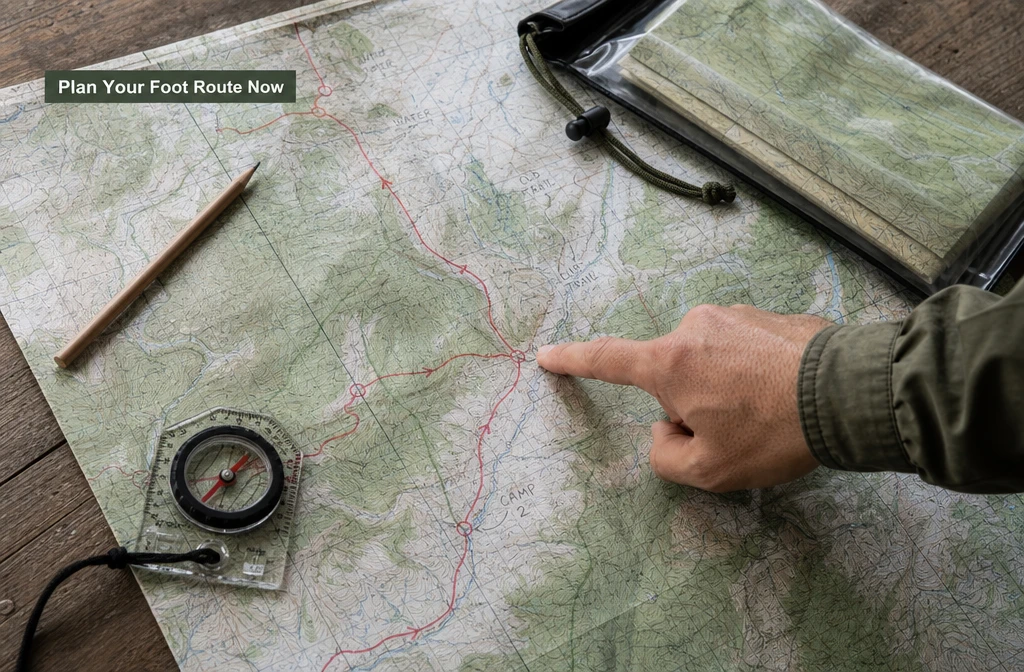
- Pull up a topographic map (USGS maps are free at usgs.gov) and trace 2–3 distinct paths.
- Walk each route in sections over several weekends. Note water sources, shelter options, choke points, and hazards.
- Mark everything on a laminated paper map. Store it in your bag.
For deeper navigation skills, the complete beginner’s guide to navigation without GPS covers map reading, compass use, and terrain association in detail.
What Are the Cheapest Lightweight Survival Gear Options?
Effective car-free bug-out gear doesn’t require expensive setups. The priority is weight-to-function ratio — every item must earn its place in the pack.
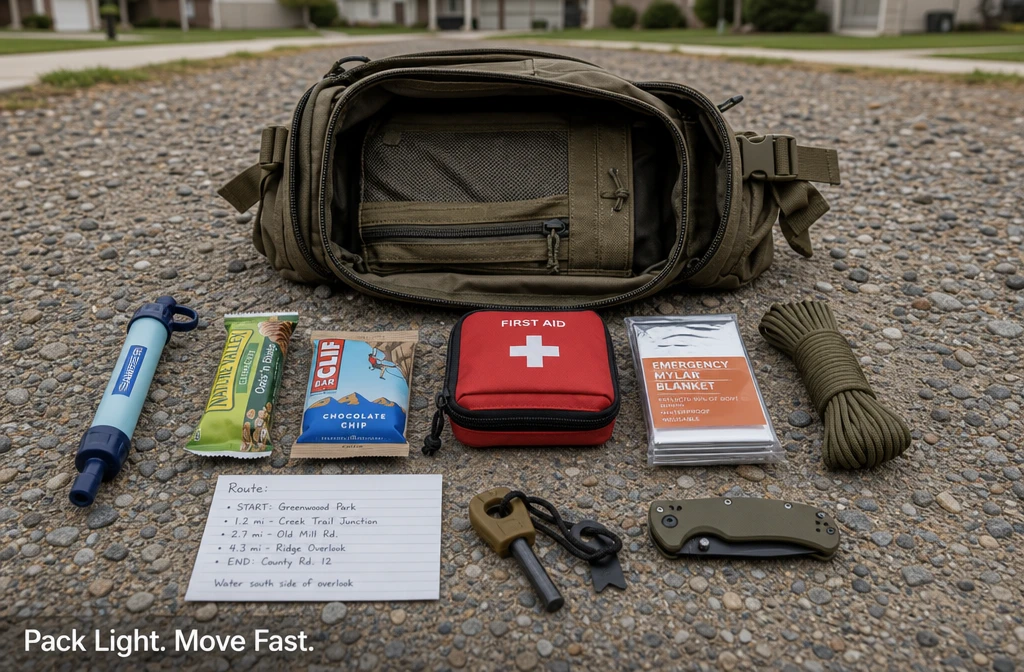
Budget-friendly essentials (under $200 total for basics):
| Item | Function | Budget Option |
|---|---|---|
| Sawyer Squeeze or LifeStraw | Water filtration | $20–$35 |
| Mylar emergency blankets (2-pack) | Warmth, signaling | $5–$10 |
| Fire starter (ferro rod) | Fire, warmth, signaling | $8–$15 |
| Paracord (100 ft) | Shelter, rigging, repairs | $8–$12 |
| Basic first aid kit | Wound care, blister treatment | $15–$25 |
| Headlamp with spare batteries | Navigation at night | $15–$30 |
| Fixed-blade or folding knife | Multi-purpose tool | $20–$40 |
| Waterproof map case + compass | Navigation | $15–$25 |
The complete bug-out bag guide breaks down a full 72-hour kit for under $200, which is a realistic and achievable target for most households.
Choose lighter if: You’re covering more than 15 miles per day, you have joint issues, or you’re packing for a child. Invest more in: Footwear (boots or trail runners) and a quality pack with a hip belt. These two items affect everything else.
How Much Water and Food Should You Pack for Emergency Evacuation?
Carry a minimum of 2 liters of water at all times and plan to resupply every 5–8 miles using a filter or purification tablets. For food, target 1,800–2,500 calories per day in compact, high-calorie formats.
Water math for a 3-day bug-out:
- Minimum daily need: 2–3 liters (more in heat or heavy exertion)
- Carrying 6+ liters adds 13+ lbs — impractical for foot travel
- Solution: Carry 2 liters, filter from natural sources, and know your resupply points
Water sources to pre-identify on your route:
- Streams, creeks, and rivers (filter before drinking)
- Municipal parks with fountains (may not work in grid-down)
- Gas stations and convenience stores (early in an event)
- Residential hose bibs (ask permission; most people help in emergencies)
For food, prioritize calorie density and no-cook options:
- Nut butter packets (100–200 calories each, lightweight)
- Jerky and hard cheese
- Energy bars (Clif, Larabars, or homemade)
- Instant oats (just need hot water, optional)
- Dried fruit and nuts
The ultimate bug-out bag food list covers specific quantities and calorie targets for 72-hour and extended scenarios.
Survival Techniques for Someone Who’s Not Super Athletic
Bugging out on foot is achievable for people with average fitness — it just requires smarter pacing, better gear choices, and honest pre-planning.
The biggest mistake non-athletic preppers make is trying to match the pace of fit hikers in online guides. A 10-mile day with rest breaks is a solid, sustainable target for most adults. Over three days, that’s 30 miles — enough to clear most urban danger zones.
Practical techniques for lower fitness levels:
- Trekking poles: Reduce knee strain by up to 25% on downhill terrain and help maintain pace on flat ground.
- Rest intervals: Walk 50 minutes, rest 10. This is the military standard and it works for a reason.
- Footwear break-in: Wear your bug-out boots on regular walks for months before you need them. Blisters are a genuine emergency.
- Pack weight audit: If you can’t carry your bag for 2 miles without pain, it’s too heavy. Cut weight, not conditioning corners.
- Staged caches: Pre-position supplies (food, water, dry clothes) at a trusted location 15–20 miles out. This removes the need to carry everything from day one.
For a broader look at the physical and mental skills that matter most, the 10 critical bug-out survival skills guide covers what preppers actually need to practice before SHTF.
What Are the Biggest Mistakes People Make When Planning to Bug Out Without a Car?
The most dangerous mistake is having no car-free plan at all — assuming the vehicle will always work. Beyond that, overpacking, under-training, and single-route thinking kill otherwise solid plans.
Top mistakes and how to fix them:
- Overpacking: A 60 lb bag sounds prepared; it’s actually a liability after mile 5. Stick to the 20–25% body weight rule.
- One route only: Roads flood, bridges close, and crowds form. Map three routes minimum.
- No water plan: Carrying only what’s in the bottle and hoping for the best is not a plan. Know every water source on your route.
- Untested gear: Gear that’s never been used in the field will fail or frustrate you at the worst moment. Practice with everything.
- No communication plan: If your group separates, how do you reconnect? A pre-set emergency communication plan with rally points and check-in times is non-negotiable.
- Ignoring footwear: Cheap boots or worn-out sneakers end bug-outs early. This is the one place not to cut costs.
- No night plan: Darkness changes everything. Know where you’ll shelter each night before you start walking.
For a deeper breakdown of gear-specific errors, the bug-out bag mistakes guide covers the most common and costly errors preppers make.
Alternative Transportation If Cars Aren’t Working
When vehicles fail, the best alternatives are bicycles, cargo carts, canoes or kayaks, and — in some scenarios — horses or livestock. Each has specific advantages depending on terrain and distance.
Comparison of car-free bug-out transport options:
| Option | Speed vs. Walking | Load Capacity | Terrain Limits | Cost |
|---|---|---|---|---|
| Bicycle | 3–4x faster | 50–100 lbs with panniers | Paved/gravel paths | $150–$600 |
| Cargo bike/e-bike | 4–5x faster | 100–200 lbs | Paved preferred | $500–$3,000 |
| Folding cart/wagon | Same speed | 100–200 lbs | Flat terrain only | $50–$150 |
| Canoe/kayak | 3–4 mph on water | 200–400 lbs | Waterway access needed | $300–$1,500 |
| Horse/mule | 4–6 mph | 200+ lbs | Most terrain | High (ownership) |
Best choice for most urban preppers: A quality mountain or hybrid bicycle. It’s fast, quiet, requires no fuel, can carry a loaded pack on a rear rack, and can be walked if terrain becomes impassable. Keep it tuned, keep the tires inflated, and store a patch kit and spare tube in your bag.
How to Bug Out With Kids or Elderly Family Members
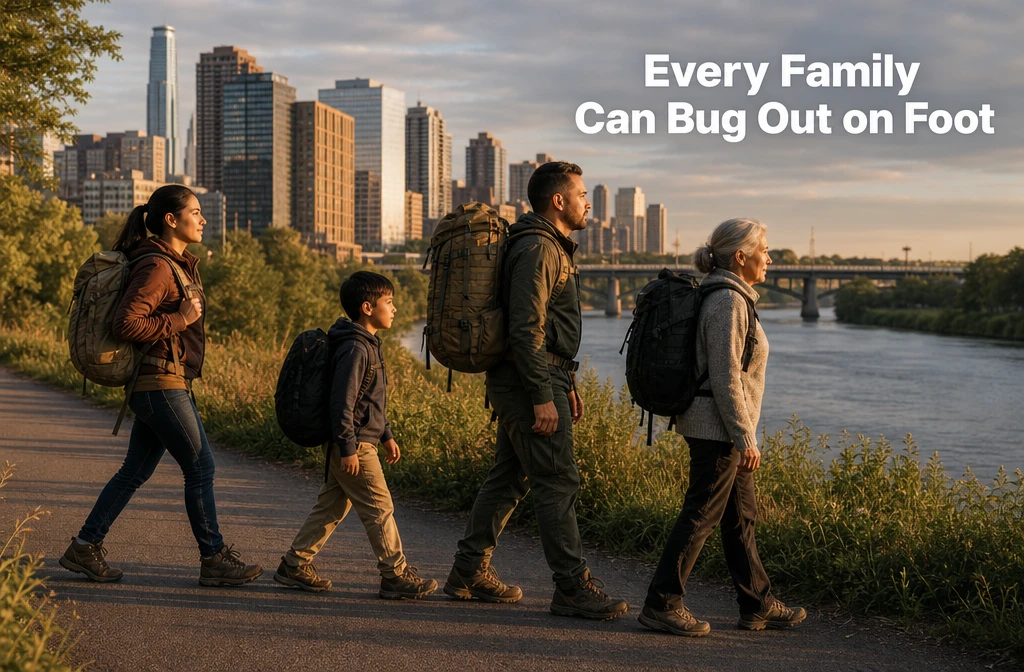
Bugging out with children or elderly family members requires adjusted distance goals, distributed loads, and pre-planned rest points. The plan has to work for the least capable person in the group — not the most capable.
For children:
- Ages 5–8: Can walk 3–5 miles per day with breaks; use a child carrier for younger ones.
- Ages 9–12: Can carry a small pack (5–10 lbs) and manage 5–8 miles.
- Teens: Treat similarly to adults but monitor for fatigue and morale.
- Keep snacks accessible, not buried in the pack. Morale matters on day two.
For elderly or mobility-limited adults:
- A folding cart or wheeled pack dramatically extends range for those with joint issues.
- Pre-identify rest locations (benches, covered areas) along your route.
- Medications are the top priority item — know exactly what’s needed and for how long.
- Consider a shorter, safer destination rather than a longer optimal one.
The family bug-out bag guide covers age-specific gear lists and load distribution in detail. For seniors specifically, the 9 essential disaster prep strategies for seniors addresses mobility, medical needs, and communication.
Rally points are critical for families. If the group separates, everyone needs to know two pre-set meeting locations — one near home, one farther along the route. Write them on a card in each person’s pack.
Wilderness Survival Skills for Complete Beginners
For someone new to survival skills, the three most important abilities for a car-free bug-out are: finding and purifying water, building emergency shelter, and navigating with a map and compass. Everything else is secondary.
These aren’t skills that require years of training. A weekend of focused practice covers the basics.
Priority skills for foot evacuation:
- Water sourcing and purification: Know how to use a filter straw, purification tablets, and boiling as a backup. Practice before you need it.
- Emergency shelter: A tarp and paracord can create weatherproof shelter in under 15 minutes. Practice the setup in your backyard.
- Fire starting: A ferro rod and dry tinder work when lighters fail. Practice in wet conditions specifically.
- Basic first aid: Blister management, wound cleaning, and sprain wrapping are the most likely needs on a foot evacuation.
- Map and compass navigation: Learn to orient a map to terrain and take a bearing. This skill takes one afternoon to learn and a lifetime to refine.
The 25 most critical wilderness survival skills ranks these by life-saving priority — a useful reference for deciding what to practice first.
What Emergency Supplies Are Most Important When Walking Out?
When every ounce counts, the most important supplies for a walking bug-out are: water filtration, shelter material, fire starting capability, first aid, food for 72 hours, navigation tools, and communication gear.
Non-negotiable items for a car-free bug-out:
- Water filter (Sawyer Squeeze or similar) + 2L capacity
- Emergency shelter (tarp or bivy, not a full tent)
- Fire starter (ferro rod + lighter as backup)
- First aid kit with blister treatment
- 72 hours of food (high-calorie, no-cook preferred)
- Paper map + compass
- Headlamp + spare batteries
- Phone with offline maps downloaded (treat as backup, not primary)
- Cash in small bills
- Copies of critical documents in a waterproof bag
What to leave behind: Anything that serves only comfort. Heavy camp chairs, full cookware sets, and redundant clothing all add weight without adding survival value on a 3-day walk.
The 72-hour bug-out bag checklist provides a complete, prioritized list with weight targets for each category.
Without GPS or a working phone, navigation relies on paper topographic maps, a baseplate compass, and terrain association. These tools work in any condition — no battery, no signal, no problem.
Basic navigation process:
- Orient your map: Align the map’s north with actual north using your compass.
- Identify your location: Find two or three landmarks (hills, roads, water features) visible around you and match them to the map.
- Set a bearing: Point your compass toward your destination, note the degree reading, and walk that bearing.
- Use terrain association: Follow ridgelines, rivers, and roads as natural guides rather than walking a straight line through unknown terrain.
Backup navigation methods:
- Sun position: Sun rises roughly east, sets roughly west. At solar noon (roughly 12–1 PM), the sun is due south in the Northern Hemisphere.
- Moss and vegetation: Generally grows denser on north-facing surfaces in the Northern Hemisphere — useful as a rough directional check, not a primary tool.
- Stars: Polaris (North Star) sits directly above true north. Find the Big Dipper and follow the two outer stars of its “cup” upward.
Download offline maps (Google Maps, Maps.me, or Gaia GPS) to your phone before any anticipated emergency. They work without cell signal and serve as a useful backup to paper.
Legal Considerations for Emergency Evacuation Routes
Most public trails, greenways, and roads are legally accessible during emergencies, but private property, railroad corridors, and some utility easements are not. Knowing the difference before a crisis matters.
What’s generally accessible:
- Public roads and highways (always)
- Designated hiking and biking trails on public land
- National and state forest land (most areas)
- River corridors with public access points
What’s legally restricted:
- Private property without owner permission
- Active railroad rights-of-way (trespassing laws apply even in emergencies)
- Some utility easements (varies by company and jurisdiction)
- Military installations and federal security zones
Practical guidance: During a declared government emergency, law enforcement priorities shift dramatically. Trespassing charges for crossing a private field to escape a wildfire are rarely pursued. That said, the goal is to pre-plan routes that don’t require that decision. Walk legal routes now so you’re not improvising under pressure later.
Check your local emergency management agency’s website for officially designated evacuation routes — many counties publish these publicly, and some include pedestrian-specific paths.
FAQ: How to Bug Out Without a Car Plan
Q: What’s the most important first step for someone with no car-free plan? Walk your most likely evacuation route on foot this weekend. Identify your destination, trace a path on a paper map, and walk the first 5 miles. Everything else builds from that baseline.
Q: How heavy should my bug-out bag be for foot travel? No more than 20–25% of your body weight. For a 160 lb person, that’s 32–40 lbs maximum — and lighter is better. Most people can build a functional 72-hour kit at 25–30 lbs.
Q: Can I bug out on foot in a city? Yes, and in many scenarios it’s faster than driving. Cities have rail trails, riverfront paths, and pedestrian corridors that bypass gridlocked roads entirely. The key is knowing those routes before the event.
Q: What if I have no fitness base at all? Start walking with your loaded pack on weekends now. Even 2–3 miles per week builds the conditioning and — more importantly — reveals gear problems before they matter. Fitness is built over months; don’t wait for a crisis to discover your limits.
Q: How do I handle security concerns while walking out? Move during daylight, avoid displaying expensive gear, stay in groups when possible, and choose routes that keep you away from high-density choke points. Situational awareness — knowing who’s around you and what’s happening — is your primary security tool.
Q: What’s the best alternative to walking if I can’t cover the distance? A bicycle is the single best alternative for most people. It multiplies your range by 3–4x, carries significant load with panniers, requires no fuel, and can be walked if terrain demands it.
Q: Should I bug out immediately or wait? The general rule is: leave early or leave late, never in the middle. Early departure (before the masses) gives you clear roads and calm conditions. If you’ve missed that window, waiting for the initial surge to pass can also work. Leaving in the middle of a mass evacuation puts you in the worst conditions.
Q: What documents should I carry in my bug-out bag? Waterproof copies of: ID, passport, insurance cards, medication list, emergency contacts, property documents, and a small amount of cash. Store these in a sealed plastic bag or waterproof document pouch.
Q: How do I keep kids calm during a foot evacuation? Routine helps. Keep snacks accessible, give older children a small job (carrying their own pack, reading the map), and maintain a predictable rhythm of walking and rest breaks. Avoid communicating panic — children read adult emotions accurately.
Q: What’s the single biggest difference between a good and bad car-free bug-out plan? Pre-walking the routes. A plan that exists only on paper has unknown variables. A plan you’ve physically tested has known terrain, identified water sources, and realistic time estimates. That difference is everything when it counts.
Products, Tools, and Resources Worth Having
These aren’t affiliate-driven recommendations — they’re the tools that actually show up in well-tested bug-out setups.
Navigation:
- USGS 7.5-minute topographic maps (free download at usgs.gov, print and laminate your local area)
- Suunto A-10 or Silva Ranger compass — reliable baseplate compasses under $30 that work in any condition
- Gaia GPS app (offline topo maps on your phone as a backup)
Water:
- Sawyer Squeeze filter — the best balance of weight, cost, and filtration reliability for foot travel
- Aquatabs purification tablets — backup option, weightless, and effective against most pathogens
Shelter and warmth:
- SOL Emergency Bivvy — lighter and more packable than a sleeping bag for 72-hour scenarios
- 8×10 silnylon tarp — versatile, waterproof, and weighs under a pound
Mobility:
- Trekking poles (Black Diamond or cheap alternatives from Amazon) — worth it for anyone over 40 or covering significant elevation
- Quality trail runners or hiking boots — invest here before anywhere else
Communication:
- Midland T71VP3 FRS/GMRS radios — reliable short-range communication for groups without cell service
- Goal Zero Flip 12 solar charger — keeps a phone alive for offline maps and emergency calls
For a comprehensive gear reference, the essential survival gear guide ranks 50 items by priority with practical notes on each.
Conclusion: Build the Plan Before You Need It
Knowing how to bug out without a car plan is one of the most practical skills in a prepper’s toolkit — because vehicle failure isn’t a fringe scenario. It’s a predictable outcome in the exact conditions that force evacuations.
The path forward is straightforward: identify your destination, map multiple routes, walk them, build a pack you can actually carry, and practice the skills that matter. Start with water sourcing and navigation. Add shelter and fire. Test everything under real conditions before a crisis makes the testing mandatory.
Actionable next steps for this week:
- Pull up a topographic map of your area and identify two bug-out destinations within 30–50 miles.
- Trace three distinct foot routes to each destination, avoiding major highways.
- Weigh your current bug-out bag. If it’s over 25% of your body weight, cut it down.
- Walk the first 5 miles of your primary route this weekend.
- Identify every water source on that route and confirm your filtration gear is functional.
Preparedness isn’t about fear. It’s about knowing that when the moment comes — and for some people it will — you’ve already made the decisions that matter. The people who thrive in emergencies aren’t the ones who react fastest. They’re the ones who planned earliest.
For a broader framework that ties all of this together, the ultimate evacuation plan guide and the 4-layer disaster plan are the logical next reads.
References
- U.S. Geological Survey (USGS). National Map — Topographic Maps. usgs.gov. (Ongoing resource)
- Federal Emergency Management Agency (FEMA). Ready.gov — Evacuation. ready.gov/evacuation. (2023)
- American Hiking Society. Trail Statistics and Trail Use Data. americanhiking.org. (2022)
- Centers for Disease Control and Prevention (CDC). Emergency Preparedness and Response — Water Safety. cdc.gov. (2023)
- U.S. Army Field Manual FM 21-18.Foot Marches. (1990, still referenced in survival training contexts)