
Hey there! Some links on this page may be affiliate links which means that, if you choose to make a purchase, I may earn a commission at no extra cost to you. I greatly appreciate your support. Read the full disclosure here.
The Ultimate Car Emergency Kit List for Survivalists and Preppers in 2026
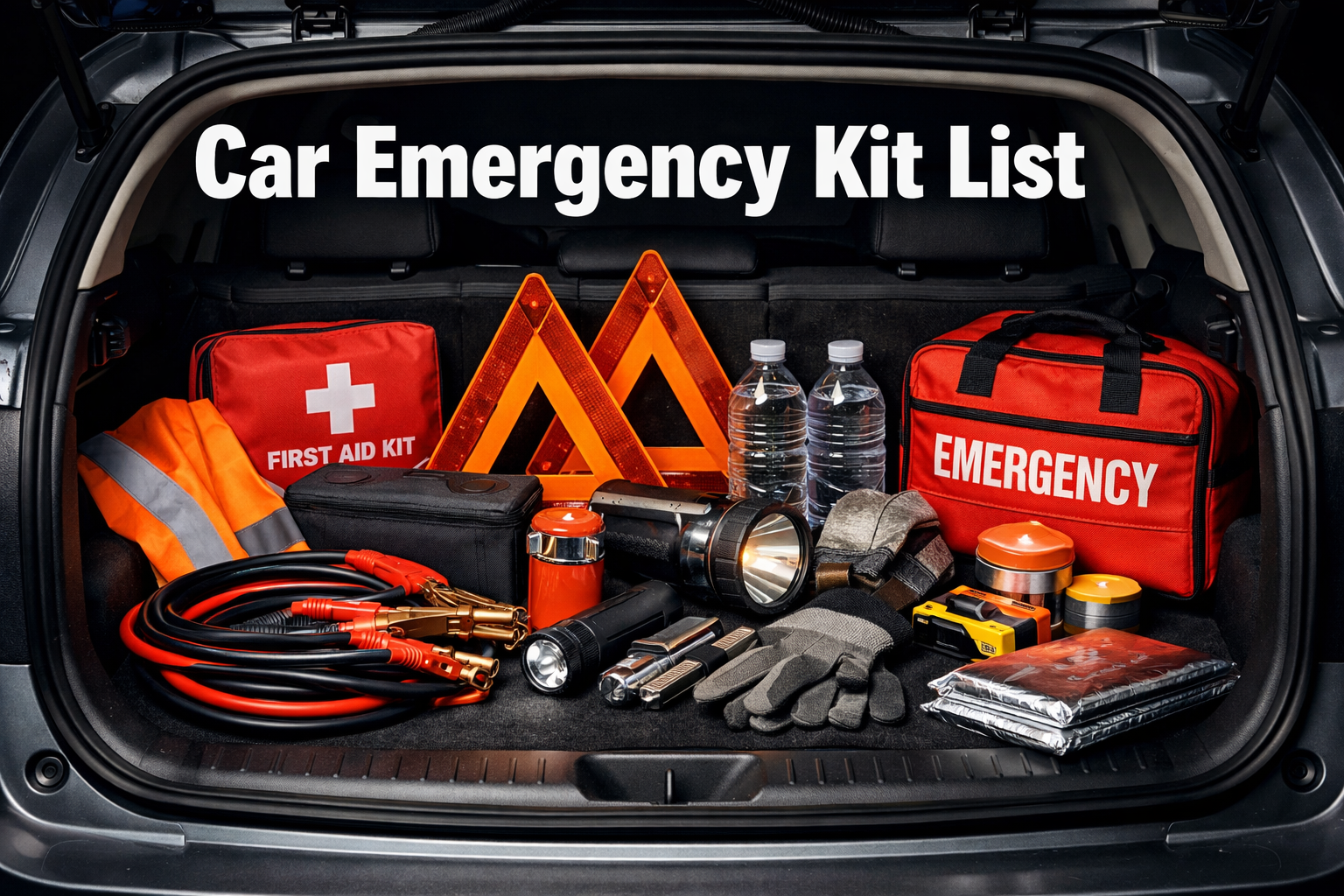
A car emergency kit list should include at minimum: jumper cables, a first aid kit, emergency blankets, road flares or reflective triangles, a flashlight with extra batteries, water, basic tools, and a tow strap. For preppers and survivalists, the list goes significantly deeper, covering multi-day survival scenarios, self-defense tools, and off-grid communication. The right kit depends on your vehicle type, terrain, climate, and how far from help you typically travel.
Key Takeaways 🚗
- A complete car emergency kit list covers five core categories: safety and signaling, medical, tools and repair, survival sustenance, and communication.
- FEMA recommends keeping at least 72 hours of emergency supplies accessible, and a vehicle kit is a critical part of that plan.
- Preppers should build their kit in layers: immediate roadside needs, short-term survival (24–72 hours), and extended grid-down scenarios.
- Weight and space matter. Prioritize multi-use items like a quality multi-tool, duct tape, and a paracord spool.
- Climate and geography should dictate at least 30% of your kit’s composition. A desert kit differs significantly from a northern winter kit.
- Rotate consumables (water, food, batteries, medications) every 6–12 months to prevent kit failure when it matters most.
- A printed copy of emergency contacts, maps, and vehicle documentation belongs in every kit, no exceptions.
- Vehicle-specific items (spare fuses, extra motor oil, tire plug kit) are often overlooked but critically important.
- The best kit is one that’s actually in the car, organized, and accessible within 60 seconds.
Why Most Car Emergency Kits Fail When It Counts
Most commercial emergency kits sold at big-box stores are built to a price point, not a survival standard. They include a few bandages, a cheap flashlight with no spare batteries, and a single emergency blanket. That’s not a kit — that’s a liability that creates false confidence.
For survivalists and preppers, a car emergency kit list isn’t a checkbox exercise. It’s a system. The vehicle is often the first place a person shelters during a sudden emergency, and it can also become a trap if the driver is unprepared. According to the American Automobile Association (AAA), U.S. drivers experienced over 32 million roadside breakdowns annually as of their most recent reporting — and that figure doesn’t account for weather events, civil unrest, or grid-down scenarios.
The difference between a bad day and a dangerous situation often comes down to what’s in the trunk.
What Should Be on a Complete Car Emergency Kit List?
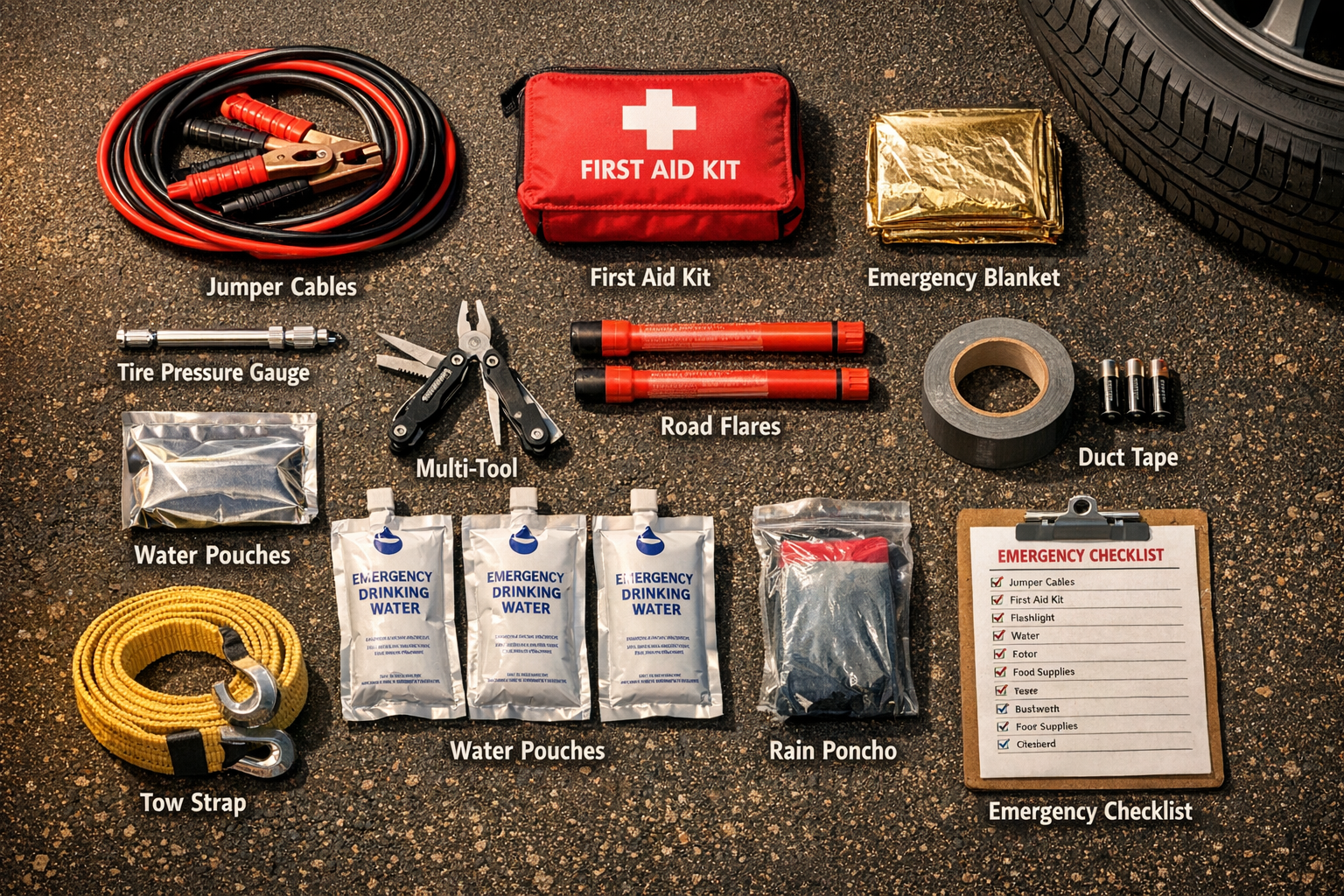
A complete car emergency kit list covers five functional categories: safety and signaling, medical response, mechanical repair, survival sustenance, and communication. Each category addresses a different failure mode, and gaps in any one of them can cascade into larger problems.
Category 1: Safety and Signaling
These items protect the driver and alert other motorists or rescuers to the vehicle’s location.
- Road flares or LED emergency triangles (minimum 3, placed at 10, 100, and 300 feet behind the vehicle)
- High-visibility safety vest (one per occupant)
- Reflective window cling or emergency flag
- Whistle (for signaling in low-visibility or loud environments)
- Bright flashlight with at least 500 lumens and spare batteries (lithium batteries last longer in cold)
- Headlamp for hands-free work
💡 Decision rule: Choose LED triangles over flares if traveling through dry, fire-prone areas. Flares are better for wet or snowy conditions where visibility is the primary concern.
Category 2: First Aid and Medical
- Comprehensive first aid kit including trauma dressings, tourniquet (CAT or SOFTT-W), hemostatic gauze, and an Israeli bandage
- Nitrile gloves (multiple pairs)
- CPR face shield
- Prescription medications (7-day supply minimum, rotated regularly)
- OTC medications: ibuprofen, antihistamine, anti-diarrheal, antacid
- Tweezers, medical scissors, SAM splint
- Emergency dental kit
⚠️ Common mistake: Most preppers include a first aid kit but skip trauma-specific items. A standard kit won’t stop arterial bleeding. Add a tourniquet and know how to use it.
Category 3: Vehicle Tools and Repair
- Jumper cables (at minimum 20 feet, 4-gauge) or a portable jump starter (lithium-ion, 1000+ peak amps)
- Tire pressure gauge
- Tire plug/patch kit and portable air compressor (12V)
- Spare fuses matching the vehicle’s fuse box
- Duct tape and zip ties
- Tow strap or recovery strap (rated for the vehicle’s weight)
- Basic tool kit: adjustable wrench, pliers, screwdrivers (flat and Phillips), socket set
- Extra motor oil and coolant (one quart each, vehicle-specific)
- Rain poncho or waterproof jacket for working in bad weather
- Work gloves
Category 4: Survival Sustenance
- Water: minimum 1 liter per person per day for 72 hours. Use sealed pouches rated for temperature extremes.
- Water purification: LifeStraw, Sawyer Squeeze, or iodine tablets as backup
- High-calorie food: emergency ration bars (3,600-calorie bars are compact and shelf-stable for 5 years)
- Folding camp stove and fuel tabs for extended scenarios
- Emergency blankets (Mylar, minimum 2 per person)
- Sleeping bag rated for local winter lows if traveling in cold climates
- Extra clothing layer: base layer, wool socks, hat, gloves
- Battery-powered or hand-crank NOAA weather radio
- Fully charged portable power bank (20,000+ mAh)
- Paper maps of the local region and state (GPS fails; paper doesn’t)
- Compass
- Laminated emergency contact card with out-of-area contacts, insurance info, and blood types
- Backup phone charger cable
- Two-way radios (FRS/GMRS) for convoy or family communication
How Do Preppers Customize a Car Emergency Kit List Beyond the Basics?
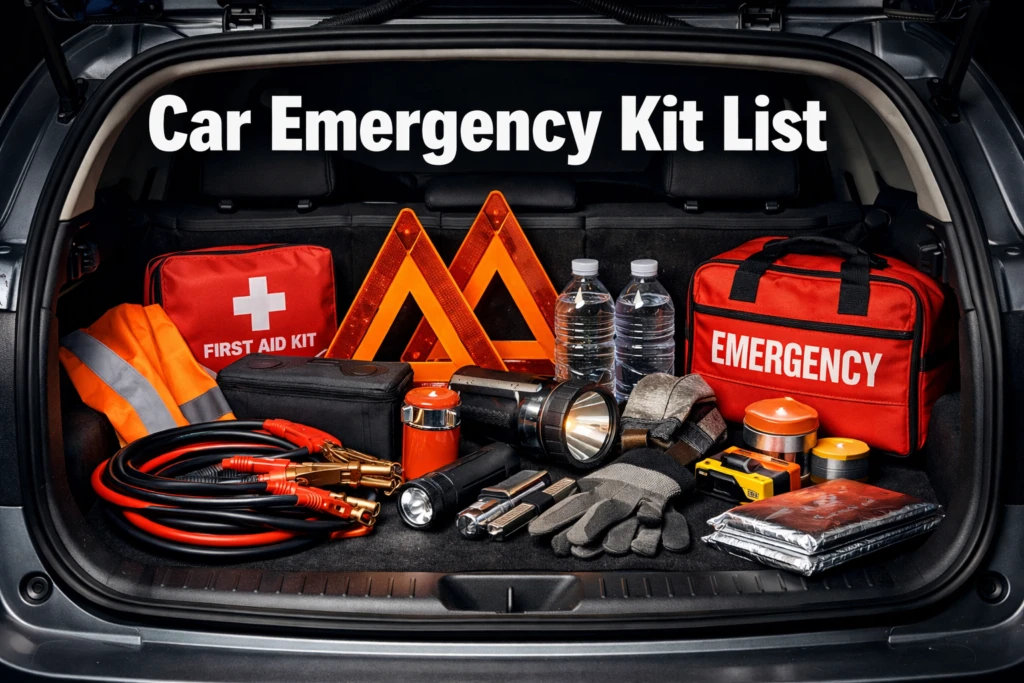 Preppers approach a car emergency kit list as a layered system rather than a flat checklist. The base layer handles common roadside emergencies. The second layer covers 24–72 hour survival if stranded or bugging out. The third layer addresses grid-down or civil emergency scenarios.
Layer 1 — Roadside (0–4 hours):
Everything in the five categories above. Fits in a single mid-size bag or organizer.
Layer 2 — Short-term survival (24–72 hours):
- Bug-out bag or get-home bag in the trunk
- Additional water (4+ liters per person)
- Fire-starting kit (lighter, waterproof matches, ferro rod, tinder)
- Fixed-blade knife and multi-tool
- Paracord (50–100 feet)
- Tarp or emergency bivy
- Cash in small bills (ATMs fail during power outages)
- USB drive with scanned copies of important documents
Layer 3 — Extended or grid-down scenarios:
- Ham radio (Baofeng UV-5R or similar) with programmed local repeaters
- Solar charger panel (foldable, 20–40W)
- Self-defense tools appropriate to local laws
- Extended food supply (7-day supply per person)
- Backup prescription glasses or contacts
- Sanitation kit: toilet paper, hand sanitizer, waste bags, N95 masks
💡 Choose Layer 3 additions if: regular travel covers rural routes more than 50 miles from a population center, or if the region has a history of natural disasters, severe weather, or infrastructure vulnerability.
What’s the Best Way to Organize a Car Emergency Kit?
Organization determines whether the kit actually gets used under stress. A disorganized bag is nearly as useless as no bag at all.
Recommended organization system:
| Container | Contents | Access Priority |
|---|---|---|
| Small grab pouch (front seat or door) | Phone charger, flashlight, first aid basics, emergency contact card | Immediate (under 10 seconds) |
| Medium bag (back seat or under seat) | Full first aid kit, jumper cables, tools, water pouches | Fast (under 60 seconds) |
| Large bag or bin (trunk) | Survival gear, food, extra clothing, recovery tools | Deliberate (1–3 minutes) |
Color-coded bags or pouches by category (red for medical, orange for tools, blue for water/food) reduce search time under stress. Label everything.
How Does Climate and Region Change the Car Emergency Kit List?
Geography isn’t optional when building a car emergency kit list. A kit built for a Phoenix summer will fail in a Minnesota January, and vice versa.
Cold/Northern climates add:
- Ice scraper and snow brush
- Folding shovel
- Sand or kitty litter (traction aid)
- Hand warmers (chemical, 10+ pairs)
- Wool or fleece blanket in addition to Mylar
- Windshield de-icer
Hot/Desert climates add:
- Extra water (double the standard recommendation)
- Electrolyte packets
- Sun shade and UV-rated tarp
- Cooling towels
- Dust masks or N95s (for dust storms)
Flood-prone or coastal regions add:
- Waterproof dry bags for electronics and documents
- Life hammer or window breaker/seatbelt cutter (mounted within arm’s reach of driver)
- Small inflatable flotation device
Rural or off-road travel adds:
- High-lift jack and base plate
- Kinetic recovery rope
- Tire chains
- Satellite communicator (Garmin inReach or SPOT)
⚠️ Edge case: A window breaker/seatbelt cutter is one of the most underrated items on any car emergency kit list. In a vehicle submersion scenario, power windows fail within seconds. Mount it on the sun visor or center console, not buried in the trunk.
How Often Should a Car Emergency Kit Be Checked and Restocked?
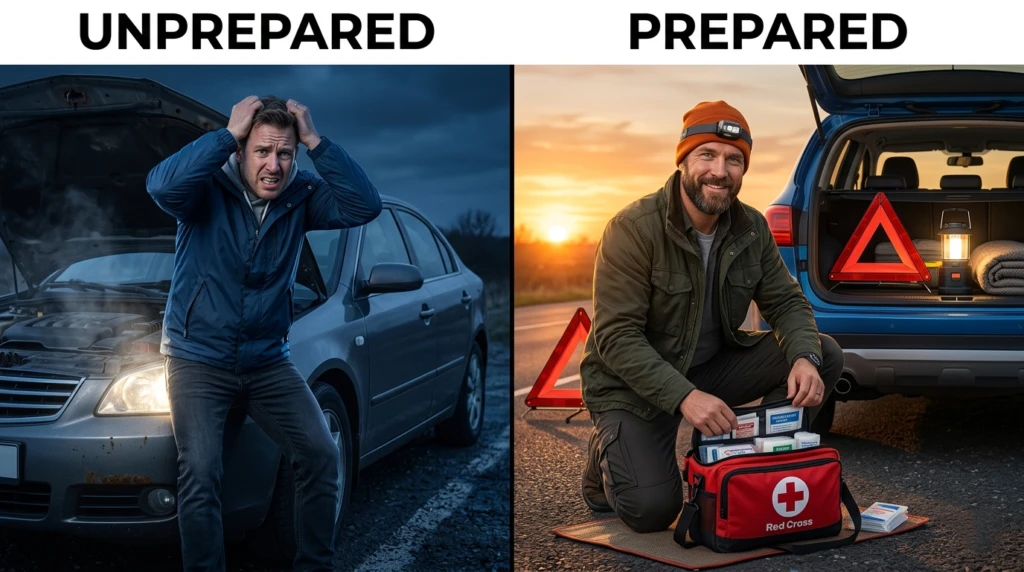 A kit that’s never maintained is a kit that fails. Set a recurring schedule and stick to it.
Minimum maintenance schedule:
- Every 6 months: Rotate water, food rations, and batteries. Check medication expiration dates. Test the flashlight and jump starter charge level.
- Every 12 months: Full kit audit. Replace expired items, check tool condition, update emergency contact cards, verify maps are current.
- After every use: Restock immediately. Don’t wait for the next scheduled review.
- Seasonally: Swap climate-specific items (add hand warmers in fall, swap them out in spring).
A good trigger: use daylight saving time changes as a reminder, similar to smoke detector battery checks.
What Are the Most Commonly Overlooked Items on a Car Emergency Kit List?
Even experienced preppers miss these. They’re not glamorous, but they’ve saved lives.
- Window breaker/seatbelt cutter combo (mounted, not stored)
- Extra prescription glasses or contacts
- Spare house and car keys (stored separately from the primary set)
- Pet supplies if traveling with animals (food, water, leash, carrier)
- Children’s medications and supplies if applicable
- Printed maps — GPS and phones die; paper doesn’t
- Spare fuses matching the specific vehicle
- Cash in small bills ($20s and $5s)
- Sanitation supplies (waste bags, toilet paper, hand sanitizer)
- A charged backup battery for the jump starter itself
FAQ: Car Emergency Kit List
Q: What’s the minimum car emergency kit for everyday driving?
At minimum: jumper cables or a jump starter, a basic first aid kit, one emergency blanket, a flashlight, road flares or triangles, and one liter of water per person. This covers the most common roadside scenarios.
Q: How much does a solid prepper-level car emergency kit cost?
A functional base-level kit runs $75–$150. A full prepper-grade kit with trauma supplies, a jump starter, satellite communicator, and extended food/water supply typically costs $300–$600 built from scratch. Buying components individually rather than pre-packaged kits usually delivers better quality per dollar.
Q: Should the kit stay in the car permanently or only during travel?
Keep it in the car permanently. Emergencies don’t schedule themselves. The only exception is extreme heat storage (above 120°F), which can degrade medications, batteries, and food — in that case, swap heat-sensitive items seasonally.
Q: What’s the difference between a car emergency kit and a get-home bag?
A car emergency kit addresses vehicle-specific failures and short-term roadside emergencies. A get-home bag is a broader survival kit designed to sustain a person traveling on foot back to home base if the vehicle becomes unusable. Many preppers keep both in the vehicle.
Q: Is a portable jump starter better than jumper cables?
For solo drivers, yes. A lithium jump starter works without a second vehicle, is compact, and doubles as a power bank. Jumper cables are heavier but more reliable in extreme cold and don’t require a charged battery. Ideally, carry both.
Q: How do I keep kids safe with a car emergency kit?
Add child-specific items: age-appropriate medications, snacks, a comfort item, and activity supplies to reduce panic. Teach older children where the kit is and how to use the whistle and emergency blanket.
Q: What’s the best bag or container for a car emergency kit?
A water-resistant, modular bag with MOLLE webbing or clear pockets works well. The 5.11 Rush 24, Condor Outdoor bags, and the Pelican 1510 case are popular among preppers for durability. For trunk storage, a collapsible organizer bin keeps items accessible without shifting during driving.
Q: Do I need a separate kit for each vehicle?
Yes. Each vehicle should have its own kit. Transferring a kit between vehicles creates the risk of it being absent when needed. Build a dedicated kit per vehicle, even if the secondary vehicle gets a lighter version.
Products, Tools, and Resources Worth Considering
These aren’t paid recommendations — they’re items that show up repeatedly in prepper communities and field testing because they actually perform.
Jump Starters:
The NOCO Boost X GBX55 handles most passenger vehicles and motorcycles. The Antigravity Micro-Start XP-10 is more compact and doubles as a serious power bank. Both hold a charge for months between uses.
Trauma Medical:
The North American Rescue CAT Tourniquet is the standard used by military and EMS. Pair it with QuikClot Combat Gauze for hemorrhage control. The MyFAK by MyMedic is a well-built all-in-one kit that bridges the gap between basic first aid and trauma response.
Communication:
The Midland ER310hand-crank/solar NOAA radio is compact and reliable. For satellite communication, the Garmin inReach Mini 2 allows two-way messaging anywhere on Earth — worth the subscription cost for anyone who regularly travels remote routes.
Water:
Datrex 125ml Emergency Water Pouches are shelf-stable for 5 years and rated for temperature extremes. The Sawyer Squeeze filter is the most packable and effective water filtration option for extended scenarios.
Navigation:
DeLorme state atlas maps or National Geographic Trails Illustrated maps for regional coverage. Keep them laminated or in a waterproof sleeve.
Multi-tool:
The Leatherman Wave+ remains the benchmark for car kit multi-tools — durable, repairable, and versatile enough to handle most field repairs.
Survival Food:
Mainstay 3600-calorie emergency ration bars are compact, taste acceptable, and carry a 5-year shelf life. They’re not a meal replacement for comfort — they’re fuel for function.
Conclusion: Build It, Stage It, Maintain It
A car emergency kit list is only as good as the kit that actually exists in the vehicle. The research, the planning, and the purchasing mean nothing if the bag is sitting on a shelf at home or if the batteries died two years ago.
For survivalists and preppers, the vehicle kit is a first line of defense — not a backup plan. Build it in layers, stage it for fast access, and maintain it on a schedule. Prioritize trauma-capable medical gear, reliable communication, and climate-appropriate supplies over novelty items.
Actionable next steps:
- Audit what’s currently in the vehicle right now. Most people will find either nothing or an expired commercial kit.
- Build or upgrade using the five-category framework: safety/signaling, medical, tools/repair, sustenance, communication.
- Add prepper-specific layers based on travel patterns and regional risks.
- Set a 6-month calendar reminder to rotate consumables.
- Practice locating and using key items (tourniquet, jump starter, tire plug kit) before an emergency requires it.
The best emergency kit is the one that’s ready before the emergency happens.
References
- American Automobile Association (AAA). Roadside Assistance Data and Vehicle Breakdown Statistics. AAA. https://newsroom.aaa.com
- Federal Emergency Management Agency (FEMA). Build A Kit. Ready.gov. https://www.ready.gov/kit
- North American Rescue. Tourniquet Use and Hemorrhage Control Training. https://www.narescue.com
- Centers for Disease Control and Prevention (CDC). Emergency Preparedness and Response: Natural Disasters. https://www.cdc.gov/niosh/topics/emres/