
Hey there! Some links on this page may be affiliate links which means that, if you choose to make a purchase, I may earn a commission at no extra cost to you. I greatly appreciate your support. Read the full disclosure here.
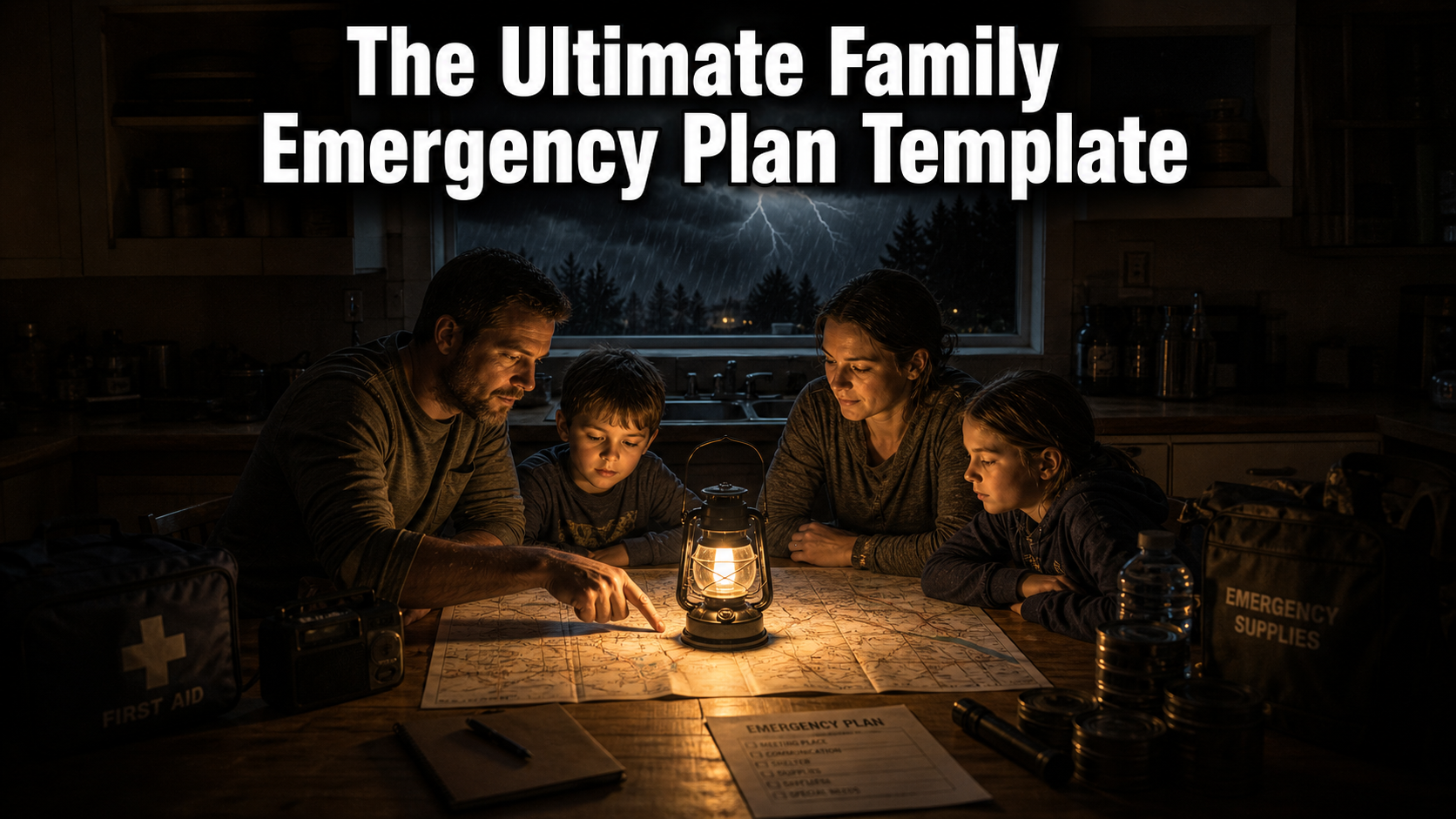
The Ultimate Family Emergency Plan Template: A Step-by-Step System to Protect Your Loved Ones
When disaster strikes, one of the most valuable tools you can have is a Family Emergency Plan Template. In those unsettling moments—when power cuts out, communication fails, and everyday systems suddenly stop working—having a clear, structured plan can make all the difference. The familiar sounds of daily life fade, replaced by uncertainty and urgency, leaving many unprepared for how quickly normal conditions can unravel.
It’s easy to believe you’ll manage when the time comes, relying on instinct or the expectation that help will arrive quickly. However, real-world events—from major hurricanes to widespread power outages—have shown that waiting to react often leads to confusion and risk. Families who handle emergencies effectively aren’t just lucky; they’ve taken the time to prepare in advance, creating a plan they can rely on when it matters most.
This guide goes beyond basic advice. It introduces a practical and well-structured approach designed to help households stay organized, connected, and resilient during a crisis. Whether you’re dealing with a short-term disruption or a larger-scale emergency, using a reliable family emergency plan template gives you the clarity and confidence needed to respond quickly and effectively.
Find this useful? Add us as a preferred source on Google and more of what we publish will show up in your results.
The False Security Trap: Why Most Family Emergency Plans Fail
 If you search the internet for a family emergency plan template, you will find thousands of identical, sterile worksheets. They ask you to fill in your name, your address, and the phone number of your local police department.
The primary reason these standard disaster preparedness checklists fail is that they treat preparedness as a static document rather than a living, breathing system. They focus entirely on the what—the contact lists, the meeting points, the gear—while completely ignoring the how and the why.
A piece of paper that sits in a filing cabinet for four years is a liability. It creates a psychological phenomenon known as the “preparedness paradox.” The mere act of printing the template creates a false sense of security, which actually reduces your motivation to do the real work. You checked the box. You moved on. But when the sky turns the color of a bruised plum and the evacuation sirens start blaring, you realize the meeting point you chose is inaccessible, the phone numbers are outdated, and your children have absolutely no idea what to do.
True family preparedness is built on three non-negotiable pillars: Redundancy, Reality, and Muscle Memory.
Redundancy: If your primary communication method fails, what is your backup? If your primary meeting point is blocked by floodwaters, what is your secondary location? A single plan is a point of failure. A system has backups.
Reality: Most preparedness advice is built for a hypothetical suburban family with a massive basement and a four-wheel-drive truck. If you live in a high-rise apartment, if you rely on public transit, or if you have a child with specialized medical needs, your emergency plan must be ruthlessly tailored to your actual reality.
Muscle Memory: A plan that has never been drilled is not a plan. It is a theory. A functional preparedness system requires regular, low-stress practice—a way to ensure every family member knows their role and can execute it when their heart rate hits 140 beats per minute.
Key Takeaways:
– A functional family emergency plan must be dynamic, emphasizing redundancy, realistic customization, and regular drills to build muscle memory.
– Use an out-of-area contact to overcome local cellular network failures during emergencies and ensure all family members memorize key phone numbers.
– Establish a three-tiered meeting point protocol with specific locations for immediate, neighborhood, and regional reunification scenarios.
– Maintain both physical and digital emergency document vaults, including identity, medical, financial records, and a video walkthrough of property for insurance claims.
– Pre-define your family’s evacuation vs. shelter-in-place decision matrix and tailor plans to protect vulnerable members like children, seniors, and pets.
Phase 1: The Communication Hub (Solving the Cell Tower Fallacy)
When a crisis hits, your first instinct is to pick up your phone and call your spouse, your kids, or your parents. It is also the instinct of every other person in your city.
Within minutes of a major regional emergency—an earthquake, a terrorist incident, a severe weather event—local cellular networks become catastrophically congested. The infrastructure isn’t necessarily destroyed; it simply cannot handle the volume of a million people trying to make a phone call at the exact same second. Local lines fail. Texts refuse to send. You get the dreaded “all circuits are busy” recording.
If your family’s entire emergency plan relies on calling each other’s cell phones, your plan is broken before it even begins.
The Out-of-Area Contact Strategy
The solution to local network congestion is the Out-of-Area Contact. During regional disasters, while local calls bounce, long-distance calls routed out of the affected area often connect perfectly.
How to build this node:
- Select the Contact: Choose a reliable friend or family member who lives at least 100 miles away (preferably in a different state or province). This person must be someone who answers their phone and can remain calm under pressure.
- Establish the Protocol: If your family is separated during an emergency and cannot reach each other directly, everyone calls the Out-of-Area Contact.
- The Check-In Script: Teach your children exactly what to say. “Hi Aunt Sarah, this is Leo. I am safe at the middle school with my teacher.I am waiting for Mom.”
- The Information Hub: The Out-of-Area Contact acts as the central switchboard, relaying messages between family members until you can be physically reunited.
The Analog Backup: Memorization
In an era where we outsource our memory to our smartphones, very few children (and surprisingly few adults) know their loved ones’ phone numbers by heart. If your teenager loses their phone during a school evacuation, can they borrow a teacher’s phone and dial your number from memory? Can they dial the Out-of-Area Contact?
Every member of your household must memorize three phone numbers: Parent 1, Parent 2, and the Out-of-Area Contact. Write these numbers on a physical card, laminate it, and put it in every child’s backpack and every adult’s wallet.
Phase 2: The Meeting Point Protocol
 “If something happens, meet at home.”
This is the default plan for most families. But what if the emergency is a house fire? What if a chemical spill has forced the evacuation of your entire neighborhood? What if the roads leading to your subdivision are blocked by debris? You need a layered approach to physical reunification.
The Three-Tiered Reunification System
Tier 1: The Immediate Vicinity (The House Fire Scenario) This is a specific, highly visible location just outside your home. It should be a safe distance from the structure but close enough to reach in seconds. Example: The large oak tree across the street, or the neighbor’s mailbox at the corner. The Rule: Once you are out, you stay out. You meet at the Tier 1 location so parents can immediately take a headcount for first responders.
Tier 2: The Neighborhood Hub (The Localized Evacuation Scenario) If your street is inaccessible or you cannot return to your immediate property, you need a location within walking distance of your home. Example: The local elementary school parking lot, the community center, or a specific church at the edge of your subdivision. The Rule: This must be a public, easily identifiable space that children can navigate to on foot without crossing major, dangerous intersections.
Tier 3: The Regional Destination (The City-Wide Disaster Scenario) If a hurricane, wildfire, or major grid failure forces a wide-scale evacuation, where is your family heading? You cannot rely on “we’ll just drive until we find a hotel.” Millions of other people will have the exact same idea, and the hotels will be booked for a 200-mile radius. Example: A relative’s house in a neighboring state, or a specific pre-vetted family cabin. The Rule: You must have physical, printed maps in your vehicles with multiple highlighted routes to this destination, as GPS routing will likely fail or lead you straight into gridlocked traffic.
Phase 3: The Emergency Document Vault
Imagine standing in a FEMA line, or sitting in an insurance adjuster’s temporary office, trying to prove who you are, what you own, and what medical conditions your children have—with nothing but the clothes on your back.
Disasters are not just physical crises; they are bureaucratic nightmares. The loss of your identity documents and financial records can turn a temporary displacement into a years-long financial catastrophe. You must build a “Go-Vault.”
The Physical Vault
 Purchase a high-quality, fireproof, and waterproof document bag. This bag should be stored in a secure but easily accessible location (like a fireproof safe that you can quickly open, or a hidden “grab-and-go” spot near your primary exit).
What goes inside:
- Identity: Copies of passports, driver’s licenses, birth certificates, marriage licenses, and Social Security cards.
- Medical: Immunization records, a list of blood types, known allergies, and a detailed list of current prescription medications and dosages for every family member.
- Financial: Copies of the front and back of credit cards, bank account numbers, and contact information for your financial institutions.
- Property: Copies of your home deed or lease, vehicle titles, and the declaration pages of your home, auto, and life insurance policies.
- Cash: Electronic payment systems fail when the power goes out. Keep $500 to $1,000 in small denominations ($1, $5, $10, and $20 bills). In a grid-down scenario, a vendor cannot make change for a $100 bill when you just want to buy a case of water.
The Digital Vault
Physical documents can be lost in a flood or left behind in a panicked evacuation. You must build a digital twin of your vault.
Scan every document listed above. Place the files onto an encrypted, password-protected USB flash drive. Put one USB drive in your physical Go-Vault, put another in your car’s emergency kit, and give a third to your Out-of-Area Contact.
The Video Walkthrough: Once a year, take your smartphone and walk through your entire house. Open every closet, every drawer, and every garage cabinet. Narrate what you are seeing. “Here is our 75-inch Samsung TV, purchased in 2024. Here is my wife’s jewelry box containing her grandmother’s pearls.” Upload this video to a secure cloud server. If your home is destroyed, this video is the ultimate, undeniable proof for your insurance adjuster.
Phase 4: The Decision Matrix (Evacuate vs. Shelter-in-Place)
 The most dangerous moment in any disaster is the moment of indecision. Should we stay, or should we go? If you wait for a government official to tell you what to do, you have waited too long. You are now part of the panicked herd, stuck in gridlocked traffic, competing for dwindling resources.
Your family emergency plan template must include a pre-determined decision matrix. You establish your “red lines” while you are calm, so you don’t have to debate them when you are terrified.
The Shelter-in-Place Protocol
You shelter in place when the environment outside your home is more dangerous than the environment inside, provided your home is structurally sound. This applies to pandemics, civil unrest, severe winter storms, and chemical spills.
The Shelter-in-Place Checklist:
- Utility Mastery: Does every adult (and capable teenager) know exactly where the gas, water, and main electrical shutoffs are? Do you have a dedicated wrench tied to the gas meter?
- The Safe Room: Identify an interior room with no windows (usually a bathroom, closet, or basement) for tornados or severe high-wind events.
- Resource Assessment: Do you have a minimum of two weeks of calorie-dense, shelf-stable food and one gallon of water per person, per day?
The Evacuation (Bug-Out) Protocol
You evacuate when your home is structurally compromised, when you are in the direct path of a lethal threat (wildfire, category 5 hurricane), or when your local resources (water, food, security) are entirely depleted with no hope of resupply.
The Evacuation Checklist:
- The 10-Minute Warning: If a wildfire is cresting the ridge, you may only have ten minutes. Your Go-Vault, your Bug Out Bags, and your pets must be ready to load instantly.
- The Fuel Rule: Never let your vehicle’s gas tank fall below half-full. In a regional evacuation, gas stations will run out of fuel within hours, and the pumps will not work if the grid is down. A half-tank of gas is your ticket out of the danger zone.
- Route Redundancy: Know your primary highway out of town, but also know the backroads, the fire roads, and the surface streets.
Phase 5: Protecting the Vulnerable (Children, Seniors, and Pets)
 A generic disaster preparedness checklist assumes every member of the household is an able-bodied adult. Reality is rarely that simple. Your plan must account for the specific vulnerabilities of your loved ones.
The Pediatric Protocol
Children process trauma differently than adults. They look to you for their emotional baseline. If you are frantic, they will be terrified. If you are focused and purposeful, they will feel secure.
- The “What If” Game: Do not sit your seven-year-old down and give them a lecture about earthquakes destroying the house. Instead, play the “What If” game during a car ride. “Hey buddy, what if we were at the grocery store and the lights went out? What would we do?” Guide them to the right answers. Make it a puzzle, not a horror story.
- Comfort Items: A child’s Bug Out Bag should contain a familiar comfort item—a specific stuffed animal, a favorite book, or a deck of cards. Psychological comfort is a survival necessity for children.
The Senior and Medical Protocol
If you are caring for elderly parents or a family member with specialized medical needs, your timeline for evacuation must be accelerated.
- Power Dependency: If someone in your home relies on a CPAP machine, an oxygen concentrator, or refrigerated medication (like insulin), a power outage is a direct threat to their life. You must invest in a portable solar generator or a reliable battery backup system specifically dedicated to their medical equipment.
- Mobility: If a family member uses a wheelchair or walker, how will you evacuate them if the elevators in your building stop working? You must have a physical plan and the necessary equipment (like an evacuation stair chair) to move them safely.
The Pet Protocol
During Hurricane Katrina, thousands of people refused to evacuate because rescue shelters would not accept pets. Today, laws have changed, but the logistical burden is still on you.
- The Pet Go-Bag: Your pet needs a 72-hour kit containing dry food, bottled water, a collapsible bowl, extra leashes, and a muzzle (even friendly dogs can bite when terrified).
- Identification: Ensure your pet is microchipped and wearing a collar with updated tags. Keep a current photo of you with your pet in your Go-Vault to prove ownership if you are separated.
Phase 6: The 15-Minute Family Drill (Building Muscle Memory)
This is where the magic happens. This is where a piece of paper transforms into a living, breathing system of protection.
You do not need to spend your entire weekend running military-style boot camps. You need 15 minutes, twice a year, to build muscle memory.
The Tuesday Night Blackout Drill: Pick a random Tuesday evening. After dinner, walk over to the breaker box and turn off the main power to the house.
Say to your family: “The power just went out, and a severe storm is coming. We have 15 minutes to get the house secure and get our emergency lighting set up. Go.”
Watch what happens. Do the flashlights have dead batteries? Does anyone know where the emergency radio is? Did someone trip over the dog in the dark?
This drill will expose the flaws in your plan in a safe, controlled environment. It turns a terrifying concept into a manageable family challenge. Once the lights are back on, sit down and discuss what worked and what failed. Adjust your plan accordingly.
Preparedness is not a destination. It is a continuous cycle of assessment, adjustment, and practice.
Frequently Asked Questions
How do I bring this up without terrifying my kids or sounding like a doomsday prepper to my spouse?
Frame preparedness as a normal, responsible part of household management—exactly like buying car insurance or wearing a seatbelt. You don’t wear a seatbelt because you are paranoid about crashing; you wear it because it is a simple system that mitigates risk. Focus the conversation on competence, resilience, and peace of mind. “I want to make sure we’re comfortable if the power goes out for a few days” is a practical, non-threatening way to start.
I’m on a tight budget. What’s the absolute cheapest way to get this started?
Start with the steps that cost absolutely nothing. Establish your Out-of-Area Contact. Designate your primary and secondary meeting points. Write down your utility shutoff locations. Scan your critical documents into a secure cloud folder. You can build 80% of a world-class family emergency plan without spending a single dollar. Once the mental framework is in place, you can slowly begin purchasing physical supplies like water storage and emergency radios.
Do I really need a paper copy if everything is on my phone?
Yes. You must have both. A physical, printed plan is essential because digital devices fail, batteries die, and severe weather can render screens useless. A digital plan is essential because it can be accessed from anywhere in the world if your physical home is destroyed. Keep a laminated physical copy in your emergency kits, and a secure digital copy in your cloud storage.
Why force my kids to memorize numbers when they literally never dial a phone manually?
In a crisis, smartphones are frequently lost, broken, or drained of battery. During a chaotic evacuation, a child might be separated from their belongings entirely. If your child is at a reunification center, they need to be able to borrow a first responder’s phone and dial your Out-of-Area Contact entirely from memory. Memorization is the ultimate, unbreakable analog backup.
Products / Tools / Resources
These are the specific items and resources that form the foundation of a serious family emergency plan—selected for reliability, value, and real-world effectiveness.
Organization and Documentation
SentrySafe Fireproof Document Bag — Waterproof and fireproof storage for physical copies of your critical documents. It features a combination lock and multiple layers of fire-retardant fiberglass. This is the most important organizational investment for your Go-Vault.
DYMO LetraTag Label Maker— Essential for organizing your emergency kit contents, clearly marking expiration dates on food and water, and labeling the utility shutoff valves in your home so anyone can find them in the dark.
Communication and Power
Midland ER310 Emergency Crank Weather Radio— The absolute gold standard for household preparedness. It features multiple power sources (internal battery, hand-crank, and solar panel), NOAA Weather Radio reception, a USB charging port for your phone, and an SOS flashlight beacon.
Fox 40 Classic Pealess Whistle — Audible at distances of over a mile, works in freezing temperatures, and has no moving parts to jam or freeze. Every emergency kit and every child’s backpack should have one attached to the zipper.
Jackery Explorer 300 Portable Power Station — A silent, fume-free lithium battery generator. Crucial for apartment dwellers who cannot run gas generators, and essential for keeping phones charged or running small medical devices like CPAP machines during a blackout.
Planning Resources
FEMA Ready.gov Emergency Plan Templates — Free, downloadable family emergency plan templates from the federal government. While they are basic, they are the perfect starting point for writing down your household’s specific information.
American Red Cross First Aid App — A free, incredibly well-designed app with step-by-step first aid instructions for common emergencies. Download it now—it works entirely offline, meaning you have a medical encyclopedia in your pocket even when the cell towers are down.