
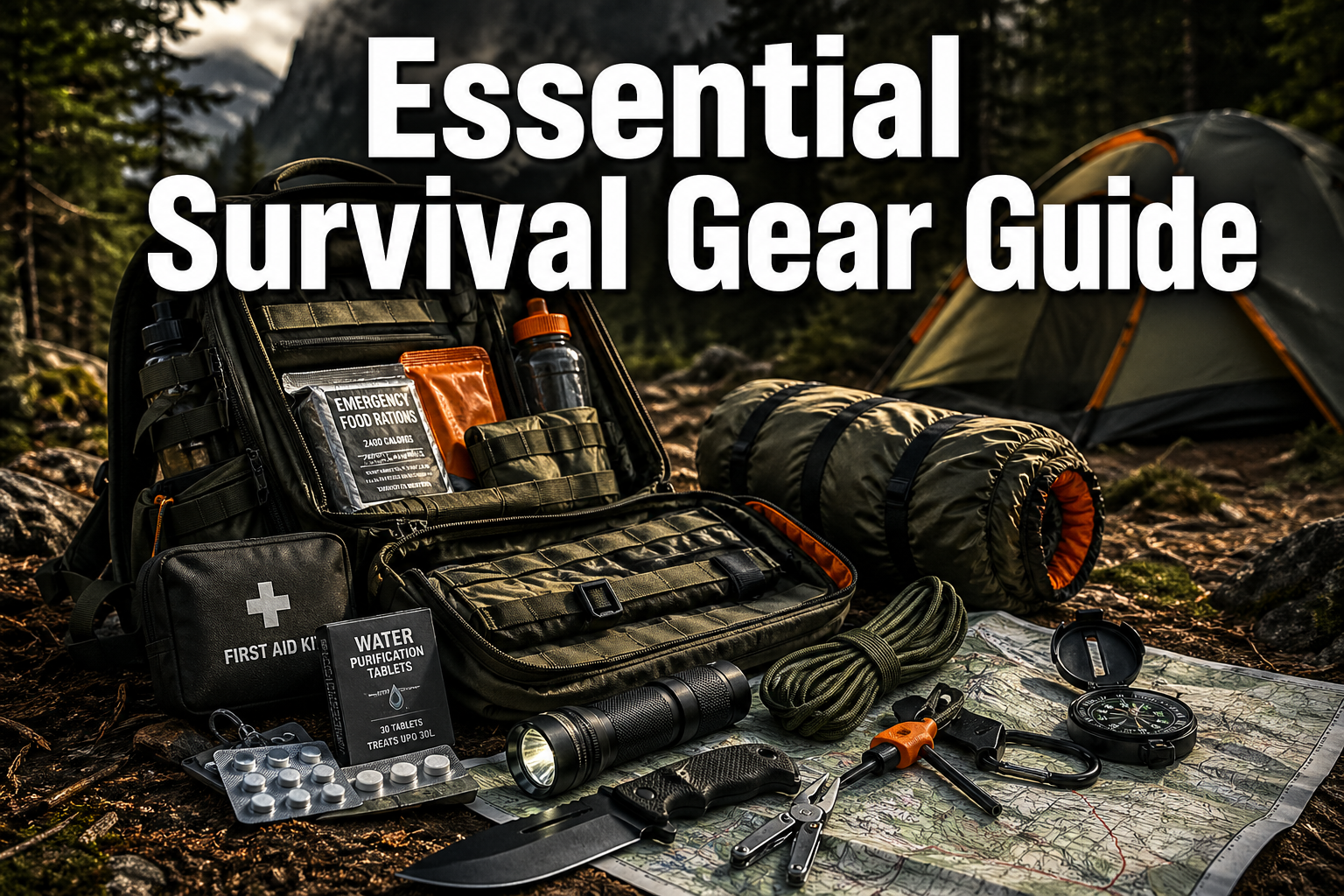
Hey there! Some links on this page may be affiliate links which means that, if you choose to make a purchase, I may earn a commission at no extra cost to you. I greatly appreciate your support. Read the full disclosure here.
Walk into any outdoor gear store, and you’ll be overwhelmed. Walls of equipment, each item promising to be the difference between life and death. Tactical knives with serrated edges and compass pommels. Fire starters that claim to work underwater. Water filters that purify a thousand gallons. Survival kits in tins, in bags, in boxes.
And you’re standing there, trying to figure out what you actually need.
Here’s the truth: most survival gear is either redundant, over-engineered, or designed to solve problems you’ll never face. The real essentials—the items that wilderness experts, search-and-rescue professionals, and backcountry guides actually rely on—are simpler, more versatile, and far more effective than the marketing would have you believe.
This isn’t a gear catalog. This is a priority-ranked system, built from decades of real-world survival experience, that will help you build a kit that actually works when everything else fails.
The Survival Gear Hierarchy: Understanding Priority vs. Preference
 Before we dive into specific items, you need to understand the framework that separates essential gear from nice-to-have equipment.
The “Rule of Threes” Applied to Gear Selection
The “Rule of Threes” is the foundational principle of survival prioritization:
- 3 minutes without air
- 3 hours without shelter (in harsh conditions)
- 3 days without water
- 3 weeks without food
Your gear should reflect these priorities. Shelter and warmth come before water. Water comes before food. This hierarchy is non-negotiable.
Survival Priorities: Shelter, Water, Fire, Food, Signaling
Every piece of survival gear should serve one or more of these five core functions:
- Shelter: Protection from the elements (hypothermia is the #1 killer in survival situations)
- Water: Sourcing, storing, and purifying
- Fire: Warmth, water purification, signaling, morale
- Food: Caloric energy for sustained survival
- Signaling: Increasing your chances of rescue
The Difference Between “Essential” and “Nice-to-Have”
An essential item is one that, if absent, significantly reduces your chances of survival in a realistic scenario. A nice-to-have item increases comfort or efficiency but isn’t critical. A camp chair is nice-to-have. A knife is essential.
Weight vs. Utility: The Backpacker’s Dilemma
Every ounce you carry is energy you expend. The goal is to maximize utility while minimizing weight. Multi-use items are gold. Single-purpose gadgets are dead weight.
The short version: Essential survival gear should be prioritized based on the “Rule of Threes”: shelter and warmth (3 hours), water (3 days), and food (3 weeks). The core functions are shelter, water, fire, food, and signaling. Multi-use items that serve multiple functions are preferred over single-purpose gadgets to minimize weight.
Key Takeaways:
– Prioritize survival gear according to the “Rule of Threes”: shelter and warmth first (3 hours), then water (3 days), and food (3 weeks).
– Essential gear must serve core functions—shelter, water, fire, food, signaling—and offer multi-use to minimize weight.
– The Tier 1 Core Four items—fixed-blade knife, fire-starting kit, water purification system, and emergency shelter—are non-negotiable fundamentals.
– Practice using your gear regularly to build skills, ensure redundancy, and maintain equipment for reliability in real situations.
– Build your survival kit in phases, starting with essentials, then expand based on environment and duration, testing in controlled conditions before relying on it.
Tier 1: The Core Four (Absolute Essentials for Any Scenario)
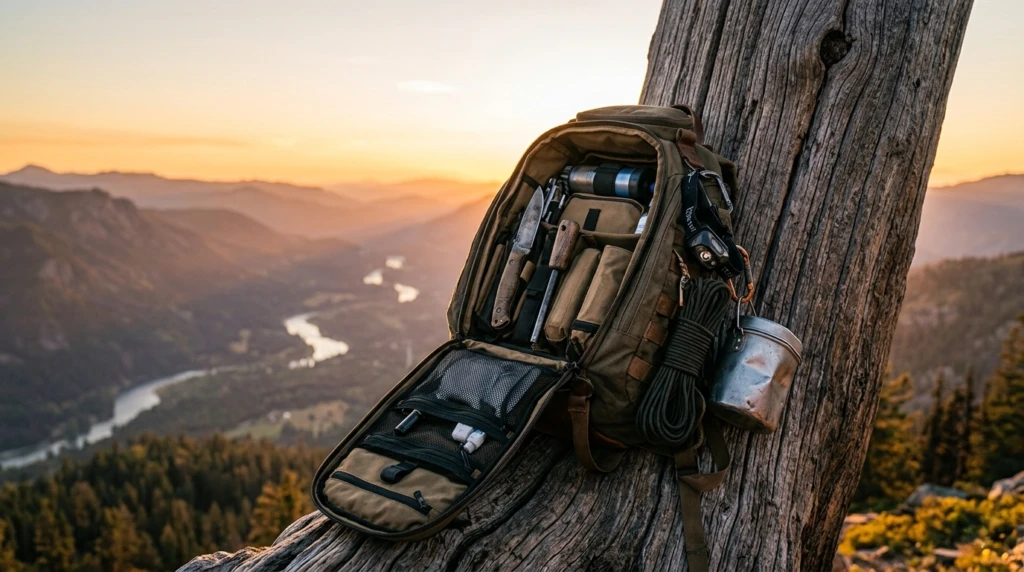 These four items are non-negotiable. If you have nothing else, you have these.
Cutting Tool (Fixed-Blade Knife)
A knife is the single most versatile survival tool. It processes firewood, prepares food, builds shelter, creates tools, and serves as a last-resort defensive weapon.
Why a knife is your most versatile survival tool
With a good knife, you can:
- Baton wood to create kindling for fire
- Carve tent stakes and shelter supports
- Process game or fish
- Cut cordage and fabric
- Create feather sticks for fire starting
- Fashion primitive tools (spears, traps)
Full-tang vs. partial-tang construction
A full-tang knife has a blade that extends the entire length of the handle, providing maximum strength and durability. A partial-tang knife is lighter but more prone to breaking under stress. For survival, always choose full-tang.
Recommended blade length and steel type
- Blade length: 4-6 inches. Long enough for batoning, short enough for detailed work.
- Steel type: High-carbon steel (like 1095) is easier to sharpen in the field but requires maintenance to prevent rust. Stainless steel (like 440C) is more corrosion-resistant but harder to sharpen without proper tools.
Top Recommendation: Mora Companion Heavy Duty (budget), ESEE-4 (mid-range), or Benchmade Bushcrafter (premium).
Fire Starting Kit (Multiple Methods)
Fire provides warmth, purifies water, cooks food, signals rescuers, and boosts morale. You need redundancy.
Ferro rod, lighter, waterproof matches: The redundancy principle
- Ferro rod (ferrocerium rod): Works when wet, lasts for thousands of strikes, doesn’t rely on fuel. This is your primary method.
- Lighter (Bic or Zippo): Fast, easy, reliable in dry conditions. Carry two.
- Waterproof matches: Backup for when fine motor skills are compromised by cold or injury.
Tinder preparation and storage
Pre-made tinder (dryer lint, petroleum jelly-soaked cotton balls, commercial fire starters) should be stored in a waterproof container. Natural tinder (birch bark, dry grass, pine needles) requires practice to identify and prepare.
Water Purification System
You can survive weeks without food, but only days without water. Contaminated water can incapacitate you with illness.
Portable filters vs. purification tablets vs. boiling
- Portable filters (Sawyer, LifeStraw, Katadyn): Remove bacteria and protozoa. Most do NOT remove viruses (less of a concern in North American wilderness). Fast and convenient.
- Purification tablets (chlorine dioxide, iodine): Kill bacteria, viruses, and protozoa. Lightweight and compact. Require wait time (30 minutes to 4 hours).
- Boiling: The most reliable method. Kills everything. Requires a metal container and fuel for fire.
Capacity and flow rate considerations
For a portable filter, look for:
- Filtration capacity: Minimum 100,000 gallons (Sawyer Squeeze)
- Flow rate: At least 1 liter per minute
- Micron rating: 0.1 microns or smaller to remove bacteria and protozoa
Top Recommendation: Sawyer Squeeze (primary filter) + Potable Aqua chlorine dioxide tablets (backup).
Emergency Shelter (Tarp or Emergency Bivy)
Exposure kills faster than dehydration. Shelter is your first priority in harsh conditions.
Mylar emergency blankets vs. durable tarps
- Mylar emergency blankets: Lightweight, compact, reflect body heat. Single-use or very limited reuse. Good for emergency kits.
- Durable tarps (silnylon, Dyneema): Reusable, versatile, can be configured into multiple shelter types. Heavier but far more functional.
Paracord and shelter-building basics
A 10×10 foot tarp and 50 feet of paracord can create a lean-to, A-frame, or debris shelter. Learn basic knots (bowline, taut-line hitch, clove hitch) before you need them.
Top Recommendation: SOL Emergency Bivy (ultralight emergency) or Aqua Quest Defender Tarp (durable multi-use).
72 Hour Bug Out Bag Checklist: Complete Prepper Guide 2026
Tier 2: The Survival Ten (Expanding Your Capability)
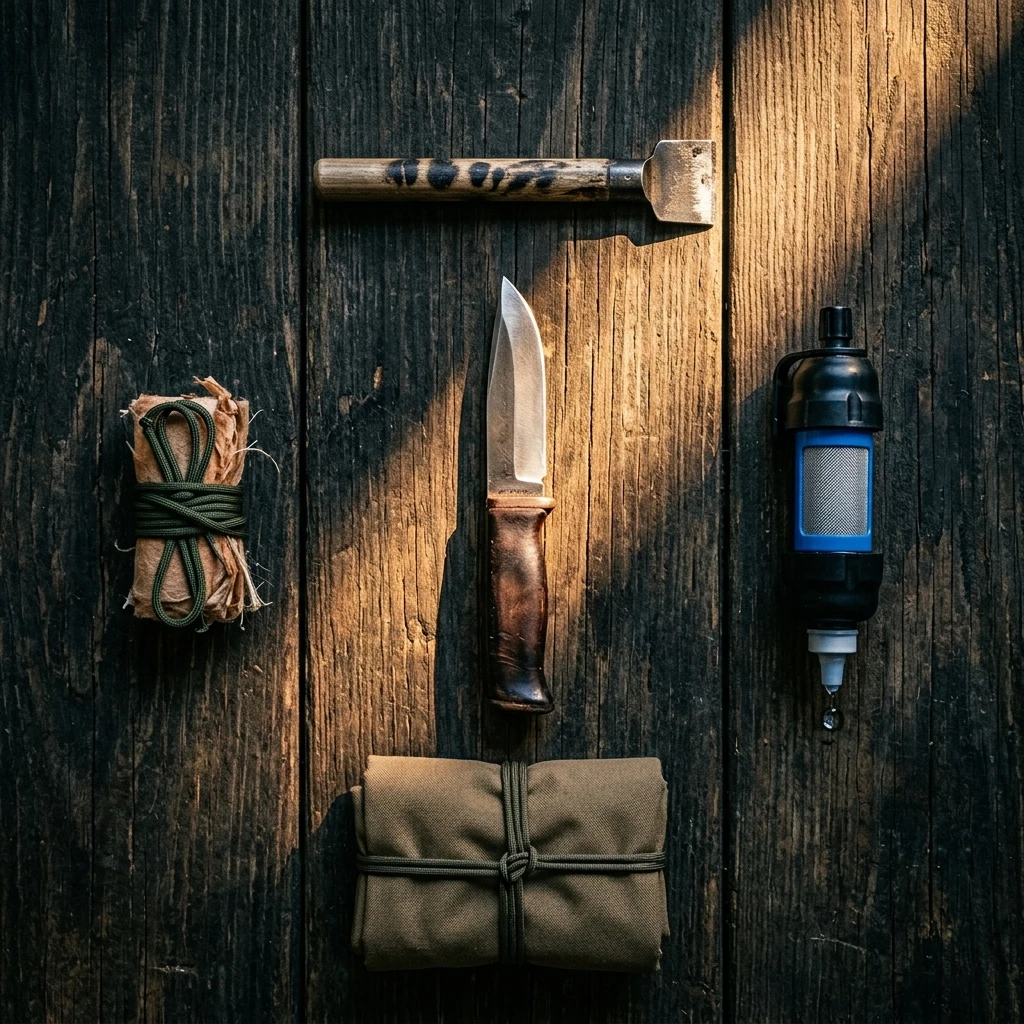 With the Core Four secured, these ten items dramatically expand your survival capabilities.
Headlamp or Flashlight (Hands-Free Lighting)
A headlamp keeps your hands free for tasks. LED technology provides long battery life and durability.
Key features: Minimum 200 lumens, red-light mode (preserves night vision), waterproof rating (IPX4 or higher), runs on AA or AAA batteries (easier to find replacements).
Top Recommendation: Black Diamond Spot or Petzl Actik Core.
First Aid Kit (Trauma and Basic Medical)
Minor injuries become major problems without proper care. Your kit should address both trauma (bleeding, fractures) and common ailments (blisters, infections, pain).
Essential components:
- Trauma: Tourniquet, Israeli bandage, QuikClot, chest seals
- Wound care: Gauze, medical tape, antiseptic wipes, antibiotic ointment
- Medications: Pain relievers, antihistamines, antidiarrheals, anti-inflammatories
- Tools: Tweezers, scissors, safety pins, thermometer
Top Recommendation: Adventure Medical Kits Trauma Pak or build your own.
GPS devices fail. Batteries die. You need analog backups.
The navigation triad:
- Topographic map: Waterproof, covers your area
- Compass: Baseplate compass with declination adjustment (Silva, Suunto)
- GPS device (optional): Garmin inReach (includes satellite communication)
Learn to use a map and compass before you need them.
Signaling Devices (Whistle, Mirror, Flare)
Increasing your visibility to rescuers can cut survival time from days to hours.
Essential signaling tools:
- Whistle: Carries farther than your voice, requires no energy. Three blasts = distress signal.
- Signal mirror: Can be seen for miles. Practice aiming the reflection.
- Flare or strobe light: For nighttime signaling.
Cordage (Paracord, Bank Line)
Cordage is endlessly useful: building shelters, securing gear, creating traps, making repairs.
Recommended: 50-100 feet of 550 paracord (7-strand inner core can be separated for finer tasks) and 50 feet of tarred bank line (rot-resistant, high tensile strength).
Multi-Tool or Folding Saw
A multi-tool provides pliers, screwdrivers, and additional blades. A folding saw processes larger wood more efficiently than a knife.
Top Recommendation: Leatherman Wave+ (multi-tool) or Silky Pocketboy (folding saw).
Metal Container (For Boiling Water)
A metal container (stainless steel or titanium) allows you to boil water for purification and cook food.
Top Recommendation: 32 oz stainless steel water bottle or titanium pot.
Emergency Food (Calorie-Dense, Lightweight)
Food is lower priority than shelter and water, but you need calories for sustained energy.
Best options:
- Energy bars (Clif, ProBar)
- Nut butter packets
- Freeze-dried meals (Mountain House)
- Pemmican or jerky
Aim for 1,200-2,000 calories per day minimum.
Rain Gear (Waterproof Layer)
Staying dry is critical for preventing hypothermia. A waterproof/breathable jacket and pants are essential.
Top Recommendation: Frogg Toggs (budget) or Arc’teryx Beta AR (premium).
Insulation Layer (Warm Clothing)
Synthetic insulation (fleece, Primaloft) retains warmth even when wet. Down is warmer but useless when soaked.
Top Recommendation: Patagonia R1 fleece or synthetic puffy jacket.
Tier 3: Advanced & Specialized Gear (Scenario-Specific)
 Once you’ve mastered Tier 1 and Tier 2, you can add specialized gear based on your environment and scenario.
Climate-Specific Additions
Cold weather:
- Insulated sleeping bag (rated to 0°F or lower)
- Hand and toe warmers
- Balaclava and insulated gloves
- Vapor barrier liner (prevents moisture buildup in sleeping bag)
Hot/arid:
- Sun protection: wide-brimmed hat, UV-blocking clothing, sunglasses
- Electrolyte tablets
- Increased water storage capacity (2+ gallons per day)
- Shade cloth
Tropical/wet:
- Hammock with mosquito netting
- Waterproof stuff sacks
- Anti-fungal powder
- Permethrin-treated clothing
Terrain-Specific Additions
Mountain/alpine:
- Ice axe and crampons
- Altitude sickness medication (Diamox)
- Avalanche beacon, probe, and shovel (if in avalanche terrain)
Desert:
- Sand gaiters
- GPS with extended battery
- Signaling mirror
Forest/jungle:
- Machete or kukri
- Insect repellent (DEET or picaridin)
- Water shoes
Duration-Specific Additions
72-hour kit: Focus on Tier 1 and select Tier 2 items. Prioritize lightweight and compact.
2-week expedition: Add full Tier 2, plus food resupply, additional clothing layers, and repair kit.
Long-term survival: Add tools for food procurement (fishing kit, snare wire), shelter building (axe, saw), and sustainability (water filtration with high capacity).
The Survival Gear Mindset: Skills Over Stuff
The best gear in the world is useless if you don’t know how to use it.
Why Knowledge Multiplies the Value of Every Item
A knife in the hands of someone who knows how to baton wood, carve feather sticks, and build a bow drill is exponentially more valuable than a knife in the hands of someone who only knows how to cut rope.
The “Two is One, One is None” Redundancy Principle
Critical systems (fire, water, light) should have backups. If your primary fire-starting method fails, you need a secondary. If your headlamp dies, you need a backup flashlight.
Regular Practice: Turning Gear into Capability
Set up your tarp shelter in your backyard. Start a fire with your ferro rod in the rain. Filter water from a local stream. Practice builds muscle memory and reveals weaknesses in your kit.
Maintenance and Inspection Schedules
Every 6 months:
- Sharpen your knife
- Check batteries in all devices
- Inspect cordage for fraying
- Replace expired medications and food
- Test your water filter
Building Your Personal Survival Kit: A Step-by-Step Approach
 Don’t try to buy everything at once. Build your kit methodically.
Step 1: Assess Your Most Likely Scenarios
Where do you live? Where do you hike or camp? What are the most common emergencies in your area? (Power outages, wildfires, floods, winter storms)
Step 2: Start with Tier 1, Master Each Item
Buy the Core Four. Learn to use each one proficiently. A $30 knife you know how to use is better than a $300 knife you don’t.
Step 3: Expand to Tier 2 Based on Your Environment
Add items from Tier 2 that address your specific needs. If you live in a wet climate, prioritize rain gear and waterproofing. If you’re in the desert, prioritize water storage.
Step 4: Add Tier 3 Items for Specific Adventures
Planning a winter mountaineering trip? Add cold-weather gear. Going to the tropics? Add insect protection and a hammock.
Step 5: Test Your Kit in Controlled Conditions
Go on a weekend camping trip using only your survival kit. You’ll quickly discover what’s missing, what’s redundant, and what needs to be replaced.
Frequently Asked Questions
What’s the single most important piece of survival gear?
If forced to choose one item, it’s a fixed-blade knife. With a good knife, you can process wood for fire, build shelter, create tools, and prepare food. It’s the most versatile survival tool.
How much should I spend on survival gear as a beginner?
You can build a functional Tier 1 kit for under $150. A Mora knife ($15-30), a ferro rod ($10), a Sawyer Squeeze filter ($25), and a basic tarp ($30-50) will cover the essentials. Invest in quality for items you’ll use frequently (knife, water filter), and go budget for items you’ll rarely use (emergency blanket).
Can I substitute cheaper alternatives for expensive gear?
Sometimes. A $15 Mora knife performs nearly as well as a $150 ESEE knife for most tasks. But a $5 gas station lighter is not a substitute for a quality ferro rod. Research reviews, understand the trade-offs, and prioritize reliability over price.
How often should I replace items in my survival kit?
- Annually: Batteries, food, medications, water purification tablets
- Every 2-3 years: Inspect and potentially replace cordage, tarps, and clothing for wear
- Every 5+ years: High-quality knives, metal containers, and tools should last decades with proper maintenance
What’s the difference between a bug-out bag and a survival kit?
A bug-out bag is a portable 72-hour kit designed for rapid evacuation from your home. A survival kit is a broader term that can include both portable kits (for wilderness travel) and stationary kits (for sheltering in place). A bug-out bag is a type of survival kit optimized for mobility.
Products / Tools / Resources
These are the specific items and resources that consistently come up in serious survival gear conversations—selected for reliability, value, and real-world effectiveness.
Cutting Tools
- Mora Companion Heavy Duty: The best budget survival knife on the market. Full-tang, high-carbon steel, and virtually indestructible for the price ($20-30).
- ESEE-4: A mid-range workhorse. 1095 carbon steel, full-tang, lifetime warranty. Trusted by military and survival instructors ($120-150).
- Benchmade – Mini Bushcrafter Outdoor: Premium option. S30V stainless steel, ergonomic handle, exceptional edge retention ($180-220).
Fire Starting
- Light My Fire Swedish FireSteel: The gold standard ferro rod. 3,000+ strikes, works in any weather ($15-20).
- Bic Mini Lighter (pack of 5): Cheap, reliable, disposable. Keep them everywhere ($5).
- UCO Stormproof Matches: Burn for 15 seconds even in high wind and after being submerged ($8 for 25 matches).
Water Purification
- Sawyer Squeeze Water Filter: 100,000-gallon capacity, 0.1-micron filtration, lightweight, versatile. The best value in portable filtration ($25-40).
- Potable Aqua Chlorine Dioxide Tablets: Kills viruses, bacteria, and Giardia. Lightweight backup purification ($10 for 30 tablets).
- MSR TrailShot Pocket-Sized Water Filter: Ultra-compact, one-handed operation, great for ultralight kits ($50).
Shelter
- SOL Emergency Bivy: Reflects 90% of body heat, waterproof, reusable. Weighs 3.8 oz ($20-25).
- Aqua Quest Defender Tarp (10×10): Waterproof, durable, versatile. Can be configured into multiple shelter types ($60-80).
- Sea to Summit Escapist Tarp (15×10): Ultralight silnylon, reinforced corners, excellent for backpacking ($120-150).
Lighting
- Black Diamond Spot Headlamp: 300 lumens, waterproof (IPX8), red-light mode, runs on AAA batteries ($40).
- Petzl Actik Core: Rechargeable with USB, 450 lumens, also accepts AAA batteries as backup ($70).
First Aid
- Adventure Medical Kits Trauma Pak Pro: Comprehensive trauma kit with tourniquet, Israeli bandage, chest seals, and QuikClot ($70-90).
- North American Rescue Individual First Aid Kit (IFAK): Military-grade trauma supplies in a compact pouch ($80-100).
- Suunto MC-2 Compass: Mirror sighting, declination adjustment, clinometer. The standard for serious navigation ($50-70).
- Garmin inReach Mini 2: GPS with two-way satellite communication and SOS. Essential for remote travel ($400 + subscription).
Multi-Tools
- Leatherman Wave+: 18 tools, replaceable wire cutters, 25-year warranty. The most versatile multi-tool ($100-120).
- Silky Pocketboy Folding Saw (170mm): Cuts through 4-inch branches with ease. Folds to pocket size ($35-45).
Training Resources
- “Bushcraft 101” by Dave Canterbury: The definitive guide to wilderness survival skills. Focuses on the “5 Cs” of survivability.
- “98.6 Degrees: The Art of Keeping Your Ass Alive” by Cody Lundin: Focuses on thermoregulation and the psychology of survival.
- Wilderness First Aid Course (NOLS or WMA): Hands-on training for treating injuries in remote environments. 2-3 day courses available nationwide.