
Hey there! Some links on this page may be affiliate links which means that, if you choose to make a purchase, I may earn a commission at no extra cost to you. I greatly appreciate your support. Read the full disclosure here.
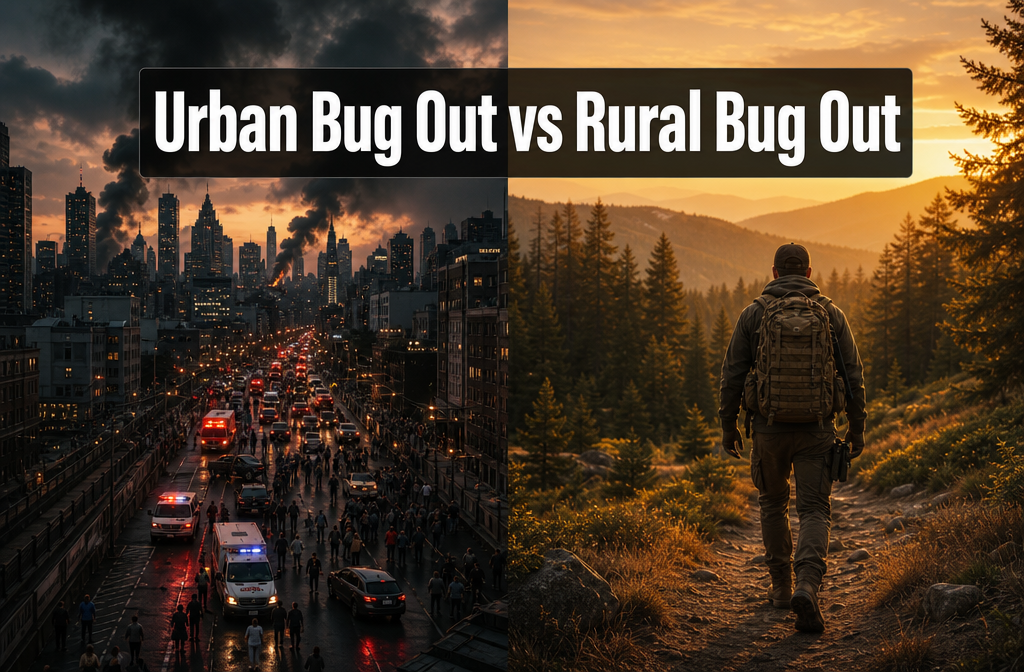
Urban Bug Out vs Rural Bug Out plans differ fundamentally in three areas: the threats you face, the gear you carry, and the skills you need to survive. City evacuations demand speed, crowd navigation, and minimal visible gear, while rural bug outs require self-sufficiency, wilderness skills, and heavier supply loads. Knowing which environment you’re bugging out from and into determines every decision in your plan.
Find this useful? Add us as a preferred source on Google and more of what we publish will show up in your results.
Key Takeaways
- Urban bug outs prioritize speed, stealth, and navigating crowds, traffic, and infrastructure collapse in a dense environment.
- Rural bug outs demand greater self-sufficiency, wilderness skills, and the ability to source food and water from the land.
- Gear loadouts differ significantly: urban kits favor compact, low-profile tools; rural kits include heavier, multi-day wilderness equipment.
- Population density is the single biggest variable that changes your evacuation strategy, threat profile, and resource availability.
- Families face unique challenges in both environments, but rural bug out locations generally offer more long-term safety and resource stability.
- Budget differences are real: a functional urban bug out bag can be assembled for $75–$150; a rural kit optimized for extended wilderness survival typically runs $200–$400+.
- The biggest urban bug out mistake is assuming roads will be passable. The biggest rural mistake is underestimating how fast wilderness conditions can turn dangerous.
- Communication tools differ sharply: urban preppers rely on redundant digital and radio systems; rural preppers must plan for zero cell coverage from day one.
- Both environments carry specific health risks that require tailored first aid and sanitation planning.
- No single plan works for everyone. Your location, family size, physical fitness, and threat scenario all shape the right approach.
What Exactly Is a Bug Out Plan and Why Do You Need One?
A bug out plan is a pre-documented strategy for leaving your home quickly when staying becomes more dangerous than going. It covers where you’re going, how you’ll get there, what you’ll carry, and how your household will communicate and reunite if separated.
Most people assume emergencies give adequate warning. They don’t. Wildfires can cut off exit routes in under an hour. Civil unrest can make a neighborhood impassable overnight. A grid-down scenario can turn a functioning city into a resource battleground within 72 hours. A bug out plan exists so that when the moment arrives, your family executes a practiced system rather than making panicked decisions under pressure.
The core components of any solid bug out plan include:
- A primary and at least two alternate evacuation routes
- A designated bug out location (BOL) — not just “the woods” or “grandma’s house,” but a specific, pre-stocked destination
- A communication protocol for when phones fail
- A bug out bag (BOB) tailored to your environment and threat profile
- Roles and responsibilities for every household member
For a deeper foundation, the Ultimate Guide to Create a Bug Out Plan walks through each component in detail.
How Are Urban and Rural Bug Out Strategies Different?
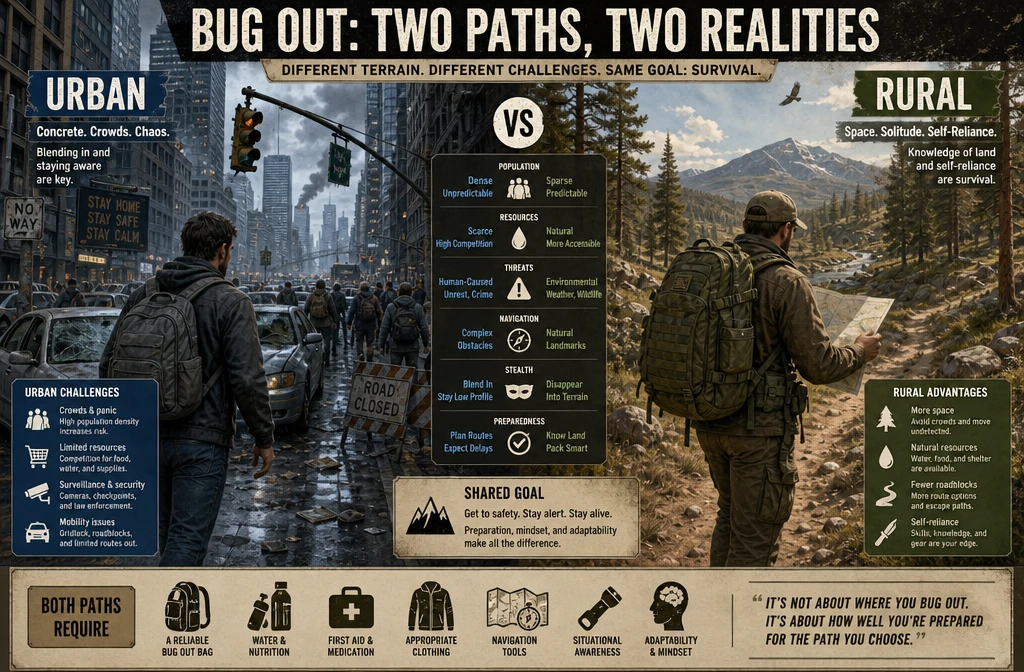
The core urban bug out vs rural bug out differences come down to density, distance, and dependency. Urban evacuees must move through or around millions of other people, compromised infrastructure, and limited natural resources. Rural evacuees face isolation, longer distances to safety, and a heavier reliance on self-sufficiency skills.
Here’s a direct comparison:
| Factor | Urban Bug Out | Rural Bug Out |
|---|---|---|
| Primary threat | Crowds, civil unrest, infrastructure failure | Terrain, weather, isolation, distance |
| Gear profile | Compact, low-profile, multi-tool focused | Heavier, wilderness-capable, multi-day |
| Water sourcing | Stored supply, urban taps (if available) | Natural sources requiring filtration |
| Food strategy | Pre-packed calories, calorie-dense bars | Foraging, hunting, extended rations |
| Navigation | Street maps, landmarks, memorized routes | Topo maps, compass, terrain reading |
| Vehicle priority | Fuel-efficient, maneuverable in traffic | High-clearance, off-road capable |
| Key skill | Situational awareness, crowd management | Fire-making, shelter-building, land nav |
| Biggest risk | Getting trapped or targeted in a crowd | Getting lost, injured, or exposed to elements |
The underlying principle is the same in both cases: get out early, move with purpose, and reach a pre-planned destination. But the execution looks completely different depending on where you start.
What Survival Gear Do You Need for Urban vs Rural Evacuation?
Gear selection is one of the most visible urban bug out vs rural bug out differences, and getting it wrong can cost you mobility, safety, or your life.
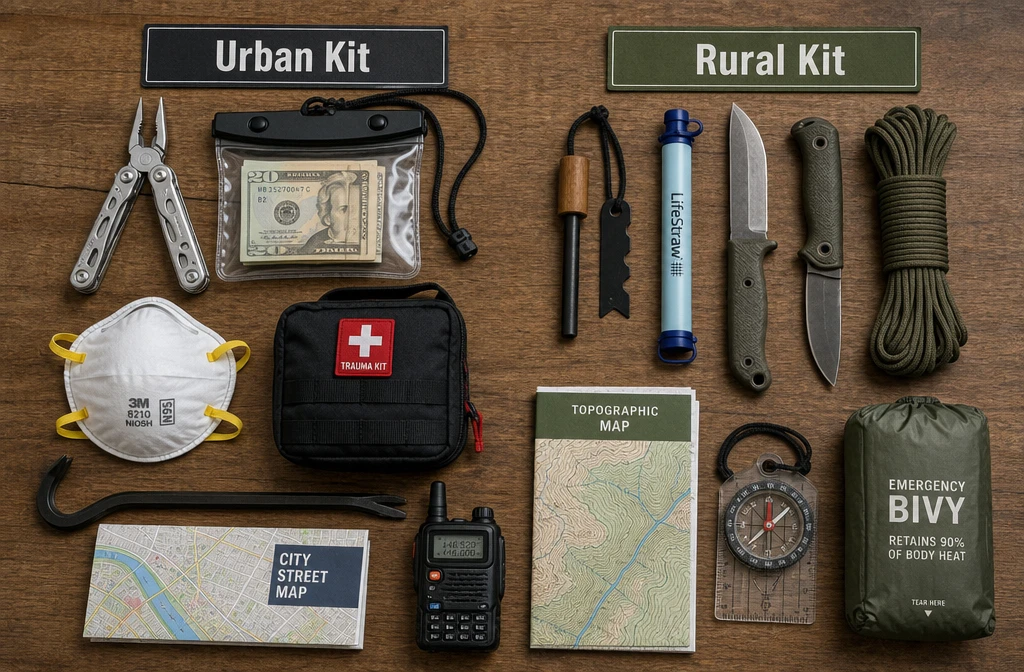
Urban Bug Out Bag Essentials:
- Compact, civilian-looking backpack (30–40L, no military aesthetics)
- Cash in small bills (ATMs fail; card readers fail)
- Printed city maps and route cards
- N95 or P100 respirator mask (smoke, tear gas, dust)
- Compact trauma kit with tourniquet and pressure bandage
- Multi-tool or folding knife
- Portable GMRS/FRS radio
- 2-liter water supply plus purification tablets
- 3-day calorie supply (bars, pouches, no-cook options)
- Phone battery bank and charging cables
- Pry bar or glass breaker for vehicle/building entrapment
Rural Bug Out Bag Essentials:
- Larger capacity pack (50–65L) with frame support
- Fixed-blade survival knife
- Fire-starting kit (ferro rod, lighter, tinder)
- Water filter (Sawyer Squeeze or similar) plus 3-liter capacity
- Topographic maps and baseplate compass
- Emergency bivy or lightweight shelter system
- Extended food supply (5–7 days minimum, calorie-dense)
- First aid kit with wilderness medicine additions (SAM splint, wound closure strips)
- Paracord (50+ feet)
- Signaling tools (whistle, signal mirror)
- Headlamp with extra batteries
For a full breakdown of what goes into a well-built kit, the Complete Bug Out Bag Guide: Build a Perfect 72-Hour Kit for Under $200 covers gear selection, weight management, and budget options in depth.
Decision rule: If your bug out route passes through more than 10 miles of urban terrain before reaching open land, prioritize the urban kit profile. If you’ll be in wilderness within the first hour of leaving home, build toward the rural loadout from the start.
Which Bug Out Location Is Safer for Families?
For most families, a rural bug out location offers greater long-term safety, but the journey to get there introduces its own serious risks. The safest choice depends on how far away that location is, how well it’s stocked, and whether the family can realistically reach it under emergency conditions.
Rural BOL advantages for families:
- Lower population density means less competition for resources and reduced conflict risk
- Access to natural water sources, firewood, and potentially arable land
- Greater privacy and defensibility with proper setup
- Less exposure to urban-specific threats like looting, riots, or infrastructure collapse
Urban shelter-in-place or staged evacuation considerations:
- Families with young children, elderly members, or medical needs may not be able to execute a multi-day rural trek
- Urban areas retain emergency services longer in most scenarios
- Staged evacuation (moving to a suburban or peri-urban location first) can reduce risk for vulnerable family members
The most practical approach for families is a tiered bug out location system:
- Tier 1: A trusted neighbor or family member within 10 miles (short-term, low-effort)
- Tier 2: A suburban or small-town location 30–60 miles out with pre-positioned supplies
- Tier 3: A rural property or wilderness-capable location 100+ miles from the primary threat zone
For families planning together, Disaster Preparedness for Families: 12 Strategies Every Prepper Must Know offers a structured framework that accounts for age-specific needs, communication, and role assignments.
How Much Does It Cost to Prepare a Bug Out Bag for City vs Countryside?
Budget is a real constraint for most preppers, and the urban bug out vs rural bug out differences extend to cost. Urban kits can be built more affordably because they rely less on specialized wilderness gear.
Estimated budget ranges (2026):
| Kit Type | Entry-Level | Mid-Range | Well-Equipped |
|---|---|---|---|
| Urban Bug Out Bag | $75–$120 | $150–$250 | $300–$500+ |
| Rural Bug Out Bag | $150–$200 | $250–$400 | $500–$900+ |
Where the cost difference comes from:
- Quality water filtration systems ($25–$80) are essential for rural kits but optional for urban ones
- Wilderness shelter (bivy, tarp, or tent) adds $30–$150 to rural kits
- Navigation tools (topo maps, quality compass) add $20–$60
- Extended food supply for 5–7 days costs more than a 72-hour urban kit
- Rural kits often require sturdier, heavier-duty gear that costs more per item
The good news: both kit types can be built incrementally. Start with the critical 10 items, then add over time. Avoid the trap of buying cheap gear that fails when it matters most, especially for items like tourniquets, water filters, and fire-starting tools.
What Are the Biggest Mistakes People Make When Planning an Urban Bug Out?
The most common urban bug out mistakes stem from overconfidence in infrastructure and underestimating crowd behavior. Urban preppers tend to assume roads will be drivable, cell phones will work, and stores will have supplies. None of those assumptions hold in a serious emergency.
Top urban bug out planning mistakes:
- Relying on a single exit route. In a real emergency, your primary route will likely be gridlocked or blocked. Plan at least three routes, including foot-travel options.
- Carrying a tactical-looking bag in a crowd. A military-style pack in a panicked urban environment makes you a target. Go gray man: civilian clothes, nondescript bag.
- No cash on hand. Electronic payment systems fail during power outages. Keep $200–$500 in mixed small bills in your kit.
- Assuming you’ll drive out. Plan for the possibility that you’ll be on foot for part or all of your evacuation.
- No printed maps. GPS and cell service are among the first things to degrade in a major urban emergency.
- Ignoring air quality threats. Fires, chemical spills, and civil unrest can make urban air dangerous. A respirator mask is non-negotiable.
- No communication plan for family members at different locations. Schools, workplaces, and home may all be in different parts of the city.
For a deeper look at what goes wrong before the bag even gets packed, Bug Out Bag Mistakes to Avoid covers the most costly errors preppers make at every experience level.
Can You Survive in a City During an Emergency Without Special Training?
Yes, but survival in an urban emergency is significantly harder without prior preparation and at least basic training. Most urban emergencies don’t require wilderness survival skills — they require situational awareness, a practiced plan, and the ability to move quickly and calmly through a chaotic environment.
What you can do without special training:
- Follow a pre-planned route to a pre-designated location
- Use stored water and food for 72 hours
- Communicate with family using a pre-agreed protocol
- Apply basic first aid with a stocked kit and printed instructions
- Navigate using printed maps
What becomes much harder without training:
- Assessing threat levels and making fast decisions under stress
- Treating serious injuries (tourniquet application, wound packing)
- Maintaining calm and leadership in a household with children or elderly members
- Identifying when to shelter in place vs when to move
The practical answer: even two to four hours of preparation — building a kit, walking your routes, and running a family drill — dramatically improves your odds. Training matters, but a practiced plan matters more than raw skill for most urban scenarios.
For urban-specific guidance, the Ultimate Urban Survival Guide for Preppers covers the full spectrum from threat assessment to movement tactics in a city environment.
What Skills Do You Need for Rural Bug Out That Are Different from Urban?
Rural bug out survival requires a distinct skill set that most urban preppers haven’t practiced. Where urban survival is largely about navigation, speed, and social awareness, rural survival depends on your ability to interact with the natural environment directly.
Skills critical for rural bug out that urban plans don’t require:
- Fire-making: Starting and maintaining a fire in wet or windy conditions is a foundational rural skill. It provides warmth, water purification, cooking, and signaling.
- Shelter construction: Knowing how to build a debris hut, lean-to, or use a tarp effectively can be the difference between hypothermia and a survivable night outdoors.
- Water sourcing and purification: Natural water sources require filtration and often chemical treatment. Knowing how to find them — streams, springs, dew collection — is essential.
- Land navigation: Reading a topographic map and using a compass without GPS is non-negotiable in wilderness terrain.
- Plant identification: Basic knowledge of edible and medicinal plants in your region adds a meaningful food and medicine layer to extended rural survival.
- Animal tracking and trapping: For scenarios lasting beyond 72 hours, protein sourcing from the land becomes a real priority.
- Wound care in the field: Without access to emergency services, knowing how to manage infections, fractures, and lacerations is critical.
The 25 Most Critical Wilderness Survival Skills — Ranked by Life-Saving Priority is a practical starting point for anyone building a rural survival skill base.
Common mistake: Rural preppers often over-invest in gear and under-invest in skills. A $400 knife won’t help if you don’t know how to build a fire in the rain. Prioritize training over equipment.
How Do Population Density and Resources Change Your Evacuation Strategy?
Population density is the single most important variable in shaping your evacuation strategy. High-density urban environments create competition for every resource — roads, water, food, medical care, and shelter — within hours of a major event. Low-density rural environments offer more resource availability but less access to emergency services and supply chains.
High-density urban environment implications:
- Roads become impassable within 2–4 hours of a major evacuation trigger (based on observed behavior during Hurricane Katrina and California wildfire evacuations)
- Stores are emptied within 24–48 hours
- Water pressure drops as municipal systems are overwhelmed
- Conflict over resources escalates quickly in prolonged scenarios
- The first 30–60 minutes after a trigger event are the most valuable for movement
Low-density rural environment implications:
- Natural resources (water, firewood, wild food) are more accessible
- Emergency services may be hours away, making self-sufficiency non-negotiable
- Neighbors are fewer but often more cooperative in rural communities
- Supply resupply is harder; what you carry is what you have
The strategic implication: If you live in a high-density area, your evacuation window is measured in minutes to hours, not days. Every hour you delay in an urban evacuation reduces your odds of a clean exit. Rural evacuees have more time but must be more self-sufficient once they move.
What Vehicles Work Best for Urban Bug Out vs Rural Bug Out Scenarios?
Vehicle choice is one of the clearest urban bug out vs rural bug out differences, and the wrong vehicle for your environment can strand you at the worst possible moment.
Urban bug out vehicle priorities:
- Fuel efficiency: You may be stuck in traffic for hours. A vehicle that gets 30+ MPG gives you more range on a tank.
- Maneuverability: Compact cars and mid-size SUVs can navigate blocked streets and turn around in tight spaces more easily than trucks.
- Reliability: An older, mechanically simple vehicle is less dependent on electronics that can fail in an EMP or grid-down scenario.
- Pre-positioned fuel: Keep your tank above half at all times. Carry a 2–5 gallon approved fuel container.
Rural bug out vehicle priorities:
- Ground clearance: Dirt roads, washed-out paths, and off-road terrain require at least 8 inches of clearance.
- 4WD or AWD capability: Essential for mud, snow, and loose terrain.
- Cargo capacity: You’re carrying more gear, potentially for multiple people.
- Mechanical simplicity: Pre-1990s trucks and SUVs are easier to repair in the field without specialized tools.
The honest middle ground: A mid-size 4WD pickup truck or body-on-frame SUV (think Toyota 4Runner, Ford F-150, or Chevy Silverado) handles both environments reasonably well. It’s not perfect for dense city traffic, but it’s far more capable than a sedan when roads deteriorate.
Are There Specific Health Risks in Urban vs Rural Bug Out Situations?
Both environments carry serious health risks, but they’re different enough to require tailored preparation. Urban health risks are largely human-made; rural risks are primarily environmental.
Urban-specific health risks:
- Air quality: Smoke, chemical spills, tear gas, and structural dust create serious respiratory hazards. N95 or P100 masks are essential.
- Contaminated water: Municipal water systems can fail or become contaminated quickly. Never assume tap water is safe after a major event.
- Crowd-related injuries: Trampling, violence, and vehicle accidents are elevated risks in mass evacuation scenarios.
- Disease transmission: High population density accelerates the spread of communicable illness, especially in shelters.
- Stress and psychological impact: Decision fatigue, panic, and acute stress reactions affect judgment and physical health.
Rural-specific health risks:
- Hypothermia and heat illness: Exposure to weather without adequate shelter is a leading cause of wilderness fatality.
- Waterborne illness: Natural water sources carry Giardia, Cryptosporidium, and bacteria. Always filter and treat before drinking.
- Wound infection: Minor cuts and blisters become serious in the field without proper wound care.
- Dehydration: Physical exertion in wilderness terrain increases water requirements significantly.
- Wildlife encounters: Depending on your region, snakes, insects, and larger predators add a layer of risk.
Water safety deserves special attention in both environments. The Ultimate Emergency Water Storage and Purification Guide covers purification methods, storage quantities, and common mistakes that apply to both urban and rural scenarios.
How Do Communication and Technology Differ Between Urban and Rural Bug Out Plans?
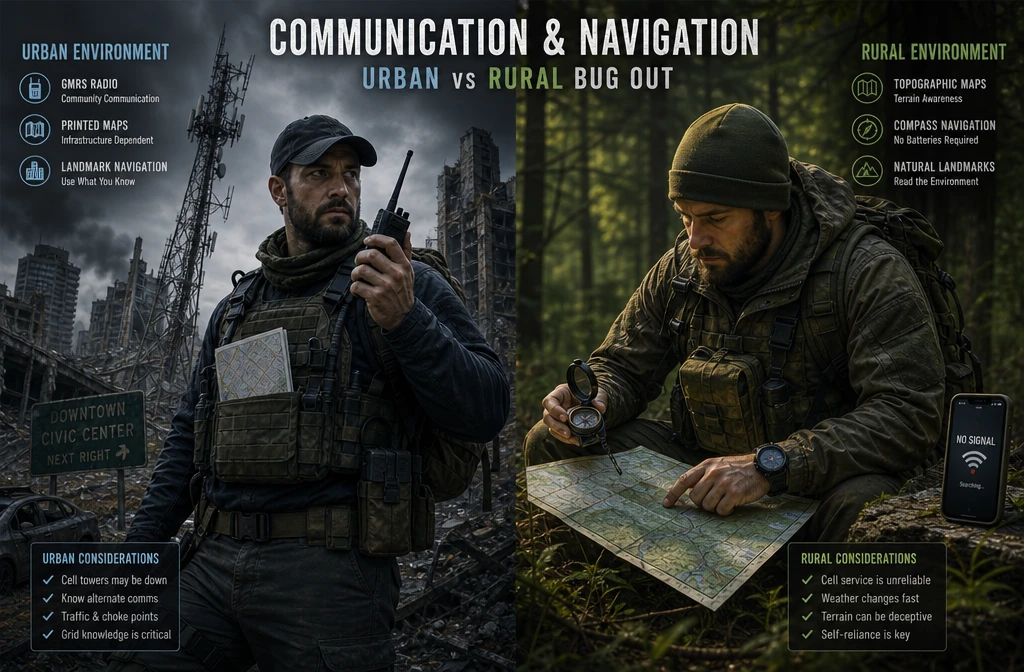
Communication planning is one of the most overlooked urban bug out vs rural bug out differences, and it’s one of the most consequential. Urban preppers often assume cell networks will stay functional. Rural preppers must assume from the start that they won’t have cell coverage at all.
Urban communication realities:
- Cell networks become overloaded within minutes of a major event (observed in 9/11, Hurricane Sandy, and multiple California wildfires)
- Text messages often get through when voice calls fail — build your family plan around texts first
- Wi-Fi calling can work when cellular voice fails, if internet infrastructure holds
- GMRS/FRS radios provide reliable short-range (1–5 mile) communication independent of infrastructure
- A pre-agreed physical meeting point is more reliable than any digital communication
Rural communication realities:
- Cell coverage may not exist at your bug out location under normal conditions
- GMRS radios with a repeater network are the most practical solution for group communication
- Satellite communicators (Garmin inReach, SPOT) provide two-way messaging and SOS capability without cell coverage — worth the investment for serious rural preppers
- Ham radio (requires licensing) provides the broadest communication range and is the gold standard for off-grid communication
- Signal mirrors and whistles remain valid emergency signaling tools in wilderness terrain
Technology dependency risk: Both urban and rural preppers should plan for a scenario where all electronic communication fails. A printed communication plan, pre-agreed meeting points, and non-electronic navigation tools are the backstop for every digital system.
For a complete communication framework, the Emergency Communication Plan: The Complete Prepper’s Guide covers redundancy planning, family protocols, and radio options in detail.
Frequently Asked Questions
Q: Do I need a different bug out bag for urban and rural scenarios? Ideally, yes. Urban kits should be compact, low-profile, and focused on 72-hour survival in a human-dense environment. Rural kits need greater capacity, wilderness gear, and extended food and water capability. If you can only have one bag, build toward the rural kit and add urban-specific items (cash, mask, city maps) as a dedicated pouch.
Q: What’s the most important skill for urban bug out survival? Situational awareness. Knowing when to move, when to stop, which routes are safe, and how to read crowd behavior keeps you out of danger more reliably than any piece of gear.
Q: How far should my rural bug out location be from my home? Between 50 and 150 miles is the practical sweet spot for most preppers. Close enough to reach in a single tank of gas, far enough to be outside the primary impact zone of most regional disasters. Anything under 25 miles may still be affected by the same event you’re fleeing.
Q: Can apartment dwellers execute a rural bug out effectively? Yes, but it requires more pre-planning. Apartment preppers typically have less storage space and no vehicle garage, so gear must be pre-positioned efficiently. The Ultimate Guide to Prepping in a Small Apartment covers how to build a capable kit in a space-constrained environment.
Q: Is bugging out always better than sheltering in place? No. For many scenarios — short-term power outages, localized civil unrest, severe weather — sheltering in place is the safer choice. Bug out when staying becomes more dangerous than going. The decision should be pre-made based on specific trigger conditions, not made in the moment under stress.
Q: How do I practice my bug out plan without actually leaving home? Run tabletop drills: sit down with your household and walk through the scenario verbally. Then do a timed gear-up drill. Then walk or drive your primary route. Each step builds muscle memory and reveals gaps in your plan before they matter.
Q: What’s the biggest gear mistake rural preppers make? Carrying too much weight. A 60-pound pack sounds prepared until you’re three miles into rough terrain and your knees are failing. Ruthlessly prioritize: water filtration, fire-starting, shelter, and navigation are non-negotiable. Everything else is secondary.
Q: Do children change the urban vs rural bug out calculation significantly? Yes. Children slow movement, require more food and water per pound of body weight, and have specific medical and emotional needs. Families with young children should generally favor shorter, more direct evacuation routes and staged bug out locations rather than attempting long wilderness treks. The Family Bug Out Bag: The Complete Age-Specific Guide addresses gear and planning for every age group.
Q: How does an EMP or grid-down scenario change urban vs rural bug out planning? Dramatically. An EMP disables modern vehicles, cell networks, and most electronic gear simultaneously. Urban environments become extremely dangerous very quickly as infrastructure collapses. Rural locations with pre-positioned supplies, non-electronic tools, and manual water sources become significantly more valuable. Pre-1990s vehicles with minimal electronics become strategic assets.
Q: Should I tell people about my bug out plan? Selectively. Your immediate household needs to know every detail. Trusted neighbors or family members who are part of your plan should know their role. Beyond that, operational security matters — advertising your supplies and routes creates risk.
Conclusion: Build the Plan That Fits Your Reality
The urban bug out vs rural bug out differences aren’t just academic distinctions — they’re the difference between a plan that works and one that falls apart in the first hour. Where you live, where you’re going, who’s coming with you, and what threats you’re most likely to face should drive every decision from gear selection to route planning to skill development.
Actionable next steps:
- Identify your starting environment. Are you primarily an urban, suburban, or rural prepper? Your current location shapes your immediate threat profile.
- Define your bug out destination. A vague plan to “head to the mountains” isn’t a plan. Pick a specific location, pre-stock it if possible, and know three ways to get there.
- Build or audit your bug out bag. Match the kit profile to your environment. Use the 72 Hour Bug Out Bag Checklist as a baseline, then customize for your scenario.
- Identify your skill gaps. Urban preppers should train situational awareness and basic trauma care. Rural preppers should practice fire-making, land navigation, and water sourcing.
- Run a family drill. Walk your primary route. Time your gear-up. Find the gaps before they find you.
- Build your communication plan. Assign meeting points, radio frequencies, and check-in schedules. Write it down and give every household member a copy.
Preparedness isn’t about predicting exactly what will happen. It’s about building the confidence and capability to handle whatever does. Whether you’re bugging out through a gridlocked city or into deep wilderness, the work you do now determines the outcome when it counts.
Products, Tools, and Resources Worth Having
These aren’t paid endorsements — they’re the categories of gear that consistently prove their value across both urban and rural bug out scenarios:
- Sawyer Squeeze or Sawyer Mini water filter — Lightweight, reliable, and works for both urban contamination scenarios and rural natural water sources. One of the highest-value items per dollar in any bug out kit.
- Baofeng UV-5R or GMRS radio (Midland GXT1000) — The UV-5R is the entry-level ham radio choice; the Midland is the plug-and-play GMRS option for families. Both provide communication when cell networks fail.
- Garmin inReach Mini 2 — For rural preppers specifically, satellite two-way messaging and SOS capability is worth the subscription cost. It works anywhere on Earth.
- Printed topographic maps — Free from USGS for any US location. Print, laminate, and store in your bag. They never need batteries.
- Quality fixed-blade knife (Mora Companion or similar) — Reliable, affordable, and essential for rural survival tasks. Skip the $200 tactical knives until the basics are covered.
- Trauma kit with tourniquet (CAT or SOFTT-W) — Both urban and rural scenarios can produce serious bleeding injuries. A tourniquet and the training to use it is the single most life-saving addition to any kit.
- Pre-positioned cash — $200–$500 in mixed small bills, stored in a waterproof pouch in your bag. Electronic payment systems are among the first things to fail in a major emergency.
For a comprehensive look at what gear actually matters and in what priority order, the Essential Survival Gear Guide: 50 Items Ranked by Priority is the most practical reference available for both urban and rural preppers.
References
- Federal Emergency Management Agency (FEMA). Are You Ready? An In-depth Guide to Citizen Preparedness. FEMA, 2004. https://www.ready.gov/
- Ripley, Amanda. The Unthinkable: Who Survives When Disaster Strikes — and Why. Crown Publishers, 2008.
- Centers for Disease Control and Prevention (CDC). Emergency Preparedness and Response. CDC, 2023. https://emergency.cdc.gov/
- U.S. Geological Survey (USGS). National Map: Topographic Maps. USGS, 2024. https://www.usgs.gov/programs/national-geospatial-program/topographic-maps
- American Red Cross. Disaster Preparedness for Families. American Red Cross, 2022. https://www.redcross.org/get-help/how-to-prepare-for-emergencies/survival-kit-supplies.html