

Hey there! Some links on this page may be affiliate links which means that, if you choose to make a purchase, I may earn a commission at no extra cost to you. I greatly appreciate your support. Read the full disclosure here.
Most American households have less than a week’s worth of food on hand at any given time, according to FEMA preparedness research. That single fact should give every serious prepper pause. How to build a 3-month emergency food supply for $100 sounds ambitious, but it’s genuinely achievable with the right strategy, a disciplined shopping list, and a clear understanding of what your household actually needs to survive.
This guide breaks down exactly how to do it, from calculating daily calorie needs to finding the cheapest bulk food sources, avoiding common storage mistakes, and building a system that holds up for years, not weeks.
Key Takeaways
- A 3-month emergency food supply for one adult is achievable on roughly $100 by focusing on high-calorie, long-shelf-life staples like rice, dried beans, oats, and canned goods.
- Adults typically need 1,800 to 2,500 calories per day; your supply must hit that target across 90 days, not just average it.
- Discount grocery chains, warehouse stores, and ethnic food markets consistently offer the lowest per-pound prices on bulk staples.
- Proper storage, cool, dark, dry, and sealed, can extend shelf life from months to decades on the right foods.
- Rotation is not optional. A food supply you never eat and never rotate becomes a liability, not an asset.
- Canned food and freeze-dried food serve different roles; for a $100 budget, canned goods and dry staples are the practical choice.
- Water storage is inseparable from food storage. Plan for at least one gallon per person per day.
- Dietary restrictions, family size, and cooking capability all change the math, account for them before you buy.
Can You Really Build a 3-Month Emergency Food Fupply For $100?
Yes, for a single adult, a 3-month emergency food supply on $100 is achievable, but it requires strict focus on the most calorie-dense, shelf-stable, and affordable staples available. It won’t be gourmet. It won’t cover every nutritional base perfectly. But it will keep a person fed and functional for 90 days.
The math works like this: at roughly $1.10 per day in food costs, you’re targeting foods that deliver maximum calories per dollar. White rice, dried beans, rolled oats, salt, cooking oil, and canned vegetables are the workhorses of any budget-conscious emergency pantry. Bought in bulk, these foods can cost as little as $0.10 to $0.30 per serving.
For larger households, scale the budget accordingly. A family of four would need approximately $400 to replicate the same supply. The strategy stays identical, only the quantities change.
“Being prepared isn’t about fear, it’s about confidence, independence, and protecting the people you love when the unexpected happens.”, Preppers HQ
For a deeper breakdown of what a full 90-day supply looks like across different household sizes, see the 3-Month Emergency Food Supply: Complete Prepper’s Guide.
How Many Calories Do You Need Per Day in an Emergency Food Supply?
The standard planning target is 2,000 calories per day per adult. In practice, the range is 1,800 to 2,500 calories depending on body size, activity level, and stress load, all of which tend to increase during an actual emergency.
Children need fewer calories (roughly 1,200 to 1,800 depending on age), while adults doing physical labor or managing high stress may need closer to 2,500. Plan conservatively: it’s far better to have a surplus than to ration from a deficit.
A simple daily calorie baseline for planning purposes:
| Person Type | Daily Calories |
|---|---|
| Adult (sedentary) | 1,800 |
| Adult (active) | 2,200-2,500 |
| Child (6-12 years) | 1,200-1,600 |
| Senior adult | 1,600-1,800 |
To calculate your 3-month supply, multiply your household’s total daily calories by 90. A single active adult needs approximately 198,000 calories over 90 days. White rice delivers roughly 1,700 calories per pound; dried beans deliver about 1,600 calories per pound. These two foods alone can cover the majority of your caloric needs at very low cost.
What Foods Have the Longest Shelf Life for Emergency Storage

The foods with the longest shelf lives, often 25 to 30 years when stored properly, are white rice, dried beans, lentils, rolled oats, wheat berries, salt, honey, and white sugar. These are the foundation of any serious long-term food supply.
Top long-shelf-life staples for a $100 budget:
- White rice (25-30 years sealed), cheapest calorie source available
- Dried beans and lentils (25-30 years sealed), protein and fiber
- Rolled oats (up to 30 years in sealed containers), versatile and calorie-dense
- Salt (indefinite shelf life), essential for flavor and preservation
- Honey (indefinite shelf life), natural sweetener and antimicrobial properties
- White sugar (indefinite shelf life), caloric density and preservative
- Canned vegetables and fruits (3-5 years, often longer), vitamins and variety
- Cooking oil (1-4 years), critical for calorie density; rotate regularly
- Powdered milk (2-10 years sealed), calcium and protein source
- Pasta (up to 30 years sealed), affordable and filling
Brown rice, whole wheat flour, and nuts have shorter shelf lives due to their oil content and should be rotated more frequently or stored in the freezer.
Cheapest Places to Buy Bulk Emergency Food Supplies
Discount grocery chains, warehouse clubs, and ethnic food markets are consistently the lowest-cost sources for bulk emergency staples. Online bulk retailers can also compete on price, especially for items like Mylar bags, oxygen absorbers, and specialty grains.
Best sources ranked by value:
- Ethnic grocery stores (Asian, Latin, Middle Eastern markets), often the cheapest source for large bags of rice, dried beans, and lentils
- Warehouse clubs (Costco, Sam’s Club), excellent for cooking oil, canned goods, oats, and sugar in bulk
- Discount grocery chains (Aldi, Winco, Grocery Outlet), competitive pricing on canned goods and dry staples
- Dollar stores, useful for canned vegetables, salt, and small pantry items
- Online bulk retailers (Azure Standard, Honeyville, Augason Farms), best for specialty items and repackaged long-term storage foods
Avoid buying emergency food from specialty “prepper supply” companies when you’re on a tight budget. Their products are often 3 to 5 times more expensive than the same calories purchased as raw bulk staples.
What’s the Difference Between Emergency Food Kits and Regular Bulk Buying?
Emergency food kits are pre-packaged, pre-portioned, and marketed for convenience. Regular bulk buying means purchasing raw staples and packaging them yourself. For a $100 budget, bulk buying delivers far more calories per dollar, often 3 to 5 times more.
Pre-packaged kits from brands like Mountain House or Wise Company can cost $5 to $10 per serving. A pound of white rice bought in bulk costs roughly $0.50 to $0.80 and delivers 10 to 12 servings. The math isn’t close.
Choose emergency food kits if: you want zero preparation effort, you’re supplementing an existing supply, or you need lightweight options for a bug-out bag. See the Ultimate Bug Out Bag Food List for more on that application.
Choose bulk buying if: you’re building a home-based supply, you’re budget-constrained, and you’re willing to spend a few hours on repackaging and organization.
For a comparison of freeze-dried options, the Ultimate Prepper’s Guide to Freeze-Dried Food covers the full cost-versus-shelf-life tradeoff.
A Practical $100 Shopping List to Build a 3-Month Emergency Food Supply on $100
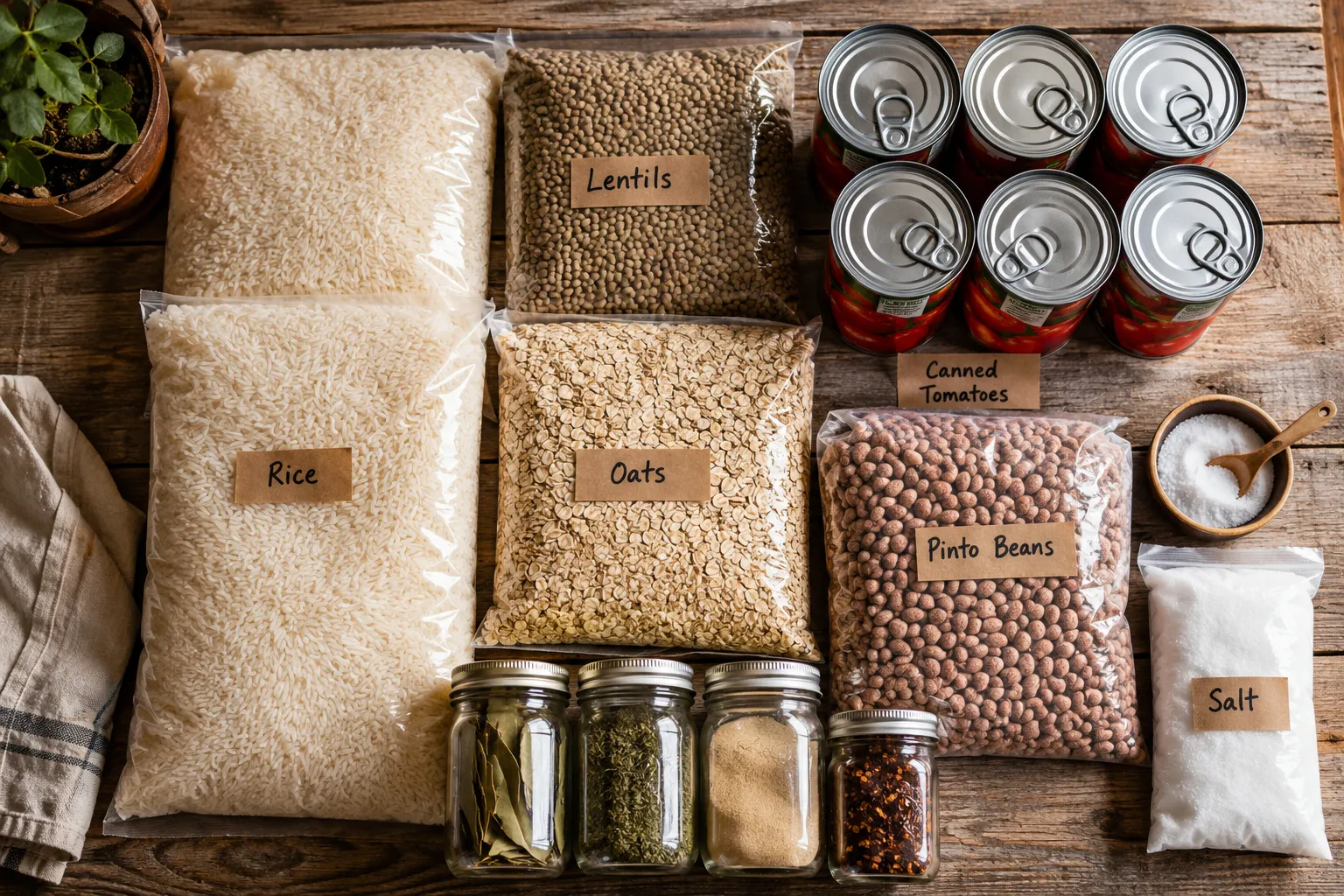
This list is designed for one adult over 90 days, targeting approximately 2,000 calories per day. Prices are estimates based on 2026 discount grocery and bulk store averages.
Core staples (estimated cost: ~$85):
- 40 lbs white rice, ~$20
- 20 lbs dried pinto or black beans, ~$16
- 10 lbs rolled oats, ~$8
- 10 lbs pasta, ~$8
- 1 gallon cooking oil, ~$8
- 5 lbs salt, ~$3
- 5 lbs sugar, ~$4
- 5 lbs powdered milk, ~$12
- 24 cans mixed vegetables, ~$18 (at roughly $0.75/can)
Supplemental items (estimated cost: ~$15):
- Multivitamins (90-day supply), ~$8
- Bouillon cubes or powder, ~$3
- Hot sauce or spice packets, ~$4
This comes in just under $100 and delivers roughly 180,000 to 200,000 calories, enough to sustain one adult at a modest 2,000 calories per day for 90 days. For meal ideas using these exact staples, explore 25 Easy Emergency Meals Using Only Canned Foods.
Best Non-Perishable Foods That Don’t Require Cooking
Several emergency staples can be eaten without any heat or cooking, which matters when power is out or fuel is limited. Rolled oats can be soaked in cold water. Canned beans are pre-cooked and edible straight from the can. Crackers, peanut butter, canned fish, and dried fruit require zero preparation.
Top no-cook emergency foods:
- Rolled oats (cold-soak method)
- Canned beans, vegetables, and fruit
- Canned tuna, salmon, or chicken
- Peanut butter or nut butters
- Crackers and hardtack
- Dried fruit and nuts
- Granola bars and energy bars
- Honey
For a full guide to no-preparation meal planning, see Best No-Cook Survival Meals for Emergency and Bug-Out Kits.
How Do You Store Emergency Food to Keep It Fresh
Proper storage dramatically extends shelf life. The four enemies of food storage are heat, light, moisture, and oxygen. Control all four and most dry staples will last decades.
Storage best practices:
- Store in a cool, dark location, ideally below 70°F (21°C). Every 10°F drop roughly doubles shelf life.
- Use food-grade containers: Mylar bags with oxygen absorbers inside 5-gallon buckets are the gold standard for dry staples.
- Seal opened packages immediately in airtight containers.
- Keep food off the floor and away from exterior walls to prevent moisture transfer.
- Label everything with the purchase date and expected use-by date.
Do you need special containers? For short-term storage (1-3 years), food-grade plastic buckets with gamma-seal lids work well. For long-term storage (5-30 years), Mylar bags with 300cc oxygen absorbers sealed inside hard-sided buckets are the most reliable option. Mason jars work well for smaller quantities and allow easy visual inspection.
Avoid storing food in cardboard boxes, thin plastic bags, or areas with temperature swings (like garages in climates with hot summers). For more on common pitfalls, read 15 Food Storage Mistakes to Avoid.
Do Emergency Food Supplies Actually Expire and How Do You Rotate Them
Yes, emergency food supplies expire, but “expiration” is more nuanced than the date on the package suggests. Most dry staples remain safe to eat well past their printed best-by dates when stored correctly. The date indicates peak quality, not safety cutoff.
Rotation is the practical solution. The FIFO method (First In, First Out) means you always use the oldest items first and replace them with fresh stock. This keeps your supply perpetually refreshed without waste.
A simple rotation schedule:
- Canned goods: use and replace every 2-3 years
- Cooking oil: use and replace every 1-2 years
- Dry staples in Mylar/oxygen-free storage: inspect every 5 years
- Powdered milk: use and replace every 2-5 years depending on storage conditions
Build rotation into your normal cooking. Use your emergency rice and beans in everyday meals, then replace what you consume. Your emergency supply stays fresh and you waste nothing.
Is Canned Food or Freeze-Dried Better for Emergency Storage
For a $100 budget, canned food wins on cost. Freeze-dried food wins on shelf life, weight, and nutritional retention, but at a price premium that makes it impractical as the primary option for budget preppers.
Canned food advantages: widely available, no special equipment needed, pre-cooked, affordable, 3-5 year shelf life (often longer in practice).
Freeze-dried advantages: 25-year shelf life, lightweight, retains nutrients well, tastes better than most canned alternatives.
The verdict for a $100 build: use canned goods and dry bulk staples as your foundation. If budget allows later, supplement with freeze-dried options for variety and extended shelf life. Don’t let the perfect be the enemy of the prepared.
How Much Water Do You Need to Store with Emergency Food
Store a minimum of one gallon of water per person per day for drinking and basic sanitation. For a 3-month supply, that’s 90 gallons per person, a significant storage challenge that most people underestimate.
Dry staples like rice, beans, and pasta require water to cook. Factor in an additional half-gallon per person per day for cooking if your supply relies heavily on these foods.
Realistically, most people can’t store 90 gallons at home. The practical approach is to store 2 weeks of water (14 gallons per person), then have a purification plan for the remaining 10 weeks. Water filtration, purification tablets, and rainwater collection systems all extend your water independence. The Ultimate Emergency Water Storage and Purification Guide covers every method in detail.
What Emergency Foods Should You Avoid with Dietary Restrictions
Dietary restrictions require deliberate planning. The default emergency food list, heavy in wheat, dairy, and legumes, creates real problems for people with celiac disease, lactose intolerance, bean allergies, or specific medical diets.
Common restriction adjustments:
- Gluten intolerance/celiac: Replace pasta and wheat crackers with white rice, corn tortillas, rice-based pasta, and certified gluten-free oats.
- Lactose intolerance: Skip powdered milk; substitute with shelf-stable non-dairy milk cartons or coconut milk powder.
- Bean/legume allergy: Increase rice, oats, canned meat, and nuts to compensate for lost protein.
- Diabetes: Reduce white rice and sugar; prioritize lower-glycemic options like lentils, oats, and canned vegetables.
- Sodium restrictions: Read canned good labels carefully; choose low-sodium or no-salt-added varieties.
Never build an emergency food supply and assume it works for everyone in the household. A supply that triggers an allergic reaction or worsens a medical condition is worse than no supply at all.
How to Calculate Whether Your Emergency Food Supply Will Last 3 Months

The calculation is straightforward. Multiply your household’s total daily calorie requirement by 90. Then add up the total calories in your stored supply and compare.
Step-by-step calculation:
- Determine daily calorie need per person (use 2,000 as a baseline).
- Multiply by number of people in the household.
- Multiply by 90 days.
- Calculate total calories in your stored food using package nutrition labels.
- Divide stored calories by daily household need to get days of supply.
Example for one adult:
2,000 calories/day x 1 person x 90 days = 180,000 calories needed.
40 lbs rice (68,000 cal) + 20 lbs beans (32,000 cal) + 10 lbs oats (17,000 cal) + 10 lbs pasta (16,000 cal) + cooking oil (30,000 cal) + canned goods and powdered milk (~20,000 cal) = approximately 183,000 calories. That clears the 90-day threshold.
Recalculate any time you add to or consume from your supply. A supply that looked sufficient on paper can fall short if you’ve been cooking from it without replacing what you’ve used.
Common Mistakes People Make Building Emergency Food Supplies
The most common mistake is building a supply that can’t actually be used, foods no one in the household will eat, items that require equipment you don’t have, or a supply that’s stored in conditions that degrade it within months.
Other frequent mistakes:
- Ignoring water: Food without water is useless. Many preppers stock months of food and days of water.
- Buying variety over calories: Spending $100 on 20 different specialty items instead of 5 high-calorie staples leaves you with a pretty pantry and an inadequate supply.
- Skipping vitamins: A diet of rice, beans, and canned goods will develop nutritional gaps over 90 days. A basic multivitamin costs almost nothing and fills critical gaps.
- No cooking plan: If your entire supply requires boiling water and you have no backup cooking method, a power outage breaks your whole system. See Emergency Cooking Without Power for solutions.
- Poor labeling: Unlabeled containers become a guessing game. Date and label everything.
- Storing in the wrong location: Garages, attics, and areas near hot water heaters dramatically shorten shelf life.
For a comprehensive list of what else might be missing from your preparedness setup, 15 Things Missing From Your Emergency Kit That Could Cost You Everything is worth reading alongside this guide.
Frequently Asked Questions
Is $100 really enough for a 3-month food supply?
For one adult, yes, if you focus exclusively on high-calorie bulk staples like white rice, dried beans, oats, and cooking oil. It won’t be varied or exciting, but it will sustain life for 90 days. For a family, multiply the budget by the number of adults and adjust for children.
What’s the single best food to buy first on a tight budget?
White rice. It’s the cheapest calorie source available, has a 25-plus year shelf life when properly sealed, and pairs with almost everything else in an emergency pantry.
Do I need oxygen absorbers for every food I store?
Oxygen absorbers are most critical for dry staples stored long-term (rice, beans, oats, pasta). Canned goods are already oxygen-free. Sugar and salt don’t require them. For anything you plan to store for more than 2 years, oxygen absorbers in Mylar bags are worth the small investment.
Can I build this supply gradually instead of all at once?
Absolutely. Buy an extra $10 to $20 of staples each week and you’ll have a solid 3-month supply within 6 to 10 weeks without straining your budget. Gradual building also lets you test what your household actually eats.
What if I live in an apartment with limited storage space?
Space constraints require creative solutions: under-bed storage, closet organization, and furniture that doubles as storage. See the Ultimate Guide to Apartment Food Storage for a full breakdown of small-space strategies.
How do I know if my stored food has gone bad?
Signs include off odors, unusual color changes, swollen or rusted cans, visible mold, and insect infestation. When in doubt, discard it. A swollen can in particular should never be opened, it’s a sign of bacterial contamination.
Does cooking skill matter for emergency food?
More than most people realize. A supply of raw rice and dried beans is useless without the knowledge and equipment to cook them. Practice making meals from your stored staples before an emergency. Knowing how to cook rice-and-bean dishes, oatmeal variations, and simple soups from canned goods is a genuine survival skill.
Should I tell people about my food supply?
This is a personal security decision. In a prolonged crisis, a visible, well-known food supply can attract unwanted attention. Discretion is a legitimate preparedness strategy.
What about pet food?
If you have pets, their food supply is part of your emergency planning. The Ultimate Pet’s Emergency Preparedness Checklist covers this in full.
How does this food supply connect to a broader preparedness plan?
Food is one layer of preparedness. Water, shelter, medical supplies, communication, and security all matter equally. The 4-Layer Disaster Plan provides a structured framework for building all of these systems together.
Conclusion
Building a 3-month emergency food supply on $100 is not a theoretical exercise. It’s a practical, achievable goal that requires discipline in what you buy, where you buy it, and how you store it. The strategy is simple: prioritize calories per dollar, focus on shelf-stable staples, store them properly, and rotate them consistently.
Start this week. Buy a 20-pound bag of white rice and a 10-pound bag of dried beans. That’s roughly $15 and represents the core of your first month’s supply. Add to it each week. Label everything. Calculate your calorie coverage. Fix the gaps.
The confidence that comes from knowing your household can eat for 90 days regardless of what happens outside, that’s not paranoia. That’s preparedness.
Recommended Resources and Tools
- 5-gallon food-grade buckets with gamma-seal lids, the most practical container for home food storage; available at hardware stores and online retailers
- Mylar bags (1-gallon and 5-gallon) with 300cc oxygen absorbers, essential for long-term dry storage; sold in bulk online
- A basic kitchen scale, helps you accurately calculate calories by weight when building your supply
- Complete Guide to Emergency Food Rationing and Cooking, covers how to stretch your supply and cook effectively during an emergency
- The Ultimate Survival Pantry List, a comprehensive reference for expanding beyond the basics once your 3-month foundation is in place
- A basic multivitamin (90-day supply), inexpensive insurance against nutritional gaps in a restricted emergency diet
- Permanent markers and adhesive labels, cheap, essential, and the difference between an organized supply and a chaotic on