
Hey there! Some links on this page may be affiliate links which means that, if you choose to make a purchase, I may earn a commission at no extra cost to you. I greatly appreciate your support. Read the full disclosure here.
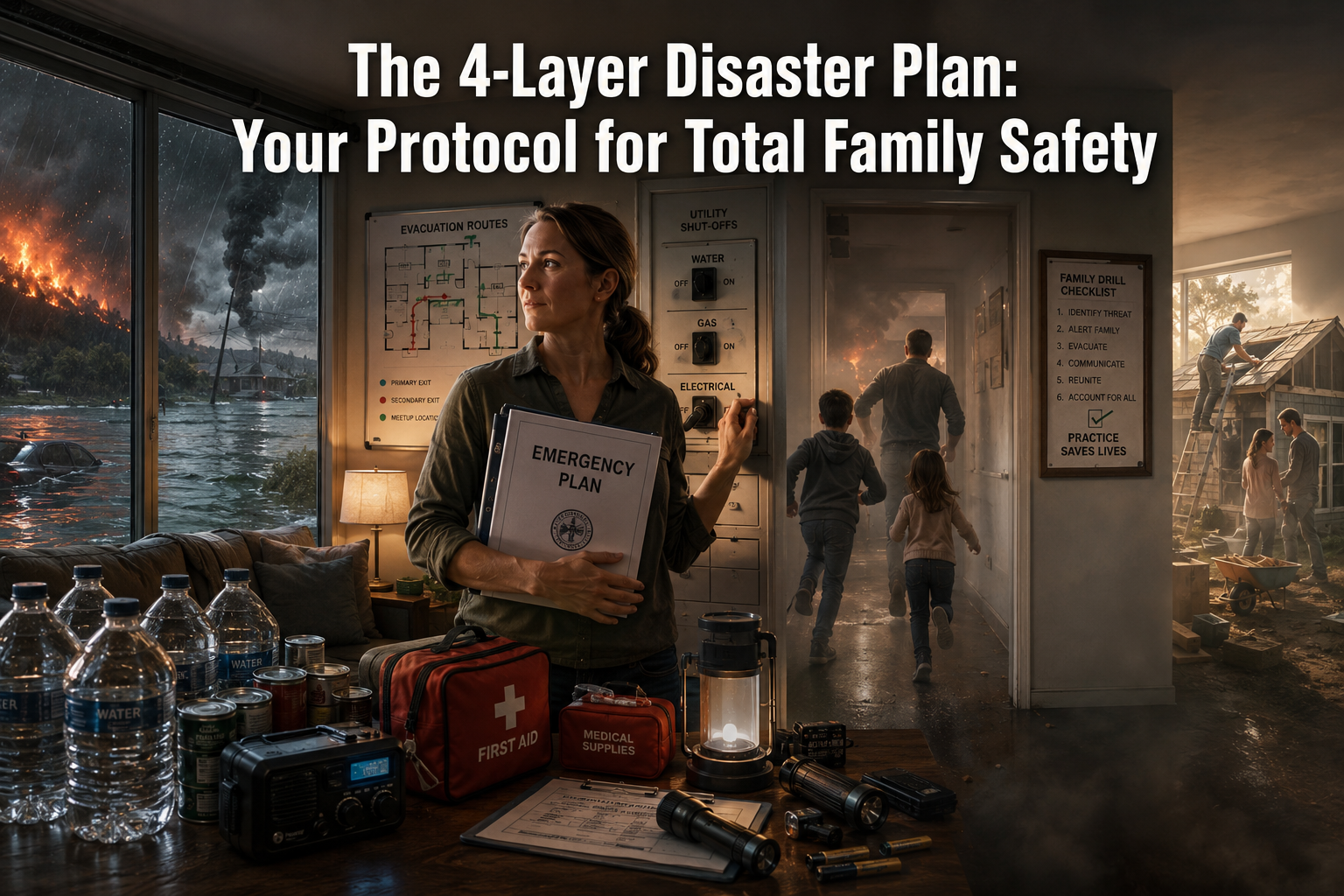
The 4-Layer Disaster Plan: FEMA-Based Protocol for Total Family Safety
4-Layer Disaster Plan starts with a simple truth: preparedness is not about panic — it’s about creating confidence before disaster strikes. Every time headlines warn of wildfires, hurricanes, floods, or widespread emergencies, families feel the same quiet anxiety creeping in: the fear of not being ready when everything changes in an instant. Most disaster preparedness advice only offers scattered shopping lists and survival gear checklists, but supplies alone cannot replace a real emergency strategy.
What families truly need is a complete system — a practical framework that transforms uncertainty into calm, deliberate action. That is exactly what the 4-Layer Disaster Plan was designed to provide.
Built from the proven guidance of organizations like Federal Emergency Management Agency (FEMA), the Environmental Protection Agency (EPA), and experienced first responders, this disaster preparedness system goes far beyond a basic emergency kit. Each layer strengthens the next, creating a comprehensive shield of readiness that protects your family from the first emergency warning through the difficult weeks of recovery afterward.
This approach is not about living in fear of disasters. It is about building resilience, security, and peace of mind. When you have a clear disaster preparedness plan in place, you replace helplessness with capability and fear with certainty. You know your family is protected because you have already done the work that matters most.
Let’s begin building that protection now.
Find this useful? Add us as a preferred source on Google and more of what we publish will show up in your results.
4-Layer Disaster Plan: Layer 1: The First 72 Hours — Your Bubble of Self-Reliance
 Statistically, the first three days after a disaster are a void. Emergency lines are swamped, roads are impassable, and help isn’t coming. Not yet. In this window, you are your own first responder. This foundational layer is about creating a bubble of complete self-sufficiency, ensuring you don’t just survive those critical hours, but command them.
Your Go-Bag: A Life Raft, Not a Checklist
Think of your Go-Bag as your life raft. It’s the pre-packed kit you can grab without a second thought, containing everything needed to leave at a moment’s notice and thrive for at least three days. The biggest mistake people make? Packing it once and shoving it in a closet. A Go-Bag is a living system. Check it twice a year, when you change your clocks.
- Water is life. The rule is one gallon per person, per day. Don’t overthink it; just buy commercially bottled water. But for true peace of mind, add a portable water filter like a Lifestraw or Sawyer Squeeze. Redundancy is your best friend.
- Food is fuel. You need a three-day supply of high-energy, no-cook foods. Protein bars, dried fruit, beef jerky, nuts. If you pack canned goods, for the love of all that is holy, do not forget the can opener.
- Light and a voice. A blackout is a profound, disorienting silence. You need a hand-crank NOAA Weather Radio to hear official updates, and you need light. An LED flashlight is good. A headlamp is better—it keeps your hands free.
- Paper and cash. In a separate waterproof pouch, keep copies of your driver’s license, passport, and birth certificate. Tuck in at least $500 in small bills. When the power is out, cash is king.
- Tools that work. A simple multi-tool, a roll of duct tape, a pair of sturdy work gloves, and a pack of N95 dust masks. These are not optional. Add a paper map of your area with evacuation routes highlighted. Your phone’s GPS will not save you when the network is down.
The “Stay-at-Home” Kit: Your Fortress When the World Stands Still
Sometimes, the smartest move is no move at all. A Stay-at-Home Kit is built for sheltering in place, often for up to two weeks. It’s the mothership to your Go-Bag’s life raft.
- Deeper reserves. Here, you’ll want a two-week supply of water and non-perishable food for everyone in your home. Prioritize things that require little to no cooking.
- Sanitation matters. Public services can be knocked out for weeks. Stock up on garbage bags, plastic ties, moist towelettes, and a simple 5-gallon bucket with a tight lid. It’s not glamorous, but it’s absolutely critical.
- Your safe room. Find the most secure, interior room in your home. Your kit should include plastic sheeting and duct tape, which can be used to seal a room from outside airborne contaminants.
- Sanity is a supply. Don’t underestimate the crushing mental weight of waiting. A deck of cards, a few good books, puzzles for the kids—these small comforts are psychological first aid.
Beyond Band-Aids: Your Medical Reality
A standard first-aid kit is a starting point, but it’s dangerously incomplete in a real crisis. You need to be prepared to handle more than a scraped knee.
- Prescriptions are priority one. You need a minimum of a one-month supply. This can be tricky with insurance, so talk to your doctor. Explain you’re building an emergency kit; most are willing to help you find a way.
- The basics, expanded. Think beyond simple pain relievers. You’ll want anti-diarrhea medication, antacids, and any allergy meds your family relies on.
- The trauma kit. This is the next level. You can buy a pre-made kit or build your own with a quality tourniquet, compression bandages, chest seals, and trauma shears. You don’t need a medical degree to save a life with these tools, but you do need to learn. Watch videos. Take a local “Stop the Bleed” class. Practice.
Keeping the Lights On: Your Personal Power Grid
A dead phone is more than an inconvenience; it’s a severed link to the outside world.
- Juice banks. Have several high-capacity power banks (20,000mAh+) charged and ready.
- Harness the sun. A foldable solar panel is one of the single best investments you can make for your kit. On a clear day, it’s a source of near-endless power for your small devices.
- Your car is a generator. A simple power inverter plugs into your car’s accessory port and gives you a standard outlet, perfect for charging more significant devices when you can safely run your vehicle.
With these supplies in place, you’ve secured your physical space. But supplies are just objects. They can’t hold your hand or tell you where to go. What happens when the people you packed them for are miles away, and the lines are dead?
Key Takeaways:
– The 4-Layer Disaster Plan builds family readiness through self-sufficiency, communication, document security, and tailored threat response.
– Layer 1 emphasizes a well-maintained Go-Bag, a robust Stay-at-Home kit, comprehensive medical supplies, and reliable power options.
– Layer 2 establishes fail-proof family communication with laminated contact forms, multiple rally points, and digital emergency alerts.
– Layer 3 secures important documents digitally, strengthens home defenses based on local risks, and includes pet preparedness in planning.
– Layer 4 customizes actions for specific disasters like wildfires, hurricanes, earthquakes, and floods to maximize safety and resilience.
Layer 2: The Human Connection — A Zero-Failure Contact Plan
 In the fog of a crisis, communication is everything. It’s the thread that pulls a family back together. Assuming a text will go through or a call will connect is a gamble you can’t afford to take. This layer is about building redundant, unbreakable lines of communication.
The Analog Answer: Your Family’s Paper Network
Your phone will fail you. It’s not a question of if, but when. Overloaded towers, damaged lines, dead batteries. The core of your communication plan must be something you can hold in your hand. Create a simple, laminated Family Communication Form for every person to keep in their wallet or bag.
On it, you’ll list:
- Key family contacts and cell numbers.
- An Out-of-State Contact. This is the linchpin. A relative or friend who lives hundreds of miles away. It’s often far easier to get a long-distance call out of a disaster zone than a local one. This person becomes the central hub everyone reports to.
- Your three designated meeting places.
- Local emergency numbers, written down.
This little card is a promise. It says, “We will find each other.”
Where We Meet: Your Rally Points
“Where do we go?” You have to answer this question tonight. Not in the middle of an emergency. Your protocol needs three pre-determined rally points.
- Alpha Point (Immediate): Right outside your home, for a fire or gas leak. Example: “The neighbor’s flagpole.”
- Bravo Point (Neighborhood): A nearby landmark if you can’t get home. Example: “The stone benches in front of the post office.”
- Charlie Point (Regional): The home of a friend or relative in another town, for a large-scale evacuation.
The Official Chirp: Mastering Digital Alerts
Your phone, when it works, can be an incredible early-warning tool. Make sure it’s set up correctly.
- Wireless Emergency Alerts (WEAs): These aren’t text messages. They use a different broadcast system that often works when cell networks are clogged. Dive into your phone’s notification settings and make sure alerts for severe weather are turned on.
- The FEMA App: Just download it. It sends real-time alerts from the National Weather Service and can point you toward open shelters nearby.
ICE: The First Responder’s Friend
First responders are trained to look for an “In Case of Emergency” contact. On any modern smartphone, you can set up a Medical ID. It’s accessible from the lock screen, without needing a passcode. Fill it out. List your emergency contacts, blood type, and allergies. It takes five minutes and could absolutely save your life.
Your supplies are packed. Your communication plan is set. Now, we protect the life you plan to return to.
Layer 3: The Fortress — Securing Your Life’s Paper Trail
 The disaster itself is only the first wave. The second is the bureaucratic nightmare of recovery—of proving who you are, what you owned, and how you can rebuild. This layer is your shield against that second disaster.
Your Digital Vault: A Cloud-Based Fortress for Your Identity
A fire or flood can turn your most important papers into ash or pulp. A Digital Vault is your answer. It’s nothing more than a secure, online folder containing a digital copy of your entire life.
- What goes inside: Use your phone to scan or take clear photos of your passports, birth certificates, social security cards, property deeds, car titles, and the declarations page of every insurance policy you hold.
- Where it lives: Use a trusted, encrypted cloud service. For good measure, save another encrypted copy on a tiny USB drive that lives in your Go-Bag. Give a third to your out-of-state contact.
- Why it’s everything: This vault is your key to getting a new driver’s license, filing for federal aid, and kickstarting an insurance claim before anyone else is even out of the starting blocks.
The Proactive Shield: Fortifying Your Home
This is where you stop planning and start doing. Look at where you live. What is the most likely threat? And what can you do about it this weekend?
- If you live with wildfire risk: Create 30 feet of “defensible space” around your house. That means clearing away dry leaves, moving woodpiles, and trimming flammable vegetation.
- If you live with flood risk: Install backflow prevention valves in your plumbing. See if your furnace and water heater can be elevated.
- If you live with earthquake risk: Secure tall furniture to the walls. Know how to shut off your gas and water mains, and practice it.
- If you live with hurricane risk: Reinforce your garage door—it’s often the weakest point. Look into storm shutters.
The Financial Backstop: Cash, Credit, and Proof
- Walk and talk: This is the single best piece of insurance advice you’ll ever get. Walk through your home with your phone, recording a video. Pan slowly. Open closets. Narrate what you’re seeing—”This is our 65-inch TV, bought in 2023… this is my grandmother’s jewelry…”—and upload that video to your Digital Vault. It is irrefutable proof of ownership.
- A clean credit card: Keep one credit card with a zero balance tucked away just for emergencies.
The Four-Legged Members: Your Pet Protocol
They are family. Period. Your plan must include them.
- Their own Go-Bag: They need food, water, a leash, and copies of their vaccination records.
- Find them fast: Make sure they are microchipped and that the chip’s contact information is current.
- Where will they go? Many emergency shelters do not accept pets. Research pet-friendly hotels on your evacuation route now, not during a panic.
You’ve now built your fortress. The final step is learning how to aim your defenses.
Layer 4: The Specialist — Adapting Your Plan to the Threat
 Your protocol is a powerful, all-purpose tool. This final layer is about sharpening its edge. It’s about knowing the specific playbook for the disaster most likely to knock on your door.
Wildfire: Reading the Smoke
- Know the language: “Ready, Set, Go!” is the national standard. “Ready” means pack your car and watch the news. “Set” means you might have to leave in minutes. “Go” means the threat is immediate. Do not wait.
- Breathe safely: Keep N95 or P100 masks with your kits. At home, a good air purifier can be a lung-saver.
Tornadoes & Hurricanes: The Wind and the Water
- The prep: Secure everything outside that could become a projectile. If you’re in a hurricane storm surge zone, your only job is to obey evacuation orders.
- The moment (Tornado): Basement or the most interior, windowless room you have. Get low.
- The moment (Hurricane): Stay away from windows. And never, ever be fooled by the eerie calm of the eye of the storm passing over. The back half is often worse.
Earthquakes: The Violent Ground
- The reflex: The moment you feel it, it’s Drop, Cover, and Hold On. Get under something sturdy and protect your head. Don’t run outside.
- The aftermath: The biggest dangers after the shaking stops are fires from broken gas lines and falling debris. If you’re near the coast, listen for tsunami warnings and be ready to move to higher ground immediately.
Floods: The Deceptive Water
- Turn Around, Don’t Drown®. It’s a national campaign for a reason. Six inches of moving water can knock you off your feet. A foot can sweep a car away. It’s never worth the risk.
- The unseen poison: Floodwater is a toxic soup of sewage, chemicals, and gasoline. It can hide downed power lines. Treat every inch of it as if it’s trying to kill you.
Frequently Asked Questions
How much water do I really need per person?
The standard is one gallon per person per day. This accounts for drinking and basic sanitation. For a family of four, a two-week stay-at-home kit would require 56 gallons of stored water.
I live in an apartment. How can I apply this plan?
The principles are the same. Your Go-Bag and Communication Plan are universal. For a Stay-at-Home kit, focus on supplies that fit your space. Coordinate with your building management to understand the building’s emergency plan, evacuation routes, and shelter-in-place policies.
Isn’t this kind of planning overkill?
Preparedness is scalable. While a full protocol may seem like a lot, every single step you take reduces risk and increases your peace of mind. Start with Layer 1 and build from there. The goal is not to live in fear, but to live with the confidence that you are ready for anything.
Where is the best place to store my emergency kits?
Store your Go-Bags in a cool, dark, and easily accessible place, like a front hall closet or in your vehicle. Your larger Stay-at-Home kit can be stored in a basement, garage, or dedicated pantry space.
Products / Tools / Resources
Building your kit shouldn’t be overwhelming. Here are a few things that are proven, reliable, and worth the investment. Think of this as a good place to start.
- Water Filter: For a personal filter, it’s hard to beat the Sawyer Squeeze. It’s light, has a fantastic lifespan, and is trusted by backcountry hikers everywhere. For a larger, family-size filter at home, look into a Berkey system.
- Emergency Radio: The Midland ER310 is a solid choice. It has a hand crank, a solar panel, and a built-in flashlight, and it receives the crucial NOAA weather alerts.
- Power Bank: Look for a brand like Anker and get something with at least a 20,000mAh capacity. It’s enough to charge a modern smartphone several times over.
- Documentation: A simple app like Scannable or your phone’s built-in notes app is perfect for creating your Digital Vault. For cloud storage, Dropbox or Google Drive offer free, secure options to get started.
- Trauma Supplies: Don’t skimp here. Get a real Combat Application Tourniquet (C-A-T). For bandages, an Israeli Emergency Bandage is a fantastic all-in-one tool. You can find these from reputable suppliers like North American Rescue.
- Further Training: Look up your local CERT (Community Emergency Response Team) program. They offer free, hands-on training that is invaluable. The American Red Cross also offers excellent first aid and CPR classes.