
Hey there! Some links on this page may be affiliate links which means that, if you choose to make a purchase, I may earn a commission at no extra cost to you. I greatly appreciate your support. Read the full disclosure here.
15 Food Storage Mistakes to Avoid That Waste Thousands (And Ruin Your Emergency Plan)
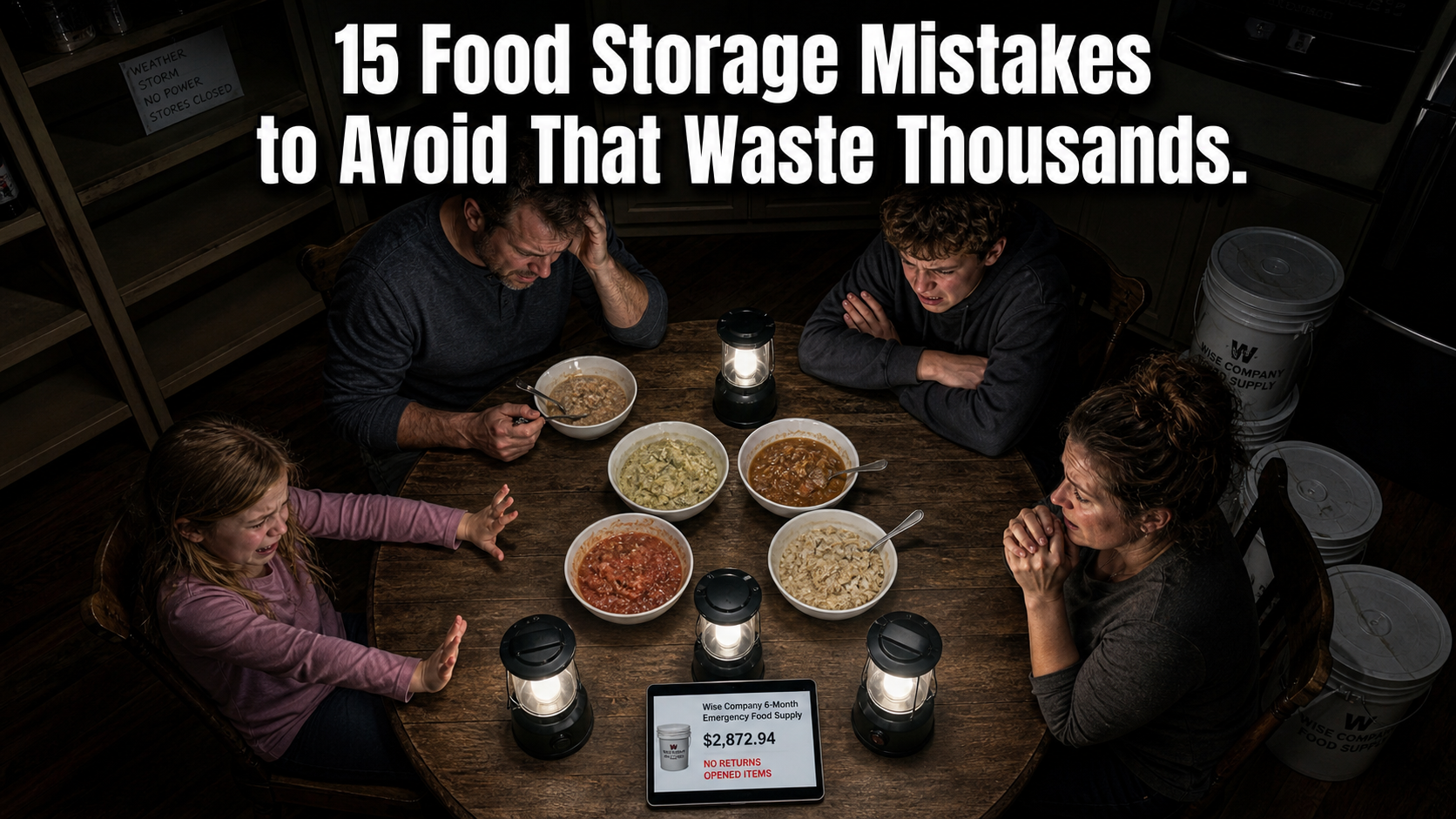
The food storage mistakes to avoid aren’t about forgetting to buy extra canned goods—they’re about the systematic failures that transform your $3,000 emergency food investment into worthless, inedible waste that your family won’t touch when crisis strikes. Most people discover their food storage mistakes at the worst possible moment: during an actual emergency, when grocery stores are empty, when they open their “1-year supply” and find degraded, expired, or inedible food that’s been slowly failing for years in their garage.
The difference between effective food storage and expensive failure is the difference between climate-controlled storage and garage heat swings, between taste-tested meals and bulk purchases you’ve never tried, between systematic rotation and “set it and forget it” neglect. It’s the difference between food that sustains your family during crisis and food that creates a secondary emergency when you realize your entire preparedness plan was built on preventable mistakes.
This is your complete guide to food storage mistakes to avoid—from the temperature failures that destroy thousands of dollars in months to the nutritional gaps that leave you malnourished despite having “plenty of food,” from the rotation oversights that waste entire inventories to the practice failures that leave your family rejecting unfamiliar food during the exact moment you need them to eat it.
The Hidden Cost of Food Storage Mistakes
 Before you add another item to your storage, understand why most food storage systems fail and what it actually costs.
Why Most Food Storage Fails When You Need It Most
The common pattern: People buy food storage, put it somewhere, assume they’re prepared, then discover during crisis that their preparation was an illusion.
Why it fails:
- Discovery timing: Mistakes are discovered during emergencies, when it’s too late to fix them
- Cascading failures: One mistake (wrong storage location) triggers others (temperature damage, shortened shelf life, wasted money)
- False security: Having food storage creates psychological comfort that masks actual vulnerabilities
- No testing: Most people never use their stored food until emergency, so they don’t know it’s failed
Real consequence: During the 2021 Texas freeze, families discovered their garage-stored emergency food had degraded from temperature cycling, their water storage had frozen and burst, and their “complete emergency plan” had multiple catastrophic failures—all discovered when they needed it most and couldn’t fix it.
The $3,000+ Mistake Most Preppers Make
The single most expensive mistake: Buying bulk without testing, then storing improperly.
The pattern:
- Research online: Find “best emergency food” articles (often affiliate-driven, not quality-focused)
- Buy cheapest option: Purchase 1-year supply from budget brand ($2,500-3,000)
- Store in garage: Put buckets in garage (convenient, out of sight)
- Forget about it: “Set it and forget it” for 5-10 years
- Discover failure: During emergency, find food is degraded, inedible, or expired
The cost breakdown:
- Initial investment: $2,500-3,000 (wasted)
- Replacement cost: $3,500-5,000 (quality food, proper storage)
- Opportunity cost: 5-10 years of false security
- Emergency cost: Buying food during crisis at inflated prices
- Total cost: $6,000-10,000+ (vs. $3,500-5,000 if done right initially)
Example: A family spent $2,847 on budget freeze-dried food, stored it in their garage for 8 years, then during a 2-week power outage discovered the food had degraded from temperature swings (garage reached 110°F in summer, 35°F in winter). The food was technically “safe” but tasted terrible and had lost 60% of its nutritional value. They couldn’t eat it, had to buy emergency food at inflated prices, and later spent $4,200 replacing their entire storage with quality food stored properly. Total cost: $7,047 vs. $4,200 if done right initially.
How Storage Errors Create Secondary Emergencies
Primary emergency: Natural disaster, power outage, economic crisis, pandemic
Secondary emergency (caused by storage mistakes):
- Nutritional crisis: Stored food lacks protein, vitamins, or essential nutrients
- Water crisis: Inadequate water storage or contaminated water
- Psychological crisis: Family rejects unfamiliar or bad-tasting food
- Health crisis: Eating degraded or contaminated food causes illness
- Financial crisis: Emergency food purchases at inflated prices
The compounding effect:
- Stress amplification: Food storage failures add stress during already stressful emergency
- Decision fatigue: Having to solve food problems during crisis depletes mental resources
- Family conflict: Arguments about food, blame for poor planning
- Reduced resilience: Malnutrition and stress reduce ability to handle other emergency challenges
The short version: Food storage mistakes to avoid include storing food in temperature-unstable locations (garages, attics), buying without taste testing, neglecting rotation systems, using improper containers, ignoring nutritional balance, overlooking special dietary needs, storing only complete meals, inadequate water storage, no practice or familiarization, ignoring packaging integrity, wrong duration planning, forgetting cooking requirements, inadequate inventory management, storing food in original retail packaging, and having no backup plans for storage failure. These mistakes waste thousands of dollars and compromise emergency preparedness.
Key Takeaways:
– Store emergency food in stable, climate-controlled environments (55-70°F) to prevent rapid degradation and extend shelf life.
– Always taste test food before bulk purchasing to ensure family acceptance and avoid wasting money on inedible supplies.
– Implement a strict rotation system (FIFO) to use older food first, prevent expiration waste, and maintain familiarity.
– Balance food storage with adequate protein, fats, vitamins, and minerals; avoid storing mostly carbohydrates.
– Practice using stored food regularly to build cooking skills, reduce psychological rejection, and identify missing supplies before emergencies.
Critical Food Storage Mistakes to Avoid
 Different mistakes have different consequences, but all are preventable with proper knowledge.
Mistake #1: Storing Food in Temperature-Unstable Locations
The mistake: Storing emergency food in garages, attics, sheds, or other non-climate-controlled spaces.
Why people do it:
- Convenience: Garage has space and is out of the way
- Assumption: “Sealed” food is impervious to temperature
- Lack of knowledge: Don’t understand temperature impact on shelf life
The reality:
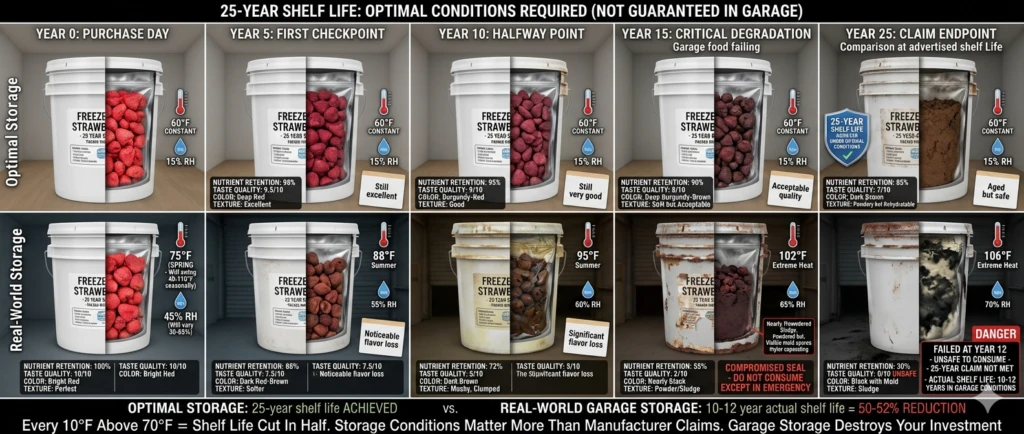
- Temperature swings destroy food: Every 10°F above 70°F cuts shelf life in half
- Garage temperatures: Can range from 35°F (winter) to 110°F+ (summer)
- Actual shelf life: 25-year shelf life becomes 5-10 years in garage
- Quality degradation: Taste, texture, and nutrition degrade faster than safety
The garage storage trap:
- Summer heat: 90-110°F temperatures accelerate degradation
- Winter cold: Freezing temperatures can damage packaging
- Humidity swings: Condensation from temperature changes
- Light exposure: Windows allow UV damage
Attic storage failures:
- Extreme heat: Attics can reach 130-150°F in summer
- Rapid degradation: Food degrades in months, not years
- Inaccessibility: Hard to access during emergency
Basement humidity problems:
- Moisture: High humidity (>50%) accelerates degradation
- Flooding risk: Basements flood, destroying ground-level storage
- Mold growth: Damp conditions promote mold
The fix:
- Climate-controlled storage: Interior closets, under beds, dedicated storage room
- Temperature range: 55-70°F constant temperature
- Humidity control: Below 50% relative humidity
- Dark storage: Away from windows and light sources
Cost of mistake: $2,000-5,000 (degraded food must be replaced)
Mistake #2: Buying Without Taste Testing
The mistake: Purchasing 6-month to 1-year supplies of food you’ve never tasted.
Why people do it:
- Bulk discounts: “Save 30% by buying 1-year supply now!”
- Urgency: Fear-based marketing creates pressure to buy immediately
- Assumption: “It’s food, it’ll be fine”
The reality:
- Quality varies dramatically: Budget brands can be inedible, premium brands excellent
- Personal preference matters: What one person loves, another hates
- Family acceptance: Children especially reject unfamiliar or bad-tasting food
- No returns: Can’t return opened food, stuck with what you bought
The bulk purchase regret cycle:
- Buy 1-year supply: $2,500-3,500 investment
- Store it away: Put in storage, feel prepared
- First use (months/years later): Open first meal during emergency or practice
- Discover it’s terrible: Tastes bad, wrong texture, family won’t eat it
- Stuck with it: Can’t return, can’t afford to replace
- Wasted investment: $2,500-3,500 of food that won’t be eaten
Brand quality variations:
- Budget brands: $0.75-1.50/serving, often inedible (mushy, over-salted, chemical taste)
- Mid-tier brands: $1.50-2.50/serving, acceptable to good quality
- Premium brands: $2.50-4.00/serving, excellent quality (near-fresh taste and texture)
The fix:
- Always sample first: Buy sample packs or individual pouches ($50-100 investment)
- Taste test 10-15 meals: Try variety before committing to bulk
- Family vote: Let everyone taste and vote on favorites
- Then buy bulk: Purchase 30-90 day supply of tested favorites
- Gradual expansion: Build to 1-year supply over time, testing as you go
Cost of mistake: $2,500-3,500 (inedible food wasted)
Mistake #3: Ignoring Expiration Date Rotation
The mistake: Buying food storage, putting it away, and never rotating or using it until it expires.
Why people do it:
- “Emergency only” mindset: Saving it for disaster
- Inconvenience: Easier to eat fresh food
- Forgetting: Out of sight, out of mind
The reality:
- Food expires: Even long-term storage food has limits (2-30 years depending on type)
- Quality degrades: Taste and nutrition decline over time
- Waste: Expired food must be discarded, wasting entire investment
- No familiarity: When emergency comes, food is unfamiliar and may be rejected
FIFO system failures:
- No labeling: Don’t know which food is oldest
- No organization: Can’t access oldest food first
- No tracking: Don’t know what’s expiring when
- No discipline: Don’t actually use oldest first
The “set it and forget it” disaster:
- Year 1: Buy food storage, feel prepared
- Years 2-5: Never think about it
- Year 6-10: Food quietly expires in storage
- Year 10+: Discover expired food during emergency or audit
- Result: 100% waste of investment
The fix:
- FIFO system: First In, First Out rotation
- Label everything: Date of purchase on every container
- Organize by date: Oldest in front, newest in back
- Monthly use: Eat 1-2 stored meals per month
- Quarterly audit: Check dates, reorganize, replace expired items
- Rotation schedule: Use and replace before expiration
Cost of mistake: $1,500-3,000 (expired food wasted)
Mistake #4: Improper Container Selection
 The mistake: Storing food in containers that allow oxygen, moisture, or light exposure.
Why people do it:
- Using original packaging: Leaving food in retail boxes or bags
- Cheap containers: Using non-airtight containers
- No oxygen absorbers: Not removing oxygen from sealed containers
The reality:
- Oxygen causes degradation: Oxidation destroys nutrients and flavor
- Moisture causes spoilage: Humidity promotes mold and bacterial growth
- Light destroys nutrients: UV exposure degrades vitamins
Oxygen exposure failures:
- Opened packages: Once opened, food degrades rapidly without resealing
- No oxygen absorbers: Oxygen in container accelerates degradation
- Poor seals: Containers that aren’t truly airtight
Moisture penetration:
- Humidity: High humidity penetrates packaging over time
- Condensation: Temperature swings cause condensation inside containers
- Flooding: Water damage from floods or leaks
Light damage:
- UV exposure: Sunlight through windows degrades vitamins
- Fluorescent lights: Even indoor lighting causes slow degradation
- Clear containers: Transparent containers don’t protect from light
The fix:
- Proper containers: Mylar bags, #10 cans, food-grade buckets with gamma lids
- Oxygen absorbers: Use appropriate size for container volume
- Opaque storage: Block light with opaque containers or dark storage location
- Moisture barriers: Store in low-humidity environment, use desiccants if needed
- Repackage opened items: Transfer to smaller airtight containers with oxygen absorbers
Cost of mistake: $500-1,500 (degraded food from improper storage)
Mistake #5: Neglecting Nutritional Balance
The mistake: Storing primarily carbohydrates (rice, pasta, oats) without adequate protein, fats, vitamins, and minerals.
Why people do it:
- Cost: Carbs are cheapest (rice, pasta, flour)
- Shelf life: Grains have longest shelf life
- Simplicity: Easy to store large quantities
- Calorie focus: Thinking only about calories, not nutrition
The reality:
- Malnutrition: Adequate calories but inadequate nutrition causes health problems
- Protein deficiency: Muscle loss, weakness, poor immune function
- Vitamin deficiency: Scurvy (vitamin C), beriberi (vitamin B1), pellagra (vitamin B3)
- Fat deficiency: Hormone disruption, poor nutrient absorption
The all-carbs trap:
- Typical storage: 80% carbs (rice, pasta, oats, flour), 15% canned goods, 5% other
- Nutritional reality: 45-65% carbs, 10-35% protein, 20-35% fats needed
- Health consequences: Malnutrition despite adequate calories
Protein deficiency in storage plans:
- Inadequate protein: Less than 10% of calories from protein
- Consequences: Muscle wasting, weakness, poor wound healing, compromised immunity
- Protein needs: 0.8-1.2g per kg body weight per day (50-100g for most adults)
Vitamin and mineral gaps:
- Vitamin C: Deficiency causes scurvy (bleeding gums, weakness, poor healing)
- Vitamin A: Deficiency causes vision problems, immune dysfunction
- B vitamins: Deficiency causes neurological problems, fatigue
- Iron: Deficiency causes anemia, fatigue
- Calcium: Deficiency causes bone loss, muscle problems
The fix:
- Balanced macros: 45-65% carbs, 10-35% protein, 20-35% fats
- Protein sources: Freeze-dried meats, canned meats, beans, lentils, protein powder
- Fat sources: Nuts, seeds, oils, butter powder, peanut butter
- Vitamin sources: Freeze-dried fruits and vegetables, multivitamins
- Mineral sources: Dairy (calcium), meats (iron), variety of foods
Cost of mistake: $800-1,500 (emergency food purchases to fill nutritional gaps + health costs)
Mistake #6: Overlooking Special Dietary Needs
The mistake: Not accounting for allergies, medical dietary requirements, or age-specific needs in food storage.
Why people do it:
- Generic planning: Using standard food storage lists
- Assumption: “We’ll make it work during emergency”
- Complexity: Easier to ignore special needs than plan for them
The reality:
- Allergies don’t pause: Food allergies remain during emergencies
- Medical needs continue: Diabetic, celiac, renal diets still required
- Age matters: Infants, elderly have different nutritional needs
Allergies and food storage:
- Common allergens: Wheat, dairy, eggs, soy, nuts, shellfish
- Hidden allergens: Many emergency foods contain multiple allergens
- Cross-contamination: Manufacturing facilities may process allergens
- Emergency risk: Allergic reactions during emergency when medical care limited
Medical dietary requirements:
- Diabetes: Need low-sugar, controlled-carb foods
- Celiac disease: Need gluten-free foods
- Kidney disease: Need low-sodium, low-protein foods
- Heart disease: Need low-sodium, low-fat foods
Age-specific nutritional needs:
- Infants: Formula, baby food (can’t eat adult emergency food)
- Toddlers: Soft foods, familiar flavors, smaller portions
- Elderly: Soft foods, lower sodium, higher protein, easier to chew
- Pregnant/nursing: Higher calorie and nutrient needs
The fix:
- Identify needs: List all family members’ dietary restrictions and requirements
- Research options: Find emergency foods that meet special needs
- Stock appropriately: Ensure adequate supply of specialized foods
- Label clearly: Mark special dietary foods to prevent accidental consumption
- Plan alternatives: Have backup options if primary foods unavailable
Cost of mistake: $500-2,000 (emergency purchases of specialized foods + health risks)
Mistake #7: Storing Only Complete Meals
The mistake: Buying only pre-made freeze-dried or dehydrated meals without storing individual ingredients.
Why people do it:
- Convenience: Complete meals are easy (just add water)
- Simplicity: Don’t have to plan recipes
- Marketing: Meal buckets heavily marketed
The reality:
- No flexibility: Can’t customize meals or create new recipes
- Meal fatigue: Eating same meals repeatedly causes psychological stress
- Higher cost: Complete meals cost more per serving than ingredients
- Limited variety: Finite number of meal options
The flexibility problem:
- Can’t adapt: Stuck with pre-made meals, can’t adjust to preferences or needs
- Can’t combine: Can’t mix ingredients to create new meals
- Can’t supplement: Can’t add fresh ingredients to improve meals
Meal fatigue and psychological stress:
- Monotony: Eating same 10-20 meals for weeks/months
- Rejection: Family refuses to eat same meals repeatedly
- Psychological impact: Food monotony increases stress during already stressful emergency
Ingredient-based storage advantages:
- Unlimited variety: Create any recipe with basic ingredients
- Customization: Adjust flavors, portions, ingredients to preference
- Cost savings: Ingredients cheaper than complete meals
- Flexibility: Combine with fresh ingredients when available
The fix:
- Mix meals and ingredients: 50% complete meals (convenience), 50% ingredients (flexibility)
- Stock basics: Freeze-dried meats, vegetables, fruits, eggs, dairy, grains
- Learn recipes: Practice cooking from stored ingredients
- Spices and seasonings: Stock variety to create different flavors
Cost of mistake: $500-1,000 (higher cost of meals vs. ingredients + psychological stress)
Mistake #8: Inadequate Water Storage
The mistake: Storing adequate food but inadequate water, or storing water improperly.
Why people do it:
- Food focus: Emphasis on food storage, water is afterthought
- Space: Water takes significant space
- Weight: Water is heavy, difficult to store large quantities
- Assumption: “I’ll find water somehow”
The reality:
- Water is more critical than food: Humans survive 3 days without water, 3 weeks without food
- Contamination: Emergency water sources often contaminated
- Quantity needed: 1 gallon per person per day minimum (drinking, cooking, hygiene)
- Purification backup: Need multiple purification methods
The 1-gallon-per-day rule failures:
- Underestimating needs: 1 gallon is minimum (drinking and cooking only)
- Hygiene needs: Additional water needed for washing, sanitation
- Climate impact: Hot climates require 2-3 gallons per person per day
- Medical needs: Illness, injury increase water requirements
Water purification backup gaps:
- Single method: Relying only on one purification method (boiling, filter, chemical)
- No backup: If primary method fails, no alternative
- Limited capacity: Small filter can’t purify enough water for family
Container contamination issues:
- Algae growth: Clear containers in light allow algae growth
- Bacterial contamination: Improper storage allows bacterial growth
- Chemical leaching: Non-food-grade containers leach chemicals
- Freezing damage: Water expands when frozen, bursts containers
The fix:
- Adequate quantity: 1 gallon per person per day minimum, 2-3 gallons in hot climates
- Duration: 30-day supply minimum (30 gallons per person)
- Proper containers: Food-grade, opaque, BPA-free containers
- Rotation: Replace every 6-12 months
- Multiple purification methods: Boiling, filtration, chemical treatment
- Backup sources: Know where to find water (streams, lakes, water heater, toilet tank)
Cost of mistake: $400-800 (emergency water purchases + dehydration health risks)
Mistake #9: No Practice or Familiarization
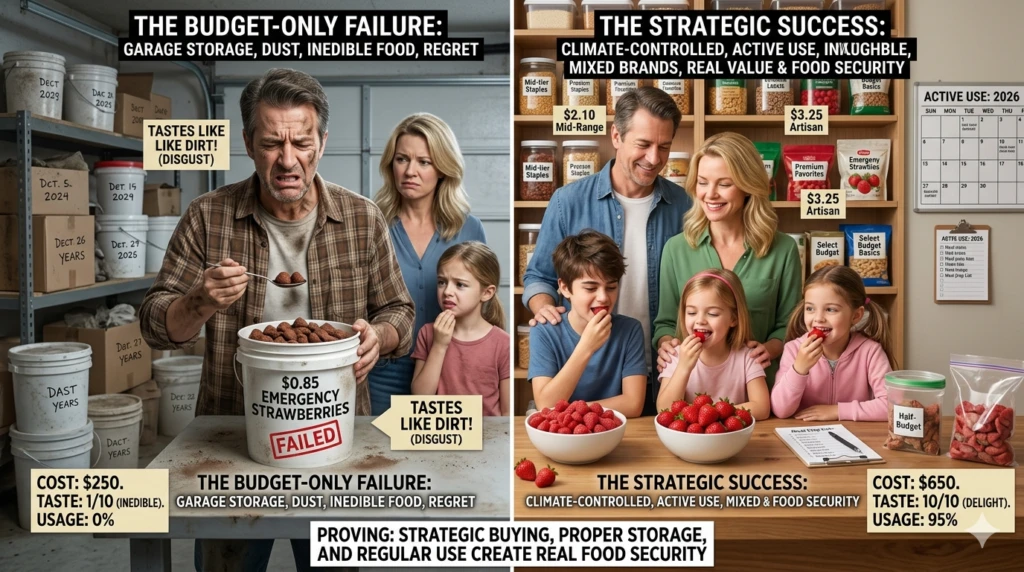 The mistake: Never using stored food until actual emergency, creating learning curve and rejection during crisis.
Why people do it:
- “Emergency only” mindset: Saving food for disaster
- Inconvenience: Easier to eat fresh food
- Procrastination: “I’ll practice later”
The reality:
- Learning curve: Preparation takes longer than expected
- Unfamiliar taste: Family rejects unfamiliar food during stress
- Missing items: Discover you lack necessary cookware, utensils, fuel
- Skill gaps: Don’t know how to prepare stored food properly
The learning curve during crisis:
- Preparation time: Freeze-dried meals take 10-15 minutes, but first time takes 30+ minutes
- Rehydration mistakes: Wrong water ratios, wrong temperature, wrong timing
- Cooking challenges: No power, unfamiliar cooking methods, limited equipment
- Stress amplification: Learning during crisis increases stress
Preparation time surprises:
- Assumption: “Just add water” is instant
- Reality: Rehydration takes 10-15 minutes, cooking takes additional time
- No-power cooking: Camp stove, grill, or fireplace takes longer than normal cooking
- Cleanup: Limited water makes cleanup challenging
Family rejection of unfamiliar foods:
- Children especially: Reject new foods during stress
- Texture issues: Freeze-dried food has different texture than fresh
- Flavor differences: Stored food tastes different than fresh
- Psychological resistance: Stress reduces willingness to try new foods
The fix:
- Monthly practice: Eat 1-2 stored meals per month
- Family involvement: Let everyone help prepare and eat
- Skill building: Practice no-power cooking methods
- Identify gaps: Discover missing items or skills before emergency
- Build familiarity: Make stored food normal, not emergency-only
Cost of mistake: Psychological stress + potential food rejection during emergency (priceless)
Mistake #10: Ignoring Packaging Integrity
The mistake: Not checking packaging for damage, not monitoring for seal failures, not protecting from pests.
Why people do it:
- Assumption: “Sealed” means safe forever
- No inspection: Never check stored food after initial storage
- Lack of knowledge: Don’t know what seal failure looks like
The reality:
- Seals fail: Packaging degrades over time, seals break
- Pests infiltrate: Rodents, insects can penetrate packaging
- Physical damage: Stacking, moving, temperature changes damage packaging
Seal failures and oxygen exposure:
- Mylar bag failures: Punctures, seal degradation, manufacturing defects
- Can failures: Rust, dents, seal compromise
- Bucket failures: Lid seal degradation, crack development
- Consequences: Oxygen exposure accelerates degradation
Pest infiltration vulnerabilities:
- Rodents: Chew through plastic, cardboard, thin metal
- Insects: Penetrate small openings, lay eggs in food
- Contamination: Droppings, urine, disease transmission
- Total loss: Infested food must be discarded
Physical damage during storage:
- Stacking damage: Heavy items crush lighter items
- Moving damage: Rough handling creates punctures, tears
- Temperature damage: Expansion/contraction stresses packaging
- Age damage: Packaging materials degrade over time
The fix:
- Initial inspection: Check all packaging before storage
- Quarterly inspection: Check for damage, seal integrity, pest signs
- Proper stacking: Heavy items on bottom, don’t overstack
- Pest prevention: Store in pest-proof containers, use traps/deterrents
- Repackage damaged items: Transfer to new containers immediately
Cost of mistake: $500-2,000 (contaminated or degraded food must be replaced)
Mistake #11: Wrong Storage Duration Planning
The mistake: Building wrong-duration storage (3-day when you need 30-day, or 1-year when you only need 3-month).
Why people do it:
- Unclear goals: Don’t know what duration to plan for
- Overwhelm: Start with too ambitious goal (1-year) and give up
- Underestimation: Think 3-day supply is adequate for all emergencies
The reality:
- Different emergencies need different durations: 3-day for power outage, 30-day for natural disaster, 1-year for economic collapse
- Scaling mistakes: Building 1-year supply when you need 30-day wastes money and space
- Inadequate supply: Having 3-day supply when you need 30-day leaves you vulnerable
3-day vs. 30-day vs. 1-year planning errors:
- 3-day supply: Adequate for short power outages, inadequate for most disasters
- 30-day supply: Adequate for most natural disasters, inadequate for extended crises
- 1-year supply: Adequate for extended crises, overkill for most people’s needs
Scaling mistakes and waste:
- Over-buying: Purchasing 1-year supply when 30-day adequate
- Under-buying: Purchasing 3-day supply when 30-day needed
- Wrong proportions: Scaling recipes incorrectly for family size
Budget allocation failures:
- All-or-nothing: Spending entire budget on 1-year supply, leaving no money for other preparedness
- Misallocation: Spending on food when water, medical, or other needs more critical
- No prioritization: Not building in layers (3-day, then 30-day, then 1-year)
The fix:
- Assess realistic needs: What emergencies are most likely in your area?
- Build in layers: Start with 3-day, expand to 30-day, then consider 1-year
- Prioritize: 30-day supply is sweet spot for most families
- Budget wisely: Allocate budget across all preparedness needs, not just food
Cost of mistake: $1,000-3,000 (over-buying or under-buying for actual needs)
Mistake #12: Forgetting Cooking Requirements
The mistake: Storing food that requires cooking but not storing fuel, cookware, or alternative cooking methods.
Why people do it:
- Assumption: “I’ll use my stove”
- Oversight: Focus on food, forget about preparation requirements
- Lack of planning: Don’t think through no-power scenarios
The reality:
- Power outages: Electric stoves don’t work without power
- Gas outages: Gas lines can be shut off during emergencies
- Cooking required: Most stored food requires hot water or cooking
- Fuel needed: Alternative cooking requires fuel (propane, charcoal, wood)
No-power cooking gaps:
- No alternative: Only have electric stove, no backup cooking method
- No fuel: Have camp stove but no propane
- No cookware: Have fuel but no pots/pans suitable for camp stove
- No knowledge: Don’t know how to cook without power
Fuel storage oversights:
- Inadequate quantity: One propane canister isn’t enough for 30 days
- Wrong fuel type: Charcoal for grill but no lighter fluid
- No rotation: Fuel expires or degrades in storage
- Safety issues: Improper fuel storage creates fire hazard
Cookware and utensil deficiencies:
- Wrong cookware: Pots/pans not suitable for camp stove or grill
- Missing utensils: No can opener, no serving spoons, no plates
- No cleanup supplies: Limited water makes cleanup challenging
- No backup: Single pot/pan, if damaged have no alternative
The fix:
- Multiple cooking methods: Camp stove, grill, fireplace, solar oven
- Adequate fuel: 30-day supply minimum (propane, charcoal, wood)
- Proper cookware: Pots, pans, utensils suitable for alternative cooking
- Practice: Cook with alternative methods before emergency
- Safety knowledge: Proper ventilation, carbon monoxide awareness
Cost of mistake: $300-600 (emergency cooking equipment and fuel purchases)
Mistake #13: Inadequate Inventory Management
The mistake: Not knowing what food you have, where it is, or when it expires.
Why people do it:
- No system: Never created inventory tracking system
- Complexity: Seems overwhelming to track everything
- Procrastination: “I’ll organize it later”
The reality:
- Can’t find items: Know you have something but can’t locate it
- Duplicate purchases: Buy items you already have
- Missing items: Think you have something but don’t
- Expired waste: Items expire because you didn’t know they were expiring
Not knowing what you have:
- No list: No written inventory of stored food
- No organization: Items scattered across multiple locations
- No categories: Don’t know how much of each food type you have
- No totals: Don’t know if you have 30-day or 90-day supply
Duplicate purchases and waste:
- Buying duplicates: Purchase items you already have in storage
- Wasted money: Spending on unnecessary items
- Wasted space: Storing excess of some items while lacking others
Missing critical items:
- Gaps: Think you’re prepared but missing essential items
- Imbalance: Too much of some items, not enough of others
- Discovery during emergency: Find gaps when it’s too late to fix
The fix:
- Create inventory: Spreadsheet or app listing all stored food
- Categorize: Group by food type, location, expiration date
- Update regularly: Add new purchases, remove used items
- Quarterly audit: Physical count to verify inventory accuracy
- Shopping list: Use inventory to identify gaps and needs
Cost of mistake: $500-1,000 (duplicate purchases + missing items discovered during emergency)
Mistake #14: Storing Food in Original Retail Packaging
The mistake: Leaving food in cardboard boxes, paper bags, or thin plastic retail packaging.
Why people do it:
- Convenience: Easier to leave in original packaging
- Assumption: “It’s packaged, it’s protected”
- Lack of knowledge: Don’t know retail packaging isn’t suitable for long-term storage
The reality:
- Cardboard degrades: Absorbs moisture, attracts pests, breaks down over time
- Paper tears: Easily damaged, not pest-proof, not moisture-proof
- Thin plastic: Not airtight, easily punctured, degrades over time
Cardboard and paper degradation:
- Moisture absorption: Cardboard absorbs humidity, becomes soft and moldy
- Pest attraction: Cardboard and paper attract insects and rodents
- Structural failure: Boxes collapse under weight or over time
- Contamination: Cardboard can harbor bacteria, mold, pests
Pest attraction and infiltration:
- Rodents: Chew through cardboard and paper easily
- Insects: Lay eggs in cardboard, infest food
- Contamination: Droppings, urine, disease in food
- Total loss: Infested food must be discarded
Repackaging best practices:
- Remove from retail packaging: Transfer to proper storage containers
- Airtight containers: Mylar bags, #10 cans, food-grade buckets
- Oxygen absorbers: Remove oxygen to extend shelf life
- Label clearly: Date, contents, quantity on every container
- Organize: Store in pest-proof, moisture-proof, temperature-stable location
The fix:
- Repackage everything: Transfer all food to proper long-term storage containers
- Use proper containers: Mylar bags with oxygen absorbers, #10 cans, gamma-seal buckets
- Protect from pests: Store in pest-proof containers and locations
- Protect from moisture: Store in low-humidity environment
- Protect from light: Use opaque containers or dark storage
Cost of mistake: $300-800 (pest damage, moisture damage, degradation requiring replacement)
Mistake #15: No Backup Plans for Storage Failure
The mistake: Storing all food in single location with no backup plan if storage fails.
Why people do it:
- Convenience: Easier to store everything in one place
- Space limitations: Only have one suitable storage location
- Lack of planning: Don’t think about what happens if storage fails
The reality:
- Single point of failure: Fire, flood, theft, or other disaster destroys entire storage
- Total loss: Lose 100% of investment in single event
- No recovery: Can’t replace during emergency when you need it most
Single point of failure risks:
- Fire: House fire destroys all stored food
- Flood: Basement flood destroys ground-level storage
- Theft: Burglary or looting takes all stored food
- Structural damage: Earthquake, tornado, hurricane damages storage area
- Pest infestation: Rodents or insects infest entire storage
Distributed storage strategies:
- Multiple locations in home: Closets, under beds, garage, basement
- Off-site storage: Family member’s house, storage unit, buried cache
- Vehicle storage: Keep 3-7 day supply in vehicle
- Workplace storage: Keep 3-day supply at work
- Redundancy: If one location fails, others remain
Emergency food replacement plans:
- Insurance: Document food storage for insurance claims
- Emergency fund: Money set aside to replace food if needed
- Community: Mutual aid agreements with neighbors/family
- Knowledge: Know where to find food during emergency (stores, distribution centers)
The fix:
- Distribute storage: Store food in multiple locations
- Prioritize: Keep most critical items in most secure location
- Document: Photos and inventory for insurance
- Plan B: Know how to replace food if primary storage fails
- Test: Practice accessing distributed storage
Cost of mistake: $3,000-6,000 (total loss of storage in single event)
How to Fix Common Food Storage Mistakes
 Many mistakes can be corrected before they cause total loss.
Immediate Actions for Temperature-Damaged Food
If you discover food stored in garage/attic:
- Move immediately: Transfer to climate-controlled location
- Inspect packaging: Check for bulging, rust, damage
- Smell test: Open one container, smell for off-odors
- Taste test: If smell is okay, taste small amount
- Decide: Keep if acceptable, discard if degraded
Temperature damage assessment:
- Mild damage (1-3 years in garage): Likely still usable, may have reduced shelf life
- Moderate damage (3-7 years in garage): Quality degraded, taste test before keeping
- Severe damage (7+ years in garage): Likely unusable, discard and replace
Salvaging Improperly Stored Supplies
Opened packages without oxygen absorbers:
- Repackage immediately: Transfer to airtight containers with oxygen absorbers
- Use quickly: Consume within 6-12 months
- Monitor: Check monthly for degradation
Moisture-exposed food:
- Dry immediately: Spread out, use dehumidifier or fan
- Inspect for mold: Discard if any mold visible
- Repackage: Transfer to dry, airtight containers
- Use quickly: Consume within 3-6 months
Pest-exposed food:
- Inspect thoroughly: Look for droppings, eggs, live pests
- Discard contaminated: Any food with pest evidence must be discarded
- Clean containers: Sanitize all containers before reuse
- Prevent recurrence: Store in pest-proof containers
When to Discard vs. When to Keep
Discard if:
- Visible mold: Any mold growth
- Off-odor: Rancid, chemical, or unusual smell
- Bulging cans: Indicates bacterial growth and gas production
- Rust or damage: Compromised packaging
- Pest evidence: Droppings, eggs, live pests, chew marks
- Extreme degradation: Color change to black/brown, complete texture breakdown
Keep if:
- Slight color change: Darkening is normal aging
- Mild flavor loss: Still edible, just less flavorful
- Texture change: Softer than fresh but still acceptable
- Past “best by” date: If stored properly, often still safe years past date
- No contamination: No mold, pests, or off-odors
When in doubt:
- Smell test: Trust your nose
- Small taste: If smell is okay, taste tiny amount
- Err on caution: If uncertain, discard (not worth health risk)
Building a Mistake-Proof Food Storage System
Prevention is cheaper and easier than correction.
The 5-Layer Food Storage Framework
Layer 1: Everyday pantry (1-week supply)
- Purpose: Normal grocery shopping, rotate naturally
- Contents: Foods you eat regularly
- Storage: Kitchen pantry, normal rotation
- Cost: $100-200
Layer 2: Extended pantry (30-day supply)
- Purpose: Short-term emergencies (power outages, storms)
- Contents: Canned goods, dry goods, freeze-dried meals
- Storage: Pantry, closets, climate-controlled
- Cost: $300-500
Layer 3: Long-term storage (90-day supply)
- Purpose: Extended emergencies (natural disasters, economic disruption)
- Contents: Freeze-dried food, bulk grains, long-term staples
- Storage: Dedicated storage area, climate-controlled
- Cost: $900-1,500
Layer 4: Deep storage (1-year supply)
- Purpose: Catastrophic long-term emergencies
- Contents: Bulk freeze-dried, grains, beans, long-term staples
- Storage: Multiple locations, climate-controlled
- Cost: $3,500-6,000
Layer 5: Backup and distributed storage
- Purpose: Redundancy, single-point-of-failure protection
- Contents: Duplicate critical items
- Storage: Off-site, vehicle, workplace
- Cost: $500-1,000
Monthly Maintenance Checklist
15-minute monthly check:
- Inspect storage area: Temperature, humidity, pest signs
- Check packaging: Look for damage, bulging, rust
- Rotate stock: Move oldest items to front
- Use stored food: Eat 1-2 stored meals
- Update inventory: Add new purchases, remove used items
- Check equipment: Test camp stove, check fuel levels
Quarterly Audit Procedures
1-hour quarterly audit:
- Full inventory: Count all items, verify against list
- Expiration check: Identify items expiring in next 6 months
- Quality check: Open and inspect random samples
- Organization: Reorganize for better access and rotation
- Gap analysis: Identify missing items or imbalances
- Shopping list: Create list of items to purchase or replace
- Practice drill: Cook full meal from storage, time the process
Frequently Asked Questions.
What’s the most common food storage mistake?
The single most common mistake: Storing food in temperature-unstable locations (garages, attics, sheds).
Why it’s so common:
- Convenience: Garage has space and is out of the way
- Lack of knowledge: Most people don’t understand temperature impact
- Assumption: “Sealed” food seems impervious to environment
- Space constraints: Don’t have climate-controlled storage space
Why it’s so costly:
- Rapid degradation: Every 10°F above 70°F cuts shelf life in half
- Garage temperatures: Can swing from 35°F to 110°F+ (extreme stress on food)
- Quality loss: Taste, texture, nutrition degrade much faster
- Wasted investment: $2,000-5,000 of food degraded in 5-10 years instead of lasting 25-30 years
The fix:
- Move to climate-controlled space: Interior closets, under beds, dedicated storage room
- Target temperature: 55-70°F constant
- Monitor: Use thermometer to verify temperature stability
- Prioritize: If space limited, store most expensive items (freeze-dried) in best location
Bottom line: Temperature-unstable storage is the #1 mistake because it’s so common (50%+ of people store in garage) and so costly (cuts shelf life by 50-75%). Moving food to climate-controlled storage is the single most impactful fix.
How do I know if my stored food has gone bad?
Visual inspection:
- Mold: Any visible mold = discard immediately
- Color change: Slight darkening is normal, black/brown is bad
- Bulging: Cans or packages bulging = bacterial gas production = discard
- Rust: Rust on cans = potential seal compromise = inspect carefully
- Pest evidence: Droppings, eggs, chew marks = discard
Smell test:
- Normal: Mild, food-appropriate smell
- Warning signs: Rancid, chemical, sour, or unusual odors
- Trust your nose: If it smells off, it probably is
Taste test (if smell is okay):
- Small amount: Taste tiny portion
- Normal: Flavor may be milder but recognizable
- Warning signs: Bitter, sour, chemical, or off-flavors
- Spit out: If taste is wrong, spit out and discard
Texture assessment:
- Normal aging: Slightly softer or darker than fresh
- Problem signs: Slimy, mushy, completely broken down, or rock-hard
When to discard:
- Any mold: Visible mold anywhere
- Off-odor: Rancid, chemical, or unusual smell
- Off-taste: Bitter, sour, or wrong flavor
- Bulging: Cans or packages under pressure
- Pest contamination: Any evidence of pests
- Extreme degradation: Complete texture or color breakdown
When it’s probably okay:
- Slight darkening: Normal aging
- Milder flavor: Flavor fades over time but food still safe
- Softer texture: Texture changes but food still edible
- Past “best by” date: If stored properly, often safe years past date
Bottom line: Use your senses (sight, smell, taste) to assess food quality. When in doubt, throw it out—the cost of replacing questionable food is much less than the cost of food poisoning during an emergency.
Can I fix food storage mistakes or do I start over?
Many mistakes can be fixed without starting over.
Fixable mistakes:
Temperature damage (caught early):
- Fix: Move to climate-controlled storage immediately
- Assessment: Inspect, smell, taste test
- Keep if: Food still acceptable quality
- Cost: $0 (just labor to move)
Improper containers:
- Fix: Repackage in proper containers with oxygen absorbers
- Timeline: Do within days of discovering mistake
- Cost: $50-100 (containers and oxygen absorbers)
No rotation system:
- Fix: Create inventory, label everything, organize by date
- Timeline: Weekend project
- Cost: $0 (just labor)
Nutritional imbalance:
- Fix: Identify gaps, purchase missing items
- Timeline: Ongoing (add items over time)
- Cost: $100-500 (fill nutritional gaps)
No practice:
- Fix: Start using stored food monthly
- Timeline: Immediate (start this week)
- Cost: $0 (using existing supplies)
Unfixable mistakes (must start over):
Severe temperature damage:
- Problem: Food stored in garage 7+ years, severely degraded
- Fix: Discard and replace
- Cost: $2,000-5,000 (full replacement)
Pest infestation:
- Problem: Rodents or insects contaminated food
- Fix: Discard contaminated food, sanitize containers, restock
- Cost: $500-2,000 (depending on extent)
Mold contamination:
- Problem: Moisture caused mold growth
- Fix: Discard moldy food, dry storage area, restock
- Cost: $300-1,500 (depending on extent)
Bought wrong food (inedible):
- Problem: Bulk purchased food family won’t eat
- Fix: Donate if possible, replace with quality food
- Cost: $2,500-3,500 (replacement cost)
Bottom line: Many mistakes are fixable if caught early. Temperature issues, container problems, rotation failures, and nutritional gaps can all be corrected. Severe degradation, contamination, and fundamentally wrong food choices require starting over. The key is regular inspection to catch problems early when they’re still fixable.
What’s the minimum viable food storage to avoid mistakes?
The 30-day supply is the sweet spot for most families.
Why 30 days:
- Adequate for most emergencies: Covers natural disasters, extended power outages, short-term disruptions
- Manageable cost: $300-500 per person (vs. $3,500-6,000 for 1-year)
- Manageable space: 10-15 cubic feet per person (vs. 120-180 for 1-year)
- Easier to maintain: Rotation and management much simpler
- Lower mistake risk: Smaller investment means smaller potential loss
Minimum viable 30-day storage (1 person):
Water (30 gallons):
- Cost: $30-50 (containers or bottled)
- Space: 4 cubic feet
Food (90 servings):
- Breakfast: 30 servings ($50-75)
- Lunch: 30 servings ($50-75)
- Dinner: 30 servings ($75-100)
- Total: $175-250
Cooking:
- Camp stove: $30-50
- Fuel: $20-30 (30-day supply)
- Cookware: $30-50
Total cost: $285-430 per person Total space: 10-15 cubic feet per person
Mistake-proofing the minimum:
- Climate-controlled storage: Interior closet, under bed
- Taste test first: Buy samples before bulk
- Proper containers: Repackage in airtight containers
- Label everything: Date and contents
- Monthly use: Eat 1-2 stored meals per month
- Quarterly check: Inspect and rotate
Scaling for family:
- Family of 4: $1,140-1,720 total, 40-60 cubic feet
- Build gradually: $100-150 per month for 3 months per person
Bottom line: A 30-day supply is the minimum viable food storage that provides real emergency coverage while remaining manageable in cost, space, and maintenance. It’s the sweet spot that balances preparedness with practicality and minimizes mistake risk.
How much does it cost to fix food storage mistakes?
Cost depends on the mistake and how long it went undetected.
Minor mistakes (caught early, fixable):
Improper storage location:
- Fix: Move to climate-controlled space
- Cost: $0 (just labor)
- Time: 2-4 hours
Inadequate containers:
- Fix: Repackage with oxygen absorbers
- Cost: $50-100 (containers, absorbers)
- Time: 3-5 hours
No rotation system:
- Fix: Create inventory and organization
- Cost: $0 (just labor)
- Time: 2-3 hours
Nutritional gaps:
- Fix: Purchase missing items
- Cost: $100-300
- Time: Ongoing
Total minor fixes: $150-400
Moderate mistakes (caught late, partially fixable):
Temperature damage (3-5 years):
- Fix: Replace degraded items
- Cost: $500-1,500 (30-50% of storage)
- Time: Weekend project
Expired food (no rotation):
- Fix: Discard expired, replace
- Cost: $800-2,000 (depending on extent)
- Time: 4-8 hours
Wrong food purchased:
- Fix: Donate, replace with quality
- Cost: $1,000-2,000 (replacement)
- Time: Research and repurchase
Total moderate fixes: $2,300-5,500
Major mistakes (caught very late, must start over):
Severe temperature damage (7+ years):
- Fix: Complete replacement
- Cost: $2,500-5,000 (full storage)
- Time: Complete restart
Pest infestation:
- Fix: Discard all, sanitize, restock
- Cost: $1,500-3,000 (depending on extent)
- Time: 1-2 weeks
Mold contamination:
- Fix: Discard contaminated, dry area, restock
- Cost: $1,000-2,500
- Time: 1-2 weeks
Bulk purchase of inedible food:
- Fix: Total replacement
- Cost: $2,500-3,500
- Time: Research and repurchase
Total major fixes: $7,500-14,000
Prevention vs. correction costs:
- Proper initial setup: $3,500-5,000 (1-year supply, done right)
- Fixing major mistakes: $7,500-14,000 (double the cost)
- Savings from prevention: $4,000-9,000
Bottom line: Fixing food storage mistakes costs 2-3x more than doing it right initially. Minor mistakes caught early cost $150-400 to fix. Moderate mistakes cost $2,300-5,500. Major mistakes requiring complete restart cost $7,500-14,000. The best strategy is prevention through proper initial setup and regular maintenance.
Taking the Next Step
You now understand the 15 critical food storage mistakes to avoid and exactly how each one wastes money, compromises your emergency preparedness, and creates secondary crises when you need your storage most.
But knowledge without action is just anxiety with a checklist.
This weekend—not next month, not when you have more time, not when you’re “ready”—do one thing. Go to your food storage right now and check the temperature where it’s stored. That’s it. Five minutes. One thermometer reading.
If it’s above 70°F or fluctuates more than 10 degrees, you’ve just identified the mistake that’s quietly destroying your investment. Move it this weekend. That single action could save you $2,000-5,000.
Small actions prevent expensive mistakes. Prevention costs nothing compared to correction. And the confidence that comes from knowing your food storage actually works—that it’s stored properly, rotated regularly, and will be there when you need it—is worth more than any dollar amount.
That’s not just avoiding mistakes. That’s building real food security.
PRODUCTS / TOOLS / RESOURCES
These are the specific products and tools that help you avoid the most common and costly food storage mistakes.
Temperature Monitoring & Control
- ThermoPro TP50 Digital Hygrometer (2-pack): Monitor temperature and humidity in storage areas. Essential for avoiding Mistake #1 ($15-20 for 2).
- Inkbird ITC-308 Temperature Controller: Automatically control heater/cooler to maintain ideal storage temperature ($35-45).
Proper Storage Containers
- Gamma Seal Lids for 5-Gallon Buckets (6-pack): Airtight, easy-open lids prevent Mistake #4 (oxygen exposure) ($45-60 for 6).
- PackFreshUSA Oxygen Absorbers (100-pack, 300cc): Remove oxygen from containers to extend shelf life ($15-25).
- Ball Wide Mouth Mason Jars (12-pack, quart size): Perfect for repackaging opened freeze-dried food ($15-20 for 12).
- Mylar Bags with Oxygen Absorbers (25-pack, 1-gallon): Professional-grade long-term storage ($25-35).
Inventory Management
- Prep & Pantry Food Storage Inventory App: Track inventory, expiration dates, rotation schedule (Free-$5/month).
- Avery Removable Labels (300-pack): Label everything with dates and contents ($8-12).
- Simple Spreadsheet Template: Free Google Sheets template for food storage inventory (Free at various preparedness sites).
Quality Food Storage (Avoiding Mistake #2)
- Mountain House Sample Pack: Taste test premium freeze-dried before bulk buying ($60-80 for 12 meals).
- Augason Farms Variety Pail: Mid-tier quality taste test sampler ($40-60 for 11 products).
- Thrive Life Sample Kit: Premium ingredients taste test ($50-70).
Nutritional Balance Tools
- Cronometer App: Track nutritional content of stored food to avoid Mistake #5 (Free-$50/year).
- USDA FoodData Central: Free database of nutritional information for planning balanced storage (Free online).
Rotation Systems
- SimpleHouseware Stackable Can Rack Organizer: FIFO rotation for canned goods, prevents Mistake #3 ($25-35).
- Shelf Reliance Cansolidator: Automatic FIFO rotation system ($40-60 per unit).
Cooking Equipment (Avoiding Mistake #12)
- Coleman Classic Propane Stove: Reliable 2-burner camp stove for no-power cooking ($50-70).
- Coleman Propane Fuel (12-pack): 30-day cooking fuel supply ($40-60 for 12).
- Stanley Adventure Camp Cook Set: Durable pots and pans for emergency cooking ($40-60).
Water Storage (Avoiding Mistake #8)
- Aqua-Tainer 7-Gallon Water Container (4-pack): Stackable, food-grade water storage ($60-80 for 4).
- Sawyer PointONE Water Filter: Backup water purification ($40-60).
- Potable Aqua Water Purification Tablets (50-pack): Chemical backup purification ($8-12).
Pest Prevention (Avoiding Mistake #10)
- Victor Metal Pedal Rat Trap (6-pack): Protect storage from rodents ($15-25 for 6).
- Safer Brand Diatomaceous Earth (4-lb): Natural pest control for storage areas ($12-18).
Education & Planning
- “The Prepper’s Cookbook” by Tess Pennington: 300+ recipes using stored food, helps with Mistake #9 (practice) ($15-20).
- “Food Storage for Self-Sufficiency and Survival” by Angela Paskett: Comprehensive planning guide ($12-18).
- Ready Store Food Storage Calculator: Free online tool for planning quantities (Free at readystore.com).
Distributed Storage Solutions (Avoiding Mistake #15)
- Plano Storage Trunk (108-quart): Waterproof, lockable for vehicle or off-site storage ($60-80).
- MTM Survivor Dry Box: Waterproof, airtight for distributed storage ($25-40).