
Hey there! Some links on this page may be affiliate links which means that, if you choose to make a purchase, I may earn a commission at no extra cost to you. I greatly appreciate your support. Read the full disclosure here.
A cast iron dutch oven weighs between 10 and 15 pounds, yet it may be the single most valuable cooking tool at your bug out location. When the grid goes down and your kitchen appliances are useless, that heavy pot sitting over a campfire becomes your stove, your oven, and your slow cooker all at once.
This guide covers everything preppers need to know about dutch oven camping recipes for your bug out location, from choosing the right size to cooking full meals with nothing but stored pantry staples and an open fire.
Key Takeaways
- A 12-inch, 6-quart cast iron dutch oven is the most versatile size for groups of 2 to 6 people at a bug out location.
- Dutch ovens work over open campfires, charcoal briquettes, and most camping stoves, making them reliable in nearly any off-grid scenario.
- The best bug out dutch oven recipes use shelf-stable ingredients: dried beans, rice, canned meat, oats, and long-term storage staples.
- Cooking times run longer outdoors than indoors, typically 30 to 90 minutes depending on heat source and recipe.
- Common mistakes, including uneven coal placement and lifting the lid too often, can ruin a meal and waste fuel.
- A pre-seasoned cast iron dutch oven requires no electricity, no non-stick spray, and minimal cleaning supplies.
- Budget-friendly options from Lodge and Camp Chef perform as well as premium brands for survival cooking purposes.
Find this useful? Add us as a preferred source on Google and more of what we publish will show up in your results.
What Is a Dutch Oven and Why Use It for Camping
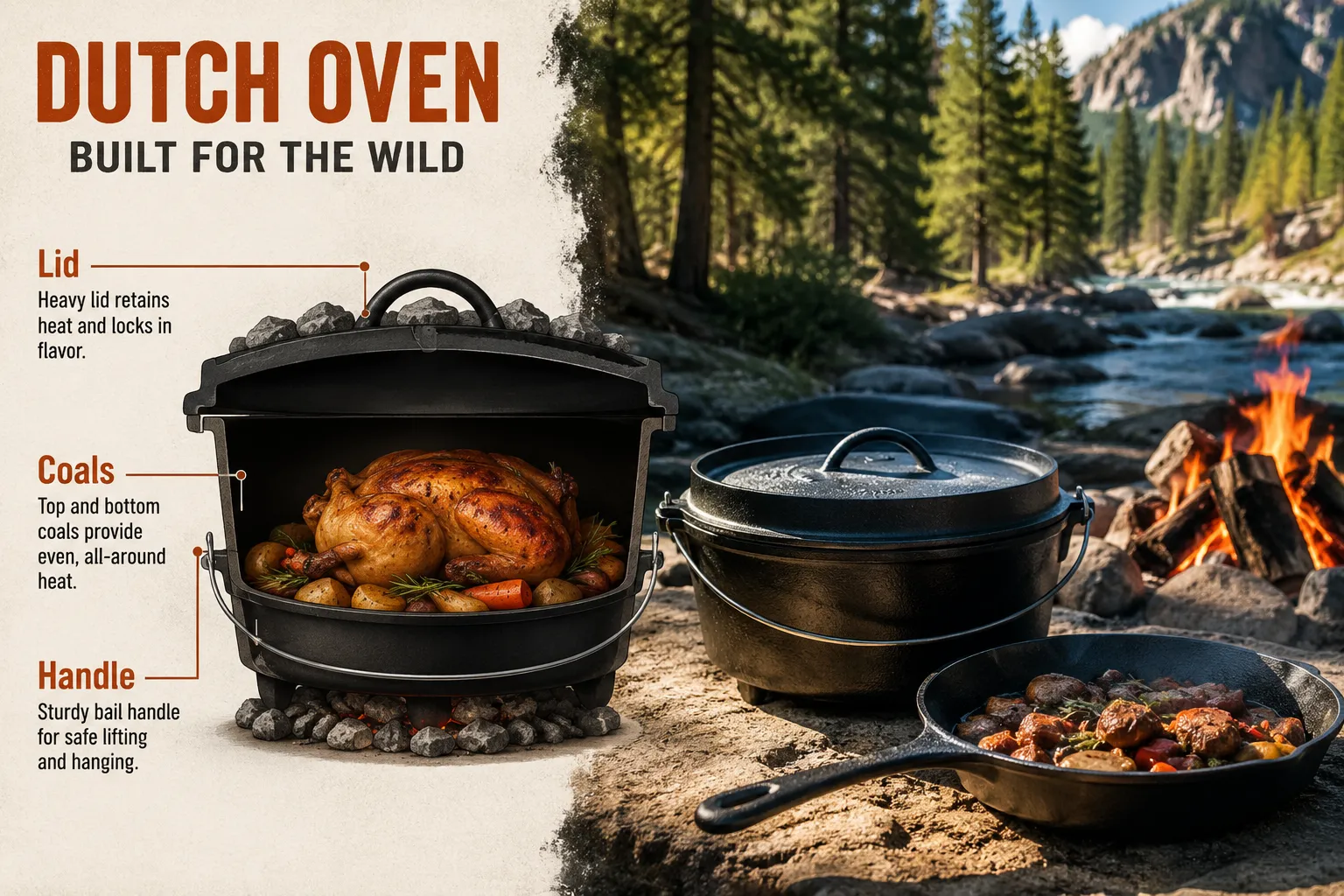
A dutch oven is a thick-walled cast iron pot with a tight-fitting lid designed to distribute and retain heat evenly. For camping and survival situations, it’s one of the most practical cooking tools available because it requires no electricity, works over any heat source, and can handle baking, boiling, frying, and slow-cooking with equal competence.
At a bug out location, where resources are limited and reliability is non-negotiable, the dutch oven earns its weight. Unlike lightweight backpacking cookware, cast iron holds heat long enough to fully cook dense foods like dried beans, bread dough, and root vegetables without constant attention. It also doubles as a serving vessel, reducing the number of dishes to clean when water may be scarce.
Why cast iron specifically:
- Retains heat far longer than aluminum or stainless steel
- Naturally non-stick when properly seasoned
- Virtually indestructible under normal use
- Compatible with open fire, charcoal, propane stoves, and wood-burning rocket stoves
- Can be passed down for generations with basic maintenance
For preppers building a long-term cooking system, the dutch oven is not a luxury, it’s a cornerstone. If you’re still building out your bug out kit, reviewing a complete bug out bag guide will help you understand what other tools belong alongside it.
What Size Dutch Oven Is Best for Bug Out Locations
The best size dutch oven for a bug out location depends on group size. A 12-inch, 6-quart dutch oven handles meals for 4 to 6 people and is the most commonly recommended size for family or small-group survival cooking. Solo preppers can get by with an 8-inch, 2-quart version that’s lighter and easier to transport.
Here’s a quick sizing reference:
| Dutch Oven Size | Quart Capacity | Best For |
|---|---|---|
| 8-inch | 2 quarts | 1 to 2 people |
| 10-inch | 4 quarts | 2 to 4 people |
| 12-inch | 6 quarts | 4 to 6 people |
| 14-inch | 8 quarts | 6 to 10 people |
Decision rule: If you’re bugging out alone or with one partner, the 10-inch is a smart middle ground. It’s lighter than the 12-inch but still large enough to cook a full pot of stew or a small loaf of bread. For family groups or community bug out scenarios, go with the 12-inch as your primary and consider a smaller secondary pot for boiling water.
Depth matters too. A “deep” dutch oven (sometimes called a camp oven) has taller walls and works better for stews, soups, and bread. A shallow model suits baking and roasting. For bug out use, the deep version is more flexible.
Dutch Oven vs Cast Iron Skillet for Camping
A dutch oven and a cast iron skillet serve different purposes, and for bug out cooking, the dutch oven wins on versatility. A skillet excels at quick, high-heat tasks like frying eggs, searing meat, or making flatbread. A dutch oven handles everything a skillet can plus slow cooking, baking, and boiling, making it the higher-priority item for a fixed bug out location.
That said, both tools together create a complete off-grid kitchen. The skillet handles breakfast and quick meals; the dutch oven handles long-cook dinners and bread baking.
Choose the dutch oven if you can only carry one piece of cookware. It can simulate a skillet by removing the lid and cooking over high heat, but a skillet cannot replicate the dutch oven’s enclosed cooking environment.
Choose both if you have a fixed bug out location with storage capacity. The combination covers nearly every cooking method without electricity.
How to Cook with a Dutch Oven Over a Campfire
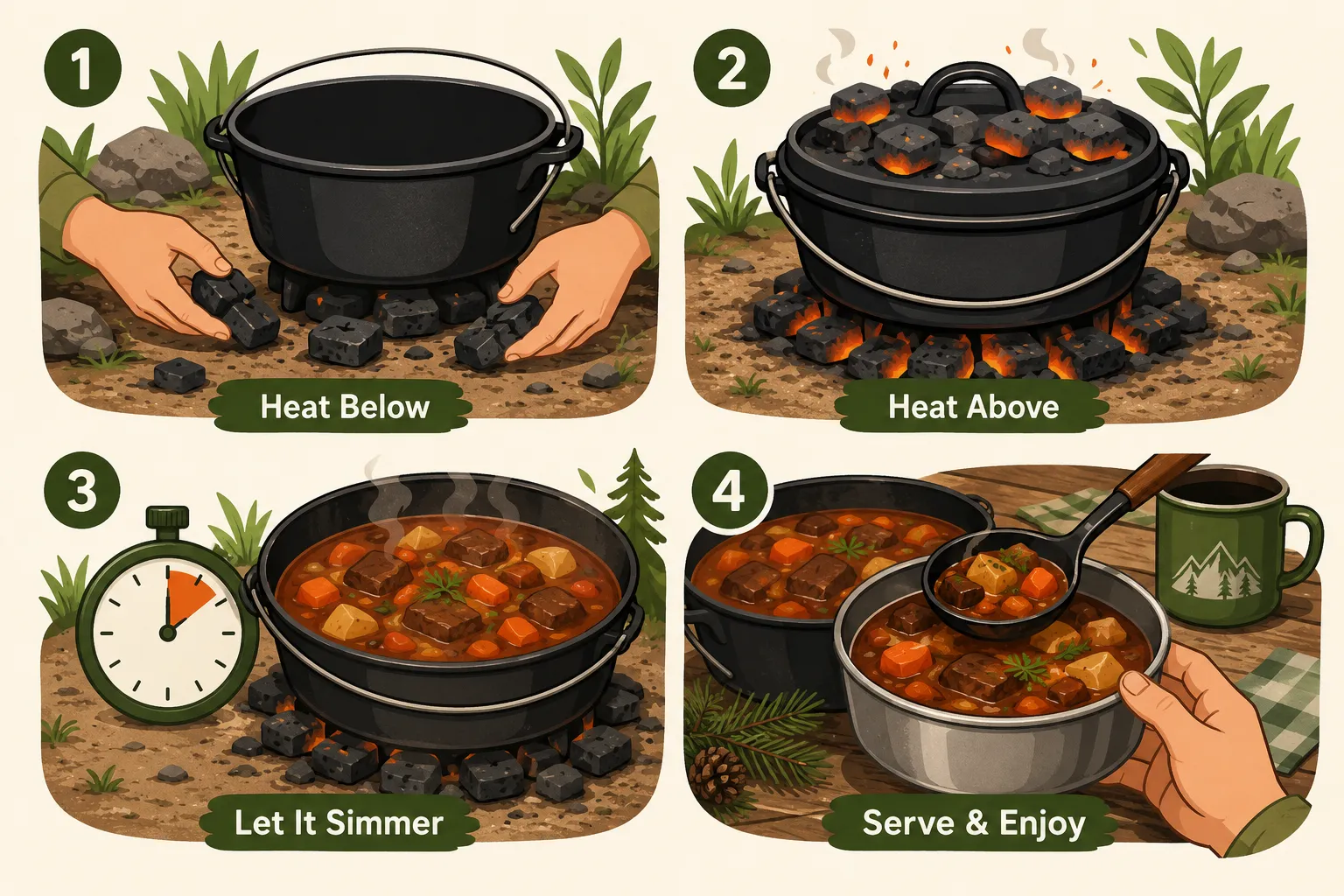
Cooking with a dutch oven over a campfire requires managing heat from both below and above the lid. The standard method uses charcoal briquettes or hardwood coals placed underneath the pot and on top of the lid to create an oven-like environment. For campfire cooking, allow your fire to burn down to a bed of glowing coals before placing the dutch oven, since open flames create uneven, often excessive heat.
Basic campfire setup steps:
- Build a fire and let it burn down to hot coals, typically 30 to 45 minutes.
- Rake a flat bed of coals about 2 inches deep.
- Place the dutch oven on a trivet or directly on the coals.
- Add additional coals or briquettes on top of the lid.
- Use a 2:1 ratio as a starting point: twice as many coals on the lid as underneath for baking, roughly equal amounts for stewing.
- Rotate the pot a quarter turn every 15 minutes to prevent hot spots.
- Resist lifting the lid more than necessary, since each peek drops the internal temperature significantly.
Charcoal briquette method (more precise): A common field estimate is that each standard briquette produces roughly 25 to 30 degrees Fahrenheit of heat. To reach approximately 350°F in a 12-inch dutch oven, place 25 briquettes total: 17 on the lid and 8 underneath. This is a widely used approximation among camp cooks, not a laboratory-verified figure, so adjust based on wind, altitude, and ambient temperature.
Learning to start and manage fire reliably is a foundational survival skill. For more on this, see the guide on how to start a survival fire in rain and the breakdown of fire starting mistakes in survival situations.
Can You Use a Dutch Oven on a Camping Stove
Yes, a cast iron dutch oven works on most camping stoves, including propane, butane, and dual-fuel models. The key limitation is stability: a heavy, loaded dutch oven on a small stove burner can tip if the stove’s grate isn’t wide enough to support the base. Use a stove with a wide, stable burner grate and keep the dutch oven centered.
Important note: Camping stoves provide heat from below only, not from above the lid. This means you lose the “oven” effect that makes dutch oven baking work. For soups, stews, and boiling, a camping stove works perfectly. For baking bread or making cobblers, you’ll need to supplement with coals or a secondary heat source on the lid.
Edge case: In high-wind conditions, a camping stove inside a sheltered area (such as a lean-to or vehicle) may actually be more fuel-efficient and controllable than an open campfire. This matters when propane supply is limited.
How Long Does Food Take to Cook in a Dutch Oven Outdoors
Outdoor dutch oven cooking takes longer than indoor cooking, typically 25 to 50 percent more time, because heat is less consistent and ambient temperature affects the pot. As a general rule, plan for 30 to 90 minutes for most recipes, with bread and baked goods on the longer end and soups on the shorter end.
Estimated cook times for common bug out recipes:
- Bean and rice stew (using pre-soaked dried beans): 60 to 75 minutes
- Canned meat and vegetable soup: 25 to 35 minutes
- Camp bread or cornbread: 45 to 60 minutes
- Oatmeal with dried fruit: 20 to 30 minutes
- Dried pasta with canned sauce: 30 to 40 minutes
- Whole grain porridge: 45 to 60 minutes
Altitude matters. At elevations above 3,500 feet, water boils at a lower temperature, which extends cook times for anything requiring boiling. Pre-soaking dried beans and grains overnight dramatically cuts cooking time and fuel use, an important consideration when wood or propane is limited.
Best Dutch Oven bug out Recipes for Beginners
The best beginner dutch oven bug out recipes use simple techniques, minimal ingredients, and forgiving cook times. These five recipes are designed specifically for preppers working with shelf-stable pantry staples and an open fire or charcoal setup.
Camp Stew with Canned Meat and Root Vegetables
This is the workhorse recipe for any bug out location. It requires no fresh ingredients and feeds 4 to 6 people from a single pot.
Ingredients: 2 cans of beef, chicken, or turkey, 2 cans of diced tomatoes, 1 cup dried lentils (pre-soaked), 2 cups water or broth (from a bouillon cube), 1 tablespoon dried onion flakes, salt, pepper, and any dried herbs available.
Method: Combine all ingredients in the dutch oven. Cover and cook over medium coals for 45 to 60 minutes, stirring occasionally. The lentils thicken the broth naturally.
Dutch Oven Cornbread
Cornbread requires no yeast and bakes reliably in a dutch oven with coals on the lid.
Ingredients: 1 cup cornmeal, 1 cup all-purpose flour, 1 tablespoon baking powder, 1 teaspoon salt, 2 tablespoons powdered milk mixed with 1 cup water, 2 tablespoons oil or lard, 1 egg (or 1 tablespoon flaxseed meal plus 3 tablespoons water as a substitute).
Method: Mix dry and wet ingredients separately, then combine. Pour into a greased dutch oven. Bake with 17 coals on the lid and 8 underneath for approximately 25 to 30 minutes until a toothpick comes out clean.
One-Pot Rice and Beans
A nutritionally complete meal that stores well and costs almost nothing to prep in advance.
Ingredients: 1 cup dried rice, 1 cup dried black beans (pre-soaked overnight), 3 cups water, 1 teaspoon cumin, 1 teaspoon garlic powder, salt to taste.
Method: Combine all ingredients. Cook covered over medium coals for 45 to 55 minutes, checking water level at the 30-minute mark and adding more if needed.
Oatmeal with Dried Fruit and Honey
A high-calorie breakfast that requires almost no prep and cooks in under 30 minutes.
Ingredients: 2 cups rolled oats, 4 cups water, 1/2 cup dried fruit (raisins, cranberries, or apricots), 2 tablespoons honey or sugar, pinch of salt.
Method: Bring water to a boil, add oats and fruit, cover and simmer for 15 to 20 minutes.
Camp Pasta with Canned Sauce
Ingredients: 2 cups dried pasta, 4 cups water, 1 can tomato sauce, 1 can diced tomatoes, 1 teaspoon Italian seasoning.
Method: Boil pasta in water until nearly tender, drain most of the water, add sauce and tomatoes, simmer 10 more minutes covered.
Dutch Oven Recipes That Work Without Fresh Ingredients
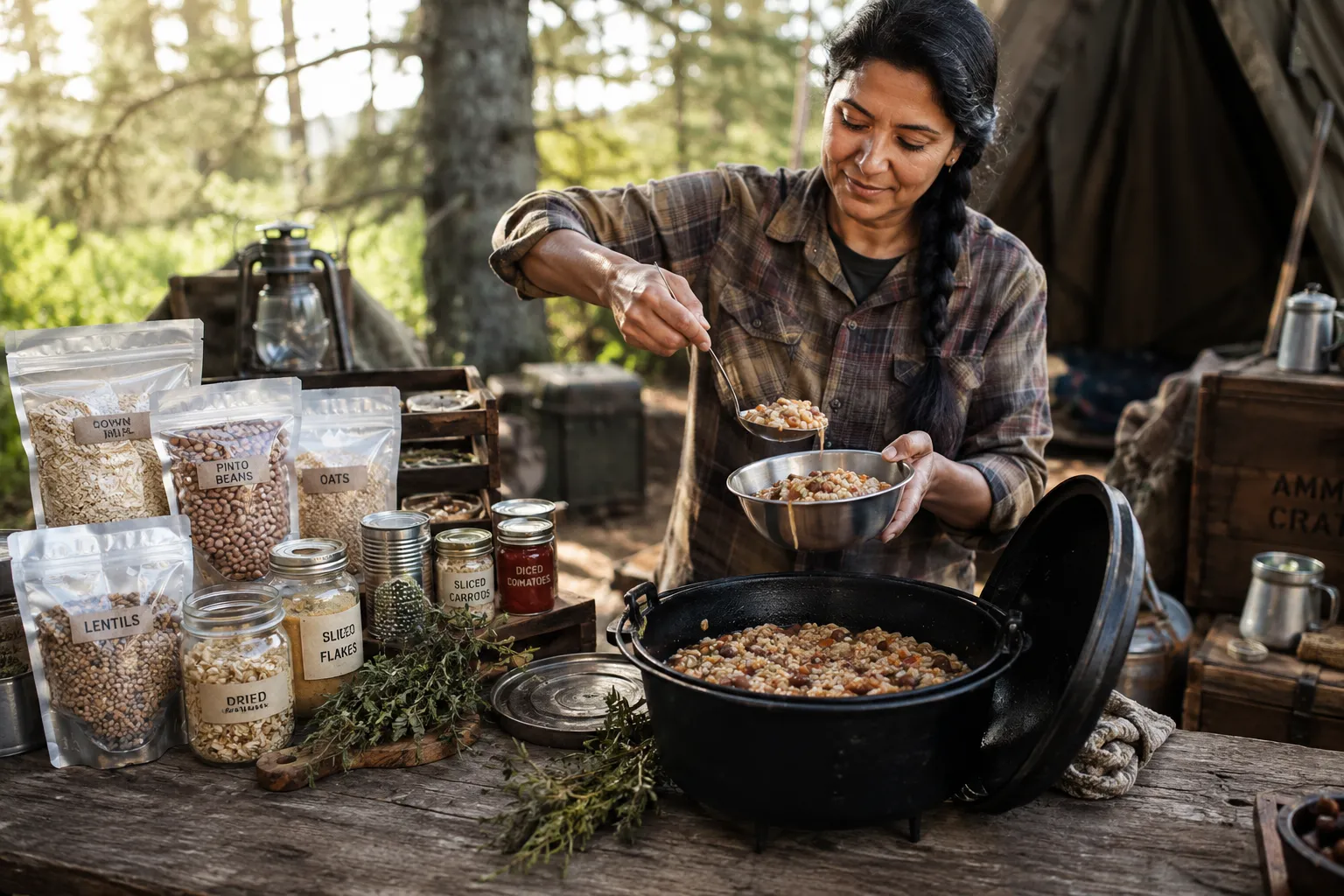
The most practical dutch oven camping recipes for your bug out location rely entirely on shelf-stable and long-term storage foods. Fresh produce, dairy, and meat are unavailable or unreliable in extended survival scenarios, so every recipe in your rotation should function without them.
Shelf-stable ingredient categories to stock:
- Dried grains: rice, oats, cornmeal, wheat berries, quinoa
- Dried legumes: lentils, black beans, pinto beans, split peas
- Canned proteins: tuna, chicken, salmon, corned beef, sardines
- Canned vegetables: tomatoes, corn, green beans, potatoes
- Fats: vegetable shortening, coconut oil (long shelf life), lard
- Flavor builders: salt, pepper, garlic powder, cumin, chili flakes, bouillon cubes, dried onion flakes
- Baking staples: flour, cornmeal, baking powder, powdered milk, powdered eggs
For a comprehensive breakdown of what to stock, the long-term food storage beginner’s guide and the 50 best foods for long-term storage are essential reading.
Powdered egg substitution tip: One tablespoon of flaxseed meal mixed with three tablespoons of water, left to sit for five minutes, replaces one egg in most baking recipes. This matters when your powdered egg supply runs low.
If your bug out location includes a garden or access to wild plants, you can supplement these pantry staples with foraged greens and root vegetables. The guide to foraging edible wild plants for beginners covers 25 plants that grow in most regions.
Dutch Oven Recipes for One Person vs Groups
Solo preppers and large groups need different approaches to dutch oven cooking. For one person, an 8 to 10-inch dutch oven is sufficient, and most recipes scale down by halving the ingredients and reducing cook time by 10 to 15 percent. For groups of 6 or more, a 12 to 14-inch dutch oven is necessary, and some recipes benefit from batch cooking.
Solo cooking adjustments:
- Use an 8-inch dutch oven to reduce fuel consumption
- Cook larger batches and reheat leftovers to save fuel
- Focus on one-pot meals that provide multiple servings
Group cooking adjustments:
- A 12-inch dutch oven feeds 4 to 6 comfortably for most stew and soup recipes
- For groups of 8 or more, consider two dutch ovens running simultaneously
- Assign one person to manage coal rotation and lid lifting to maintain consistent heat
Practical note: Cooking for a group at a bug out location is also a morale activity. A hot, well-seasoned meal does more for group cohesion and mental resilience than most people anticipate. That’s not a small thing in a prolonged emergency.
Cheapest Dutch Oven Brands for Bug Out Bags and Survival Cooking
The most affordable cast iron dutch ovens that still perform reliably for survival cooking come from Lodge, Camp Chef, and Bruntmor. Lodge is the most widely recommended brand among preppers and outdoor cooks because it’s pre-seasoned from the factory, widely available, and has a track record of decades of reliable use.
Budget-friendly options worth considering:
- Lodge Logic 12-inch Camp Dutch Oven: Pre-seasoned, has legs for coal cooking, flat lid for stacking, widely available for under $60 as of 2026.
- Camp Chef 12-inch Classic Dutch Oven: Similar features to Lodge, often available in the same price range, good for beginners.
- Bruntmor Pre-Seasoned Dutch Oven: A lower-cost alternative available online, suitable for light to moderate use.
What to avoid: Enameled dutch ovens, while excellent for home kitchens, are not ideal for open-fire survival cooking. The enamel coating can crack under extreme temperature changes, and they cannot be re-seasoned if damaged. For bug out use, bare cast iron is the correct choice.
A dutch oven is not something to include in a 72-hour bag due to its weight. It belongs at a fixed bug out location or a vehicle-based kit. For bag-specific food planning, the ultimate bug out bag food list covers lightweight options that complement your dutch oven setup once you arrive.
Common Mistakes When Cooking with Dutch Ovens While bug out
The most common dutch oven camping mistakes are using open flames instead of coals, lifting the lid too frequently, and not pre-soaking dried legumes. Each of these errors either ruins the meal or wastes fuel, both costly in a survival scenario.
Mistakes to avoid:
- Open flame cooking: Direct flames create hot spots that scorch the bottom while leaving the top undercooked. Always cook over coals.
- Lifting the lid constantly: Each time you lift the lid, you lose significant heat and extend cook time. Limit checks to once every 15 to 20 minutes.
- Skipping pre-soaking: Dried beans and legumes cooked without soaking take 2 to 3 hours versus 45 to 60 minutes when pre-soaked. In a fuel-limited scenario, that difference matters.
- Ignoring wind: Wind strips heat from the pot rapidly. Position your cooking setup with a windbreak (a log, rock, or tarp wall) to maintain consistent temperature.
- Not rotating the pot: Campfire coals are rarely perfectly even. Rotating the dutch oven a quarter turn every 15 minutes prevents one side from burning.
- Overfilling the pot: Fill no more than two-thirds full to allow for simmering and expansion, especially with grains that absorb water.
- Skipping seasoning maintenance: After each use, wipe the dutch oven clean, apply a thin layer of oil, and heat briefly to maintain the seasoning. Rust develops quickly in outdoor conditions.
FAQ
Can a dutch oven replace all my cooking equipment at a bug out location?
For most survival cooking tasks, yes. A 12-inch dutch oven can boil, bake, fry, and slow-cook. The one gap is high-speed tasks like quick stir-frying, where a cast iron skillet is more practical. Together, a dutch oven and a skillet cover virtually every cooking method without electricity.
How do I clean a dutch oven without running water?
Wipe it out while still warm with a dry cloth or paper towel. For stuck food, add a small amount of water and heat briefly to loosen debris, then wipe clean. Avoid soap when possible, as it degrades the seasoning. Apply a thin coat of oil after cleaning.
What happens if my dutch oven rusts?
Rust is not the end. Scrub the rust off with steel wool or a stiff brush, rinse, dry completely over heat, then re-season by applying a thin layer of oil and heating the pot upside down over coals or a fire for 30 to 60 minutes. Repeat two to three times for a solid seasoning layer.
Can I bake bread in a dutch oven without a thermometer?
Yes. Use the briquette counting method as a temperature guide (described above) and check doneness by tapping the top of the loaf. A hollow sound indicates the bread is baked through. A toothpick or thin stick inserted in the center should come out clean.
How much water do dutch oven recipes use?
Most stew and soup recipes use 2 to 4 cups of water per batch. Baking recipes use minimal water. In a water-scarce situation, prioritize recipes that use canned goods (which contain liquid) and dried lentils (which require less soaking water than whole beans). For water management at your bug out location, the emergency water storage and purification guide is an essential companion resource.
Is a dutch oven safe to use inside a tent or enclosed shelter?
No. Any open-fire or charcoal cooking produces carbon monoxide, which is lethal in enclosed spaces. Always cook outdoors or in a well-ventilated open structure. This is non-negotiable.
How long does a cast iron dutch oven last?
With basic maintenance, a cast iron dutch oven lasts generations. Many preppers use dutch ovens that are 50 or more years old. The investment is a one-time purchase if cared for properly.
What’s the best way to transport a dutch oven to a bug out location?
Wrap it in a thick cloth or place it in a padded bag to prevent chipping. Store it in your vehicle kit or at a pre-positioned cache at the bug out location itself. Its weight makes it impractical for foot travel beyond short distances.
Can kids help with dutch oven cooking at a bug out location?
Older children (10 and up) can help with measuring, mixing, and monitoring the timer. Keep younger children away from the hot coals and pot. Teaching camp cooking skills to children before an emergency is genuinely valuable preparation.
Do I need special tools to handle a dutch oven over a fire?
A lid lifter (a simple hook tool) and a pair of heavy leather gloves are the two most important accessories. They prevent burns when rotating the pot or checking the lid. A small shovel or tongs for moving coals is also useful.
Conclusion
Dutch oven camping recipes for your bug out location are not a nice-to-have. They’re a practical, tested system for feeding yourself and your group when the grid is gone and the grocery store is irrelevant. The dutch oven itself is simple technology that has worked for centuries, and it will keep working long after modern appliances become useless.
Start with the basics: get a pre-seasoned 12-inch Lodge camp dutch oven, stock your bug out location with the shelf-stable ingredients listed in this guide, and practice at least three of these recipes before you need them. Cooking over coals feels unfamiliar the first time. By the third time, it becomes routine.
Actionable next steps:
- Purchase a 12-inch pre-seasoned cast iron camp dutch oven and practice the cornbread and stew recipes at home or on a camping trip.
- Build a 30-day supply of the shelf-stable ingredients listed in this guide at your bug out location.
- Pre-soak and cook a batch of dried beans over an open fire to understand your local fuel and timing conditions.
- Review your 10 critical bug-out survival skills to ensure cooking is integrated into your broader preparedness plan.
- Cross-reference your food storage with the freeze-dried food guide to round out your long-term supply.
The people who thrive in a prolonged emergency are not the ones with the most gear. They’re the ones who practiced with what they had before it mattered.
Products, Tools, and Resources
Lodge Logic 12-Inch Camp Dutch Oven: The benchmark for survival cooking. Pre-seasoned, has three legs for coal cooking, and a flat lid that doubles as a skillet. Available at most outdoor retailers and online. Expect to pay in the $50 to $70 range as of 2026.
Camp Chef 12-Inch Classic Dutch Oven: A solid alternative to Lodge with similar specs and comparable performance. Worth considering if Lodge is unavailable in your area.
Lid Lifter and Glove Set: Any heavy-duty leather welding gloves paired with a cast iron lid lifter hook will do the job. These are inexpensive and essential for safe coal cooking.
Charcoal Briquettes (Kingsford or equivalent): Standard briquettes provide consistent, predictable heat that’s easier to manage than wood coals for beginners. Store a supply at your bug out location in a sealed container.
Lodge Seasoning Spray or Flaxseed Oil: For maintaining your dutch oven’s seasoning between uses. Flaxseed oil creates one of the hardest, most durable seasoning layers available.
Preppers HQ Long-Term Food Storage Resources: For building the pantry that feeds your dutch oven recipes, the long-term food storage beginner’s guide and the 50 best foods for long-term storage are the most practical starting points on the site.