
Hey there! Some links on this page may be affiliate links which means that, if you choose to make a purchase, I may earn a commission at no extra cost to you. I greatly appreciate your support. Read the full disclosure here.
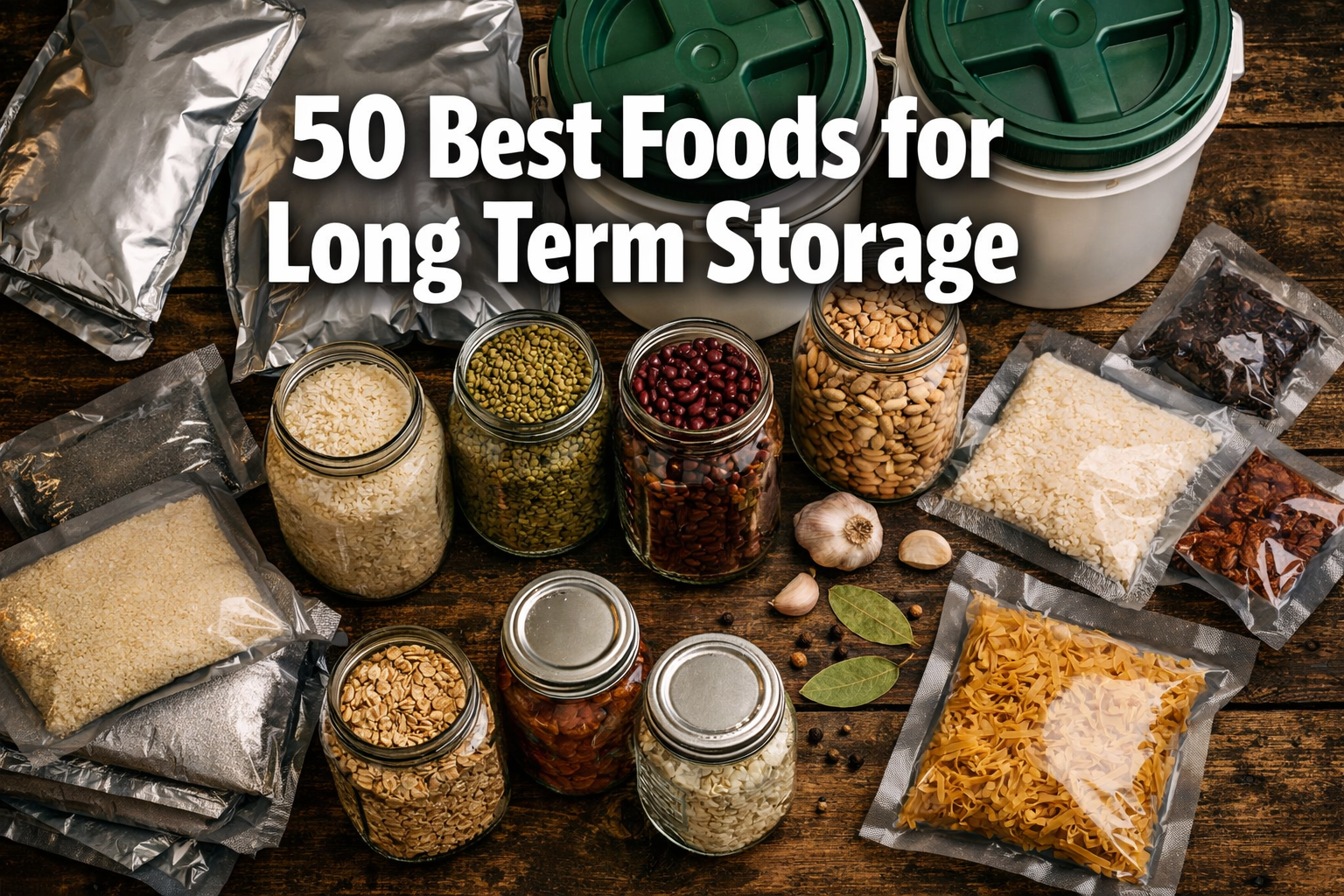
The 50 best foods for long-term storage include grains like white rice and hard red wheat, legumes like dried pinto beans and lentils, fats like coconut oil and ghee, proteins like freeze-dried meat and canned fish, and sweeteners like honey and white sugar. When stored correctly in airtight containers with oxygen absorbers, many of these foods last 25 years or more. Prioritize caloric density, nutritional balance, and foods your household already eats.
Long Term Food Storage: The Complete Beginner’s Guide
Key Takeaways
- White rice is the single most practical long-term storage staple, offering 25+ year shelf life when sealed in mylar bags with oxygen absorbers.
- Shelf life varies widely: honey never expires, but brown rice goes rancid in 6 months due to oil content.
- Storage conditions matter more than the food itself: heat, light, moisture, and oxygen are the four enemies of any food stockpile.
- Nutritional balance is critical: a stockpile heavy on carbs but low in fats, proteins, and vitamins will cause health problems within weeks.
- Rotate your stock: first-in, first-out (FIFO) keeps food fresh and prevents waste.
- Freeze-dried foods retain up to 97% of their original nutrition and are the gold standard for protein and vegetable storage.
- Avoid storing foods you don’t normally eat: a crisis is not the time to learn you hate powdered eggs.
- Caloric density per dollar should guide purchasing decisions for budget-conscious preppers.
- Water storage must accompany food storage, especially for grains and legumes that require significant water to prepare.
- A well-rounded stockpile covers at minimum: grains, legumes, fats, proteins, sweeteners, salt, and vitamins.
Why Long-Term Food Storage Matters More Than Ever
Food supply disruptions are not hypothetical. The USDA reported that in 2020 alone, supply chain breakdowns left grocery store shelves depleted for weeks in many U.S. regions. For survivalists and preppers, a well-stocked pantry is not paranoia — it is practical risk management.
The 50 best foods for long-term storage are chosen based on four criteria:
- Shelf life (how long the food remains safe and nutritious when stored properly)
- Caloric density (calories per pound or per dollar)
- Nutritional value (macronutrient and micronutrient contribution)
- Versatility (how many meals or uses it supports)
This guide covers all 50 foods across major categories, explains storage requirements, and flags common mistakes that shorten shelf life.
The 50 Best Foods for Long-Term Storage, Organized by Category
 The foods below are grouped by category to make stockpile planning easier. Each category fills a specific nutritional role. Skipping any one category creates gaps that become serious problems during extended emergencies.
🌾 Grains and Starches (12 Foods)
Grains are the caloric backbone of any long-term food supply. They are cheap, dense in carbohydrates, and store exceptionally well when kept dry and sealed.
| # | Food | Shelf Life (Sealed) | Notes |
|---|---|---|---|
| 1 | White rice | 25–30 years | Best overall staple; avoid brown rice for long-term |
| 2 | Hard red wheat (whole berry) | 25–30 years | Requires a grain mill; highest nutrition of all wheats |
| 3 | Hard white wheat | 25–30 years | Milder flavor; good for bread baking |
| 4 | Rolled oats | 20–30 years | Versatile; eaten hot or cold |
| 5 | Cornmeal | 5–10 years | Store in mylar; good for cornbread and porridge |
| 6 | All-purpose white flour | 5–10 years | Shorter life than whole wheat berries; rotate regularly |
| 7 | Pasta (white, dried) | 25–30 years | Avoid whole wheat pasta for long-term storage |
| 8 | Quinoa | 8–10 years | Complete protein; a rare grain with all essential amino acids |
| 9 | Barley (pearled) | 8 years | Good for soups and stews |
| 10 | Rye berries | 8 years | Dense nutrition requires grinding |
| 11 | Buckwheat groats | 2 years | Gluten-free alternative; shorter shelf life |
| 12 | Instant mashed potatoes | 25–30 years | High caloric value; quick to prepare |
Common mistake: Storing brown rice instead of white. Brown rice contains natural oils that go rancid within 6 months, even when sealed. White rice is the correct choice for long-term storage.
🫘 Legumes (10 Foods)
Legumes are the primary protein and fiber source in most long-term food plans. They are inexpensive and pair naturally with grains to form complete proteins.
| # | Food | Shelf Life (Sealed) | Notes |
|---|---|---|---|
| 13 | Pinto beans | 25–30 years | Most popular prepper legume |
| 14 | Black beans | 25–30 years | High in antioxidants |
| 15 | Kidney beans | 25–30 years | Good for chili and stews |
| 16 | Lentils (red or green) | 25–30 years | No soaking required; fastest-cooking legume |
| 17 | Split peas | 25 years | Great for soups; high in protein |
| 18 | Chickpeas (garbanzo beans) | 25–30 years | Versatile; can make hummus with stored tahini |
| 19 | Navy beans | 25–30 years | Small size cooks faster; good for baked beans |
| 20 | Adzuki beans | 8–10 years | Slightly shorter life; nutritious alternative |
| 21 | Black-eyed peas | 25 years | Southern staple; easy to cook |
| 22 | Soybeans (whole, dried) | 8–10 years | Complete protein; requires longer cooking |
Decision rule: Choose lentils if cooking fuel is limited. They cook in 20–30 minutes without pre-soaking, compared to 90+ minutes for most dried beans.
🥩 Proteins Beyond Legumes (8 Foods)
 Legumes alone won’t cover all protein needs, especially for physically active adults during a crisis. These additional protein sources add variety and nutritional completeness.
| # | Food | Shelf Life | Notes |
|---|---|---|---|
| 23 | Freeze-dried chicken | 25–30 years | High cost; highest protein retention |
| 24 | Freeze-dried beef | 25–30 years | Excellent for stews and rice dishes |
| 25 | Canned tuna (in water) | 3–5 years | Rotate frequently; affordable protein |
| 26 | Canned salmon | 3–5 years | Higher omega-3 content than tuna |
| 27 | Canned sardines | 3–5 years | Excellent fat and protein ratio |
| 28 | Powdered whole eggs | 5–10 years | Critical for baking and nutrition |
| 29 | Powdered milk (non-fat) | 20–25 years | Good calcium and protein source |
| 30 | Canned chicken | 3–5 years | Convenient; no preparation needed |
🫙 Fats and Oils (5 Foods)
Fat is the most calorie-dense macronutrient at 9 calories per gram. Most preppers under-stock fats, which leads to caloric deficits and a condition sometimes called “rabbit starvation” when protein is consumed without adequate fat.
| # | Food | Shelf Life | Notes |
|---|---|---|---|
| 31 | Coconut oil (refined) | 2–5 years | Stable saturated fat; resists rancidity |
| 32 | Ghee (clarified butter) | 1–2 years (unopened) | Shelf-stable without refrigeration |
| 33 | Olive oil (extra virgin) | 2 years | Store in dark, cool location |
| 34 | Shortening (vegetable) | 8–10 years | Useful for baking; long shelf life |
| 35 | Peanut butter powder | 4–5 years | Lighter to store than jarred; high fat and protein |
Edge case: Liquid oils stored in clear plastic bottles degrade rapidly from light exposure. Transfer to dark glass containers and store in a cool, dark location.
🍯 Sweeteners and Salt (4 Foods)
These foods serve dual roles: caloric value and flavor. Salt is also essential for food preservation itself.
| # | Food | Shelf Life | Notes |
|---|---|---|---|
| 36 | Honey (raw) | Indefinite | Archaeologists found 3,000-year-old honey still edible |
| 37 | White granulated sugar | 30+ years | Store in airtight containers away from moisture |
| 38 | Maple syrup (pure) | 4 years (unopened) | Freeze for longer storage |
| 39 | Iodized salt | Indefinite | Also critical for food preservation and electrolyte balance |
🌿 Herbs, Spices, and Flavor Enhancers (5 Foods)
Eating the same foods for weeks without seasoning causes appetite fatigue, which leads people to eat less than they need. Spices are lightweight, cheap, and dramatically improve morale.
| # | Food | Shelf Life | Notes |
|---|---|---|---|
| 40 | Black pepper (whole) | 3–4 years | Grind as needed for best flavor |
| 41 | Garlic powder | 3–4 years | Adds flavor and has antimicrobial properties |
| 42 | Cayenne pepper | 2–3 years | Adds heat; also has medicinal uses |
| 43 | Cumin | 3–4 years | Essential for beans, rice, and stews |
| 44 | Bouillon cubes/powder | 2 years | Transforms plain grains into flavorful meals |
🥦 Freeze-Dried and Dehydrated Vegetables (4 Foods)
Fresh vegetables are the hardest category to replicate in long-term storage. Freeze-dried options are the best solution, though they come at a higher cost.
| # | Food | Shelf Life | Notes |
|---|---|---|---|
| 45 | Freeze-dried spinach | 25–30 years | High in iron and vitamins A, C, K |
| 46 | Freeze-dried broccoli | 25–30 years | Excellent vitamin C and fiber source |
| 47 | Dehydrated onions | 10–15 years | Adds flavor and nutrition to almost any dish |
| 48 | Freeze-dried bell peppers | 25–30 years | Vitamin C source; adds variety |
💊 Nutritional Supplements (2 Foods)
No food list is complete without acknowledging that even the best stockpile has nutritional gaps. Two supplements address the most common deficiencies in grain-and-legume-heavy diets.
| # | Item | Shelf Life | Notes |
|---|---|---|---|
| 49 | Multivitamins | 2–3 years | Rotate regularly; address micronutrient gaps |
| 50 | Vitamin C powder (ascorbic acid) | 3 years | Critical for immune function; prevents scurvy in long-term scenarios |
How to Store These Foods Correctly
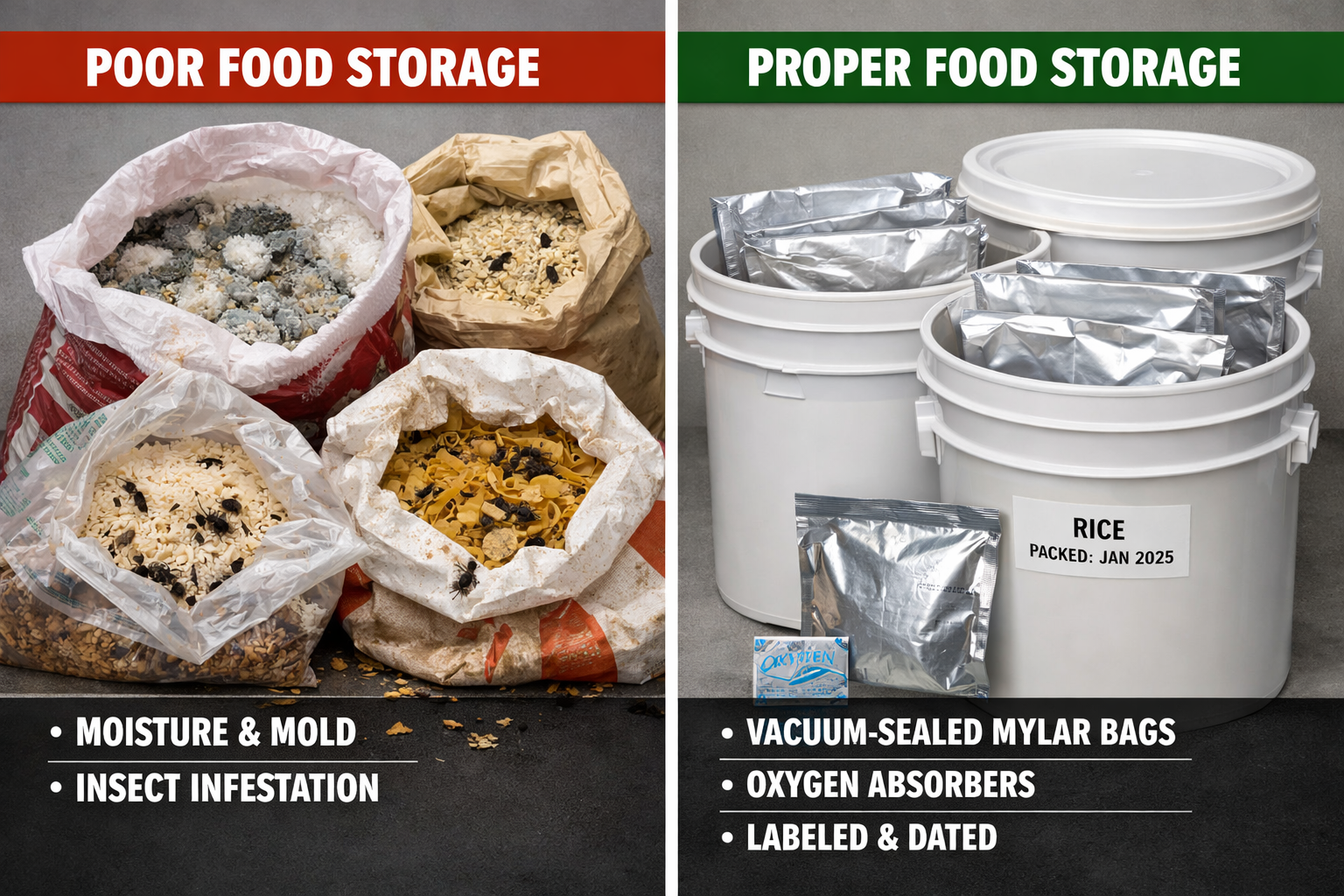
Proper storage is what separates a 25-year shelf life from a 2-year one. The four enemies of stored food are heat, light, moisture, and oxygen.
The standard long-term storage method:
- Use food-grade mylar bags (5-mil thickness minimum) inside food-grade plastic buckets (5-gallon, HDPE #2).
- Add oxygen absorbers appropriate to container size (typically 2,000cc per 5-gallon bucket for grains).
- Seal the mylar bag with a clothes iron or hair straightener along the top edge.
- Label every container with the food name, date packed, and quantity.
- Store in a cool, dark location — ideally below 70°F (21°C). Every 10°F reduction in temperature roughly doubles shelf life.
💡 Pull quote: “Temperature is the single most powerful variable in food shelf life. A pantry at 60°F stores food nearly twice as long as one at 80°F.”
Container options by food type:
- Grains and legumes: Mylar bags in 5-gallon buckets
- Oils and fats: Dark glass bottles or original sealed containers, stored cool
- Canned goods: Original cans; avoid dented or bulging cans
- Spices: Original airtight containers in a cool, dark cabinet
Common Mistakes That Ruin Long-Term Food Storage
Even experienced preppers make these errors. Knowing them in advance prevents costly losses.
- Storing brown rice or whole wheat flour instead of white rice and whole wheat berries. Oils in these foods cause rapid rancidity.
- Skipping oxygen absorbers in sealed containers. Oxygen enables mold, bacteria, and insect eggs to survive and destroy food.
- Storing food in a garage or attic where temperatures regularly exceed 80°F. Heat is the fastest way to cut shelf life in half.
- Building a stockpile of unfamiliar foods. If the household doesn’t eat lentils now, a crisis won’t make them more appealing.
- Ignoring fat storage. A diet of rice and beans without adequate fat leads to caloric deficiency and health deterioration within weeks.
- Failing to rotate canned goods. Canned foods stored past their best-by date lose nutritional value and eventually become unsafe.
How Much Food Should a Prepper Store?
A standard benchmark used by many preparedness organizations is a one-year supply per person. FEMA recommends a minimum 72-hour emergency kit, but serious preppers target 3 months to 1 year as a baseline.
Rough caloric targets per adult per day:
- Sedentary adult: 2,000 calories
- Active adult or manual labor: 2,500–3,000 calories
- Children (ages 6–12): 1,400–1,600 calories
Estimated quantities for one adult for one year (approximate):
| Food | Quantity |
|---|---|
| White rice | 150–200 lbs |
| Dried beans/lentils | 60–80 lbs |
| Wheat berries | 100–150 lbs |
| Rolled oats | 50 lbs |
| Sugar | 40 lbs |
| Salt | 8 lbs |
| Cooking oil | 10–12 quarts |
| Powdered milk | 16 lbs |
| Honey | 6–8 lbs |
These are estimates based on a 2,000-calorie-per-day diet. Adjust based on household size, activity level, and dietary needs.
FAQ
Q: What is the single best food for long-term storage?
White rice is the most practical single food for long-term storage. It provides dense carbohydrates, has a 25–30 year shelf life when sealed in mylar with oxygen absorbers, and costs less per calorie than almost any other storable food.
Q: Does honey really last forever?
Yes. Honey is hygroscopic and naturally antimicrobial. Archaeologists have found honey in Egyptian tombs thousands of years old that was still edible. The key is keeping it sealed and free from moisture contamination.
Q: Can canned goods be stored long-term?
Canned goods are safe to eat beyond their printed best-by dates in most cases, but nutritional value and taste decline over time. Most canned goods are best rotated within 3–5 years for optimal quality.
Q: What foods should NOT be stored long-term?
Avoid brown rice, whole wheat flour, nuts (unless vacuum-sealed), crackers, chips, and any food with high moisture content. These foods go rancid or stale quickly and are poor candidates for multi-year storage.
Q: Do oxygen absorbers work for all foods?
Oxygen absorbers work well for dry goods like grains, legumes, pasta, and powdered foods. Do not use them with sugar (it will harden into a solid brick) or with foods that have high fat content, where they are less effective.
Q: How do I store cooking oil long-term?
Refined coconut oil and vegetable shortening are the most stable options. Store in a cool, dark location. Avoid storing large quantities of olive or vegetable oil, as they go rancid within 1–2 years even when unopened.
Q: Is freeze-dried food worth the cost?
For proteins and vegetables, yes. Freeze-dried foods retain up to 97% of original nutrition and last 25–30 years. The cost is significantly higher than that of bulk grains, so prioritize freeze-dried options for foods that cannot be stored any other way.
Q: How do I prevent insects in stored grains?
Oxygen absorbers eliminate the oxygen that insects need to survive. Diatomaceous earth (food-grade) can also be added to bulk grain storage. Freezing grains for 72 hours before sealing kills any existing insect eggs.
Q: What is the best container for long-term food storage?
5-mil mylar bags sealed inside food-grade HDPE 5-gallon buckets with gamma-seal lids is the gold standard for grains and legumes. Glass mason jars with oxygen absorbers work well for smaller quantities of spices, seeds, and powders.
Q: Should I store water alongside my food supply?
Absolutely. Grains and legumes require significant water to cook. FEMA recommends 1 gallon of water per person per day as a minimum. For a one-year food supply, water storage or a reliable water filtration system is non-negotiable.
Q: How do I build a stockpile on a tight budget?
Start with the cheapest, highest-calorie foods first: white rice, pinto beans, rolled oats, and salt. Add one or two items per grocery trip. Buying in bulk from warehouse stores or restaurant supply companies reduces the cost per pound significantly.
Q: Do I need special equipment to store food long-term?
At minimum: a clothes iron or hair straightener for sealing mylar bags, oxygen absorbers, food-grade mylar bags, and food-grade buckets with lids. A vacuum sealer is useful but not essential for most bulk dry goods.
Conclusion: Build Your Stockpile Strategically
The 50 best foods for long-term storage cover every major nutritional category a household needs to survive and function through an extended emergency. The framework is straightforward: start with caloric staples (rice, beans, oats, wheat), add fats and proteins, fill nutritional gaps with freeze-dried vegetables and supplements, and season everything with a solid spice collection.
Actionable next steps for 2026:
- Audit your current pantry and identify which of the 50 foods you already have.
- Calculate your household’s caloric needs based on the estimates above.
- Purchase your first month’s supply of white rice, pinto beans, rolled oats, and salt this week.
- Invest in proper storage containers: mylar bags, oxygen absorbers, and food-grade buckets.
- Set a monthly budget for expanding your stockpile and stick to it.
- Rotate regularly: eat what you store and replace what you eat.
A well-built food supply is not built in a day. It’s built in consistent, deliberate steps. Start with what’s practical, expand methodically, and prioritize the foods your household will actually eat.
References
- U.S. Department of Agriculture (USDA). Food Safety and Inspection Service: Shelf-Stable Food. https://www.fsis.usda.gov/food-safety/safe-food-handling-and-preparation/food-safety-basics/shelf-stable-food (2013)
- Federal Emergency Management Agency (FEMA). Emergency Supply List. https://www.ready.gov/kit (2021)
- Church, Deanna. The Prepper’s Pantry: Building and Thriving with Food Storage. Alpha Books. (2014)
- National Center for Home Food Preservation, University of Georgia. Drying Foods. https://nchfp.uga.edu/how/dry.html (2020)
- Nummer, Brian A. Historical Origins of Food Preservation. National Center for Home Food Preservation. https://nchfp.uga.edu/publications/nchfp/factsheets/food_pres_hist.html (2002)
Meta Description: Discover the 50 best foods for long-term storage with shelf lives, storage tips, and quantities. The complete survivalist guide for building a reliable food supply.