

Hey there! Some links on this page may be affiliate links which means that, if you choose to make a purchase, I may earn a commission at no extra cost to you. I greatly appreciate your support. Read the full disclosure here.
Only 39% of Americans report having an emergency kit at home, according to a 2023 FEMA National Household Survey. For a family of four, that gap between intention and action isn’t just a statistic, it’s a vulnerability. A properly built emergency kit for family of 4 can mean the difference between managing a crisis calmly and scrambling in the dark.
This guide covers everything: what to pack, how much water you actually need, how to adapt for kids, elderly parents, pets, allergies, and whether you live in a studio apartment or a house with a full garage.
Find this useful? Add us as a preferred source on Google and more of what we publish will show up in your results.
Key Takeaways
- A complete emergency kit for a family of four should cover at least 72 hours, with a 2-week supply as the stronger preparedness target
- Water is the single most critical supply: plan for a minimum of 1 gallon per person per day, totaling at least 12 gallons for a 3-day kit
- Pre-made kits are a solid starting point, but almost every family will need to customize for medications, dietary needs, and children’s items
- Supplies should be inspected every 6 months and rotated based on expiration dates
- Bug out bags and home emergency kits serve different purposes and both have a place in a complete family preparedness system
- Families with pets, elderly members, or members with medical conditions need dedicated add-on supplies beyond the standard checklist
- Storage location matters: cool, dry, and accessible beats any other consideration
- Cost to build a solid DIY kit from scratch typically ranges from $150 to $400, depending on quality and depth of supplies
What Should Be in an Emergency Kit for a Family of 4
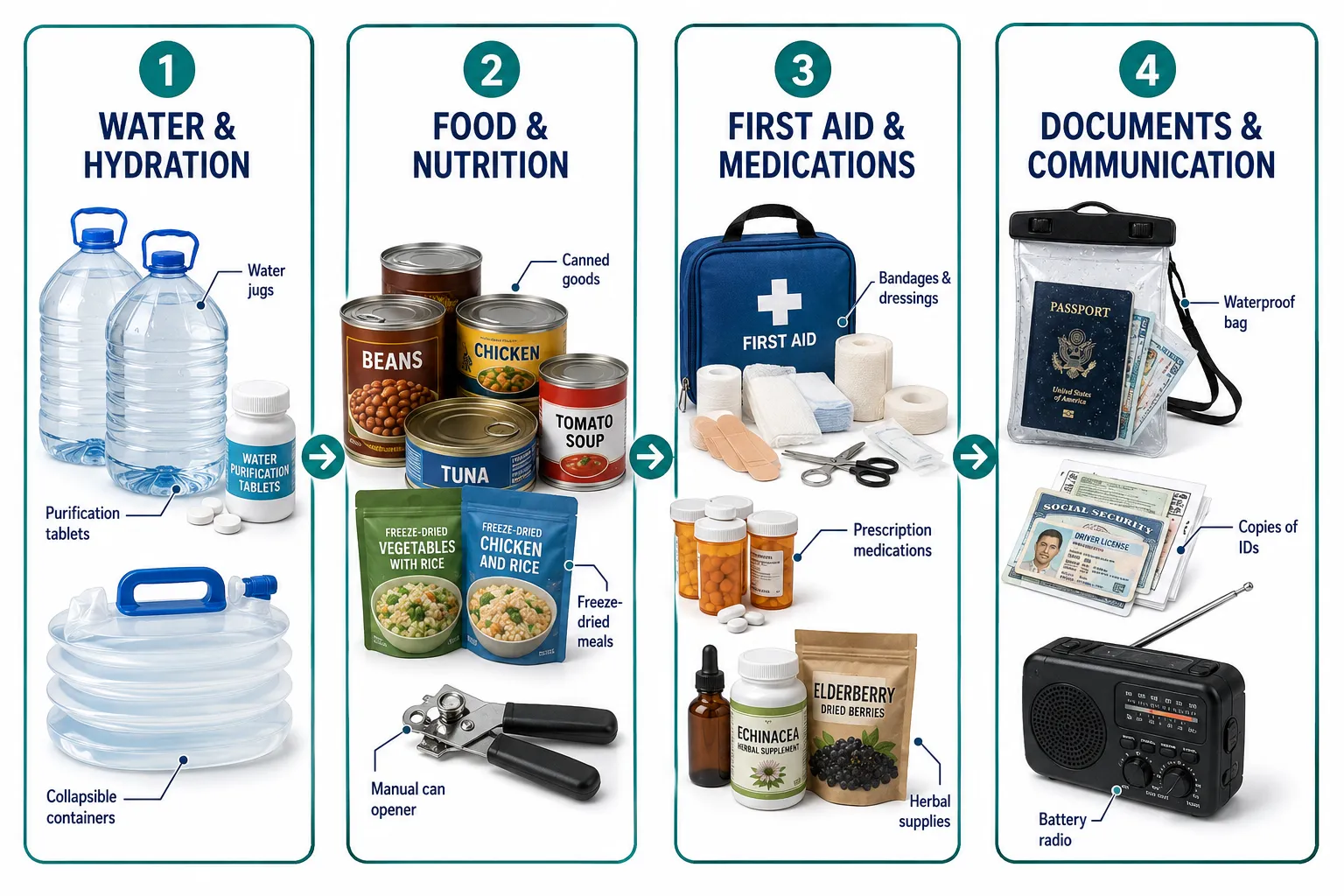
A complete emergency kit for a family of four covers six core categories: water, food, first aid, tools and safety, documents, and communication. Every item in the kit should serve at least one of these categories.
Here is a practical master checklist organized by category:
Water and Hydration
- 12 gallons of stored water minimum (1 gallon per person per day for 3 days)
- Water purification tablets or a quality filter (LifeStraw Family or Sawyer Squeeze)
- Collapsible water containers for refilling at secondary sources
Food and Nutrition
- 3-day minimum supply of non-perishable food (target 2,000 calories per adult per day)
- Canned goods, freeze-dried meals, energy bars, and peanut butter
- Manual can opener, do not skip this
- Foods your family will actually eat (comfort matters during stress)
For budget-conscious families, see this guide to building a 3-month emergency food supply for $100, the same principles apply when scaling down to a 72-hour kit.
First Aid and Medical
- Comprehensive first aid kit: bandages, gauze, antiseptic, medical tape, tourniquets
- 7-day minimum supply of all prescription medications (30-day preferred)
- Over-the-counter medications: pain relievers, antihistamines, antidiarrheal, antacids
- Thermometer, blood pressure cuff if applicable, extra glasses or contacts
Tools and Safety
- Flashlights with extra batteries (or hand-crank models)
- Battery-powered or hand-crank weather radio (NOAA-capable)
- Multi-tool or Swiss Army knife
- Duct tape, paracord, work gloves
- Emergency whistle for each family member
- Fire extinguisher (if not already staged in the home)
Documents
- Waterproof bag containing: copies of IDs, passports, insurance policies, bank account info, medical records, and a written family emergency contact list
- USB drive with digital copies of critical documents
- Small amount of cash in small bills (ATMs fail during power outages)
Communication and Shelter
- Fully charged portable power bank
- Extra phone charging cables
- Emergency mylar blankets (one per person, minimum)
- Change of clothes and sturdy shoes for each family member
- Sanitation supplies: hand sanitizer, toilet paper, garbage bags, feminine hygiene products
For a deeper dive into items most people overlook, read 15 things missing from your emergency kit that could cost you everything.
How Much Water Does a Family of 4 Need in an Emergency Kit
The standard recommendation from FEMA and the Red Cross is 1 gallon of water per person per day. For a family of four, that means 12 gallons for a 3-day kit, 28 gallons for a 7-day kit, and 56 gallons for a 2-week supply.
That 1-gallon figure covers drinking and basic sanitation. In hot climates, during physical exertion, or for pregnant or nursing women, that number should increase to 1.5 to 2 gallons per person per day.
Practical water storage options for families:
- 1-gallon jugs: easy to rotate, but storage-intensive
- 5-gallon stackable containers: the most space-efficient option for most homes
- 55-gallon water barrels: ideal for garages or basements, not apartments
- WaterBOB bathtub liner: fills a standard tub with up to 100 gallons during a pre-disaster warning period
Beyond storage, always have a backup purification method. Water sources can become compromised during floods or infrastructure failures. The ultimate emergency water storage and purification guide covers filtration, chemical treatment, and boiling protocols in full detail.
Best Emergency Kit for Families with Kids
Families with children need to add age-specific items that standard adult kits simply don’t include. A family emergency kit for a family of four with young children requires a dedicated children’s section.
For infants and toddlers:
- Formula or breast milk storage supplies
- Baby food pouches (no cooking required)
- Diapers, wipes, diaper rash cream
- Baby carrier or sling (keeps hands free during evacuation)
- Comfort item (small stuffed animal or blanket)
For school-age children:
- Activity books, cards, or small games (critical for morale during extended sheltering)
- Child-sized N95 masks
- Copies of school emergency contact cards
- Their own small backpack with a few personal items
Teaching children what to do during an emergency is just as important as the gear itself. The guide on emergency preparedness for kids covers age-appropriate drills and tasks that build real confidence.
Emergency Kit for a Family of 4 with Pets
Pets require their own dedicated emergency supplies, they cannot share from the family kit. A pet add-on kit for a family of four with one or two animals should include at minimum a 3-day supply of food, water, and essential medical items.
Pet emergency kit essentials:
- 3-day supply of pet food in sealed, waterproof containers
- Water and a collapsible bowl
- Copies of vaccination records and vet contact information
- Any prescription medications with at least a 7-day supply
- Leash, harness, and a secure carrier or crate
- Comfort items and familiar toys to reduce stress
- Waste bags or a portable litter setup for cats
For a complete breakdown, the ultimate pet emergency preparedness checklist covers 45 items across all pet types.
Emergency Kit for a Family of 4 with Elderly Parents or Medical Conditions
Elderly family members and those with chronic medical conditions require significant customization beyond the standard kit. This is one of the most commonly under-prepared areas in family emergency planning.
Priority additions for elderly or medically vulnerable family members:
- Extended medication supply (30-day minimum for critical prescriptions)
- Medical device power backup: portable battery packs for CPAP machines, hearing aid batteries, insulin cooler packs
- Mobility aids: spare cane, walker, or wheelchair-compatible evacuation plan
- Written medication schedule and dosage instructions (in case a caregiver is unavailable)
- Medical alert information card in a visible location on their person
- Comfort items and familiar routines to reduce cognitive stress during crises
For families managing senior-specific needs, the guide on 9 essential disaster prep strategies for seniors provides targeted protocols.
Emergency Kit for a Family of 4 with Allergies or Medications
Food allergies and prescription medications require dedicated planning that a standard pre-made kit will not address. Every family member’s medical profile should be documented and stored in the kit’s document pouch.
Allergy and medication checklist:
- Maintain at least two EpiPens per person with a severe allergy, stored in a temperature-stable location
- Audit all food supplies for allergen cross-contamination (many emergency food brands use shared facilities)
- Keep a written list of all medications, dosages, prescribing doctors, and pharmacy contact numbers
- Store medications in their original labeled containers where possible
- For insulin-dependent diabetics: a cooler pack, extra test strips, and a glucagon emergency kit
- Antihistamines in both liquid and tablet form for varied reactions
What’s the Difference Between a Bug Out Bag and an Emergency Kit
A bug out bag is a portable, person-specific pack designed for rapid evacuation, typically a 72-hour supply carried on your back. A home emergency kit is a stationary, household-level supply cache designed for sheltering in place for 72 hours to 2 weeks or more.
Both are necessary. They serve different scenarios.
| Feature | Bug Out Bag | Home Emergency Kit |
|---|---|---|
| Purpose | Rapid evacuation | Shelter in place |
| Size | Portable backpack | Multiple containers or bins |
| Duration | 72 hours per person | 72 hours to 2+ weeks for the family |
| Location | Bedroom, vehicle | Home storage area |
| Weight | 20-35 lbs per person | No weight limit |
For a family of four, the ideal setup includes both: individual bug out bags for each adult (and age-appropriate versions for children) plus a central home emergency kit. See the family bug out bag complete age-specific guide for how to build both systems in parallel.
Emergency Kit Checklist: Family of 4 in an Apartment vs. a House
Where you live directly shapes how you store and access your emergency kit. Apartment dwellers face space constraints and building-specific evacuation rules. Homeowners have more storage flexibility but often spread supplies too thin across the property.

Apartment-specific strategies:
- Use under-bed storage containers for flat, stackable items
- Prioritize portable, lightweight gear that can leave with you quickly
- Store water in 1- to 5-gallon containers rather than large barrels
- Know your building’s evacuation routes and stairwell locations
- Keep a go-bag near the front door at all times
House-specific strategies:
- Dedicate a specific shelf, closet, or area of the garage to emergency storage
- Larger water storage (55-gallon barrels) becomes viable
- Consider a secondary cache in the vehicle
- Basements are excellent for temperature-stable food storage
For apartment-specific guidance, the urban survival kit for apartment residents covers space-efficient setups in detail.
Do You Need Separate Emergency Kits for Each Family Member
No, a single centralized home emergency kit is sufficient for most families, but each adult and older child should also have a personal go-bag or bug out bag. The home kit covers the household as a unit. Individual bags cover scenarios where family members are separated or must evacuate independently.
A practical approach for a family of four:
- One central home emergency kit (covers shelter-in-place needs)
- Two adult bug out bags (72-hour individual kits)
- One shared children’s bag or additions to a parent’s bag for younger kids
- A vehicle kit stored in the car year-round
How Much Does an Emergency Kit for a Family of 4 Cost
Building a solid DIY emergency kit for a family of four typically costs between $150 and $400, depending on the quality of supplies and how much you already own. A pre-made commercial kit from brands like Ready America, Sustain Supply Co., or Judy typically runs $200 to $500 for a family-sized option.
Cost breakdown estimate (DIY):
- Water storage containers and purification: $40-$80
- Food supply (3-day, 4 people): $50-$100
- First aid kit: $30-$60
- Tools, flashlights, radio: $40-$80
- Documents, cash, and miscellaneous: $20-$40
The advantage of DIY is customization. Pre-made kits are convenient but often include generic food that families won’t eat and miss critical items like prescription medications, pet supplies, or infant gear. Most experienced preppers use a pre-made kit as a base and then supplement it.
Where to Buy Pre-Made Emergency Kits for Families
Pre-made family emergency kits are available from several reliable sources. The quality varies significantly, so knowing what to look for matters more than the brand name.
Recommended sources:
- Ready America and Sustain Supply Co.: widely available on Amazon and directly; solid baseline kits for families
- Judy: modern design, family-focused, includes a good document organizer
- Emergency Zone: budget-friendly with decent food and water components
- Costco: seasonal emergency kit bundles offer strong value per dollar
- FEMA’s ready.gov: free downloadable checklists to supplement any purchased kit
Always check the food calorie counts and water quantity before buying. Many “family kits” marketed for four people contain only 1,200 calories per day per person, well below what an active adult needs during a stressful emergency.
How Often Should You Replace Emergency Kit Supplies
Emergency kit supplies should be inspected every 6 months and rotated based on individual expiration dates. A good habit is to tie inspections to daylight saving time changes in spring and fall, the same time most people test smoke detector batteries.
Rotation schedule by item type:
- Water (commercially sealed): replace every 1-2 years
- Canned food: rotate based on “best by” date, typically 2-5 years
- Freeze-dried food: shelf life of 25+ years, but inspect packaging annually
- Medications: replace as they expire, maintain a rolling 30-day supply
- Batteries: replace every 1-2 years or switch to rechargeable with a solar charger
- First aid supplies: check for expired antiseptics and medications annually
- Documents: update whenever there is a major life change (new insurance, new address, new family member)
Emergency Kit for a Family of 4 for Natural Disasters
The core kit stays the same across most disasters, but specific natural disaster scenarios call for targeted additions. A family of four living in a hurricane zone has different priorities than one in earthquake country.
By disaster type:
- Earthquakes: heavy-duty work gloves, crowbar or pry bar, dust masks (N95), water shut-off wrench. See the ultimate earthquake emergency kit checklist for a full breakdown.
- Hurricanes: plywood or window film, extra tarps, waterproof document bags, extended food and water supply (2 weeks minimum). The hurricane preparedness checklist covers pre-storm, during, and post-storm needs.
- Wildfires: N95 masks for every family member, goggles, a 30-minute evacuation checklist, and a pre-packed go-bag always ready to leave
- Floods: waterproof boots, life jackets for children, elevated storage for the kit itself, and a flood emergency plan
For a complete regional threat assessment, the ultimate geographic threat prep guide by US region helps families prioritize based on where they live.
How to Store an Emergency Kit for a Family of 4
Store the kit in a cool, dry, accessible location, not in a hot garage, a damp basement corner, or a locked storage unit you can’t reach at 2 a.m. The best location is somewhere every adult family member knows and can access within 60 seconds.
Storage best practices:
- Use clearly labeled, waterproof bins or duffel bags
- Keep the kit off the floor to prevent moisture damage
- Avoid storing near chemicals, paint, or fuel
- Use a first-in, first-out rotation system for food
- Keep a printed inventory list taped to the inside of the container lid
- Store a secondary smaller kit in your vehicle
Temperature stability matters for food and medications. Ideal storage temperature is between 50 and 70 degrees Fahrenheit. Items stored in a hot car or uninsulated garage can degrade significantly faster than their labeled shelf life suggests.
Frequently Asked Questions
How long should an emergency kit for a family of four last? The minimum standard is 72 hours (3 days). FEMA now recommends a 2-week supply for households that can manage it. For families in high-risk areas or those who want serious preparedness depth, a 30-day supply is the next logical target.
Can I just buy a pre-made kit and call it done? A pre-made kit is a solid starting point, but no commercial kit accounts for your family’s specific medications, dietary restrictions, infant needs, or pet requirements. Plan to customize any purchased kit within the first week of owning it.
What’s the most important item in a family emergency kit? Water. Nothing else comes close. You can survive weeks without food, but only 3 days without water, and that timeline shortens fast in heat, stress, or physical exertion.
Should children have their own emergency bags? Children over age 8 can carry a small personal bag with a water bottle, snack, comfort item, and an emergency contact card. Younger children’s supplies should be distributed between the parents’ bags. See the full emergency preparedness for kids guide for age-specific recommendations.
How do I keep my emergency kit from becoming outdated? Set a calendar reminder every 6 months to inspect, rotate, and update. Tie it to daylight saving time changes so it becomes a habit. Update documents after any major life event.
Is a bug out bag the same as an emergency kit? No. A bug out bag is a portable 72-hour individual pack for evacuation. A home emergency kit is a stationary household supply for sheltering in place. A complete family preparedness system includes both.
What if I can’t afford to build a full kit at once? Start with water and a basic first aid kit, those two categories alone address the most immediate survival needs. Add food, tools, and documents over the following weeks. A functional starter kit can be assembled for under $50 by focusing on the highest-priority items first.
Do I need a separate emergency kit for my car? Yes. A vehicle kit should include water, a first aid kit, jumper cables, a flashlight, a blanket, and basic tools. It serves a different purpose than the home kit and covers scenarios where you’re caught away from home during an emergency.
How much food should I store for a family of four for 3 days? Plan for approximately 2,000 calories per adult per day and 1,400 to 1,800 for children, depending on age and size. For 3 days, that’s roughly 18,000 to 22,000 total calories for a family of four with two adults and two children.
What documents should be in an emergency kit? Copies of passports, driver’s licenses, birth certificates, insurance policies (home, health, auto, life), bank account information, medical records, vaccination records, and a written list of emergency contacts with phone numbers. Store originals in a fireproof safe and copies in the kit.
Conclusion
Building an emergency kit for a family of four is one of the most practical, high-return investments a household can make. It doesn’t require a bunker or a six-figure budget, it requires a clear checklist, a few hours of assembly, and a commitment to keeping supplies current.
Start with the non-negotiables: water, food, first aid, and documents. Then layer in the customizations that make the kit actually work for your family, medications, children’s items, pet supplies, and disaster-specific gear for your region.
The families who come through emergencies with the least disruption aren’t the ones who panicked and bought everything at once. They’re the ones who built their system methodically, practiced it, and updated it regularly.
For a broader framework that ties the emergency kit into a complete household preparedness system, the ultimate guide to home emergency preparedness and the 4-layer disaster plan based on FEMA protocols are the logical next steps.
Products, Tools, and Resources
Water Storage
- WaterBOB Emergency Bathtub Water Storage Container (100 gallons)
- Augason Farms Water Storage Barrel (55-gallon with pump)
- Sawyer Products SP128 Squeeze Water Filtration System
Food Storage
- MyPatriotSupply Survival/Emergency Food
- Augason Farms 30-Day Emergency Food Storage Supply
- DATREX Emergency Food Ration Bars (72-hour, compact)
First Aid
- Adventure Medical Kits Trauma Pack with QuikClot
- MyMedic MyFAK Standard First Aid Kit
Tools and Communication
- Midland ER310 Emergency Crank Weather Radio (NOAA-certified)
- Anker PowerCore 26800 Portable Charger
- Gerber Gear Suspension-NXT Multi-Tool
Documentation
- Vaultz Locking Document Bag (waterproof, fireproof-rated)
- SanDisk 64GB Ultra USB Drive (for digital document backup)
Pre-Made Family Kits
- Sustain Supply Co. Premium Emergency Survival Kit (4-person)
- Ready America 70492 Deluxe Emergency Kit (4-person, 3-day)
- Judy The Mover Emergency Kit (family-focused, modern design)