
Hey there! Some links on this page may be affiliate links which means that, if you choose to make a purchase, I may earn a commission at no extra cost to you. I greatly appreciate your support. Read the full disclosure here.
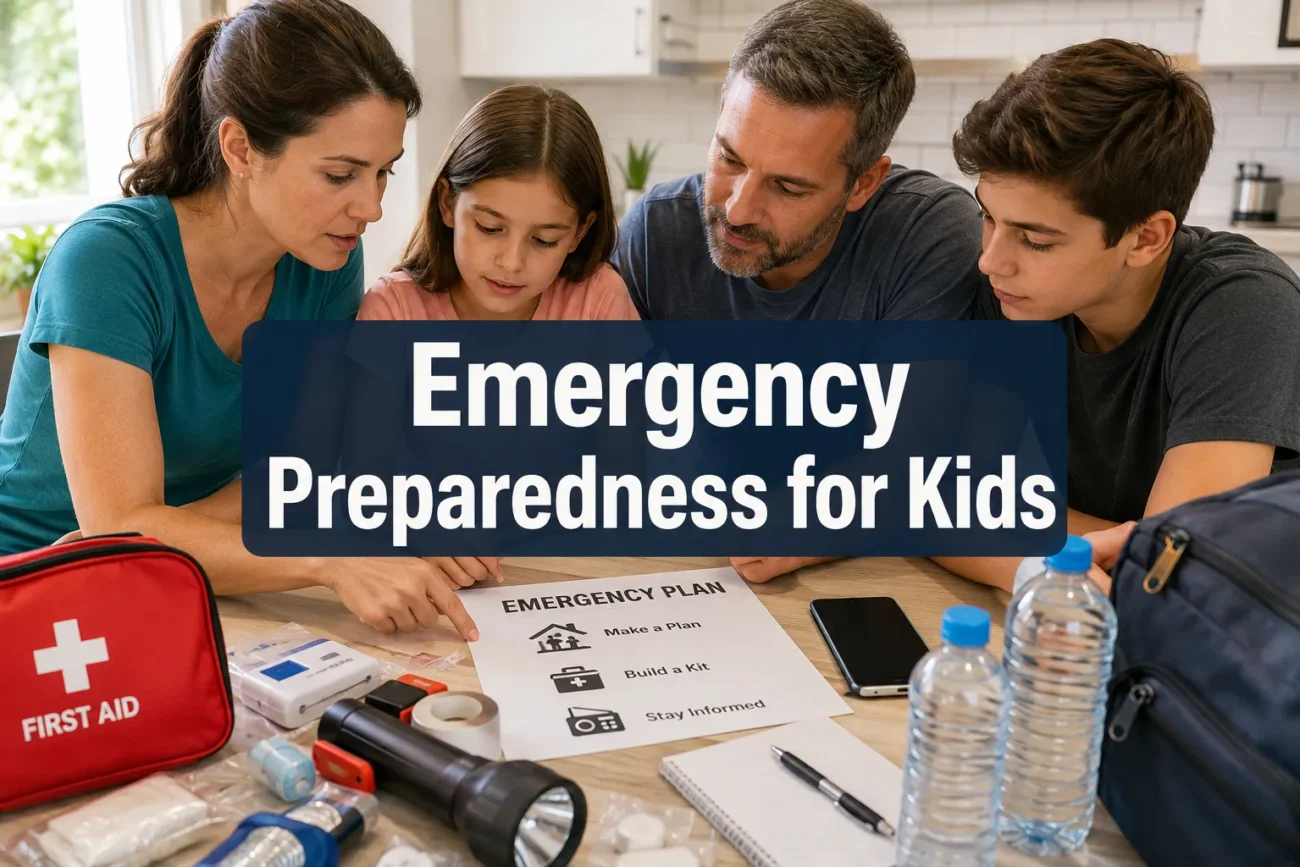
Most children who experience a disaster have never been told what to do. According to FEMA’s Ready.gov program, fewer than half of American households have a documented emergency plan, and even fewer have practiced it with their children. That gap between knowing and doing is exactly where families become vulnerable.
Emergency preparedness for kids isn’t about scaring children into anxiety. It’s about giving them the right skills at the right age so that when something goes wrong, they act instead of freeze. This guide breaks down emergency preparedness for kids by age group, covering what children can realistically learn and do at each developmental stage, from toddlers to teenagers.
Key Takeaways
- Children as young as 3 can begin learning basic emergency concepts like “stop, drop, and roll” and recognizing the sound of a smoke alarm.
- Age-appropriate tasks build genuine competence. A 10-year-old can administer basic first aid, call 911, and navigate a family meeting point independently.
- Teenagers can function as secondary adults during an emergency, managing younger siblings, executing evacuation routes, and operating communication tools.
- Framing preparedness as a family skill rather than a threat response dramatically reduces anxiety in children.
- Regular drills (at least twice per year) reinforce skills far better than one-time conversations.
- Every child old enough to carry a backpack should have their own age-appropriate emergency kit.
- Emergency contact memorization should begin around age 5 and be treated as a core life skill.
- Games, role-play, and hands-on practice are the most effective teaching methods for children under 12.
What Age Can Kids Start Learning About Emergency Preparedness
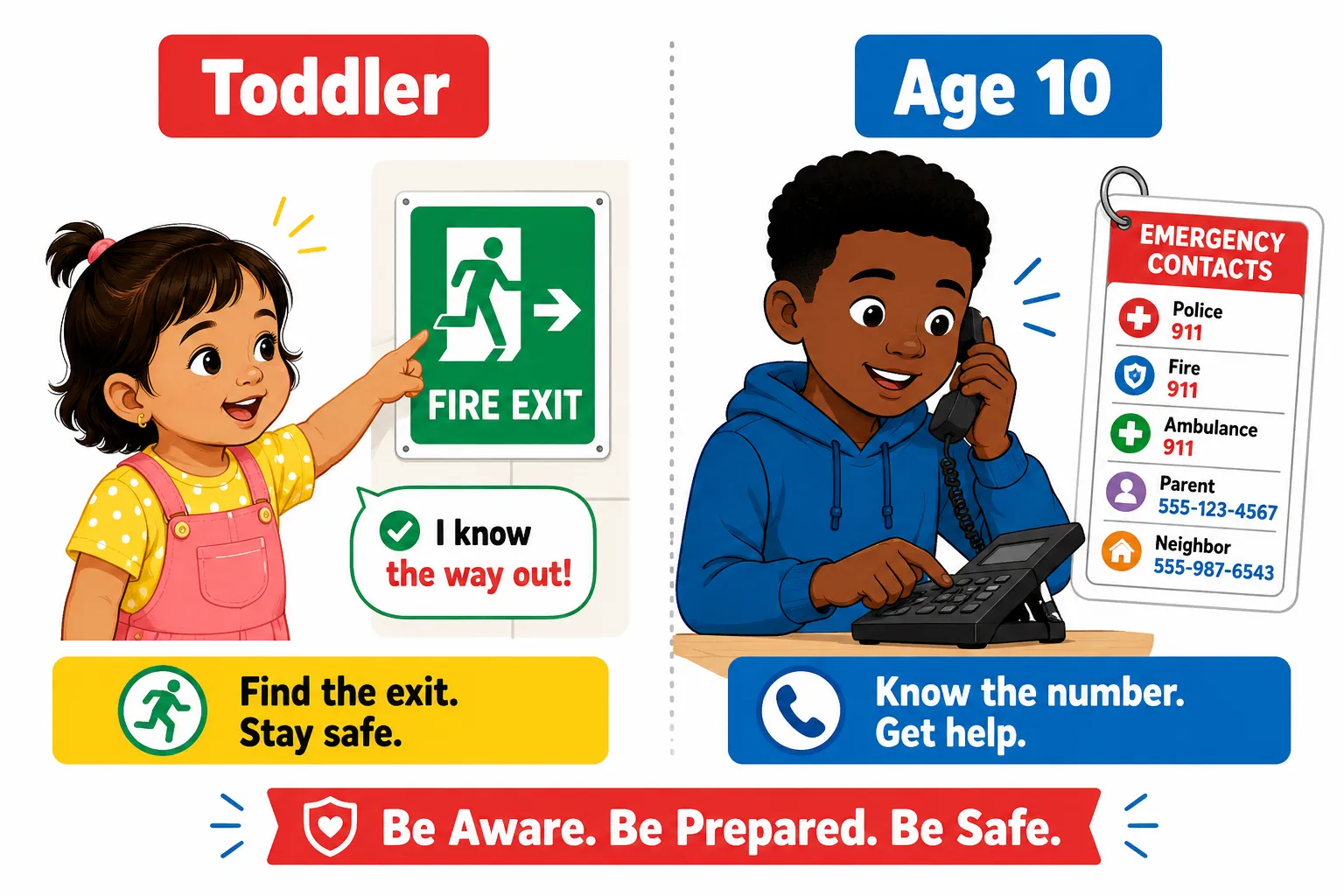
Children can begin learning basic emergency preparedness concepts as early as age 2 to 3. At this stage, the goal isn’t procedural knowledge, it’s simple, repeated exposure to safety cues like alarm sounds, exit locations, and the word “emergency.”
Developmental psychology supports a tiered approach. Children under 5 learn through repetition and sensory experience. Children between 6 and 10 can handle procedural steps and memorized information. Preteens and teenagers can manage abstract planning, independent decision-making, and leadership roles during a crisis.
The mistake most families make is waiting until children are “old enough to understand.” By that logic, many kids never receive any preparation at all. Start simple, start early, and build on it every year.
Age-by-age overview:
- Ages 2-3: Recognize alarm sounds, know their first name, understand “go to Mom/Dad”
- Ages 4-5: Know their full name and address, practice stop-drop-and-roll, identify safe exits
- Ages 6-8: Memorize a parent’s phone number, understand the family meeting point, know when to call 911
- Ages 9-11: Operate basic first aid, execute an evacuation plan independently, maintain a personal go-bag
- Ages 12-14: Lead younger siblings during drills, use a map, communicate via radio or backup phone
- Ages 15+: Function as a secondary adult, manage emergency supplies, support family decision-making
How to Teach a 5-Year-Old About Emergencies Without Scaring Them
Young children can learn emergency skills without developing fear when the teaching is framed as a game or a family superpower rather than a threat. The key is keeping language concrete, positive, and action-focused.
Avoid phrases like “what if something terrible happens.” Instead, use “here’s what our family does when the fire alarm goes off.” Children this age respond to routine and repetition, so embedding safety practice into normal life, rather than treating it as a special scary lesson, makes all the difference.
Practical approaches for ages 4-6:
- Practice fire drills as a family “adventure,” timing how fast everyone gets outside
- Use picture books about firefighters, storms, and helpers to normalize emergency responders
- Teach the child their full name, home address, and one parent’s phone number through songs or rhymes
- Walk them through every exit in the house and let them open the doors themselves
- Introduce the concept of a “meeting tree” or specific landmark where the family reunites
One effective technique: ask children to be the “safety inspector” and help identify smoke detectors, fire extinguishers, and exit routes. Giving them a role shifts the emotional frame from fear to competence.
For families building a broader household plan, the Ultimate Guide to Home Emergency Preparedness covers the structural elements that make these child-level lessons stick.
What Emergency Skills Should a 10-Year-Old Know
A 10-year-old should be able to execute the family emergency plan independently, perform basic first aid, contact emergency services, and reach the family meeting point without adult guidance. These aren’t aspirational goals, they’re achievable with regular practice.
By age 9 to 11, children have the cognitive capacity for multi-step procedures and can retain memorized information under moderate stress. This is the window where real competency gets built.
Core skills for ages 9-11:
- Call 911 and clearly communicate name, address, and the nature of the emergency
- Apply pressure to a wound and recognize signs of shock
- Use a fire extinguisher (with supervised practice)
- Pack and carry their own 72-hour go-bag
- Navigate to the family meeting point using a physical landmark or simple map
- Know which neighbors are safe to approach for help
- Understand the difference between shelter-in-place and evacuation scenarios
A child who can do all of the above is genuinely safer than most adults who’ve never practiced any of it. Pair these skills with the 47 Things Every Prepper First Aid Kit Needs to ensure the tools match the training.
Difference Between Prepping a Toddler vs. a Teenager for Emergencies
The difference between prepping a toddler and a teenager is the difference between protection and partnership. Toddlers need to be protected and guided. Teenagers need to be trained as capable contributors.
With toddlers (ages 1-3), the entire preparedness burden falls on adults. The goal is to ensure the child can be safely moved, stays calm when adults stay calm, and begins absorbing the most basic safety vocabulary. With teenagers, the goal is near-adult competency, they should be able to run a drill, manage a younger sibling, and make sound decisions if separated from parents.
| Age Group | Primary Role | Key Tasks | Adult Dependency |
|---|---|---|---|
| Toddler (1-3) | Passive participant | Stay calm, follow adult, respond to name | Full |
| Young child (4-6) | Guided learner | Know address, stop-drop-roll, exit routes | High |
| Middle child (7-10) | Active participant | Call 911, first aid basics, carry own bag | Moderate |
| Preteen (11-13) | Junior leader | Lead drills, navigate, manage younger kids | Low |
| Teenager (14+) | Secondary adult | Execute full plan, communicate, make decisions | Minimal |
The transition from “protected” to “capable” happens gradually. Families that treat teenagers as full team members, rather than passengers, build households that are exponentially more resilient.
Best Way to Practice Emergency Drills With Young Children
The best emergency drills for young children are short, frequent, low-stakes, and immediately followed by positive reinforcement. A drill that causes distress defeats its own purpose. One that feels like a practiced routine builds genuine muscle memory.
For children under 8, drills should last no more than 5 to 10 minutes and should end with a clear “all clear” signal and a small reward, a sticker, a high-five, or a favorite snack. Predictability matters. Children who know what a drill looks like are less likely to panic during the real thing.
Drill structure for young children:
- Announce the drill clearly beforehand (“We’re going to practice our fire drill now”)
- Trigger the alarm or use a verbal cue
- Walk through the exit procedure together, narrating each step
- Reach the meeting point and do a headcount
- Debrief in simple terms: “Great job. That’s exactly what we do.”
- Repeat every 3 to 6 months, gradually reducing the advance warning
For older children and teenagers, unannounced drills are more effective because they test actual response rather than performance. Introduce scenario variations, “what if the front door is blocked?”, to build adaptive thinking.
The Ultimate Family Emergency Plan Template provides a complete framework for structuring these drills across the entire household.
What Should Kids Keep in Their Own Emergency Kit
Every child old enough to carry a backpack should have a personal emergency kit sized and weighted for their age. A child’s kit is not a scaled-down adult bag, it’s a targeted set of items that serve their specific needs and capabilities.
The kit serves two purposes: practical utility during an emergency, and psychological ownership. A child who has packed and practiced with their own bag is more confident, less likely to panic, and more useful to the family group.
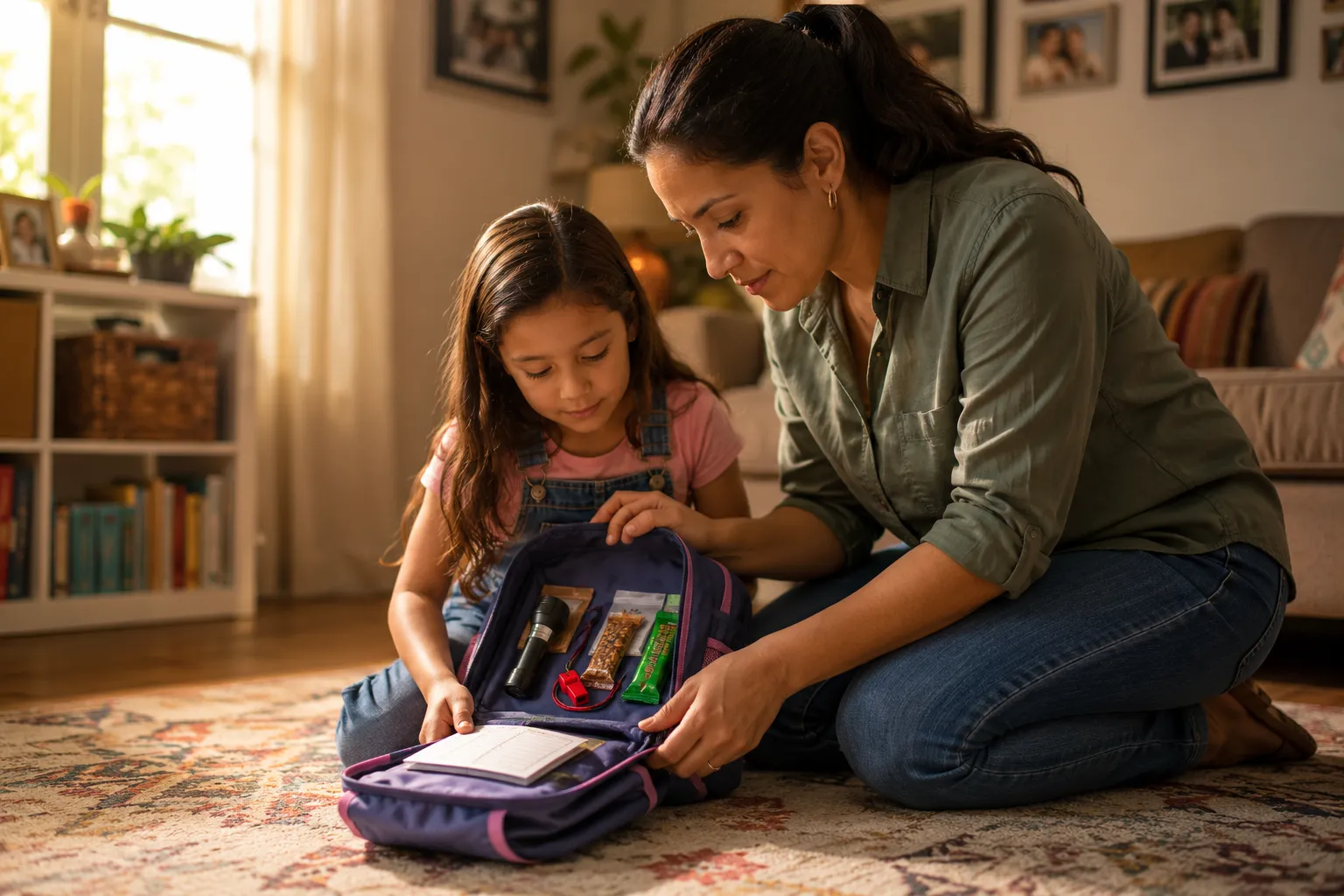
Age-appropriate kit contents:
For ages 5-8:
- Small flashlight with extra batteries
- Personal snacks (granola bars, dried fruit)
- A comfort item (small stuffed animal or familiar object)
- Laminated card with full name, address, and parent phone numbers
- Whistle
- Emergency mylar blanket
For ages 9-12, add:
- Basic first aid supplies (bandages, antiseptic wipes, gauze)
- Water bottle and a basic water purification tablet
- Copy of the family emergency plan
- Small notebook and pencil
- Local area map
For teenagers, the kit should approach a full 72-hour bug out bag with age-appropriate tools, communication devices, and enough supplies to be self-sufficient for three days.
How to Explain Natural Disasters to Kids in an Age-Appropriate Way
Natural disasters should be explained to children using factual, calm language that focuses on what the family will do rather than the damage the event can cause. Framing matters enormously. “Earthquakes happen when the ground moves, and our plan is…” lands very differently than “earthquakes can destroy buildings and hurt people.”
For children under 7, keep explanations brief and action-focused. For children 8 and older, age-appropriate factual information actually reduces anxiety because it replaces imagination with reality. Most children’s fears about disasters are worse than the actual statistical risk.
By disaster type:
- Earthquakes: “The ground shakes because of pressure underground. We drop, cover, and hold on.”
- Hurricanes/Tornadoes: “Strong storms with powerful wind. We go to our safe room and wait.”
- Wildfires: “Fires can spread fast. Our plan is to leave early and meet at [location].”
- Floods: “Water rises and we move to higher ground. We never drive through flooded roads.”
- Power outages: “The electricity stops working. We have lights, food, and water ready.”
The Natural Disaster Preparedness: A Step-by-Step Guide covers the household-level planning that gives these child-facing conversations a solid foundation.
Can Kids Help With Family Emergency Planning
Yes, and they should. Children who participate in creating the family emergency plan are significantly more likely to remember and execute it correctly. Participation creates ownership, and ownership creates follow-through.
Assign age-appropriate planning roles. A 6-year-old can help decide where the family meeting spot is. A 10-year-old can help inventory the emergency food supply. A 14-year-old can research evacuation routes and help update the contact list. These aren’t token gestures, they’re real contributions that make the plan stronger.
Planning tasks by age:
- Ages 5-7: Choose the family meeting spot, help pack their own kit
- Ages 8-10: Draw the home exit map, help check supply expiration dates
- Ages 11-13: Research local emergency alerts, practice calling emergency contacts
- Ages 14+: Help draft the full plan, lead a family drill, manage a section of the supply inventory
For a complete planning system, the 12 Essential Disaster Preparedness Strategies for Families outlines how to build a household-wide approach that includes every family member.
Common Mistakes Parents Make Teaching Kids About Emergencies
The most common mistake is a single “talk” with no follow-up practice. Information without repetition fades fast, especially in children. A child told once what to do in a fire will likely not remember it six months later under stress.
Other frequent errors include:
- Over-explaining the danger rather than focusing on the response plan
- Skipping drills because they feel disruptive or unnecessary
- Assuming older children will figure it out without explicit instruction
- Not updating the plan as children age and their capabilities change
- Leaving children out of planning entirely, which reduces buy-in and recall
- Creating a kit for kids without ever practicing using it together
The fix for most of these is a simple calendar commitment: schedule two family drills per year, review the plan every six months, and update each child’s kit and responsibilities on their birthday.
What If My Child Has Anxiety About Emergency Preparedness
Children with anxiety about emergencies need a slower, more gradual introduction to preparedness, but they still need it. Avoidance doesn’t reduce anxiety; it preserves it. The goal is to build competence, because competence is the most reliable anxiety reducer available.
Start with the least threatening elements. A child anxious about fires can begin by simply learning where the smoke detector is and what it sounds like, without any drill or urgency. Build from there over weeks, not a single session.
Strategies for anxious children:
- Lead with control: “Here’s exactly what we do, step by step”
- Normalize the topic: “Lots of families practice this, just like seatbelts”
- Avoid worst-case framing entirely; focus only on the action plan
- Use books, videos, and games before live drills
- Let the child set the pace for adding new information
- Celebrate every small step with genuine acknowledgment
If a child’s anxiety is severe enough to interfere with daily functioning, that’s a conversation for a pediatric mental health professional, not something preparedness training alone can address. For families navigating the psychological dimensions of crisis readiness more broadly, the Psychological Preparedness in Crisis Situations guide offers deeper context.
How Often Should Families Practice Emergency Procedures With Kids
Families should practice emergency procedures at minimum twice per year, with brief monthly reinforcement check-ins for younger children. Two full drills per year is the baseline recommended by FEMA and the American Red Cross. More frequent practice is better, particularly when children are young or when the family’s circumstances have changed.
Monthly check-ins don’t need to be full drills. A 5-minute conversation at dinner, “where do we meet if there’s a fire?”, is enough to keep the information active in a child’s memory.
Recommended schedule:
- Full household drill: every 6 months (spring and fall)
- Kit review and supply check: every 6 months, aligned with drill schedule
- Contact information review: annually, or when numbers change
- Scenario conversations with children: monthly, casual and brief
- Plan update: whenever the family moves, a child ages into a new responsibility tier, or a new family member joins
What Emergency Contact Information Should Kids Memorize
Children should memorize at minimum one parent’s cell phone number, their home address, and the number 911. These three pieces of information cover the most likely scenarios where a child is separated from their family or needs to summon help.
By age 5, most children can memorize a 10-digit phone number with consistent practice. Treat it like learning a birthday or a classroom rule, repeat it daily until it sticks.
Memorization targets by age:
- Age 4-5: Full name, home address, one parent’s phone number
- Age 6-8: Both parents’ numbers, school address, a trusted neighbor’s name
- Age 9-11: Family emergency contact list (3-4 numbers), out-of-state contact, meeting point address
- Age 12+: Full contact list, insurance information location, family code word for emergencies
A laminated card in the child’s backpack or emergency kit serves as a backup, but memorization is the failsafe, because cards get lost and phones die.
For building out the broader communication infrastructure, the Emergency Communication Plan: The Complete Prepper’s Guide covers family communication protocols in detail.
Games and Activities to Teach Emergency Preparedness to Kids
Games and hands-on activities are the most effective teaching tools for children under 12. Play is how children learn, and emergency preparedness is no exception. The goal is to make the skills feel natural and automatic, and games do that far better than lectures.
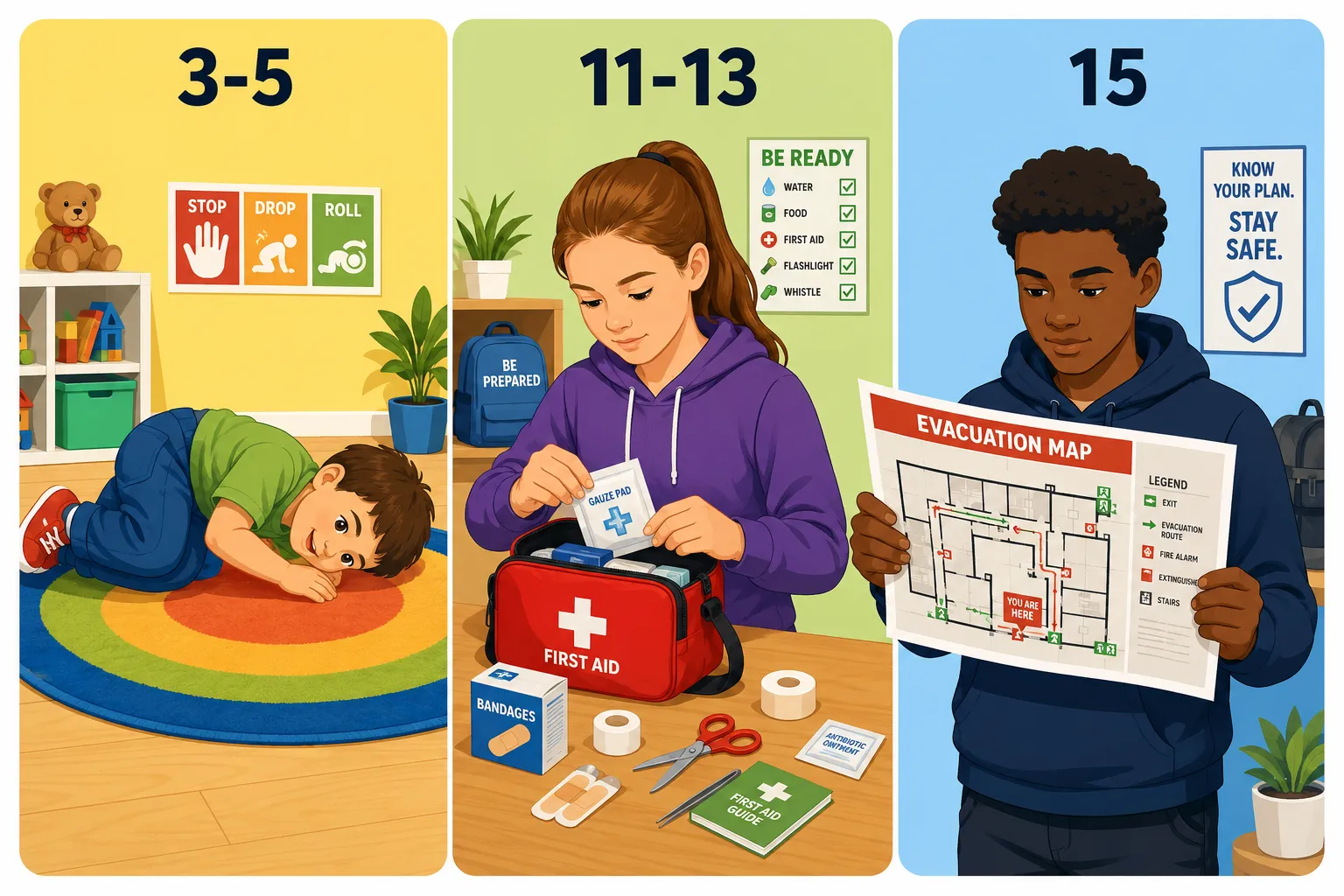
Proven activities by age:
For ages 3-6:
- “Safety Scavenger Hunt”, find all the smoke detectors, exits, and fire extinguishers in the house
- “Stop, Drop, and Roll” practice as a silly game with stuffed animals
- Flashlight hide-and-seek to normalize using emergency lighting
For ages 7-11:
- “Emergency Scenario Cards”, draw a card describing a situation and talk through what to do
- First aid practice on dolls or willing parents
- Map-drawing challenge: draw the home exit routes from memory
- Timed drill competitions with a small prize for fastest safe exit
For ages 12+:
- Tabletop scenario planning: “A hurricane is 48 hours away. What do we do first?”
- Kit-building challenge with a set budget
- Navigation exercises using a paper map of the local area
- Practice radio communication with a handheld device
The Disaster Preparedness for Families: 12 Strategies Every Prepper Must Know includes additional family-wide engagement strategies that complement these activities.
FAQ
At what age should I start emergency preparedness with my child?
Start at age 2 to 3 with the simplest concepts, alarm sounds, exit locations, and staying with a parent. Formal skills like calling 911 and using a first aid kit can begin around age 7 to 8.
How do I talk to my kids about emergencies without terrifying them?
Focus entirely on the action plan, not the threat. Say “here’s what we do when the alarm goes off” rather than “fires can trap people.” Action-focused language builds confidence; threat-focused language builds fear.
Should every child have their own emergency kit?
Yes. Any child old enough to carry a backpack should have a personal kit sized for their age and weight capacity. The kit should be practiced with, not just packed and stored.
What’s the single most important thing a young child should memorize?
A parent’s cell phone number. A child who can recite that number to any adult or 911 operator can be reunited with their family in almost any scenario.
How long should a family emergency drill take?
For young children, 5 to 10 minutes is ideal. For older children and teenagers, 15 to 20 minutes allows for scenario variations and a debrief. The goal is practiced repetition, not length.
What if my child refuses to participate in drills?
Reframe the drill as a family activity rather than a safety requirement. Involve the child in planning the drill, give them a specific role, and follow up with something enjoyable. Resistance usually drops when children feel ownership rather than obligation.
Can a 10-year-old really call 911 effectively?
Yes, with practice. A 10-year-old who has rehearsed what to say, name, address, nature of emergency, can communicate clearly to a dispatcher. Practice this specifically, not just in theory.
How do I keep emergency skills fresh without over-drilling?
Use brief monthly check-ins (5 minutes at dinner), rotate scenario conversations, and tie supply reviews to seasonal changes. Consistency over time matters more than intensity.
Should teenagers be included in adult-level emergency planning?
Absolutely. Teenagers who understand the full family plan, including evacuation routes, supply locations, and communication protocols, can function as secondary adults when it matters most.
What’s the biggest mistake families make with kids and emergency preparedness?
Treating it as a one-time conversation. Skills fade without repetition. The families who are genuinely prepared are the ones who practice regularly, update their plans, and treat preparedness as an ongoing household habit.
Are there good books or resources for teaching young children about emergencies?
FEMA’s Ready Kids program offers free, age-appropriate materials. The American Red Cross also provides family preparedness guides with child-specific sections. Local fire departments often offer school programs that reinforce home learning.
What if my child is neurodivergent or has special needs?
Adapt the approach to the child’s communication style and sensory profile. Some children benefit from visual schedules of the emergency plan. Others need more repetition or a trusted adult to walk through each step alongside them. The core principles still apply, start simple, build gradually, and prioritize calm over urgency.
Conclusion
Emergency preparedness for kids isn’t a single conversation or a one-time drill. It’s a layered, ongoing process that grows with each child, from a toddler who learns to recognize an alarm to a teenager who can lead their family through an evacuation. The families who build this capacity over time aren’t operating from fear. They’re operating from confidence.
Actionable next steps:
- This week: Identify which age tier each child in your household falls into and assign their first two learning tasks
- This month: Schedule the first family drill and build or update each child’s personal emergency kit
- This season: Complete a full family emergency plan review using the Ultimate Family Emergency Plan Template
- Ongoing: Set a calendar reminder for two drills per year and a six-month supply check
Every skill a child learns today is one less gap in the family’s readiness tomorrow.
Products, Tools, and Resources
For building children’s emergency kits: Look for child-sized backpacks in the 10 to 15-liter range with padded straps. Brands like Osprey and Deuter make durable options that fit children aged 5 and up. Pair with a basic first aid kit designed for youth, a hand-crank or battery-powered flashlight, and a laminated contact card in a waterproof sleeve.
For family drills and planning: FEMA’s Ready.gov website offers free downloadable family communication plan templates and child-friendly activity sheets. The American Red Cross First Aid app (free) is worth installing on any household device a child over 10 has access to.
For first aid training: Many local Red Cross chapters offer “Babysitter’s Training” courses for children 11 and older that cover CPR, wound care, and emergency response, skills that directly apply to family preparedness.
For deeper household preparedness: The Ultimate Disaster Preparedness Checklist covers the full household supply system that supports everything children are being trained to use. And if the family has pets, the Ultimate Pet’s Emergency Preparedness Checklist ensures no family member, four-legged or otherwise, gets left out of the plan.
For communication tools: A pair of basic FRS/GMRS walkie-talkies (Midland, Motorola, or Baofeng entry-level models) gives older children and teenagers a reliable communication option that doesn’t depend on cell service. Practice using them during drills so the tools feel familiar before they’re ever needed.