

Hey there! Some links on this page may be affiliate links which means that, if you choose to make a purchase, I may earn a commission at no extra cost to you. I greatly appreciate your support. Read the full disclosure here.
Every year, thousands of families head into the backcountry, and a significant number end up in situations they weren’t prepared for. According to the National Park Service, search-and-rescue operations number in the tens of thousands annually across U.S. parks, and a substantial portion involve families with young children. The difference between a terrifying ordeal and a manageable situation almost always comes down to preparation done before the trip, not during the emergency.
Wilderness survival for families with children is a different discipline than solo or adult-group survival. Children process fear differently, have smaller bodies that lose heat faster, carry less gear, and need age-appropriate roles to stay calm and useful. This guide covers everything a prepared family needs, from teaching kids survival skills without causing anxiety, to the right gear, the right mindset, and the right training.
Key Takeaways
- Children as young as 3 can learn basic survival rules like “stop, stay, and signal.”
- Wilderness survival for families with children requires age-scaled skills, not dumbed-down ones.
- The biggest family survival mistakes involve gear weight, poor communication plans, and underestimating child-specific risks like hypothermia and dehydration.
- Family survival trips should start short (one to two nights) and build complexity gradually.
- Mental preparation matters as much as physical gear, children who practice scenarios stay calmer in real emergencies.
- A family-specific bug-out kit differs meaningfully from an adult kit in weight distribution, caloric density, and comfort items.
- Wilderness survival courses designed for families exist and are worth the investment before any serious backcountry trip.
Find this useful? Add us as a preferred source on Google and more of what we publish will show up in your results.
What Are the Essential Wilderness Survival Skills Families With Kids Need to Know
The core survival priorities for families with children are shelter, water, signaling, and navigation, in that order. Fire-making and food foraging are secondary skills that matter more in extended scenarios. The key difference for families is that every skill must be taught at multiple competency levels so each child can contribute meaningfully.
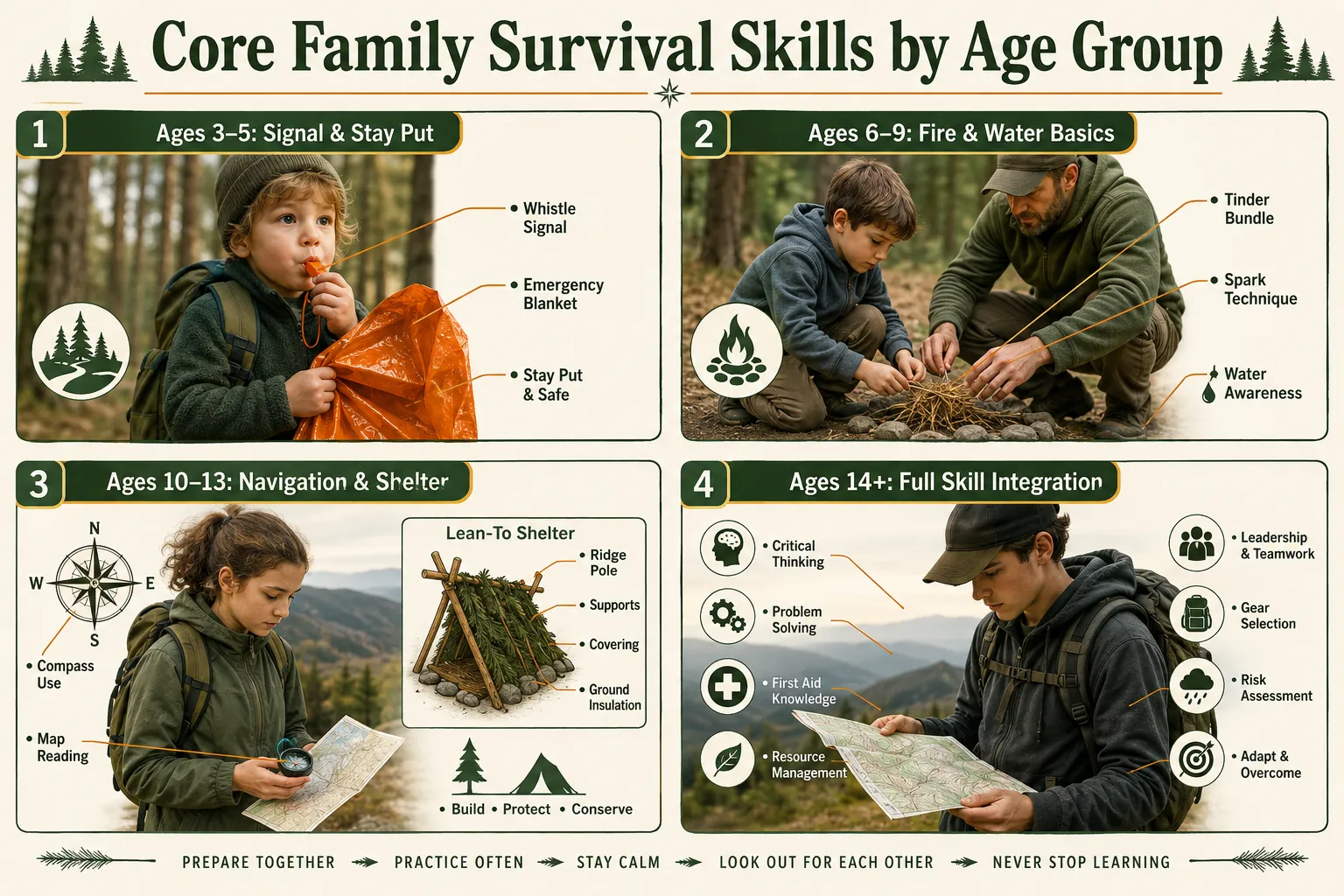
Start with the “survival priorities” framework and assign each family member a role within it:
- Shelter: Adults build; older children (10+) assist with tarp rigging and insulation gathering; younger children collect dry leaves and pine needles for ground cover.
- Water: Adults filter and purify; children aged 8+ can operate a squeeze filter like a Sawyer Squeeze under supervision. For a deep dive into water sourcing and purification methods, see the 25 Most Critical Wilderness Survival Skills, Ranked By Life-Saving Priority.
- Signaling: Every child old enough to hold a whistle (age 3+) should carry one and know the universal distress signal, three short blasts.
- Navigation: Teens can learn compass and topo map basics. Younger children should memorize the family’s campsite landmark and a simple “stay put and signal” rule.
- Fire: A critical skill, but one that requires careful age-gating. Review how to start fire in wet conditions before teaching this skill outdoors.
The 12 Essential Survival Skills for Kids resource at Preppers HQ breaks these down specifically for younger learners and is worth bookmarking for structured practice sessions.
What Age Can Kids Start Learning Wilderness Survival Skills
Children can begin learning age-appropriate survival concepts as early as age 3. The key is matching the skill complexity to the child’s developmental stage, not waiting until they’re teenagers.
| Age Range | Appropriate Skills |
|---|---|
| 3-5 years | Whistle signals, stay-put rule, recognizing the family’s emergency color (bright orange) |
| 6-9 years | Basic fire safety, finding and identifying water sources, simple knot tying, building a debris hut with supervision |
| 10-13 years | Compass use, water filtration, shelter construction, basic first aid, fire starting with a ferro rod |
| 14+ years | Full navigation, advanced first aid, fire starting in adverse conditions, foraging basics, leading younger siblings through drills |
The biggest mistake parents make is waiting too long. A 10-year-old who has practiced these skills for several years is far more capable and calm in a real scenario than one who just learned them.
How Do You Teach Children Wilderness Survival Without Scaring Them
Frame survival skills as adventure competencies, not disaster preparation. Children who learn these skills in a low-stakes, game-like context absorb them faster and don’t develop fear associations.
Practical approaches that work:
- Call it “adventure training,” not “what to do if we get lost.” The framing matters enormously for younger children.
- Use games. A navigation challenge where kids use a compass to find a hidden “treasure” teaches the same skill as a survival drill without the anxiety.
- Practice at home first. Build a debris shelter in the backyard. Purify water from a garden hose using a filter. The familiar environment lowers the emotional stakes.
- Debrief, don’t lecture. After any practice session, ask what they noticed, what felt hard, what they’d do differently. This builds metacognitive resilience.
- Normalize uncertainty. Teach children that “I don’t know, but here’s how we figure it out” is a valid and powerful response.
For older children and teens, the 14 Essential Survival Skills Every Prepper Must Know guide provides a structured curriculum that can be adapted into a family learning plan.
Best Wilderness Survival Gear for Families With Young Children
Family survival gear differs from solo gear in three critical ways: weight distribution, redundancy for child-specific needs, and comfort items that prevent panic. Adults carry the heavy items; children carry their own lightweight essentials.

Adult pack essentials (per adult):
- Water filtration system (Sawyer Squeeze or LifeStraw Mission for group use)
- Emergency shelter (two-person mylar bivy or lightweight tarp)
- Fire-starting kit (ferro rod, waterproof matches, lighter, all three)
- First aid kit scaled for children (include children’s pain reliever, antihistamine, moleskin)
- Navigation tools (topo map, compass, and a backup GPS device)
- 72-hour food supply (calorie-dense, no-cook options preferred)
Child pack essentials (age 6+, 10-15% of body weight maximum):
- Personal whistle (attached to zipper, not loose)
- Emergency mylar blanket
- Small headlamp with fresh batteries
- Snacks (familiar comfort foods reduce stress significantly)
- One comfort item (small stuffed animal for young children is not frivolous, it’s a psychological anchor)
For a comprehensive gear framework, the Essential Survival Gear Guide: 50 Items Ranked By Priority is an excellent reference when building out your family kit.
Child-specific gear considerations:
- Children lose body heat faster than adults due to higher surface-area-to-mass ratios. Pack an extra insulating layer for every child, regardless of the forecast.
- Hydration needs per pound of body weight are higher in children. Plan water supply accordingly and review how long you can survive without clean water to understand the stakes.
Wilderness Survival vs. Camping With Kids: What’s the Difference
Camping with kids is recreational. Wilderness survival with kids is skills-based and scenario-driven. The distinction matters because the mindset, gear choices, and training goals are fundamentally different.
- Camping: Comfort-focused, established campsites, car access, amenities nearby.
- Survival training: Skills-focused, remote locations, self-reliance required, contingency planning built in.
Families don’t need to choose one or the other. The most effective approach is to layer survival skill practice into camping trips, start at a campground, practice specific skills (shelter, fire, water), then gradually move to more remote, less-supported environments as competency builds.
A common mistake: families who camp regularly assume they’re prepared for a survival scenario. They’re not. Camping familiarity and survival competency are different skill sets. The gear overlap is partial, but the decision-making framework is entirely different.
How to Keep Children Safe During Wilderness Survival Training
Safety during training is non-negotiable. The goal is controlled stress exposure, not real danger.
Key safety protocols:
- Always have a communication device. A satellite communicator (Garmin inReach or SPOT) is worth the investment for any backcountry family trip.
- File a trip plan. Leave a detailed itinerary with a trusted contact who knows when to call for help if they don’t hear from you.
- Establish a family rally point. Every family member, including young children, should know a specific landmark to return to if separated.
- Practice the “hug a tree” protocol. Teach children to stop moving immediately if lost, find a large tree or landmark, and signal with their whistle.
- Supervise fire and blade work absolutely. No exceptions for age-inappropriate tool use during training.
- Monitor for hypothermia and dehydration actively. Children often don’t report feeling cold or thirsty until the problem is already significant.
Wilderness Survival Tips When You Have Toddlers or Babies
Wilderness survival for families with children under age 4 requires a different risk calculus entirely. Toddlers and infants cannot self-regulate temperature, cannot signal for help, and cannot follow instructions in a crisis.
Practical adjustments for families with very young children:
- Reduce exposure distance. Keep backcountry trips within reasonable evacuation range. A 2-mile trail hike is very different from a 10-mile backcountry route when you’re carrying a toddler.
- Carry more insulation than you think you need. Infants and toddlers in carriers lose heat through contact with the carrier fabric. A fleece layer inside the carrier is essential below 60°F.
- Hydration is critical. Breastfed infants need nursing mothers to stay well-hydrated. Formula-fed infants require clean water access at all times, carry more than you think you’ll need.
- Have a clear evacuation trigger. Define in advance what conditions will cause you to abort the trip and evacuate. Don’t make that decision under stress.
- Never leave a toddler unattended near water, fire, or drop-offs. This sounds obvious but wilderness environments create new hazards that don’t exist at home.
Can families with very young children do wilderness survival activities? Yes, but the activities should be low-risk, short-duration, and close to evacuation routes. Think backyard survival games, day hikes with survival skill stops, and car-camping with deliberate skill practice. Full backcountry survival scenarios are better suited to families whose youngest child is at least 6-8 years old.
Wilderness Survival Games and Activities for Kids
Games are the most effective teaching tool for children under 12. They build skills without the anxiety that comes from framing things as emergency preparation.
High-value survival games:
- Compass treasure hunt: Give children a compass bearing and a distance. The “treasure” is a small prize or snack. Teaches navigation fundamentals in 20 minutes.
- Shelter speed challenge: Time how fast the family can build a tarp shelter. Compete against your own previous time. Builds muscle memory for shelter construction.
- Water identification walk: On any hike, ask children to identify potential water sources (streams, rock depressions, morning dew). Discuss which are safe and why.
- Fire-building relay: Older children and adults compete in teams to build a fire using only natural materials. Teaches tinder selection, fire structure, and patience.
- Edible plant scavenger hunt: Using a regional field guide, identify three edible plants per outing. Never consume anything without 100% identification certainty, the game is identification only.
For foraging education, Foraging Edible Wild Plants for Beginners provides a solid foundation for teaching plant identification safely.
How to Prepare Kids Mentally for Wilderness Survival Situations
Mental preparation is the most underrated element of wilderness survival for families with children. A child who has mentally rehearsed a scenario will respond far more effectively than one encountering it for the first time under stress.
Techniques that work:
- Scenario walk-throughs. “What would you do if you couldn’t find me at the campsite?” Walk through the answer together, calmly and matter-of-factly.
- Controlled stress inoculation. Mild, supervised challenges, navigating a short trail solo, spending 10 minutes alone at a campsite, build confidence gradually.
- Teach the “calm first” rule. Before any action in a stressful situation, take three slow breaths. This is physiologically effective and teachable to children as young as 5.
- Normalize mistakes. In training, mistakes are data. Celebrate problem-solving, not perfection.
- Build a family survival identity. Families that talk about preparedness as a shared value, not a fear response, raise children who approach challenges with confidence rather than panic.
Wilderness Survival Courses for Families With Children
Structured wilderness survival courses for families exist and are worth the investment before any serious backcountry trip. Several organizations offer family-specific programming.
What to look for in a family survival course:
- Age-appropriate curriculum with separate instruction tracks for different age groups
- Hands-on skill practice (not just classroom lecture)
- Certified instructors with wilderness first responder (WFR) credentials
- Small group sizes that allow individual attention
- Scenario-based learning, not just technique demonstration
Course types to consider:
- BOSS (Boulder Outdoor Survival School): Offers family programs with age-appropriate tracks
- NOLS (National Outdoor Leadership School): Family courses available in select seasons
- Local wilderness first aid courses: Many REI Co-op locations offer family-friendly wilderness first aid workshops
- Scouting programs: BSA and Girl Scouts offer structured outdoor survival skill progression that aligns well with family preparedness goals
The Disaster Preparedness for Families resource at Preppers HQ complements field-based courses with home and community preparedness planning.
How Long Should a Family Wilderness Survival Trip Be With Kids
For first-time family survival trips, one to two nights is the right starting point. This duration is long enough to practice meaningful skills but short enough to manage fatigue, food logistics, and child temperament.
Progression framework:
- First trip: One night, established campsite with car access, two to three targeted skill practices
- Second and third trips: Two nights, primitive campsite, expanded skill set, reduced gear comfort items
- Advanced trips: Three to five nights, backcountry location, full self-reliance scenario with satellite communicator as only safety net
The biggest mistake families make is scaling too fast. A miserable three-day trip with a 7-year-old who’s cold, hungry, and exhausted doesn’t build survival competency, it builds resistance to future training. Shorter, well-executed trips build the confidence and enthusiasm that make longer, more challenging trips possible.
Common Mistakes Parents Make Teaching Kids Wilderness Survival
The most common mistakes are avoidable with a little advance planning.
- Overloading children’s packs. A child carrying too much weight becomes a liability, not an asset. Keep child pack weight at 10-15% of body weight maximum.
- Teaching fear instead of competence. Framing survival skills around disaster scenarios creates anxiety. Frame them around adventure and capability.
- Skipping practice at home. Skills learned only in the field don’t stick. Practice water filtration, fire starting, and shelter building at home first.
- Ignoring child-specific medical needs. Children’s medications, allergy considerations, and hydration requirements differ from adults. Build a child-specific first aid kit.
- No communication plan. Every family member, including children who can talk, should know the family’s rally point, the emergency contact’s name and number, and the three-whistle distress signal.
- Assuming camping experience equals survival preparedness. It doesn’t. See the section above on the camping vs. survival distinction.
For a broader look at foundational skills that underpin all of these, the Survival Skills Checklist: 7 Core Skills Every Prepper Needs is a practical reference.
Frequently Asked Questions
What’s the single most important survival rule to teach young children? The “stop, stay, and signal” rule. If a child is lost or separated, they should stop moving immediately, stay in one place, and signal with their whistle (three blasts, pause, repeat). This rule has saved lives and is teachable to children as young as 3.
How do I know if my child is ready for a backcountry survival trip? A child is ready when they can follow multi-step instructions under mild stress, carry their own pack without complaint for the planned distance, and have practiced the core skills (shelter, water, signaling) at least twice in a controlled setting.
What’s the best first survival skill to teach a 6-year-old? Whistle signaling and the stay-put rule. These are immediately life-saving, require no physical strength, and can be mastered in a single session.
Should I bring comfort items for young children on survival training trips? Yes. A small stuffed animal or familiar blanket for children under 8 is not a luxury, it’s a psychological stabilizer that prevents panic and improves cooperation. Don’t leave it behind to “toughen them up.”
How do I handle a child who refuses to participate in survival training? Don’t force it. Reframe the activity as something else, a game, an adventure, a challenge. Forced participation creates negative associations. Patient, low-pressure exposure over time is far more effective.
What’s the minimum water supply I should carry for a family of four with two young children? Plan for at least 2 liters per adult per day and 1-1.5 liters per child per day as a baseline, plus a reliable filtration method for sourcing additional water. Always carry more than you think you’ll need.
Are survival courses worth the cost for families? For families planning any backcountry travel, yes. A one-day family wilderness first aid course alone can make the difference between a manageable emergency and a catastrophic one.
What’s the most overlooked piece of gear for families with children? A satellite communicator. Cell service is unreliable in backcountry environments. A device like the Garmin inReach Mini provides two-way messaging and SOS capability anywhere on the planet.
At what age can children start learning fire-starting? With close adult supervision, children aged 10 and older can begin learning ferro rod fire-starting. Younger children should learn fire safety rules and the fire triangle concept first, without hands-on ignition practice.
How do I teach navigation to a child who struggles with maps? Start with landmarks, not coordinates. Teach children to identify and name three landmarks visible from camp. Progress to simple compass bearings only after landmark navigation is solid.
Conclusion
Wilderness survival for families with children is one of the most meaningful investments a prepared family can make. The skills are real, the confidence they build is lasting, and the family bonds forged through shared challenge are irreplaceable. Start small, start early, and build systematically.
The framework is straightforward: match skills to age, frame training as adventure, practice at home before the field, gear up for child-specific risks, and never skip the mental preparation. Families who do this consistently don’t just survive emergencies, they thrive in them.
Actionable next steps for 2026:
- Assign every child a personal whistle this week and practice the three-blast distress signal.
- Book a family wilderness first aid course before your next backcountry trip.
- Build a family-specific survival kit using the gear framework in this guide.
- Schedule one “survival skill Saturday” per month, rotate through shelter, water, fire, and navigation.
- Plan a one-night primitive camping trip with two targeted skill practices built into the itinerary.
Resources and Tools
Recommended reading and gear:
- 12 Essential Survival Skills for Kids, a structured curriculum for teaching children survival competencies by age group
- Disaster Preparedness for Families, a comprehensive family preparedness planning resource
- 25 Most Critical Wilderness Survival Skills, the full adult skill set that underpins family wilderness preparedness
- Sawyer Squeeze Water Filter, lightweight, reliable, and operable by older children under supervision
- Garmin inReach Mini 2, satellite communicator for backcountry family trips; the single most important safety device for remote travel
- Adventure Medical Kits Mountain Series, pre-built first aid kits with child-appropriate supplies included
- Tom Brown Jr.’s “Tom Brown’s Field Guide to Nature and Survival for Children”, one of the most respected books on teaching wilderness skills to young people, written by one of America’s foremost survival instructors