
Hey there! Some links on this page may be affiliate links which means that, if you choose to make a purchase, I may earn a commission at no extra cost to you. I greatly appreciate your support. Read the full disclosure here.
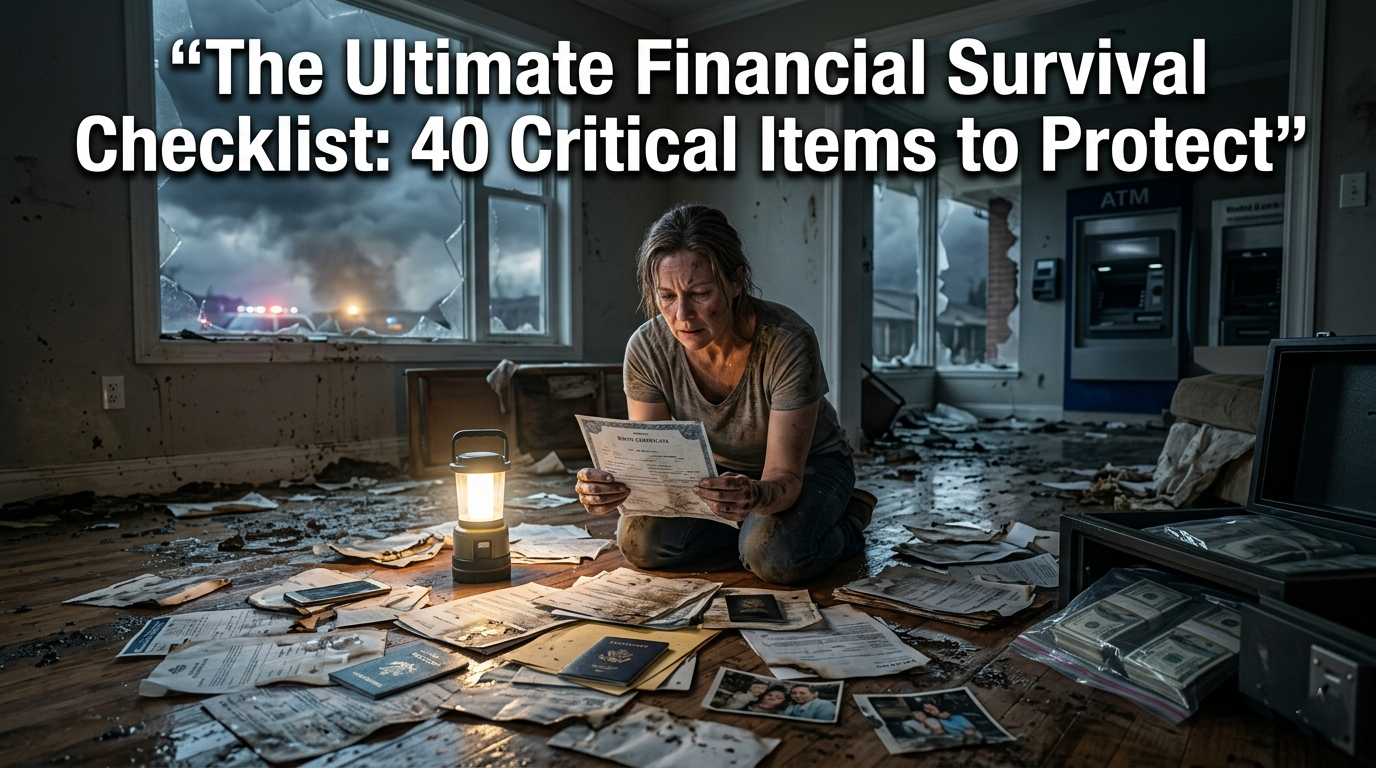
The Ultimate Financial Survival Checklist: 40 Critical Documents, Cash, and Assets to Protect Before Disaster Strikes
Financial Survival begins with a simple but unsettling truth: most modern wealth exists only as digital information. Your bank accounts, insurance policies, property records, and personal identity are stored across servers, databases, and online systems that feel permanent—until a disaster disrupts access. A house fire, flood, cyberattack, or extended power outage can instantly disconnect you from the financial systems you depend on every day. In that moment, if you cannot prove who you are, what you own, or which insurance policies protect you, your savings become temporarily unreachable, no matter how much money you actually have.
Most people approach Financial Survival with little organization. Important documents are scattered across random drawers, outdated filing cabinets, forgotten safe-deposit boxes, or vulnerable digital folders without a backup plan. When disaster strikes, critical records such as birth certificates, insurance policies, medical documents, property deeds, and account information are often lost, damaged, or impossible to locate. The result is a stressful bureaucratic nightmare that forces families to rebuild their financial lives while already coping with the emotional impact of the crisis itself.
Cash is another overlooked pillar of Financial Survival. In normal times, physical currency seems outdated because credit cards, debit cards, and mobile payment apps work seamlessly. But during emergencies, electronic payment systems are often among the first services to fail. Stores may still have food, fuel, medicine, and supplies available, yet without working payment networks or ATM access, digital money becomes useless. Having emergency cash on hand can mean the difference between security and helplessness during a temporary systems failure.
Financial Survival is not about fearing economic collapse or hiding wealth from the government. It is about protecting access to what already belongs to you when normal systems become temporarily unreliable. By organizing essential documents, securing backup records, and maintaining accessible emergency cash, you create a resilient financial foundation that can withstand unexpected disruptions with minimal effort and potentially life-changing results. But it creates a massive, almost unfair advantage when you actually need them.
Financial Preparedness Plan for Economic Collapse
The Digital Illusion: Why Your Financial Life Is More Fragile Than You Think
 We live in an age of unprecedented convenience. With a few taps on a screen, we can access our bank accounts, pay our bills, and manage our investments. This digital ecosystem is efficient and powerful, but it is also profoundly fragile. Its functionality depends entirely on a complex, interconnected web of power grids, internet infrastructure, and secure data centers.
What Happens to Digital Records When the Grid Fails?
A long-term power outage, a significant cyber-attack, or a natural disaster that damages infrastructure can render this entire digital world inaccessible. Websites go offline. Apps stop responding. The cloud, which feels ethereal and permanent, is in reality a collection of physical servers that require constant power and connectivity. When that power is gone, your access to your digital financial life is gone with it.
The “Functionally Broke” Problem
This is the core paradox of modern financial preparedness. You can have a healthy bank balance, a robust investment portfolio, and excellent credit, but if you cannot access any of it, you are “functionally broke.” You cannot buy food, you cannot purchase fuel, you cannot pay for a hotel room if you’ve been evacuated. You are a person with wealth but no liquidity. In a crisis, liquidity is all that matters.
Key Takeaways
– Organize essential documents into four categories: Identity, Property, Financial & Insurance, and Medical & Legal to ensure rapid access and proof of ownership when disaster strikes.
– Maintain at least $500 per person in small bills as emergency cash, spread across multiple secure locations for immediate liquidity during system outages.
– Use fireproof, waterproof safes and encrypted digital backups stored both onsite and offsite to protect documents against physical and digital threats.
– Employ redundancy strategies such as multiple bank accounts, diverse credit cards, and credit freezes to reduce risk and maintain financial access in crises.
– Prioritize securing birth certificates and passports first, as these foundational identity documents simplify recovery and replacement of all other paperwork.
The Document Vault: Building Your Proof of Life and Ownership
 Your document vault is the physical and digital repository of your identity, your assets, and your legal standing. It is the single most important system for post-disaster recovery. It should be organized into four distinct categories.
Category 1: Identity Documents (Who You Are)
Without these, you cease to exist in any official capacity. You cannot file for insurance, apply for government aid, or even prove that your children are yours.
- Birth Certificates: For every member of the family.
- Social Security Cards: Do not carry the originals; keep them secured.
- Passports / Passport Cards: The ultimate form of photo ID.
- Driver’s Licenses / State ID Cards: Both front and back.
- Marriage Certificate / Divorce Decrees: To establish legal relationships.
- Military Records (DD-214): If applicable.
Pro Tip: Obtain certified copies of birth certificates and marriage licenses from the issuing agency. Store these separately from the originals. A certified copy is legally valid and provides critical redundancy.
Category 2: Property Documents (What You Own)
These documents prove ownership of your most valuable physical assets. Without them, insurance claims become a prolonged, agonizing battle.
- House Deeds / Mortgage Documents: Or your lease agreement if you rent.
- Vehicle Titles (Cars, Boats, RVs): Proof of ownership is required for insurance claims.
- Property Tax Records: Establishes residency and property value.
- Receipts for Major Purchases: Jewelry, electronics, furniture, art.
- A Complete Home Inventory: This is the most critical and most overlooked property document.
The Home Inventory Protocol: Once a year, take your smartphone and create a video walkthrough of your entire home. Open every closet, every drawer. Narrate what you are seeing. “This is our living room. We have a Samsung 75-inch television, model number XYZ, purchased in 2024. A leather sofa from Crate & Barrel. My grandmother’s antique grandfather clock.” This video, stored in the cloud, is undeniable proof for an insurance adjuster.
Category 3: Financial & Insurance Documents (What You’re Owed)
These documents provide the map to accessing your money and insurance benefits.
- Bank Account Information: Bank name, account numbers, routing numbers, and customer service phone numbers for all checking and savings accounts.
- Investment Account Statements: From brokerages like Fidelity, Vanguard, or Charles Schwab.
- Retirement Account Paperwork (401k, IRA):
- Loan Documents: For mortgages, auto loans, and student loans.
- Insurance Policies: The full policy documents (not just the declaration pages) for homeowners/renters, auto, life, and health insurance.
Category 4: Medical & Legal Documents (How to Care for You)
In a medical emergency, when you may be unable to communicate, these documents speak for you.
- Medical Records Summary: A summary of chronic conditions, past surgeries, and known allergies for each family member.
- Prescription List: A detailed list of all medications, dosages, and prescribing doctors.
- Vaccination Records: For both children and adults.
- Health Insurance Cards: And policy information.
- Legal Documents:
- Wills: To ensure your assets are distributed according to your wishes.
- Powers of Attorney (Financial & Medical): Designates who can make decisions for you if you are incapacitated.
- Living Wills / Advance Directives: Specifies your wishes for end-of-life medical care.
- Trust Documents: If applicable.
The Analog Backup: How Much Cash to Keep and Where
 Physical cash is the ultimate analog backup. It requires no power, no internet, and no functioning banking system. It is the bridge currency that gets you through the gap between when a disaster strikes and when normal financial systems come back online.
The Baseline Calculation: How Much Cash Per Person?
Start with a baseline of at least $500 per person in your household. For a family of four, this means a minimum of $2,000 in physical cash. This is enough to cover several days of food, fuel, and basic supplies if stores are open but can’t process cards. A more robust goal, recommended by many financial preparedness experts, is one month of essential living expenses in cash ($3,000 to $5,000 for many families).
Why Small Bills Are More Valuable Than Large Ones
In a crisis, a hundred-dollar bill is a liability. It’s hard to use when buying $15 worth of supplies from a vendor who has no change. Your cash cache should consist mostly of twenties, tens, and fives, with a healthy supply of ones. Small bills are functional. Large bills are a problem.
The Multi-Location Storage Strategy
Do not keep all your emergency cash in one place. Distribute it to create redundancy.
- Home Safe: The primary cache, stored with your critical documents.
- Vehicle Kits: A smaller amount ($200-$300) in each vehicle for roadside emergencies.
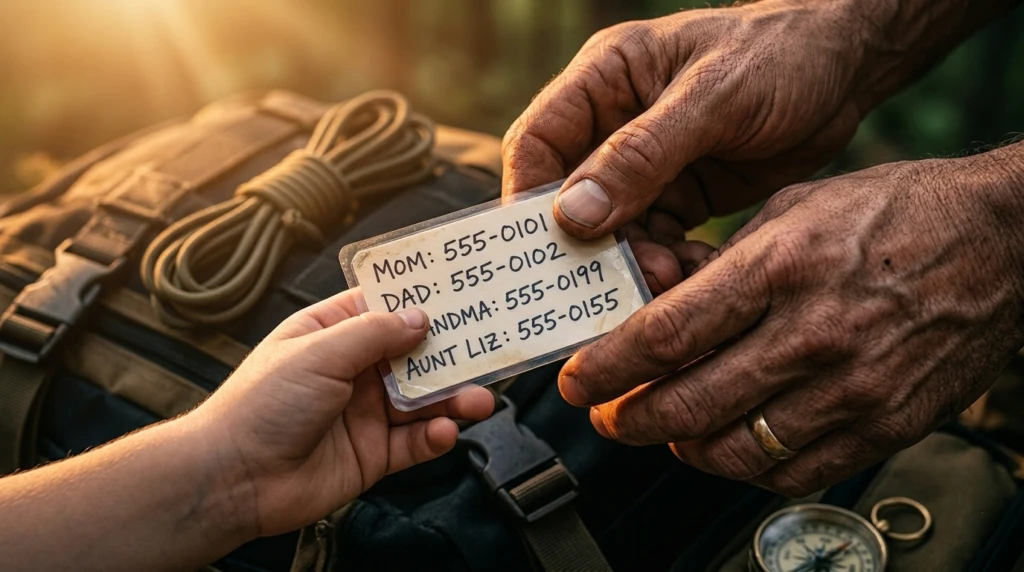
- Go-Bags: A portion of cash in each family member’s “Go-Bag” or emergency kit.
- Hidden Caches: For deep-level preparedness, consider well-hidden locations within your home.
This distribution ensures that a single event—a house fire, a car theft—does not wipe out your entire emergency fund.
The Redundancy Protocol: Physical and Digital Storage Systems
 Having the right documents means nothing if they are destroyed in the same disaster that makes you need them. A resilient document system uses multiple storage methods in multiple locations.
Home Storage: The Fireproof & Waterproof Safe
A high-quality fireproof and waterproof safe is the cornerstone of your home document storage. It protects your critical papers from the most common disasters.
- Fire Rating: Look for a safe with a minimum 1-hour fire rating at 1700°F (927°C).
- Waterproofing: Ensure the safe is rated to be submerged for a period of time.
- Security: Bolt the safe to the floor. If it’s not bolted down, it should be heavy enough that a thief cannot easily carry it away.
Offsite Storage: Surviving a Total Home Loss
Offsite storage creates the ultimate redundancy.
- Safe Deposit Box: Excellent for storing items you don’t need immediate access to in a crisis (like original stock certificates or jewelry). Be aware that banks will be inaccessible during extended power outages or civil emergencies. Do not store your primary emergency cash or original passports here.
- Trusted Contact: Give copies of your most critical documents to a trusted family member or friend who lives in a different city or state. This is your ultimate offsite backup.
The Digital Twin: Encrypted Cloud and Offline Backups
Your digital vault should be a mirror of your physical one.
- Scan Everything: Use a high-quality scanner or your smartphone to create digital copies of every document in your vault.
- Cloud Storage: Upload the encrypted files to a secure cloud service like Google Drive, Dropbox, or a dedicated encrypted service like Sync.com. Use a strong, unique password and enable two-factor authentication.
- Offline Storage: Copy the encrypted files to at least two separate USB flash drives. Store one in your home safe and the other in your offsite location (safe deposit box or with your trusted contact).
A Note on Passwords: A password manager is excellent for daily life but requires power and a device to access. For your most critical accounts (primary bank, email), you must have a written, analog backup of your passwords and recovery information. Store this list in your fireproof safe. The risk of a thief finding this list is lower than the risk of you being completely locked out of your own life during a crisis.
Advanced Financial Survival Resilience: Protecting Assets During a Crisis
 Beyond documents and cash, a few strategic moves can dramatically increase your financial resilience.
The Multi-Bank Account Strategy
If all your money is in one bank and that institution experiences a technical failure, a localized disaster, or a cyber-attack, you are cut off. By splitting your funds between two or three different banking institutions, you create institutional redundancy. This also increases your FDIC insurance coverage, which is calculated per depositor, per institution.
Credit Card Redundancy
Payment networks can fail. If Visa’s system goes down, your Mastercard might still work. Carry credit cards from at least two different payment networks (e.g., Visa, Mastercard, American Express). Keep one card with a low or zero balance locked in your safe as a dedicated emergency backup.
Credit Freezes: The Ultimate Identity Theft Protection
During the chaos of a disaster, identity theft skyrockets. Criminals exploit the confusion to open fraudulent accounts. The single most powerful tool to prevent this is a credit freeze. A freeze blocks all new credit applications in your name. You can place a freeze for free with all three major credit bureaus (Equifax, Experian, TransUnion). Keep your credit frozen as a default, and only temporarily “thaw” it when you are actively applying for new credit.
FAQ
How much cash is too much to keep at home?
This is a balance between preparedness and risk. The baseline of $500 per person is a good starting point. A more robust goal is one month of essential living expenses. If keeping a large amount of cash at home makes you a target or causes significant anxiety, start smaller and focus on building a robust emergency fund in an accessible savings account. The key is having enough cash to bridge the first 72 hours to one week of a grid-down scenario.
Is a safe deposit box really safe during a long-term emergency?
It’s safe from fire and theft, but it’s not accessible. During an extended power outage, civil unrest, or a declared bank holiday, banks will be closed. You will not be able to get into your box. For this reason, a safe deposit box is for long-term storage of valuables you won’t need in an immediate crisis. Your primary emergency documents and cash must be stored where you can access them 24/7.
What’s the single most important document to protect first?
Your birth certificate and/or passport. These are the foundational documents of your legal identity. Without them, replacing every other document (like a driver’s license or Social Security card) becomes exponentially more difficult. Secure these first.
Products / Tools / Resources
These are the specific items and resources that form the foundation of a serious financial preparedness system—selected for reliability, value, and real-world effectiveness.
Physical Storage
- SentrySafe SFW123GDC Fireproof and Waterproof Safe: A consistently well-reviewed home safe that offers a 1-hour fire rating and 24-hour water protection. Its size is suitable for most families’ document needs, and it features a digital keypad with a backup key.
- ENGPOW Fireproof Document Bags: For creating a portable “Go-Vault.” These bags are less secure than a safe but offer excellent fire and water protection for documents you need to grab and go. Use them inside your main safe for layered protection or in your bug-out bag.
Digital Storage & Security
- Samsung BAR Plus USB 3.1 Flash Drive: A durable, reliable, and fast USB drive for your offline digital backups. Its metal casing is more resilient than plastic alternatives.
- Sync.com: An end-to-end encrypted cloud storage service based in Canada. A more privacy-focused alternative to Google Drive or Dropbox for storing sensitive digital documents.
- 1Password or Bitwarden: Top-tier password managers that can securely store not only passwords but also notes, credit card information, and digital copies of documents.
Financial Tools
- Credit Freeze Services: These are free services offered directly by the three major credit bureaus:
- Equifax: equifax.com/personal/credit-report-services/credit-freeze/
- Experian: experian.com/freeze/center.html
- TransUnion: transunion.com/credit-freeze
Planning Resources
- FEMA Emergency Financial First Aid Kit (EFFAK): A free, comprehensive guide and checklist from the U.S. government that details exactly which documents and financial information to gather. An excellent starting point.
- The Prepared (theprepared.com): One of the most rigorous and evidence-based emergency preparedness websites. Their guides on document storage and financial preparedness are extensively researched and highly practical.