
Hey there! Some links on this page may be affiliate links which means that, if you choose to make a purchase, I may earn a commission at no extra cost to you. I greatly appreciate your support. Read the full disclosure here.
Only 39% of American adults say they have an emergency plan in place, according to FEMA survey data — and women, who statistically serve as primary caregivers in most households, are disproportionately unprepared for the specific challenges a crisis brings. The Female Prepper’s Starter Kit: 30 Days to Basic Preparedness exists to close that gap, not with fear, but with a structured, actionable plan that builds real confidence over a single month.
This guide covers everything from what goes into a woman-specific emergency kit to how to start on a tight budget, what medical supplies matter most, and which survival skills are worth learning first. Whether you live in a city apartment or a rural homestead, the framework here applies.
Key Takeaways
- A female prepper’s starter kit differs from a generic kit by including gender-specific hygiene supplies, medications, and safety tools calibrated to a woman’s daily reality.
- The 30-day timeline breaks preparedness into four weekly phases so the process never feels overwhelming or expensive all at once.
- A functional basic kit can be built for $100 to $300, depending on household size and what you already own.
- Water storage is the single highest-priority item — the standard recommendation is one gallon per person per day for a minimum of 72 hours, ideally extended to 30 days.
- Medical supplies for women should include menstrual management options, prenatal vitamins if applicable, and any prescription medications in 30-day backup supply.
- Urban preppers face different challenges than rural ones, but the core kit requirements are identical.
- Teaching children basic emergency protocols reduces household panic and gives kids a sense of agency during a crisis.
- First aid training — at minimum a basic CPR/AED certification — should accompany any physical kit.
What Exactly Is a Prepper Kit and Why Do Women Need One
A prepper kit is a curated collection of supplies, tools, and documented plans designed to sustain a person or household through an emergency without relying on outside infrastructure. Women need one for the same reasons anyone does — but with additional considerations that generic kits routinely ignore.
Standard emergency supply lists are built around a neutral, often male-default template. They rarely account for menstrual supplies, the physical demands of carrying gear while pregnant or postpartum, the reality of being a solo female in an unsafe environment, or the medical needs tied to hormonal health. A woman-specific approach fills those gaps without overcomplicating the process.
The Female Prepper’s Starter Kit: 30 Days to Basic Preparedness is also a mindset shift. Preparedness isn’t about stockpiling out of paranoia — it’s about building the kind of independence that means a three-day power outage, a flood evacuation order, or a job loss doesn’t send your household into crisis mode.
For a broader foundation, the Complete Prepping Guide for Beginners is an excellent companion resource.
What’s Different Between a Male and Female Prepper’s Starter Kit
The structural difference between a male and female prepper kit comes down to three categories: hygiene, health, and personal security.
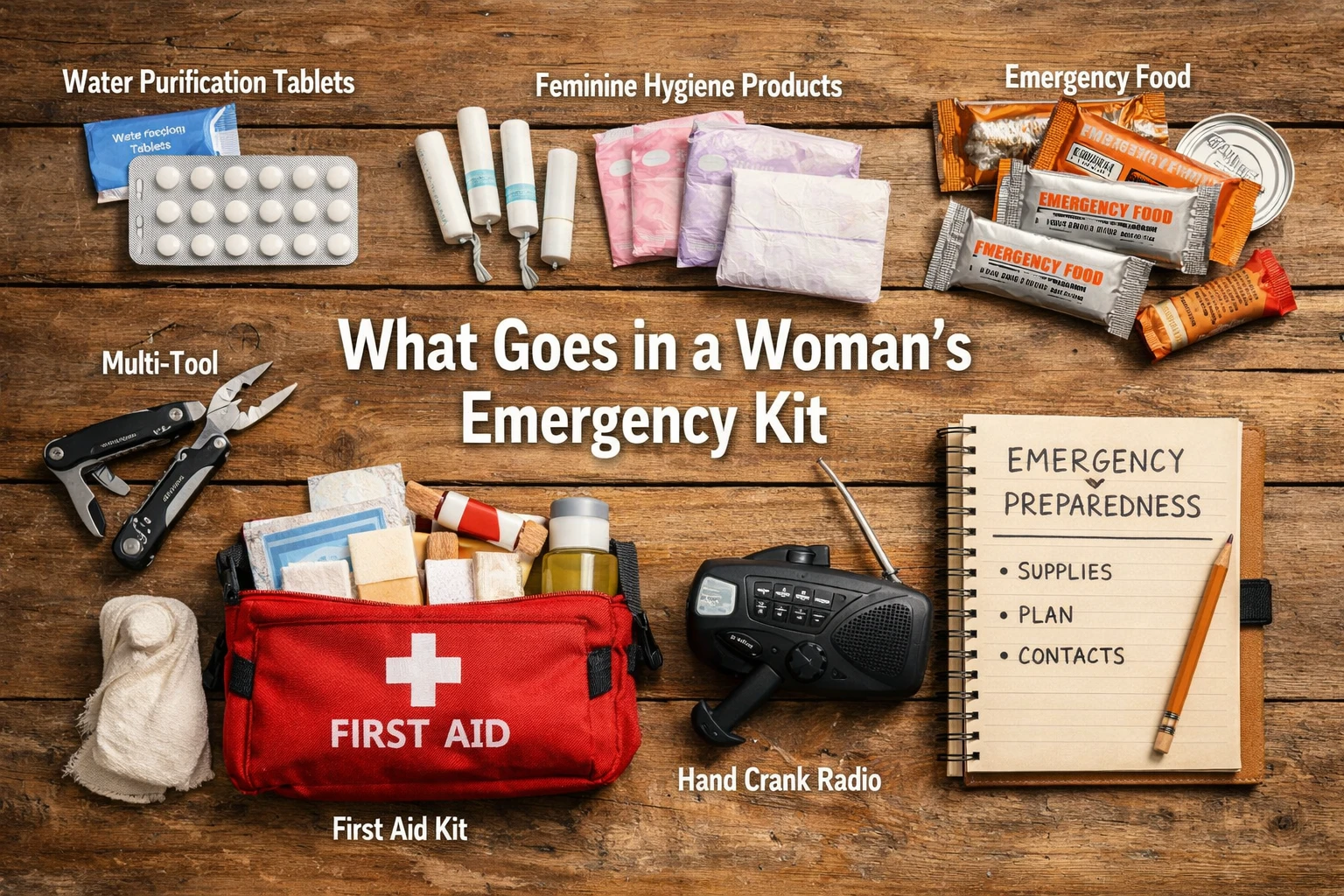
Hygiene additions specific to women:
- Menstrual products (pads, tampons, a menstrual cup for long-term use)
- Feminine wipes and pH-balanced cleansing options
- UTI prevention supplies (cranberry supplements, extra clean water allocation)
- Nursing supplies if applicable (breast pads, nipple cream, a manual pump)
Health additions:
- Hormonal medications or birth control in backup supply
- Prenatal vitamins if there is any possibility of pregnancy
- Yeast infection treatment (stress and disrupted diet increase risk during emergencies)
- Iron supplements, particularly for women with heavy menstrual cycles
Personal security additions:
- Personal alarm (a loud, keychain-style device)
- Pepper spray where legally permitted
- A basic self-defense plan and, ideally, some training
Everything else — water, food, shelter, communication, first aid — is identical in priority to any other household member’s kit. The Ultimate Emergency Supplies List covers the shared baseline in detail.
What Supplies Do You Really Need for 30 Days of Survival
For a 30-day supply, the core categories are water, food, shelter and warmth, light and power, communication, first aid, and documentation. Here is what that looks like in practical terms:
Water
- One gallon per person per day (30 gallons minimum for one person)
- Water purification tablets or a quality filter as backup
- Collapsible containers for portability
Food
- Shelf-stable items with at least a one-year expiration date
- Caloric target: roughly 2,000 calories per day per adult
- Rotate stock every six to twelve months
Shelter and warmth
- Emergency Mylar blankets (at least two per person)
- A change of weather-appropriate clothing in your go-bag
- Sleeping bag rated for your region’s lowest expected temperature
Light and power
- Hand-crank or solar flashlight
- Extra batteries
- A portable battery bank for phones
Communication
- Battery-powered or hand-crank NOAA weather radio
- A written list of emergency contacts (phones die; paper doesn’t)
- Whistle for signaling
First aid
- Comprehensive kit with wound care, medications, and a first aid manual
- 30-day supply of any prescription medications
Documentation
- Copies of IDs, insurance cards, prescriptions, and financial records in a waterproof bag
For a structured week-by-week approach to building this out, the Prepper Checklist for Beginners 30-Day System is worth bookmarking.
How Much Does It Cost to Build a Basic Emergency Preparedness Kit
A functional 30-day kit for one person costs between $100 and $300 when built gradually. For a family of four, expect $300 to $700 depending on food choices and gear quality.
Rough cost breakdown (single person):
| Category | Estimated Cost |
|---|---|
| Water storage (containers + purification) | $20 to $50 |
| 30-day food supply (canned + dry goods) | $60 to $120 |
| First aid kit (pre-assembled or DIY) | $25 to $60 |
| Light, power, and communication | $30 to $70 |
| Women’s hygiene and health supplies | $20 to $40 |
| Documentation and miscellaneous | $10 to $20 |
| Total estimate | $165 to $360 |
These are not one-time purchases made in a single weekend. The 30-day framework is specifically designed to spread costs across four weeks, making the process manageable on any income.
How to Start Prepping If You’re on a Tight Budget
Start with water, then food, then everything else. That priority order holds regardless of budget.
The most effective budget strategy is to add $10 to $20 worth of preparedness supplies to your regular grocery run each week. Over a month, that adds up to a meaningful foundation without a single large expenditure. Buy store-brand canned goods, use existing containers for water storage, and repurpose a backpack you already own as a go-bag.
Practical budget tips:
- Dollar stores carry flashlights, batteries, lighters, and basic first aid supplies at low cost
- Warehouse clubs (Costco, Sam’s Club) offer bulk rice, oats, and canned goods at lower per-unit prices
- Watch for sales on bottled water and stock up when the price drops
- Free resources like FEMA’s Ready.gov offer printable checklists and planning templates at no cost
Avoid the trap of buying expensive gear before you’ve covered the basics. A $200 tactical flashlight does nothing if you don’t have three days of water stored. Cover fundamentals first, then upgrade.
What Medical Supplies Should a Woman Include in Her Emergency Kit
Every woman’s emergency kit should include a comprehensive first aid kit plus a set of gender-specific medical items that standard kits omit.
Core first aid supplies:
- Adhesive bandages in multiple sizes
- Sterile gauze pads and medical tape
- Antiseptic wipes and antibiotic ointment
- Elastic bandage (ACE wrap)
- Tweezers, scissors, and a thermometer
- Over-the-counter pain relievers, antihistamines, and anti-diarrheal medication
- A first aid manual (physical copy, not just an app)
Women-specific medical additions:
- Menstrual supplies (enough for at least two full cycles)
- Yeast infection treatment (one or two courses)
- UTI relief medication (phenazopyridine)
- Any hormonal prescriptions with a 30-day backup supply
- Prenatal vitamins if applicable
- Breast pump and nursing supplies if breastfeeding
Common mistake: Many women pack a first aid kit but forget to include their prescription medications in the kit itself. Keep a 30-day backup supply sealed and stored with your emergency supplies, and rotate it regularly so it doesn’t expire.
What Kind of First Aid Training Do You Need With Your Prepper Kit
At minimum, every adult in a household should hold a current CPR and AED certification. Beyond that, a basic first aid course from the American Red Cross or a similar organization covers wound care, choking response, and shock management — skills that apply in any emergency.
For women who are primary caregivers, pediatric first aid training is also worth the few hours it requires. Knowing how to manage a child’s allergic reaction, febrile seizure, or accidental poisoning is directly relevant to household preparedness.
More advanced options include:
- Stop the Bleed training (hemorrhage control, widely available and often free)
- Wilderness First Aid (WFA) for those in rural areas or with outdoor lifestyles
- Community Emergency Response Team (CERT) training through local emergency management offices
A kit without training is just a box of supplies. The training is what makes those supplies useful under pressure.
Survival Skills Every Woman Should Know
The Female Prepper’s Starter Kit: 30 Days to Basic Preparedness isn’t complete without a skills component. Physical supplies can be lost, stolen, or exhausted. Skills stay with you.
Priority survival skills for women:
- Water purification — knowing how to boil, filter, and chemically treat water is non-negotiable. See the Ultimate Emergency Water Storage and Purification Guide for the full breakdown.
- Basic navigation — reading a paper map and using a compass, because GPS fails.
- Fire starting — using a lighter, matches, and a ferro rod as backup.
- Wound care — cleaning, closing, and bandaging injuries without professional help.
- Food rationing — calculating daily caloric needs and stretching supplies.
- Self-defense basics — awareness, de-escalation, and physical techniques if needed.
- Emergency communication — knowing how to reach family members and local emergency services when normal channels are down.
The 14 Essential Survival Skills Every Prepper Must Know expands on these with step-by-step guidance.
Is Prepping Just for Rural Areas or Important for City Dwellers Too
Prepping is equally critical for urban residents — arguably more so, because cities concentrate risk and reduce self-sufficiency options. A power grid failure affects a rural homestead differently than a 40-story apartment building. Urban preppers face unique challenges: limited storage space, no yard for a garden, dependence on elevators, and higher population density during evacuations.
That said, the core kit requirements are identical. Water, food, first aid, communication, and a documented plan matter whether you live on ten acres or in a studio apartment.
Urban-specific adaptations include:
- Prioritizing lightweight, compact gear that fits in a standard backpack
- Storing water in stackable containers designed for small spaces
- Knowing multiple evacuation routes out of the city
- Building relationships with neighbors for mutual aid
The Ultimate Urban Survival Guide for Preppers addresses city-specific preparedness in depth, and the Apartment Water Storage Complete Guide solves the storage space problem directly.
Best Lightweight Survival Gear for Women Who Want to Be Prepared
Women who plan to carry their own go-bag — whether evacuating on foot or managing a family during a crisis — benefit from gear chosen with weight and ergonomics in mind.
Recommended lightweight options:
- Backpack: A 40 to 50-liter pack with a hip belt to distribute weight off the shoulders. Women-specific fit models are worth the investment.
- Water filter: The Sawyer Squeeze or LifeStraw weighs under 3 ounces and filters thousands of gallons.
- Emergency food: Freeze-dried pouches are calorie-dense and light. The Ultimate Prepper’s Guide to Freeze-Dried Food covers the best options.
- Multi-tool: A compact Leatherman or Victorinox Swiss Army knife covers most field needs.
- Personal alarm: A 120-decibel keychain alarm weighs almost nothing and is one of the most practical personal security tools available.
- Mylar emergency blankets: Weigh less than two ounces each and reflect 90% of body heat.
- Hand-crank radio: Compact models like the Midland ER310 provide NOAA alerts and USB charging in one unit.
Rule of thumb: Your fully loaded go-bag should not exceed 25% of your body weight. If it does, you’ll exhaust yourself before you reach safety.
Common Mistakes Women Make When Building a Female Prepper’s Starter Kit
The most common mistake is starting with gear instead of a plan. A box of supplies without a documented evacuation route, communication plan, and household roles is far less effective than a simple plan backed by modest supplies.
Other frequent mistakes:
- Ignoring personal medications: Forgetting to include a backup supply of prescriptions is the single most dangerous oversight in any kit.
- Buying cheap water containers: Thin plastic bottles leach chemicals and fail under pressure. Use food-grade containers rated for long-term storage.
- Neglecting hygiene supplies: Stress and disrupted sanitation increase the risk of infection. Feminine hygiene and basic sanitation supplies are not optional.
- Overpacking the go-bag: A bag too heavy to carry is useless. Prioritize ruthlessly.
- Never practicing: Supplies and plans only work if you’ve used them before. Run drills. Open the first aid kit. Know where everything is.
- Assuming it won’t happen to you: The most prepared people are those who accepted the possibility of disruption before it arrived.
For a deeper look at what gets left out of most kits, see the 15 Things Missing From Your Emergency Kit.
The 30-Day Build Plan: Week by Week
The Female Prepper’s Starter Kit: 30 Days to Basic Preparedness is most effective when built in phases. Here is a practical weekly structure:
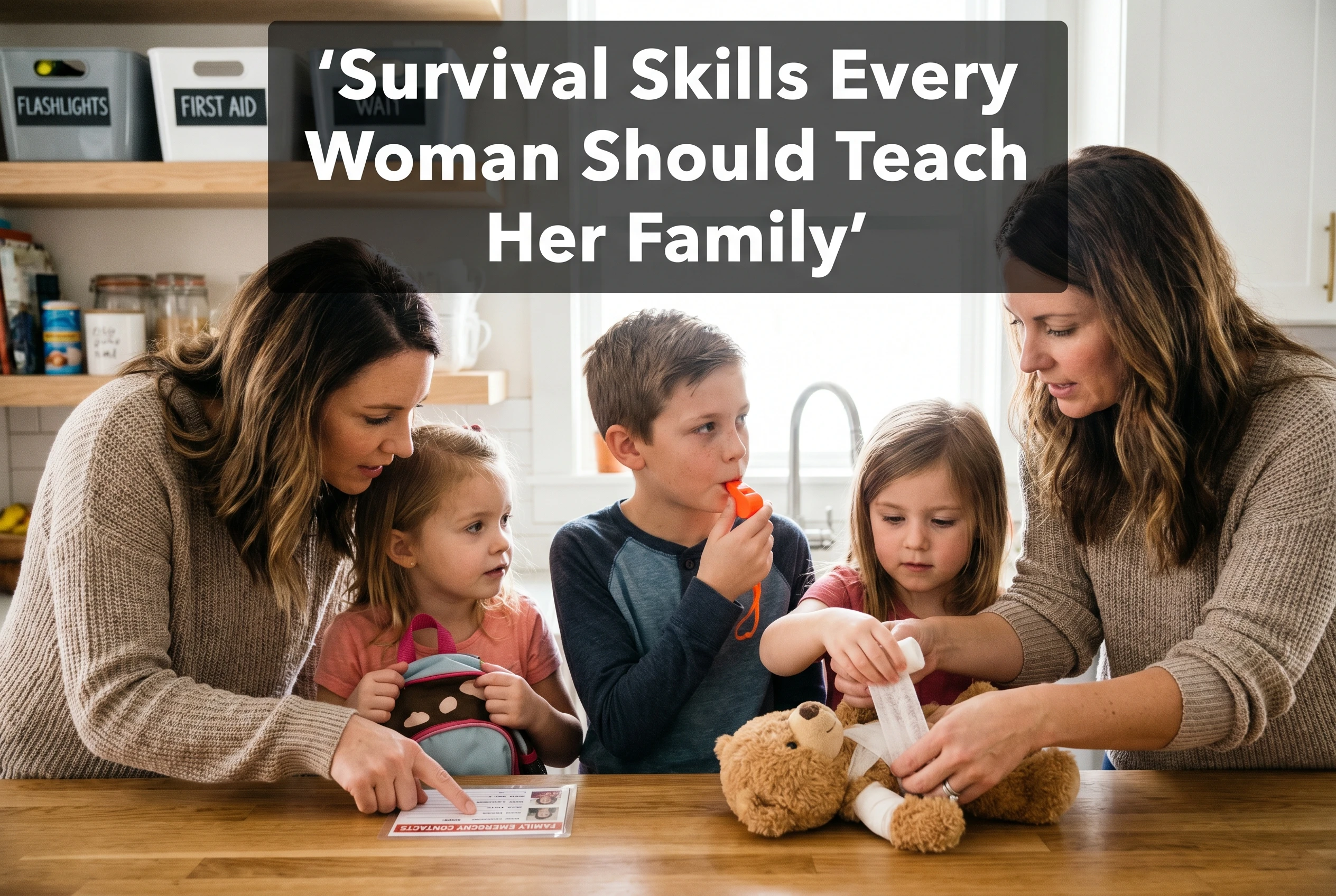
Week 1 — Water and Documentation
- Store a minimum 72-hour water supply (3 gallons per person)
- Gather copies of important documents in a waterproof bag
- Download or print a paper emergency contact list
Week 2 — Food and First Aid
- Build a 7-day food supply from shelf-stable pantry items
- Assemble or purchase a comprehensive first aid kit
- Add women-specific medical supplies
Week 3 — Communication and Light
- Purchase a hand-crank NOAA weather radio
- Assemble a light and power kit (flashlight, batteries, battery bank)
- Write and share your family emergency communication plan
Week 4 — Go-Bag and Skills
- Pack a 72-hour go-bag for each household member
- Complete a basic first aid or CPR course
- Run one household evacuation drill
By the end of day 30, you have a functional foundation — not a perfect system, but a real one. Preparedness is not a destination. It’s a practice.
FAQ
Do I need a separate kit for my car? Yes. A basic car emergency kit should include water, a first aid kit, a blanket, jumper cables, a flashlight, and a multi-tool. The Ultimate Car Emergency Kit List covers everything worth including.
How long does it actually take to build a 30-day supply? Realistically, four to eight weeks if you add supplies gradually to your regular shopping. The 30-day framework in this guide is designed to feel manageable, not rushed.
What if I rent and can’t modify my space for storage? Storage doesn’t require modifications. Use under-bed space, closet floors, and stackable containers. The Guide to Prepping in a Small Apartment has specific solutions for renters.
Should I tell people I’m prepping? That’s a personal decision. Sharing your plans with immediate household members and trusted neighbors has practical benefits (mutual aid, shared resources). Broadcasting your supply inventory widely does not.
What’s the most important thing to buy first? Water storage. Nothing else matters as much in the first 72 hours of any emergency.
Can I use tap water for storage? Yes, with proper containers and rotation. Tap water stored in clean, food-grade containers is safe for six to twelve months. Add unscented liquid chlorine bleach (8 drops per gallon) if storing long-term.
What if I have a baby or toddler? Add formula, baby food, diapers, wipes, and any infant medications to your kit. Infant needs should be calculated separately and stocked generously — running out of formula during an emergency is a serious risk.
Is a go-bag the same as a bug-out bag? Essentially yes. A go-bag or bug-out bag is a portable kit designed to sustain you for 72 hours if you must leave home quickly. The 72-Hour Bug Out Bag Checklist provides a complete packing list.
How do I keep my kit from expiring? Use a rotation system — first in, first out. Label everything with purchase and expiration dates. Check the kit every six months and replace anything within three months of expiration.
What about pets? Pets need their own emergency supplies: food, water, medications, carriers, and documentation. The Ultimate Pet’s Emergency Preparedness Checklist covers the full list.
Is prepping expensive long-term? Once the initial kit is built, ongoing costs are minimal — mainly rotating food and water and updating documents. Most households spend $20 to $50 per month maintaining their supplies.
What’s the biggest difference between a beginner and an experienced prepper? Practice. Experienced preppers have tested their gear, run their plans, and identified the gaps. The supplies matter less than knowing how to use them.
Conclusion
Thirty days is enough time to go from zero preparedness to a functional, woman-specific emergency foundation. The Female Prepper’s Starter Kit: 30 Days to Basic Preparedness isn’t about building a bunker or preparing for the worst-case scenario in every possible form. It’s about being the kind of person who can handle a power outage, a natural disaster, or a sudden evacuation without losing control of the situation.
Start with water this week. Add food next week. Build the first aid kit the week after. By day 30, you’ll have something real — and the confidence that comes with it.
Actionable next steps:
- Store your first 3 gallons of water today using clean containers you already own.
- Print a paper emergency contact list and post it somewhere visible.
- Add $15 to $20 worth of shelf-stable food to your next grocery run.
- Register for a free CPR or first aid course in your area within the next 30 days.
- Bookmark the Prepper Checklist for Beginners 30-Day System and work through it alongside this guide.
Preparedness is confidence. Build it one week at a time.
Products, Tools, and Resources
Water storage: WaterBOB bathtub bladder (100 gallons, emergency use), Aquatabs water purification tablets, Sawyer Squeeze water filter for portable use.
Food: Mountain House or Augason Farms freeze-dried meals for long shelf life, canned goods from your local grocery store for budget-friendly rotation stock.
First aid: Adventure Medical Kits Sportsman series for a well-organized pre-built option, or build your own using a Pelican case for durability.
Communication: Midland ER310 hand-crank emergency radio, a basic two-way radio set for household communication during grid-down scenarios.
Personal security: SABRE personal alarm keychain, Fox Labs pepper spray (check local regulations), a basic self-defense course from a local instructor.
Training: American Red Cross First Aid/CPR/AED certification (available online and in-person), Stop the Bleed training through the American College of Surgeons (free, widely available).
Planning templates: FEMA’s Ready.gov offers free downloadable family emergency plan templates, communication cards, and supply checklists.